💥UPSC 2026, 2027, 2028 UAP Mentorship (March Batch) + Access XFactor Notes & Microthemes PDF

Archives: News

  • Pharma Sector – Drug Pricing, NPPA, FDC, Generics, etc.

    Medical Devices (Amendment) Rules, 2020

    The Ministry of Health and Family Welfare has notified changes in the Medical Devices Rules, 2017 to regulate medical devices on the same lines as drugs under the Drugs and Cosmetics Act, 1940.

    Medical Devices (Amendment) Rules, 2020

    • These rules are applicable to devices intended for internal or external use in the diagnosis, treatment, mitigation or prevention of disease or disorder in human beings or animals” (as notified by the ministry).
    • It requires online registration of these devices “with the Central Licensing Authority through an identified online portal established by the Central Drugs Standard Control Organisation for this purpose.
    • Among the information that the manufacturer has to upload are “name & address of the company or firm or any other entity manufacturing the medical device along with name and address of manufacturing site.
    • It also need to upload certificate of compliance with respect to ISO 13485 standard accredited by National Accreditation Board for Certification Bodies or International Accreditation Forum.
    • This would mean that every medical device, either manufactured in India or imported, will have to have quality assurance before they can be sold anywhere in the country.
    • After furnishing of the above information a registration number will be generated. Manufacturer shall mention the registration number on the label of the medical device.

    What are the items covered under the new Rules?

    • A large number of commonly used items including hypodermic syringes and needles, cardiac stents, perfusion sets, catheters, orthopaedic implants, bone cements, lenses, sutures, internal prosthetic replacements etc are covered under the new rules.
    • For some items such as sphygmomanometers (used to monitor blood pressure), glucometers (to check blood sugar), thermometers, CT scan and MRI equipment, dialysis and X-ray machines, implants etc, different deadlines for compliance have been set.
    • For example for the first three, it is January 2021, for the others it is April next year. For ultrasound equipment, it is November 2020.

    Is this a sudden move?

    • This has been in the offing for some time now.
    • In October last year, the ministry had circulated copies of the then proposed notification for public comments following recommendations of the Drugs Technical Advisory Board (DTAB), which is the highest technical body for these decisions and has experts among its members.
    • In April last year, the DTAB had recommended that all medical devices should be notified as “drugs” under the drug regulation law to ensure they maintain safety and quality standards.
    • The notification makes it clear that the government has issued it in consultation with the DTAB.

    Why was the move required?

    • For much of the last one year, the health sector has been at the centre of attention following revelations about faulty hip implants marketed by pharma major Johnson & Johnson.
    • This has caused major embarrassment to the government, too, as it exposed the lack of regulatory teeth when it came to medical devices.
    • The matter dragged on, exposing the regulatory loopholes until finally the company agreed in court to pay Rs 25 lakh each to the 67 people who had had to undergo revision surgeries because the implants were defective.
    • That is really where the discussion started about regulation of medical devices.

    What are the penal provisions under Indian law?

    • There are various penal provisions under the Drugs and Cosmetics Act, 1940 for various kinds of offences. Manufacture or sale of substandard items is punishable with imprisonment of at least 10 years, which may extend to imprisonment for life.
    • There is also a provision for fine that will “not be less than Rs 10 lakh rupees or three times value of the confiscated items”.

  • Terrorism and Challenges Related To It

    Conviction of Hafiz Saeed

    The Lashkar-e-Taiba founder (LeT) and Jamat-ud Dawa (JuD) chief Hafiz Saeed was convicted by a Pakistan court in two terror-financing cases and sentenced to five-and-a-half years in prison concurrently.

    Why such move?

    • With pressure from the international community building up, Pakistan has been trying to convince the Financial Action Task Force (FATF) to prevent it getting blacklisted.
    • Saeed’s conviction is perhaps a reflection of Pakistan’s changing approach towards its treatment of terror groups, given the FATF’s actions and warnings.

    Who is Hafiz Saeed?

    • Hafiz Saeed is the founder and leader of the fundamentalist terrorist organisation Lashkar-e-Taiba (LeT), which is a group that follows an extreme interpretation of religious texts.
    • It was founded in 1990 and its goals include conducting jihad, preaching the true religion and training the new generation along true religious lines.
    • Some of its goals are aligned with that of Pakistan, including the liberation of Kashmir from India.

    Why his conviction matters?

    • Saeed is also the mastermind of the 2008 Mumbai terrorist attacks.
    • Other attacks that LeT has been involved in include the 2001 shootout at Parliament House in New Delhi, and, most recently, the 2016 attack on the military headquarters in Uri.
    • In 2012, in order to support India in its attempt to extradite Saeed, the US State Department offered a bounty of up to $10 million for information that could lead to his arrest or conviction.
    • Moreover, the US Department of the Treasury has marked Saeed as a Specially Designated Global Terrorist since 2012.
    • ISI and the Pakistani government too help the LeT bring in funds, and it is believed to have fund-raising offices in Bangladesh, Nepal, Maldives and the Gulf region.

    A shield against FATF actions

    • The FATF placed Pakistan in the grey list in July 2018 nonetheless.
    • Before Saeed’s arrest, the FATF had warned Pakistan to deliver on its commitments to curb terror financing. Pakistan feared being a part of FATF’s “Grey List”.
    • Significantly, if Pakistan did not follow up on FATF’s warnings, it could potentially be downgraded to the Black List, which would make things more difficult for the country.
    • FATF is de facto run by the US Treasury Department.
  • RBI Notifications

    New Umbrella Entity (NUE) for Retail Payment Systems

    The Reserve Bank of India (RBI) has proposed to set up a new pan-India new umbrella entity (NUE) or entities focussing on retail payment systems with a minimum paid-up capital of Rs 500 crore.

    New Umbrella Entity (NUE)

    • The proposed entity will set up, manage and operate new payment systems especially in the retail space.
    • It would comprise of but not limited to ATMs, white label PoS, Aadhaar-based payments and remittance services, develop payment methods, standards and technologies, monitor related issues and internationally.
    • It would take care of developmental objectives like enhancement of awareness about the payment systems.
    • The RBI retains the right to approve the appointment of directors as also to nominate a member on the board of the NUE.
    • The NUE should conform to the norms of corporate governance along with ‘fit and proper’ criteria for persons to be appointed on its board.

    Functions

    It will:

    • operate clearing and settlement systems
    • identify and manage relevant risks such as settlement, credit, liquidity and operational and preserve the integrity of the system
    • monitor retail payment system developments and related issues in the country and internationally to avoid shocks, frauds and contagions that may adversely affect the system and the economy in general

    Terms of reference

    • The entity eligible to apply as promoter or the promoter group for the NUE should be ‘owned and controlled by residents’ with 3 years’ experience in the payments ecosystem as Payment System Operator (PSO) or Payment Service Provider (PSP) or Technology Service Provider (TSP).
    • The shareholding pattern should be diversified.
    • Any entity holding more than 25 per cent of the paid-up capital of the NUE will be deemed to be a promoter.
  • Coronavirus – Health and Governance Issues

    Novel Coronavirus renamed as COVID-19 by WHO

    The World Health Organization (WHO) gave an official name to the disease caused by the novel coronavirus. The death toll from the virus has now crossed 1,000 and the disease has infected tens of thousands of people, the majority of them in China.

    COVID-19

    • The disease will be called “COVID-19”; the “CO” stands for coronavirus, “VI” for virus and “D” for disease.
    • The coronavirus itself is called “nCoV-2019”.

    WHO nomenclature

    • The WHO, in consultation with the World Organisation for Animal Health (OIE) and the Food and Agriculture Organization of the United Nations (FAO), has identified best practices for naming new human diseases.
    1. These best practices apply to a new disease:
    2. That is an infection, syndrome, or disease of humans;
    3. That has never been recognised before in humans;
    4. That has potential public health impact; and
    5. Where no disease name is yet established in common usage
    • Names that are assigned by the WHO may or may not be approved by the International Classification of Diseases (ICD) at a later stage.
    • The ICD, which is also managed by the WHO, provides a final standard name for each human disease according to standard guidelines that are aimed at reducing the negative impact from names while balancing science, communication and policy.

    Terms to avoid

    • The agreed best practices include advice on what the disease names should not include, such as geographic location (Middle East Respiratory Syndrome, Spanish Flu, Japanese encephalitis).
    • Disease names should not include people’s names (Creutzfeldt-Jakob disease, Chagas disease), the species or class of animal or food (swine flu, monkeypox etc.), cultural or occupational references (miners, butchers, cooks, nurses etc.) and terms that incite “undue fear” such as death, fatal and epidemic.
    • The use of names such as “swine flu” and “Middle East Respiratory Syndrome” has had “unintended negative impacts” by stigmatising certain communities and economic sectors.

    Terms to include

    • The best practices include using generic descriptive terms such as respiratory diseases, hepatitis, neurologic syndrome, watery diarrhoea.
    • They include using specific descriptive terms that may indicate the age group of the patients and the time course of the disease, such as progressive, juvenile or severe.
    • If the causative pathogen is known, it should be used as part of the disease name with additional descriptors such as the year when the disease was first reported or detected.
    • The names should also be short (rabies, malaria, polio) and should be consistent with the guidelines under the International Classification of Diseases (ICD) Content Model Reference Guide.
    • As per the WHO, “severe” should be used only for those diseases that have a very high initial case fatality rate. “Novel” can be used to indicate a new pathogen of a previously known type
    • In the case of the novel coronavirus, “recognizing that this term will become obsolete if other new pathogens of that type are identified”, the WHO has now changed its name.
  • Human Rights Issues

    ‘2 Billion Kilometers to Safety’ campaign


    The UN Refugee Agency UNHCR has announced a new global campaign urging people worldwide to cover the total distance travelled by refugees each year – 2 billion kilometers – by running, jogging or walking.

    About the campaign

    • The “2 Billion Kilometers to Safety” campaign vies to encourage people to support refugees by championing individual acts of solidarity.
    • The goal is to acknowledge the resilience and strength of refugees.
    • It calls on the public to show their solidarity with refugees by running, walking or cycling to collectively cover two billion kilometers.
    • Participants can use their fitness apps or the campaign website to log the kilometers and contribute to the global total.

    Distance covered by refugees 

    • UNHCR traced the journeys of refugees around the world and calculated that, collectively, people forced to flee travel approximately two billion kilometers every year to reach the first point of safety.
    • This is roughly the distance that separates Earth from somewhere between the planets Saturn and Uranus.
    • According to UNHCR estimates, Syrian refugees travelled over 240 kilometers each to reach Turkey.
    • South Sudanese refugees travelled more than 640 kilometers to reach Kenya. Rohingya refugees from Myanmar travelled approximately 80 kilometers to reach Bangladesh.
  • New Species of Plants and Animals Discovered

    In news: Yaravirus

    In a lake in Brazil, researchers have discovered a virus that they find unusual and intriguing.

    Yaravirus

    • The Yaravirus infects amoeba and has genes that have not been described before, something that could challenge how DNA viruses are classified.
    • It has a puzzling origin and phylogeny (evolutionary relationship).
    • Because of the Yaravirus’s small size, it was unlike other viruses that infect amoeba and they named it as a tribute to Yara, the “mother of waters” in the mythological stories of the Tupi-Guarani indigenous tribes.
    • The virus does not infect human cells, according to the researchers.
  • Corruption Challenges – Lokpal, POCA, etc

    Six years on, Lokpal is a non-starter

    Context

    More than six years after the Lokpal law received the President’s assent, the institution of the Lokpal is yet to play any significant role in tackling corruption in the country.

    Delay in appointment

    • Five-year delay in appointment: For more than five years, the chairperson and members of the Lokpal were not appointed.
      • LoP issue: The government claimed that since no one could be recognised as the Leader of the Opposition (LoP) after the 2014 general election, the committee responsible for selecting members of the Lokpal could not be constituted.
      • This malady could have been easily remedied by either recognising the leader of the single largest party in Opposition in the Lok Sabha as the LoP, or by amendment as was done for the selection committee of the CBI Director.
      • However, neither recourse was taken.

    Truncated appointment committee

    • Special invitee: The leader of the largest Opposition party in the Lok Sabha was invited for meetings of the selection committee as a ‘special invitee’.
      • Which he declined on grounds that it was mere tokenism.

    Non-starter

    • More than 10 months later, however, evidence suggests that the Lokpal is a non-starter.
    • No rules prescribing the form: Till date, the government has not made rules prescribing the form for filing complaints to the Lokpal.
    • No rules regarding asset disclosure: The Central government has also failed to formulate rules regarding asset disclosure by public servants.
    • In order to ensure independent and credible action on allegations of corruption, the Lokpal was empowered under the law to set up its own inquiry wing headed by a Director of Inquiry and its own prosecution wing headed by a Director of Prosecution.
    • The Inquiry and prosecution wing not set up yet: The inquiry and prosecution wings of the anti-corruption ombudsman are yet to be set up.
      • The Lokpal has also not appointed the Director of Inquiry or Prosecution.
      • Regulations for inquiry and investigation not made: Regulations which the Lokpal was obligated to make under the law are yet to be made, including those specifying the manner and procedure of conducting preliminary inquiry and investigation.
    • Legal veracity of the decisions uncertain: Since necessary procedures to operationalise the law are yet to be put in place, the legal veracity of the decisions of the Lokpal could potentially be challenged in a court of law.

    Conclusion

    The failure to operationalise the Lokpal in an effective manner lays bare the lack of will of the government. It took nearly half a century for the Lokpal law to be enacted from the time the need for the oversight institution was first articulated. The government must act to have an effective, independent and empowered Lokpal.

  • US policy wise : Visa, Free Trade and WTO

    A new approach on investment

    Context

    When Prime Minister Narendra Modi welcomes U.S. President Donald Trump to India this month the two leaders are expected to sign a first-ever trade agreement.

    What will be on the agenda of the trade deal?

    • GSP issues: The restoration of India’s Generalised System of Preferences benefits,
    • Pricing of medical devices.
    • And agriculture trade are all important.
    • Incremental outcomes: If the two sides continue efforts to achieve incremental outcomes, the start of negotiations on a comprehensive free trade agreement (FTA) could even be a credible scenario. Presently, this is not the case.

    What could be the incremental outcomes?

    • The most obvious candidates are-
      • Intellectual property rights (IPR).
      • IPR has historically been an area of contention between the two, but discussions on IPR have progressed well in recent years.
      • Digital trade.
      • Both are grappling with the appropriate scope and approach for regulating electronic commerce issues in this digital age.
      • Ideally, there should be room to seriously consider better ways to encourage skilled professionals to work in the other’s economy.
    • Progress on the investment

    There are already some shared interests in the area of investment.

    • For example, India invests in the U.S. and continues to seek U.S. investment in India.
    • FDI issue: Foreign direct investment (FDI), this is an important moment to do more to encourage it than simply welcoming it.
    • Need to negotiate o investment: Ideally, the two sides should move ahead to negotiate an agreement on investment matters that can provide greater transparency, predictability, and regulatory certainty to investors from the other country.
    • Negotiation on FDI off the table: It appears that the traditional approach through which countries pursue commitments on FDI, bilateral investment treaties, or ‘BITs’ (bilateral investment treaties) is off the table.
    • The Trump administration has put a hold on negotiating additional BITs and appears to be suspicious of how well they balance U.S. interests.
    • The Indian government is similarly sceptical of BITs, having cancelled all existing ones soon after it came into office.

    Need for the new approach on the investment issues

    • Until they resume their work on BITs, the two sides may find common ground in devising a new approach to investment issue.
    • What the new approach involve?
    • Taking cues from their respective FTAs: A starting point should be to review what they have done in their recent FTAs.
    • Abandonment of investor-state dispute settlement: The recently concluded U.S.-Mexico-Canada Agreement contains a novel approach on investment notably its abandonment of investor-state dispute settlement with respect to the U.S. and Canada.
      • Similarly, the Regional Comprehensive Economic Partnership, which India had been negotiating with ASEAN, Australia, China, Japan, Korea, and New Zealand, does not include investor-state dispute settlement.
      • While India chose not to join the Regional Comprehensive Economic Partnership when it was concluded at the end of last year, it appears to have been on board with the FTA’s investment provisions.
    • Where the agreement focus as of now? For now, however, both countries should focus on what is doable. A U.S.-India investment agreement could focus on-
      • Fair treatment for investors from the other country.
      • Regulatory transparency and predictability.
      • And approaches for resolving concerns short of investor-state dispute settlements.
    • At a later stage: At a later stage-
      • Most likely when the two are prepared to negotiate a more comprehensive bilateral FTA, they can go further on investment matters.

    Conclusion

    A new, hybrid approach on investment would be a substantial step in the right direction. It will be critical to sustaining momentum coming out of a first trade deal when the two leaders meet in Delhi. If India and the U.S. fail this test, the trade relationship is more likely to languish than blossom.


  • Government Budgets

    Shun fiscal adventurism

    Context

    In the run-up to the budget, there was enormous pressure on the finance minister to launch a fiscal stimulus so as to pump-prime the economy. That she did not succumb to the temptation is a big relief.

    Why fiscal stimulus is unwarranted?

    • There is already considerable stimulus in the system. 
    • Excessive fiscal deficit: To her credit, the finance minister took a step towards transparency by admitting to off-balance-sheet borrowings of 0.8 per cent of GDP for both the current and next fiscal year.
      • Acknowledging that the fiscal deficit would actually be higher at 4.6 per cent and 4.3 per cent of GDP respectively. This is already excessive.
    • Unrealistic projection of revenue growth: Add to this the unrealistic projections of revenue growth and disinvestment proceeds for next year and we have a potentially unsustainable fiscal situation.
      • Any stimulus on top of this would have been clearly

    Possibility of undermining the RBI’s efforts

    Fiscal pressure could harm the RBI’s efforts to revive the economy in the following ways-

    • Harming long term investment rates: Fiscal pressures will undermine the Reserve Bank of India’s struggle to revive investment by bringing down long-term interest rates.
    • Rating downgrades: It could result in a sovereign rating downgrade and jeopardise efforts to attract foreign capital.
    • Increase in inflationary pressure: It can stoke inflationary pressures, something we cannot afford when inflation is above the RBI’s target rate.
    • Pressure on the external sector: And most importantly, it can lead to pressures on the external sector.
    • Past experiences: The balance of payments crisis of 1991 and the near crisis of 2013 in the wake of taper tantrums were, at their heart, a consequence of extended fiscal profligacy.

    Counter-arguments of the supporters of the stimulus and fallacies in it

    • Low Debt-to-GDP ratio: It is argued that our debt-to-GDP ratio is low in international terms.
      • Misleading comparison: The data don’t bear this out. In any case, our experience, as well as research, shows that international comparisons of debt-to-GDP ratios, without reference to other parameters, are misleading.
    • Debt in domestic currency: It is also argued that we do not need to worry because our debt is mostly in domestic currency unlike that of many emerging economies.
      • The fallacy in this argument: Our debt in the domestic market didn’t protect us from previous crises, and there is no reason to believe that it will protect us from the next one, especially as our foreign debt is proportionally higher than before.
    • Robust foreign exchange reserves: It is argued that our foreign exchange reserves are robust and a balance of payments crisis is improbable. Such complacency is misplaced.
      • Fallacy- No forex is large enough in bad times: We should not forget the lesson that in good times any amount of forex reserves looks like it is too large, but in bad times no amount of reserves is large enough.

    Quality of fiscal consolidation

    • Quality a cause for concern: As much as the headline fiscal deficit numbers are a cause for concern, the underlying quality of fiscal consolidation is a bigger concern.
    • Increasing revenue deficit: Conveniently off the radar, the revenue deficit, far from coming down, is actually going up.
      • Two-third borrowing to finance revenue expenditure: This year, more than two-thirds of what the government is borrowing is going to finance current expenditures like salaries, pensions, interest payments and subsidies.
      • That ratio will rise to three-quarters next year.
      • Crowding out of the expenditure: This debt-financed revenue expenditure is simply unsustainable as it will increasingly crowd out capital expenditure.
    • Red flags on the state finances.
      • Another dimension of the quality of fiscal consolidation is the combined fiscal position of states which is, in fact, the big elephant in the room.
      • Together, states spend one-and-a-half times more than the Centre.
      • Larger development impact than Centre: Studies show that how efficiently states spend their money has a much greater development impact as compared to the Centre.
      • Red flags by the RBI on states finances: The states are not doing a good job. In its latest annual report on state finances, the RBI raised several red flags on state finances-
      • states’ increasing weakness in their own revenue generation.
      • Their unsustainable debt burdens.
      • And their tendency to retrench capital expenditures in order to accommodate fiscal shocks such as farm loan waivers, power sector loans under UDAY and a host of income transfer schemes.
      • Consequences in the market: The market will penalise mismanagement of public finances; it does not care who is responsible — the Centre or states — for an unsustainable fiscal stance.

    Conclusion

    • The fear of one-off fiscal stimulus becoming permanent: By far the biggest fear about a fiscal stimulus is that it is tempting to plunge into a spending programme saying it is a one-off and will be withdrawn when the pressure eases. Experience shows that it is very difficult to bail out. It is good that the finance minster avoided doing any such thing.
      • As Milton Friedman famously said, there is nothing more permanent than a temporary government programme.
    • Need to kick-start the private investment: What the economy needs for a sustained turnaround is kick-starting private investment.
      • Implementation of reforms: A necessary condition for inspiring investor confidence is the implementation of structural and governance reforms. This will be a long-haul.
      • That the budget did not launch the journey is a big disappointment. But, at least, the budget did not make a bad situation worse by embarking on fiscal adventurism.
      • It’s better, as Keynes said, to be roughly right than precisely wrong.


  • Minority Issues – SC, ST, Dalits, OBC, Reservations, etc.

    SC uphold changes in SC/ST Atrocities Law


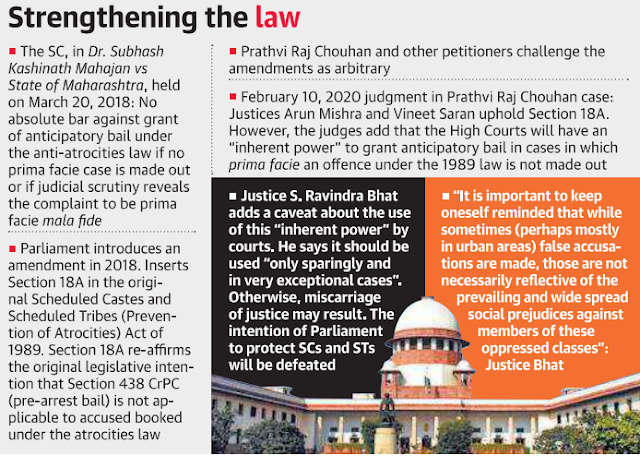
    The Supreme Court has upheld the SCs/STs (Prevention of Atrocities) Amendment Act of 2018, which nullified it’s own controversial March 20, 2018 judgement.  Earlier judgment had diluted the original 1989 legislation, saying they were using its provisions to file false criminal complaints against innocent persons.

    Why such ruling?

    • The 2018 Act had nullified a March 20 judgment of the Supreme Court, which allowed anticipatory bail to those booked for committing atrocities against Scheduled Castes and Scheduled Tribes members.
    • The original 1989 Act bars anticipatory bail.
    • The Supreme Court verdict saw a huge backlash across the country. Several died in ensuing protests and property worth crores of rupees was destroyed.
    • The government reacted by filing a review petition in the Supreme Court and subsequently amended the 1989 Act back into its original form.
    • The government had enacted the Amendments, saying the SCs and STs continued to face the same social stigma, poverty and humiliation which they had been subjected to for centuries.

    Why was the SC/ST Act enacted?

    • Since crimes against SCs and STs are fundamentally hate crimes, the Rajiv Gandhi enacted the Act in 1989.
    • It gave furtherance to the provisions for abolition of untouchability (Article 17) and equality (Articles 14, 15).

    Why it was amended?

    • The Bench reasoned that human failing and not caste is the reason behind the lodging of false criminal complaints.
    • The Supreme Court condemned its own earlier judgment, saying it was against “basic human dignity” to treat all SC/ST community members as “a liar or crook.”
    • Caste of a person cannot be a cause for lodging a false report, the verdict observed.
    • Members of the SCs and STs, due to backwardness, cannot even muster the courage to lodge an FIR, much less, a false one, the judgment noted.

    The Subhash Kashinath Mahajan case

    • Mahajan was Director of Technical Education in Maharashtra.
    • Two non-SC officers had made an adverse entry on the character and integrity of a Dalit employee, whom Mahajan in 2011 denied sanction for prosecution against those officers.
    • The denial was challenged on the ground that the state government and not the director was the competent authority.
    • The apex Court held that safeguards against blackmail are necessary as by way of rampant misuse, complaints are largely being filed against public servants with oblique motive for the satisfaction of vested interests.

    In what manner had the 2018 judgment diluted provisions for arrest?

    ANTICIPATORY BAIL

    • In section 18 of the Act, Parliament had laid down that the provision of anticipatory bail under Section 438 of the CrPC of 1973 will not be available to an accused under the Act.
    • The provision of anticipatory bail was introduced for the first time on the recommendation of 41st Law Commission in 1973.
    • It is a statutory right, not part of the right to life and personal liberty under Article 21 of the Constitution, and thus there is no fundamental right to anticipatory bail.
    • In the 2018 judgment, the Court laid down safeguards, including provisions for anticipatory bail and a “preliminary enquiry” before registering a case under the Act.
    • While review the Bench said Section 18 was enacted to instil a sense of deterrence and relied on Kartar Singh (1994) in which the court had held that denial of anticipatory bail does not violate Article 21.

    FIR

    • The court had observed that “liberty of one cannot be sacrificed to protect another”, and the “Atrocities Act cannot be converted into charter for exploitation or oppression by unscrupulous persons or by police for extraneous reasons”.
    • He ordered that neither is an FIR to be immediately registered nor are arrests to be made without a preliminary inquiry by an SSP.
    • An arrest can only be made if there is “credible” information and police officer has “reason to believe” that an offence was committed.
    • In the review judgment, Justice Mishra said public servants already have a remedy in false cases under CrPC Section 482 and can get such FIRs quashed by High Courts.
    • He rejected the need of an SSP’s approval for arrest.

    PERMISSION

    • In 2018, the court had said that even if a preliminary inquiry is held and a case registered, arrest is not necessary, and that no public servant is to be arrested without the written permission of the appointing authority.
    • The court extended the benefit to other citizens and said they cannot be arrested without the written permission of the SSP of the district.
    • In review the court said that the decision on arrest is to be taken by the investigating authority, not the appointing authority.

    Were other provisions diluted?

    • The court had observed that interpretation of Atrocities Act should promote constitutional values of fraternity and integration of the society.
    • This may require ‘check on false implication of innocent citizens on caste lines’.
    • Observing that the law should not result in caste hatred, the court overlooked the fact that the Act had to be enacted due to caste hatred.
    • The review judgment said that such riders for registering a report are wrong and it would give an advantage to upper castes whose complaints can be registered without any such inquiry.

    How frequently do SCs/STs face atrocities?

    • A crime is committed against an SC every 15 minutes. Six SC women are raped every day on an average.
    • Between 2007 and 2017, there was a 66 per cent growth in crimes against SCs.
    • Data from the National Crime Record Bureau, which the 2018 judgment was based on, showed cases of rape of SC women had doubled in 10 years.

    Assist this newscard with:

    [Burning Issue] SC/ST Prevention of Atrocities Act

Join the Community

Join us across Social Media platforms.