💥UPSC 2027,2028 Mentorship (April Batch) + Access XFactor Notes & Microthemes PDF

Archives: News

  • Trade Sector Updates – Falling Exports, TIES, MEIS, Foreign Trade Policy, etc.

    “China Plus One” Strategy

    Why in the News?

    Japanese companies, along with other global players, are increasingly turning to India under the China Plus One strategy, aiming to diversify supply chains and reduce overdependence on China.

    About China Plus One Strategy:

    • It is a global business model introduced in 2013 to reduce dependence on China by adding another country to the manufacturing or sourcing base.
    • It emerged due to concerns about geopolitical risks, trade tensions, and regulatory unpredictability in China.
    • The strategy gained momentum after the US–China trade war, China’s Zero-Covid policy, and increasing labour and compliance costs.
    • Its goal is to create resilient and diversified supply chains by operating in China and one or more alternative countries.
    • Vietnam, Mexico, and Taiwan have become early beneficiaries in sectors like machinery, electronics, and transport.

    Benefits for India:

    • India offers a large market, skilled labor, and cost advantages, making it an attractive destination for diversification.
    • The growing digital infrastructure and industrial corridors support the relocation of manufacturing, with government schemes like PLI and Make in India aligning with the China Plus One goals.
    • Challenges:
      • India faces limited integration into global value chains, logistics inefficiencies, and regulatory bottlenecks.
      • Historical protectionist trade policies and lack of participation in trade agreements like RCEP hinder its full potential.
      • To compete with nations like Vietnam or Mexico, India needs labour reforms, improved ease of doing business, and better trade facilitation.
    [UPSC 2021] Consider the following:

    1.Foreign currency convertible bonds 2.Foreign institutional investment with certain conditions 3.Global depository receipts 4.Non-resident external deposits Which of the above can be included in Foreign Direct Investments?

    Options: (a) 1, 2 and 3* (b) 3 only (c) 2 and 4 (d) 1 and 4


  • [3rd May 2025] The Hindu Op-ed: A profound shift in the global order

    PYQ Relevance:

    [UPSC 2019] ‘The long-sustained image of India as a leader of the oppressed and marginalised Nations has disappeared on account of its new found role in the emerging global order”. Elaborate.

    Linkage: India is at a turning point, and the world is becoming more equal, moving away from old colonial ways. As Asia becomes more important again, this change is also affecting how India is seen and positioned globally.


    Mentor’s Comment:  India is at another turning point, similar to when Vasco da Gama arrived in Kozhikode in 1498 and the local ruler, the Zamorin, failed to act strategically. But this time, it’s not about sea trade routes—it’s about how global value chains are being reshaped through power and influence. This is a crucial moment for India, which is on track to become the world’s third-largest economy. For the past 75 years, the world has followed a post-colonial order known as globalisation. It was based on countries following common rules for the greater good, and divided the world into “donors” and “recipients.” But this idea no longer works, especially after China overtook the U.S. in foreign aid, manufacturing, and global trade share. As a result, institutions like the WTO, UN, and various treaties have become less useful to powerful countries, leading to U.S. pullouts.

    Today’s editorial analyses global value chains as being reshaped through power and influence. This content would help in the GS Paper II (International Relations).

    _

    Let’s learn!

    Why in the News?

    President Donald Trump is not acting randomly. He is reacting to a world where countries are becoming more equal and breaking free from old colonial ideas, while still trying to keep their fading advantages.

    What shift in global trade is compared to Vasco De Gama’s arrival?

    • Transition from Trade Routes to Value Chains: Vasco De Gama’s 1498 voyage opened sea-based trade routes connecting India to Europe. Today, the world is witnessing a shift from traditional trade to technology-driven global value chains (GVCs), reshaped by geopolitical forces rather than free markets. Eg: The semiconductor supply chain, where countries like Taiwan, South Korea, and the U.S. dominate chip design and fabrication, reflecting value chain complexity over simple trade.
    • Strategic Inertia vs Strategic Foresight: The Zamorin’s complacency during Vasco’s arrival represents a lack of strategic foresight in seizing global opportunities. India now faces a similar moment and must act strategically to capitalize on the global trade realignment and not miss out like in the colonial past. Eg: India’s PLI (Production Linked Incentive) schemes in electronics and pharmaceuticals are efforts to plug into global manufacturing chains proactively.
    • Geopolitically Driven Trade Structures: Earlier global trade was commercially motivated, but today it is increasingly geopolitically driven, with blocs forming and multilateralism weakening. Eg: The U.S.-China trade war and decoupling from Chinese supply chains are forcing countries like India to reposition themselves in new GVCs.

    Why is the post-colonial global order losing relevance?

    • Shift from Multilateralism to Bilateralism and Power Politics: The post-colonial world order was built on rule-based multilateral institutions (e.g., WTO, UN), promoting equal participation. Now, major powers prefer bilateral deals that prioritize national interest over global consensus. Eg: The U.S. withdrawing from multilateral agreements like the Paris Climate Accord and WTO dispute mechanisms.
    • Obsolescence of Donor-Recipient Hierarchy: The older order assumed a world divided into ‘donors’ (developed nations) and ‘recipients’ (developing nations). This has become irrelevant as emerging powers like China now surpass traditional Western powers in aid and trade influence. Eg: China’s Belt and Road Initiative (BRI) has made it a larger global lender than the World Bank in many regions.
    • Erosion of Trust During Global Crises: Global institutions failed to uphold equitable principles during emergencies, revealing self-serving behavior by developed nations. Eg: During the COVID-19 pandemic, G-7 countries hoarded vaccines and medical supplies, sidelining poorer nations and weakening trust in global cooperation.

    Who should lead India’s push for new global governance principles?

    • India’s World-Class Diplomats: India should empower its skilled and experienced diplomatic corps to frame and advocate new governance principles suited to a multipolar world. Eg: Indian diplomats played a key role in shaping the International Solar Alliance, showing leadership in global climate governance.
    • Cooperation Between Political Leadership and Policy Experts: A coordinated approach involving political vision (e.g., Prime Minister’s “Asian Century” narrative) and strategic policy institutions can guide India’s global engagement. Eg: NITI Aayog and MEA’s policy think tanks can jointly shape proposals for reforms in multilateral institutions like the WTO and UN.
    • Engagement with Global South and Emerging Institutions: India must lead with inclusive principles by aligning with BRICS, ASEAN, and the African Union, promoting a fair and tech-driven global order. Eg: India’s BRICS presidency and advocacy for the Global South Voice at G-20 summits shows readiness for leadership beyond the West-dominated system.

    How can India become a global leader in AI and technology?

    • Leverage Human Capital and Digital Infrastructure: India must build on its skilled workforce, vast datasets, and proven digital stack (like Aadhaar, UPI) to drive AI innovation. Eg: IndiaStack enabled large-scale digital public goods, which can now serve as the foundation for developing large language models (LLMs) and AI applications.
    • Promote Open-Source and Indigenous Innovation: Focusing on open-source technologies and encouraging local R&D will allow India to innovate independently and at scale. Eg: India can emulate models like DeepSeek (an open-source AI rivaling U.S. models) to build affordable, accessible AI tools.
    • Create National Consensus and Industry-Academia Collaboration: A national policy consensus involving all stakeholders—governments, academia, and industry—must be built to focus on AI, chips, and deep tech. Eg: China’s rise in hardware was driven by state-industry coordination; India needs similar programs for semiconductors and AI research centers.

    Which regions should India partner with for a new economic framework?

    • ASEAN (Association of Southeast Asian Nations): India should collaborate with ASEAN to build an Asian Common Market and leverage regional complementarities in trade, manufacturing, and digital economy. Eg: India’s Act East Policy and its trade agreements with Singapore and Thailand provide a base for deeper economic integration.
    • African Union: Africa offers a growing consumer base and untapped potential for investment in infrastructure, technology, and education. Eg: India’s Pan-African e-Network Project and growing pharma exports make Africa a strategic partner in India’s south-south cooperation.
    • BRICS and Emerging Economies: Collaborating within BRICS helps India shape multipolar global governance and alternative trade norms. Eg: India’s proposal for a BRICS currency system and its role in the New Development Bank demonstrate long-term strategic engagement.
    • Middle East (West Asia): Strong energy ties and growing interest in tech cooperation make the Middle East a key partner in India’s economic future. Eg: The India-UAE CEPA and I2U2 group (India-Israel-UAE-USA) promote trade, food security, and innovation-led partnerships.
    • Latin America and Caribbean (LAC): This region provides opportunities for trade diversification, agricultural cooperation, and technology exchange. Eg: India’s investments in pharmaceuticals and IT sectors in Brazil and Mexico mark a growing footprint in the LAC region.

    Way forward: 

    • Institutionalise Strategic Partnerships: India should formalise economic and technology alliances through frameworks like FTAs, digital cooperation pacts, and regional value chains with emerging regions (ASEAN, Africa, LAC).
    • Champion Inclusive Global Norms: Lead the Global South in advocating reforms in global governance institutions, emphasising equity, sustainability, and tech sovereignty to shape a multipolar, resilient global order.

  • Parliament – Sessions, Procedures, Motions, Committees etc

    Strengthening parliamentary oversight in India

    Why in the News?

    Along with having efficient governance, there should also be a high level of accountability, which should begin with a strong and effective Parliament.

    What mechanisms does the Indian Parliament currently use to ensure executive accountability?

    • Question Hour: A daily session where Members of Parliament (MPs) ask questions to the government, holding the executive accountable for its actions. Eg: During Question Hour, MPs can ask questions on various issues like government policies, spending, and public welfare programs. If the government fails to respond adequately, it is held accountable in front of the public.
    • Zero Hour: An informal session where MPs can raise urgent matters of public importance without prior notice. Eg: In the past, MPs have used Zero Hour to raise concerns about natural disasters, governance issues, or urgent societal problems like price hikes or corruption, which require immediate attention from the government.
    • Standing Committees (e.g., Department-related Standing Committees): These committees examine the policies and functioning of various government departments, scrutinizing their budget proposals, schemes, and implementation. Eg: The Standing Committee on Railways in 2015 recommended waiving dividend payments to Indian Railways to improve its financial health, which was subsequently implemented.
    • No-Confidence Motion: A formal motion in Parliament that can be moved by MPs to express a lack of confidence in the government. If passed, it leads to the resignation of the government. Eg: In the 17th Lok Sabha, a no-confidence motion was raised against the government over issues related to economic policies, though it did not pass, it highlighted the need for greater executive accountability.
    • Public Accounts Committee (PAC): This committee scrutinizes government expenditure and ensures that public funds are used efficiently and for their intended purposes. Eg: The PAC exposed irregularities in the Commonwealth Games 2010, revealing delays, opaque appointments, and corrupt practices, leading to corrective actions and reforms.

    Why has the effectiveness of Question Hour and parliamentary committees declined in recent years?

    • Frequent Disruptions during Question Hour: Question Hour is often disrupted by protests and disruptions, leading to adjournments and reducing the time spent on addressing important government issues. Eg: During the 17th Lok Sabha (2019-24), Question Hour functioned for only 60% of its scheduled time in the Lok Sabha and 52% in Rajya Sabha, limiting its effectiveness in holding the government accountable.
    • Focus on Isolated Queries rather than Systematic Scrutiny: MPs often focus on individual queries rather than engaging in comprehensive, cross-ministerial scrutiny of complex issues, which limits the depth of oversight. Eg: Instead of addressing broader policy issues, MPs tend to ask specific questions that do not contribute to a deeper analysis of government actions or programs.
    • Limited Impact of Parliamentary Committees’ Reports: Despite generating detailed reports, parliamentary committees’ findings are often not discussed in Parliament, leading to a lack of follow-up on recommendations and diminishing their influence on legislation and executive actions. Eg: Even though the Standing Committees on Railways and Transport made significant recommendations, such as waiving the dividend payments and influencing the Motor Vehicles Bill, many committee reports have not led to substantial legislative or executive changes.

    How can technology and data analytics improve the quality of parliamentary scrutiny?

    • AI and Data Analytics for Efficient Scrutiny: Technology can help MPs analyze vast amounts of data, such as budget documents and audit reports, enabling them to quickly identify irregularities and policy trends. Eg: Using AI, Parliament can automatically flag inconsistencies in spending or uncover patterns in policy implementation, helping MPs ask more informed, evidence-based questions during sessions like Question Hour.
    • Enhancing Accessibility and Transparency of Committee Findings: Technology can make parliamentary committee reports more accessible to the public and MPs by translating them into local languages, creating visual explainers, or using short videos. This increases transparency and public engagement while also aiding MPs in scrutinizing complex issues. Eg: The use of visual tools and AI-driven summaries could simplify the analysis of technical reports, helping MPs quickly grasp important findings and engage in more meaningful debates in Parliament.

    Way forward: 

    • Strengthen Post-Legislative Scrutiny: Establish a formal process for tracking the implementation and impact of laws, ensuring timely reviews and corrections. This can be modeled on the UK system, where government departments submit reviews of major laws within a set period.
    • Enhance Technology Integration: Leverage AI, data analytics, and digital tools to support MPs with real-time insights, enabling more effective questioning and in-depth scrutiny of government actions and policies.

    Mains PYQ:

    [UPSC 2018] Why do you think the committees are considered to be useful for parliamentary work? Discuss, in this context, the role or the Estimates Committee.

    Linkage: General usefulness of parliamentary committees, which are highlighted as crucial mechanisms for accountability and scrutiny. It specifically asks about the Estimates Committee, another important financial committee alongside the PAC. 

  • Port Infrastructure and Shipping Industry – Sagarmala Project, SDC, CEZ, etc.

    Port economy will drive India’s growth: PM

    Why in the News?

    Prime Minister Narendra Modi said on Friday that coastal states and port cities will play a major role in India’s growth as it becomes more developed. He was speaking after the launch of the ₹8,800 crore Vizhinjam International Deepwater Multipurpose Seaport in Kerala’s capital.

    What is the significance of the Vizhinjam International Deepwater Multipurpose Seaport for India’s maritime trade?

    • Strategic Global Location: Located close to the international East-West shipping route, making it ideal for global container traffic. Eg: Ships passing through the Suez Canal–Malacca route can now directly dock at Vizhinjam without diversion, saving cost and time.
    • India’s First Dedicated Transshipment Port: Will handle transshipment of containers that earlier went to foreign ports like Colombo (Sri Lanka), Dubai, or Singapore. Eg: Around 75% of India’s transshipped cargo is currently handled abroad; Vizhinjam aims to reverse this trend and retain revenue domestically.
    • Natural Deep Draft for Large Vessels: With a natural draft of nearly 20 metres, it can host Ultra Large Container Vessels (ULCVs) without the need for expensive dredging. Eg: Ports like Colombo or Rotterdam require regular dredging, while Vizhinjam offers cost-effective long-term operations.
    • Boost to Logistics and Trade Efficiency: Reduces logistics costs, cargo handling time, and dependence on intermediate ports, increasing India’s ease of doing business. Eg: Indian exporters from hinterland states can now ship directly via Vizhinjam, avoiding time-consuming rerouting through foreign ports.
    • Economic Multiplier Effect and Self-Reliance: Encourages Make in India, builds maritime self-reliance, and fuels coastal economy development. Eg: Encourages investments in warehousing, ship repair, and allied services around the port zone—generating local employment and GDP growth.

    Why is private sector participation considered crucial in developing port infrastructure in India?

    • Mobilization of Capital and Faster Project Execution: The private sector brings in large-scale investments that the government alone may not be able to allocate promptly. Eg: The ₹8,800 crore Vizhinjam Port was developed through a public-private partnership (PPP) with Adani Ports, accelerating infrastructure delivery.
    • Technological Innovation and Operational Efficiency: Private companies often introduce modern technologies and international best practices, improving service quality and turnaround time. Eg: Mundra Port, operated by Adani Ports, has emerged as one of India’s most efficient ports due to automation and smart logistics.
    • Risk Sharing and Long-Term Sustainability: PPP models allow for shared risks between the public and private sectors, reducing the financial burden on the government and ensuring long-term commitment. Eg: The collaboration between Kerala’s state government and Adani Group in Vizhinjam port demonstrates how risk-sharing enables execution even in ideologically diverse environments.

    Where is the new shipbuilding and repair cluster being set up?

    • Strategic Location in Kochi, Kerala: Kochi has been selected for its existing maritime infrastructure and strategic coastal position. The cluster aims to enhance India’s shipbuilding and repair capabilities, reducing reliance on foreign facilities. Eg: The cluster is being developed through a collaboration between Cochin Shipyard Limited and Drydocks World, aiming to create world-class ship repair facilities in Kochi.
    • Public-Private Partnerships Driving Development: The project leverages public-private partnerships to combine government support with private sector efficiency and investment. This approach is expected to bring in advanced technologies and best practices. Eg: Cochin Shipyard Limited, a government-owned entity, has signed an MoU with Drydocks World to jointly develop the ship repair cluster in Kochi.
    • Economic Growth and Employment Opportunities: The cluster is anticipated to generate substantial employment, particularly benefiting the local population in Kerala. It will also contribute to the growth of ancillary industries and services. Eg: The establishment of the shipbuilding and repair cluster in Kochi is expected to create numerous new employment opportunities, providing Kerala’s local talent and youth with a platform for growth.

    What opportunities is it expected to create?

    • Job Creation and Skill Development: The new shipbuilding and repair cluster in Kochi is expected to create thousands of direct and indirect jobs, particularly benefiting the local population by providing employment opportunities in shipbuilding, repair, and ancillary services.  
    • Boost to India’s Maritime and Manufacturing Sectors: The cluster will significantly enhance India’s shipbuilding capabilities, reducing dependence on foreign facilities and positioning India as a key player in global shipbuilding and repair.  

    Way forward: 

    • Strengthen Port Connectivity and Infrastructure: Enhance hinterland connectivity to ensure seamless movement of goods between ports and key industrial zones. Eg: Develop efficient road, rail, and inland waterways to complement the Vizhinjam Port and Kochi shipbuilding cluster.
    • Focus on Skill Development and Innovation: Invest in specialized maritime education and training programs to create a skilled workforce. Eg: Collaborate with global institutions to bring advanced shipbuilding technologies and best practices to India, fostering innovation and sustainability in the maritime sector.

    Mains PYQ:

    [UPSC 2021] “Investment in infrastructure is essential for more rapid and inclusive economic growth.”Discuss in the light of India’s experience.

    Linkage: Coastal states and port cities will be key growth centres and that strengthening the maritime sector through infrastructure is essential for driving economic power and achieving the full potential of the port economy. Thus, this question aligns with the core idea that ports, as critical infrastructure, are drivers of growth.

  • Port Infrastructure and Shipping Industry – Sagarmala Project, SDC, CEZ, etc.

    PM inaugurates Vizhinjam Port

    Why in the News?

    Prime Minister has formally commissioned India’s first deep-sea transshipment port at Vizhinjam in Kerala.

    About Vizhinjam Port

    • Vizhinjam Port is India’s first deep-sea transshipment port located near Thiruvananthapuram.
    • Developed under a Public-Private Partnership (PPP) model, the port cost ₹8,900 crore to build.
    • It is operated by Adani Vizhinjam Port Pvt. Ltd., with a 61.5% stake held by Kerala’s government and 9.6% by the Central government.
    • Commercial operations began in December 2024, following a trial run in July 2024.
    • The port has handled 285 ships and processed 5.48 lakh TEUs since its operational launch.
    • Positioned just 10 nautical miles from a major international shipping route, it provides quick access to global trade lanes.

    Notable Features of the Port:

    • It is India’s first semi-automated port, utilizing AI-powered control rooms and the Indigenous Vessel Traffic Management System (VTMS).
    • Its deep natural draft (up to 24 meters) allows it to accommodate Ultra Large Container Vessels (ULCVs).
    • The current infrastructure includes a 3,000-meter breakwater and an 800-meter container berth, with full capacity expected by 2028–29 at 6.2 million TEUs annually.
    • The port is designed as a multi-purpose, green port, ensuring year-round operations.
    • Positioned 20 kilometers from Trivandrum International Airport, it offers seamless air-sea connectivity.
    [UPSC 2023] Consider the following pairs:

    Port—–Well known as

    1. Kamarajar Port—-First major port in India registered as a company

    2. Mundra Port—–Largest privately owned port in India

    3. Visakhapatnam—-Largest container port in India

    Options: (a) Only one pair  (b) Only two pairs*  (c) All three pairs  (d) None of the pairs


  • Renewable Energy – Wind, Tidal, Geothermal, etc.

    Green Hydrogen Certification Scheme (GHCS)

    Why in the News?

    The Ministry of New and Renewable Energy (MNRE) has launched Green Hydrogen Certification Scheme (GHCS) under the National Green Hydrogen Mission.

    About Green Hydrogen Certification Scheme (GHCS):

    • GHCS aims to certify that hydrogen produced in India meets the criteria to be labelled as “green hydrogen”, based on verified emissions data.
    • The scheme enhances transparency, credibility, and traceability in hydrogen production and supports India’s goal of becoming a global hub for green hydrogen exports.
    • The Bureau of Energy Efficiency (BEE) is the nodal agency responsible for the implementation of this scheme.
    • Certification under GHCS also helps producers access carbon credits under the Carbon Credit Trading Scheme (CCTS), subject to additional requirements.
    • The scheme covers hydrogen produced using electrolysis with renewable energy or biomass conversion.

    Key Features of GHCS:

    • Hydrogen will be certified as “green” if its non-biogenic greenhouse gas emissions are ≤ 2 kg CO equivalent per kg of hydrogen, averaged over 12 months.
    • The certification process includes four stages:
      • Concept Certificate (project design stage)
      • Facility-Level Certificate (infrastructure readiness)
      • Provisional Certificate (early production data)
      • Final Certificate (verified emissions based on actual production)
    • Only the Final Certificate is mandatory for producers seeking government incentives or selling hydrogen in the domestic market.
    • Producers must appoint Accredited Carbon Verification (ACV) agencies for independent verification, recognized by the BEE.
    • The scheme is aligned with international standards like ISO 19870:2023, ensuring global credibility.
    • Certificates are issued in multiples of 100 kg of hydrogen, containing details on emission intensity and production sources.
    [UPSC 2023] With reference to green hydrogen, consider the following statements:

    1. It can be used directly as a fuel for internal combustion. 2. It can be blended with natural gas and used as fuel for heat or power generation . 3. It can be used in the hydrogen fuel cell to run vehicles. How may of the above statements are correct?

    Options: (a) Only one (b) Only two (c) All three * (d) None


  • Climate Change Impact on India and World – International Reports, Key Observations, etc.

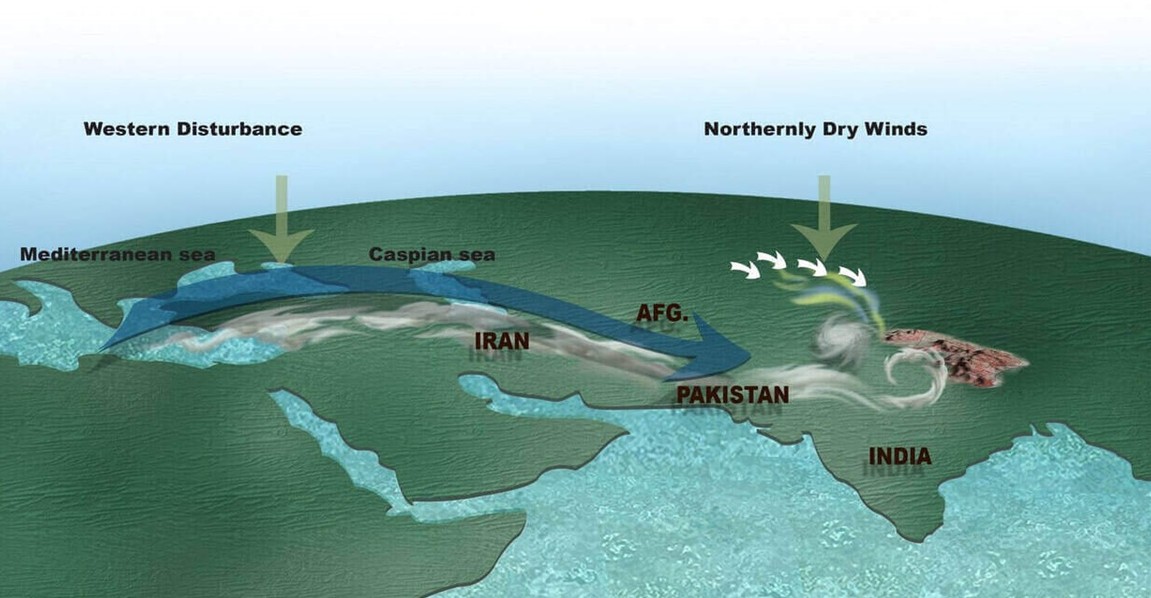
    Changing patterns of Western Disturbances

    Why in the News?

    Heavy rainfall and strong winds disrupted life in Delhi due to a fresh splash of Western Disturbances over North India.

    Changing patterns of Western Disturbances

    What are Western Disturbances?

    • Western Disturbances are extra-tropical weather systems that originate near the Mediterranean region.
    • They carry moisture from the Mediterranean Sea, Black Sea, Caspian Sea, and Arabian Sea.
    • These disturbances are embedded within the subtropical westerly jet stream, a fast-moving air current in the upper atmosphere.
    • They bring rain, snow, and fog, especially from December to March, as they encounter the Himalayas, causing rainfall in the plains and snowfall at higher altitudes.
    • They are responsible for most of the winter and pre-monsoon rainfall in Northwest India and are critical for rabi crops like wheat.

    Recent Changes in its Pattern:

    • Recent observations show an increase in frequency, particularly from late January onwards, with disturbances now occurring outside the winter season.
    • These disturbances have been observed even in May, June, and July, where they were once rare.
    • The geographic spread of these disturbances is widening, affecting larger parts of North and Northwest India.
    • Reasons behind:
      • The strengthening of the subtropical westerly jet stream, likely influenced by rising global temperatures, is a key factor.
      • The delayed retreat of the jet stream is affecting the timing of the summer monsoon, leading to overlapping weather patterns.
      • The warming of the Arabian Sea (by 1.2°C to 1.4°C over recent decades) is increasing moisture, intensifying rainfall.
    [UPSC 2015] Consider the following statements:

    1. The winds which blow between 30° N and 60° S latitudes throughout the year are known as westerlies. 2. The moist air masses that cause winter rains in North-Western region of India are part of westerlies.

    Which of the statements given above is/are correct?

    Options: (a) 1 only (b) 2 only * (c) Both 1 and 2 (d) Neither 1 nor 2


  • Wildlife Conservation Efforts

    Red-Crowned Roofed Turtle returns to Ganga after 3 Decades

    Why in the News?

    The red-crowned roofed turtle has returned to the Ganga River after nearly 30 years of absence.

    Red-Crowned Roofed Turtle returns to Ganga after 3 Decades

    About Red-Crowned Roofed Turtle

    • The Red-Crowned Roofed Turtle (Batagur kachuga) is one of the most endangered freshwater turtle species in the world.
    • It is native to South Asia, particularly India, Bangladesh, and Nepal.
    • Historically found in deep, flowing rivers with sandbar nesting sites, it now survives only in the Chambal River, with fewer than 300 individuals remaining.
    • This species plays a crucial role in maintaining river ecosystem balance by controlling aquatic vegetation and contributing to nutrient cycling.
    • Under the Namami Gange Mission and Turtle Survival Alliance India (TSAFI) project, 20 turtles (10 males, 10 females) were released into the Ganga River at Haiderpur Wetland and Hastinapur Wildlife Sanctuary.
    • The IUCN Red List categorizes it as Critically Endangered, while India’s Wildlife Protection Act, 1972 lists it in Schedule I, offering the highest legal protection.
    • It is also listed under Appendix I of CITES, regulating international trade of the species.
    [UPSC 2017] In India, if a species of tortoise is declared protected under Schedule I of the Wildlife (Protection) Act, 1972, what does it imply?

    Options: (a) It enjoys the same level of protection as the tiger*. (b) It no longer exists in the wild, a few individuals are under captive protection; and how it is impossible to prevent its extinction.  (c) It is endemic to a particular region of India. (d) Both (b) and (c) stated above are correct in this context.


  • Foreign Policy Watch: India-China

    [2nd May 2025] The Hindu Op-ed: China’s strategic push — Asia ties amid tariff tensions

    PYQ Relevance:

    [UPSC 2017] China is using its economic relations and positive trade surplus as tools to develop potential military power status in Asia’, In the light of this statement, discuss its impact on India as her neighbor.

    Linkage: China’s economic relations to its strategic power status in Asia and asks about the impact on India, which aligns with the broader implications of China’s growing regional influence discussed in the source.


    Mentor’s Comment:  Chinese President Xi Jinping’s visit to Vietnam, Malaysia, and Cambodia from April 14-18, 2025, aimed to present China as the most reliable partner in the region. With a 145% tariff on Chinese goods imposed by the Trump administration, China is rethinking its foreign trade strategies, particularly with countries in Southeast Asia where it has strong ties and supportive partners. This visit is not just regular diplomacy but a strategic move by China to ease economic pressure, show stability, and strengthen its leadership role in the Indo-Pacific region.

    The editorial today analyzes Chinese President Xi Jinping’s recent visit to Vietnam, Malaysia, and Cambodia. This analysis can help in understanding the broader dynamics of China’s foreign policy and its impact on international relations, which is relevant for GS Paper 2 in the UPSC exam.

    _

    Let’s learn!

    Why in the News?

    Beijing’s efforts to engage with Southeast Asia could make it harder for the U.S. to form a coalition aimed at isolating or limiting China economically.

    What was the aim of Xi Jinping’s Southeast Asia tour?

    • Counter U.S. Economic Pressure and Protectionism: In response to the 145% tariff on Chinese exports by the Trump administration, China used the tour to strengthen trade ties with receptive Southeast Asian partners like Vietnam, Malaysia, and Cambodia.
    • Position China as a Stable and Reliable Partner in the Indo-Pacific: Xi signed 45 agreements with Vietnam and over 30 with Malaysia, showcasing China’s willingness to invest in digital economy, AI, agriculture, and infrastructure — directly contrasting U.S. policies perceived as protectionist or security-centric.
    • Promote China’s Regional Leadership and Soft Power: Xi emphasized non-interference, cultural ties, and the Belt and Road Initiative, including major projects like the Funan Techo Canal in Cambodia, to build a “community with a shared future” and present China as the regional leader.

    Why is Southeast Asia key to China’s trade strategy?

    • Buffer Against U.S. Trade Pressures: As the U.S. imposes tariffs (e.g., 145% on Chinese exports under Trump), China needs trade partners less influenced by Washington. Eg: Cambodia, Vietnam, and Malaysia are not aligned with U.S. protectionism and offer alternate trade routes.
    • Alternative Manufacturing Base: Rising labor costs and export restrictions push China to shift low-cost manufacturing to nearby countries. Eg: Many Chinese firms are investing in Vietnamese and Malaysian industrial parks as part of their “China Plus One” strategy.
    • Gateway to Regional Supply Chains: Southeast Asia is integrated into global value chains and is a key node in East Asian manufacturing. Eg: The Regional Comprehensive Economic Partnership (RCEP) links China with ASEAN, allowing tariff-free trade on many goods.
    • Diplomatic and Economic Receptiveness: ASEAN countries are generally open to China’s Belt and Road Initiative (BRI) and infrastructure investment. Eg: The Funan Techo Canal in Cambodia, funded by China, improves logistics and deepens economic ties.
    • Market Expansion and Political Influence: Growing middle classes and urbanization offer long-term markets for Chinese goods and services. Eg: Digital economy and AI agreements with Malaysia expand Chinese tech firms’ reach while strengthening bilateral ties.

    Which agreements were signed with Vietnam, Malaysia, and Cambodia?

    • Vietnam – Strategic and Economic Deepening: China and Vietnam signed 45 cooperation agreements covering infrastructure, trade, connectivity, and border management. Eg: Agreements included railway connectivity, digital economy initiatives, and boosting cross-border trade.
    • Malaysia – Tech and Economic Collaboration: Over 30 agreements were signed focusing on the digital economy, artificial intelligence, agriculture, and infrastructure. Eg: MoUs on AI cooperation, palm oil trade, and joint development of industrial parks were key highlights.
    • Cambodia – Investment and Infrastructure Expansion: China reaffirmed its role as Cambodia’s largest investor and trading partner, with a focus on large-scale infrastructure projects. Eg: The Funan Techo Canal project was a major outcome, seen as a symbol of deepened strategic and economic ties.

    How does China’s approach differ from the U.S. in the region?

    • Economic Diplomacy vs. Security-Centric Strategy: China emphasizes infrastructure, trade, and investment, while the U.S. often leads with security alliances and military cooperation. Eg: China’s Belt and Road projects (like the Funan Techo Canal in Cambodia) contrast with U.S.-led initiatives like AUKUS and the Quad.
    • Non-Interference vs. Value-Based Engagement: China promotes a policy of non-interference and economic cooperation without imposing political conditions. The U.S. ties engagement to democracy, human rights, and strategic alignment. Eg: China’s warm ties with Cambodia, despite its authoritarian governance, contrast with U.S. criticism of its human rights record.
    • Tangible Deliverables vs. Abstract Frameworks: China offers clear economic incentives (like market access and investments), while U.S. initiatives often lack concrete trade benefits. Eg: China signs dozens of bilateral agreements; the U.S.’s Indo-Pacific Economic Framework (IPEF) has been criticized for lacking market access.

    What could be the impact on India? 

    • Strategic Space Shrinkage in Southeast Asia: As China deepens ties with ASEAN countries, India may find it harder to expand its influence in the region. Eg: Vietnam engaging with China despite maritime tensions may dilute India’s strategic partnership with Hanoi.
    • Competitive Pressure on Infrastructure and Trade Diplomacy: China’s aggressive investment through BRI challenges India’s outreach via initiatives like the Act East Policy or Mekong–Ganga Cooperation. Eg: China’s infrastructure push in Cambodia (e.g., Funan Techo Canal) may overshadow India’s developmental efforts in the region.
    • Risk of Regional Economic Isolation: Closer China-ASEAN integration may sideline India from key trade and supply chains unless it accelerates its economic engagement. Eg: India’s exit from RCEP and China’s expanding trade deals with ASEAN may reduce India’s leverage in setting regional economic norms.

    Way forward: 

    • Strengthen Economic and Infrastructure Diplomacy: India should deepen its engagement with Southeast Asia through large-scale infrastructure projects, trade agreements, and digital economy initiatives to compete with China’s Belt and Road Initiative (BRI). Eg: Focusing on improving connectivity, like the India-Myanmar-Thailand trilateral highway, and enhancing regional supply chains could help.
    • Foster Strategic Partnerships and Multilateral Cooperation: India should prioritize strengthening its strategic ties with ASEAN countries through multilateral platforms like the East Asia Summit (EAS) and the Quad, focusing on security and regional stability. Eg: India must increase its participation in economic partnerships to counter China’s growing influence.
  • Turn and churn: On caste count and next Census 

    Why in the News?

    The Centre’s decision to include caste data in the next national Census is a significant change for the ruling BJP, as it goes against their earlier stance on the issue.

    What prompted the government to shift its stance and include caste enumeration in the next Census?

    • Electoral Setback Due to Perception of Anti-Reservation Agenda: Calls for constitutional overhaul and earlier statements questioning caste-based reservations created fear among backward communities about erosion of their rights. Eg: The lack of a clear electoral majority in the 2024 general elections was partly attributed to concerns among OBC and Dalit communities.
    • Rising Political Demand and Ground Realities in Key States: Increasing public support for caste enumeration, especially in socially diverse states, compelled the government to reconsider its position. Eg: With state elections approaching and widespread demand for a caste census, continuing opposition risked alienating a significant voter base.
    • Pressure from Social Justice Movements and Civil Society: Growing civil society activism and calls for greater transparency in the distribution of benefits made it difficult to ignore the demand for a caste count. Eg: Public discussions on expanding reservations and ensuring proportional representation intensified the push for a data-driven approach.

    Why is there growing concern about the political implications of a caste census, especially in Bihar?

    • Impact on OBC and Dalit Mobilization: A caste census could provide more accurate data on the representation of OBCs and Dalits, leading to demands for more targeted reservations and welfare programs. Eg: In Bihar, where caste-based politics has been historically influential, a caste census could alter the political calculus by intensifying demands for more affirmative action.
    • Electoral Strategy and Vote Bank Politics: Political parties in Bihar may try to exploit caste-based data to attract specific voter segments, resulting in increased polarization. Eg: In Bihar, caste-based mobilization has historically influenced election results, and any shift in data could be used to either strengthen or disrupt existing political alliances.
    • Social Tensions and Division: The caste census may exacerbate social divisions, particularly in a state like Bihar, where caste identities play a significant role in shaping societal relations and political behavior. Eg: Tensions may rise between communities if the census results challenge current power dynamics, leading to potential unrest and further fragmentation within society.

    How have national political parties historically approached caste-based policies?

    • Ambivalence and Opposition to Caste-Based Politics: Initially, national parties were reluctant to fully embrace caste-based policies, viewing them as divisive. This led to a more generic approach focused on broader social and economic justice. Eg: The Congress party, traditionally seen as the party of social justice, was hesitant to fully adopt caste-based policies until the 1990s, when it started advocating for the inclusion of OBCs and Dalits.
    • Shift Towards Inclusivity and Affirmative Action: Over time, national parties, particularly the Congress and BJP, began adopting affirmative action policies, such as reservations, to address caste-based inequities and broaden their electoral base. Eg: In the 1990s, after the Mandal Commission report, both Congress and BJP supported the implementation of OBC reservations to gain support from OBC communities, especially in states like Uttar Pradesh and Bihar.
    • Caste-Based Mobilization for Electoral Gains: National parties have increasingly used caste-based mobilization as a tool to win elections, though they often avoid explicitly acknowledging it, relying on coalition politics instead. Eg: The BJP, after initially distancing itself from caste politics, has adapted by incorporating OBCs into its fold, as seen in its strategy in Uttar Pradesh and Bihar, leading to its dominance in the 2014 and 2019 general elections.

    When was the last comprehensive caste census conducted in India?

    • The Last Comprehensive Caste Census: The last detailed caste census in India was conducted in 1931 during British rule, which included data on various social groups, castes, and tribes.
    • Post-Independence Efforts: Since then, India has not conducted a comprehensive caste census. However, caste data has been collected through surveys like the Socio-Economic and Caste Census (SECC) in 2011, though it was not as detailed as the one in 1931.

    Way forward: 

    • Ensure Data Privacy and Equity in Implementation: A caste census should be conducted with strict guidelines to ensure data privacy and avoid misuse, ensuring that it is used only for policy planning and affirmative action rather than political exploitation.
    • Strengthen Social Welfare Mechanisms Based on Census Data: The government should leverage the caste census data to create targeted social welfare programs that address the needs of backward communities without exacerbating social divisions.

    Mains PYQ:

    [UPSC 2024] Despite comprehensive policies for equity and social justice, underprivileged sections are not yet getting the full benefits of affirmative action envisaged by the Constitution. Comment.

    Linkage: The core issue that a caste census, as discussed in the article, aims to potentially improve: ensuring that underprivileged sections receive the intended benefits of affirmative action and social justice policies.

Join the Community

Join us across Social Media platforms.