💥UPSC 2027,2028 Mentorship (April Batch) + Access XFactor Notes & Microthemes PDF

Archives: News

  • Judicial Reforms

    How the judiciary maintains accountability

    Why in the News?

    The recent remarks made by the Vice-President of India about the role of judges have raised serious concerns and need to be carefully examined.

    What concerns arise from the Vice-President’s comments on judges’ roles in India?

    • Undermines Judicial Authority: Calling judges a “super parliament” questions the legitimacy of judicial review — a core function to uphold the Constitution. Eg: Criticism of court directions to Governors on bill assent.
    • Erosion of Constitutional Balance: His comments disrupt the delicate balance among the legislature, executive, and judiciary by implying judicial overreach without constitutional basis. Eg: In cases like Kesavananda Bharati v. State of Kerala (1973), the Supreme Court protected constitutional principles through its basic structure doctrine—critical for maintaining checks and balances.
    • Erodes Public Trust: Statements from high offices may weaken public faith in judicial impartiality and independence. Eg: Comments implying judges are unaccountable raise doubts on rule of law.

    Why is the term “super parliament” problematic in India’s parliamentary system?

    • Contradicts the Principle of Popular Sovereignty: Parliament derives its authority from the people; no organ, including the judiciary, can override it. Calling the judiciary a “super parliament” distorts this hierarchy. Eg: In Rojer Mathew v. South Indian Bank Ltd. (2019), the Supreme Court clarified that judicial review strengthens—not replaces—parliamentary supremacy.
    • Misrepresents the Role of Judicial Review: Judicial review is a constitutional mechanism to check the validity of laws—not an attempt to legislate. Calling it a “super parliament” falsely equates judicial scrutiny with lawmaking. Eg: In Minerva Mills v. Union of India (1980), the Court struck down amendments violating the Constitution’s basic structure without encroaching on the legislative domain.
    • Undermines Separation of Powers: The term falsely suggests that the judiciary exceeds its mandate, eroding the balance between the three organs of government enshrined in the Constitution. Eg: The L. Chandra Kumar v. Union of India (1997) judgment upheld judicial review as part of the basic structure, emphasizing that courts act within their defined constitutional limits.

    How does the Constitution ensure judicial independence and separation of powers?

    • Fixed Tenure and Security of Judges: Judges of the Supreme Court and High Courts enjoy security of tenure and can only be removed through a rigorous impeachment process, ensuring they are free from executive or legislative pressure. Eg: The impeachment process under Article 124(4) was invoked in the case of Justice V. Ramaswami (1993), though it did not lead to removal, demonstrating the difficulty of arbitrary dismissal.
    • Financial Independence of the Judiciary: The salaries, allowances, and pensions of judges are charged on the Consolidated Fund of India and are not subject to parliamentary vote, protecting them from financial manipulation. Eg: This provision, under Article 112 and Article 125, ensures that the executive cannot curtail judicial functioning by reducing funds.
    • Constitutional Authority of Judicial Review: The Constitution explicitly empowers courts to review laws and executive actions for constitutional validity, preserving checks and balances between organs of government. Eg: In Kesavananda Bharati v. State of Kerala (1973), the Supreme Court asserted its authority to strike down amendments violating the Constitution’s basic structure.

    What justifies the judiciary setting deadlines for the President to clear Bills in line with popular sovereignty?

    • Fixed Tenure and Security of Judges: Judges of the Supreme Court and High Courts enjoy security of tenure and can only be removed through a rigorous impeachment process, ensuring they are free from executive or legislative pressure. Eg: The impeachment process under Article 124(4) was invoked in the case of Justice V. Ramaswami (1993), though it did not lead to removal, demonstrating the difficulty of arbitrary dismissal.
    • Financial Independence of the Judiciary
      The salaries, allowances, and pensions of judges are charged on the Consolidated Fund of India and are not subject to parliamentary vote, protecting them from financial manipulation. Eg: This provision, under Article 112 and Article 125, ensures that the executive cannot curtail judicial functioning by reducing funds.

    Why is the claim that judges are above the law considered irrational?

    • Judges are bound by the Constitution and Rule of Law: Judges operate strictly within the constitutional framework and are accountable to it. Any violation of constitutional provisions by a judge amounts to “proved misbehaviour” and can lead to removal. Eg: Article 124(4) allows Parliament to impeach a Supreme Court judge for proven misbehaviour or incapacity, showing they are not immune from the law.
    • Parliament can override judicial decisions by making new laws: If the judiciary overreaches or issues controversial verdicts, Parliament can counter it through legislative action, reinforcing democratic accountability. Eg: After the Shah Bano case (1985), Parliament passed the Muslim Women (Protection of Rights on Divorce) Act, 1986, effectively reversing the Court’s judgment.

    Way forward: 

    • Respect Constitutional Boundaries: All constitutional authorities should uphold the principle of separation of powers and avoid statements that may undermine public trust in institutions.
    • Promote Constructive Dialogue: Encourage open, respectful discussions between the judiciary and executive to resolve differences while maintaining democratic values.

    Mains PYQ:

    [UPSC 2020] Judicial Legislation is antithetical to the doctrine of separation of powers as envisaged in the Indian Constitution. In this context justify the filing of large number of public interest petitions praying for issuing guidelines to executive authorities.

    Linkage:  Judicial action (issuing guidelines to the executive) to the separation of powers doctrine. It discusses judicial legislation, which is when courts effectively create law, blurring the lines between the judiciary and legislature. This raises concerns about accountability – to whom is the judiciary accountable when it is perceived to be legislating?

  • Trade Sector Updates – Falling Exports, TIES, MEIS, Foreign Trade Policy, etc.

    UK-India Free Trade Agreement (FTA) signed

    Why in the News?

    India and the United Kingdom signed a Free Trade Agreement (FTA), ending nearly 3 years of negotiations, with an aim to boost trade and investment between the two nations.

    Free Trade Agreement

    What is Free Trade Agreement (FTA)?

    • An FTA is an agreement between two or more countries to reduce or eliminate customs tariffs and non-tariff barriers on trade between them.
    • Objective: To promote trade by making it easier and more cost-effective for businesses to import and export goods and services.
    • FTAs can cover goods, services, investment, and intellectual property rights.
    • By reducing trade barriers, FTAs also benefit consumers by offering a wider range of products at lower prices.
    • FTAs play a key role in boosting economic growth and job creation by facilitating trade between countries.
    • India’s FTAs:
      • India has signed FTAs with 16 countries or regional blocs as of May 2025. 
      • These FTAs cover major partners such as Sri Lanka, Bhutan, Thailand, Singapore, Malaysia, South Korea, Japan, Australia, UAE, Mauritius, ASEAN (10 countries), and EFTA (4 countries).

    Key terms of the UK-India FTA:

    • Trade Growth: Expected to boost bilateral trade by £25.5 billion annually by 2040.
    • Whisky and Gin Tariffs: Tariffs reduced from 150% to 75%, eventually to 40% over 10 years.
    • Automobile Tariffs: India to reduce automotive tariffs from over 100% to 10%.
    • Other Goods: Tariffs reduced on cosmetics, aerospace, medical devices, chocolate, and more.
    • Services and Work Permits: Increased quotas for Indian workers in IT and healthcare, with 100 new visas annually for professionals.
    • Carbon Tax: Dispute over UK’s proposed carbon tax on metal imports.
    • Supply Chain Resilience: FTA aims to reduce reliance on China and improve supply chain security.
    [UPSC 2017] The term ‘Broad-based Trade and Investment Agreement (BTIA)’ is sometimes seen in the news in the context of negotiations held between India and:

    Options: (a) European Union* (b) Gulf Cooperation Council (c) Organization for Economic Cooperation and Development (d) Shanghai Cooperation Organization.


  • Terrorism and Challenges Related To It

    Civil Defence under the Civil Defence Act, 1968

    Why in the News?

    The Union Home Ministry directed all states and Union Territories to conduct a Civil Defence Mock Drill, aimed at assessing and enhancing the readiness of India’s civil defence mechanisms.

    About Civil Defence under the Civil Defence Act, 1968

    • The Civil Defence Act, 1968 was enacted to ensure measures for civil defence to protect citizens, properties, and establishments from hostile attacks or natural disasters.
    • It aims to prepare the population to respond to emergencies such as military attacks, terrorist activities, and natural calamities.
    • Civil Defence Corps is formed at both national and state levels. Volunteers from various sectors are enlisted and trained.
    • The corps operates under the Central Government’s rules for civil defence.
    • Key functions include- Evacuation of civilians; Protection from danger and destruction; Salvage of property; Managing hazardous materials.
    • The Central Government has the authority to:
      • Make rules for civil defence across India.
      • Enforce evacuation procedures, control over dangerous substances, and manage disaster relief.
    • Penalties for non-compliance with the civil defence regulations.

    Recent Context: Civil Defence Mock Drill on 7th May 

    • This exercise assesses and enhances the readiness of India’s civil defence systems to respond promptly during emergencies.
    • The drills will occur across nearly 300 civil defence districts, including sensitive locations like Mumbai, Uran (Jawaharlal Nehru Port), and Tarapur (nuclear power plant).
    • The mock drill aims to improve response time for rescue and relief operations, focusing on critical situations in the first few minutes of an emergency.
    [UPSC 2010] With reference to the National Rehabilitation and Resettlement Policy, 2007, consider the following statements:

    1. This policy is applicable only to the persons affected by the acquisition of land for projects and not to the involuntary displacement due to any other reason.

    2. This policy has been formulated by the Ministry of Social Justice and Empowerment.

    Which of the statements given above is/are correct?

    Options: (a) 1 only (b) 2 only (c) Both 1 and 2 (d) Neither 1 nor 2*


  • Global Geological And Climatic Events

    Palaeofires from Permian and Late Silurian in the Godavari Basin

    Why in the News?

    Recent research has uncovered evidence of ancient wildfires (palaeofires) in the Godavari Basin, shedding light on Earth’s geological and climatic history from over 250 million years ago.

    What are Palaeofires?

    • Palaeofires refer to ancient wildfires that occurred in the Earth’s past, influencing the vegetation, climate, and even the formation of coal.
    • These fires, spanning from the Late Silurian (419.2 to 443.8 million years ago) to the Quaternary (2.58 million years ago), left their mark across various landscapes.

    Ancient Palaeofires in the Godavari Basin:

    • Palaeofires, traced back to the Permian period, provide evidence of how fires influenced prehistoric landscapes.
    • Advanced techniques like Raman Spectroscopy and FTIR Spectroscopy were used to differentiate between in situ (on-site) and ex situ (transported) charcoal.
    • The research also highlighted how sea level changes impacted charcoal deposition, with well-preserved fire signatures during regressive phases and more oxidized charcoal during transgressive phases.
    • These findings contribute to understanding carbon storage in the Earth’s crust and provide insights into past climate dynamics and fire behavior.

    Role of Palaeofires in Earth’s Past:

    • Palaeofires were crucial in shaping Earth’s climate, vegetation, and contributing to coal formation across various geological periods.
    • During the Permian period, palaeofires were widespread in Gondwana, affecting plant life and coal deposits.
    • Fossil charcoal found in coal-bearing formations like the Raniganj Coalfield suggested a connection between seasonal droughts and wildfires.
    • These wildfires influenced vegetation patterns and led to the accumulation of carbon-rich deposits.
    • High atmospheric oxygen levels likely intensified these wildfires, significantly affecting both climate and ecosystem changes.
    • Understanding palaeofires helps in grasping long-term carbon sequestration processes.
    [UPSC 2001] The approximate age of the Aravalli range is:

    Options: (a) 370 million years (b) 470 million years (c) 570 million years* (d) 670 million years


  • Human Development Report by UNDP

    India up three spots to 130 in HDI

    Why in the News?

    India ranks 130th out of 193 countries in the 2025 Human Development Report (HDR), marking continued progress in human development according to the United Nations Development Programme (UNDP).

    hdi

    About Human Development Index (HDI):

    • HDR has been published by UNDP since 1990, exploring various human development themes.
    • HDI is a composite index that measures the average achievement in human development based on 3 key indicators:
      1. Life expectancy at birth (SDG 3: Good Health and Well-Being).
      2. Expected years of schooling and Mean years of schooling (SDG 4: Quality Education).
      3. Gross National Income (GNI) per capita (SDG 8: Economic Growth).

    India’s Progress on HDI:

    • India ranks 130th, improving from 133rd in 2022.
    • India’s HDI value increased from 0.676 in 2022 to 0.685 in 2023, remaining in the medium human development category.
    • Life expectancy in India reached 72 years in 2023, the highest recorded since the inception of the index, reflecting recovery post-pandemic.
    • Children in India now stay in school for 13 years on average, up from 8.2 years in 1990, driven by initiatives like the Right to Education Act and National Education Policy (2020).
    • India’s Gross National Income (GNI) per capita is $2,230 in 2023, reflecting moderate economic growth.
    • Among BRICS members, India trailed Brazil (89th), Russia (59th), China (75th), and South Africa (110th).
    • Regionally, Sri Lanka led while Nepal and Bhutan lagged.
    [UPSC 2003] As per the Human Development Index given by UNDP, which one of the following sequences of South Asian countries is correct, in the order of higher to lower development?

    Options: (a) India-Sri Lanka-Pakistan-Maldives (b) Maldives-Sri Lanka-India-Pakistan (c) Sri Lanka-Maldives-India-Pakistan* (d) Maldives-India-Pakistan-Sri Lanka


  • Animal Husbandry, Dairy & Fisheries Sector – Pashudhan Sanjivani, E- Pashudhan Haat, etc

    Total Allowable Catch (TAC) in Fishing

    Why in the News?

    A recent legal dispute between the US and Russia has brought the issue of Total Allowable Catch (TAC) into the spotlight.

    About Total Allowable Catch (TAC):

    • TAC refers to the maximum quantity of a specific fish species that can be legally harvested in a defined period.
    • It is established to prevent overfishing and ensure sustainable fish populations.
    • These limits are essential for maintaining ecological balance and supporting long-term fishing industries.

    Various Laws Governing TAC:

    • TACs are set by international fisheries management organizations like:
      • FAO (Food and Agriculture Organization).
      • RFMOs (Regional Fisheries Management Organizations) for shared or migratory fish stocks.
    • European Union (EU): TACs are managed under the Common Fisheries Policy (CFP), which sets quotas for member states based on scientific advice. Landing obligations ensure that all catches are counted against quotas, preventing waste.
    • India: India enforces a seasonal fishing ban in its Exclusive Economic Zone (EEZ) for 61 days to protect breeding fish. This ban serves as a TAC equivalent of zero for specific periods, supporting fish stock regeneration.
    • New Zealand: The Fisheries Act sets TACs for various stocks and specifies catch limits in terms of weight or numbers, updated by official notices.
    [UPSC 2013] The most important fishing grounds of the world are found in the regions where:

    Options: (a) Warm and cold atmospheric currents meet (b) Rivers drain out large amounts of freshwater into the sea (c) Warm and cold oceanic currents meet* (d) continental shelf is undulating.


  • Foreign Policy Watch: India-Pakistan

    [6th May 2025] The Hindu Op-ed: The messaging from putting the IWT in ‘abeyance’ 

    PYQ Relevance:

    [UPSC 2016] Present an account of the Indus Water Treaty and examine its ecological, economic and political implications in the context of changing bilateral relations.

    Linkage: The decision to put the IWT in ‘abeyance’ is discussed in the article within the context of changing bilateral relations between India and Pakistan following a terror attack. The article highlights the political implications and the strategic considerations behind the decision, which aligns with examining the treaty’s implications in changing bilateral relations.


    Mentor’s Comment:  On April 24, India declared that it would temporarily suspend the Indus Waters Treaty (IWT) of 1960 until Pakistan stops supporting cross-border terrorism. The term “abeyance” means a temporary pause, with the possibility of restarting the treaty if Pakistan takes real actions to stop terrorism, especially following the Pahalgam terror attack on April 22.

    Today’s editorial discusses India’s temporary suspension of the Indus Waters Treaty (IWT) of 1960. This topic is relevant for GS Paper II (International Relations).

    _

    Let’s learn!

    Why in the News?

    Using water resources as a strategic tool may offer short-term gains, but it could ultimately harm India in the long run.

    Why has India placed the Indus Waters Treaty in abeyance?

    • Response to Cross-Border Terrorism: India used the IWT as a strategic pressure tool following the Pahalgam terror attack (April 22, 2024), holding Pakistan accountable for supporting terrorism. Eg: Similar to the 2016 Uri attack response (surgical strikes), this move sends a message of zero tolerance.
    • Political Messaging and Public Sentiment: The decision caters to domestic outrage and shows a firm stance, particularly after recurring terror incidents. It helps the government project decisive action without immediate military escalation. Eg: After the Pulwama attack in 2019, India took firm actions like revoking Article 370 — a similar pattern of assertiveness is evident.
    • Leverage to Expedite Infrastructure Projects: India aims to use this pause to accelerate stalled or disputed hydropower and irrigation projects like Ratle and Tulbul Navigation on western rivers. Eg: Pakistan’s objections delayed the Kishenganga and Baglihar projects — abeyance reduces procedural hurdles temporarily.
    • Legal Dispute over Treaty Mechanism: India had already accused Pakistan of violating dispute resolution provisions of the IWT by unilaterally approaching the Permanent Court of Arbitration in 2023. Eg: India considers this a material breach and is using “abeyance” as a middle path instead of outright termination.
    • Strategic Signalling Amid Regional Instability: Given Pakistan’s current political and economic instability, India sees an opportunity to reshape the narrative and strengthen its own water security posture. Eg: With Pakistan’s military losing public support and the government under pressure, India is testing diplomatic leverage.

    Can using water resources strategically bring short-term gains but harm India long-term?

    • Diplomatic Strain: Using water as a tool for leverage can strain diplomatic relations with neighbouring countries, potentially leading to prolonged conflicts. Eg: If India disrupts water-sharing agreements under the Indus Waters Treaty, it could escalate tensions with Pakistan, affecting regional stability.
    • International Reputation: Strategic manipulation of water resources may damage India’s global image as a responsible water-sharing partner, undermining trust in future agreements. Eg: India’s suspension of the IWT may invite international criticism for violating treaty obligations, harming its reputation in the international community.

    What are the legal limitations under the IWT and international law regarding unilateral suspension or abeyance of a treaty?

    • Principle of Pacta Sunt Servanda: Under international law, treaties must be honored in good faith. This principle (pacta sunt servanda) ensures that once a treaty is ratified, it cannot be unilaterally suspended or abrogated without serious justification. Eg: In the IWT, India and Pakistan are obligated to maintain water-sharing arrangements despite political tensions.
    • Article 60 of the Vienna Convention on the Law of Treaties: A treaty can only be suspended or terminated unilaterally if there is a “material breach” or a fundamental change in circumstances (rebus sic stantibus), and this must be declared after due process. Eg: If one party to a treaty deliberately violates its terms, the other party might argue that the treaty is no longer binding.
    • Specific Treaty Provisions: Many treaties, including the IWT, include specific provisions about suspension, termination, or modification in certain circumstances. These provisions must be followed. Eg: In the IWT, disputes are to be resolved through a permanent commission rather than unilateral suspension of obligations.
    • Dispute Resolution Mechanisms: Most treaties include mechanisms for resolving disputes rather than allowing unilateral suspension, reinforcing the need for cooperation and dialogue. Eg: The IWT mandates the use of a Permanent Indus Commission to address any disputes regarding the water-sharing arrangement.

    How might India use the term “abeyance” to affect procedural cooperation mechanisms under the Indus Waters Treaty?

    • Suspension of Dispute Resolution Mechanism: The term “abeyance” suggests temporarily putting something on hold rather than full termination, which could lead to the suspension of mechanisms like the Permanent Indus Commission (PIC) for resolving water-sharing disputes. Eg: If India places certain provisions of the IWT in abeyance, it could halt the regular meetings and communication under the PIC, leading to delayed resolutions.
    • Impact on Technical Cooperation: The IWT relies on continuous technical cooperation to monitor water flows and manage the shared river systems. “Abeyance” may disrupt such technical collaboration, affecting data sharing and joint assessments. Eg: India’s use of “abeyance” could delay joint inspections or data exchange related to water quality or infrastructure projects, impacting the treaty’s smooth functioning.
    • Erosion of Trust: Using “abeyance” could signal a lack of commitment to the treaty, potentially undermining trust between India and Pakistan and hindering future cooperation under the IWT. Eg: If India temporarily halts cooperation on the IWT, Pakistan may view it as a breach of good faith, weakening the foundation of trust that is critical for long-term collaboration.
    • Escalation of Diplomatic Tensions: The term could be interpreted as a politically motivated pause, which may lead to diplomatic tensions between the two countries. This would make it harder to revive procedural cooperation when needed. Eg: India’s declaration of “abeyance” after the 2019 Pulwama attack could escalate tensions and make it more difficult to resume dialogue on water-related issues, as the diplomatic focus shifts to security concerns.

    Way forward: 

    • Engage in Diplomatic Dialogue: India and Pakistan should prioritize re-engaging through the Permanent Indus Commission to address grievances and resume cooperation on water-sharing, ensuring that the IWT remains intact while managing political tensions.
    • Strengthen Dispute Resolution Mechanisms: Both countries should strengthen the dispute resolution mechanisms under the IWT, ensuring that any concerns over violations are addressed through legal channels rather than unilateral actions, preserving long-term stability and trust.
  • Citizenship and Related Issues

    Detaining Non-Citizens and the Rule of Law

    Why in the News?

    Assam’s immigration detention system not only harms the freedom and well-being of the people held there, but also raises serious questions about whether it follows the basic rules and values of the Constitution.

    What laws are used to detain non-citizens in India?

    • Foreigners Act, 1946: Allows the government to detain and deport individuals deemed as foreigners without valid documents. Eg: In Assam, many people declared as “foreigners” by Foreigners Tribunals were detained under this Act.
    • National Security Act (NSA), 1980: Permits preventive detention of individuals if they pose a threat to national security or public order. Eg: Non-citizens suspected of disturbing public order can be detained for up to 12 months without trial.
    • Passports Act, 1967: Penalizes entry or stay in India without valid passport or travel documents; used in conjunction with the above laws. Eg: A person found without a passport may be prosecuted and detained before deportation proceedings begin.

    How do they impact detainees?

    • Indefinite and Arbitrary Detention: Many non-citizens are detained for years without trial or clear deportation prospects. Eg: In Assam, over 1.5 lakh people declared foreigners, but only a few dozen have actually been deported.
    • Lack of Legal Safeguards and Due Process: Detainees are often denied proper legal representation, and decisions are based on minor discrepancies in documents. Eg: Variations in spelling or lack of pre-1971 documentation have led to detention, despite lifelong residence in India.
    • Harsh Living Conditions and Psychological Distress: Detention camps have been criticised for overcrowding, poor facilities, and causing mental trauma. Eg: Many families are separated and live in uncertainty for years in Assam’s detention centres.

    Why have many people in Assam been stripped of citizenship through the NRC process?

    • Stringent Documentation Requirements: Applicants had to prove ancestry from before March 24, 1971, using official documents. Eg: Many rural residents could not furnish land or birth records from that period due to illiteracy or displacement.
    • Loss or Inaccessibility of Records: Natural disasters, especially floods, led to the destruction or loss of vital documents. Eg: In flood-prone areas of Assam, many families lost old records multiple times over decades.
    • Minor Discrepancies Rejected: Minor differences in names or spelling between documents led to rejection. Eg: A person listed as “Rafiqul” in one document and “Rafiqul Islam” in another was flagged as suspicious.
    • Exclusion of Marginalised Communities: The verification process disproportionately affected Bengali Muslims, women, and tribal groups who lacked formal documentation. Eg: Women often lacked independent proof of lineage due to patriarchal registration systems.
    • Unfair and Opaque Procedures: Many claims were rejected by Foreigners Tribunals without transparent reasoning or opportunity for appeal. Eg: Individuals were declared foreigners without being adequately notified or heard by the tribunal.

    How does the detention of non-citizens in Assam violate constitutional safeguards under Article 21 and 22?

    • Violation of Right to Life and Personal Liberty (Article 21): Detention without fair reason or legal justification breaches the fundamental right to life and liberty. Eg: People who have committed no crime are detained for years without any realistic prospect of deportation.
    • Absence of Procedural Safeguards (Article 22): Article 22 requires clear legal procedures and rights during preventive detention, such as being informed of grounds and access to legal counsel. Eg: Many detainees in Assam are not told why they’re detained or given timely legal aid.
    • Detention Without Conviction or Trial: Under Indian law, liberty can be curtailed mostly through judicial sanction, such as after conviction or during trial — not arbitrarily. Eg: People declared “foreigners” by tribunals (quasi-judicial bodies) are detained despite not being criminals or facing trial.
    • Detention Without Legitimate Preventive Purpose: Preventive detention must be for a specific, imminent threat — not indefinite holding due to lack of documents. Eg: Detainees are held even when deportation is not possible, making the detention purposeless.
    • Executive Overreach Undermines Judicial Role: Detention decisions are taken by the executive or tribunals without proper judicial oversight, undermining separation of powers. Eg: Tribunals and officials act without court direction, limiting detainees’ access to judicial remedy.

    Way forward: 

    • Ensure due process and legal aid: Establish transparent procedures with timely legal representation for those declared non-citizens, ensuring compliance with Articles 21 and 22.
    • Pursue humane alternatives to detention: Introduce community release programs or supervised residency for non-deportable individuals instead of indefinite detention.

    Mains PYQ:

    [UPSC 2017] Examine the scope of Fundamental Rights in the light of the latest judgement of the Supreme Court on Right to Privacy.

    Linkage: The scope of fundamental rights, including Article 21, which is central to the discussion on the legality of detention in the article.

  • Air Pollution

    Hydrogen versus Battery: The Cost of Clean Public Transport

    Why in the News?

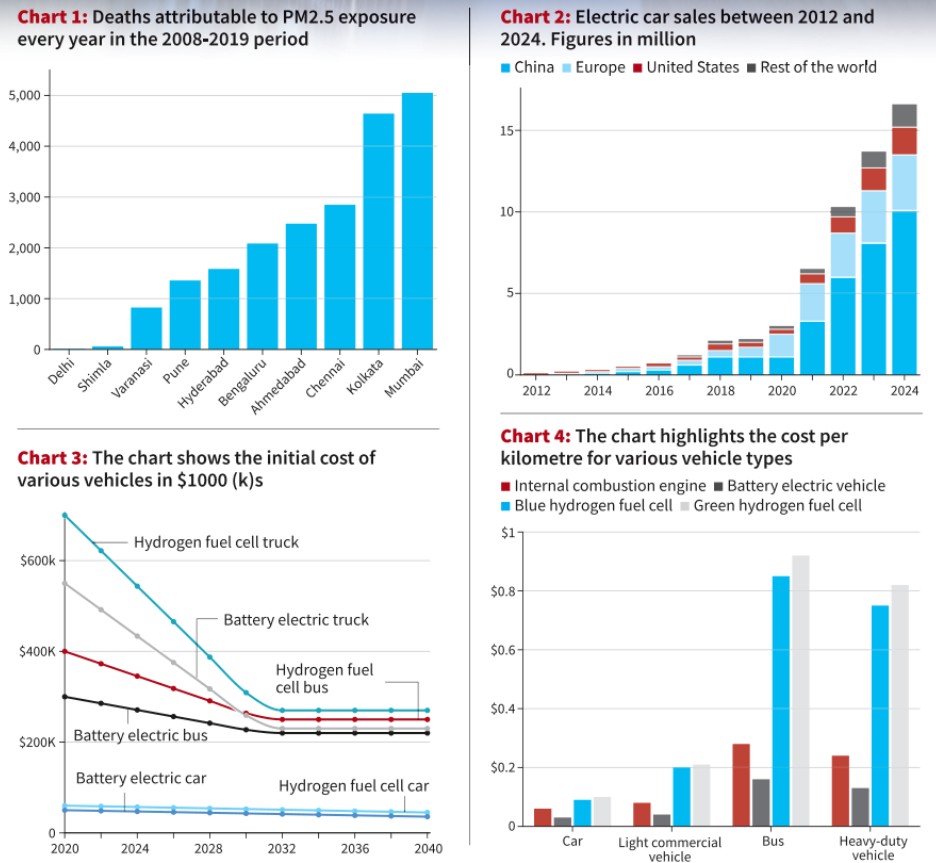
    In India, a study published in The Lancet found that between 2008 and 2019, breathing in high levels of PM2.5 air pollution for short periods caused around 30,000 deaths each year in 10 major cities—making up about 7.2% of all deaths in those areas.

    What are the major health impacts of urbanisation-related air pollution in Indian cities, as reported by the Lancet study?

    • High Mortality Due to PM2.5 Exposure: Short-term exposure to fine particulate matter (PM2.5) caused nearly 30,000 deaths annually across 10 major Indian cities from 2008 to 2019.
    • Significant Share of Urban Deaths: These pollution-related deaths represented about 7.2% of all deaths in these cities, indicating a severe public health burden directly linked to air quality.
    • City-Specific Impact – Mumbai: Mumbai recorded the highest number of annual deaths due to PM2.5, with approximately 5,100 deaths each year attributed to air pollution.
    • Severe Effects in Eastern and Southern Metropolises: Kolkata and Chennai also showed worrying trends, with 4,678 deaths/year in Kolkata and 2,870 deaths/year in Chennai due to polluted air.
    • Urbanisation Intensifies Health Risks: Rapid urban growth increases traffic congestion and emissions, compounding the effects of air pollution and increasing the risk of respiratory and cardiovascular diseases.

    Why are Fuel Cell Electric Vehicles (FCEVs) considered more suitable for long-distance travel and extreme conditions despite their low adoption?

    • Longer Driving Range: FCEVs offer greater range than battery electric vehicles (BEVs) due to the higher energy density of hydrogen fuel. Eg: Hydrogen-powered vehicles can travel 500–700 km on a single tank, ideal for intercity transport.
    • Quick Refuelling Time: FCEVs can be refuelled in just 5–15 minutes, similar to petrol or diesel vehicles, unlike BEVs which may take hours to recharge. Eg: Hydrogen buses can be quickly refuelled during breaks, making them suitable for continuous long-haul operations.
    • Better Performance in Cold Weather: FCEVs are less affected by cold temperatures, which often reduce the efficiency and range of battery-powered vehicles. Eg: FCEVs are more reliable in regions with harsh winters like high-altitude or Himalayan areas.
    • Lighter Vehicle Weight: Hydrogen fuel cells are generally lighter than large lithium-ion battery packs, improving efficiency and payload capacity. Eg: Fuel cell trucks can carry more cargo weight over rugged terrain compared to heavier BEVs.
    • Ideal for Heavy-Duty and Rugged Use: Due to their durability and efficiency, FCEVs are well-suited for buses, trucks, and long-range vehicles on varied terrains. Eg: Countries like Japan and South Korea are deploying hydrogen buses for public transport in hilly and industrial regions.

    Which countries and regions are leading in global electric car sales and how does India compare?

    Country/Region 2023 EV Sales Market Share Key Highlights
    China 9.05 million 37% of total car sales World’s largest EV market; accounts for ~58% of global EV consumption
    Europe 3.02 million 24% of total car sales Strong adoption in countries like Norway, Germany, and the Netherlands
    United States 1.39 million 9.5% of total car sales Third-largest EV market globally
    India 80,000 ~5% of total car sales Rapid growth; EV sales nearly doubled in 2023; leading in electric three-wheeler sales

    When will hydrogen vehicle costs match battery-electric vehicles?

    • Cost Convergence Expected by 2030: Experts predict that the initial purchase cost of hydrogen Fuel Cell Electric Vehicles (FCEVs) will match that of BEVs by around 2030, due to advancements in hydrogen fuel cell technology and mass production. Eg: A hydrogen-powered bus may cost the same as a battery-electric bus by 2030, narrowing today’s 20–30% cost gap.
    • Technology and Manufacturing Scale-Up: As production scales up, the cost of fuel cells, hydrogen storage systems, and related components is expected to fall significantly. Eg: Mass production of hydrogen tanks and cheaper catalysts could lower vehicle costs similar to how lithium-ion battery costs declined over time.
    • Infrastructure Development and Government Support: Increased investment in hydrogen refuelling infrastructure and government subsidies are crucial for cost parity. Eg: Japan and South Korea are funding hydrogen highways and offering tax incentives to make hydrogen cars more affordable.
    • Operational Costs to Remain High: While initial costs may match BEVs by 2030, running costs are expected to remain significantly higher beyond that due to fuel prices. Eg: Operating a green hydrogen bus currently costs around $0.91/km, compared to $0.17/km for electric buses.
    • Limited Market Segments for Parity: Cost matching is likely only in specific segments like heavy-duty transport, not across all vehicle categories. Eg: Long-haul hydrogen trucks may achieve cost parity with electric trucks sooner than passenger cars due to their high utility.

    What are the steps taken by the Indian Government? 

    • FAME India Scheme: Launched in 2015, it offers financial incentives for EV adoption and charging infrastructure development. Phase II (2019) focuses on public transport EVs and charging stations.
    • PLI Scheme: A ₹26,000 crore initiative to boost domestic EV and hydrogen vehicle manufacturing, reduce imports, create jobs, and support ‘Make in India.’
    • Customs Duty Reduction: Import duties on EVs above $35,000 have been reduced from up to 100% to 15%, with a cap of 8,000 vehicles annually for five years, provided manufacturers commit to local production.
    • NEMMP: The 2013 National Electric Mobility Mission Plan aims to boost EV and hybrid vehicle adoption through technology, infrastructure, and demand generation.
    • State-Level Initiatives: States like Uttar Pradesh, Tamil Nadu, and Delhi have implemented various EV policies, including subsidies, tax waivers, and electric auto rickshaw programs to promote adoption.

    Way forward: 

    • Enhance R&D and Subsidies: Support innovation and provide financial incentives to reduce the cost of hydrogen vehicles and fuel.
    • Build Targeted Infrastructure: Develop hydrogen refuelling stations along key freight corridors and urban hubs.

    Mains PYQ:

    [UPSC 2024] How do electric vehicles contribute to reducing carbon emissions and what are the key benefits they offer compared to traditional combustion engine vehicles?

    Linkage: Electric vehicles (which often implies BEVs) and their role in reducing carbon emissions, aligning with the “clean public transport”.

  • Irrigation In India – PMKSY, AIBP, Watershed Management, Neeranchan, etc.

    Kaleshwaram Lift Irrigation Project (KLIP)

    Why in the News?

    The National Dam Safety Authority (NDSA) has reported major structural and operational defects in Telangana’s Kaleshwaram Lift Irrigation Project (KLIP), citing “irreparable damage” to three key barrages, including Medigadda.

    Kaleshwaram Lift Irrigation Project (KLIP)

    About Kaleshwaram Lift Irrigation Project (KLIP)

    • KLIP, located on the Godavari River in Telangana, is the world’s largest multi-stage lift irrigation project, inaugurated on June 21, 2019.
    • The project aims to irrigate 45 lakh acres, supply drinking water to Hyderabad, and support industrial use.
    • It plans to lift 240 TMC of water, with 195 TMC from Medigadda, 20 TMC from Sripada Yellampalli, and 25 TMC from groundwater.
    • The infrastructure includes 7 links, 28 packages, a 500 km span, 1,800+ km canal network, 20 reservoirs, and Asia’s largest pump house at Ramadugu.
    • Estimated cost: ₹80,000 crore to ₹1.2 lakh crore.

    Issues with the Project

    • In October 2023, Pillar No. 20 of the Medigadda barrage sank, causing flood-related damages.
    • NDSA’s April 2024 report identified structural distress in all 3 barrages (Medigadda, Annaram, Sundilla) due to poor design, lack of geotechnical studies, and inadequate safety protocols.
    • Overloading of barrages (10 TMC water stored instead of 2 TMC) caused foundation damage.
    • The state incurs ₹16,000 crore annually in loan and interest repayments, despite the project being criticized as a “man-made disaster.”

    Back2Basics: Godavari River

    • The Godavari, also known as Dakshin Ganga, is the largest peninsular river in India.
    • Originates from Trimbakeshwar in Maharashtra, flowing 1465 km to the Bay of Bengal.
    • Its basin spans: Maharashtra, Telangana, Andhra Pradesh, Chhattisgarh, Odisha, and parts of Madhya Pradesh, Karnataka, and Puducherry.
    • Right bank tributaries include Pravara, Manjira, and Maner; Left bank tributaries include Purna, Pranhita, Indravati, and Sabari.


    [UPSC 2024] Recently, the term “pumped-storage hydropower” is actually and appropriately discussed in the context of which one of the following?

    Options: (a) Irrigation of terraced crop fields (b) Lift irrigation of cereal crops (c) Long duration energy storage* (d) Rainwater harvesting system


Join the Community

Join us across Social Media platforms.