💥UPSC 2026, 2027, 2028 UAP Mentorship (March Batch) + Access XFactor Notes & Microthemes PDF

Archives: News

  • Health Sector – UHC, National Health Policy, Family Planning, Health Insurance, etc.

    Hidden dangers of irrational use of antibiotics on microbiome    

    Why in the news?

    While vital for treating infections, antibiotics can disrupt the microbiome by indiscriminately killing both harmful pathogens and beneficial gut bacteria, especially broad-spectrum types.

    Various roles played by Antibiotics (Applications):  


    Treatment of Infections

    Antibiotics are essential for treating bacterial infections, significantly reducing mortality rates associated with infectious diseases

    For example, penicillin and other antibiotics, the mortality rate from strep throat dropped dramatically from 1% to less than 0.1%.

    Preventing Disease Spread 

    Treating bacterial infections, antibiotics can prevent the spread of disease to other individuals

    For instance, during the 2009 H1N1 influenza pandemic, antibiotics were used to treat secondary bacterial pneumonia, which was a major cause of death.

    Reducing Complications

    Antibiotics can reduce the risk of serious complications from bacterial infections.

    For instance, In the case of urinary tract infections (UTIs), untreated infections can lead to kidney damage or life-threatening conditions like sepsis. However, with prompt antibiotic treatment, the risk of complications is greatly reduced

    Supporting Medical Procedures

    Antibiotics are used prophylactically to prevent infections before certain medical procedures

    For example in surgery

    Concerning Aspects of Antibiotic Use

    • Dysbiosis: The disruption of the microbiome, known as dysbiosis, can lead to severe health issues, including inflammatory bowel disease (IBD) and irritable bowel syndrome (IBS). 
    • Increased Infection Risk: Antibiotics can reduce colonization resistance, which is the microbiome’s ability to prevent pathogenic microorganisms from establishing infections. This reduction increases the risk of infections by harmful bacteria, such as Clostridioides difficile.
    • Antimicrobial Resistance (AMR): Overuse of antibiotics contributes to the development of antimicrobial resistance, making it more challenging to treat infections. The global crisis of antibiotic resistance is exacerbated by the enrichment of antibiotic resistance genes within the gut microbiota due to antibiotic exposure.
    • Long-term Health Consequences: Repeated antibiotic use can prevent full recovery of the microbiome, leading to chronic health issues. Research shows that children who receive multiple courses of antibiotics are at higher risk for developing conditions like IBD later in life.
    • Impact on Other Organ Systems: Dysbiosis can affect various organ systems through gut-organ axes, influencing conditions such as mental health disorders (via the gut-brain axis), liver diseases (via the gut-liver axis), and skin conditions (via the gut-skin axis) due to altered immune responses and increased permeability.

    Government initiatives: 

    1. The Indian Council of Medical Research (ICMR) has initiated an antibiotic stewardship program (AMSP) on a pilot basis in 20 tertiary care hospitals across India to control the misuse and overuse of antibiotics in hospital wards and ICUs.
    2. ICMR collaborated with the Indian Council of Agriculture Research, Department of Animal Husbandry, Dairy and Fisheries, and the Drugs Controller General of India (DCGI) to ban the use of Colistin as a growth promoter in animal feed in poultry.
    3. The Government of India launched the National Action Plan on Antimicrobial Resistance (NAP-AMR) in April 2017, focusing on a One Health approach.

    Way forward: 

    • Antibiotic Stewardship Programs: Implement and promote antibiotic stewardship programs in healthcare settings to ensure antibiotics are prescribed only when necessary and with the appropriate dosage and duration.
    • Probiotic Supplementation: Encourage the use of probiotics alongside antibiotic treatments to help maintain a healthy microbiome and mitigate the risks of dysbiosis and related health issues.

    Mains PYQ: 

    Q Can overuse and free availability of antibiotics without Doctor’s prescription, be contributors to the emergence of drug-resistant diseases in India? What are the available mechanisms for monitoring and control? Critically discuss the various issues involved. (2014)

  • Climate Change Impact on India and World – International Reports, Key Observations, etc.

    Cold War nuke tests light up a bug in present-day climate models  

    Why in the News?

    A new calculation suggests that climate models might be overestimating how long plants keep carbon before releasing it as per the recent study published in Science by an international research team.

    Study by an International Team of Researchers:

    • A recent study published in Science by an international research team suggests that plants absorb more CO2 from the atmosphere than previously thought but release it back into their surroundings sooner than expected.
    • Researchers utilized climate models to analyze the impact of radiocarbon (carbon-14) from nuclear bomb tests on the carbon cycle. They tracked changes in radiocarbon levels in the atmosphere and how it was absorbed by plants during photosynthesis.
    • The study estimates that plants store around 80 billion tonnes of carbon per year, primarily in leaves and finer roots, which is higher than previous estimates of 43-76 billion tonnes. This indicates that plants may be cycling carbon through the atmosphere and soil more rapidly than previously thought.

    Study from the Relics of the Cold War:

    • The nuclear bomb tests conducted during the Cold War inadvertently provided scientists with valuable data for climate research.
      • The tests released significant amounts of radiocarbon into the atmosphere, allowing researchers to study its movement and absorption by vegetation.
    • The presence of radiocarbon in the atmosphere serves as a marker for understanding carbon dynamics.
      • The study analyzed the radiocarbon levels before and after the 1963 Limited Test Ban Treaty, which halted atmospheric nuclear testing, providing insights into how carbon is cycled between the atmosphere and vegetation.
    • The study highlights that many climate models have not incorporated radiocarbon data, which could lead to inaccuracies in predicting carbon cycling and its impact on climate change.
      • Only one model, the Community Earth System Model 2, has accounted for radiocarbon, but it predicted lower absorption levels than the study found.

    How the Whole System is Cycling Faster?

    • Accelerated Carbon Exchange: The researchers concluded that the entire carbon cycle is operating faster than previously understood.
      • This means that while plants absorb more CO2, they also release it back into the atmosphere more quickly, leading to a more dynamic and less stable carbon storage system.
    • Implications for Climate Mitigation: The findings suggest that strategies relying on plant carbon sequestration to offset fossil fuel emissions may need to be reevaluated.
      • If plants are releasing carbon sooner than expected, the potential for mitigating climate change through natural carbon sinks could be less effective than previously thought.

    Way forward: 

    • Incorporate Radiocarbon Data: Integrate radiocarbon data into existing and future climate models to more accurately predict carbon cycling and the role of vegetation in carbon sequestration. This will lead to more reliable forecasts of climate change impacts and inform better policy decisions.
    • Develop Dynamic Carbon Cycle Models: Improve models to account for the faster carbon cycling observed, ensuring they reflect the actual pace at which carbon is absorbed and released by plants. This will help in refining strategies for climate mitigation.
  • Disasters and Disaster Management – Sendai Framework, Floods, Cyclones, etc.

    What is the Nankai Trough?  

    Why on the News?

    Japanese authorities have warned its citizens of a ‘megaquake’ and large tsunamis along the Nankai Trough.

    What is the Nankai Trough?

    • The Nankai Trough is an extensive subduction zone, nearly 900 km long.
    • It is the place of collision of the Eurasian Plate over the Philippine Sea Plate.
    • This trough has a history of producing large earthquakes approximately every 100 to 150 years.
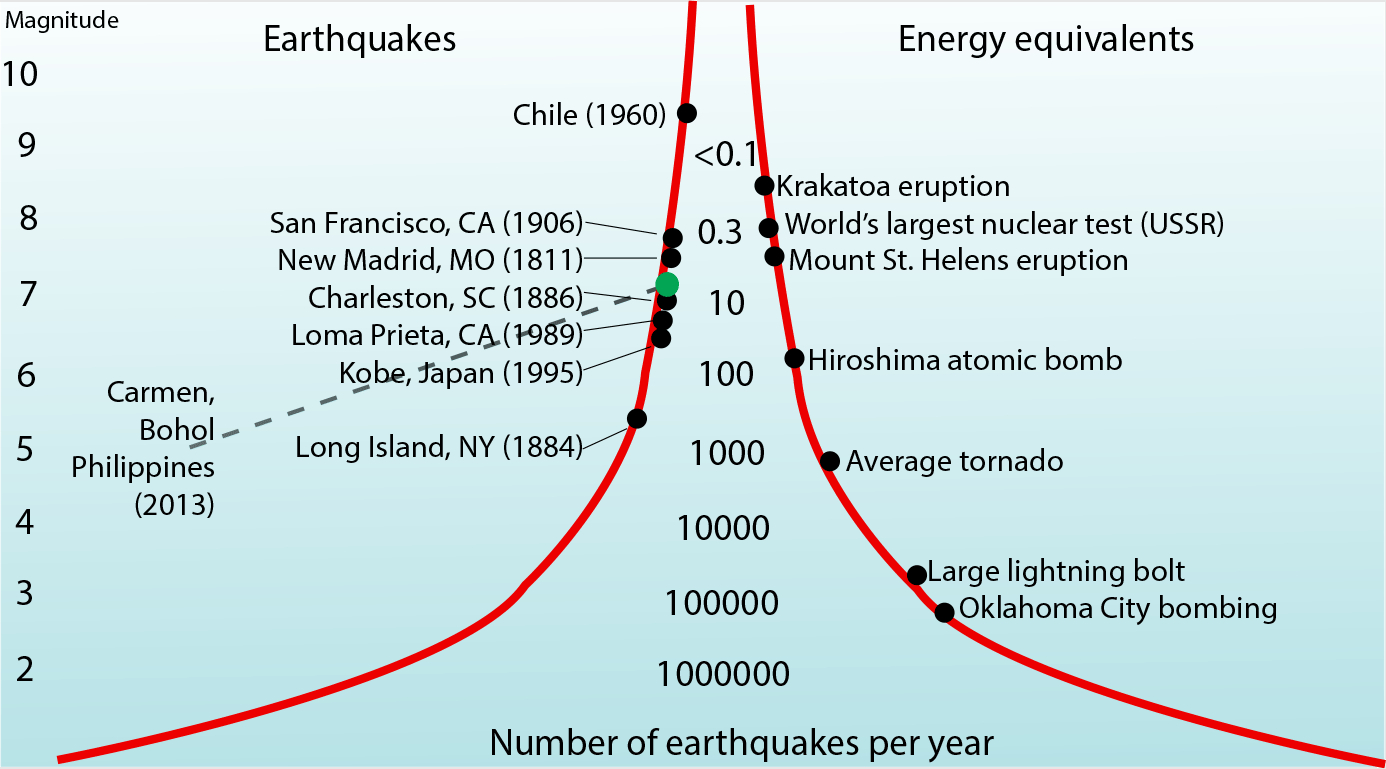
    • The most recent Nankai Trough quake happened in 1946 with magnitude 8.0 tremor and 6.9 metre tsunami, killing 1,330 people.

    Potential for a Megaquake: 

    • Japan’s researchers estimated in January 2022 that there is a roughly 70% chance of a magnitude 8-9 megaquake striking the Nankai Trough within next 30 years.
    • Such a quake could affect a vast region stretching from central Shizuoka, about 150 km south of Tokyo, to southwestern Miyazaki.

    PYQ:

    [2014] Explain the formation of thousands of islands in Indonesian and Philippines archipelagos.

  • Global Geological And Climatic Events

    What is the Perseid Meteor Shower?

    Why in the News?

    The Perseid meteor shower, which began in July, is currently at its peak activity from August 11 to 13, 2024.

    About Perseid Meteor Shower

    Details
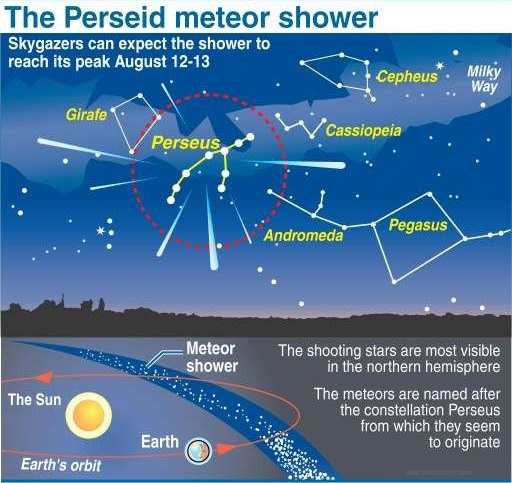
    Origin Named after the constellation Perseus, from which the meteors appear to originate.
    Cause Caused by debris left behind by Comet Swift-Tuttle as it orbits the Sun.
    How It Occurs
    • Consists of ice, rock, and dust particles shed by Comet Swift-Tuttle.
    • Earth passes through this debris field annually between mid-July and late August.
    • Particles enter Earth’s atmosphere at around 214,000 km/h, causing them to heat up and create bright streaks of light.
    Discovery The connection between the Perseid meteor shower and Comet Swift-Tuttle was established in 1862 by Lewis Swift and Horace Tuttle.
    Historical Observations Observed for centuries, with records dating back to ancient Chinese, Japanese, and European civilizations.
    Impact of Earth’s Gravity
    • Earth’s gravity pulls particles from the debris field, causing them to enter the atmosphere.
    • Larger particles can create fireballs—bright meteors that are more intense and last longer.

    Note: In the 1990s, scientists feared comet Swift-Tuttle might hit Earth or the Moon in 2126, but later calculations confirmed safety for two millennia.

    PYQ:

    [2011] What is the difference between asteroids and comets?

    1. Asteroids are small rocky planetoids, while comets are formed of frozen gases held together by rocky and metallic material.
    2. Asteroids are found mostly between the orbits of Jupiter and Mars, while comets are found mostly between Venus and Mercury.
    3. Comets show a perceptible glowing tail, while asteroids do not.

    Which of the statements given above is/are correct?

    (a) 1 and 2 only
    (b) 1 and 3 only
    (c) 3 only
    (d) 1, 2 and 3

  • Wildlife Conservation Efforts

    Neelakurinji included in Red List of threatened species   

    Why in the News?

    Neelakurinji has been categorized as Vulnerable in the IUCN Red List of threatened species for the first time under Criteria A2c.

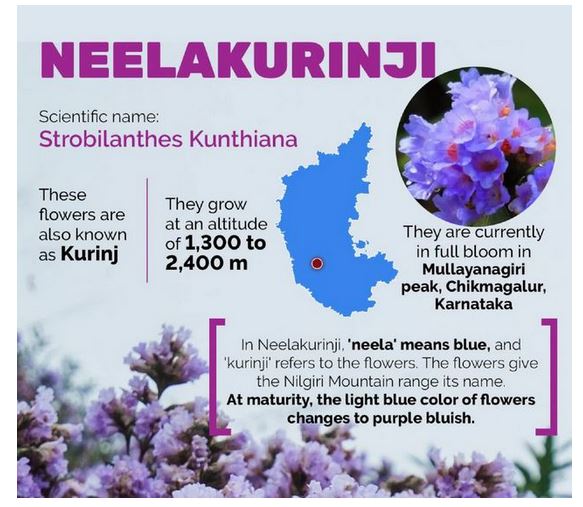
    About Neelakurinji (Strobilanthes kunthiana)

    Details
    Blooming Cycle
    • Blooms once every 12 years.
    • Some bloom once every 7 years.
    Physical Description
    • Shrub that can grow up to 3 meters in height.
    • Vibrant purplish-blue flowers bloom synchronously over large areas.
    • Named after Kunthi River which flows through Kerala’s Silent Valley National Park.
    Habitat and Distribution
    • Endemic to high-altitude Shola grasslands of the Western Ghats.
    • Found at elevations between 1,340 to 2,600 meters.
    • Key regions: Nilgiris, Munnar, Palani-Kodaikanal, Anamalai mountains, and some isolated populations in the Eastern Ghats (Yercaud, Shevaroy Hills).
    Historical Blooming Records Documented blooming in 1838, 1850, 1862, 1874, 1886, 1898, 1910, 1922, 1934, 1946, 1958, 1970, 1982, 1994, 2006, and 2018.
    Cultural Significance
    • Nilgiri Hills named after its purplish-blue flowers.
    • Paliyan tribal people of Tamil Nadu used it to calculate their age.
    Ecological Importance
    • Critical for the biodiversity of montane grasslands.
    • Provides nectar for pollinators during mass flowering.


    PYQ:

    [2011] The “Red Data Books” published by the International Union for Conservation of Nature and Natural Resources (IUCN) contain lists of

    1. Endemic plant and animal species present in the biodiversity hotspots.
    2. Threatened plant and animal species.
    3. Protected sites for conservation of nature and natural resources in various countries.

    Select the correct answer using the codes given below:

    (a) 1 and 3

    (b) 2 only

    (c) 2 and 3

    (d) 3 only

  • Industrial Sector Updates – Industrial Policy, Ease of Doing Business, etc.

    Diamond Imprest Licence

    Why in the News?

    • Union Minister for Commerce and Industry has introduced Diamond Imprest Licence at the 40th edition of the India International Jewellery Show (IIJS) 2024.
      • The event was organized by the Gem & Jewellery Export Promotion Council (GJEPC).

    What is the Diamond Imprest Licence?

    • The Diamond Imprest Licence is a regulatory framework introduced by the Indian government to facilitate the import of diamonds for exporters, particularly benefiting Micro, Small, and Medium Enterprises (MSMEs) in the diamond industry.
    • It will allow Indian diamond exporters who meet a certain export turnover threshold to import up to 5% of their average export turnover over the preceding three years.
    • This policy aims to create a level-playing field for MSME diamond exporters, enabling them to compete more effectively with larger industry peers.

    About the Gem & Jewellery Export Promotion Council (GJEPC )

    Details
    Establishment
    • Established in 1966 by the Ministry of Commerce and Industry, Government of India.
    • Granted an autonomous status in 1998.
    Headquarters
    • Mumbai, India
    • Regional offices in New Delhi, Kolkata, Chennai, Surat, Jaipur
    Membership Represents almost 7,000 exporters from across India.
    Role and Functions
    • Promotes exports of gems and jewellery
    • Presents industry issues to the government and recommends policy interventions.
    Common Facility Centers (CFCs) Established in Amreli, Visnagar, Palanpur, and Junagadh in Gujarat.
    Services include planning, laser sawing, and cutting facilities to process diamonds.
    Awards Organizes premier jewellery design competitions and awards, celebrating creativity and innovation in jewellery design.
    Key Events Hosts the Design Inspirations seminar annually in Mumbai, educating jewellers, designers, and students about upcoming trends in India, Europe, and the US.
    Educational Institutes Operates 7 educational institutes across five cities, including the Indian Institute of Gems & Jewellery (IIGJ) in Mumbai, Jaipur, Delhi, Varanasi, and Udupi.
    Gemmological Laboratories
    • Gemmological Institute of India (GII), Mumbai: Established in 1971, focusing on gemological training, research, and certification.
    • Gem Testing Laboratory, Jaipur: Specializes in grading and certifying colored gemstones.
    • Indian Gemological Institute, New Delhi: Provides gem testing and certification services, particularly for the North Indian market.


    PYQ:

    [2018] Which one of the following foreign travelers elaborately discussed about diamonds and diamond mines of India?

    (a) Francois Bernier

    (b) Jean-Baptiste Tavernier

    (c) Jean de Thevenot

    (d) Abbe Barthelemy Carre

  • Climate Change Impact on India and World – International Reports, Key Observations, etc.

    Why A23a is spinning in its place?

    Why in the News?

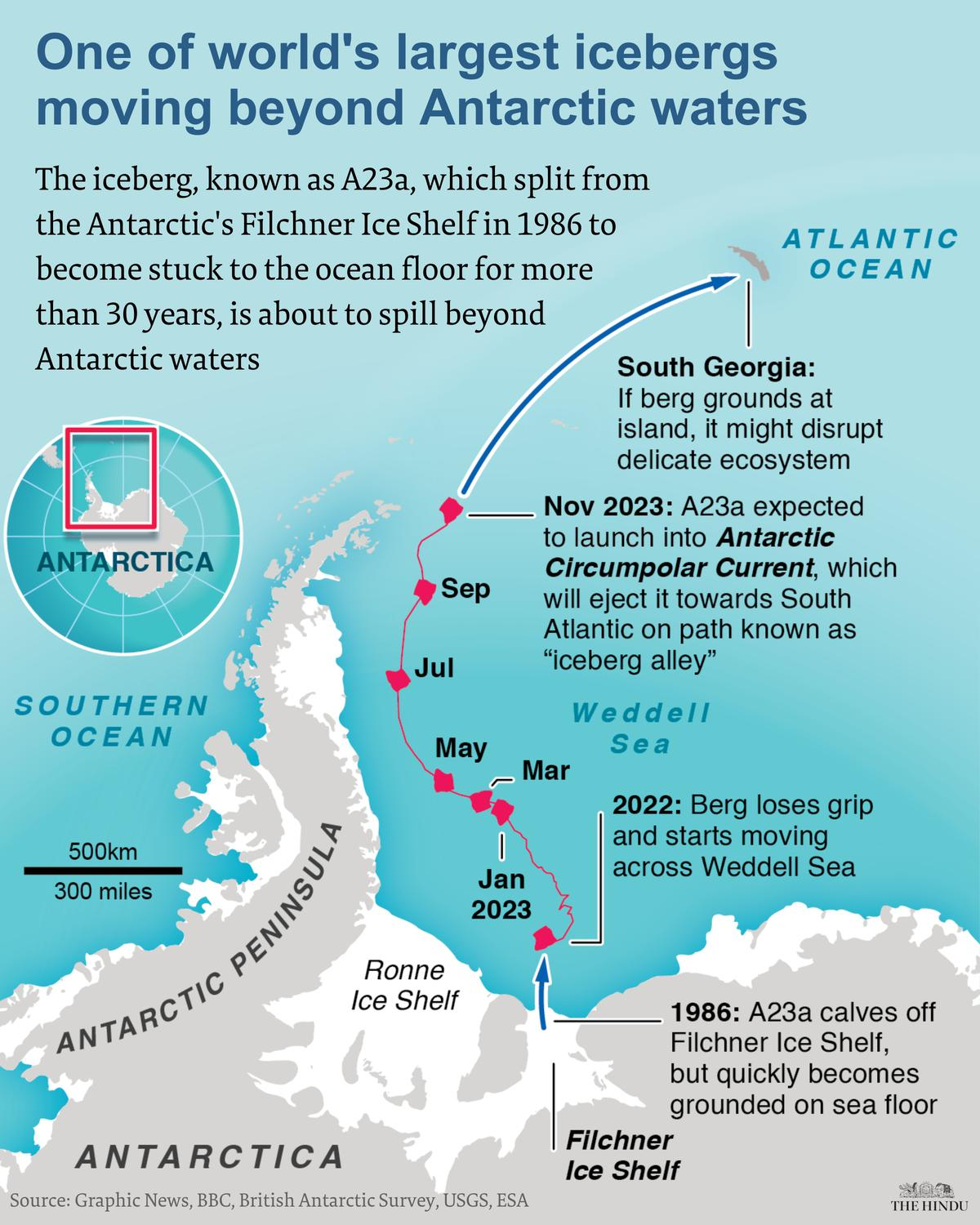
    • A23a, the world’s largest iceberg, has recently started spinning in place after drifting away from Antarctica in 2020.
      • Now it is near South Orkney Islands, about northeast of the Antarctic Peninsula.

    What is A23a?

    • A23a is an iceberg, about 3,855 square kilometers in area, which is 5 times the size of New York City.
    • It was originally part of an even larger iceberg called A23.
    • It broke off from the Filchner Ice Shelf in Antarctica in 1986.

    What is happening with A23a?

    • It is now trapped over a seamount, and is spinning slowly in place.
    • It is completing a full spin approximately in 24 days.
    • Reason behind the spinning: Icebergs spin in Iceberg Alley because they get pulled by the strong Antarctic Circumpolar Current, moving into warmer waters where they melt.

    Implications

    • A23a’s melting does not contribute to global sea level rise since it is already floating.
    • Its extended stay in this vortex could impact marine life in the area, especially plankton and other organisms in the food chain.
    • The situation also provides a unique opportunity for scientists to study how such large icebergs behave in the ocean.

    PYQ:

    [2021] With reference to the water on the planet Earth, consider the following statements:

    1. The amount of water in the rivers and lakes is more than the amount of groundwater.

    2. The amount of water in polar ice caps and glaciers is more than the amount of groundwater.

    Which of the statements given above is/are correct?

    (a) 1 only

    (b) 2 only

    (c) Both 1 and 2

    (d) Neither 1 nor 2


    [2021] How do the melting of the Arctic ice and glaciers of the Antarctic differently affect the weather patterns and human activities on the Earth? Explain. 

  • No population Census — in the dark without vital data 

    Why in the News?

    Despite growing concerns, India’s decadal Census has been delayed by over three years. In fact, there is an overwhelming misconception among officials about substituting the Census with alternative ways and means of counting the population.

    Significance of Calculating Census

    • Comprehensive Population Data: The Census provides a detailed population count, which includes locational, familial, and individual information.
      • For instance, the Census can reveal insights into population density, age distribution, educational attainment, and employment status.
    • Foundation for Surveys and Indicators: The Census acts as a foundational frame for large-scale surveys like the National Family Health Survey (NFHS) and Periodic Labour Force Survey (PLFS). 
    • Support for SDG Monitoring: In the context of Sustainable Development Goals (SDGs), Census data is crucial for generating accurate indicators, particularly those requiring disaggregated data below the sub-national level.
      • For instance, to monitor progress on goals related to poverty reduction, gender equality, and health, precise demographic data is necessary to identify disparities and target interventions effectively.
    • Demographic Transition Insights: The Census is vital for capturing changes in population composition, familial structures, and occupational distribution, especially during periods of rapid demographic transition.
    • Global Implications: Given India’s significant influence on global population trends, accurate Census data is crucial for global demographic studies and projections.
      • For example Global Health Security Index and Multidimensional Poverty Indices.

    Changes to understand before taking Census Count

    • Population Dynamics: Since the last Census, significant changes in population count and composition must be understood, including shifts due to migration, fertility, and mortality rates.
      • For example: In India, the average annual growth rate of the population has slowed from 2.2% in 1971 to 1.1% in 2021, with projections indicating further declines to 0.58% by 2036.
    • Impact of COVID-19: The pandemic has had a profound impact on health, employment, and livelihoods, which need to be accurately captured in the Census.
      • For example, The Indian government reported over 500,000 COVID-19 related deaths, which have affected overall mortality statistics and health indicators.
    • Socio-economic Transformations: Changes in education, occupation, and employment patterns over the last decade are crucial to understanding current societal trends.
      • For example, The literacy rate in India has improved significantly, rising from 64.8% in 2001 to 77.7% in 2011, with further increases expected.
    • Infrastructure and Development Changes: The transformation in physical and digital infrastructure, as well as regional development patterns, must be considered to accurately reflect the current state of the nation.
      • For example, the COVID-19 pandemic accelerated the adoption of digital technologies, with a reported increase in internet users from 560 million in 2019 to over 800 million in 2022. This digital transformation has reshaped how people work and access services.

    Demand for Caste Census in India

    • Political Motivations: The demand for a caste Census is largely driven by political interests, aiming to establish differential entitlements based on perceived representation and deprivation.
      • For instance, leaders from the Indian National Developmental Inclusive Alliance (INDIA) have emphasized the need for a caste Census
    • Historical Context: Caste auditing was part of earlier Census exercises but was discontinued for specific reasons.
      • For example, Caste auditing was part of earlier Census exercises, with the British-era Censuses from 1881 to 1931 enumerating all castes. However, after independence, the Government of India decided not to enumerate castes in the 1951 Census, except for Scheduled Castes (SC) and Scheduled Tribes (ST).
    • Assessment of Mobility: There is a lack of systematic assessment of social mobility in education and occupation across caste lines, despite decades of affirmative action. A caste Census could potentially address this gap but is viewed with skepticism.
      • For instance, while reservations exist for OBCs and SCs, the actual impact on social mobility remains unclear due to insufficient data.

    Way forward: 

    1. Incorporation of Caste Data: Need to amend the Census Act of 1948 to mandate the enumeration of caste data alongside other demographic information. This would provide a legal framework for collecting comprehensive caste-wise data.
    2. Independent Studies and Pilot Surveys: The government should conduct independent studies at district and state levels to gather data on castes and sub-castes.

    Mains PYQ: 

    Q Has caste lost its relevance in understanding the multi-cultural Indian Society? Elaborate your answer with illustrations. (2020)

  • Nobel and other Prizes

    [pib] Winners at Olympics, 2024

    Why in the News?

    India has won a total of 6 medals at the 33rd Summer Olympic Games in Paris, with 5 bronze medals and 1 silver medal.

    Full List of Medal Winners

    Game Medal Details
    Manu Bhaker 10m Air Pistol Women’s Bronze Secured a bronze medal with a score of 221.7 after 22 attempts.


    Manu Bhaker, Sarabjot Singh 10m Air Pistol Mixed Team Bronze It was a team event.

    Manu now is the first Indian woman to win two medals in a single Summer Games.

    Swapnil Kusale 50m Rifle 3 Position Bronze First-ever Indian medal in this event.
    Men’s Hockey Team  Hockey Bronze Defeated Spain by 2-1 in the third-place playoff, with skipper Harmanpreet Singh scoring both goals.
    Neeraj Chopra Men’s Javelin Throw Silver Secured medal with a distance of 89.45m.

    Became first Indian to win two Olympic medals in track-and-field.

    Aman Sehrawat Men’s Wrestling Freestyle 57kg Bronze Men’s Freestyle 57kg category by defeating Darian Toi Cruz of Puerto Rico 13-5.


    PYQ:

    [2021] Consider the following statements in respect of the Laureus World Sports Award which was instituted in the year 2000 :​

    1. American golfer Tiger Woods was the first winner of this award.​

    2. The award was received mostly by ‘Formula One’ players so far.​

    3. Roger Federer received this award maximum number of times compared to others.​

    Which of the above statements are correct?​

    (a) 1 and 2 only ​

    (b) 2 and 3 only​

    (c) 1 and 3 only ​

    (d) 1, 2 and 3 other​

  • Parliament – Sessions, Procedures, Motions, Committees etc

    Opposition to move No-Confidence Motion against VP

    Why in the News?

    As many as 50 Opposition MPs have reportedly signed a resolution to bring a no-confidence motion against Vice-President (Rajya Sabha Chairman) Jagdeep Dhankhar.

    No-Confidence Motion against Vice President of India

    Details
    Provision Article 67(b) of the Indian Constitution
    Who Can Initiate Can only be introduced in the Rajya Sabha, not the Lok Sabha.
    Notice Requirement At least 14 days’ advance notice must be given before moving the resolution.
    Voting in Rajya Sabha Requires an effective majority (majority of all members present and voting) in the Rajya Sabha.
    Voting in Lok Sabha Requires a simple majority (more than 50% of members present and voting) in the Lok Sabha.
    Grounds for Removal Constitution does not specify any grounds or justifications for the removal of the Vice President.
    Temporary Vacancy If the Vice President is removed -> Deputy Chairman of the Rajya Sabha assumes the role of Chairman.
    Historical Context No Vice President has ever been removed under this Article in Indian parliamentary history.


    PYQ:

    [2013] Consider the following statements:

    1. The Chairman and the Deputy Chairman of the Rajya Sabha are not the members of that House.

    2. While the nominated members of the two Houses of the Parliament have no voting right in the

    Presidential election, they have the right to vote in the election of the Vice President.

    Which of the statements given above is/are correct?

    (a) 1 only

    (b) 2 only

    (c) Both 1 and 2

    (d) Neither 1 nor 2

Join the Community

Join us across Social Media platforms.