💥UPSC 2027,2028 Mentorship (April Batch) + Access XFactor Notes & Microthemes PDF

Archives: News

  • Animal Husbandry, Dairy & Fisheries Sector – Pashudhan Sanjivani, E- Pashudhan Haat, etc

    White Revolution 2.0

    Why in the News?

    The Ministry of Cooperation unveiled White Revolution 2.0, focusing on empowering women farmers and creating job opportunities in the dairy cooperative sector.

    What is White Revolution 2.0?

    Details
    Objective Transforming India’s dairy sector by empowering women farmers, increasing milk production, and modernizing dairy infrastructure.
    Target  Increase procurement from the current 660 lakh litres per day to 1,000 lakh litres per day.
    Funding • Initial funding of ₹40,000 per Multi-Purpose Primary Agricultural Credit Society (PACS) by National Dairy Development Board.
    • Total outlay of ₹70,125 crore with full government budgetary support.
    Provisions and Features 1. Women Empowerment: Focus on empowering women in the dairy sector and strengthening women’s cooperatives.
    2. Increase in Milk Procurement: Aims to raise procurement by 50% over the next five years.
    3. Cooperative Infrastructure: 100,000 new and existing cooperative societies (district cooperative societies and Primary Agricultural Credit Societies) to be set up or enhanced.
    4. RuPay Kisan Credit Cards: Nationwide rollout for dairy farmers, with micro-ATMs at cooperative societies.
    5. Computerisation of Primary Agricultural Credit Societies: 67,930 Primary Agricultural Credit Societies will be computerised for better management.
    Significance 1. Women Empowerment: Creates leadership opportunities for women in dairy, promoting gender equality.
    2. Boost to Rural Economy: Strengthening cooperatives and milk procurement will improve rural livelihoods.
    3. Improved Infrastructure: Modern technology, micro-ATMs, and computerisation will increase efficiency.
    4. Job Creation: Expanding cooperatives and modern practices will generate jobs for 130 million farmers.
    5. Malnutrition Reduction: Enhances dairy quality to combat malnutrition.
    6. Cooperative Modernisation: Focus on Artificial Intelligence and advanced technologies.
    7. Dairy Exports Boost: Improved production and quality to enhance India’s dairy exports.


    PYQ:

    [2017] Explain various types of revolutions, took place in Agriculture after Independence in India. How these revolutions have helped in poverty alleviation and food security in India?

  • Health Sector – UHC, National Health Policy, Family Planning, Health Insurance, etc.

    Amoebic Meningoencephalitis

    Why in the News?

      • This year, Kerala faced a sudden surge in Amoebic Meningoencephalitis cases, caused by free-living amoebae (FLA) found in freshwater ponds, lakes, and rivers.
    • Kerala also saw a diverse range of amoebic infections, caused by Naegleria fowleri, Vermamoeba vermiforis, and Acanthamoeba.

    What is Primary Amoebic Meningoencephalitis (PAM)?

    • PAM is caused by the Naegleria fowleri, often referred to as the “brain-eating amoeba“. It destroys brain tissue, causing severe swelling and is fatal in most cases.
      • An amoeba is a type of cell or unicellular organism with the ability to alter its shape, primarily by extending and retracting pseudopods.
      • Higher temperatures of up to 115°F (46°C) are conducive to its growth and it can survive for short periods in warm environments.
    • The amoeba enters the body through the nose, typically during activities like swimming, and travels to the brain, causing severe damage.
    • PAM is also non-communicable.
    • Symptoms: Headache, fever, nausea, vomiting, stiff neck, confusion, seizures, hallucinations, and coma.
      • According to the US Centers for Disease Control and Prevention (CDC), most people with PAM die within 1 to 18 days after symptoms begin. It usually leads to coma and death after 5 days.

    Diagnosis and Treatment:

    • Currently, there are no established effective treatments for PAM.
    • Diagnosis involves PCR tests of cerebrospinal fluid, though detection can be challenging due to the rarity of PAM.
    • Treatment follows CDC guidelines, including miltefosine, Azithromycin, and Amphotericin B, with miltefosine recently procured by the State Health Department from Germany.
      • Medical interventions typically involve a combination of drugs, including amphotericin B, azithromycin, fluconazole, rifampin, miltefosine, and dexamethasone.
  • Historical and Archaeological Findings in News

    100 Years of Harappan Civilization

    Why in the News?

    It has been 100 years since the discovery of the Harappan Civilization, announced by John Marshall on September 20, 1924.

    Harappa: Remains of a Civilization

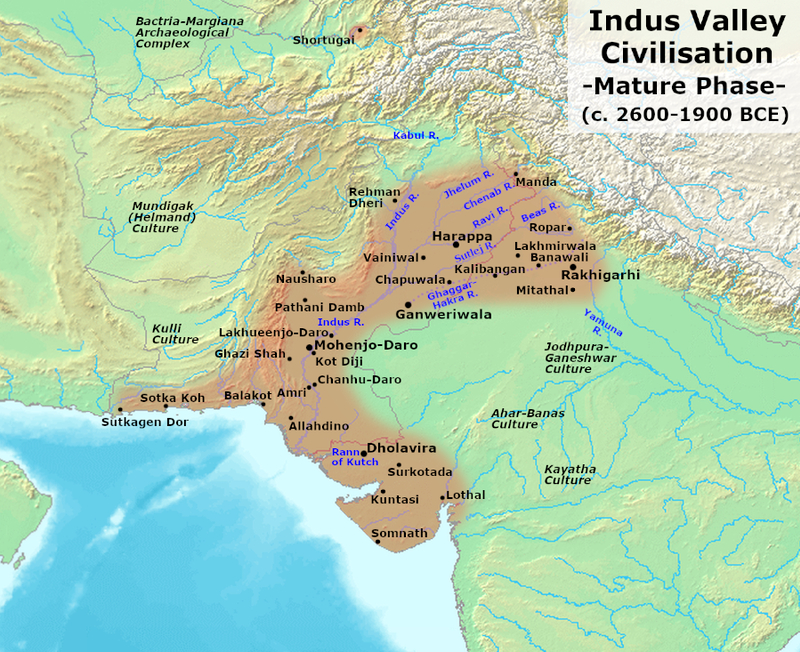
    • The Harappan Civilization, also known as the Indus Valley Civilization, flourished between 2600 BCE and 1900 BCE, with earlier settlements dating back to 3200 BCE.
    • The origins of this civilisation are traced back to Mehrgarh in Balochistan, which dates to 7000 BCE.
    • It is considered one of the three earliest civilizations, alongside Egypt and Mesopotamia.
    • The civilization covered over 1.5 million sq. km, stretching across modern-day India, Pakistan, and Afghanistan.
    • Remains of the civilization include:
      • Well-planned cities with a grid layout, intersecting streets, and fortified structures.
      • Advanced drainage systems with underground sewers and covered drains, showing a strong emphasis on hygiene.
      • Granaries, warehouses, and dockyards, indicating the presence of structured trade and food storage mechanisms.
      • The discovery of seals made of steatite, often engraved with animals and an un-deciphered script, suggesting a sophisticated administrative system.
      • Craftsmanship in pottery, bead-making, terracotta figurines, metal artefacts, and weaving.
      • Water management systems such as reservoirs, wells, and baths, indicating an advanced understanding of hydraulic engineering.

    The Discoverers:

    • Two ASI archaeologists were credited with the discovery:
      • Daya Ram Sahni excavated Harappa in 1921-22, discovering seals, pottery, and beads.
      • Rakhal Das Banerji began excavating Mohenjo-daro in 1922, finding similar items such as seals and copper objects.
    • John Marshall noticed the similarity between the objects found at Harappa and Mohenjo-daro, despite the sites being 640 km apart.

    About the Mohenjo-daro Site:

    • Mohenjo-daro is one of the largest cities of the Harappan Civilization, located in the Sindh province of Pakistan, discovered in 1922 by Rakhal Das Banerji.
    • The city represents one of the finest examples of ancient urban planning:
      • Great Bath: A large, centrally located structure thought to be used for ritual bathing or religious ceremonies. It is considered one of the earliest public water tanks in history.
      • Granaries: Massive storage facilities near the citadel suggest an organized system of storing food for the community.
      • Citadel and Lower Town: The city was divided into a raised citadel for the ruling elite and a lower town for common people. Both areas had well-planned streets and residential complexes.
      • Drainage Systems: Mohenjo-daro featured covered drainage systems with individual toilets connected to the drainage network, showcasing an impressive public sanitation system.
      • Residential Buildings: Homes were built from uniform mud bricks, with courtyards and bathrooms, and were often multi-storied. The use of standardised brick sizes (ratio 1:2:4) and cubic weights showed their high degree of organisation.
    • Artefacts found at Mohenjo-daro include:
      • Seals with animal motifs and the un-deciphered Harappan script, believed to have been used for administrative or trade purposes.
      • Pottery and tools made of bronze and copper.
      • Terracotta figurines, jewellery, and toys that reflect a highly developed artistic culture.
      • Weights and measures based on a uniform standard, indicating the use of a standardized economic system.
    • The city’s streets were aligned north-south and east-west, cutting at right angles, allowing for efficient transportation, including bullock carts.
    • Mohenjo-daro is believed to have had trade links with Mesopotamia, as suggested by artefacts with Mesopotamian connections.

    PYQ:

    [2013] Which of the following characterizes/characterize the people of Indus Valley Civilization?

    1. They possessed great palaces and temples.

    2. They worshipped both male and female deities.

    3. They employed horse-drawn chariots in warfare.

    Select the correct statement/statements using the codes given below.

    (a) 1 and 2 only

    (b) 2 only

    (c) 1, 2 and 3

    (d) None of the statements given above is correct

  • Global Geological And Climatic Events

    Why Earth will temporarily get a ‘Mini-Moon’ in September?

    Why in the News?

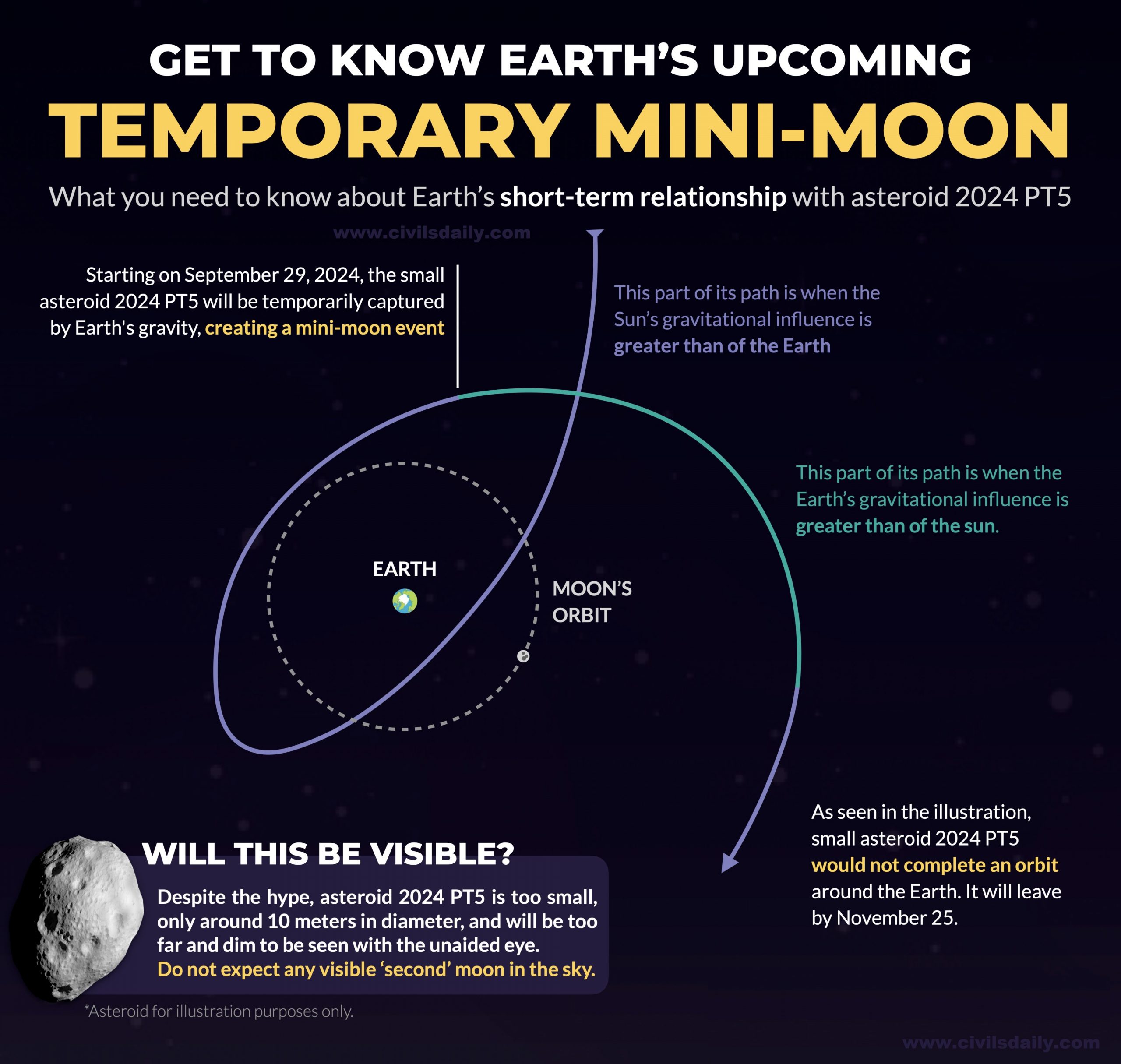
    In a rare celestial event, Earth’s gravitational field will witness a small asteroid, 2024 PT5, creating a “mini-moon” for two months.

    What is Mini-Moon?

    • A mini-moon is a small asteroid temporarily captured by Earth’s gravitational field, orbiting the planet for a short period before escaping back into space.
    • Unlike Earth’s permanent moon, mini-moons only stay for a few months to a few years before being ejected from orbit.
    • Mini-moons are a rare occurrence because most asteroids either pass by Earth or burn up in the atmosphere rather than being captured by Earth’s gravity.
    • Mini-moons are usually small, often just a few meters in diameter.
      • For example, 2024 PT5 is only about 33 feet (10 meters) in length.
    • They are hard to detect and are usually discovered using advanced telescopic surveys like NASA’s Asteroid Terrestrial-impact Last Alert System (ATLAS).

    Significance of Mini-Moons

    • Mini-moons offer scientists a unique opportunity to study near-Earth objects, enhancing our understanding of asteroids’ behavior and composition.
    • Mini-moons could contain valuable minerals or water, making them potential targets for future space missions to extract resources.
    • Studying mini-moons helps scientists learn more about Earth’s gravitational influence and how it interacts with space objects.

    PYQ:

    [2011] What is the difference between asteroids and comets?

    1. Asteroids are small rocky planetoids, while comets are formed of frozen gases held together by rocky and metallic material.
    2. Asteroids are found mostly between the orbits of Jupiter and Mars, while comets are found mostly between Venus and Mercury.
    3. Comets show a perceptible glowing tail, while asteroids do not.

    Which of the statements given above is/are correct?

    (a) 1 and 2 only
    (b) 1 and 3 only
    (c) 3 only
    (d) 1, 2 and 3

  • Indian Army Updates

    [pib] A poem on ‘National War Memorial’ and a chapter on ‘Veer Abdul Hameed’ included in NCERT

    Why in the News?

    A poem on National War Memorial and a chapter about Veer Abdul Hameed (PVC) introduced by the Ministries of Defence and Education has been included in the NCERT Class VI curriculum.

    About National War Memorial

    • The National War Memorial was unveiled on 25th February 2019 to honor Indian soldiers who sacrificed their lives in conflicts with Pakistan, China, 1961 Goa war and Operation Pawan.
    • The monument is designed in a C-hexagon layout, with names of the fallen soldiers inscribed on its walls.
    • It was designed by Yogesh Chandrasan of WeBe Design Lab.
    • Key features include the Amar Chakra (Circle of Immortality) with the ‘Eternal Flame’ symbolizing the nation’s commitment to remembering the soldiers.
    • The Veerta Chakra showcases six bronze murals depicting acts of bravery.
    • The Rakshak Chakra symbolizes protection with trees representing troops safeguarding the nation.
    • Tyag Chakra (Circle of Sacrifice) features concentric granite walls honoring the soldiers who have died since Independence.
    • The memorial also features busts of 21 soldiers who have received the Param Vir Chakra, India’s highest gallantry award.

    Who was Veer Abdul Hameed?

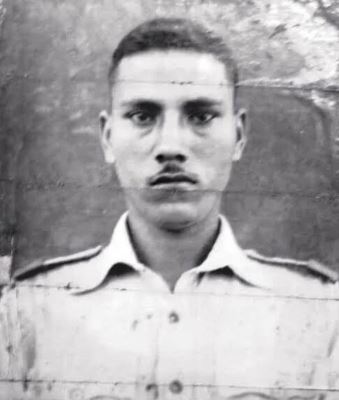
    • Abdul Hamid was a soldier in the 4th Grenadiers of the Indian Army.
    • He fought in the Battle of Asal Uttar during the 1965 India-Pakistan war, which took place near the India-Pakistan border in Punjab.
    • On 10th September 1965, he destroyed 3 Pakistani tanks and damaged a 4th near Chima village. He was killed during the battle.
    • For his exceptional bravery, he was posthumously awarded the Param Vir Chakra, India’s highest military honour.
    • A war memorial now stands at the site of his death, featuring a captured Pakistani Patton tank as a tribute to his courage.
  • INCOIS Launches Integrated Ocean Energy Atlas  

    Why in the News?

    INCOIS unveiled an ‘Integrated Ocean Energy Atlas’ for India’s EEZ, highlighting vast marine energy potential from solar, wind, waves, tides, currents, and thermal resources.

    About INCOIS:

    • The Indian National Centre for Ocean Information Services (INCOIS) is an autonomous body established in 1999 under the Ministry of Earth Sciences (MoES) in India.
    • Its primary mission is to provide ocean data, information, and advisory services to various stakeholders, including society, industry, government, and the scientific community through sustained ocean observations.

    Key Features of the Integrated Ocean Energy Atlas

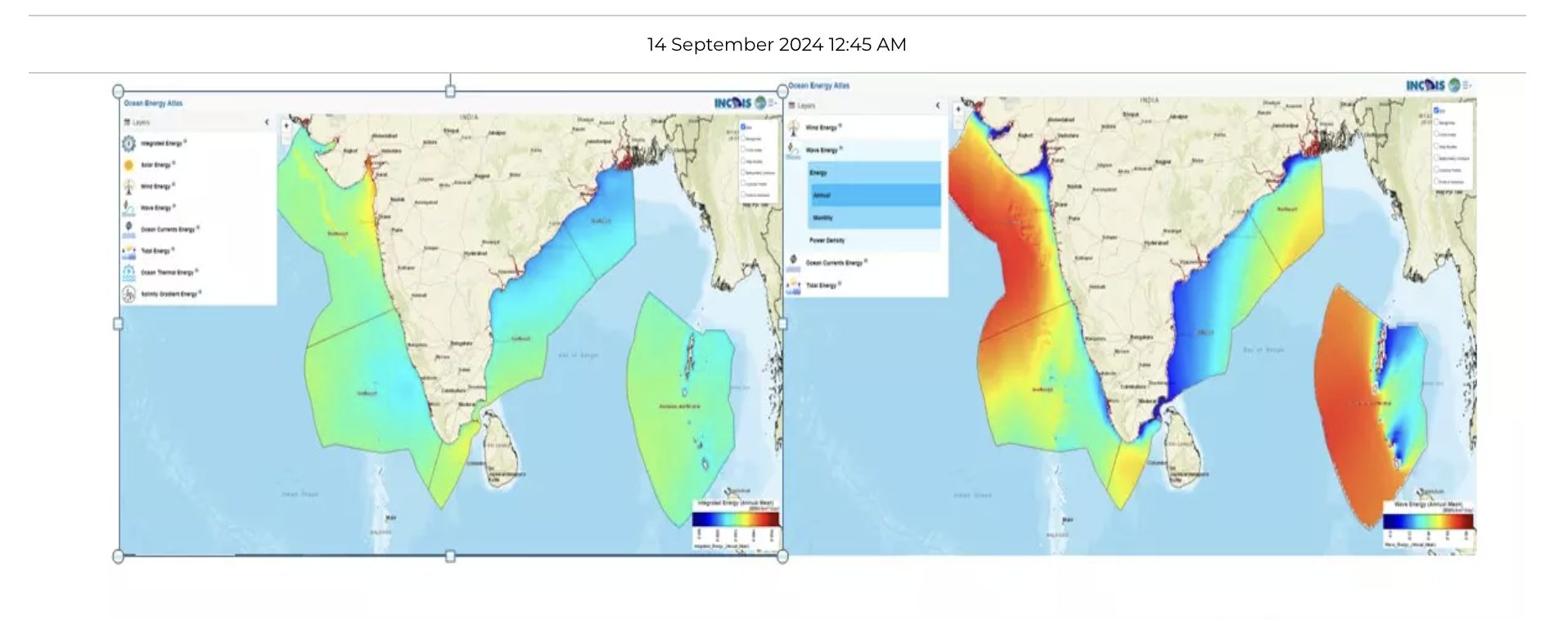
    • The Atlas encompasses marine meteorological energy sources like solar and wind, and hydrological energy forms such as waves, tides, currents, ocean thermal, and salinity gradients within India’s EEZ.
    • It identifies areas with high potential for energy generation and will serve as a reference for policymakers, industry and researchers for harnessing these rich energy resources.
    • INCOIS prepared the annual, monthly, and daily energy estimates of ocean energy components that can be visualised through a WebGIS interface at 5 km grid resolution.

    Significant potential of the Indian Exclusive Economic Zone (EEZ)

    • INCOIS has estimated integrated ocean energy of approximately 9.2 lakh TWh per annum within the EEZ of India.
    • The vast coastline of over 7,000 km and the EEZ covering up to 220 km from the coast offers ample scope for generating energy from blue renewable sources like tidal waves, currents, solar and wind.

    What India can learn from this Report? (Way forward)

    • The Atlas provides a blueprint for India to tap into its vast untapped ocean energy resources to meet its growing energy demands in a sustainable manner.
    • It offers estimated values of renewable energy that can be generated from individual or integrated blue renewable sources at potential sites along the coast
    • The detailed mapping of energy potential at a granular 5 km grid level can help industries plan and make informed decisions for developing offshore renewable energy projects.
    • Collaborating with industrial partners and public sector companies to harness energy at high-potential zones identified in the Atlas can accelerate the adoption of marine energy technologies.
    • The Atlas can serve as a model for other countries in the Indian Ocean region to assess their blue energy reserves and promote regional cooperation in harnessing ocean energy resources.

    Mains PYQ:

    Q Describe the benefits of deriving electric energy from sunlight in contrast to the conventional energy generation. What are the initiatives offered by our government for this purpose? (UPSC IAS/2020)

  • One Nation, One Election: Prospects and Challenges

    Simultaneous polls plan gets Union Cabinet nod

    Why in the News?

    The Union Cabinet accepted the Kovind committee’s recommendations for simultaneous Lok Sabha and State Assembly elections, with municipal and panchayat polls within 100 days.

    What are the recommendations given by the Kovind Panel?     

    • The panel recommended holding simultaneous elections for the Lok Sabha and State Assemblies as a first step, followed by municipal and panchayat polls within 100 days of the general election.
    • The President would issue a notification setting an “Appointed Date” to mark the start of the new electoral cycle. All State Assemblies formed after this date would conclude their terms before the next general election.
    • The panel recommended amendments to Article 83 (duration of Parliament) and Article 172 (duration of State Legislatures) to account for scenarios like a hung assembly or no-confidence motion.
    • A single electoral roll for Lok Sabha, State Assemblies, and local bodies was proposed to streamline the election process, requiring coordination between the Election Commission of India (ECI) and State Election Commissions (SECs).
    • The panel suggested 18 amendments to synchronize elections, most of which do not require ratification by State Assemblies but will require a two-thirds majority in both Houses of Parliament.

    Significance of Simultaneous Polls:

    • Cost Efficiency: Holding simultaneous elections is expected to reduce the financial burden by cutting down on the repetitive cost of conducting separate elections.
    • Increased Governance Efficiency: Simultaneous polls would allow governments to focus on governance rather than being in continuous election mode.
    • Reduced Electoral Fatigue: Voters and political parties will face fewer disruptions caused by the constant election cycle, leading to more stable and efficient governance.
    • Economic Benefits: By reducing the frequency of elections, resources can be allocated more effectively toward development and economic growth.

    What do the critics say?

    • Impracticality in a Federal Setup: Critics, including the Congress president, argue that simultaneous elections undermine federalism and the autonomy of State legislatures, which may need to dissolve at different times.
    • Constitutional Hurdles: Critics emphasize that the changes required would demand significant amendments to the Constitution and may face legal and political challenges, including garnering the required majority in Parliament.
    • Logistical Concerns: Managing elections for both national and local bodies across a large and diverse country like India would pose logistical difficulties.
    • Impact on Democracy: Some fear that simultaneous polls may result in the overshadowing of local issues by national politics, potentially harming the representation of state-specific concerns.

    Way forward: 

    • Consensus Building and Pilot Implementation: Gradually introduce simultaneous elections by building political consensus through consultations with state governments and stakeholders, and consider a phased implementation, starting with a few states as a pilot.
    • Strengthening Electoral Framework: Enhance coordination between the Election Commission of India (ECI) and State Election Commissions (SECs), and ensure legal reforms such as the creation of a unified electoral roll and addressing potential challenges like a hung assembly through constitutional safeguards.

    Mains PYQ:

    Q ‘Simultaneous election to the Lok Sabha and the State Assemblies will limit the amount of time and money spent in electioneering but it will reduce the government’s accountability to the people’ Discuss. (UPSC IAS/2017)

  • Foreign Policy Watch: India-Pakistan

    India to Freeze Negotiations with Pakistan on Indus Treaty  

    Why in the News?

    The Permanent Indus Commission meetings are on hold until India and Pakistan talk about updating the 64-year-old Indus Water Treaty. The last meeting took place in May 2022.

    What is the Indus Treaty?

    • The Indus Waters Treaty (IWT), signed on September 19, 1960, is a water-sharing agreement between India and Pakistan, mediated by the World Bank.
    • The treaty allocates the waters of the Indus River system, which includes three eastern rivers (Ravi, Beas, and Sutlej) to India and three western rivers (Indus, Chenab, and Jhelum) to Pakistan.
    • This framework was established to manage the sharing of water resources in a region where water scarcity is a significant concern due to agricultural demands and population growth.

    Features of Treaty: 

    • Permanent Indus Commission: The treaty established the Permanent Indus Commission, which consists of representatives from both nations tasked with resolving disputes and facilitating communication regarding water management.
    • Dispute Resolution: The treaty includes mechanisms for dispute resolution, allowing for consultation with neutral experts or arbitration through international courts if disagreements arise.

    Why did the Indian government opt to modify and review the Treaty?

    • Changed Demographics: India emphasizes that significant changes in population demographics necessitate a reassessment of water-sharing obligations under the treaty.
    • Environmental Considerations: The need to accelerate clean energy development (Hydro power electricity) to meet emission targets has been highlighted as a reason for modifying the treaty’s provisions, reflecting broader environmental concerns.
    • Security Issues: Persistent cross-border terrorism has been cited as a factor undermining India’s ability to utilize its rights under the treaty fully.
    • Perceived Imbalance: Analysts in India have described the treaty as “one-sided,” arguing that it disproportionately favors Pakistan given India’s larger population and growing water needs.
      • They believe India’s leverage over western rivers should be enhanced, especially during heightened tensions.

    Way forward: 

    • Renegotiation of Terms: India and Pakistan should engage in bilateral talks to update the Indus Waters Treaty, reflecting modern challenges like demographic changes, energy needs, and security concerns, while ensuring fair water distribution.
    • Enhanced Cooperative Framework: Strengthen the role of the Permanent Indus Commission by introducing regular environmental and security assessments, and improving communication to prevent conflicts and ensure sustainable water management.

    Mains PYQ:

    Q Present an account of the Indus Water Treaty and examine its ecological, economic and political implications in the context of changing bilateral relations. (UPSC IAS/2016)

  • ISRO Missions and Discoveries

    TRISHNA Mission

    Why in the News?

    Philippe Baptiste, head of the French Space Agency, talked about the joint India-France “TRISHNA Mission.”

    TRISHNA Mission:

    Details
    Overview A joint Indo-French Earth observation satellite project developed by ISRO and CNES (French Space Agency).

    Acronym for “Thermal infraRed Imaging Satellite for High-resolution Natural resource Assessment” (TRISHNA Mission)

    Launch Year Targeted for 2026.
    Mission Lifespan Designed for a 5-year operational life.
    Primary Objectives • Monitor water and energy budgets of the continental biosphere.

    • Assess evapotranspiration for efficient water management.

    • Improve agricultural water productivity and assist in irrigation water management.

    • Provide high-resolution observations of water quality in coastal and inland waters. 

    • Assess urban heat islands and detect heat anomalies.

    Payloads Thermal Infrared (TIR) Payload: Provided by CNES, this sensor maps surface temperature and emissivity in high resolution.

    Visible-Near Infrared-Short Wave Infrared (VNIR-SWIR) Payload: Developed by ISRO, this sensor uses seven spectral bands for detailed mapping of surface reflectance.

    Orbit and Spatial Resolution • TRISHNA will operate in a sun-synchronous orbit at an altitude of 761 km.

    • Spatial resolution: 57 meters for land and coastal areas, 1 km for ocean and polar regions.

    Application and Significance   • Supports water resource management, agriculture, and urban planning through precise data on water stress, crop productivity, and urban heat islands.
    • Enhances climate resilience by tracking droughts, evapotranspiration, and permafrost changes.
    • Contributes to global environmental initiatives like GEOGLAM and Sustainable Development Goals (SDGs) by providing key agricultural and climate variables.


    PYQ:

    [2016] Discuss India’s achievements in the field of Space Science and Technology. How the application of this technology helped India in its socio-economic development?

    [2010] In the context of space technology, what is “Bhuvan”, recently in the news?

    (a) A mini satellite launched by ISRO for promoting the distance education in India

    (b) The name given to the next Moon Impact Probe, for Chandrayaan-II

    (c) A geoportal of ISRO with 3D imaging capabilities of India

    (d) A space telescope developed by India

  • Global Geological And Climatic Events

    The Volcanic Island of Rapa Nui

    Rapa Nui

    Why in the News?

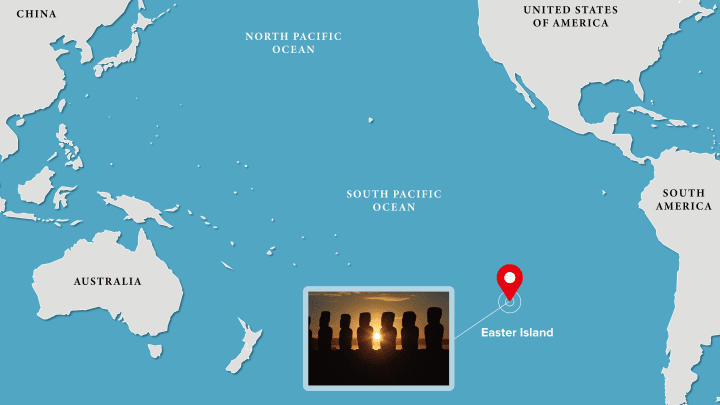
    The Volcanic Island of Rapa Nui (also known as Easter Island) has always been mysterious due to its harsh geography and iconic Moai statues.

    About Rapa Nui Island

    Details
    Location • Situated in the southeastern Pacific Ocean, Rapa Nui is part of Polynesia and a territory of Chile.
    • One of the most remote islands, about 3,500 km from Chile.
    Size • Covers an area of 160 sq. km.
    Geographical details • The island has a volcanic origin, featuring lava-covered terrain and rocky soil.

    • Notable volcanoes include Terevaka, Poike, and Rano Kau.

    Tropical climate with average temperatures ranging between 18°C and 28°C.

    Rainfall occurs mostly in the winter months.

    Moai Statues • Famous for over 900 moai statues, some as tall as 40 ft and weighing 75 tonnes.
    • These statues were built between the 13th and 16th centuries to honor revered ancestors.
    • Carved from volcanic rock and transported across great distances.
    Discovery • Discovered by European sailors on Easter Sunday, 1722, which gave it the name Easter Island.
    • The island had been settled centuries earlier by Polynesian explorers who navigated thousands of kilometers of ocean.
    Significance of New Findings • Recent studies, including the use of AI analysis of satellite images, have debunked earlier theories of ecological collapse.
    • Genetic studies show Native American ancestry before European contact, indicating earlier interactions with South America.


    PYQ:

    [2018] Consider the following statements:

    1. The Barren Island volcano is an active volcano located in the Indian territory.

    2. Barren Island lies about 140 km east of Great Nicobar.

    3. The last time the Barren Island volcano erupted was in 1991 and it has remained inactive since then.

    Which of the statements given above is/are correct?

    (a) 1 only

    (b) 2 and 3

    (c) 3 only

    (d) 1 and 3

Join the Community

Join us across Social Media platforms.