💥UPSC 2026, 2027, 2028 UAP Mentorship (March Batch) + Access XFactor Notes & Microthemes PDF

Archives: News

  • Economic Indicators and Various Reports On It- GDP, FD, EODB, WIR etc

    India’s GDP growth is impressive, but can it be sustained?

    Why in the news?

    The release of India’s GDP data was eagerly anticipated, especially following the recent upgrade in the “sovereign rating outlook” by S&P. It comes just days before the announcement of the union election results.

    Back2Basics: Rating Agency

    • A rating agency is a company that assesses the financial strength of companies and government entities, especially their ability to meet principal and interest payments on their debts.
    • Fitch Ratings, Moody’s Investors Service and Standard & Poor’s (S&P) are the big three international credit rating agencies controlling approximately 95% of the global rating business.
    • In India, six credit rating agencies are registered under the Securities and Exchange Board of India (SEBI): CRISIL, ICRA, CARE, SMERA, Fitch India and Brickwork Ratings.

    What does the data say?

    • India’s GDP growth for 2023-24 is 8.2%, exceeding market expectations and surpassing the previous year’s growth of 7%.
    • Fourth-quarter growth is particularly robust at 7.8%, with upward revisions in previous quarters contributing to overall growth.
    • Notable divergence of 1 percentage point between GDP and GVA growth in 2023-24, mainly due to increased net taxes.
    • Sectoral analysis reveals mixed performance, with manufacturing and construction showing strong growth, while agriculture remains subdued.
    • Expenditure-side breakdown highlights a slower growth rate in private consumption but healthy growth in investment, led mainly by government spending.

    Pillars need to be sustained:

    • Private Consumption: Ensuring sustained consumer spending, particularly by addressing high inflation and low wage growth, to maintain economic momentum.
    • Investment: Continuously stimulating both government and private sector investment to drive economic expansion and foster innovation and productivity.
    • Exports: Maintaining competitiveness in global markets and promoting export-oriented growth to leverage external demand and diversify revenue sources.

    How to ensure the benefits of high growth trickle down to the lower-income categories?

    • Improving Private Consumption: Focus on reviving private consumption, especially among lower-income groups. Address concerns of high inflation and low wage growth affecting consumer confidence.
    • Enhancing Employment Opportunities: Prioritize improving the employment scenario, particularly in sectors generating significant employment like IT and the unorganized sector. Recognize the importance of employment in sustaining consumption growth and overall economic stability.
    • Investment in Rural Development: Ensure spatial and temporal distribution of rainfall for rural demand recovery. Moderating food inflation and improving employment conditions crucial for rural consumption revival.
    • Boosting Private Capex Cycle: Create an environment conducive to private investment, focusing on policy certainty and confidence in economic stability. Encourage private sector investment through favourable policies and supportive regulatory frameworks.
    • Policy Focus on Inclusive Growth: Direct policy attention towards ensuring that the benefits of high growth extend to lower-income categories. Implement targeted social welfare programs and initiatives to support vulnerable groups and reduce income inequality.
    • Monitoring Global Developments: Stay vigilant of global economic trends and developments that could impact the Indian economy, such as geopolitical tensions and supply shocks. Adapt policies accordingly to mitigate risks and capitalize on opportunities for sustained economic growth.

    Conclusion: The Indian government aims to bolster equitable growth through measures such as stimulating private consumption, enhancing employment prospects, and fostering a conducive investment environment, supported by targeted policies and proactive global monitoring.

    Mains PYQ:

    Q Explain the difference between the computing methodology of India’s Gross Domestic Product (GDP) before the year 2015 and after the year 2015. (UPSC IAS/2021)

  • RBI Notifications

    RBI brings back 100 tonnes Gold from UK to its Vaults 

    Why in the News?

    The RBI has repatriated over 100 tonnes of gold from the UK to its domestic vaults, the largest transfer since at least 1991.

    What are Gold Reserves?

      • A gold reserve is the gold held by a country’s central bank, acting as a backup for financial promises and a store of value.
      • India, like other nations, stores some of its gold reserves in foreign vaults to spread out risk and facilitate international trading.
    • India’s Gold Reserves:
      • As of the end of March 2024, the RBI held 822.10 tonnes of gold, with 408.31 tonnes stored domestically.
      • The share of gold in the total forex of India is around 7-8% as of 2023.

    Where does the RBI store its gold?

    • India’s gold reserves are primarily stored in the Bank of England, which is known for its stringent security protocols.
    • The RBI also stores a portion of its gold reserves at the:
    1. Bank for International Settlements (BIS) in Basel, Switzerland, and the
    2. Federal Reserve Bank of New York in the United States.
    • During India’s foreign exchange crisis in 1990-91, the country pledged some of its gold reserves to the Bank of England to secure a $405 million loan, according to reports.
    • Even though the loan was paid back by November 1991, India decided to keep the gold in the UK for convenience.

    Why does the RBI store its gold in foreign banks?

    • Convenience: Storing gold overseas makes it easier for India to trade, engage in swaps and earn returns.
    • Averting Risks: There are risks involved, especially during times of geopolitical tensions and war.
      • The recent freezing of Russian assets by Western nations has raised worries about the safety of assets kept abroad and the RBI decision to shift a portion of the gold reserve to India could be prompted by these concerns.
    • Stable Prices: Unlike fiat currencies, which can be subject to inflation or devaluation due to various economic factors, the value of gold tends to be relatively stable over time, which makes it an attractive asset for central banks to hold as a reserve.

    Benefits Offered by Gold Reserves

    • Control domestic gold prices: With its big stash of gold, the RBI can help control local gold prices by using some of it in India. Last financial year, the RBI added about 27.47 tonnes of gold to the total reserve, bringing it to 794.63 tonnes.
    • Security buffer: The increased gold reserve works as a hedge against any financial crisis and to take measures to control inflation as well as currency devaluation.

    Why is the recent move significant?

    • Efficiency and Confidence: Bringing gold back to India reduces storage fees and signals confidence in the stability of the Indian economy.
    • Logistical Efficiency: Moving gold to India saves on storage fees paid to foreign custodians, such as the Bank of England.
    • Diversified Storage: Repatriation ensures diversified storage, enhancing security and reducing dependency on foreign storage.

    Has the RBI made similar purchases or transfers of gold in the past?

    • RBI started buying gold in 2018 and had previously bought 200 tonnes during the global financial crisis in 2009.
    • In the first quarter of 2024, the RBI bought 19 tonnes of gold, surpassing the 16 tonnes purchased throughout 2023.

    PYQ:

    [2015] The problem of international liquidity is related to the non-availability of:

    (a) Goods and services

    (b) Gold and silver

    (c) Dollars and other hard currencies

    (d) Exportable surplus

  • Global Geological And Climatic Events

    Hunga Tonga Volcanic Eruption

    Why in the News?

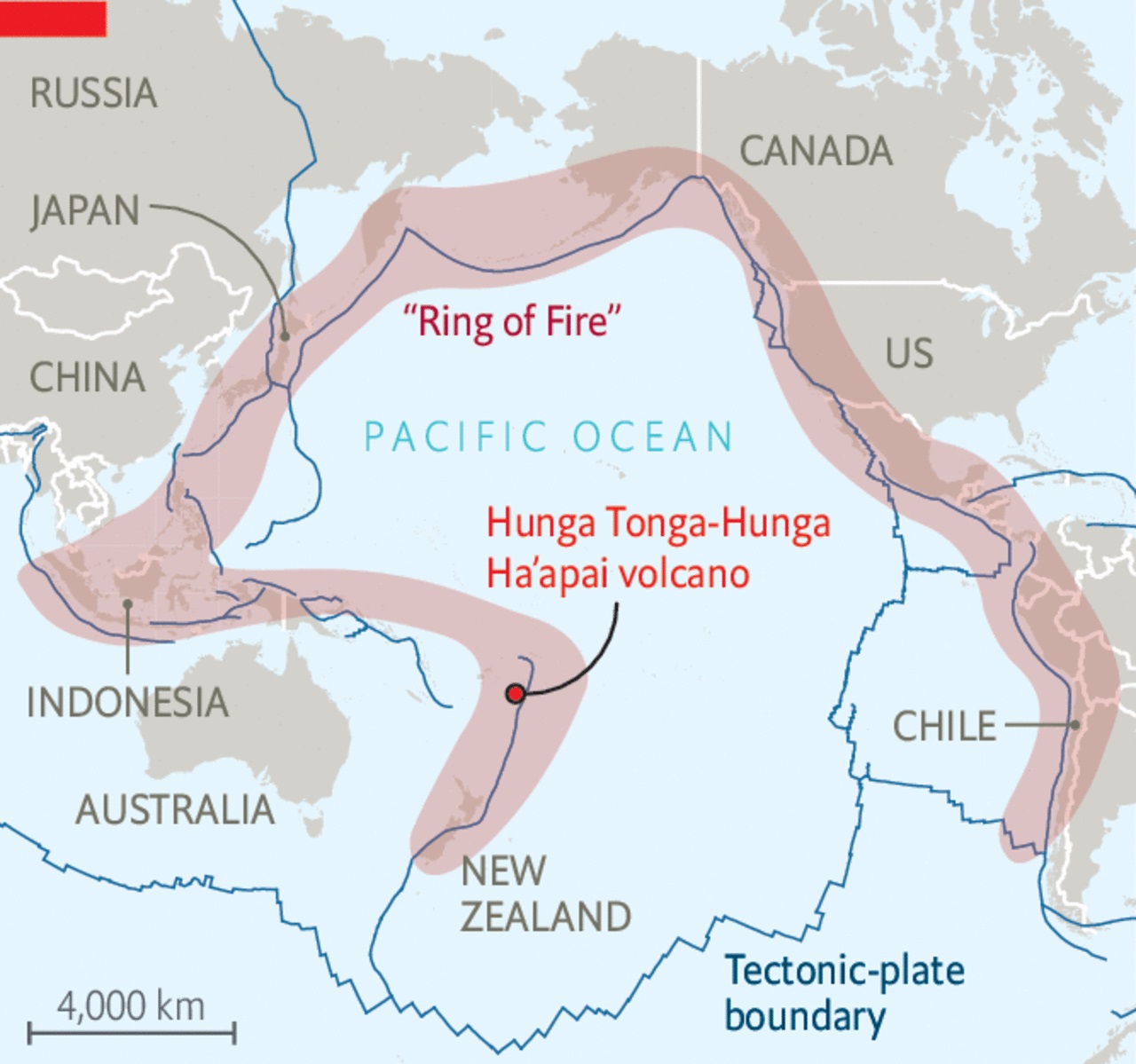
    Hunga Tonga-Hunga Ha’apai (Hunga Tonga) erupted in Tonga, triggering a tsunami and global seismic waves.

    About Hunga Tonga Volcano

    • The Hunga Tonga-Hunga Ha’apai volcano is situated in the western South Pacific Ocean, west of the main inhabited islands in the Kingdom of Tonga. It lies on the Pacific Ring of Fire.
    • It forms part of the Tofua Arc, within the larger Tonga-Kermadec volcanic arc, resulting from the subduction of the Pacific Plate beneath the Indo-Australian Plate.
    • It comprises two small uninhabited islands, Hunga-Ha’apai and Hunga-Tonga.
    • Hunga Tonga is one of 12 confirmed submarine volcanoes along the Tofua Arc.

    Key Findings on Hunga Tonga Eruption

    • The Hunga Tonga eruption primarily emitted water vapour, which reached the stratosphere, affecting ozone depletion and acting as a potent greenhouse gas. Minimal smoke was produced.

    Impact on Weather

    • Ozone Hole: The study reveals that Hunga Tonga contributed to the exceptionally large ozone hole in the preceding year and the unexpectedly wet summer of 2024.
    • Global Mean Temperatures: While the eruption had a negligible effect on global temperatures, it induced lasting regional disruptions in atmospheric wave patterns.
      • Traditionally, massive volcanic eruptions reduce temperatures by emitting sulfur dioxide, which forms sulphate aerosols reflecting sunlight.
    • Regional Effects: Anticipated changes include colder and wet winters in northern Australia, warmer winters in North America, and colder winters in Scandinavia until approximately 2029.

    Do you know?

    Previous volcanic eruptions, such as Tambora in 1815 and Samalas in 1257, have significantly impacted global climate, leading to phenomena like the “year without a summer” and the onset of the Little Ice Age.


    PYQ:

    [2021] Discuss about the vulnerability of India to earthquake-related hazards. Give examples including the salient features of major disasters caused by earthquakes in different parts of India during the last three decades.

  • ISRO Missions and Discoveries

    PraVaHa tool for Aerodynamic Design and Analysis

    Why in the News?

    The Indian Space Research Organisation (ISRO) has launched the Computational Fluid Dynamics (CFD) software named Parallel RANS Solver for Aerospace Vehicle Aero-thermo-dynamic Analysis (PraVaHa).

    About PraVaHa

    • PraVaHa was developed at ISRO’s Vikram Sarabhai Space Centre (VSSC), showcasing India’s prowess in aerospace technology.
    • It can simulate both external and internal flows on various aerospace vehicles, including launch vehicles, and winged, and non-winged re-entry vehicles.
    • It facilitates initial aerodynamic design studies by evaluating numerous configurations, crucial for optimizing vehicle performance and safety.

    Role of Computational Fluid Dynamics (CFD)

    • CFD predicts aerodynamic and aerothermal loads by solving governing equations. It has matured to offer high accuracy and fast simulations, addressing aerospace challenges like high pressure and intense heat flux.

    Integration in Gaganyaan Program

    • Key Applications: PraVaHa plays a pivotal role in the Gaganyaan program, facilitating aerodynamic analysis of human-rated launch vehicles such as HLVM3, Crew Escape System (CES), and Crew Module (CM).
    • Scalability and Collaboration: Designed to leverage both CPU and GPU architectures, PraVaHa ensures compatibility with existing and future supercomputing facilities, fostering collaboration with academic and government institutions.

    PYQ:

    [2010] In the context of space technology, what is “Bhuvan”, recently in the news?

    (a) A mini satellite launched by ISRO for promoting the distance education in India.

    (b) The name given to the next Moon Impact Probe, for Chandrayaan-II.

    (c) A geoportal of ISRO with 3D imaging capabilities of India.

    (d) A space telescope developed by India.

  • Foreign Policy Watch: India-SAARC Nations

    India to Chair ‘Colombo Process’

    Why in the News?

    India has become chair of the regional grouping “Colombo Process” for the first time since its inception in 2003.

    What is the Colombo Process?

    • The Colombo Process, established on March 19, 2003, in Colombo, Sri Lanka, is a regional consultative initiative addressing challenges faced by migrant workers from South and Southeast Asia.
    • Objective:
      • Primary Goal: The Colombo Process aims to enhance the management of contractual labour migration from Asian countries.
      • Focus: It seeks to safeguard the rights and welfare of migrant workers while maximizing the benefits of labour migration for both sending and receiving countries.
    • The Process is non-binding and decision-making is by consensus.

    Membership:

    • Initial Composition: Initially comprising 11 member countries, including Afghanistan, Bangladesh, China, India, Indonesia, Nepal, Pakistan, the Philippines, Sri Lanka, Thailand, and Vietnam.
    • Expansion: The Process has since expanded to include additional countries like Cambodia and Myanmar.

    Five Thematic Area Working Groups (TAWGs) i.e. 

    1. Skills and Qualification Recognition (chaired by Sri Lanka);
    2. Fostering Ethical Recruitment (chaired by Bangladesh);
    3. Pre-Departure Orientation and Empowerment (chaired by the Philippines);
    4. Remittances (chaired by Pakistan) and
    5. Labour Market Analysis (chaired by Thailand).

    Key Focus Areas:

    • Policy Development: Addressing various aspects of labour migration, including policy development, capacity building, data collection, and sharing best practices.
    • Rights Protection: Ensuring the protection of migrant workers’ rights, skills recognition, ethical recruitment, and combating human trafficking and irregular migration.

    Activities and Initiatives:

    • Dialogue Platforms: Regular meetings, conferences, and workshops serve as platforms for dialogue and cooperation among member countries.
    • Guidelines and Toolkits: Development of guidelines, toolkits, and policy frameworks to assist member countries in effectively managing labour migration.
    • Collaboration: Collaboration with international organizations such as the International Labour Organization (ILO) and the International Organization for Migration (IOM) to implement joint initiatives and projects.

    PYQ:

    [2022] ‘India is an age-old friend of Sri Lanka.’ Discuss India’s role in the recent crisis in Sri Lanka in light of the preceding statement.

  • Health Sector – UHC, National Health Policy, Family Planning, Health Insurance, etc.

    India and the ‘managed care’ promise

    PYQ Relevance

    Q Public health system has limitations in providing universal health coverage. Do you think that the private sector can help in bridging the gap? What other viable alternatives do you suggest? (UPSC IAS/2015)

    Q The increase in life expectancy in the country has led to newer health challenges in the community. What are those challenges and what steps need to be taken to meet them? (UPSC IAS/2022)

    Mentor Comment: Health insurance, now central to India’s UHC policy, is being enhanced by digital advancements, enabling reforms akin to the U.S. but with cost-effective local adaptations. A South Indian healthcare chain recently integrated insurance and care provision, forming an Indian-style MCO. This prompts reflection on MCOs’ potential to extend universal health care in India significantly.

    Let’s learn_ _ 

    Why in the news?

    Universal healthcare poses a multifaceted challenge, yet managed care organizations may offer a piece of the solution that Indian healthcare requires.

    What is a Managed Care Organization?

    • A Managed Care Organization (MCO) is a health care company or a health plan that is focused on managed care as a model to limit costs, while keeping quality of care high.

    The background of Managed Care Organizations (MCOs) in the United States and India:

    Evolution of MCOs in the United States:

    •  MCOs have their origins in rudimentary prepaid healthcare practices in the 20th century.
    • The mainstreaming of MCOs gained momentum in the 1970s due to concerns over healthcare costs.The economic slowdown post-1970s made high insurance premiums less attractive to purchasers.
    • A shift occurred towards integrating insurance and healthcare provisioning functions. Focus areas included prevention, early management, and cost control, all under a fixed premium paid by enrollees.
    • MCOs have evolved through multiple generations and forms, deeply penetrating the health insurance market. While evidence of their effectiveness in improving health outcomes and prioritizing preventive care is mixed, they have been effective in reducing costly hospitalizations and associated costs.

    Evolution of MCOs in India:

    • The first public commercial health insurance emerged in the 1980s.The focus has primarily been on indemnity insurance and covering hospitalization costs.
    • There is a significant market for outpatient consultations, valued at nearly $26 billion.
    • Health insurance in India has traditionally lagged behind life and general insurance. The sector faces issues such as lack of innovation and high, often unsustainable, operational costs.
    • As per Thomas (2011), Health insurance has played a secondary role to other forms of insurance. The industry’s operational inefficiencies and high costs have been persistent issues.

    Challenges in India:

    • Lack of Natural Incentives for Cost Control: The evolutionary trajectory of Indian health insurance has not incentivized consumer-driven cost control.
    • Target Demographic: Health insurance has mainly targeted a thin, urban, well-off segment, neglecting broader demographics.
    • Informality in Outpatient Practices: There is widespread informality among outpatient practices, complicating efforts to standardize and regulate care.
    • Lack of Clinical Protocols: The absence of widely accepted clinical protocols hampers the quality and consistency of care.
    • Economic Viability: Unprofitable operations and unaffordable premiums pose significant economic challenges, preventing sustainable growth and systemic improvement.
    • Limited Impact on UHC: Private initiatives, despite their potential, are unlikely to significantly contribute to Universal Health Coverage (UHC) without public support.
    • Insufficient Control Over Patient Journeys: Health insurers have little control over the patient’s journey before hospitalization, limiting their ability to manage early interventions and reduce costs through comprehensive outpatient care.

    Prospective Solutions and Remaining Issues:

    • Potential for Big Healthcare Brands: Large healthcare brands with loyal urban patient bases and substantial resources may initiate successful managed care projects.
    • Need for Public Patronage: Exploring managed care with cautious and incremental public patronage could be promising, indicating a need for government involvement to achieve broader impacts.
    • Underutilization of Outpatient Insurance: Given the low share of insurance in outpatient care spending and the average of three consultations per year per person, there is significant potential to reduce healthcare costs through early interventions and comprehensive outpatient care coverage.

     NITI Aayog Report:

    • Outpatient care insurance scheme: In 2021, NITI Aayog released a report advocating for an outpatient care insurance scheme based on a subscription model to enhance savings through improved care integration.
    • Yield significant benefits: A well-functioning managed care system can yield significant benefits, including consolidating practices, streamlining management protocols, and emphasizing preventive care in the private sector.
    • Catering for the beneficiaries of PMJAY: The report highlights the potential of incentives under the Ayushman Bharat Mission to encourage the establishment of hospitals in underserved areas catering to beneficiaries of the Pradhan Mantri Jan Arogya Yojana (PMJAY).

    Conclusion: While Managed Care Organizations are not a perfect solution, they can play a role in addressing the complexities of achieving Universal Health Coverage (UHC) in India by being part of a broader strategy.

  • Health Sector – UHC, National Health Policy, Family Planning, Health Insurance, etc.

    Women often outlive men but in poorer health: what new Lancet study says

    Why in the news?

    Over 30 years, a study examining 20 diseases revealed minimal advancements in narrowing the disparity between genders as per “the Lancet Public Health Journal”.

    What does the New Lancet report say?

    • On Health Disparities: The study highlights that women tend to suffer more from lower back pain, depression, and headaches, while men have shorter life expectancies due to higher rates of road accidents, cardiovascular diseases, and, recently, COVID-19.
    • On Health Burden: Women spend more time in poor health, while men are more likely to die prematurely from severe conditions.
    • Overall Global Analysis: The analysis examines differences in the 20 leading causes of illness and death globally, considering all ages and regions.

    What Causes the Differences in Diseases Between Women and Men? (Observations)

    • Biological Factors:
        • Hormonal Differences: Hormonal fluctuations in women, such as during menstrual cycles, pregnancy, and menopause, can influence susceptibility to certain conditions like migraines, depression, and autoimmune diseases.
        • Genetic Variations: Variations in genes and genetic predispositions may contribute to differences in disease susceptibility and severity between sexes.
        • Anatomical Variances: Physiological differences, such as in skeletal structure and hormonal regulation, can affect the manifestation of certain diseases like lower back pain and reproductive disorders.
    • Societal and Gender Norms:
        • Healthcare-Seeking: Societal norms and gender roles may influence healthcare-seeking behaviors, with men often less likely to seek medical attention for mental health issues due to perceived notions of masculinity.
        • Occupational Hazards: Occupational differences between genders can lead to varying exposures to health risks, with certain professions associated with higher rates of injury or exposure to harmful substances.
        • Socioeconomic Factors: Disparities in socioeconomic status can impact disease prevalence and outcomes differently for women and men.
    • Healthcare System Bias:
        • Diagnostic Bias: Gender biases in healthcare may result in underdiagnosis or misdiagnosis of certain conditions in women, leading to delays in treatment and poorer health outcomes.
        • Treatment Disparities: Differences in treatment approaches and responses may exist between sexes, with women sometimes receiving less aggressive treatment for cardiovascular diseases or being undertreated for pain conditions.
        • Research Bias: Historically, medical research has often focused on male subjects, leading to a lack of understanding of how diseases manifest and progress differently in women.
    • No Improvement in Care for Women Over Time
      • Stable Gender Gap: Despite overall health improvements, the disparity between male and female health conditions remains stable.
      • Conditions Affecting Women: Conditions like lower back pain and depressive disorders have shown little to no decrease over time compared to male-dominated conditions.
      • Reproductive Focus: Global health systems have historically focused on women’s reproductive health, neglecting other significant health issues affecting women.

    What Needs to Be Done (Way Forward)

    • Better Data Collection: Governments should consistently collect and categorize health data by sex and gender to better understand and address health disparities.
    • Targeted Health Interventions: Specific health interventions should be developed and implemented based on detailed sex and gender data.
    • Increased Funding: More financial resources should be allocated to underfunded conditions that disproportionately affect women, such as mental health.
    • Addressing Healthcare Bias: Efforts should be made to eliminate biases in healthcare to ensure women receive appropriate and timely treatment for their conditions.

    Mains PYQ: 

    Q Can the vicious cycle of gender inequality, poverty and malnutrition be broken through microfinancing of women SHGs? Explain with examples. (UPSC IAS/2021)

  • Capital Markets: Challenges and Developments

    Can domestic MFs invest in their overseas counterparts?

    Why in the news?

    SEBI issued a consultation paper, proposing a framework to enable domestic Mutual Funds (MFs) to invest in their overseas counterparts or Unit Trusts (UTs) that allocate a portion of their assets to Indian securities.

    About the Framework for Facilitating Investments by Domestic Mutual Funds (MFs)

    • Aim: To clarify the process and regulations surrounding such investments to encourage domestic MFs to diversify globally while maintaining limited exposure to Indian securities.

    About the Proposals:

    • On Investment Cap: SEBI proposes that overseas instruments being considered for investment by domestic MFs must not have more than 20% exposure to Indian securities.
      • This cap is intended to balance facilitating global investments while preventing excessive exposure to Indian markets.
    • On Pooling of Contributions: Indian MFs must ensure that all investors of the overseas MF/UT pool their contributions into a single investment vehicle. This ensures fair distribution of gains among investors, proportional to their contributions, without any preferential treatment.
    • On Autonomous Management: Investments must be made autonomously by the manager of the overseas instrument, without influence from investors or undisclosed parties, to avoid conflicts of interest.
    • About Transparency and Disclosure: SEBI requires periodic public disclosures of the portfolios of such overseas MF/UTs for transparency.
    • No Advisory Agreements: SEBI warns against any advisory agreement between the Indian MF and the overseas MF/UT to prevent conflicts of interest and avoid undue advantage.
    • On Observance Period: If an overseas instrument breaches the 20% limit, the Indian MF scheme will enter a six-month observance period for rebalancing the portfolio.
      • Further investments will only be allowed when the exposure is below the limit. If not rebalanced within six months, the MF must liquidate its investment in the overseas instrument.

    Impacts of the Regulation

    • Diversification of Opportunities: The framework provides a structured path for Indian MFs to invest in overseas instruments, enhancing diversification opportunities for Indian investors.
    • Market Transparency: The requirement for periodic public disclosures of portfolios will increase transparency and investor confidence in overseas investments.
    • Risk Management: The 20% exposure cap and autonomous management of investments help mitigate risks associated with excessive exposure to Indian securities and conflicts of interest.
    • Compliance Burden: The need to adhere to strict regulations and rebalance portfolios within specified periods may increase the compliance burden on domestic MFs.
    • Potential for Growth: By facilitating global investments, the framework can potentially attract more investors to Indian mutual funds, contributing to the growth of the mutual fund industry in India.

    What are the concerns associated with this framework?

    • RBI’s Upper Limit: The Reserve Bank of India’s (RBI) upper limit for overseas investment by mutual funds poses a concern. RBI Governor Shaktikanta Das indicated there are no plans to increase this limit, which means the overall industry limit for overseas investments is already exhausted.
    • Practical Impact: As the industry limit for overseas investments is effectively exhausted, the changes to regulations may not have an immediate practical impact, limiting the diversification opportunities for Indian investors.
    • Implementation and Compliance: Ensuring compliance with the 20% exposure cap and other regulations may pose challenges for domestic MFs, requiring careful monitoring and management of their overseas investments.

    Conclusion: Need to establish collaborations with global investment firms to gain insights and best practices in managing overseas investments. Learning from established global players can help Indian mutual funds navigate the complexities of international markets more effectively.

    Mains PYQ:

    Q The product diversification of financial institutions and insurance companies, resulting in overlapping of products and services strengthens the case for the merger of the two regulatory agencies, namely SEBI and IRDA. Justify. (UPSC IAS/2013)

  • Economic Indicators and Various Reports On It- GDP, FD, EODB, WIR etc

    Does inequality lead to growth? | Explained

    Why in the news?

    Studies conducted by researchers from “the Paris School of Economics” indicate that inequality in contemporary India surpasses that of colonial times.

    How does Inequality harm Democratic processes?

    • Concentration of Power: Inequality can lead to the concentration of monopoly power among a few capitalists relative to the labor force. This concentration allows dominant business groups to set prices, resulting in lower real wages and reduced purchasing power for the majority.
    • Impact on Consumption and Welfare: High inequality can negatively impact consumption and welfare due to higher mark-ups and lower real wages.
      • Lower real wages mean that workers can afford fewer goods, which reduces overall consumption and welfare.
    • Effect on Democratic Processes: Economic inequality can translate into unequal political power, undermining democratic processes.
      • Those with significant wealth can have disproportionate influence over political decisions, policies, and elections, leading to governance that favours the wealthy over the general populace.

    How Redistribution and Growth Can Work Together

    • Wealth Taxes and Redistribution: Taxing wealth and redistributing it can enhance economic growth by increasing incomes and consumption among the lower and middle classes, who have a higher propensity to consume.
    • Multiplier Effect: Redistribution can strengthen the multiplier effect, where an initial increase in investment leads to a greater overall increase in income and consumption. Higher incomes among workers and goods-sellers lead to more purchases, driving further economic activity and growth.
    • Investment and Profit Expectations: Investment is driven by future profit expectations rather than past wealth. Therefore, taxing wealth does not necessarily reduce investment.
    • Creation of New Entrepreneurs: Redistribution can support the emergence of new entrepreneurs by providing financial resources and reducing dependence on wage employment. This can foster innovation and competition, further contributing to economic growth.
    • Curtailing Monopolies: Reducing monopolistic power through redistribution and other policy measures can lower prices and increase real wages. Higher real wages boost demand, leading to increased investment and economic expansion.

    Conclusion:  Addressing inequality through redistribution can promote inclusive growth, empowering marginalized communities and advancing progress towards a more equitable society, essential for fulfilling SDG Goal 10 (Reduced Inequalities).


    Mains PYQ:

    Q How did land reforms in some parts of the country help to improve the socio-economic conditions of marginal and small farmers? (UPSC IAS/2021)

  • Women empowerment issues – Jobs,Reservation and education

    Fewer women are being hired for leadership positions

    Why in the news?

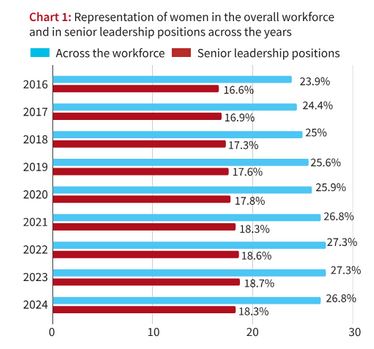
    Although women’s representation in the workforce has grown over the years “LinkedIn’s Economic Graph data”  indicates that progress has stalled since 2022 and declined in 2024.

    What does the data show?

    • Representation of women in the workforce has increased over the years but progress has stalled since 2022 and declined in 2024. The promotion of women to senior and leadership roles has stagnated in recent years.
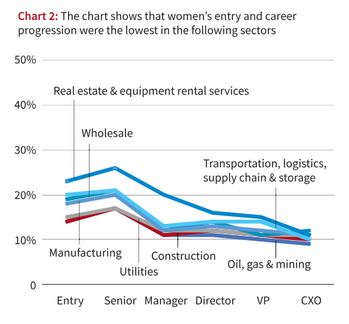
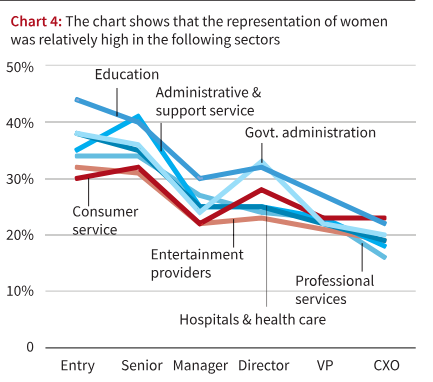
    • Sectors like healthcare, education, administrative, and support services have higher female representation in senior positions, while sectors like manufacturing, construction, oil, and gas have poor representation.

    Representation of women in the overall workforce and in senior positions 

    Entry and career progression of women  


    • Oil, Gas, and Mining: Among the lowest representation of women in leadership roles, at around 11%.
    • Construction: Very few women are represented, especially in senior roles.
    • Utilities: Women face significant barriers in advancing to leadership positions.
    • Wholesale: Low entry and career progression for women.
    • Manufacturing: Poor representation of women across all positions, including senior roles.
    • Transportation: Limited career progression opportunities for women.
    • Real Estate: Few women in leadership positions, with significant entry barriers.

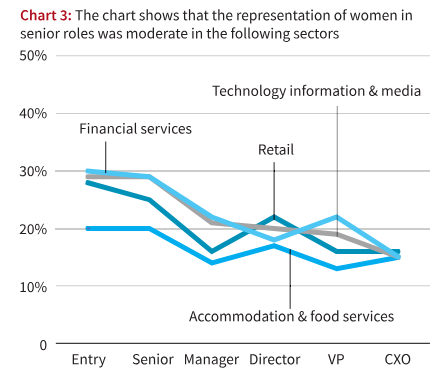
    About the accommodation and other services  

    • Representation of women in senior roles within the accommodation and food services sector falls between 15% and 20%.
    • This sector exhibits a moderate level of female representation compared to other industries.
    • While not the highest, it surpasses sectors like oil, gas, mining, construction, utilities, wholesale, manufacturing, transportation, and real estate, where women hold just 11%-14% of leadership positions.
    • The data suggests there’s still room for improvement in increasing the number of women in leadership roles within the accommodation and food services sector.
    • Efforts to improve gender diversity and inclusion should be continued and perhaps intensified in this sector, aligning with broader industry and societal goals for gender parity in the workforce.

    Administrative and support services:

    • Women hold senior positions in administrative and support services at a rate of 22% to 30%, indicating a moderate level of representation compared to other sectors.
    • This sector demonstrates a higher level of female representation in leadership roles compared to industries like oil, gas, mining, construction, utilities, wholesale, manufacturing, transportation, and real estate, where women’s leadership roles range from 11% to 14%.
    • The education sector boasts the highest representation of women in senior positions at 30%, suggesting that sectors like administrative and support services still have room for improvement.
    • Efforts to promote gender diversity and inclusion within administrative and support services should be sustained, aiming for further increases in the representation of women in leadership roles.
    • Continued focus on addressing biases, societal norms, and structural barriers is essential to achieving greater gender parity and advancement opportunities for women within this sector.

    Way Forward

    • Efforts by policymakers and business leaders are needed to tackle challenges faced by women in reaching leadership roles, focusing on “women-led development”.
    • Stricter enforcement of laws such as the Companies Act, 2013, which mandates women directors on company boards. Between April 2018 and December 2023, 507 companies were fined for non-compliance, with 90% being listed companies.

    Mains PYQ 

    Q Micro-Finance as an anti-poverty vaccine, is aimed at asset creation and income security of the rural poor in India”. Evaluate the role of the Self Help Groups in achieving the twin objectives of empowering women in rural India. (UPSC IAS/2020)

Join the Community

Join us across Social Media platforms.