💥UPSC 2026, 2027, 2028 UAP Mentorship (March Batch) + Access XFactor Notes & Microthemes PDF

Archives: News

  • ISRO Missions and Discoveries

    NISAR to map Himalayas’ Seismic Zones

    nisar

    Central idea

    • The ISRO and the NASA have jointly developed a forthcoming satellite called NISAR.
    • It will map the most earthquake-prone regions in the Himalaya.

    What is NISAR?

    • NISAR stands for NASA-ISRO Synthetic Aperture Radar.
    • The mission aims to provide global measurements of the causes and consequences of land surface changes using advanced radar imaging.
    • The satellite is equipped with two types of synthetic aperture radars (SAR): L-band and S-band, which will allow for high-resolution, all-weather imaging of the Earth’s surface.
    • The NISAR satellite is expected to be launched in January 2024.

    How it will be used for earthquake monitoring?

    • It will generate data that can potentially give advance warning of land subsidence and identify places that are at greatest risk from earthquakes.
    • The geoscience community can use this to determine how strain is building up in various parts of the Himalayas.
    • Strain refers to the deformation that occurs in rocks when it is under pressure from other rocks.
    • Movements of continental plates that are sliding, colliding, or subducting against each other cause strain.
    • With a frequency of 12 days and the ability to provide images even under cloudy conditions, NISAR would be a valuable tool to study deformation patterns, such as in Joshimath.

    Strain Map already in place

    • In 2021, scientists from the Geological Survey of India published a “strain map” of the Himalayas based on data from 1,252 GPS stations along the Himalayas.
    • It identified regions that had the greatest odds of generating earthquakes of magnitude above 8 and their extent.
    • However, these many stations are still too few, and there’s only one satellite (Sentinel) that we rely on.
    • With NISAR, the costliest space mission ever, we can have a game-changer in earth-science observation.


    Seismic Zones of India

    nisar

    India is divided by Bureau of Indian Standards (BIS) into 4 seismic zones based on the level of seismicity and the frequency of earthquakes that occur in that particular region.

    These zones are as follows:

    1.      Zone 2: This is a low seismic zone comprising of areas with the lowest risk of earthquakes. It includes regions like the northeastern states of India, parts of J&K, Himachal Pradesh, and Uttarakhand.

    2.      Zone 3: This is a moderate seismic zone comprising of areas that are at moderate risk of earthquakes. It includes regions like Gujarat, Haryana, Delhi, parts of UP, Bihar, West Bengal, and parts of Jharkhand.

    3.      Zone 4: This is a high seismic zone comprising of areas that are at high risk of earthquakes. It includes regions like the A&N Islands, parts of Himachal Pradesh, J&K, Uttarakhand, and the entire northeastern region.

    4.      Zone 5: This is a very high seismic zone comprising of areas that are at the highest risk of earthquakes. It includes regions like the entire state of J&K, Himachal Pradesh, Uttarakhand, the entire northeastern region, parts of Gujarat, Rajasthan, Maharashtra, and the A&N Islands.


  • Modern Indian History-Events and Personalities

    In news: Mahad Satyagraha

    mahad

    Central idea

    • B.R. Ambedkar’s life was full of milestones, and he was the first Dalit to study at Elphinstone College in Bombay.
    • He was also the chair of the drafting committee of the Constitution of India and became the first law minister of independent India.
    • Moreover, he contributed significantly to the movement for Dalit emancipation, awakening Dalit consciousness and leading the community’s bid for political power.

    Context of the Mahad Satyagraha

    • The Mahad Satyagraha of 1927 was one of the earlier and most significant milestones in Ambedkar’s life.
    • The events leading up to it began in August 1923, when the Bombay Legislative Council passed a resolution to allow the Untouchable classes to use all public water sources.
    • Although the Bombay government adopted the resolution, the situation on the ground remained unchanged, with upper-caste Hindus still not allowing lower castes to access public water sources.

    What happened at the Satyagraha?

    • Ramchandra Babaji More, a Mahad-based Dalit political leader, approached Ambedkar to preside over a conference of the Untouchables in Konkan, and Ambedkar agreed.
    • Around 2,500 delegates, workers, and leaders of Depressed Classes attended the conference, including boys of fifteen to old men of seventy.
    • On the first day of the conference, progressive non-Dalit leaders addressed the attendees and promised to help them in their struggle.
    • Ambedkar stressed creating “a wave of awakening” among the lower caste people of Konkan.
    • After the day’s proceedings, Ambedkar and the other organizers and attendees marched to the nearby Chavadar tank the next morning, where people from untouchable communities were not allowed to draw water from.
    • They implemented the resolution by picking up water with their cupped hands and drank it.

    Key event: Burning of Manusmriti

    • Despite the court injunction prohibiting Babasaheb and other Dalits from going to the tank or taking water from it until further orders, the Satyagraha was held on a much larger scale on December 26, 1927.
    • Although most people wanted to go ahead, the Satyagraha was suspended on the advice of Ambedkar, and unlike the last time, no water was drawn from the Chavadar tank.
    • Ambedkar and his followers burnt the Manusmriti, a powerful rejection of the caste system, for the first time in symbolic action.

    Significance of the Satyagraha

    • The Mahad Satyagraha is considered to be the “foundational event” of the Dalit movement.
    • The community collectively displayed its resolve to reject the caste system and assert their human rights for the first time.
    • It became the blueprint for organizing future movements against the caste system and its practices.
    • It marked an important point in Ambedkar’s political journey, catapulting him to the leadership of the downtrodden and oppressed classes in the country.


    Try this PYQ:

    Which of the following parties were established by Dr. B. R. Ambedkar?

    1. The Peasants and Workers Party of India
    2. All India Scheduled Castes Federation
    3. The Independent Labour Party

    Select the correct answer using the codes given below:

    (a) 1 and 2 only

    (b) 1, 2 and 3

    (c) 1 and 3 only

    (d) 2 and 3 only


    Post your answers here.


  • Innovations in Sciences, IT, Computers, Robotics and Nanotechnology

    What is Magnetoresistance?

    magnet


    Researchers in the UK, led by Nobel laureate Andre Geim, have discovered magnetoresistance in graphene – a single-atom-thick layer of carbon atoms bonded in a honeycomb pattern – that further distinguishes this ‘wonder’ material.

    Graphene’s anomalous Giant Magnetoresistance (GMR)

    • Graphene displayed an anomalous giant magnetoresistance (GMR) at room temperature.
    • GMR is the result of the electrical resistance of a conductor being affected by magnetic fields in adjacent materials.
    • It is used in hard disk drives and magnetoresistive RAM in computers, biosensors, automotive sensors, micro-electromechanical systems, and medical imagers.

    What is GMR?

    • GMR is a phenomenon where the electrical resistance of a conductor is affected by magnetic fields in adjacent materials.
    • Say a conductor is sandwiched between two ferromagnetic materials (commonly, metals attracted to magnets, like iron).
    • When the materials are magnetised in the same direction, the electrical resistance in the conductor is low.
    • When the directions are opposite each other, the resistance increases.

    Significance of the finding

    • The magnetoresistance observed in the graphene-based device was almost 100 times higher than that observed in other known semimetals in this magnetic field range.
    • In the study, the magnetoresistance in monolayer graphene at 27º C held between two layers of boron nitride increased by 110% under a field of 0.1 tesla.
    • To compare, the magnetoresistance in these conditions increases by less than 1% in normal metals.
    • The team attributed this to the presence of a ‘neutral’ plasma and the electrons’ mobility.

    Try this MCQ

    Which of the following best describes magnetoresistance?

    (a) The magnetic resistance of a conductor to electrical current flow

    (b) The phenomenon where the electrical resistance of a conductor is affected by magnetic fields in adjacent materials

    (c) The ability of a conductor to produce a magnetic field when an electrical current is passed through it

    (d) The resistance of a magnet to demagnetization by an external magnetic field


    Post your answers here.


  • Climate Change Impact on India and World – International Reports, Key Observations, etc.

    Bioluminescence observed at Visakhapatnam beach

    bio

    The blooms of Noctiluca Scintillans, commonly known as “sea sparkle or bioluminescence” are being witnessed along the coasts of Visakhapatnam, AP.

    Noctiluca Scintillans

    • Scintillans is a bioluminescent specie that brightens the seawater during the night.
    • It grazes on other micro-organisms such as larvae, fish eggs, and diatoms. But the unicellular phytoplankton that lives inside it can photosynthesize, turning sunlight into energy.
    • They help their host cell survive even when food was scarce.
    • Thus, N. Scintillans acts as both a plant and an animal

    Threats posed

    • According to marine experts, the phenomenon is an indicator of climate change.
    • While smaller blooms may be harmless, slow-moving larger blooms may have an impact on deep-sea fishes.
    • The toxic blooms of N. Scintillans were linked to massive fish and marine invertebrate kills.
    • Though the species does not produce a toxin, it was found to accumulate toxic levels of ammonia, which is then excreted into the surrounding waters, possibly acting as the killing agent in blooms.
    • They have displaced microscopic algae called diatoms, which form the basis of the marine food chain. This has deprived food for the planktivorous fish.

    Back2Basics: Bioluminescence

    • It is the property of a living organism to produce and emit light.
    • Animals, plants, fungi and bacteria show bioluminescence. A remarkable diversity of marine animals and microbes are able to produce their own light.
    • It is found in many marine organisms such as bacteria, algae, jellyfish, worms, crustaceans, sea stars, fish and sharks.
    • Luminescence is generally higher in deep-living and planktonic organisms than in shallow species.


  • GI(Geographical Indicator) Tags

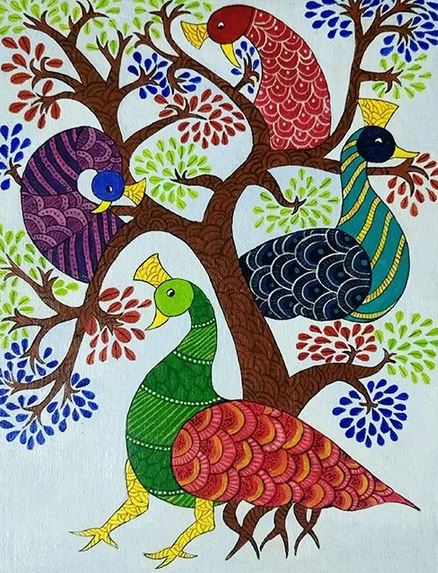
    Madhya Pradesh’s Gond Painting gets GI Tag

    gond

    The Gond painting of Madhya Pradesh has received the prestigious Geographical Indication (GI) tag.

    Other recent GI tags awarded in UP

    10 products from UP got GI Tag on March 31:

    • Aligarh Tala
    • Bakharia Brassware
    • Banda Shazar Patthar Craft
    • Pratapgarh Aonla (Amla)
    • Ramnagar Bhanta (Brinjal)
    • Muzaffarnagar Gur (jaggery)
    • Banarasi Pan
    • Nagina Wood Craft
    • Hathras Hing
    • Banaras Langda Aam


    Gond Art

    • Gond painting is a traditional art of Madhya Pradesh and belongs to the Gond tribe.
    • Patangarh village of Dindori district is famous for Gond paintings, where there is an artist in every house.
    • Their work is famous in the state and abroad for its unique style, theme, and motifs.
    • Gond art has been passed down through generations, traditionally adorning the walls of each artist’s home in Patangarh.

    Features of Gond Painting

    • Gond paintings showcase the beauty of nature, including trees, plants, animals, the moon, sun, river, drains, God, and Goddesses.
    • The paintings also portray daily life activities such as food, plough making, and even how the king used to fight.

    Back2Basics: Geographical Indication (GI)

    • A GI is a sign used on products that have a specific geographical origin and possess qualities or a reputation that are due to that origin.
    • Nodal Agency: Department for Promotion of Industry and Internal Trade (DPIIT), Ministry of Commerce and Industry
    • India, as a member of the World Trade Organization (WTO), enacted the Geographical Indications of Goods (Registration and Protection) Act, 1999 w.e.f. September 2003.
    • GIs have been defined under Article 22 (1) of the WTO Agreement on Trade-Related Aspects of Intellectual Property Rights (TRIPS) Agreement.
    • The tag stands valid for 10 years.


  • Modern Indian History-Events and Personalities

    India’s Philosophy Stand Out As A Beacon To The World

    Philosophy

    Central Idea

    • The philosophical underpinnings of India’s civilization are unique and powerful, and they empower India to withstand waves of invasions, natural calamities, and societal challenges. India’s worldview and approach towards human life make India stand out as a beacon to the world. However, many Indians remain ignorant of their own philosophical heritage, and building on these foundational values can serve as building blocks for India’s soft power.

    The Fundamentals of Indian Philosophy

    • Indian philosophy cannot be ascribed to any particular scripture.
    • The fundamentals of the perceived philosophy of India have come from many scriptures, and the Indian approach is to let a thousand flowers bloom.

    The Five Tenets that Make India Stand Out

    India’s philosophy has at least five fundamental tenets that make it stand out: 1. Spiritual democracy, 2. Unity in diversity, 3. Confluence with nature, 4, antyodaya, and 5. vasudhaiva kutumbakam. These tenets reflect the teachings of sages and philosophers such as Gautama Buddha, Adi Shankara, and Guru Nanak.

    1. Spiritual Democracy: India rejects any monopolistic approach to ways of worship, and it welcomes diversity in ways of worship. This approach reflects the fundamental unity of all that exists, and sages call it by various names.
    2. Unity in Diversity: India’s unity is inherent in its diversity, and this diversity is our innate unity that manifests in myriad ways. India not only accommodates but also celebrates the pervasive diversity.
    3. Confluence with Nature: India does not aspire to conquer nature, but instead, it has a tradition of sincere and deepest gratitude towards nature. Many Indian traditions and rituals reflect this approach, and sustainability is a part of our philosophy of human life.
    4. Antyodaya: India’s unique concept of antyodaya puts the last man first. The most deprived are the most deserving when it comes to the distribution of the fruits of development. Antyodaya encompasses both social and economic justice and takes us beyond the binary of capitalism and socialism.
    5. Vasudhaiva Kutumbakam: India has imagined the entire world as one family, where values like mutuality, sharing, and collectivism are given primacy. This approach nips in the bud all the uncalled-for apprehensions about ultra-nationalistic or jingoistic approaches.

    India’s Philosophical Heritage Can Build on Its Soft Power

    • India can build on its unique philosophical heritage, which can serve as building blocks of India’s soft power.
    • India’s foundational values are needed now more than ever, as the global community faces conflicts and wars emanating from weird ideas of supremacy, oneupmanship, and monopolistic spirituality.

    Conclusion

    • India’s philosophy and approach towards human life and worldly concerns are unique and powerful, and they make India stand out as a beacon to the world. India’s soft power can build on its unique philosophical heritage, and India can use this to assert itself even in the most complex and unpredictable future. The key challenge is to establish that India is capable of walking the talk and using its philosophy to deal with societal challenges. Indian philosophy empowers us to handle the contemporary challenges, and it has gained India huge goodwill among the global community.

    Mains Question

    Q. India’s philosophy and approach towards human life and worldly concerns are unique and powerful, and they make India stand out as a beacon to the world. Discuss

  • Police Reforms – SC directives, NPC, other committees reports

    Supreme Court rulings on Encounters

    encounter

    Central idea: A gangster-turned-politician son and his aide were killed in an encounter in UP.

    Why discuss this?

    • The National Human Rights Commission (NHRC) and the Supreme Court have laid down proper guidelines and procedures to be followed to prevent any misuse of power by the law enforcement agencies.
    • However, this encounter has brought to the forefront the issue of extra-judicial killings or “encounters” by the police in India.

    Supreme Court Guidelines on Encounters

    • In September 2014, a bench of then CJI RM Lodha and Rohinton Fali Nariman issued detailed guidelines.
    • These guidelines came in the case “People’s Union for Civil Liberties v State of Maharashtra”.
    • The guidelines enumerated 16 points to be followed in the matters of investigating police encounters in the cases of death as the standard procedure for a thorough, effective and independent investigation-
    1. Registration of a first information report (FIR) as mandatory
    2. Magisterial inquiry
    3. Keeping written records of intelligence inputs
    4. Independent investigation by bodies such as the CID
    5. A Magisterial Inquiry must invariably be held in all cases of death which occur in the course of police action
    6. Next of kin of the deceased must invariably be associated in such inquiry
    7. In every case when a complaint is made against the police alleging commission of a criminal act on their part, which makes out a cognizable case of culpable homicide, an FIR to this effect must be registered under appropriate sections of the IPC
    8. Such an inquiry made under Section 176 of the Code of Criminal Procedure, 1973, must show “whether use of force was justified and action taken was lawful.”
    9. Whenever the police receives any intelligence or tip-off on criminal movements or activities relating to the commission of grave criminal offence, “it shall be reduced into writing in some form (preferably into case diary) or in some electronic form.”
    10. Following such tip-off or intelligence, if an encounter takes place and a firearm is used by the police party, resulting in death, then an FIR to that effect has to be registered and forwarded to the court under Section 157 without delay.
    11. Provisions for an independent investigation into the encounter
    12. The requirements/norms must be strictly observed in all cases of death and grievous injury in police encounters by treating them as law declared under Article 141 of Indian Constitution.
    13. The law declared by the Supreme Court shall be binding on all other courts in Indian Territory.
    14. NHRC’s involvement is not necessary, “unless there is serious doubt about independent and impartial investigation.”
    15. The information about the incident must be sent to NHRC or the State Human Rights Commission.

    NHRC Guidelines on Encounters

    • The National Human Rights Commission (NHRC) has asked all states and Union Territories to ensure that police follow a set of guidelines in cases where death is caused in police encounters.
    • These included the police’s duty to enter all information received about encounter deaths in an “appropriate register” and provisions for investigation by independent agencies like the State CID.

    Issues with such encounters

    • Defies rule of law: This practice undermines the rule of law and due process, and violates the right to life and other human rights.
    • Use of force: There have been allegations of police and security forces using excessive force.
    • Fake encounters: There have been instances of staging encounters, and conducting fake encounters to eliminate suspects without following the due legal process.
    • Autocracy: These incidents have raised concerns about impunity, lack of accountability, and the need for reforms to ensure that law enforcement officials are held accountable for their actions.
    • Distrust among the public: Public often tend to lose belief among the constitutional process of justice.

    Why are such encounters popular among public?

    • Lack of trust in the legal system: Some people may view extrajudicial killings and encounters as a way of bypassing the legal system which they may view as corrupt or inefficient.
    • Perception of safety: There may be a belief among some members of the public that such encounters can help to deter criminals and make their communities safer.
    • Frustration with the slow pace of justice: The Indian legal system can be slow and protracted, and some people may view extrajudicial killings and encounters as a way to expedite the process of justice.
    • Lack of awareness about human rights: Some people may not be aware of the human rights implications of such encounters, or may view them as a necessary means to an end.

    Conclusion

    • It is important to note, however, that extrajudicial killings and encounters are illegal, undermine the rule of law, and violate human rights.
    • They also carry the risk of abuse, and can result in innocent people being targeted or killed.
    • Therefore, such practices cannot be justified or condoned in a democratic and law-abiding society.

    Back2Basics: National Human Rights Commission

    • NHRC is an independent statutory body established in India on 12 October 1993 under the Protection of Human Rights Act, 1993.
    • It is responsible for the protection and promotion of human rights, and prevention of their violations.
    • It is empowered to investigate complaints of human rights violations and recommend appropriate remedial measures.
    • It also monitors the human rights situation in the country, undertakes research and advocacy, and conducts various educational and awareness programs to promote human rights awareness and sensitivity among various sections of society.


  • Modern Indian History-Events and Personalities

    Dr. B.R. Ambedkar’s Vision Continues to Inspire Present Day Governance

    B.R. Ambedkar

    Central idea

    • The 132nd birth anniversary of B.R. Ambedkar is an occasion to recognize his ideas and actions which continue to inspire and guide the present and future generations.

    B.R. Ambedkar’s Legacy

    • R. Ambedkar was more than an individual, and his ideas and actions continue to illuminate the present and are a guiding light for the future.
    • He epitomised the spirit of justice and stressed establishing institutions for a just society.

    Ambedkar’s contribution to nation-building

    • Multidimensional contribution: The centenary of Ambedkar’s work, The Problem of Rupee: Its Origin and its Solution, paved the foundation of the Reserve Bank of India in 1934. During that time, the country was trying to come out of the clutches of colonialism, and Ambedkar vigorously advocated for significant nation-building measures in a multidimensional manner.
    • Tirelessly work to safeguarding the interests of the people: From his work on the Simon Commission to representing the Depressed Classes in the Round Table conferences and chairing the Constitution’s drafting committee, Ambedkar tirelessly worked towards safeguarding the interests of the people.

    Quick knowledge box from civilsdaily: Dr. B.R. Ambedkar’s literary work

    Literary Works

    Description

    Castes in India: Their Mechanism, Genesis and Development A paper presented by Ambedkar to an anthropology seminar at Columbia University, which discusses the caste system in India and its origins
    The Problem of the Rupee: Its Origin and Its Solution A work that proposed a solution to the problem of currency fluctuations in India and paved the way for the establishment of the Reserve Bank of India
    Annihilation of Caste A speech delivered by Ambedkar that strongly criticized the caste system in Hindu society and advocated for its annihilation
    What Congress and Gandhi Have Done to the Untouchables A book that criticized the Indian National Congress and Mahatma Gandhi for their treatment of the untouchables in India
    States and Minorities A book that analyzes the relationship between the majority and minority communities in India and argues for the protection of minority rights
    The Untouchables: Who Were They and Why They Became Untouchables? A book that traces the history of the untouchables in India and argues for their social and economic upliftment
    Buddha and His Dhamma A book that describes the life and teachings of the Buddha and how they can be applied to contemporary society
    Who Were the Shudras? A book that examines the origins and history of the Shudra caste in Hindu society

    Present government’s commitment to Ambedkar’s vision

    • Ambedkar’s vision in planning and implementation: The present-day government led by PM Modi has been committed to adhering to Ambedkar’s vision from planning to implementation.
    • People-centric policy measures: The government has taken steps towards the ease of life of citizens, such as the implementation of pro-poor and people-centric policy measures.
    • For instance: Schemes such as Stand-Up India, Start-Up India, PM Awas Scheme, BHIM, Mudra, and JAM trinity, which show that the government is leaving no stone unturned to fulfill the assigned targets and ensure saturation-level implementation.
    • Government’s efforts to preserve Ambedkar’s legacy: Government’s has adopted a sensitive approach towards preserving Ambedkar’s legacy. The National Research for Conservation of Cultural Property has preserved Ambedkar’s belongings for posterity, which will be showcased at the upcoming Dr B R Ambedkar Socio-Economic & Culture Centre. The Centre will serve as a sacred place highlighting glimpses of Ambedkar’s contribution to building the nation.

    Ambedkar’s relevance to present-day India

    • Panch Pran mantra: There are parallels between Ambedkar’s ideas and the Prime Minister’s Panch Pran mantra for making a developed India.
    • Azadi Ka Amrit Mahotsav: Ambedkar believed that the constitutional ideals and social philosophy of liberty, equality, and fraternity have Indian cultural roots, and the government’s initiatives, such as Azadi Ka Amrit Mahotsav, reflect this belief.

    Conclusion

    • India’s commitment to Ambedkar’s vision would have resulted in greater public welfare if earlier governments had accepted him in this manner. On Ambedkar’s 132nd birth anniversary, it is essential to recognize his legacy and commitment to establishing institutions for a just society. The legacy of B.R. Ambedkar is a guiding light for India, and his ideas and actions continue to inspire and provide a moral force for justice.

    Mains Question

    Q. Discuss the relevance of B.R. Ambedkar’s ideas to present-day India. How has the present government committed to adhering to Ambedkar’s vision in planning and implementation of policies?

  • Capital Markets: Challenges and Developments

    Dabba Trading and its impact on the Economy

    dabba

    Central idea

    • The National Stock Exchange (NSE) has issued a series of notices warning retail investors about entities involved in ‘dabba trading’.
    • The NSE cautioned investors not to subscribe or invest using these products offering indicative, assured or guaranteed returns in the stock market as they are prohibited by law.
    • The entities involved in dabba trading are not recognized as authorized members by the exchange.

    What is Dabba Trading?

    • Dabba (Box) trading refers to informal trading that takes place outside the purview of the stock exchanges.
    • It involves betting on stock price movements without incurring a real transaction to take physical ownership of a particular stock as is done in an exchange.
    • In simple words, it is gambling centred around stock price movements.

    How does it work?

    • In dabba trading, investors place bets on stock price movements at a certain price point.
    • If the price point rises, they make a gain, and if it falls, they have to pay the difference to the dabba broker.
    • The broker’s profit from the investor’s loss, and vice versa.
    • Transactions are facilitated using cash and unrecognised software terminals or informal records, which helps traders stay outside the regulatory mechanism.

    What are the problems with dabba trading?

    • Since dabba traders do not maintain proper records of income or gain, they are able to escape taxation, which results in a loss to the government exchequer.
    • The use of cash also means that they are outside the purview of the formal banking system.
    • Investors in dabba trading do not have formal provisions for investor protection or grievance redressal mechanisms available within an exchange, which exposes them to the risk of broker defaults or insolvency.
    • Dabba trading also perpetuates a parallel economy, potentially encouraging the growth of black money and criminal activities.

    What is the current scenario?

    • Industry observers have reported that dabba brokers harass clients for default payments and refuse payments upon profit.
    • Potential investors are lured by aggressive marketing, ease of trading using apps with quality interfaces, and lack of identity verification.
    • Brokers keep their fees and margins open to negotiation depending on an individual’s trading profile.
    • The mechanism could potentially induce volatility and cause losses for the regulated bourse when dabba brokers look to hedge their exposures.

    What are the legal implications?

    • Dabba trading is recognised as an offence under Section 23(1) of the Securities Contracts (Regulation) Act (SCRA), 1956.
    • Upon conviction, it can invite imprisonment for a term extending up to 10 years or a fine up to ₹25 crore, or both.


  • Microfinance Story of India

    What is MUDRA Scheme?

    mudra

    PM hit out at people ridiculing the Pradhan Mantri Mudra Yojana (PMMY) and said those who gave loans to big businessmen “over phone” never understood the power of microfinance.

    MUDRA Scheme

    • MUDRA (Micro Units Development and Refinance Agency) Scheme is a financial initiative launched by the Government of India in April 2015 to provide financial support to micro-enterprises in India.
    • The scheme is designed to cater to the financial needs of the non-corporate, non-farm sector enterprises in the country.
    • The objective of the scheme is to promote entrepreneurship, employment generation, and to provide access to finance to small and micro-businesses in India.

    Range of loans

    • The MUDRA scheme provides loans ranging from Rs. 50,000 to Rs. 10 lakhs to small and micro-businesses.
    • These loans are provided through various financial institutions such as banks, microfinance institutions, and non-banking financial companies (NBFCs).
    • The scheme also offers refinance support to these institutions.
    Category Loan Amount
    Shishu Up to Rs. 50,000
    Kishore Rs. 50,001 to Rs. 5 lakhs
    Tarun Rs. 5 lakhs to Rs. 10 lakhs

    Key features of the MUDRA scheme

    • Refinance support: The scheme offers refinance support to various financial institutions, such as banks, microfinance institutions, and non-banking financial companies (NBFCs), to provide loans to small and micro-businesses.
    • Employment generation: The scheme aims to promote entrepreneurship and employment generation in the country.
    • Digitalization of financial transactions: The scheme has helped in promoting the digitalization of financial transactions.
    • Focus on underprivileged and marginalized sections: The scheme aims to provide financial assistance to underprivileged and marginalized sections of the society, especially those belonging to the non-corporate, non-farm sector enterprises in the country.
    • Simplified loan processing: The loan processing under the scheme is simplified and requires minimal documentation.
    • No collateral requirement: The loans provided under the scheme do not require any collateral or security.
    • Competitive Interest rate: The interest rate for the loans provided under the scheme is competitive and affordable.


Join the Community

Join us across Social Media platforms.