💥UPSC 2026, 2027, 2028 UAP Mentorship (April Batch) + Access XFactor Notes & Microthemes PDF

Archives: News

  • NAPCC: India’s National Action Plan on Climate Change

    Planned sand mining


    sand miningContext

    • From flora and fauna to human residents, no one has been left untouched due to the wanton extraction of sand mining from Yamuna River.

    What is sand?

    • Sand is a granular material made up of finely divided rock and mineral fragments. According to The Mines and Minerals (Development and Regulations) Act of 1957, sand is classified as a “minor mineral”.

    What is Sand mining?

    • Sand mining is the extraction of sand, mainly through an open pit but sometimes mined from beaches and inland dunes or dredged from ocean and river beds. Sand is often used in manufacturing, for example as an abrasive or in concrete.

    Sand Mining overview

    • Least regulated: Sand and gravel are the second largest natural resources extracted and traded by volume after water, but among the least regulated.
    • Uneven distribution: Sand is created by slow geological processes, and its distribution is not even.
    • Desert sand: Available in plenty, is not suited for construction use because it is wind-smoothed, and therefore non-adherent.
    • Environmental impact: While 85% to 90% of global sand demand is met from quarries, and sand and gravel pits, the 10% to 15% extracted from rivers and sea shores is a severe concern due the environmental and social impacts.

    sand miningConcerns of excessive mining

    • Deteriorating river banks: Their extraction often results in river and coastal erosion and threats to freshwater and marine fisheries and aquatic ecosystems, instability of river banks leading to increased flooding, and lowering of ground water levels.
    • Critical hotspot: The report notes that China and India head the list of critical hotspots for sand extraction impacts in rivers, lakes and on coastlines.
    • Broken replenishment: system exacerbates pressures on beaches already threatened by sea level rise and intensity of storm-waves induced by climate change, as well as coastal developments.
    • Aesthetic sense is reduced: There are also indirect consequences, like loss of local livelihoods an ironic example is that construction in tourist destinations can lead to depletion of natural sand in the area, thereby making those very places unattractive and safety risks for workers where the industry is not regulated.
    • No comprehensive assessment: Despite this, there is no comprehensive assessment available to evaluate the scale of sand mining in India.
    • Damage to the environment: Regional studies such as those by the Centre for Science and Environment of the Yamuna riverbed in Uttar Pradesh have observed that increasing demand for soil has severely affected soil formation and the soil holding ability of the land, leading to a loss in marine life, an increase in flood frequency, droughts, and also degradation of water quality.
    • Loss to exchequer: It is not just damage to the environment. Illegal mining causes copious losses to the state exchequer.

    Innovative use of technology

    State governments such as Gujarat have employed satellite imagery to monitor the volume of sand extraction and transportation from the riverbeds.

    sand miningSustainable Sand and Minor Mineral Mining – Guidelines

    • Where to mine and where to prohibit mining: District Survey Report for each district in the country, focusing on the river as a single ecological system. ISRO, remote sensing data, and ground truthing are all used.
    • Sustainable mining: It involves extracting only the amount of material that is deposited each year.
    • District authorities’ participation in the process: The District Collector chairs the District Environment Impact Assessment Authority (DEIAA). The District Collector will be assisted by the District Level Expert Appraisal Committee (DEAC), which is led by the Executive Engineer (Irrigation Department) and is tasked with granting environmental clearance for up to 5 hectares of mine lease area for minor minerals, primarily sand.

    Conclusion

    • Protecting sand mineral requires investment in production and consumption measurement and also monitoring and planning tools. To this end, technology has to be used to provide a sustainable solution.

    Mains question 

    Q. A growing global population increasingly living in cities has led to a spiralling rise in the extraction of sand and aggregates, with serious environmental, political and social consequences. Examine.


    UPSC 2023 countdown has begun! Get your personal guidance plan now! (Click here)

  • Police Reforms – SC directives, NPC, other committees reports

    Preventive Detention

    Preventive detentions in 2021 up by 23.7% compared to year before - The  Hindu

    Preventive detentions in 2021 saw a rise by over 23.7% compared with the year before, with over 1.1 lakh people being placed under preventive detention, according to statistics released by the National Crime Records Bureau (NCRB).

    What does NCRB report say on Preventive Detention?

    • Over 24,500 people placed under preventive detention were either in custody or still detained as of 2021-end — the highest since 2017 when the NCRB started recording this data.
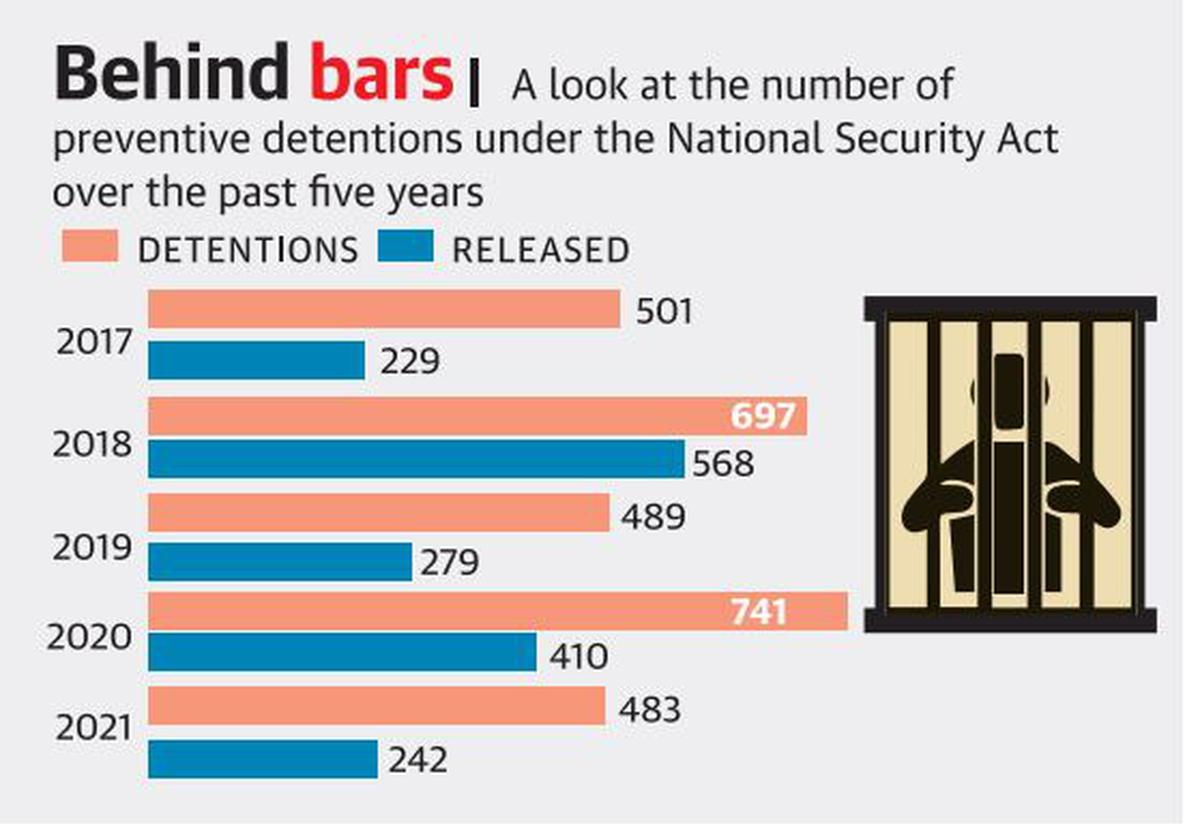
    • Over 483 were detentions under the National Security Act, of which almost half (241) were either in custody or still detained as of 2021-end.
    • In 2017, the NCRB’s Crime in India report found that 67,084 persons had been detained as a preventive measure that year.
    • Of these, 48,815 were released between one and six months of their detention and 18,269 were either in custody or still in preventive detention as of the end of the year.

    Various provisions invoked for Preventive Detention

    • Among other laws under which the NCRB has recorded data on preventive detentions are the:
    1. Goonda Act (State and Central) (29,306),
    2. Prevention of Illicit Traffic in Narcotic Drugs and Psychotropic Substances Act, 1988 (1,331), and
    3. A category classified as “Other Detention Acts”, under which most of the detentions were registered (79,514).
    • Since 2017, the highest number of persons to be placed under preventive detention has consistently been under the “Other Detention Acts” category.

    Concerns over the report

    • The number of persons placed under detention has been increasing since 2017 — to over 98,700 in 2018 and over 1.06 lakh in 2019 — before dipping to 89,405 in 2020 (due to lockdowns).
    • The number of persons placed under preventive detention has seen an increase in 2021.

    What is Preventive Detention?

    • Preventive detention means detaining a person so that to prevent that person from commenting on any possible crime.
    • In other words, preventive detention is an action taken by the administration on the grounds of the suspicion that some wrong actions may be done by the person concerned which will be prejudicial to the state.

    Preventive Detention in India

    A police officer can arrest an individual without orders from a Magistrate and without any warrant if he gets any information that such an individual can commit any offense.

    • Preventive Detention Law, 1950: According to this law any person could be arrested and detained if his freedom would endanger the security of the country, foreign relations, public interests, or otherwise necessary for the country.
    • Unlawful Activities Prevention Act (UAPA) 1968: Within the ambit of UAPA law the Indian State could declare any organization illegal and could imprison anyone for interrogation if the said organization or person critiqued/questioned Indian sovereignty territorially.

    What is the difference between Preventive Detention and an Arrest?

    • An ‘arrest’ is done when a person is charged with a crime.
    • In the case of preventive detention, a person is detained as he/she is simply restricted from doing something that might deteriorate the law-and-order situation.
    • Article 22 of the Indian Constitution provides protection against arrest and detention in certain cases.

    Rights of an Arrested Person in India

    A/c to Article 22(1) and 22(2) of the Indian constitution:

    • A person cannot be arrested and detained without being informed why he is being arrested.
    • A person who is arrested cannot be denied to be defended by a legal practitioner of his choice. This means that the arrested person has right to hire a legal practitioner to defend himself/ herself.
    • Every person who has been arrested would be produced before the nearest magistrate within 24 hours.
    • The custody of the detained person cannot be beyond the said period by the authority of magistrate.

    Exceptions for Preventive Detention

    Article 22(3) says that the above safeguards are not available to the following:

    • If the person is at the time being an enemy alien
    • If the person is arrested under certain law made for the purpose of “Preventive Detention”

    Constitutional provision

    • It is extraordinary that the framers of the Indian Constitution, who suffered most because of the Preventive Detention Laws, did not hesitate to give Constitutional sanctity.
    • B.R. Ambedkar was of the opinion that the freedom of the individual should not supersede the interests of the state.
    • He had also stated that the independence of the country was in a state of inflancy and in order to save it, preventive detention was essential.

    Issues with preventive detention

    • Arbitrariness: The police determinations of whether a person poses a threat are not tested at a trial by leading evidence or examined by legally trained persons.
    • Rights violation: Quiet often, there is no trial (upto 3 months), no periodic review, and no legal assistance for the detained person.
    • Abuse: It does not provide any procedural protections such as to reduce detainees’ vulnerability to torture and discriminatory treatment, and to prevent officials’ misusing preventive detention for subversive activities.
    • Tool for suppression: In the absence of proper safeguards, preventive detention has been misused, particularly against the Dalits and the minorities.

    What has the apex court recently rule?

    • Preventive detention is a necessary evil only to prevent public disorder, ruled the Supreme Court in 2021.
    • The State should not arbitrarily resort to “preventive detention” to deal with all sundry “law and order” problems, which could be dealt with by the ordinary laws of the country.
    • Whenever an order under a preventive detention law is challenged, one of the questions the court must ask in deciding its legality is: was the ordinary law of the land sufficient to deal with the situation?
    • If the answer is in the affirmative, the detention order will be illegal.

    Upholding the Article 21

    • Preventive detention must fall within the four corners of Article 21 (due process of law) read with Article 22 (safeguards against arbitrary arrest and detention) and the statute in question, Justice Nariman ruled.
    • The Liberty of a citizen is a most important right won by our forefathers after long, historical, and arduous struggles.

    Way forward

    • Having such kind of acts has a restraining influence on the anti-social and subversive elements.
    • India is a large country and many separatist tendencies against the national security and integrity existed and existing and a strict law is required to counter the subversive activities.
    • The number of persons detained in these acts is not a very large and due attention is made before preventive detention.
    • The state should have very effective powers to deal with the acts in which the citizens involve in hostile activities, espionage, coercion, terrorism, etc.


    UPSC 2023 countdown has begun! Get your personal guidance plan now! (Click here)
  • LGBT Rights – Transgender Bill, Sec. 377, etc.

    Ban on Conversion Therapy for the LGBTQIA+ Community

    The National Medical Commission (NMC), the apex regulatory body of medical professionals in India, has written to all State Medical Councils, banning sexual conversion therapy and calling it a “professional misconduct”.

    What is the news?

    • The NMC has empowered the State bodies to take disciplinary action against medical professionals who breach the guideline.
    • The NMC was following a Madras High Court directive to issue an official notification listing conversion therapy as a wrong, under the Indian Medical Council (Professional Conduct, Etiquettes and Ethics) Regulations, 2002.

    What is Sexual Conversion Therapy?

    • Conversion or reparative therapy is an intervention aimed at changing the sexual orientation or gender identity of an individual.
    • It uses either psychiatric treatment, drugs, exorcism and even violence, with the aim being to make the individual a heterosexual.
    • The conversion therapy umbrella also includes efforts to change the core identity of youth whose gender identity is incongruent with their sex anatomy.
    • Often, the therapy is offered by quacks with little expertise in dealing with the issue.
    • As late as 2018, medical books listed homosexuality and lesbianism as a “perversion”.

    What are the risks?

    • The interventions under conversion therapy are provided under the false premise that homosexuality and diverse gender identities are pathological.
    • They are not; the absence of pathology means there is no need for conversion or any other like intervention.
    • Conversion therapy poses the risk of causing or exacerbating mental health conditions, like anxiety, stress and drug use which sometimes even lead to suicide.

    What is the role of the Madras High Court in the ban?

    On June 7, 2021, Justice N. Anand Venkatesh of the Madras High Court gave a landmark ruling on a case he was hearing about the ordeal of a same-sex couple who sought police protection from their parents.

    • Pending adequate legislation more protective of the community, Justice Venkatesh issued a slew of interim guidelines.
    • It aimed for the police, activists, Union and State Social Welfare Ministries, and the National Medical Commission to ensure their safety and security to lead a life chosen by them.
    • The ruling prohibited any attempt to medically “cure” or change the sexual orientation of LGBTQIA+ (lesbian, gay, bisexual, transgender, queer, intersex, asexual or of any other orientation) people.
    • It urged the authorities to take action against professionals involving themselves in any form or method of conversion therapy,” which could include the withdrawal of licence to practice medicine.
    • On July 8, 2022, the court gave an order to the NMC directing it to issue necessary official notification by enlisting ‘Conversion Therapy’ as a professional misconduct.

    What were some of the other guidelines issued by the court?

    • The court asked the Ministry of Social Justice & Empowerment to draw up a list of NGOs and other groups which could handle the issues faced by the community, and gave it a time of 8 weeks from the date of the order.
    • The court said the community should be provided with legal assistance by the District Legal Services Authority in coordination with law enforcement agencies.
    • It asked agencies to follow the Transgender Persons (Protection of Rights) Rules, 2020, and the Transgender Persons (Protection of Rights) Act, 2019, in letter and spirit.
    • The court said it was imperative to hold sensitisation programmes for an all-out effort to understand the community and its needs.

    Way forward

    • Schools and colleges must effect changes in curricula for a better understanding of the community.
    • People of a different sexual orientation or gender identity often narrate harrowing tales of bullying, discrimination, stigma and ostracization.
    • Gender-neutral restrooms should be compulsory in educational institutes and other places.
    • Parents too need to be sensitised, because the first point of misunderstanding and abuse often begins at home, with teenagers being forced to opt for “conversion” therapies.
    • Health professionals point out that even adults opting for sex reassignment surgeries need to get proper guidance like therapy pre and post operation.

    Back2Basics: Transgender Persons (Protection of Rights) Act, 2019: Key Features

    Defining Transperson

    • The act defines a transgender person as one whose gender does not match the gender assigned at birth.
    • It includes trans-men and trans-women, persons with intersex variations, gender-queers, and persons with socio-cultural identities, such as kinnar and hijra.

    Prohibition against discrimination

    • It prohibits the discrimination against a transgender person, including denial of service or unfair treatment in relation to education, employment, healthcare, access to, or enjoyment of goods, facilities, opportunities available to the public.
    • Every transgender person shall have a right to reside and be included in his household.
    • No government or private entity can discriminate against a transgender person in employment matters, including recruitment, and promotion.

    HRD measures

    • A transgender person may make an application to the District Magistrate for a certificate of identity, indicating the gender as ‘transgender’.
    • Educational institutions funded or recognised by the relevant government shall provide inclusive facilities for transgender persons, without discrimination.
    • The government must provide health facilities to transgender persons including separate HIV surveillance centres, and sex reassignment surgeries.

    Grievances redressal

    • The National Council for Transgender persons (NCT) chaired by Union Minister for Social Justice, will advise the central government as well as monitor the impact of policies with respect to transgender persons.
    • It will also redress the grievances of transgender persons.

    Legal Protection

    • The Bill imposes penalties for the offences against transgender persons like bonded labour, denial of use of public places, removal from household & village and physical, sexual, verbal, emotional or economic abuse.


    UPSC 2023 countdown has begun! Get your personal guidance plan now! (Click here)

  • Railway Reforms

    Indian Railways powerful experiment on AC III tier economy class coaches

    AC III tier economy class coachesContext

    • The Indian Railways’ experiment to introduce AC III tier economy class coaches has started to pay off. Since its introduction, in the last one year, these coaches have earned the Railways more than Rs.230 crore in revenue.

    AC III tier economy classWhat is AC III tier economy class coach?

    • The AC 3 tier economy class in Indian Railways is a milestone concerning pocket-friendly traveling experience for common man.
    • With fare slightly more than sleeper class and lower than conventional AC class.
    • The objective of the railway is to move sleeper class passengers to a comfortable AC class with luxurious facilities. AC-3 tier comprises air-conditioned coaches with 64 sleeping berths.

    When it is introduced?

    • The Indian Railway has introduced the first AC III tier Economy Class for North Central Railway Zone in 2021 to provide a convenient traveling experience to the passengers.
    • As of now 7 trains are equipped with AC III tier economy class coaches are running on the tracks

    AC III tier economy class coachesFeatures of the AC III tier economy coach:

    • Pocket friendly: According to the Indian Railways, the fair in these coaches are cheaper than the normal AC three-tier coach. Fares in AC III tier economy are 6%-7% cheaper than the AC III tier class. The economy class has a capacity of 83 berths compared to 72 in the regular coach.
    • Divyang friendly and modern designs: The coaches were specially designed for the convenience of the divyangs. Providing Improved and modular design of berths and ergonomically designed ladder for accessing the middle and upper berths etc.
    • Modern features: In these, modern arrangements have been made for mobile phones and magazine holders, fire safety, personalised reading lights, AC vents, USB points, mobile charging points.
    • Optimum Speed: These air-conditioned three-tier economy class coaches are capable of running at an optimum speed of 160 kilometers per hour.
    • More Capacity: The economy class has a capacity of 83 berths compared to 72 in the regular coach.

    What is the current status of AC III tier class?

    • AC- III tier, the favorite mode of train travel of people falling in the bottom rung of the middle class, is the only class that earns the Railways profit among all its passenger services.
    • The AC III tier is the only class of service which has generated consistent profits for the Railways. Between FY16 and FY20,
    • AC III tier coaches carried only 1% of the total passengers, but were responsible for 21% of the earnings from travelers. Such a low-passenger, high-revenue dichotomy was not seen in any other class.
    • It is not as expensive as the other AC classes and at the same time, its share in revenue has not been impacted by the relatively low pricing

    AC III tier economy class coachesRevenue of Indian railways

    • The overall revenue of Indian Railways at the end of August 2022 was Rs 95,486.58 crore, showing an increase 38 per cent over the corresponding period of last year.
    • Goods revenue climbed by Rs 10,780.03 crore (or 20 per cent) to Rs 65,505.02 crore till August-end this year
    • The revenue from passenger traffic was Rs 25,276.54 crore, an increase of Rs 13,574.44 crore (116 per cent) year-on-year.
    • Passenger traffic also increased compared to last year in both the segments — reserved and unreserved
    • Railways’ total revenue during the entire last fiscal (2021-22) stood at Rs.1,91,278.29 crore.

    What are the issues faced by Indian railways to increase its revenue?

    • Cross Subsidized: The cross-subsidiszation in respect of second class, ordinary class and suburban services has increased continuously in the past five years with subsidy on ordinary class being the maximum,
    • Concessional fare: The revenue forgone in passenger earnings due to concessions to various categories of passengers (physically challenged persons, patients, senior citizens, Izzat monthly season tickets, press correspondents, sport persons and war widows among others) increased from Rs 1,994.83 crore in 2018-19 to Rs 2,058.61 crore in 2019-20.
    • Low -Revenue dichotomy in Expensive class: A high-passenger, low-revenue dichotomy was seen in the inexpensive classes. For instance, over 90% passengers travelled by second class which accounted for only 37% of the earnings.
    • Operational Loss: Operational losses (in crore) incurred while operating various classes of service. For instance, in operating AC first class service, the Railways incurred a loss of 403 crore in FY20

    Conclusion

    • Adding more AC III tier economy class coaches is a step in the right direction as it has shown positive result in revenue generation for railways and it provides a travel with dignity to a common man. But If Indian railway has to benefit it have to work extensively on operational loss incurred out of low Revenue dichotomy in Expensive classes.

    Mains Question

    Q. Indian Railways is often referred to as the lifeline of the country but runs at a loss when it comes to running class-divided coaches. In this context discuss the utility of class divided coaches.

    UPSC 2023 countdown has begun! Get your personal guidance plan now! (Click here)

  • Industrial Sector Updates – Industrial Policy, Ease of Doing Business, etc.

    Services PMI flags rebound in August

    The services sector rebounded in August from a four-month low in July and created the most jobs in 14 years as input cost pressures eased to the slowest pace in 11 months, as per S&P Global India Services Purchasing Managers’ Index (PMI), which expanded to 57.2 last month, from July’s 55.5.

    Purchasing Managers’ Index (PMI)

    • PMI is an indicator of business activity — both in the manufacturing and services sectors.
    • It is a survey-based measure that asks the respondents about changes in their perception of some key business variables from the month before.
    • It is calculated separately for the manufacturing and services sectors and then a composite index is constructed.
    • The PMI is compiled by IHS Markit based on responses to questionnaires sent to purchasing managers in a panel of around 400 manufacturers.

    How is the PMI derived?

    • The PMI is derived from a series of qualitative questions.
    • Executives from a reasonably big sample, running into hundreds of firms, are asked whether key indicators such as output, new orders, business expectations and employment were stronger than the month before and are asked to rate them.

    How does one read the PMI?

    • A figure above 50 denotes expansion in business activity. Anything below 50 denotes contraction.
    • Higher the difference from this mid-point greater the expansion or contraction. The rate of expansion can also be judged by comparing the PMI with that of the previous month data.
    • If the figure is higher than the previous month’s then the economy is expanding at a faster rate.
    • If it is lower than the previous month then it is growing at a lower rate.

    What are its implications for the economy?

    • The PMI is usually released at the start of the month, much before most of the official data on industrial output, manufacturing and GDP growth becomes available.
    • It is, therefore, considered a good leading indicator of economic activity.
    • Economists consider the manufacturing growth measured by the PMI as a good indicator of industrial output, for which official statistics are released later.
    • Central banks of many countries also use the index to help make decisions on interest rates.


    UPSC 2023 countdown has begun! Get your personal guidance plan now! (Click here)

  • Historical and Archaeological Findings in News

    Pakistan floods may take away Mohenjo Daro’s World Heritage Tag

    Heavy floods in Pakistan has pushed the archeological site of Mohenjo Daro – near the bank of the Indus river – to the “brink of extinction”.

    What is the news?

    • Pakistan’s Department of Archaeology has said that Mohenjo Daro might be removed from the world heritage list, if urgent attention towards its conservation and restoration is not given.

    About Mohenjo Daro

    • Mohenjo Daro, a group of mounds and ruins, is a 5000-year-old archaeological site located about 80-km off the city of Sukkur.
    • It comprises the remnants of one of two main centres of the ancient Indus Valley Civilisation, the other one being Harappa, located 640 km to the northwest, in Punjab province.
    • Mohenjo Daro, which means ‘mound of the dead’, was one of the oldest cities of the world.
    • Known to be a model planned city of the ancient civilisation, the houses here had bathrooms, toilets and drainage system.
    • The sheer size of the city, and its provision of public buildings and facilities, suggests a high level of social organization.
    • Though in ruins, the walls and brick pavements in the streets are still in a preserved condition.

    How did it came to prominance

    • The ruins of the city remained undocumented for around 3,700 years, until 1920, when archaeologist RD Banerji visited the site.
    • Its excavation started in 1921 and continued in phases till 1964-65.
    • The site went to Pakistan during Partition.

    Other Indus Valley sites

    • The Indus Valley Civilisation spanned much of what is now Pakistan and the northern states of India (Gujarat, Haryana and Rajasthan), even extending towards the Iranian border.
    • Its major urban centres included Harappa and Mohenjo Daro in Pakistan, and Lothal, Kalibangan, Dholavira and Rakhigarhi in India.
    • Mohenjo Daro is considered the most advanced city of its time, with sophisticated civil engineering and urban planning.
    • When the Indus Valley Civilisation went into sudden decline around 19th century BC, Mohenjo Daro was abandoned.

    What next for the site

    • According to media reports, many streets and sewerage drains of the historical ruins have been badly damaged due to the floods.
    • However, the work of removing the sediments deposited due the flooding is still underway.
    • But if this kind of flooding happens again, the heritage site may once again get buried under the ground, archaeologists say.
    • It is expected that UN Secretary General Antonio Guterres will visit the site during his visit to Pakistan on September 11.
    • The visit might provide some clarity on if the site has lost some of its attributes that are necessary for it to retain its prestigious world heritage tag.

    Losing world heritage tag

    • There are around 1,100 UNESCO listed sites across its 167 member countries.
    • Last year, the World Heritage Committee decided to delete the property ‘Liverpool – Maritime Mercantile City’ (UK) from the World Heritage List.
    • This was due to the irreversible loss of attributes conveying the outstanding universal value of the property.
    • Liverpool was added to the World Heritage List in 2004 in recognition of its role as one of the world’s major trading centres in the 18th and 19th centuries – and its pioneering dock technology, transport systems and port management.
    • Before that, the first venue to be delisted by the UNESCO panel was the Arabian Oryx Sanctuary in Oman, in 2007, after concerns over poaching and habitat degradation.
    • Another site to be removed from the World Heritage list in 2009 was Elbe Valley in Dresden, Germany, after the construction of the Waldschloesschen road bridge across the Elbe River.

    Back2Basics: UNESCO World Heritage Sites

    • A World Heritage Site is a landmark or area, selected by the UN Educational, Scientific and Cultural Organization (UNESCO) for having cultural, historical, scientific or other forms of significance, which is legally protected by international treaties.
    • The sites are judged to be important for the collective and preservative interests of humanity.
    • To be selected, a WHS must be an already-classified landmark, unique in some respect as a geographically and historically identifiable place having special cultural or physical significance (such as an ancient ruin or historical structure, building, city, complex, desert, forest, island, lake, monument, mountain, or wilderness area).
    • It may signify a remarkable accomplishment of humanity, and serve as evidence of our intellectual history on the planet.
    • The sites are intended for practical conservation for posterity, which otherwise would be subject to risk from human or animal trespassing, unmonitored/uncontrolled/unrestricted access, or threat from local administrative negligence.
    • The list is maintained by the international World Heritage Program administered by the UNESCO World Heritage Committee, composed of 21 “states parties” that are elected by their General Assembly.

    UNESCO World Heritage Committee

    • The World Heritage Committee selects the sites to be listed as UNESCO World Heritage Sites, including the World Heritage List and the List of World Heritage in Danger.
    • It monitors the state of conservation of the World Heritage properties, defines the use of the World Heritage Fund and allocates financial assistance upon requests from States Parties.
    • It is composed of 21 states parties that are elected by the General Assembly of States Parties for a four-year term.
    • India is NOT a member of this Committee.


    UPSC 2023 countdown has begun! Get your personal guidance plan now! (Click here)

  • Corruption Challenges – Lokpal, POCA, etc

    Untangling Kerala’s Lokayukta Amendment Controversy

    The Kerala Legislative Assembly passed the Kerala Lok Ayukta (Amendment) Bill on August 30, amid a boycott.

    Who are Lokpal-Lokayuktas?

    • The Lokpal-Lokayukta issue has always generated intense debate in the country.
    • In fact, this term was first used in a report of the Administrative Reforms Commission headed by Morarji Desai as far back as in 1966.
    • Political corruption had become rampant by then and it was thought that a credible system of an ombudsman should be established to redress public grievances against the leaders and public officials.
    • The first Bill on Lokpal was introduced in the Lok Sabha in 1968 which lapsed with the dissolution of the House.
    • Anna Hazare’s movement and the active involvement of civil society generated a lot of moral pressure on the Government which ultimately led to the passing of the Bill in 2013.

    Composition of Lokpal

    • The Lokpal is no ordinary investigative body.
    • It is headed by the incumbent Chief Justice of India or a retired judge.
    • It has eight members, four of whom are judicial members.
    • Thus the whole system is studded with judges or judicial men.
    • The Lokpal has an inquiry wing and a prosecution wing to deal with investigation and prosecution, respectively.
    • The director of prosecution files the case in the special court based on the findings of the Lokpal.

    Who falls under the ambit of Lokpal?

    • The Lokpal has jurisdiction to inquire into allegations of corruption against the Prime Minister, Ministers, Members of Parliament, Group A, B, C and D officers and officials of the central government.
    • After the conclusion of the investigation, the Lokpal may file a case in the special court in case the findings disclose the commission of offence under the Prevention of Corruption Act by the PM, Ministers or MPs.
    • However, the Lokpal does not have the power to ask the President to remove the Prime Minister or a Minister from office.

    What about the states?

    • The Lokpal and Lokayukta Act delegates the power to States to establish by law the Lokayukta to deal with complaints relating to corruption against public functionaries.
    • Some States already have established Lokayuktas. For example, Maharashtra in 1971, and Kerala in 1999.

    What is the Keralan controversy?

    • In order to get a clearer perspective on the Kerala Lokayukta controversy, it is necessary to understand the scheme of the Lokpal and Lokayuktas Act enacted by Parliament.
    • The long title of the Act says: “An Act to provide for the establishment of a body of Lokpal for the Union and Lokayukta for States to inquire into allegations of corruption against certain public functionaries….”
    • Thus, the Lokpal is conceived of as a body which will inquire into allegations of corruption.
    • It is basically an investigative body whose task is to conduct prompt and fair investigation and the prosecution of cases of corruption.

    Issues with the Amendment

    • The amendments were related to the competent authority to consider Lok Ayukta recommendations.
    • In the case of any unfavourable decision from the Lok Ayukta against the CM, the competent authority will now be the Legislative Assembly instead of the Governor as is prescribed in the existing Act.
    • The amendment tries to take away at the powers of the Governor.
    • The Lokayukta has indirectly expressed its resentment over the attempt to take away some of its powers.

    Arguments by Kerala Government

    • The Government, on the other hand, claims that through the amendment, a provision in the original Act which is unconstitutional has been excised.
    • Earlier it gave power to the Lokayukta to give directions to the Governor to remove a CM or a Minister on being found guilty of corruption.
    • This meant that the Lokayukta was to be over and above the office of Governor.

    Legal and constitutional implications

    Two important points need to be made here:

    (A) Overpowering the Lokpal

    • One, an investigative body does not have the legal authority to direct the public servant to resign his post on the basis of its findings.
    • It can only submit its findings to the competent authority or, as is provided in the Lokpal Act, file a case in the special court.
    • The Lokayukta is basically an investigative body with certain powers to carry out an investigation into cases relating to the Prevention of Corruption Act.
    • The only special feature of this body is that it is headed by a retired judge of the Supreme Court or a retired Chief Justice of a High Court.
    • But that does not alter the basic character of the Lokayukta as an investigative body.

    (B) Compulsion on Governor

    • The Chief Minister or a Minister holds office during the pleasure of the Governor (Article 164).
    • The Constitution of India does not contemplate any external pressure on the Governor to withdraw his pleasure.
    • The Sarkaria Commission had suggested that the Governor can dismiss a Chief Minister only when he loses his majority in the Assembly and refuses to step down.
    • The Supreme Court has accepted this recommendation of the Sarkaria Commission.
    • Another occasion when the Governor could withdraw his pleasure is on account of CM having been convicted in a criminal case and sentenced to not less than two years of imprisonment.
    • In other words, a Chief Minister cannot be asked to resign when he enjoys a majority in the House.
    • The Governor, being a high constitutional authority, cannot be compelled by a law to act in a particular manner so far as his constitutional duties and functions are concerned.

    Other contentious provisions

    (1) Undue burden on Political Parties

    • There are some other provisions as well which may not stand legal scrutiny.
    • For example, this law includes the office bearers of political parties within its definition of ‘public servant’.
    • Basically, the Prevention of Corruption Act deals with corruption in the government and allied agencies, statutory bodies, elected bodies, etc.
    • The functionaries of political parties do not come within the mischief of this law. So, it is difficult to understand how they can be brought within the sweep of the Lokayukta Act.

    (2) Reports of Lokayukta

    • Another problematic provision in this law is the one which deals with the reports of Lokayukta (Section 12).
    • It says that the Lokayukta shall, on the allegation of corruption being substantiated, send the findings along with recommendation of action to the competent authority who is required to take action as recommended by the Lokayukta.
    • It further says that if the Lokayukta is satisfied by the action taken by the competent authority, he shall close the case.
    • The question is how the Lokayukta can close a corruption case which is a criminal case and which invites imprisonment for three to seven years.
    • The Lokpal files the case in the court after the investigation. There is no provision in the central law under which the Lokpal can close the case before it reaches the court.
    • The Lokayukta not being a court does not have the legal capacity to close the corruption case under any circumstances.

    Way forward

    • The Kerala Lokayukta Act should be re-examined by a committee of the Assembly and should be brought on a par with the Lokpal Act.
    • Legislation that seeks to punish corrupt functionaries should be placed above controversies.

    Back2Basics: Lokpal Movement

    • The Lokpal, the apex body to inquire and investigate graft complaints against public functionaries, came into being with the appointment of its chairperson and members in March 2019.
    • In March 2019, former SC judge Justice Pinaki Chandra Ghose was selected as the first head of the Lokpal.

    Lokpal and Lokayuktas Act, 2013

    • The Lokpal Act 2013 is anti-corruption legislation that seeks to provide for the establishment of the institution of Lokpal.
    • It seeks to inquire into allegations of corruption against certain important public functionaries including the PM, cabinet ministers, MPs, Group A officials of the Central Government, etc.
    • The Bill was introduced in the parliament following massive public protests led by anti-corruption crusader Anna Hazare and his associates.
    • The Bill is one of the most widely discussed and debated Bills in India in recent times.

    Its history

    • The term Lokpal was coined in 1963 by Laxmi Mall Singhvi, a member of parliament during a parliamentary debate about grievance mechanisms.
    • The Administrative Reforms Commission (ARC) headed by Morarji Desai submitted an interim report on “Problems of Redressal of Citizen’s Grievances” in 1966.
    • In this report, ARC recommended the creation of two special authorities designated as ‘Lokpal’ and ‘Lokayukta’ for a redress of citizens’ grievances.
    • Maharashtra was the first state to introduce Lokayukta through The Maharashtra Lokayukta and Upa-Lokayuktas Act in 1971.


    UPSC 2023 countdown has begun! Get your personal guidance plan now! (Click here)

  • ISRO Missions and Discoveries

    ISRO tests system recoverable rocket ‘Inflatable Aerodynamic Decelerator (IAD)’

    The Indian Space Research Organisation (ISRO) has successfully tested a technology that could aid the cost-effective recovery of spent rocket stages and safely land payloads on other planets.

    What is IAD?

    • IAD is a technique used for an atmospheric entry payload.
    • An inflatable envelope and an inflatant (anything that inflates the envelope, like air or helium) make up the inflatable aerodynamic decelerator.
    • While entering the atmosphere, it inflates like a balloon and decelerates the lander.
    • The inflatant is designed to fill the inflatable envelope to a condition such that it surrounds the payload meant to enter the atmosphere of a planet or satellite and causes aerodynamic forces to slow it down.
    • In simpler words, IAD is designed to increase drag upon entering the atmosphere of any planetary body, like Earth, Mars, or even Moon.
    • Its shape is maintained by a closed, gas-pressured body and the inflatant gas is also generated internally. Some versions also use ram air or both.

    How significant is this IAD?

    • Some space agencies, including NASA, have already successfully tested advanced versions of the technology, including the supersonic and hypersonic variants.
    • However, for near future missions of ISRO, the current version that it tested is perfect.
    • Its use was first proposed by NASA more than 50 years ago for planetary entries.

    Minuscule of ISRO’s IAD

    • The IAD tested by ISRO was inflated at an altitude of around 84 km and the sounding rocket’s cargo dropped through the atmosphere on it.
    • It is fitted with a booster motor. It also has a spin rocket that is ejectable.
    • The inflatable structure is made out of Kevlar fabric, which is a very strong synthetic fibre and also heat resistant to withstand atmospheric pressure and temperature changes.
    • On top of it, it’s coated with polychloroprene, an oil and wax resistant rubber, to withstand extreme temperatures.
    • In the inflation system, it uses compressed nitrogen stored in a bottle.
    • It has consistently decreased the payload’s velocity through aerodynamic drag while maintaining the expected trajectory during the test flight.

    Where does ISRO intend to use it?

    • The IAD will help ISRO in performing many space tasks effectively including recovery of spent stages of rockets, for landing payloads on missions to other planetary bodies.
    • This is the first instance where an IAD has been specially created for spent stage recovery.
    • So inter-planetary missions are certainly one aspect that ISRO wishes to explore.


    UPSC 2023 countdown has begun! Get your personal guidance plan now! (Click here)

  • ISRO Missions and Discoveries

    India’s first Dark Sky Reserve to come up in Ladakh

    In a first-of-its-kind initiative, the Department of Science & Technology (DST) has announced the setting up of India’s first dark sky reserve at Hanle in Ladakh in the next three months.

    What is a Dark Sky Reserve?

    • A dark-sky reserve is an area, usually surrounding a park or observatory that is kept free of artificial light pollution.
    • The purpose of a dark sky preserve is generally to promote astronomy.
    • Because different national organizations have worked independently to create their programs, different terms have been used to describe the areas.

    How is it designated?

    • A dark sky reserve is a designation given to a place that has policies in place to ensure that a tract of land or region has minimal artificial light interference.
    • The International Dark Sky Association is a US-based non-profit that designates sites as international dark sky places, parks, sanctuaries and reserves, depending on the criteria they meet.
    • Several such reserves exist around the world but none so far in India.

    Dark Sky Reserve at Hanle

    • Hanle, which is about 4,500 metres above sea level, hosts telescopes and is regarded as one of the world’s most optimal sites for astronomical observations.
    • However, ensuring that the site remains well-suited for astronomy implies keeping the night sky pristine, or ensuring minimal interference to the telescopes from artificial light sources such as electric lights and vehicular lights from the ground.
    • The site will have activities to help in boosting local tourism and economy through interventions of science and technology.

    The Himalayan Chandra Telescope, High Energy Gamma Ray Telescope, Major Atmospheric Cherenkov Experiment Telescope and GROWTH-India are the prominent telescopes located at the Hanle observatory.

    Ideal conditions in India

    • The Indian Astronomical Observatory, the high-altitude station of the IIA, is situated to the north of Western Himalayas, at an altitude of 4,500 metres above mean sea level.
    • Located atop Mt. Saraswati in the Nilamkhul Plain in the Hanle Valley of Changthang, it is a dry, cold desert with sparse human population.
    • The cloudless skies and low atmospheric water vapour make it one of the best sites in the world for optical, infrared, sub-millimetre, and millimetre wavelengths.


    UPSC 2023 countdown has begun! Get your personal guidance plan now! (Click here)

  • Judicial Reforms

    Regional Benches of Supreme Court

    TN Chief Minister yet again reiterated the State’s request for establishing a Regional Bench of the Supreme Court in Chennai and allowing Tamil to be used in the Madras High Court as one of its official languages.

    Why in news?

    • Outgoing Vice President, M Venkaiah Naidu suggested bifurcation of the Supreme Court into four regional benches for speedy disposal of cases.
    • However, the Supreme Court has maintained on previous occasions that there is no need for such benches outside Delhi.

    Why the Supreme Court is located in New Delhi?

    • Article 130 of the Constitution of India reads- The Supreme Court shall sit in Delhi or in such other place or places, as the Chief Justice of India may, with the approval of the President, from time to time, appoint.
    • The law thus provides scope for setting up the Supreme Court in multiple places, subject to the concurrence of the CJI and the President.

    Who can establish the SC benches outside New Delhi?

    • The Supreme Court in Union of India v. S.P. Anand Verdict (2009), held that the Article vests exclusive discretionary powers on the matter with the Chief Justice of India.
    • It is an enabling provision and if the Chief Justice (after taking relevant factors into account) feels that the Court should sit elsewhere, s/he can seek the President’s approval for it.
    • No authority can compel the Chief Justice of India to act in a particular way under the Article.

    Voices for circuit benches

    • The Law Commission in its 229th Report had suggested setting up a Constitution Bench of the Court in New Delhi and four other benches in different regions i.e., Northern region in Delhi, Southern region in Chennai/Hyderabad, Easter region in Kolkata and Western region in Mumbai.
    • However, this idea did not find favour with the Judges of the Supreme Court.

    Reasons for having Regional/Circuit Benches

    • Access to Justice: Many litigants are discouraged to travel to Delhi from far away locations like south or northeast India.
    • Geographical Constraints: A disproportionately high number of cases filed in the Supreme Court originated in High Courts closer to Delhi. Hence coming up with regional benches will remove this constraint.
    • Huge pendency of cases: Increased workload on the Supreme Court and at present more than 65,000 cases are pending in the Supreme Court, and disposal of appeals takes many years.
    • Reducing Cost of Justice: It is observed that besides travelling to New Delhi, engaging expensive Supreme Court counsel to pursue a case is beyond the means of most litigants.

    Advantages of having circuit courts

    • Promotes Article 39A: It has been pointed out that Article 39A says that the state shall secure that the operation of the legal system promotes justice, on a basis of equal opportunity.
    • Remove Geographical Constraints: It is high time we had more benches because in a country as vast as India the litigants have to travel long distances and spend a huge amount of money and energy.
    • Upholding the spirit of the constitution: Setting up Benches outside Delhi would neither impair unity and integrity nor undermine the importance of the Supreme Court.


    UPSC 2023 countdown has begun! Get your personal guidance plan now! (Click here)

Join the Community

Join us across Social Media platforms.