💥UPSC 2027,2028 Mentorship (April Batch) + Access XFactor Notes & Microthemes PDF

Archives: News

  • North-East India – Security and Developmental Issues

    Explained: Arunachal-Assam Boundary Dispute

    Less than a month after the Union government gave the seal of approval to an agreement to partially resolve the disputed sectors on the Assam-Meghalaya border, Arunachal Pradesh CM and his Assam counterpart decided to form district-level committees for settling their inter-state boundary disputes.

    Arunachal-Assam Boundary Dispute

    • Assam has had boundary disputes with all the north-eastern states that were carved out of it.
    • While Nagaland became a State in 1963, Meghalaya first became an Autonomous State in 1970 and a full-fledged State in 1972.
    • Arunachal Pradesh and Mizoram were separated from Assam as Union Territories in 1972 and as States in 1987.
    • None of the new States accepted the “constitutional boundary” that they said was dictated by the partisan administration of undivided Assam without consulting the tribal stakeholders.
    • They also claimed that the disputed areas were traditionally under the control of tribal chieftains before Assam, post-India’s independence, inherited the “imaginary boundaries” drawn during British rule.
    • The issue with Arunachal Pradesh has more to do with a 1951 report prepared by a sub-committee headed by Assam’s first Chief Minister, Gopinath Bordoloi.

    Genesis of the dispute

    • Arunachal Pradesh and Assam have disputes at about 1,200 points along their 804 km boundary.
    • The disputes cropped up in the 1970s and intensified in the 1990s with frequent flare-ups along the border.
    • However, the issue dates back to 1873 when the British government introduced the inner-line permit vaguely separating the plains from the frontier hills.
    • This area became the North-East Frontier Agency (NEFA) in 1954, three years after a notification based on the 1951 report saw 3,648 sq. km of the “plain” area of Balipara and Sadiya foothills being transferred to the Darrang and Lakhimpur districts of Assam.
    • Arunachal has been celebrating its statehood with an eye on China since 1987, but what has been causing resentment is the inability of the people living in the transferred patches.
    • Leaders in Arunachal Pradesh claim the transfer was done arbitrarily without consulting its tribes who had customary rights over these lands.
    • Their counterparts in Assam say the 1951 demarcation is constitutional and legal.

    Earlier attempts for resolving dispute

    • There were several efforts to demarcate the boundary between Assam and NEFA/Arunachal Pradesh between 1971 and 1974.
    • To end the stalemate, a high-powered tripartite committee involving the Centre and the two States was formed in April 1979 to delineate the boundary based on Survey of India maps.
    • About 489 km of the inter-state boundary north of the Brahmaputra River was demarcated by 1984, but Arunachal did not accept the recommendations and staked claim to much of the areas transferred in 1951.
    • Assam objected and approached the Supreme Court in 1989, accusing Arunachal Pradesh of “encroachment”.
    • The apex court-appointed a local boundary commission in 2006 headed by one of its retired judges.
    • In its September 2014 report, this commission recommended that Arunachal Pradesh should get back some of the areas transferred in 1951. However, this did not work out.

    Way forward

    • Following the model adopted in the exercise to resolve the dispute with Meghalaya, Assam and Arunachal Pradesh have agreed to form district-level committees.
    • They will be tasked with undertaking joint surveys in the disputed sectors to find tangible solutions to the long-pending issue based on historical perspective, ethnicity, contiguity, people’s will and administrative convenience.
    • The two States have decided to form 12 such committees involving the districts sharing the boundary. Assam has eight districts touching the boundary with Arunachal Pradesh, which has 12 such districts.

    Conclusion

    • The Assam-Meghalaya boundary agreement has raised hopes of the Assam-Arunachal boundary dispute being resolved.
    • This is especially in light of egging the north-eastern States to end their territorial issues once and for all by August 15, 2022, when the country celebrates 75 years of independence.
    • Moreover, there is a general belief that the region’s sister-States are in a better position to fast-track the resolution since they are ruled by the present regime with the same dispensation at the Centre.


    UPSC 2023 countdown has begun! Get your personal guidance plan now! (Click here)

  • Higher Education – RUSA, NIRF, HEFA, etc.

    TN clips Governor’s power to appoint VCs

    The Tamil Nadu Assembly has adopted two Bills that seek to empower the government to appoint Vice-Chancellors (VCs) to 13 State universities under the aegis of the Higher Education Department by amending the respective Acts.

    Role of Governors in State Universities

    • In most cases, the Governor of the state is the ex-officio chancellor of the universities in that state.
    • Its powers and functions as the Chancellor are laid out in the statutes that govern the universities under a particular state government.
    • Their role in appointing the Vice-Chancellors has often triggered disputes with the political executive.

    Who is a Chancellor of a University?

    • In India, almost all universities have a chancellor as their titular head whose function is largely ceremonial.
    • The governor of the state, appointed as the union’s representative of state by the president, is the honorary chancellor of all State owned universities.
    • The de facto head of any government university is the vice-chancellor.
    • In private non-profit universities, normally the head of the foundation who has established the university is the chancellor of the university and is the head of the university.

    What about Central Universities?

    • Under the Central Universities Act, 2009, and other statutes, the President of India shall be the Visitor of a central university.
    • With their role limited to presiding over convocations, Chancellors in central universities are titular heads, who are appointed by the President in his capacity as Visitor.
    • The VCs too are appointed by the Visitor from panels of names picked by search and selection committees formed by the Union government.
    • The Act adds that the President, as Visitor, shall have the right to authorize inspections of academic and non-academic aspects of the universities and also to institute inquiries.

    What are the highlights of the TN Bills?

    • The Bills passed in Tamil Nadu stress that “every appointment of the Vice-Chancellor shall be made by the Government from out of a panel of three names” recommended by a search-cum-selection committee.
    • Currently, the Governor, in his capacity as the Chancellor of state universities, has the power to pick a VC from the shortlisted names.
    • The Bills also seek to empower the state government to have the final word on the removal of VCs, if needed.
    • Removal will be carried out based on inquiries by a retired High Court judge or a bureaucrat who has served at least as a Chief Secretary, according to one of the Bills.

    Are other states trying to curtail the Governor’s role in appointing VCs?

    • In December, the Maharashtra Assembly passed a Bill amending the Maharashtra Public Universities Act, 2016.
    • Under the original Act, the Maharashtra government had no say in the appointment of VCs.
    • If the changes take effect, the Governor will be given two names to choose from by the state government.
    • In 2019, the West Bengal government took away the Governor’s authority in appointing VCs to state universities.
    • It has also hinted at removing the Governor as the Chancellor of the universities.
    • But all such motives have been challenged by the University Grants Commission (UGC).

    What is at the root of the differences?

    • In West Bengal, Maharashtra and Tamil Nadu, the elected governments have repeatedly accused the Governors of acting at the behest of the Centre on various subjects, including education.
    • The regulations, which differ from state to state, are often open to interpretation and disputes are routine.
    • In fact, the TN Bills make a case for giving the state government the upper hand in the VC appointment process by citing the examples of Gujarat and Telangana.
    • In Karnataka, Jharkhand and Rajasthan, state laws underline the need for concurrence between the state and the Governor.
    • The terms “concurrence” or “consultation” are absent from state legislation in most cases.

    What is the UGC’s role in this?

    • Education comes under the Concurrent List.
    • But entry 66 of the Union List states — “coordination and determination of standards in institutions for higher education or research and scientific and technical institutions”.
    • This gives the Centre substantial authority over higher education.
    • The UGC plays that standard-setting role, even in the case of appointments in universities and colleges.
    • According to the UGC Regulations, 2018, the “Visitor/Chancellor” — mostly the Governor in states — shall appoint the VC out of the panel of names recommended by search-cum-selection committees.
    • Higher educational institutions, particularly those that get UGC funds, are mandated to follow its regulations.
    • These are usually followed without friction in the case of central universities, but are sometimes resisted by the states in the case of state universities.

    Judicial observations in this regard

    • A Bench of Justices M R Shah and B V Nagarathna said “any appointment as a VC contrary to the provisions of the UGC Regulations can be said to be in violation of the statutory provisions, warranting a writ of quo warranto”.
    • It said every subordinate legislation of the UGC, in this case the one on minimum standards on appointments, flows from the parent UGC Act, 1956.
    • Therefore, being a subordinate legislation, UGC Regulations become part of the Act.
    • In case of any conflict between state legislation and central legislation, central legislation shall prevail by applying the rule/principle of repugnancy as enunciated in Article 254 of the Constitution.
    • It reiterated that the subject ‘education’ is in the Concurrent List of the Seventh Schedule of the Constitution.


    UPSC 2023 countdown has begun! Get your personal guidance plan now! (Click here)

  • Defence Sector – DPP, Missions, Schemes, Security Forces, etc.

    India is now 3rd highest military spender

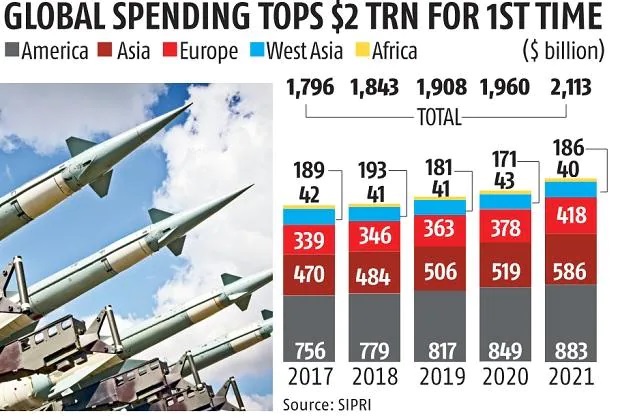
    World military spending continued to grow in 2021, reaching a record $2.1 trillion despite the economic fallout of the pandemic, according to new data on global military spending published by the Stockholm International Peace Research Institute (SIPRI).

    Top defence spenders in 2021

    • The five largest spenders in 2021 were the U.S., China, India, the U.K. and Russia, together accounting for 62% of expenditure.
    • The U.S. and China alone accounted for 52%.

    India’s defence expenditure

    • India’s military spending of $76.6 billion ranked third highest in the world.
    • This was up by 0.9% from 2020 and by 33% from 2012.
    • Amid ongoing tensions and border disputes with China and Pakistan that occasionally spill over into armed clashes, India has prioritised the modernisation of its armed forces and self-reliance in arms production, the report said.

    What about Russia and Ukraine?

    • Russia increased its military expenditure by 2.9% in 2021, to $65.9 billion, at a time when it was building up its forces along the Ukrainian border.
    • On Ukraine, the report remarked that as it had strengthened its defences against Russia, its military spending “has risen by 72% since the annexation of Crimea in 2014”.
    • Spending fell in 2021, to $5.9 billion, but still accounted for 3.2% of the country’s GDP.

    Also read-

    [Sansad TV] Perspective: Self-Reliance in Defence

    UPSC 2023 countdown has begun! Get your personal guidance plan now! (Click here)
  • Russian Invasion of Ukraine: Global Implications

    Places in news: Kuril Islands

    Japan has recently described the Kuril Islands (which Japan calls the Northern Territories and Russia as the South Kurils) as being under Russia’s “illegal occupation”.

    Note the Islands of Japan in North to South Direction:  Hokkaido, Honshu , Shikoku, and Kyushu

    What are the Kuril Islands/ Northern Territories?

    • These are a set of four islands situated between the Sea of Okhotsk and the Pacific Ocean near the north of Japan’s northernmost prefecture, Hokkaido.
    • Both Moscow and Tokyo claim sovereignty over them though the islands have been under Russian control since the end of World War II.
    • The Soviet Union had seized the islands at the end of World War II and by 1949 had expelled its Japanese residents.
    • Tokyo claims that the disputed islands have been part of Japan since the early 19th century.

    Why in news?

    • This is the first time in about two decades that Japan has used this phrase to describe the dispute over the Kuril Islands.
    • Japan had been using softer language since 2003, saying that the dispute over the islands was the greatest concern in Russia-Japan bilateral ties.

    What lies behind the dispute?

    • Japan’s sovereignty over the islands is confirmed by several treaties since 1855.
    • Russia, on the other hand, claims the Yalta Agreement (1945) and the Potsdam Declaration (1945) as proof of its sovereignty.
    • It argues that the San Francisco Treaty of 1951 is legal evidence that Japan had acknowledged Russian sovereignty over the islands.
    • Under Article 2 of the treaty, Japan had “renounced all right, title and claim to the Kuril Islands.”
    • However, Japan argues that the San Francisco Treaty cannot be used here as the Soviet Union never signed the peace treaty.

    Continuing the WW2

    • In fact, Japan and Russia are technically still at war because they have not signed a peace treaty after World War II.
    • In 1956, during Japanese PM Ichiro Hatoyama’s visit to the Soviet Union, it was suggested that two of the four islands would be returned to Japan once a peace treaty was signed.
    • However, persisting differences prevented the signing of a peace treaty though the two countries signed the Japan-Soviet Joint Declaration, which restored diplomatic relations between the two nations.
    • The Soviet Union later hardened its position, even refusing to recognise that a territorial dispute existed with Japan.
    • It was only in 1991 during Mikhail Gorbachev’s visit to Japan that the USSR recognised that the islands were the subject of a territorial dispute.

    Have there been attempts at resolution?

    • Since 1991, there have been many attempts to resolve the dispute and sign a peace treaty.
    • The most recent attempt was under PM Shinzo Abe when joint economic development of the disputed islands was explored.
    • In fact, both countries had agreed to have bilateral negotiations based on the 1956 Japan-Soviet Joint Declaration.
    • Russia was even willing to give back two islands, the Shikotan Island and the Habomai islets, to Japan after the conclusion of a peace treaty as per the 1956 declaration.
    • Japan’s attempt to improve ties with Russia was driven by its need to diversify energy sources and Russia by its need to diversify its basket of buyers and bring in foreign investments.
    • But nationalist sentiments on both sides prevented resolution of the dispute.

    Implications for Japan

    • Soon after the Russian invasion of Ukraine, Japan made its unhappiness with Russia clear.
    • Japan has been among the most steadfast of Western allies in denouncing Russian aggression and punishing it with sanctions.
    • Japan has probably been spurred by its fears of a Russia-China alliance as Japan itself has territorial disputes and an uneasy history with China.
    • Secondly, Japan might have felt that this is a good opportunity to further isolate Russia and paint it as a “habitual offender” of international law.
    • Finally, Tokyo might have been prompted to take this position as it feels that the invasion of Ukraine proves that getting back the Kuril Islands is a lost cause.


    UPSC 2023 countdown has begun! Get your personal guidance plan now! (Click here)

  • Zoonotic Diseases: Medical Sciences Involved & Preventive Measures

    Settling India’s COVID-19 mortality data

    Context

    Over the last year, the World Health Organization (WHO) has been busy, in an unprecedented effort, to calculate the global death toll from COVID-19.

    Revision of Covid-19 death toll by WHO

    • Globally from an estimated six million reported deaths, WHO now estimates these deaths to be closer to almost triple the number.
    • The new estimates also take into account formerly uncounted deaths, but also deaths resulting from the impact of COVID-19.
    • For example, millions who could not access care, i.e., diagnosis or treatment due to COVID-19 restrictions or from COVID-19 cases overwhelming health services.
    • India’s stand: India is in serious disagreement with the WHO-prepared COVID-19 mortality estimates.
    • The argument being made by India’s health establishment through a public clarification is that this is an overestimation, and the methodology employed is incorrect.

    India’s Covid response

    • India’s COVID-19 response has been replete with delays and denials.
    • For instance, for the longest time that India’s COVID-19 number rose, the health establishment continued to insist that community transmission was not under way.
    • It took months and several lakh cases before they agreed that COVID-19 was finally in community transmission.
    • The devastation of the second wave showed how unprepared we were to combat the deadly Delta variant.
    •  By the time the wave subsided, India’s population was devastated, and helpless, seeing dignity neither in disease nor in death.

    Conclusion

    The figures ratchet up not only issues of administrative but also moral accountability for governments that they have been previously side stepped.

    UPSC 2022 countdown has begun! Get your personal guidance plan now! (Click here)

  • Foreign Policy Watch: India-Sri Lanka

    Finding workable solutions to India-Sri Lanka fisheries issue

    Context

    After a gap of 15 months, the India-Sri Lanka Joint Working Group (JWG) on fisheries held its much-awaited deliberations (in virtual format) on March 25.

    Background of the issue

    • As sections of fishermen from the Palk Bay bordering districts of Tamil Nadu continue to transgress the International Maritime Boundary Line (IMBL), cases of many of them getting arrested and their boats being impounded by the Sri Lankan authorities continue.
    • Apart from poaching in the territorial waters of Sri Lanka, the use of mechanised bottom trawlers is another issue that has become a bone of contention between the fishermen of the two countries; the dispute is not just between the two states.
    • Use of mechanised bottom trawlers: This method of fishing, which was once promoted by the authorities in India, is now seen as being extremely adverse to the marine ecology, and has been acknowledged so by India.
    • The actions of the Tamil Nadu fishermen adversely affect their counterparts in the Northern Province.
    • Reason for transgression: The fishermen of Tamil Nadu experience a genuine problem — the lack of fishing areas consequent to the demarcation of the IMBL in June 1974.
    • If they confine themselves to Indian waters, they find the area available for fishing full of rocks and coral reefs besides being shallow.
    • Under the Tamil Nadu Marine Fishing Regulation Act 1983, mechanised fishing boats can fish only beyond 3 NM from the coast.
    • This explains the trend of the fishermen having to cross the IMBL frequently.

    Way forward

    • Transition to deep-sea fishing: While Indian fishermen can present a road map for their transition to deep sea fishing or alternative methods of fishing, the Sri Lankan side has to take a pragmatic view that the transition cannot happen abruptly.
    • In the meantime, India will have to modify its scheme on deep-sea fishing to accommodate the concerns of its fishermen, especially those from Ramanathapuram district, so that they take to deep-sea fishing without any reservation.
    • Alternative livelihood measures: There is a compelling need for the Central and State governments to implement in Tamil Nadu the Pradhan Mantri Matsya Sampada Yojana in a proactive manner.
    • The scheme, which was flagged off two years ago, covers alternative livelihood measures too including seaweed cultivation, open sea cage cultivation, and sea/ocean ranching.
    • During Mr. Jaishankar’s visit, India had signed a memorandum of understanding with Sri Lanka for the development of fisheries harbours.
    • This can be modified to include a scheme for deep-sea fishing to the fishermen of the North.
    • Joint research on fisheries: . It is a welcome development that the JWG has agreed to have joint research on fisheries, which should be commissioned at the earliest.
    • Institutional mechanism: Simultaneously, the two countries should explore the possibility of establishing a permanent multi-stakeholder institutional mechanism to regulate fishing activity in the region.
    • Using common thread of culture, language and religion: The people of the two countries in general and fisherfolk in particular have common threads of language, culture and religion, all of which can be used purposefully to resolve any dispute.

    Conclusion

    What everyone needs to remember is that the fisheries dispute is not an insurmountable problem. A number of options are available to make the Palk Bay not only free of troubles but also a model for collaborative endeavours in fishing.

    UPSC 2022 countdown has begun! Get your personal guidance plan now! (Click here)

  • Food Procurement and Distribution – PDS & NFSA, Shanta Kumar Committee, FCI restructuring, Buffer stock, etc.

    Why reforming the system of free food is necessary

    Context

    The release of two new working papers, one from the World Bank and the other from the IMF, has led to a renewed debate on poverty in India.

    A substantial decline in extreme poverty in India

    • Both papers claim that extreme poverty in the country, based on the international definition of $1.90 per capita per day (in purchasing power parity (PPP), has declined substantially.
    • The World Bank paper uses the Consumer Pyramid Household Surveys (CPHS) data to conclude that 10.2 per cent of the country’s population was at extreme poverty levels in 2019.
    • The IMF paper calculates poverty by using the NSO Consumer Expenditure Survey as the base and adjusts it for the direct effect of the massive food grain subsidy given under the National Food Security Act (NFSA, 2013) and PM Garib Kalyan Anna Yojana (PMGKAY) during the pandemic period.
    • It claims that extreme poverty has almost vanished – it was 0.77 per cent in 2019 and 0.86 per cent in 2020.
    • Another estimate of poverty by the NITI Aayog, the multi-dimensional poverty index (MPI), has put Indian poverty at 25 per cent in 2015 based on NFHS data.
    • How MPI is calculated?: This MPI is calculated using twelve key components from areas such as health and nutrition, education and standard of living.

    How much should be the coverage under NFSA, 2013?

    • The offtake of grains under NFSA in FY20 was 56.1 million metric tonnes (MMT).
    • Following the outbreak of Covid-19, the government launched the Pradhan Mantri Garib Kalyan Anna Yojana (PMGKAY) in April 2020 to distribute 25 kg cereals per family per month in addition to food transfers under the NFSA.
    •  That catapulted the offtake to 87.5 MMT (under PMGKAY and NFSA) in FY21.
    • The scheme continued in FY22, and the grain offtake touched 93.2 MMT. 

    Issues with the wide coverage

    • A further extension of free food on top of the NFSA allocations was uncalled for.
    • This will strain the fisc, reduce public investments and hamper potential job creation.
    • A look at the size of food freebies will help understand the gravity of this problem.
    • As of April 1, the Food Corporation of India’s wheat and rice stocks stood at 74 MMT against a buffer stock norm of 21 MMT – there is, therefore, an “excess stock” of 53 MMT. 
    • The cost of excess stock: The economic cost of rice, as given by FCI, is Rs 3,7267.6/tonne and that of wheat is Rs 2,6838.4/tonne (2020/21).
    • The value of “excess stocks”, beyond the buffer norm, is, therefore, Rs 1.85 lakh crore — this, despite a total of 72.2 MMT grains distributed for free under the PMGKAY in FY21 and FY22.
    • Ballooning food subsidy: All this results in a ballooning food subsidy for FY 23, it is provisioned at Rs 2.06 lakh crore, for FY 23, it is provisioned at Rs 2.06 lakh crore.
    • But this amount is likely to go beyond Rs 2.8 lakh crore with the continuing distribution of free food under the PMGKAY.
    • This would amount to more than 10 per cent of the Centre’s net tax revenue (after deducting the states’ share).

    Way forward

    • It is all the more important to change the current policy of free food given the massive leakages in the PDS.
    • As per the High-Level Committee on restructuring FCI, leakages were more than 40 per cent based on the NSSO data of 2011.
    • Ground reports suggest that these leakages hover around 30 per cent or so today.
    • Make PDS more targeted: In reforming this system of free food, wisdom lies in going back to the Antyodaya Anna Yojana (AAY).
    • Under AAy, the “antyodaya” households (the most poor category) get more rations (35 kg per household) at a higher subsidy (rice, for instance, at Rs 3/kg and wheat at Rs2/kg).
    • For the remaining below poverty line (BPL) families, the price charged was 50 per cent of the procurement price and for above poverty line families (APL), it was 90 per cent of the procurement price.
    •  This will make PDS more targeted and lead to cost savings.
    • Use of technology: There could be some problems in identifying the poor. However, technology can help overcome this difficulty.
    • Option of cash transfer: This measure should be combined with giving people the option of receiving cash instead of providing grains to targeted beneficiaries.
    • The savings so generated from this reform can be ploughed back as investments in agri-R&D, rural infrastructure (irrigation, roads, markets) and innovations that will help create more jobs and reduce poverty on a sustainable basis.

    Conclusion

    The government needs to bite the bullet and emulate the Vajpayee  government (which had introduced AAY) in using scarce resources more wisely.

    UPSC 2022 countdown has begun! Get your personal guidance plan now! (Click here)

  • Russian Invasion of Ukraine: Global Implications

    India can be the fulcrum of the new global order

    Context

    As Mahatma Gandhi’s nation, India must be a committed and relentless apostle of peace and non-violence, both at home and in the world.

    How the Russia-Ukraine conflict is reshaping the world order

    • Ever since the fall of the Berlin Wall in 1989, a paradigm of free societies, frictionless borders and open economies evolved to be the governing order in many nations.
    • This catalysed freer movement of people, goods, services and capital across the world.
    • India too has benefited enormously from being an active participant in this interconnected world, with a tripling of trade (as share of GDP) in the last three decades and providing vast numbers of jobs.
    • Such tight inter-dependence among nations will lead to fewer conflicts and promote peace, was the established wisdom.
    • The Russia-Ukraine conflict has dismantled this wisdom.
    • Mutually beneficial to mutually harmful: If inter-connectedness and trade among nations were mutually beneficial, then it follows that its disruption and blockade will be mutually harmful.
    • Global Village was built on the foundation of advanced transportation networks, cemented with the U.S. dollar as the reserve currency and fenced by integrated payment systems.
    • Any disruption to this delicate balance runs the risk of plunging the ‘Global Village’ into disequilibrium and derailing the lives of all.

    Trade opportunity for India

    • Trade with other nations should and will always be an integral cornerstone of India’s economic future.
    • A reversal towards isolationism and protectionism will be foolhardy and calamitous for India.
    • As the western bloc of nations looks to reduce dependence on the Russia-China bloc of nations, it presents newer avenues for India to expand trade.
    • It presents a tremendous opportunity for India to become a large producing nation for the world and a global economic powerhouse.
    • However, to capitalise on these opportunities, India needs free access to these markets, an accepted and established global currency to trade in and seamless trade settlements.

    Suggestions for India

    1] Bilateral currency agreements are unsustainable

    • The American dollar has emerged as the global trade currency, bestowing an ‘exorbitant privilege’ on the dollar.
    • But a forced and hurried dismantling of this order and replacing it with rushed bilateral local currency arrangements can prove to be more detrimental for the global economy in the longer run.
    • We had an Indian rupee-Russian rouble agreement in the late 1970s and 1980s, when we mutually agreed on exchange rates for trading purposes.
    • Now, with India’s robust external sector, a flourishing trading relationship with many nations and tremendous potential to expand trade, such bilateral arrangements are unsustainable, unwieldy, and perilous.

    2] Avoid discounted commodity purchases from Russia

    • In the long run, India stands to gain more from unfettered access to the western bloc markets for Indian exports under the established trading order than from discounted commodities purchased under new bilateral currency arrangements that seek to create a new and parallel global trade structure.
    • It entails a prolonged departure from the established order of dollar-based trade settlement or jeopardises established trading relationships with western bloc markets, it can have longer term implications for India’s export potential.

    3] Non-disruptive geo-economic policy

    • India needs not just a non-aligned doctrine for the looming new world order but also a non-disruptive geo-economic policy that seeks to maintain the current global economic equilibrium.
    •  By the dint of its sheer size and scale, India can be both a large producer and a consumer.
    • To best utilise this opportunity, India needs not just cordial relationships with nations on either side of the new divide but also a stable and established global economic environment.

    4] Social harmony is a must

    • Just as it is in India’s best interests to balance the current geo-economic equilibrium, it is also imperative for India to maintain its domestic social equilibrium.
    • Social harmony is the edifice of economic prosperity.
    • Fanning mutual distrust, hate and anger among citizens, causing social disharmony is a shameful slide to perdition.

    Conclusion

    The reshaping and realignment of the world order will be a unique opportunity for India to reassess its foreign policy, economic policy and geo-political strategy and don the mantle of global leadership.

    UPSC 2022 countdown has begun! Get your personal guidance plan now! (Click here)

  • Urban Transformation – Smart Cities, AMRUT, etc.

    Understanding the Olga Tellis Judgment

    A 37-year-old Constitution Bench judgment of the Supreme Court which held that pavement dwellers are different from trespassers. This may become a game-changer in the Jahangirpuri case.

    What is the Olga Tellis judgment?

    • The judgment, Olga Tellis vs. Bombay Municipal Corporation, was given in 1985 by a five-judge Bench led by then Chief Justice of India Y.V. Chandrachud (F/O Justice D.Y Chandrachud).
    • It is agreed that pavement dwellers do occupy public spaces in an unauthorized manner.

    Key takeaways of the Judgment

    • Opportunity to depart: The court maintained they should be given a chance to be heard and a reasonable opportunity to depart before force is used to expel them.
    • No use of force: The Supreme Court reasoned that eviction using unreasonable force, without giving them a chance to explain is unconstitutional.
    • Right to life: Pavement dwellers, too, have a right to life and dignity. The right to life included the right to livelihood. They earn a meagre livelihood by living and working on the footpaths.
    • No misuse of powers of eviction: A welfare state and its authorities should not use its powers of eviction as a means to deprive pavement dwellers of their livelihood.

    What led to the judgment?

    • Sometime in 1981, the State of Maharashtra and the Bombay Municipal Corporation decided that pavement and slum dwellers in Bombay city should be evicted and “deported to their respective places of origin or places outside the city of Bombay.”
    • Some demolitions were carried out before the case was brought to the Bombay High Court by pavement dwellers, residents of slums across the city, NGOs and journalists.
    • While they conceded that they did not have “any fundamental right to put up huts on pavements or public roads”, the case came up before the Supreme Court on larger questions of law.

    What were the questions discussed before the Supreme Court?

    • One of the main questions was whether eviction of a pavement dweller would amount to depriving him/her of their livelihood guaranteed under Article 21 of the Constitution.
    • The Article mandates that “no person shall be deprived of his life or personal liberty EXCEPT according to procedure established by law.”
    • The Constitution Bench was also asked to determine if provisions in the Bombay Municipal Corporation Act, 1888, allowing the removal of encroachments without prior notice, were arbitrary and unreasonable.
    • The Supreme Court also decided to examine the question whether it was constitutionally impermissible to characterise pavement dwellers as trespassers.

    What was the State government’s defence?

    • The State government and the corporation countered that pavement dwellers should be estopped (estoppel is a judicial device whereby a court may prevent or “estop” a person from making assertions.
    • Estoppel may prevent someone from bringing a particular claim from contending that the shacks constructed by them on the pavements cannot be demolished because of their right to livelihood.
    • They cannot claim any fundamental right to encroach and put up huts on pavements or public roads over which the public has a ‘right of way.’

    How did the Supreme Court rule?

    • The Bench threw out the government’s argument of estoppel, saying “there can be no estoppel against the Constitution.”
    • The court held that the right to life of pavement dwellers were at stake here.
    • The right to livelihood was an “integral component” of the right to life. They can come to court to assert their right.
    • If the right to livelihood is not treated as a part of the constitutional right to live, the easiest way of depriving a person of his right to life would be to deprive him of his means of livelihood to the point of abrogation.
    • Any aggrieved person can challenge the deprivation as offending the right to life.
    • Removal of encroachments without prior notice was arbitrary; the court held that such powers are designed to operate as an “exception” and not the “general rule.
    • The procedure of eviction should lean in favour of procedural safeguards which follow the natural principles of justice like giving the other side an opportunity to be heard.
    • Finally, the court emphatically objected to authorities treating pavement dwellers as mere trespassers.
    • The encroachment committed are involuntary acts in the sense that those acts are compelled by inevitable circumstances and are not guided by choice.

    Way ahead

    • It is not a free choice to exercise as to whether to commit an encroachment and if so, where.
    • Trespassers should not be evicted by using force greater than what is reasonable and appropriate.
    • He/she should be asked and given a reasonable opportunity to depart before force is used to expel him.


    UPSC 2022 countdown has begun! Get your personal guidance plan now! (Click here)

  • Anti Defection Law

    Anti-Defection Law

    Vice-President M. Venkaiah Naidu said that there was a need to amend the anti-defection legislation in the country to plug existing loopholes.

    What did VP notice now?

    • Stating that there was no clarity in the law about the time frame for the action of the House Chairperson or Speaker in anti-defection cases.
    • Some cases are taking six months and some even three years.
    • There are cases that are disposed of after the term is over.

    What is Anti-defection Law?

    • The Anti-Defection Law under the Tenth Schedule of the Constitution punishes MPs/ MLAs for defecting from their party by taking away their membership of the legislature.
    • It gives the Speaker of the legislature the power to decide the outcome of defection proceedings.
    • It was added to the Constitution through the Fifty-Second (Amendment) Act, 1985 when Rajiv Gandhi was PM.
    • The law applies to both Parliament and state assemblies.

    Cases considered under the anti-defection law

    The law covers three scenarios with respect to shifting of political parties by an MP or an MLA.

    (1) Voluntary give-up

    • The first is when a member elected on the ticket of a political party “voluntarily gives up” membership of such a party or votes in the House against the wishes of the party.
    • Such persons lose his seat.

    (2) Independent members

    • When a legislator who has won his or her seat as an independent candidate joins a political party after the election.
    • In both these instances, the legislator loses the seat in the legislature on changing (or joining) a party.

    (3) Nominated MPs

    • In their case, the law gives them six months to join a political party, after being nominated.
    • If they join a party after such time, they stand to lose their seat in the House.

    Powers to disqualification

    • Under the anti-defection law, the power to decide the disqualification of an MP or MLA rests with the presiding officer of the legislature.
    • The law does not specify a time frame in which such a decision has to be made.
    • As a result, Speakers of legislatures have sometimes acted very quickly or have delayed the decision for years — and have been accused of political bias in both situations.

    Significant role of the Speaker/Presiding Officer

    • Pandit Nehru had referred to the Speaker as “the symbol of the nation’s freedom and liberty” and emphasized that Speakers should be men of “outstanding ability and impartiality”.
    • Several judgments on the anti-defection law have been rendered by the Supreme Court.
    • A common factor that shows up in these rulings is the blatant, partisan conduct of speakers in state assemblies.

    Reasons for Speakers’ ambiguous action

    • The Speaker continues to belong to a particular political party.
    • The electoral system and conventions in India have ‘not been developed to ensure protection to the office, there are cogent reasons for Speakers to retain party membership.
    • It would be unrealistic to expect a speaker to completely abjure all party considerations while functioning.
    • There are structural issues regarding the manner of appointment of the Speaker and her tenure in office.

    Way forward

    • Parliament may seriously consider a Constitutional amendment to bring in a permanent Tribunal for dealing with defection cases.
    • It is suggested that a scheme should be brought wherein Speakers should renounce all political affiliations, membership, and activity once they have been elected.
    • We can learn from the UK model. In practice, once elected, the Speaker gives up all-partisan affiliation, as in other Parliaments of British tradition.
    • He/she remains in office until retirement, even though the majority may change and does not express any political views during debates.

    Conclusion

    • Impartiality, fairness, and autonomy in decision-making are the hallmarks of a robust institution.
    • It is the freedom from interference and pressures which provide the necessary atmosphere where one can work with an absolute commitment to the cause of neutrality as a constitutional value.


    UPSC 2022 countdown has begun! Get your personal guidance plan now! (Click here)

Join the Community

Join us across Social Media platforms.