💥UPSC 2026, 2027, 2028 UAP Mentorship (March Batch) + Access XFactor Notes & Microthemes PDF

Type: Explained

  • Swachh Bharat Mission

    Swachh Bharat Mission averted 70,000 infant deaths a year

    Note4Students

    From UPSC perspective, the following things are important:

    Mains level: Effectiveness of Swachh Bharat Mission;

    Why in the News?

    A new study published in the peer-reviewed “journal Nature” has found that the construction of toilets under the government’s “Swachh Bharat Mission” helped prevent approximately 60,000 to 70,000 infant deaths annually between 2011 and 2020.

    Key Highlights of the Report:

    • Impact of SBM: The study revealed that districts with over 30% toilet coverage under SBM experienced reductions of 5.3 in the Infant Mortality Rate and 6.8 in the Under Five Mortality Rate per thousand live births.
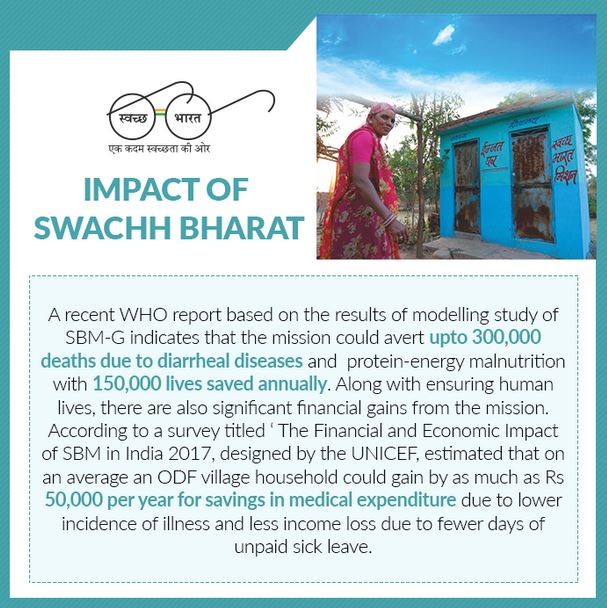
      • Over 9.5 crore toilets being built across the country since 2014;
      • 564,658 villages being declared Open Defecation Free (ODF);
      • 30 States/UT’s being 100% covered with individual household latrines (as of 2019).
    • Unique Approach of SBM: The approach of combining toilet construction with substantial investments in IEC (Information, Education, and Communication) and community engagement represents a marked departure from traditional efforts in India.
    • Novel Evidence of Impact: The study provides novel evidence of reductions in infant and child mortality following SBM’s comprehensive national sanitation program, indicating its transformative role in improving public health outcomes.
    • Asian Enigma: The report touches on the “Asian Enigma,” which highlights persistently high levels of undernutrition and stunting among children despite sufficient food availability, linking it to poor sanitation practices and open defecation.
     

    Successful Journey since Inception (2014-present):

    • Phase I (2014): The SBM 1.0  aimed to make urban centers open-defecation-free and improve sanitation infrastructure, particularly toilets.
        • The mission targeted constructing household, community, and public toilets, converting insanitary latrines, and improving solid-waste management.
    • Phase II (2020): The SBM 2.0 commenced in 2020, and is expected to run till 2025-26. It aims to sustain the achievements of phase I and ensure that treatment of both liquid and solid waste is achieved through the help of technology and private sector engagement.
    • This will focus on making Indian cities garbage-free by improving scientific waste management systems.

    Way forward: 

    • Global Model for Sanitation: India’s national sanitation campaign under SBM could serve as a model for other low- and middle-income countries where sanitation remains a major public health challenge.
    • Focus on Behavioral Change: Alongside infrastructure development, efforts are needed to sustain behavioural changes to eliminate open defecation.
    • Expand Sanitation Infrastructure in Rural Areas: Prioritize extending sanitation coverage and scientific waste management systems to underserved rural regions, building on the success of SBM to reduce mortality further and improve public health.

  • Capital Markets: Challenges and Developments

    House Panel includes SEBI review in agenda, likely to summon Buch 

    Note4Students

    From UPSC perspective, the following things are important:

    Prelims level: Market Economy; SEBI; Public Accounts Committee (PAC)

    Mains level: Market Economy; Issues related to regulatory bodies;

    Why in the News?

    The Public Accounts Committee (PAC) has included a review of SEBI’s performance, amid political controversy surrounding chairperson Madhabi Puri Buch following Hindenburg Research’s allegations.

    What are the allegations against SEBI?  

    • Conflict of Interest: SEBI chairperson Madhabi Puri Buch faces conflict of interest allegations due to her past ICICI Bank role amid Adani investigations.
    • Toxic Work Environment: Reports have surfaced from approximately 500 SEBI employees claiming that the work culture at the regulatory body is “toxic and fearful.” This has led to demands for an impartial inquiry into the alleged workplace issues and the overall management of SEBI.
    • Response to Allegations: Buch and SEBI have denied wrongdoing, asserting that all necessary disclosures and recusal norms have been followed diligently.

    Significance and Functions of the Public Accounts Committee (PAC)

    The PAC was introduced in 1921 after its first mention in the Government of India Act, 1919 (Montford Reforms).

    • Oversight Role: The PAC serves as a parliamentary watchdog for government spending, ensuring accountability and transparency in the use of public funds. It plays a crucial role in auditing the revenue and expenditure of the government.
    • Review of Regulatory Bodies: The PAC has the authority to review the performance of regulatory bodies established by the Act of Parliament.
    • Suo-motu subjects: The PAC can select subjects for in-depth examination beyond the standard audit reports, allowing it to address pressing issues that may arise in the public interest, such as the allegations against SEBI’s chairperson.
    • Advisory Role: While the PAC can make recommendations based on its findings, it does not have the authority to enforce compliance. Its recommendations are advisory in nature.

    How SEBI can improve its regulation considering recent challenges? (Way forward) 

    • Enhanced Disclosure Regulations: SEBI has already made progress with the SEBI (Listing Obligations and Disclosure Requirements) Regulations, 2023, but further refinement is needed.
      • It should focus on clarifying the scope of disclosures required from companies, particularly regarding financial irregularities and conflicts of interest.
    • Bolstering Whistleblower Protections: SEBI should strengthen its whistleblower protection framework to encourage the reporting of internal issues or malpractices, ensuring accountability and protection for informants.
    • Improving Internal Governance and Work Culture: SEBI can address concerns about a toxic work environment by conducting independent reviews of its internal governance, improving employee welfare, and fostering a transparent, positive work culture.
    • Collaborating with Global Regulatory Bodies: SEBI can work more closely with global financial regulators to align with international best practices and enhance cross-border market oversight, ensuring that India’s markets remain resilient and transparent.
  • Tourism Sector

    A tourism policy ill-suited for Jammu and Kashmir  

    Note4Students

    From UPSC perspective, the following things are important:

    Mains level: Impact of Tourism policy on Himalayan areas;

    Why in the News?

    Kashmir’s fragile environment faces severe damage from urbanization, commercialization, and climate change, underscoring the urgent need for a resilient and sustainable tourism model.

    Aims and Objectives of J&K Tourism Policy

    • Promoting all forms of Tourism: The policy aims to promote traditional recreational tourism as well as adventure, pilgrimage, spiritual, and health tourism. This diversification can attract a wider range of tourists.
    • Sustainable Practices: The policy emphasizes the need for sustainable tourism practices that minimize environmental degradation, conserve water, and protect biodiversity.
    • Infrastructure Development: It seeks to improve infrastructure, including hotels, roads, and recreational facilities, to accommodate the growing number of tourists.
    • Community Engagement: The policy aims to include local communities in tourism planning and decision-making processes, promoting their involvement in conservation efforts and sustainable practices.
    • Diversification of Tourism: By promoting various forms of tourism, such as eco-tourism, adventure tourism, and cultural tourism, the policy aims to reduce over-reliance on traditional tourist spots and distribute tourist footfall more evenly across the region.

    What are the effects of the new Policy? 

    Positive Impacts  Negative Impacts:
    • Increased Tourist Influx: Since the announcement of the New Tourism policy in 2020, over 40 million tourists have visited Kashmir.
    • Increase in Employment: The policy helps to generate employment of approximately 50,000 people per year, which can significantly boost the local economy.
    • Promotes Culture and Festivals: The policy promotes city-wise events and festivals with a pre-defined calendar to attract tourists.
    • Boosting Exports and Collaborations: The policy helps the handicraft industry, which was earlier limited to select destinations, to directly export and collaborate both nationally and internationally.
    • Environmental Stress: The rapid increase in tourist activities has led to significant ecological disturbances, including deforestation, waste accumulation, and pollution of water bodies.
    • Increase in Infra-strain: It also resulted in encroachment on natural habitats and increased pressure on local resources, such as water and electricity.
    • Climate Change Impact: The region is experiencing accelerated effects of climate change, including glacial depletion and erratic weather patterns, which threaten agricultural sustainability and water availability.

    Major Challenge: Fragility of the Region

    • Natural Disasters: Jammu and Kashmir is prone to natural disasters such as earthquakes, floods, and landslides, which can be exacerbated by unchecked commercialization and environmental degradation.
    • Ecological Sensitivity: The region’s delicate ecosystems are highly vulnerable to the impacts of tourism and urbanization, necessitating careful management to prevent irreversible damage.
    • Resource Depletion: The increased demand for water and energy resources is leading to the depletion of aquifers and heightened reliance on hydroelectric projects, which disrupt local aquatic ecosystems.

    Need for a Resilient Tourism Model (Way Forward)

    • Sustainable Tourism Practices: There is an urgent need to adopt a resilient and sustainable tourism model that prioritizes eco-friendly practices, waste reduction, and conservation of natural resources.
    • Community Involvement: Engaging local communities in tourism planning and decision-making is crucial for fostering sustainable practices and ensuring that the benefits of tourism are shared equitably.
    • Infrastructure Resilience: Developing infrastructure that can withstand extreme weather events and diversifying tourism offerings beyond peak seasons will help mitigate the impacts of climate change.
    • Policy Integration: A cohesive approach that integrates sustainable tourism policies with broader economic and environmental strategies is essential for preserving the region’s natural beauty while supporting local economies.
  • Finance Commission – Issues related to devolution of resources

    What is Vertical Fiscal Imbalance? 

    Note4Students

    From UPSC perspective, the following things are important:

    Prelims level: Finance Commission

    Mains level: Vertical Fiscal Imbalance (VFI) in India;

    Why in the News?

    The financial relationship between the Union and State governments in India is imbalanced, similar to other nations with a federal constitutional structure.

    What is Vertical Fiscal Imbalance (VFI)?

    Vertical fiscal imbalance (VFI) refers to the mismatch between the revenue-raising powers and expenditure responsibilities of different levels of government (between the Center and state) within a country.

    Why should Vertical Fiscal Imbalance (VFI) be reduced?

    • Decentralization of Expenditure: States are responsible for 61% of the revenue expenditure, focusing on crucial sectors like health, education, and infrastructure, but they generate only 38% of the revenue.
      • This imbalance creates a dependency on central transfers, limiting the States’ fiscal autonomy.
    • Need Efficiency in Spending: Reducing VFI would provide states with more resources, allowing them to respond better to local needs and improve governance efficiency.
    • Need to strengthen Fiscal Federalism: A reduction in VFI promotes a healthier system of cooperative federalism, ensuring that states have adequate resources to carry out their constitutional responsibilities and meet the demands of their populations.
    • Need Preparedness for crises: VFI becomes more pronounced during crises (e.g., COVID-19), leading to fiscal stress for States. A more balanced fiscal arrangement ensures better crisis management at the sub-national level.

    Present Scenario of VFI and Tax Devolution in India

    • VFI Extent: The 15th Finance Commission noted that despite States‘ heavy spending responsibilities, their revenue-raising powers are limited.
    • Tax Devolution Rates: The 14th and 15th FC recommended devolving 42% and 41%, however, estimates suggest that an average share of 48.94% was necessary between 2015-2023 to eliminate the VFI.
    • Exclusion of Cesses and Surcharges: The exclusion of cesses and surcharges from the divisible pool of taxes shortens the net proceeds. States argue this limits the resources available to them to meet their expenditure responsibilities.
    • Fiscal Responsibility: Despite the constraints, states have largely adhered to borrowing limits under fiscal responsibility legislation. However, states still struggle to meet their expenditure responsibilities, highlighting the need for greater financial support from the Centre.
    Note: The Sixteenth Finance Commission was constituted on December 31 2023 with Dr. Arvind Panagariya as the Chairman. The 16th FC has been requested to make its report available by the 31st day of October 2025 covering 5 years commencing on the 1st day of April, 2026.


    What should be the role objective of the 16th FC?

    • Increase Tax Devolution: Many States demand that tax devolution from the Union’s net proceeds should be raised to 50%. The 16th Finance Commission must consider raising the devolution rate to around 49% to address the VFI and ensure sufficient untied funds for States.
    • Address Cesses and Surcharges: The 16th Finance Commission should evaluate the exclusion of cesses and surcharges from the divisible pool.
    • Empower States with Fiscal Autonomy: The Commission’s objective should be to empower States with greater fiscal autonomy by ensuring adequate resources for them to perform their constitutional duties without undue dependence on the Centre.
    • Support Local Priorities: The Commission should aim to provide States with untied resources, enabling them to cater to jurisdictional needs and set priorities that align with their specific developmental challenges, ensuring a more responsive governance system.
  • Foreign Policy Watch: India-Africa

    Africa can make India’s ‘critical mineral mission’ shine  

    Note4Students

    From UPSC perspective, the following things are important:

    Prelims level: India-Africa Relations;

    Mains level: Significance of Africa for India; India-China;

    Why in the News?

    India has invested approximately $75 billion in Africa, focused on energy assets and mining.

    • This includes reaching out to resource-rich countries in Africa and Latin America to negotiate access to critical mineral resources.

    Recent Initiatives by the Indian Government:

    • Critical Mineral Mission (Union Budget 2024-25): This mission aimed at securing the supply of critical minerals crucial for India’s economic growth and green transition.
      • It focuses on expanding domestic production, recycling critical minerals, and incentivizing overseas acquisition.
    • Mines and Minerals (Development and Regulation) Amendment Bill, 2023: Removes six minerals from the atomic list, allowing private sector participation in their exploration.
      • This also supports India’s drive for self-reliance in critical minerals, such as lithium, cobalt, and rare earth elements.
    • Khanij Bidesh India Limited (KABIL): It was established in 2019 to secure overseas critical mineral assets. It Signed its first lithium exploration deal in Argentina in 2024, marking a significant step towards India’s goal of securing critical mineral supplies.

    Africa’s significance in advancing Global and Indian Priorities

    • Critical Mineral Reserves: Africa holds 30% of the world’s critical mineral reserves, making it a crucial partner for India’s supply chain needs.
    • Existing Partnerships: India has strong political, economic, and historical ties with Africa, including a three-million-strong diaspora and $98 billion in bilateral trade (2022-23), with a focus on mining and mineral sectors.
      • India has already invested $75 billion in Africa, largely for energy asset acquisition.
    • African Green Mineral Strategy: African countries are moving towards minerals-based industrialization. Policies in Tanzania, Zimbabwe, and Namibia focus on value addition, offering India an opportunity to align its critical mineral strategy with Africa’s development goals

    Major issues in Africa 

    • Sudan and Syria Issue:

        • Humanitarian Crisis: Sudan’s crisis is particularly acute due to its strategic location and resource wealth, leading to a massive displacement crisis, with over 10 million people displaced since April 2023
        • Parallel Conflicts: Both Sudan and Syria have experienced severe internal conflicts driven by authoritarian regimes, regional power plays, and foreign interventions, leading to widespread human suffering and instability.
    • India’s Strategic Considerations:

        • Economic Interests: India’s trade with Sudan reached $2,034 million in 2022-23, with a significant trade surplus. India has also invested heavily in Sudan’s oil sector, with cumulative investments worth $2.3 billion.
        • Historical Ties: India has maintained strong people-to-people ties with Sudan, including educational exchanges and medical tourism. President A.P.J. Abdul Kalam’s visit in 2003 reinforced these relations.
        • Humanitarian and Diplomatic Engagement: India evacuated its nationals early in the conflict, but the ongoing crisis may require continued diplomatic and humanitarian engagement to protect its broader interests in the region.
    • Challenges of China-Africa Debt:

      • Chinese loans to African countries amounted to approximately $170 billion from 2000 to 2022. However, Chinese lenders represent only about 12% of Africa’s total public and private debt, indicating that China is not the primary creditor.
      • A significant portion of Chinese loans is not disclosed in sovereign debt records, complicating the understanding of Africa’s overall debt levels. This lack of transparency raises concerns about the sustainability of these debts.
      • Despite concerns over “debt trap diplomacy,” China is unlikely to forgive or cancel debts but may consider writing off smaller, interest-free loans.

    China Domination:

    • China dominates the global critical mineral supply chain, particularly in cobalt mining in Africa (e.g., the Democratic Republic of Congo). China’s control poses significant risks for India, especially in terms of access and geopolitical influence.
    • Recently, China signed a $7 billion minerals-for-infrastructure deal, demonstrating its strategic approach to securing mineral resources in Africa.

    What are the opportunities for the Indian Government? (Way forward)

    • Collaborating on Infrastructure and Technology: India can support Africa’s critical mineral sector by building mining-adjacent infrastructure (e.g., railways, power grids) and providing technological solutions through its tech start-ups to enhance mining exploration, extraction, and processing.
    • Strengthening Diplomatic and Economic Ties: Leveraging existing partnerships and India’s deep historical ties with Africa, the government can work with African nations on strategic projects and value addition initiatives, supporting both regions’ developmental goals.
    • Reducing Dependence on China: By engaging with African countries for critical minerals, India can diversify its supply chains, reducing the economic and geopolitical risks posed by China’s dominance in the global critical mineral market.
  • Women Safety Issues – Marital Rape, Domestic Violence, Swadhar, Nirbhaya Fund, etc.

    State changes in Rape law

    Note4Students

    From UPSC perspective, the following things are important:

    Prelims level: Aparajita Bill, Disha Bill and Shakti Bill;

    Mains level: Issues related to women;

    Why in the News?

    Due to the ongoing protest in Kolkata, the WB Assembly has unanimously passed a Bill mandating the death penalty for rape cases where victims die or are left in vegetative states.

    Features of West Bengal’s Aparajita Bill:

    • Death Penalty: The Bill mandates the death penalty for individuals convicted of rape if the victim dies or is left in a permanent vegetative state. It also introduces the death penalty as the maximum punishment for all rape cases.
    • Amendments to Existing Laws: The Bill amends the Bharatiya Nyaya Sanhita, 2023, Bharatiya Nagarik Suraksha Sanhita, 2023, and the Protection of Children from Sexual Offences Act, 2012, to strengthen penalties for sexual offenses.
    • Special Task Force and Courts: It establishes a district-level Aparajita Task Force for investigating rape cases and mandates the creation of Special Courts to expedite trials, aiming to complete investigations within 21 days.
    • Increased Penalties for Repeat Offenders: The Bill enhances punishments for repeat offenders, replacing simple life imprisonment with rigorous life imprisonment.
    • Privacy Protections: It introduces penalties for unauthorized disclosure of a victim’s identity and for publishing information related to court proceedings in rape cases.
    • Focus on Speedy Justice: The Bill aims to reduce the time frame for investigations and trials, emphasizing a victim-centered approach to minimize trauma.

    How Bengal’s Aparajita Bill differ from the Andhra Pradesh and Maharashtra laws?

    Dimensions West Bengal (Aparajita Bill) Andhra Pradesh (Disha Bill) Maharashtra (Shakti Bill)
    Scope of Death Penalty Death is mandatory in cases of rape leading to the victim’s death or vegetative state Death penalty for the rape of minors below 16, gang rape, and repeat offenders Similar to Andhra Pradesh, it introduced the death penalty for heinous cases, such as acid attacks and severe rape cases, but it also does not mandate death in all instances.
    Special Institutions Aparajita Task Forces and Special Courts in every district specifically for rape cases, ensuring expedited legal proceedings with strict timelines. Propose Special Police Teams and Exclusive Special Courts for dealing with crimes against women, along with a registry for offenders. Formation of special courts but also emphasizes digital cooperation
    Timeframes for Legal Processes: Investigation time is 21 days (extendable to 15 more), and trials must be completed within 30 days post-chargesheet. Investigation time is  seven days and mandates trials be completed within 21 days. Completed within 15 working days after an FIR is filed, with an extension of up to 7 days if the investigating officer provides written reasons for the delay and the trial must be completed within 30 working days from the date of filing the charge sheet.
    Amendments to POCSO Introduces the death penalty for penetrative sexual assault under the POCSO Act. Amended the POCSO Act to include death penalties, particularly for heinous offenses, but do not make it mandatory in all cases. Same as Disha bill
    Use of Digital Platforms No available No available Unique features penalizing social media platforms and intermediaries that fail to provide requested data for investigations.

    Why President’s Assent is essential?

    • Criminal law falls under the Concurrent List of the Indian Constitution, meaning both state and central legislatures can legislate on the subject. However, state laws require the President’s approval to take precedence over existing central laws.
    • Without presidential assent, the provisions of the Aparajita Bill, as well as those from Andhra Pradesh and Maharashtra, cannot be enforced, rendering them ineffective despite being passed by the respective state assemblies.

    Conclusion:

    The state should launch public awareness campaigns and involve stakeholders to build broad-based support, emphasizing the Bill’s objectives of enhancing victim protection and delivering speedy justice to encourage timely presidential approval.

  • Foreign Policy Watch: India-ASEAN

     Singapore: A partner in India’s growth story  

    Note4Students

    From UPSC perspective, the following things are important:

    Prelims level: India-Singapore Bilateral Relations; ASEAN Countries;

    Mains level: India-Singapore Bilateral Relations;

    Why in the News?

    The PM’s upcoming visit to Singapore offers a chance to reflect on the current state of the relationship. India-Singapore ties are dynamic, continually presenting new opportunities.

    India-Singapore Bilateral Relations

    • Historical Ties: Diplomatic relations were established shortly after Singapore’s independence in 1965, with India being one of the first countries to recognize Singapore. 
      • The relationship has evolved through high-level visits and collaborations, particularly since the 1990s.
    • Look East Policy: Singapore has been pivotal in India’s “Look East” policy initiated in the early 1990s, which aimed to strengthen economic and strategic ties with Southeast Asia.
    • Comprehensive Economic Cooperation Agreement (CECA): Signed in 2005, CECA has significantly enhanced trade and investment ties, making Singapore India’s largest ASEAN trading partner and a key foreign direct investment (FDI) source.
    • Defense and Security Cooperation: The bilateral relationship includes extensive defence cooperation, with joint military exercises and training, particularly in maritime security, reflecting shared strategic interests.

    What is Singapore’s contribution to India’s Growth Story?

    • Economic Hub: Singapore is India’s largest trade partner in ASEAN. Singapore serves as a crucial gateway for Indian companies seeking to expand in Southeast Asia, providing a robust platform for trade and investment.
    • Largest Source of FDI:  It is the leading source of FDI, among the largest sources of External Commercial Borrowings and Foreign Portfolio Investment, accounting for about 17% of total FDI inflows since 2000, with investments exceeding USD 136 billion over the last 22 years. 
    • Knowledge exchange: Singapore’s status as a hub for Indian talent, especially from IITs and IIMs, facilitates knowledge exchange and enhances India’s capabilities in various sectors
    • Cultural Exchange: The strong cultural ties, supported by the Indian community in Singapore, have enriched bilateral relations. Ethnic Indians constitute approximately 9.1% of Singapore’s resident population.

    How this relationship can achieve more considering the ASEAN region and Chinese dominance? (Way forward)

    • Strategic Partnership: The relationship can be further strengthened by enhancing strategic dialogues and collaborations in areas like security, technology, and sustainability, particularly in the context of the Indo-Pacific region.
    • Regional Connectivity: Initiatives like the Trilateral Highway, which aims to connect India with Myanmar and Thailand, can enhance regional connectivity and trade, positioning India and Singapore as central players in ASEAN.
    • Countering Chinese Influence: As China asserts its influence in the region, India and Singapore can collaborate more closely to address shared concerns, leveraging their partnership to promote stability and security in Southeast Asia.
    • Emerging Technologies: Focusing on emerging sectors such as semiconductors, green technologies, and electric mobility can open new avenues for cooperation, aligning with both nations’ goals for sustainable development.
  • Government Budgets

    Gap between allocations for health, outcomes in States 

    Note4Students

    From UPSC perspective, the following things are important:

    Prelims level: Centrally Sponsored initiatives related to the Health sector;

    Mains level: Health Infrastructure and Funding in India;

    Why in the News?

    Realizing the full potential of Union Budget 2024-25 health allocations depends on State-level factors, as states share costs and handle the implementation of Centrally Sponsored Schemes (CSS).

    About the two major Centrally Sponsored initiatives  

    • Pradhan Mantri Ayushman Bharat Health Infrastructure Mission (PM-ABHIM): Focuses on improving health infrastructure through health and wellness centres (AB-HWCs), block-level public health units (BPHUs), district public health laboratories (IDPHLs), and critical care hospital blocks (CCHBs).
    • Human Resources for Health and Medical Education (HRHME): Aims to boost medical personnel by building new medical, nursing, and paramedical colleges, increasing seats, and upgrading district hospitals to medical colleges.

    Issue of Low Fund Utilization and Faculty Shortage:

    • Poor Fund Absorption in PM-ABHIM: Fund absorption has been poor, with only 29% used in 2022-23. The reasons are – complex execution structures, reliance on health grants from the 15th FC (only 45% utilized), and delays in construction due to rigid procedures.
    • Low Fund Utilization in HRHME: Utilization of funds in educational infrastructure was only around 25% of the budget estimates in both 2022-23 and 2023-24. 
    • Shortage of teaching faculty: There is a significant shortage of teaching faculty in newly established medical institutions, with over 40% vacancies reported in 11 of the 18 All India Institutes of Medical Sciences.
    • For example, in Uttar Pradesh, 30% of teaching faculty positions were vacant in 2022 for government medical colleges established between 2019-21.
    • Lack of specialist positions: The shortage of specialists affects the establishment and upgrading of medical colleges and district hospitals, with more than a third of sanctioned specialist positions in urban CHCs and two-thirds in rural CHCs remaining vacant as of March 2022.

    How can states work on Fiscal space? (Way forward)

    • Enhanced Budget Planning and Allocation: States should prioritize and allocate funds efficiently for health infrastructure and recurring costs.
    • Strengthening Revenue Generation: States can explore increasing their own revenue sources through improved tax collection, introducing new revenue streams, or enhancing public-private partnerships. 
    • Optimizing Expenditure Management: Implementing better financial management practices, such as cost control measures, transparent procurement processes, and efficient use of existing resources, can help in managing and maximizing the impact of budget allocations for health infrastructure and services.
  • Why gold nuggets are found in quartz veins?

    Note4Students

    From UPSC perspective, the following things are important:

    Prelims level: World's orogenic gold systems;

    Mains level: Reason and significance of the world's orogenic gold systems;

    Why in the News?

    Researchers have been curious about why the majority of gold nuggets discovered throughout history have been found in orogenic quartz veins.

    Location and distribution of Gold:

    • Orogenic gold systems are commonly found in mountainous regions where large-scale geological processes, such as the collision of tectonic plates, have occurred.
    • For example, the Himalayas, the Canadian Shield, and the Western Australian goldfields.
    • Large gold nuggets are often found in orogenic quartz veins formed during the tectonic processes that create mountains.
    • These nuggets form because, during earthquakes, the stress on quartz crystals causes a reaction that deposits gold on their surfaces. This process happens repeatedly, leading to the accumulation of gold nuggets.

    Note: 

    • Gold nuggets are naturally occurring pieces of gold that have formed into lumps or chunks. They are typically found in riverbeds, streams, or within rock formations, often in quartz veins.
    • Orogenic quartz veins are quartz veins that form in mountainous regions.

    Findings by Researchers:

      • Piezocatalytic Effect and Gold Accumulation: Researchers discovered that the piezocatalytic effect of quartz under seismic stress causes the accumulation of gold in quartz veins.
        • The piezoelectric quartz crystal generates an electric field when subjected to stress. 
        • This field can drive electrochemical reactions at the interface between the quartz and a surrounding aqueous solution containing dissolved gold. These reactions cause gold to be deposited on the quartz surface. 
      • Seismic Activity and Localized Gold Deposits: The study suggests that gold nuggets in orogenic systems are formed through repeated piezocatalytic reactions over time, driven by natural seismic activity. This process explains the highly localized and interconnected nature of gold deposits within quartz veins.
      Conclusion: Researchers have found that gold nuggets in orogenic quartz veins form through piezocatalytic reactions caused by seismic stress on quartz. This process drives gold deposition on quartz surfaces, explaining the concentration and localization of gold in mountainous regions.

    Mains PYQ:

    Q Craze for gold in Indian has led to surge in import of gold in recent years and put pressure on balance of payments and external value of rupee. In view of this, examine the merits of Gold Monetization scheme. (UPSC IAS/2015)

  • Tax Reforms

    Did Corporate Tax cuts increase Wages?

    Note4Students

    From UPSC perspective, the following things are important:

    Mains level: Impact of tax cut on the economy;

    Why in the News?

    Before the pandemic, the U.S. and India reduced corporate taxes to boost growth but we now we can evaluate their effects.

    Case Study on the Effects of Tax Cuts in the U.S.

    The Tax Cuts and Jobs Act (TCJA), enacted in December 2017, significantly reduced the corporate tax rate from 35% to 21%. A recent analysis by economists Gabriel Chodorow-Reich, Owen Zidar, and Eric Zwick highlights several key findings:

    • Investment Increase: The TCJA led to an estimated increase in investment of approximately 8% to 14%.
    • GDP Growth: The long-term increase in GDP is projected to be modest, around 0.9%, which is substantially lower than initial expectations.
    • Wage Impact: The increase in annual wages due to the tax cuts was less than $1,000 per worker, contrasting sharply with earlier claims of increases between $4,000 and $9,000.
    • Tax Revenue Decline: The TCJA is expected to result in a long-term reduction in tax revenue of nearly 41%, raising concerns about the fiscal health of the U.S. economy.

    Tax Cuts in India

    In September 2019, India also implemented corporate tax cuts, reducing the rate for existing companies from 30% to 22% and for new companies from 25% to 15%.  The primary reason for this move was to stimulate economic growth and attract investment, particularly in the manufacturing sector.

    Impact of the Tax cuts:

    • Revenue Loss: The tax cuts resulted in a revenue loss of approximately ₹1 lakh crore in 2020-21.
    • Gig workers (insecure forms of work): Although unemployment has decreased since the pandemic, much of the new employment is in insecure forms of work.
    • Decline in Regular Employment: According to the Periodic Labour Force Survey (PLFS) in India, the share of regular wage employment fell from 22.8% in 2017-18 to 20.9% in 2022-23.
    • Tax Burden Shift: There has been a notable shift in the tax burden from corporate taxes to individual income taxes. The share of corporate taxes in gross tax revenues fell from about 32% in 2017-18 to 26.5% in 2024-25.

    What must be the next step? ( Way forward)

    • Focus on Future Investment: Policymakers should consider implementing high taxes on existing profits while providing incentives for future investments to stimulate economic activity.
    • Addressing Income Inequality: Tax policies should be designed to ensure that the benefits of tax cuts do not disproportionately favour wealthier individuals or corporations at the expense of wage earners.
    • Evaluating Economic Conditions: Need to evaluate the tax cuts to ensure they are not merely providing short-term benefits without addressing long-term growth and fiscal stability.

    Mains PYQ:

    Q  Enumerate the indirect taxes which have been subsumed in the Goods and Services Tax (GST) in India. Also, comment on the revenue implications of the GST introduced in India since July 2017. (UPSC IAS/2019)
