💥UPSC 2026, 2027, 2028 UAP Mentorship (March Batch) + Access XFactor Notes & Microthemes PDF

Type: Explained

  • Foreign Policy Watch: India-Myanmar

    India issues new advisory against fake job rackets in Myanmar, flags another ‘dangerous’ area

    Note4Students

    From UPSC perspective, the following things are important:

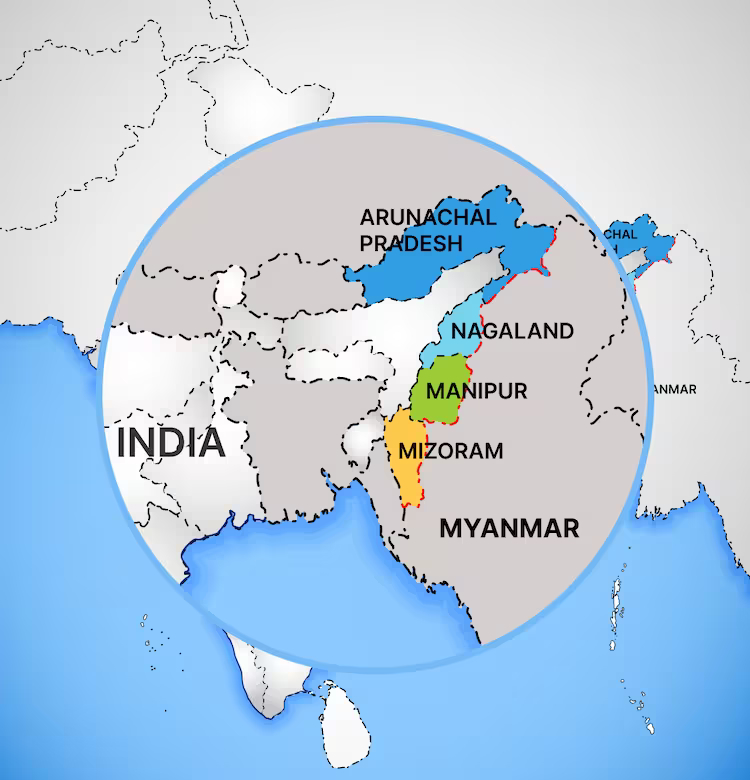
    Prelims level: States bordering with Myanmar


    Why in the news?

    The advisory was shared on social media by the Indian Embassy in Yangon on Monday (June 3 2024), urging caution against job offers in the Pha Lu area, south of Myawaddy town. This region has recently emerged as a hotspot where most Indian victims are being trafficked, often via Thailand.
    Highlights made by the Indian Embassy’s Advisories:

      • The embassy has issued multiple advisories warning against fake job rackets in Myanmar, highlighting the significant and ongoing threat.
      • Declared New Danger Zone: The Pha Lu area, south of Myawaddy town, has been identified as a new hotspot for trafficking, necessitating heightened vigilance. Previous advisories flagged Myawaddy, Yangon, Laukkaing, Lashio, and Tachileik as risky areas.
        • There’s been a rise in Indian nationals falling victim to crime syndicates in the Myawaddy region on the Myanmar-Thailand border.
    • On Security Issues:
      • Broader insecurity: Not just Indian nationals, but individuals from countries like Malaysia and the UAE have also been targeted by these syndicates.
      • Social Media Caution: Emphasis on avoiding job offers made through social media or unverified sources.
      • Security Worsening: The security situation in Myanmar has deteriorated since the February 2021 military coup, exacerbating human trafficking issues.
    • Consultation Urged: Indian nationals are urged to verify job offers and consult respective Indian embassies before accepting employment abroad.

    India-Myanmar Bilateral Relations:

      • India and Myanmar signed a Treaty of Friendship in 1951, and the visit of Prime Minister Rajiv Gandhi in 1987 laid the foundations for a stronger relationship.

    Significance of India-Myanmar Relation:

      • Economic Cooperation: India is Myanmar’s 4th largest export market and 5th largest import partner. The bilateral trade target of $1 billion was achieved by 2017.
      • Strategic Cooperation: India’s engagement with Myanmar is motivated by a desire to counter China’s growing influence in the region and enhance its own influence and standing.
      • Security Ties: India and Myanmar have cooperated on security issues, including combating drug trafficking and insurgent groups operating in the border areas.
      • Recent Developments: India gifted Myanmar its first submarine, and the two countries have carried out joint operations against insurgent camps.

    The relationship faces challenges such as the Rohingya issue, the coup by the military junta, and the exploitation of the porous border by terrorist outfits and insurgent groups

    Way Forward:

    • Need Monitoring and Ground Surveillance: India can collaborate with social media platforms to monitor and remove fraudulent job postings and take legal action against those responsible.
    • Stronger Bilateral Cooperation: Strengthen cooperation with Myanmar and neighboring countries like Thailand, Laos, and Cambodia to crack down on human trafficking networks and facilitate the safe return of victims.

    Mains PYQ:

    Q Cross-border movement of insurgents is only one of the several security challenges facing the policing of the border in North-East India. Examine the various challenges currently emanating across the India-Myanmar border. Also, discuss the steps to counter the challenges. (UPSC IAS/2019)

  • Foreign Policy Watch: India-Canada

    India second-biggest foreign threat to Canadian democracy: report

    Note4Students

    From UPSC perspective, the following things are important:

    Mains level: Challenges between India and Canada

    Why in the news?

    A parliamentary committee report in Canada has claimed India as the second-biggest foreign threat to the country’s democracy.

    About the Khalistan Movement

    • Origins and Objectives: The Khalistan Movement is a separatist movement seeking to create an independent Sikh state called Khalistan in the Punjab region of India.
    • Activities in Canada: Canada has a significant Sikh population, and some members support the Khalistan Movement. This has led to tensions between Canadian Sikhs and the Indian government.
    • Notable Incident: The murder of Hardeep Singh Nijjar, a pro-Khalistan ideologue, in Surrey, British Columbia, on June 18, 2023, intensified these tensions.

    Historical Background

    • Canada and India established diplomatic relations in 1947. The relationship was enhanced by personal ties between Indian Prime Minister Jawaharlal Nehru and Canadian Prime Ministers Louis St. Laurent and Lester B. Pearson in the 1940s and 1960s.
    • Canada provided significant aid to India under the “Colombo Plan”, including food aid, project financing, and technical assistance. India has been one of the largest recipients of Canadian bilateral aid, amounting to over $3.8 billion CAD.

    Recent Developments

    • India and Canada have seen significant growth in bilateral trade, reaching $8.16 billion in 2023.
    • Canada is home to over 1.2 million people of Indian origin, who are well-integrated into the mainstream and active in politics.
    • The two countries have a strategic partnership underpinned by shared values of democracy and pluralism, with regular high-level interactions and long-standing people-to-people ties.
    • India and Canada have signed several agreements, including the Air Services Agreement, Extradition Treaty, Mutual Legal Assistance Treaty, and Nuclear Cooperation Agreement.

    Challenges

    • Interference Allegations: Canada claims that India has expanded its interference efforts beyond countering pro-Khalistani activities to include targeting Canadian politicians, ethnic media, and Indo-Canadian communities.
    • Mutual Suspicion: The Canadian Security Intelligence Service has also accused India of being involved in the election process in Canada, a claim denied by India.
    • Ethnic and Political Dynamics: The presence of a significant pro-Khalistan population in Canada complicates bilateral relations, with domestic politics in both countries influencing diplomatic interactions.

    India’s Stand

    • Denial of Allegations: The Indian government has consistently denied allegations of interference in Canadian affairs and the murder of Hardeep Singh Nijjar.
    • Counter-Terrorism: India views the Khalistan Movement as a terrorist threat and seeks to counter its activities both domestically and internationally.
    • Diplomatic Responses: In response to accusations from Canada, India has taken measures such as suspending visa services and issuing official statements to refute claims of interference.

    Way forward:

    • Regular Consultations: Establish a framework for regular high-level meetings between Indian and Canadian officials to address mutual concerns and prevent misunderstandings.
    • Bilateral Committees: Form joint committees to handle specific issues such as security concerns, immigration, and trade disputes.

    Mains question for practice:

    Q Discuss the origins and objectives of the Khalistan Movement and analyse the current challenges it poses to bilateral relations between India and Canada. 15M

  • Capital Markets: Challenges and Developments

    Regulator SEBI expands promoter definition for IPO-bound companies    

    Note4Students

    From UPSC perspective, the following things are important:

    Prelims level: SEBI and its regulatory functions

    Mains level: Issue Over Subjective Definition

    Why in the news?

    • SEBI expands promoter definition for IPO-bound companies, including founders holding 10% or more, and their immediate relatives.
      • According to current SEBI regulations, a promoter is someone who controls the affairs of the company or can appoint the majority of directors or is named as such in an offer document.

    What is an IPO?

    • An IPO is an initial public offering, in which shares of a private company are made available to the public for the first time.
    • An IPO allows a company to raise equity capital from public investors.
    • The Dutch are credited with conducting the first modern IPO by offering shares of the Dutch East India Company to the general public.

    What Norms Say

    • Expanded Definition of Promoter: The definition of a promoter has been expanded for companies preparing for an IPO. A promoter is someone who controls the company’s affairs, can appoint the majority of directors, or is named as such in an offer document.
    • Previous Criteria: Founders holding 25% were previously deemed promoters due to their negative control and power to block special resolutions.
    • New Criteria: Founders holding 10% or more must classify themselves as promoters if they are key managerial personnel (KMP) or directors in the company. Immediate relatives on the company board or KMP will also be classified as promoters, even if they hold just 1%.

    About Declassification and 31A of LODR (Listing Obligations and Disclosure Requirements) Regulations

    • Declassification Difficulty: The current regulations do not provide an easy path for declassifying a promoter as a public shareholder.
    • Rule 31A of LODR Regulations: To be declassified, a person must not hold more than 10% in the listed company along with their relatives.
    • Restrictive Nature: This restrictive rule makes declassification almost impossible for immediate relatives who are classified as promoters by virtue of their relationship, especially problematic for married daughters with no active role in the company.

    Issue Over Subjective Definition

    • Subjective Nature of Promoter Definition: The definition of a promoter has been historically subjective, leading to varying interpretations and legal disputes.
    • Court Rulings: There have been several court rulings addressing the subjective nature of who qualifies as a promoter, highlighting inconsistencies and complexities.
    • Complex Criteria: Accounting standards and regulatory criteria for determining control and influence in a company are often complicated and can be interpreted in multiple ways.
    • Need for Objectivity: Experts argue for a more objective test to ascertain control and promoter status, which would provide clearer guidelines and reduce disputes.
    • Example: Vinod Kothari, Director at Vinod Kothari Consultants, points out that moving towards an objective test is a positive step, given the current complexities in determining control.

    Way forward: 

    • Standardised Guidelines: Develop clear and standardised guidelines for identifying promoters, reducing subjectivity and ensuring consistency.
    • Detailed Disclosures: Mandate detailed disclosures from companies about their promoters, including shareholding patterns, roles, and influence in decision-making.

    Mains PYQ:

    Q In the light of Satyam Scandal (2009), discuss the changes brought in corporate governance to ensure transparency and accountability. (UPSC IAS/2015)

  • Women empowerment issues – Jobs,Reservation and education

    The representation of women in the incoming Lok Sabha, how it compares to previous years

    Note4Students

    From UPSC perspective, the following things are important:

    Prelims level: Women in Lok Sabha 2024

    Mains level: Different Demographic Observations and What Needs to Be Done?

    Why in the news?

    Over time, there has been a general inclination towards enhancing women’s representation in the Lok Sabha. However, the advancement has been gradual and inconsistent.

    Women in Lok Sabha 2024 (PRS data):

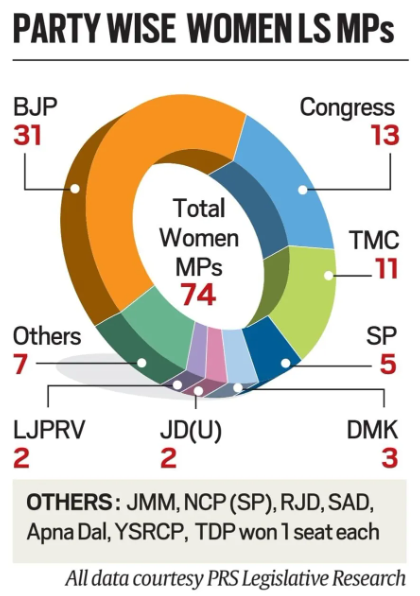
    • Number of Women MPs: India has elected 74 women MPs to the Lok Sabha in 2024, which is four fewer than in 2019.
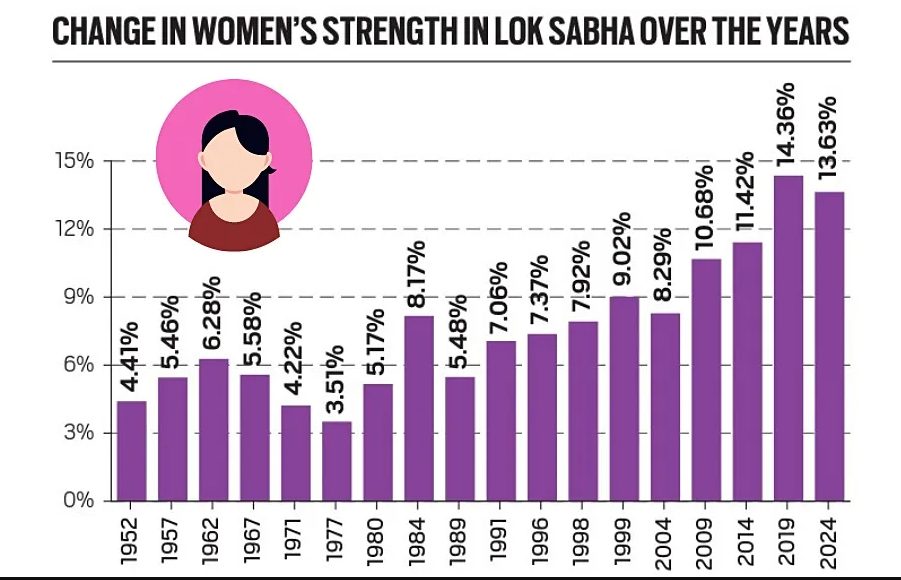
    • Percentage of Representation: Women MPs make up just 13.63% of the elected strength of the Lower House.
    • Party-wise Distribution: Women MPs come from 14 different parties, with the BJP leading with 31 women MPs, followed by the Congress with 13.

    Different Demographic Observations:

    • Trend in Representation: Over the years, there has been a slow and non-linear increase in women’s representation in the Lok Sabha.
    • Historical Trends: Women’s representation started at 4.41% in 1952 and peaked at 14.36% in 2019.
    • New Faces: Out of the 74 women MPs elected, 43 are first-time MPs, indicating a higher percentage of newcomers compared to the overall House.
    • Younger Representation: The average age of women MPs is 50 years, younger than the overall House age of 56 years.

    Comparison with Other Countries:

    • International Comparison: India lags behind several countries in terms of women’s representation, with countries like South Africa, the UK, and the US having higher percentages of women MPs.
    • Global Rankings: Women make up 46% of MPs in South Africa, 35% in the UK, and 29% in the US.

    What Needs to Be Done?

    • Increase in Representation: There is a need for greater efforts to increase women’s representation in the Lok Sabha to achieve gender parity.
    • Policy Measures: Implementation of policy measures such as reserving seats for women in the Lok Sabha could help improve representation.
    • Encouraging Participation: Encouraging more women to enter politics and providing support for their political careers can contribute to greater representation.
    • Education and Awareness: Promoting education and awareness about the importance of gender equality in politics is essential for fostering a more inclusive political environment.

    Mains PYQ:

    Q What are the continued challenges for Women in India against time and space?  (UPSC IAS/2019)

  • Innovations in Biotechnology and Medical Sciences

    Will understanding Cancer become a data problem? 

    Note4Students

    From UPSC perspective, the following things are important:

    Mains level: Use of Data Analytical Tools in Diagnosis

    Why in the news?

    WHO reports 33,000 new brain cancer cases yearly in India, highlighting widespread suffering.

    What is brain cancer?

    • Brain cancer, also known as primary brain cancer, is an overgrowth of cells in the brain that form masses called brain tumours.
    • It is different from secondary brain cancer, which occurs when cancer that began in another part of the body spreads to the brain

    The World Health Organization (WHO) Report:

    • Incidence of Brain Cancer: WHO reports approximately 33,000 new incidences of brain cancer annually in India.
    • Global Cancer Observatory 2020: Brain cancer ranks as the 19th most common type of cancer worldwide.

    Use of Data Analytical Tools in Diagnosis:

    • Potential of Data Analytics: Utilization of data analytical tools like Next-Generation Sequencing (NGS) can simplify the diagnosis process.
    • Advantages: Data analysis can provide real-time results with precision, reducing the need for invasive procedures like surgeries.
    • Liquid Biopsy: The introduction of techniques like liquid biopsy offers a less invasive alternative to surgery, enhancing patient comfort.

    Impact on Risks, Discomfort, and Pain:

    • Reduction of Risks: Adoption of data analytics in diagnosis can lower the risks associated with invasive procedures, ranging from short-term paralysis to death.
    • Enhanced Patient Experience: By offering less invasive alternatives, such as liquid biopsy, patients and their families can experience reduced discomfort and pain during the diagnostic process.
    • Improved Precision: Data analytics enable clinicians to detect genetic patterns indicative of cancer cells, facilitating early detection and treatment planning, ultimately leading to better outcomes for patients.

    Way forward:

    • Emphasize the transformative potential of data analytics in oncology research, particularly in simplifying diagnosis and reducing risks and discomfort for patients.
    • Highlight the importance of leveraging innovative technologies like NGS to unlock new possibilities in cancer research and treatment.

    Mains PYQ:

    Q What are the research and developmental achievements in applied biotechnology? How will these achievements help to uplift the poorer sections of the society? (UPSC IAS/2021)

  • Nuclear Diplomacy and Disarmament

    Do North Korea’s trash balloons indicate an escalation?

    Note4Students

    From UPSC perspective, the following things are important:

    Prelims level: Why South Korea has suspended the 2018 agreement?

    Why in the news?

    South Korea has suspended the 2018 peace agreement and announced the possibility of resuming propaganda broadcasts in North Korea following Pyongyang’s release of thousands of balloons filled with trash and human waste into the South.

    Inter-Korean Peace Agreement, 2018

    • The 2018 inter-Korean peace agreement refers to several agreements and declarations made between North and South Korea to reduce military tensions and improve diplomatic relations. Key elements of the agreement included:
      • Ceasefire Maintenance: Maintaining and reinforcing the Korean Armistice Agreement.
      • Demilitarization: Implementing measures to reduce military tensions, such as dismantling guard posts in the Demilitarized Zone (DMZ).
      • Family Reunions: Facilitating family reunions for those separated by the Korean War.
      • Economic Cooperation: Pursuing economic projects and infrastructure development.
      • Propaganda Halt: Both sides agreed to cease propaganda broadcasts and leaflet drops across the DMZ.

    Why did South Korea suspend the 2018 agreement?

    • Recent Provocations: North Korea’s recent aggressive actions, including GPS signal jamming, missile launches, and the release of balloons carrying trash and human waste, pose a threat to South Korean security and civilian safety.
    • Lack of Trust: The ruling People Power Party (PPP) in South Korea cited a significant erosion of trust between the two Koreas. Senior PPP official Choo Kyung-ho emphasized that mutual trust needs to be restored for any agreements to be honoured.
    • Calls for Apology: South Korea demands an immediate apology from North Korea for these provocations, highlighting the need for accountability and reparations for the damages caused.

    North Korea emboldened by Russian support 

    • Military Assistance: The US has warned that Russia is aiding North Korea in developing advanced weapons technologies, such as hypersonic missiles, in exchange for artillery shells amid Russia’s ongoing war in Ukraine.
    • Diplomatic Shield: As a permanent member of the UN Security Council, Russia provides a diplomatic shield for North Korea, stalling efforts to pass new resolutions condemning North Korean actions. This backing allows Pyongyang to act more aggressively without significant international repercussions.

    Escalated Danger of Conflict

    The situation on the Korean Peninsula poses an escalated danger of conflict due to several factors:

    • Aggressive Posturing: North Korea’s recent actions, including missile tests and aerial provocations, signal an aggressive stance that could lead to military confrontations.
    • Policy Shift: Analysts believe Kim Jong Un may be deviating from the defensive policies of his predecessors, adopting a more aggressive strategy aimed at altering the status quo on the peninsula.
    • International Alliances: North Korea’s alignment with Russia, and possibly other authoritarian states like China and Iran, suggests a willingness to use military force to achieve geopolitical goals, challenging the US-led liberal world order.
    • Military Preparedness: The South Korean military and its allies need to stay vigilant as North Korea tests the South’s air defences and military response times, indicating a higher readiness for potential conflict.

    Way forward:

    • Engage in Multilateral Talks: Revitalize dialogue with key stakeholders, including the United States, China, Japan, and Russia, to address North Korea’s actions and find diplomatic solutions.
    • Leverage International Organizations: Utilize platforms like the United Nations to garner international support and pressure North Korea to comply with international norms.

    Mains PYQ: 

    Q Evaluate the economic and strategic dimensions of India’s Look East Policy in the context of the post-Cold War international scenario. (UPSC IAS/2016)

  • Renewable Energy – Wind, Tidal, Geothermal, etc.

    Securing India’s energy transition 

    Note4Students

    From UPSC perspective, the following things are important:

    Prelims level: Critical Mineral Acquisition Plans of India in Africa

    Mains level: Government Initiatives to Secure Critical Minerals

    Why in the news?

    India has signed new agreements and updated existing ones with a dozen African countries to secure critical minerals. This initiative is crucial for achieving India’s energy transformation goals.

    India’s Critical Mineral Acquisition Plans in Africa

    • India has signed new agreements and updated existing ones with a dozen African countries to secure critical minerals.
    • This initiative is crucial for India’s energy transformation goals, aiming to diversify sources and reduce dependence on any single supplier.
    • The agreements are part of a broader strategy to secure access to minerals necessary for renewable energy technologies and electric vehicles.

    Demand for Energy in India and China’s Dominance

    • Energy Demand in India: India’s peak power demand increased to 250 GW in 2023-24, marking a 12.7% increase from the previous year. By 2030, India’s peak power demand is expected to reach 366 GW, up from the current level of 240 GW.
    • China’s Dominance: China leads in securing and processing critical minerals, having established long-term relationships with mineral-rich countries in Africa and Latin America. Chinese companies dominate mining rights in economically poor yet mineral-rich nations.
      • China has built significant capacities for processing and refining minerals, making it the primary global hub for critical mineral processing.

    India’s Other Overseas Critical Mineral Acquisition Plans

    • Earlier this year, India signed an agreement with Argentina to explore and develop five lithium brine blocks.
    • The Geological Survey of India (GSI) discovered inferred lithium reserves of 5.9 million tonnes in Jammu & Kashmir.
    • India aims to diversify its sources of critical minerals by securing mining leases abroad, ensuring a stable and sustainable supply chain.

    Government Initiatives to Secure Critical Minerals

    • Exploration and Geological Studies: The government is pushing for more extensive exploration and geological studies within India to identify potential reserves of critical minerals. The Geological Survey of India has been tasked with accelerating the exploration of India’s 3.2 lakh sq km land mass using new data and technologies.
    • Securing Mining Leases Abroad: India is focusing on securing mining leases in other countries to ensure a diversified supply of critical minerals. The agreements with African countries and Argentina are examples of this strategy.
    • Building Domestic Capacities: The government is providing incentives to build refining and processing capacities within India for critical minerals. There is an emphasis on attracting private miners, both domestic and global, to participate in critical mineral exploration within India.
    • Policy and Auction Reforms: The government is analyzing why auctions often fail to generate enough interest and is considering policy changes to attract big players. Coordinated efforts between the Centre and state governments on clearances and royalty payments are being emphasized to streamline the auction process.
    • White Hydrogen Exploration: There is a call for active exploration of potential White Hydrogen deposits within India’s geographical borders.

    Way forward:

    • Accelerate exploration efforts across India’s 3.2 lakh sq km land mass.
    • Utilize new data sources and advanced technologies to identify potential reserves of critical minerals.
    • Focus on unexplored areas for potential discoveries of critical minerals, including White Hydrogen deposits.

    Mains PYQ:

    Q Do you think India will meet 50 percent of its energy needs from renewable energy by 2030? Justify your answer. How will the shift of subsidies from fossil fuels to renewables help achieve the above objectives? Explain. (UPSC IAS/2022)

  • Electoral Reforms In India

    Two lakh plus NOTA votes in Indore: Why NOTA was introduced, its consequences

    Note4Students

    From UPSC perspective, the following things are important:

    Prelims level: NOTA

    Mains level: Impact of NOTA Receiving the Highest Number of Votes in a Particular Constituency

    Why in the news? 

    Over 200,000 votes were cast for NOTA in the Indore Lok Sabha constituency. Let’s explore the reasons behind the introduction of this option and what occurs if, in an improbable scenario, NOTA garners more votes than all other candidates.

    Back2Basics: NOTA in Indian Elections

    • NOTA, which stands for None of The Above, is an electoral choice where voters can express their disapproval of all the candidates in a voting system.
    • In the 2013 PUCL v. Union of India case, the Supreme Court mandated the use of NOTA in direct elections for the Lok Sabha and State Assemblies.
    • The ruling specified that in such elections, voters should have the option to select to indicate their dissatisfaction with all candidates or political parties listed on the ballot.
    • The NOTA option was first used in the 2013 legislative assembly elections held in four states—Chhattisgarh, Mizoram, Rajasthan, and Madhya Pradesh, and the union territory of Delhi.

    Impact of NOTA Receiving the Highest Number of Votes in a Particular Constituency

    1. Legal Consequence:

    • Current Status: NOTA has no legal consequence; the candidate with the highest votes after NOTA wins the election.
    • Indore Case: Shankar Lalwani won with a massive margin over NOTA, which received the highest number of votes ever recorded for NOTA in any constituency.
    • Possible Change: There are ongoing discussions and petitions urging that elections be declared null and void if NOTA receives the highest number of votes.

    2. Future Considerations:

    • Petition by Shiv Khera: Calls for the ECI to frame guidelines to declare elections null and void if NOTA receives the majority vote and to debar candidates who receive fewer votes than NOTA for five years.

    Judicial Stand

    • 2013 Judgment: The Supreme Court ruled that the right to secrecy in voting includes those who choose not to vote, mandating the introduction of the NOTA option.
    • Rationale: The Court emphasised that secrecy is an essential feature of free and fair elections, supported by the introduction of EVMs to maintain voter anonymity.

    Current Deliberations:

    • New Petition (2024): The Supreme Court is considering a petition to make elections null and void if NOTA gets the highest votes, with additional consequences for candidates.
    • State-Level Precedents: Some states and union territories (e.g., Maharashtra, Haryana, Delhi) have declared NOTA as a “Fictional Electoral Candidate” for local elections, mandating fresh elections if NOTA receives the majority vote.

    Way forward:

    • Null and Void Clause: Introduce a clause in the Representation of the People Act to declare elections null and void if NOTA receives the highest number of votes.
    • Debarment of Candidates: Amend the law to debar candidates who receive fewer votes than NOTA from contesting elections for a specified period (e.g., five years).

    Mains PYQ:

    Q Discuss the procedures to decide the disputes arising out of the election of a Member of the Parliament or State Legislature under The Representation of the People Act, 1951. What are the grounds on which the election of any returned candidate may be declared void? What remedy is available to the aggrieved party against the decision? Refer to the case laws. (UPSC IAS/2022)

  • Capital Markets: Challenges and Developments

    SEBI forms panel for reviewing economic structure of clearing corporations  

    Note4Students

    From UPSC perspective, the following things are important:

    Prelims level: What is a Clearing Corporation?

    Mains level: Significance of Usha Thorat Committee Reviewing the Ownership and Economic Structure of Clearing Corporations

    Why in the news?

    SEBI forms a committee to review clearing corporations’ ownership and economic structure, aiming to enhance resilience, independence, and neutrality as risk managers.

    About the Securities and Exchange Board of India (SEBI):

    • SEBI is the capital markets regulator in India responsible for regulating the securities market and protecting the interests of investors.
    • It was established in 1988 and given statutory powers in 1992 under the SEBI Act.
    • SEBI’s functions include regulating stock exchanges, registering and regulating brokers and other intermediaries, and promoting fair and transparent securities markets.

    What is a Clearing Corporation? 

    • A clearing corporation is a central counterparty (CCP) that provides clearing and settlement services for trades executed on various exchanges.
    • It acts as an intermediary between buyers and sellers, guaranteeing the completion of transactions and managing counterparty risk.
    • Clearing corporations ensure the smooth functioning of financial markets by facilitating the timely settlement of trades and reducing systemic risk.

    About Usha Thorat Committee on Reviewing the Ownership and Economic Structure of Clearing Corporations:

    • SEBI has formed a committee chaired by Usha Thorat, former Deputy Governor of the Reserve Bank of India (RBI), to review the ownership and economic structure of clearing corporations.
    • The committee’s mandate includes examining the ownership structure and finances of clearing corporations to ensure their resilience, independence, and neutrality as risk managers.
    • It will assess the feasibility of broadening the list of eligible investors allowed to hold stakes in clearing corporations and suggest categories of investors who can acquire such stakes.
    • The committee will also explore alternative ownership structures and shareholding patterns suited to an interoperable environment, where clearing corporations provide services across multiple exchanges.
    • It aims to propose alternatives that address the periodic capital needs of clearing corporations and ensure sufficient capital and liquidity during market-wide systemic stress.
    • The current ownership structure of clearing corporations is dominated by the parent exchange, which exposes them to the expectations of shareholders of the parent exchange.

    Conclusion: The Usha Thorat Committee aims to enhance the resilience and independence of clearing corporations by exploring alternative ownership structures and suggesting measures to ensure adequate capital and liquidity.

    Mains PYQ: 

    Q The product diversification of financial institutions and insurance companies, resulting in overlapping of products and services strengthens the case for the merger of the two regulatory agencies, namely SEBI and IRDA. Justify.(UPSC IAS/2013)

  • Electoral Reforms In India

    The verdict points to the importance of economic issues

    Note4Students

    From UPSC perspective, the following things are important:

    Mains level: Need of Federalism in India

    Why in the news?

    The outcome of the Lok Sabha elections surprised those who had relied on the flawed exit polls.

    The visible message from the general elections of 2024 emphasized two main points:

    • Revival of Federalism: The elections underscored the importance of revitalizing federalism, moving away from the centralized control that had characterized the previous decade. It highlighted the need for state governments to have more autonomy and the ability to deliver public services without excessive interference from the central government.
    • Constructive and Inclusive Political Approach: The results indicated that political parties need to adopt a more constructive and inclusive approach to nation-building. This includes a stronger focus on social justice, addressing economic issues such as unemployment and low wages, and ensuring that policies cater to the needs and rights of various segments of the population, including youth, women, farmers, and workers. The electorate showed a preference for parties that prioritize livelihood and employment issues along with social justice.

    Need to revive the Federalism

    • Decentralization of Power: Federalism ensures a more balanced distribution of power between the central and state governments. This decentralization allows states to manage their affairs more effectively, tailoring policies and programs to their specific needs and circumstances.
    • Enhanced Public Service Delivery: State governments are primarily responsible for delivering essential public services such as health, education, and infrastructure. A revived federalism would enable states to perform these functions without undue interference from the central government, leading to more efficient and responsive governance.
    • Cultural and Regional Autonomy: India is a diverse country with varied cultural, linguistic, and regional identities. Federalism respects and accommodates this diversity by allowing states to preserve and promote their unique identities and traditions within the framework of a united nation.

    Political Parties need to be more constructive, and inclusive in their approach to nation-building

    • Addressing Economic Challenges: Parties must focus on pressing economic issues such as unemployment, low wages, and the rising cost of living. Constructive policies that create jobs, support small businesses, and address economic disparities are crucial for national progress.
    • Social Justice and Inclusion: Inclusivity involves addressing the needs and rights of marginalized and disadvantaged groups. This includes ensuring social justice for various castes, genders, and socio-economic backgrounds. Emphasizing social justice can help reduce inequality and promote a more cohesive society.
    • Responsive to Public Needs: Political parties need to listen to and address the genuine needs and concerns of the populace. This involves creating policies that reflect the realities faced by people in different regions and socio-economic conditions.

    Conclusion: The 2024 Lok Sabha elections underscored the need for revitalized federalism and a constructive, inclusive political approach focused on economic issues and social justice to address diverse public needs effectively.

    Mains PYQ 

    Q How far do you think cooperation, competition and confrontation have shaped the nature of federation in India? Cite some recent examples to validate your answer. (UPSC IAS/2020)