💥UPSC 2026, 2027, 2028 UAP Mentorship (March Batch) + Access XFactor Notes & Microthemes PDF

Type: Explained

  • Cooperatives at crossroads

    Introduction

    The National Cooperative Policy, 2025 has triggered a sharp Centre–State tussle, with Kerala at the forefront of resistance. Beyond a policy dispute, it reflects deeper tensions around cooperative federalism, involving constitutional authority, political stakes, and nearly ₹3 lakh crore in deposits, making the issue both high-stakes and nationally significant.

    The Current Tussle between Centre and Kerala

    1. Policy provokes backlash: Kerala describes the National Cooperative Policy as “unconstitutional”, asserting that it violates the State’s exclusive authority over cooperatives.
    2. Political dimension: The Left Democratic Front (LDF) government accuses the BJP of attempting to capture Kerala’s cooperative network for political consolidation.
    3. Financial stakes: Kerala’s cooperatives manage deposits worth ₹2.94 lakh crore, making them critical financial entities in the State’s economy.

    The Contentious Nature of the National Cooperative Policy

    1. Federalism at stake: Cooperative societies are a State List subject, yet the Centre is asserting influence, reviving concerns first raised during the Multi-State Cooperative Societies (Amendment) Act, 2023.
    2. Kerala’s historical legacy: Cooperative institutions date back to early 20th century Travancore, Cochin, and Malabar, and evolved through the Kerala Cooperative Societies Act, 1969, making them central to socio-economic life.
    3. Grassroots importance: Primary Agricultural Cooperative Societies (PACS) serve as the credit backbone of Kerala’s rural economy.

    Kerala’s Political and Institutional Response

    1. Political opposition: State Cooperation Minister V.N. Vasavan termed the policy “harmful to cooperatives.”
    2. Organised resistance: The Kerala Primary Agricultural Cooperative Society association passed a resolution against the policy.
    3. Workers’ unions’ concerns: The Kerala Cooperative Employees Union (KCEU) alleged that the Centre seeks to hand over the cooperative sector to corporates.

    Existing Challenges in the Cooperative Sector

    1. Credibility crisis: Several cooperative banks face embezzlement scandals and non-refund of depositors’ money.
    2. Case in point: The Karuvannur Service Cooperative Bank scam in Thrissur dented public confidence and put the State government on the defensive.
    3. State reforms: In 2023, Kerala amended its Cooperative Societies Act to plug loopholes and strengthen safeguards.

    Structural Reforms in Kerala’s Cooperative System

    1. Bank consolidation: Merging of district cooperative banks into the Kerala State Cooperative Bank (Kerala Bank) reduced the traditional three-tier credit structure into a two-tier system.
    2. Policy rationale: Streamlining was aimed at improving efficiency and financial stability in the sector.

    Future Trajectory of Kerala’s Cooperatives

    1. New crossroads: Accelerated urbanisation, youth aspirations, and sectoral shifts in energy, shipping, technology, and health present opportunities for cooperative diversification.
    2. Future trajectory: The ability of cooperatives to adapt and modernise will shape Kerala’s economic resilience in the coming decades.

    Conclusion

    Kerala’s cooperative movement, historically a pillar of rural credit and grassroots empowerment, stands at a critical juncture. The National Cooperative Policy, 2025, while framed in the language of reform, has exposed fault lines in India’s federal structure and deepened Centre–State tensions. For Kerala, the challenge lies in balancing its rich cooperative legacy with the demands of modernisation and transparency. For the Union, respecting constitutional boundaries while ensuring financial discipline will be key to sustaining trust in the cooperative model.

    Value Addition

    Overview of the National Cooperative Policy 2025

    The National Cooperative Policy, 2025—officially unveiled on July 24, 2025 —replaces the 2002 framework with a visionary 20-year roadmap (2025–2045) centered on “Sahkar se

    Policy Goals:

    • Tripling cooperative sector’s GDP contribution by 2034 through expanded outreach and growth-boosting measures
    • Establish one cooperative unit in every village, and set up 5 model cooperative villages per tehsil, with active creation of 2 lakh new multipurpose PACS by 2026
    • Bring 50 crore more people into the fold, increasing cooperative membership and societal participation

    Core Pillars of the Policy: Outlined across six strategic pillars designed to transform cooperatives:

    • Strengthening Foundations
    • Promoting Vibrancy
    • Preparing Cooperatives for the Future (e.g., digitalisation)
    • Enhancing Inclusivity & Reach
    • Expanding into Emerging Sectors
    • Engaging the Younger Generation

    Institutional and Structural Measures:

    • Legal & governance revamp: Updated model bye‐laws, regular review mechanisms (every 10 years), and cluster-based monitoring systems for accountability and responsiveness
    • Tribhuvan Cooperative University: A first-of-its-kind cooperative education hub aimed at professionalising the sector and reducing nepotism
    • National Cooperative Exports Limited (NCEL): To enhance global market integration for cooperatives, especially in staples like wheat and rice
    • Leveraging existing schemes: Integration with programs like DIDF, PMMSY, NPDD to establish infrastructure and functional PACS

    Sectoral Diversification & Modernisation:

    • New sectors for cooperatives: Including green energy, insurance, tourism, taxi services (“Sahkar Taxi”), Jan Aushadhi Kendras, LPG outlets, CSCs, and more
    • Model Cooperative Villages: Combining dairy, fisheries, floriculture, agri-services, and focused inclusion of women and tribal groups as excellence center

    Why It Matters:

    • Policy Revitalisation: First major overhaul in 23 years, indicating the renewed importance given to cooperatives by the government
    • Aligning with National Vision: Anchored in the larger goal of Viksit Bharat 2047, positioning cooperatives as engines of inclusive, rural-led development
    • Digital and Professional Transformation: Emphasises tech adoption, capacity building, and modern governance—crucial in restoring public trust and efficiency
    • Inclusivity at Core: Explicit focus on increasing participation of women, Dalits, Adivasis, and youth—building on the ethos of cooperative empowerment
    • Decentralized Growth Strategy: Village and tehsil-level expansion ensures economic decentralisation and rural integration—a critical tool for grassroots development

    PYQ Relevance

    [UPSC 2014] “In the villages itself no form of credit organisation will be suitable except the cooperative society.” – All India Rural Credit Survey. Discuss this statement in the background of agricultural finance in India. What constraints and challenges do financial institutions supplying agricultural finance face? How can technology be used to better reach and serve rural clients?”

    Linkage: The 2014 question emphasised cooperatives as the most suitable form of rural credit, highlighting their role in agricultural finance. The Kerala–Centre tussle over the 2025 policy shows how this very grassroots credit system, with PACS and cooperative banks at its core, remains vital yet contested. Thus, the article provides a contemporary case study of both the potential and challenges of cooperatives in India’s agricultural and financial landscape.

  • Freedom of Speech – Defamation, Sedition, etc.

    False righteousness

    Introduction

    In a democracy, the judiciary acts as the guardian of fundamental rights, ensuring that executive and legislative actions remain within constitutional limits. However, recent judicial pronouncements urging the executive to tighten controls over online speech raise a worrying question: Is the Court inadvertently enabling state encroachment into constitutionally guaranteed freedoms? This concern is sharpened by the backdrop of the IT Rules, 2021, which already tilt power heavily towards the government in regulating digital speech.

    Expanding Powers of the Executive over Free Speech

    1. Judicial Instructions: The Supreme Court recently directed the Union government to frame guidelines on regulating online speech.
    2. Problematic Precedent: Instead of protecting rights, the Court’s instructions risk empowering the executive to expand censorship powers under vague grounds like “misuse of freedom of speech.”

    Digital Speech: Between Regulation and Censorship

    1. IT Rules, 2021: These rules already allow the government to flag and order removal of online content, with penalties for intermediaries.
    2. 2023 Amendment: Expanded scope to hold social media companies accountable for user-generated content, giving the state wide-ranging discretionary powers.
    3. Challenge Pending in SC: These rules are already under constitutional challenge, making further expansion questionable.

    The Risk of False Righteousness

    1. Distasteful vs. Criminal: While hate speech and incitement to violence are already criminalised, regulating distasteful humour or dissenting opinions risks expanding censorship beyond constitutional boundaries.
    2. Chilling Effect: Citizens begin to self-censor, fearing repercussions for expressing views.
    3. Suppression of Creative Expression: Film producers, directors, and journalists face FIRs and restrictions, stifling art, reporting, and debate necessary for a vibrant democracy.

    Judiciary’s Institutional Role under Question

    1. Protector of Rights: The Court is constitutionally mandated to check executive overreach.
    2. Risk of Overstepping: By urging executive rulemaking, the judiciary risks acting like an unquestioned lord in a feudal setup rather than a rights-protecting institution.
    3. Misplaced Priorities: Instead of fortifying existing protections against hate speech, the Court seems to encourage executive expansion into grey zones.

    Broader Democratic Implications

    1. Weaponisation of Laws: Governments have a record of using regulations to target political opponents and inconvenient voices.
    2. Threat to Democratic Discourse: An atmosphere of censorship undermines deliberation, dissent, and innovation—all vital for a progressive society.
    3. Global Comparison: Mature democracies often rely on civil remedies and self-regulation, rather than empowering the state to police thought and humour.

    Conclusion

    The judiciary’s role is not to expand executive power but to ensure constitutional freedoms are protected. Hate speech and incitement to violence are already criminalised; expanding censorship to regulate humour, dissent, or artistic expression risks creating an atmosphere of fear and conformity. The Supreme Court must remember its constitutional role as the sentinel on the qui vive—guarding liberty, not enabling its curtailment.

    PYQ Relevance

    [UPSC 2014] Discuss Section 66A of the IT Act, with reference to its alleged violation of Article 19 of the Constitution.

    Linkage: The present debate on the Supreme Court urging the executive to frame guidelines for regulating social media echoes the concerns raised in Section 66A of the IT Act, where vague terms led to misuse against free expression. Just like 66A, expanding executive powers risks creating a chilling effect on speech beyond Article 19(2)’s reasonable restrictions. Both highlight the judiciary’s responsibility to act as a protector of rights, not an enabler of censorship.

  • Electoral Reforms In India

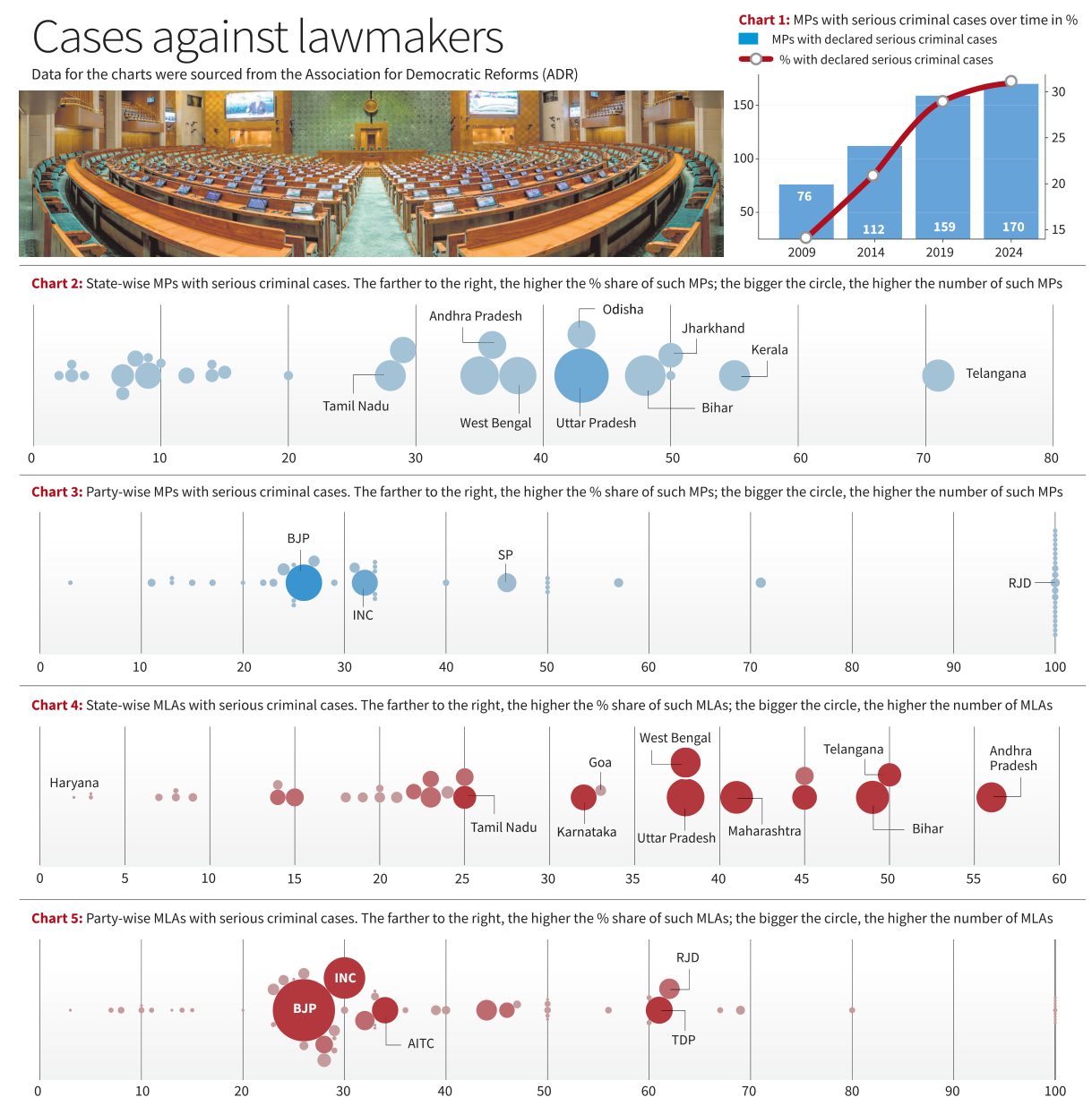
    About 30% of MPs and MLAs face serious criminal cases

    Introduction

    The intertwining of crime and politics is not new in India, but the recent figures are deeply concerning. An analysis of elected representatives reveals that 31% of MPs and 29% of MLAs across India have declared serious criminal charges against them. More strikingly, in the Lok Sabha, this share has more than doubled from 14% in 2009 to 31% in 2024. Such data points underscore a disturbing trend where democratic institutions are increasingly being captured by individuals with questionable integrity.

    About 30% of MPs and MLAs face serious criminal cases

    The Scale of Criminalisation in Indian Politics

    • MPs with serious charges: 31% in 2024, compared to 14% in 2009.
    • MLAs with serious charges: 29% nationwide, amounting to more than 1,200 legislators.
    • Definition of serious crimes: Offences with punishments of 5+ years, or non-bailable in nature.

    State-wise Picture of the Crisis

    • Telangana: Highest share of MPs with serious cases (71%).
    • Bihar: Second-highest share of MPs (48%).
    • Uttar Pradesh: Highest absolute number of MPs (34) and MLAs (154 or 38%).
    • Andhra Pradesh: Highest share of MLAs with serious cases (56%), followed by Telangana (50%).

    Political Party-Wise Trends

    • BJP: Largest absolute number—63 MPs (26%) and 436 MLAs (26%).
    • Congress: 32 MPs (32%) and 194 MLAs (30%).
    • RJD: 100% of its 4 MPs, and 62% of MLAs face serious cases.
    • TDP: 61% of MLAs facing serious charges.

    Criminalisation of politics as a Democratic Crisis

    1. Undermines Rule of Law: Representatives sworn to make laws are themselves accused of violating them.
    2. Erodes Public Trust: Citizens lose faith in democratic institutions.
    3. Policy Capture Risk: Legislators with criminal backgrounds may promote laws benefiting vested interests.
    4. Vicious Cycle: Money, muscle power, and electoral compulsions perpetuate the entry of tainted candidates.

    Constitutional and Legal Context

    • Representation of People’s Act, 1951: Currently disqualifies convicted representatives but not those with pending cases.

    Judicial Interventions:

    1. Lily Thomas vs Union of India (2013): Immediate disqualification upon conviction.
    2. Public Interest Foundation vs Union of India (2018): Urged political parties to disclose candidate criminal records widely.

    Conclusion

    The latest data underscores that criminalisation in politics is not just persisting but worsening, with more than one in four lawmakers facing serious charges. Unless systemic reforms, ranging from fast-track courts to stricter disqualification laws, are implemented, India risks democratic backsliding. For a healthy democracy, the moral legitimacy of legislatures must be restored.

    Value Addition

    Issues with Criminalisation in Politics

    • Erosion of Democratic Legitimacy: Lawmakers accused of breaking the law undermine the moral authority of Parliament/Assemblies.
    • Weakening of Rule of Law: Offenders often manipulate investigations, delay trials, and escape accountability.
    • Policy Capture & Corruption: Legislators may pass laws or influence contracts to protect vested interests.
    • Distortion of Electoral Choices: Voters are forced to choose between tainted candidates, limiting free and fair choice.
    • Loss of Public Trust: Citizens lose faith in governance when crime and politics merge.
    • Security Threats: Nexus of politics and crime leads to rise in muscle power, intimidation, and weakens internal security.

    Why do Parties Field Candidates With Criminal Background?

    • Money Power: Candidates with criminal networks bring enormous funds to finance expensive elections.
    • Muscle Power: They help in mobilising voters, intimidating opponents, and managing booths in certain constituencies.
    • Winnability Factor: Studies show voters often overlook criminal charges if the candidate is influential, caste-backed, or delivers local patronage.
    • Weak Legal Framework: Only convicted representatives are barred; those with pending cases can contest. With trials dragging on for years, many continue to fight elections.
    • Vote-Bank Politics: Parties use “strongmen” with community backing to secure caste/religion-based votes.

    Way Forward with Committee Reports, Judgments & Reforms

    Committee Recommendations

    • Vohra Committee (1993): Flagged deep nexus between crime, politics, and bureaucracy.
    • Law Commission 170th Report (1999): Recommended disqualification of candidates once charges are framed in heinous offences.
    • Law Commission 244th Report (2014): Suggested immediate disqualification in cases with charges punishable by 5 years or more, and where charges are framed by a court.
    • Election Commission of India (ECI) Recommendations: Ban on candidates facing heinous charges; fast-track courts to decide political cases within a year.

    Judicial Interventions

    • Lily Thomas vs Union of India (2013): MPs/MLAs disqualified immediately upon conviction (earlier they could continue for 3 months pending appeal).
    • Public Interest Foundation vs Union of India (2018): Directed political parties to publicise candidate criminal records widely (website, media, papers).

    Suggested Reforms

    • Fast-track Courts: To ensure cases against politicians are resolved within strict timelines.
    • Stricter Disqualification Norms: Disqualify candidates at the stage of framing of charges (with safeguards against false cases).
    • Political Party Accountability: Legal provisions to penalise parties giving tickets to tainted candidates.
    • State Funding of Elections: Reduce dependence on money/muscle power.
    • Voter Awareness: Encourage citizens to reject candidates with serious charges through awareness campaigns.

    PYQ Relevance

    [UPSC GS II] There is a need for simplification of procedure for disqualification of persons found guilty of corrupt practices under the Representation of Peoples Act.” Comment

    Linkage: The issue of disqualification under the Representation of People’s Act (RPA), 1951 is central to tackling criminalisation of politics. Recent data showing over 30% MPs/MLAs facing serious criminal charges highlights the inadequacy of current provisions that act only after conviction. Simplifying and strengthening disqualification procedures, as urged by committees and the Supreme Court, is vital to restore public trust in democracy.

  • Parliament – Sessions, Procedures, Motions, Committees etc

    Before legislation becomes litigation

    Introduction

    The framers of the Indian Constitution rejected the British model of absolute parliamentary sovereignty and instead vested sovereignty in the Constitution. Parliament was given the power to make laws, but within constitutional limits. Judicial review was meant to be a sparing power, used exceptionally when laws violated constitutional principles. However, what was once exceptional has increasingly become the norm. With vague drafting, bypassing of procedures, and lack of constitutional guidance, Indian law-making has frequently ended up in litigation. This trend not only undermines democratic trust but also burdens the judiciary and disrupts policy implementation.

    Why is this issue in the news?

    The controversy around the Waqf (Amendment) Act, 2025, which was challenged in the Supreme Court within days of its enactment, highlights a disturbing pattern. Shockingly, the challengers included MPs themselves, indicating a lack of confidence in their own law-making. The Law Ministry has admitted that 35 central legislations and constitutional amendments were under challenge before the Supreme Court between 2016 and 2022. This points to a systemic crisis in legislative drafting and scrutiny.

    The constitutional design of law-making

    • No absolute sovereignty: Unlike Britain, Parliament in India operates within constitutional limits; no law can derogate from the Constitution.
    • Judicial review as exception: The power to strike down laws was meant to be sparing, not routine.
    • Current practice: Courts are increasingly forced into the role of a “parallel legislator” due to Parliament’s failures in precision and scrutiny.

    Why do laws end up in litigation

    • Constitutional scrutiny: Laws may violate constitutional guarantees or principles (e.g., Transgender Persons Act, 2019 vis-à-vis Bharatiya Nyaya Sanhita).
    • Political theatre: Legal challenges are sometimes used as political tactics by opposition parties or even MPs.
    • Flawed drafting: Vague definitions, incoherent clauses, poor harmonisation with existing laws, and internal contradictions.

    Where does the system break down

    • Bypassing procedure: Bills introduced without notice; committees sidelined.
    • Rushed debates: Clause-by-clause discussion often ignored.
    • Poor consultation: Stakeholders and experts not adequately consulted.
    • Dense legalese: MPs unable to engage with overly technical drafting, reducing their role to party-line voting.

    The human cost of poor drafting

    • Economic loss: Unclear or contradictory laws disrupt industries and businesses.
    • Social injustice: Unequal punishments (e.g., transgender vs. women sexual abuse provisions).
    • Democratic deficit: MPs are unable to represent citizens effectively when legislation is incomprehensible.

    The case for a stronger Attorney-General (AG) role

    • Article 88 of the Constitution: AG has the right to participate in Parliament’s proceedings but rarely invoked.
    • Preventive review: AG can identify constitutional infirmities during debate itself.
    • Non-partisan guidance: AG’s counsel would enable lawmakers to vote more responsibly.
    • Better statutes: Well-drafted laws prevent substitution of legislative intent by judicial interpretation.

    Conclusion

    India’s constitutional democracy rests on the balance of powers between Parliament and the judiciary. When Parliament abdicates its responsibility of precise and constitutional law-making, the courts inevitably step in, eroding this balance. Institutionalising preventive constitutional review within Parliament, particularly through a proactive role for the Attorney-General, can ensure that legislation serves people effectively without routinely ending up in litigation. A robust democracy demands laws that are clear, just, and constitutionally sound before they leave the House.

    Value Addition

    What procedural lapses in Parliament lead to flawed laws?

    • Bypassing Committees: Less than 25% of Bills (2019–2023) were sent to Parliamentary Standing Committees, compared to 60–70% in earlier decades. This reduces scrutiny and expert input.
    • Rushed Legislation: Important laws such as the Farm Acts (2020) and the Aadhaar Bill (2016) were passed as Money Bills to bypass Rajya Sabha, undermining debate.
    • Poor Stakeholder Consultation: Unlike developed democracies, draft bills in India are rarely put out for public comments. (E.g., Data Protection Bill, 2019, was tabled without thorough consultation)
    • Clause-by-Clause Neglect: Debates are cut short; MPs often do not engage with technical legal provisions due to lack of time and expertise.
    • Opaque Drafting Process: Drafting happens primarily within ministries with little parliamentary/legal vetting before introduction.
    • ARC 2nd Report (Ethics in Governance): Calls for greater pre-legislative scrutiny and institutional strengthening of committees.

    How does flawed drafting affect democracy and society?

    • Judicial Overreach: Poorly worded statutes lead to constant constitutional challenges (e.g., NJAC Act struck down in 2015, Transgender Rights Act 2019 contradictions). The Judiciary ends up legislating by interpretation.
    • Erosion of Parliamentary Sovereignty: Frequent judicial invalidation makes Parliament look ineffective, undermining public trust.
    • Democratic Deficit: Laws in dense legalese alienate both MPs and citizens, reducing informed participation.
    • Economic Uncertainty: Unclear laws discourage investment (e.g., retrospective taxation case leading to Vodafone arbitration).
    • Social Injustice: Disparities in sentencing/punishment (e.g., lower penalties for abuse of transgender persons than for women) perpetuate inequality.
    • Law Commission Report (2008, 210th Report): Identified vague language and excessive delegation as reasons why laws face repeated judicial strikes.

    Comparative Perspective

    • UK: Parliamentary sovereignty model; no judicial review of primary legislation, but House of Lords Committees scrutinise bills heavily pre-enactment.
    • USA: Strong judicial review, but bills are subject to Congressional hearings and exhaustive committee scrutiny with expert testimonies before passage.
    • Germany: Has a robust Bundesrat (Upper House) system where laws undergo constitutional and legal vetting before final passage.
    • India: Hybrid system; has judicial review, but Parliamentary scrutiny is weak. Unlike the US/UK, pre-legislative consultation is not institutionalised.

    Way Forward

    • Mandatory Committee Review: Make it compulsory for all non-Money Bills to be referred to standing/select committees.
    • Pre-legislative Consultation Policy (2014): Institutionalise it across all ministries with draft bills published in public domain.
    • Strengthening Legislative Research Services: Provide MPs with non-partisan legal/technical assistance (as in US Congressional Research Service).
    • Empowering the Attorney-General: Invoke Article 88 to ensure AG flags constitutional issues during debates.
    • Clarity & Accessibility: Draft laws in plain language versions for MPs and citizens, alongside legal text.
    • Judicial-Parliamentary Dialogue: Structured interactions between constitutional benches and parliamentary committees to ensure harmony.

    PYQ Relevance

    [UPSC GS II] Individual Parliamentarian’s role as the national lawmaker is on a decline, which in turn, has adversely impacted the quality of debates and their outcome. Discuss.

    Linkage: The decline in the individual role of MPs as lawmakers, noted in the PYQ (2019), directly links to the article’s theme of flawed law-making. Dense legalese, party whip culture, and bypassed scrutiny reduce MPs’ capacity for meaningful debate. This weakens legislative quality and pushes more laws into judicial review.

  • Internal Security Architecture Shortcomings – Key Forces, NIA, IB, CCTNS, etc.

    How have deception techniques evolved

    Introduction

    Modern warfare is no longer about firepower alone; it is equally about deception. As precision-guided missiles, drones, and AI-enabled targeting systems grow deadlier, militaries are turning to decoy technologies to confuse radars, mislead missiles, and protect valuable assets. India’s reported use of the AI-enabled X-Guard decoy during Operation Sindoor shows how deception has become a central element of national security strategy.

    The Growing Relevance of Deception in Modern Warfare:

    1. Evolving threat environment: Precision-guided munitions, drones, and AI-enabled targeting systems make military platforms highly vulnerable.
    2. Strategic asset: Decoys create confusion, waste enemy munitions, and buy crucial time for retaliation.
    3. Game-changing event: Operation Sindoor showcased India’s successful use of an AI-enabled decoy, termed by experts as “the best instance of spoofing and deception ever seen.”

    Inside the X-Guard Fibre-Optic Towed Decoy 

    1. Lightweight & reusable: At just 30 kg, retractable and deployable in flight.
    2. Radar mimicry: Replicates the Rafale’s Radar Cross Section (RCS), doppler velocity, and spectral signature across multiple bands.
    3. 360-degree jamming: Works seamlessly with the Rafale’s SPECTRA suite to form a layered defensive shield.
    4. Operational success: Reports suggest Pakistan’s J-10C fighters misidentified decoys as actual aircraft, wasting advanced PL-15E missiles.

    Global landscape of comparable decoy systems: 

    1. BriteCloud (Leonardo UL): Used on Eurofighter Typhoons, Gripen-Es, and some F-16s.
    2. AN/ALE-50/55 series (Raytheon/BAE Systems): Deployed on U.S. Navy F/A-18E/F Super Hornets.
    3. Adaptability to UAVs: Modified for platforms like Israeli Herons and U.S. MQ-9 Reapers.

    Battlefield deception on Land Forces: 

    1. Inflatable & heat-emitting decoys: Simulate tanks, artillery, and missile batteries to divert strikes.
    2. Ukraine’s wooden & 3D-printed fakes: Exhaust Russian drone and missile stocks.
    3. Russia’s Inflatech decoys: Create entire armoured formations in minutes.
    4. Indian Army initiative (2025): Issued a request for decoys mimicking T-90 tanks, including thermal and acoustic signatures.

    Naval countermeasures and Decoy strategies

    1. Layered naval countermeasures: Chaff, acoustic decoys, and offboard active deception protect against missiles and submarines.
    2. Nulka decoy (Australia–U.S.): Self-propelled system mimicking large ship radar signatures to mislead missile guidance.

    Conclusion

    Deception, once limited to camouflage and dummy equipment, has evolved into a sophisticated digital-age shield. Airborne fibre-optic decoys, inflatable ground tanks, and naval missile deflectors now define modern survivability. India’s reported use of the X-Guard highlights its adaptation to the evolving battlefield. For a relatively low investment, such systems deliver high-impact protection, proving that in the wars of tomorrow, deception may be as decisive as destruction.

    PYQ Relevance

    “How is S-400 air defence system technically superior to any other system presently available in the world?”

    Linkage: This question shows UPSC’s focus on defence technology and comparative capability analysis. The same lens applies to India’s deployment of AI-enabled decoys like the X-Guard FOTD, which enhance survivability against advanced missile systems. Both highlight the importance of evaluating cutting-edge military technology for national security.

  • Make in India: Challenges & Prospects

    Reforming the steel framework

    Introduction

    Independence Day speeches are often symbolic, but in 2025 the Prime Minister shifted focus to frontier technologies, semiconductors, clean energy, AI, quantum computing, and defence indigenisation. Unlike earlier years, this vision was paired with the acknowledgment that bureaucratic inertia and regulatory red tape remain India’s toughest hurdles. The central challenge is whether India’s governance structures can keep pace with its technological ambitions.

    Significance of the 2025 Speech by the Prime Minister 

    • Future focus: Strong emphasis on frontier areas like semiconductors, EVs, and jet engines.
    • Symbolic push: The PM asked if fighter jet engines should not be Indian-made.
    • Bold promise: India will shed dependency in two decades.
    • Data milestone: India is the largest per capita data consumer (32 GB), ahead of China and the US.

    India’s current position in technology and self-reliance

    • Strength in mid-tech: Success in fintech, data access, and digitisation
    • Emerging hubs: Bengaluru, Hyderabad, Pune, Gurugram drive high-tech growth.
    • Import dependency: India depends heavily on imports in semiconductors, defence hardware, AI hardware, and clean energy technologies.
    • Global presence: Firms like Nvidia and IBM rely on India’s talent pool, but domestic ecosystems remain thin.

    Bureaucratic Challenges that obstruct deep-tech ambition

    • Colonial bureaucratic legacy: The Westminster model prioritised control over innovation and accountability.
    • Rigid steel frame: The “steel frame” of the civil services designed to ensure subservience to colonial administrators remains rigid even a century after the Public Service Commission’s creation in 1926.
    • Unrealised reforms: The Veerappa Moily Committee (2005) suggested domain experts and ethics codes-still pending.
    • Lateral entry limits: Attempts at inducting experts face systemic resistance.

    Why are regulatory and judicial reforms critical?

    • Persistent red tape: The Deregulation Commission (2025) was set up to identify redundant compliance norms, but structural bottlenecks persist.
    • Judicial backlog: Slow dispute resolution and investment climate, affectshigh-tech sectors.
    • Comparative lessons:
      • US & China: Despite different models, both empower political leadership over bureaucracy to push national interests.
      • UK: Even Britain debates its bureaucratic model, Dominic Cummings under Boris Johnson pushed for external competition and greater ministerial control.

    How does this link to Viksit Bharat@2047?

    • Ambition vs. architecture: India’s goal of becoming a deep-tech powerhouse is contingent not just on financial investment but on restructuring governance.
    • Symbolic timing: The UPSC centenary in 2026 is a historic chance for overhaul.
    • Future-readiness: Without structural reform, Atmanirbhar Bharat may remain aspirational.

    Conclusion

    India’s ambition to lead in deep-tech must be matched with institutional reform. The PM’s 2025 speech acknowledged that Atmanirbharta is as much about fixing bureaucratic bottlenecks as building jet engines or quantum labs. The centenary of UPSC offers an opportune moment to align India’s governance with its 2047 goals.

    Value Addition
    Committees on Civil Service Reforms

    1. Santhanam Committee (1964)

    • Focus: Preventive corruption measures.
    • Key suggestion: Creation of the Central Vigilance Commission (CVC).

    2. Kothari Committee (1976)

    • Focus: Recruitment and exam structure of Civil Services.
    • Key suggestion: Recommended 3-stage exam (Prelims, Mains, Interview), which is still followed today.

    3. Satish Chandra Committee (1989)

    • Focus: Review of recruitment and selection.
    • Key suggestion: Increased emphasis on aptitude and ethics in recruitment.

    4. Hota Committee (2004)

    • Focus: Ethics, transparency, and performance.
    • Key suggestion: Right to Information, performance-linked incentives, citizen charters.

    5. Second Administrative Reforms Commission (ARC) – Veerappa Moily (2005–2009)

    Most comprehensive civil service reform report (15 volumes). Key suggestions:

    • Lateral entry of domain experts.
    • Code of Ethics & Code of Conduct.
    • Citizen-centric administration
    • Performance-based appraisal system.
    • Training in e-governance and modern management practices

    6. Punchhi Commission (2010) – on Centre-State relations

    • Relevant link: Stressed need for civil service neutrality in federal governance.

    7. Baswan Committee (2016)

    1. Focus: UPSC exam age and attempts.
    2. Key suggestion: Reduce maximum age for UPSC CSE (though not implemented).

    8. Current initiatives 

    • Lateral entry into Joint Secretary and Director-level posts.
    • Mission Karmayogi (2020): National Programme for Civil Services Capacity Building (NPCSCB) to train officers with competency-based framework.
    • Deregulation Commission (2025): Identifying and scrapping redundant compliances.

    Mapping Microthemes

    • GS Paper-II: Civil Service Reform, Regulation, Judiciary
    • GS Paper -III: Tech missions, Defence Indigenisation, Atmanirbhar Bharat
    • GS Paper -IV: Accountability, Ethics in governance

    PYQ Relevance

    [UPSC 2016] Civil Services “Traditional bureaucratic structure and culture have hampered the process of socio-economic development in India.” Comment.

    Linkage: PM Modi’s Independence Day 2025 address highlighted that despite India’s technological advances, the colonial-era bureaucratic “steel frame” continues to obstruct innovation, investment, and governance reforms. The traditional bureaucratic structure—designed for control rather than development—remains a bottleneck in achieving Atmanirbhar Bharat. Thus, the speech directly echoes the UPSC 2016 theme that outdated bureaucratic culture hampers socio-economic transformation.

  • Foreign Policy Watch: India-Canada

    Canada will match U.S. exemptions to punishing tariffs, says Canadian official

    Introduction

    Canada has decided to drop retaliatory tariffs and mirror the U.S. exemptions on goods covered under the United States-Mexico-Canada Agreement (USMCA). This represents a success in preserving tariff-free trade for over 85% of Canada-U.S. commerce. But sector-specific tariffs like the 50% duties on steel and aluminium continue to hurt Canadian industries. The development is crucial, given Canada’s heavy reliance on the U.S. market, with more than 75% of its exports heading south.

    Significance of the News

    1. Tariff Alignment: Canada has chosen to align its tariff exemptions with those of the U.S., signaling a conciliatory move in contrast with earlier retaliatory tariffs.
    2. First-time Reset: For the first time since retaliatory duties were announced, Canada is rolling them back to match U.S. exemptions under USMCA, a notable policy reversal.
    3. Trade Dependence: With over 75% of Canadian exports going to the U.S., the stakes are extremely high, making tariff negotiations critical for economic stability.
    4. Striking Data: 85% of Canada-U.S. trade is still tariff-free, reflecting both success in negotiations and risks if the pact weakens.

    What is USMCA?

    1. USMCA Pact: Signed in 2020, it replaced NAFTA and provides preferential treatment for Canadian and Mexican goods entering the U.S.
    2. Carve-out Mechanism: Goods shielded under the agreement are protected from punitive tariffs, preserving market access.
    3. Upcoming Review : The pact is up for review in 2026, adding urgency to Canada’s attempt to preserve smooth trade relations.

    How does Canada benefit from this carve-out?

    1. Preferential Access: Canadian goods remain shielded from most punitive duties.
    2. Export Stability: With 75% of exports going to the U.S., the pact secures critical market access.
    3. Low Tariff Burden: U.S. average tariffs on Canadian goods remain among the lowest globally.

    What are the challenges despite tariff exemptions?

    1. 232 Tariffs: The U.S. has imposed sector-specific duties, including 50% tariffs on steel and aluminium, straining Canadian industries.
    2. Renegotiation Risk: U.S. Commerce Secretary Howard Lutnick has hinted at reopening USMCA talks, creating uncertainty.
    3. Dependence Dilemma: Canada retains some retaliatory tariffs, but its heavy reliance on U.S. markets weakens bargaining power.

    Why is this crucial for North American trade stability

    1. Export Dependence: More than 75% of Canada’s exports and 80% of Mexico’s exports head to the U.S., underlining their vulnerability.
    2. Regional Integration: The USMCA has reestablished tariff-free trade for the majority of goods, preventing economic disruption in North America.
    3. Geopolitical Context: At a time of growing global protectionism, North America’s internal trade pact provides a stabilising force, but also exposes Canada and Mexico to unilateral U.S. decisions.

    Conclusion

    Canada’s decision to align its tariffs with U.S. exemptions under USMCA reflects both pragmatism and vulnerability. While the pact secures tariff-free trade for the majority of goods, sector-specific tariffs and the looming threat of renegotiation highlight the fragile foundation of North American trade integration. For Canada, the challenge lies in balancing sovereignty with economic dependence, a dilemma increasingly relevant in today’s protectionist world.

    Value Addition

    United States–Mexico–Canada Agreement (USMCA)

    Key Features (vs. NAFTA)

    1. Rules of Origin – Higher thresholds for auto production (75% North American content vs. 62.5% under NAFTA).
    2. Labour Provisions – Stronger labour standards; Mexico required to reform labour laws.
    3. Digital Trade – New rules on data flows, e-commerce, and IP rights absent in NAFTA.
    4. Sunset Clause – Agreement reviewed every 6 years; expires after 16 years unless renewed.
    5. Agriculture – U.S. gained greater access to Canadian dairy market.

    PYQ Relevance

    [UPSC 2018] How would the recent phenomena of protectionism and currency manipulations in world trade affect macroeconomic stability of India?

    Linkage: The USMCA episode shows how U.S. protectionism through sectoral tariffs (like 50% on steel/aluminium) can destabilize even close trade partners like Canada. Such measures reflect the larger global trend of tariff wars and currency leverage, which disrupt supply chains and investment flows. For India, this highlights risks to macroeconomic stability via trade deficits, inflationary pressures, and exchange rate volatility.

  • Foreign Policy Watch: India-China

    Amid the disruptions unleashed by the US President Trump, should India rethink its engagement with China, and to what extent?

    Introduction

    The India-China equation has once again come into focus with Chinese Foreign Minister Wang Yi’s recent visit to India. Coming at a time when Donald Trump’s unpredictable moves are reshaping US–China relations and India faces pressure over its Russian oil purchases, the visit is being viewed as a tactical outreach by Beijing. For the first time since the Galwan clash, both sides agreed on a 10-point understanding, from reopening border trade points to restarting stalled dialogues. Yet, beneath the gestures of cooperation, deep mistrust lingers: unresolved tensions in Ladakh, Beijing’s quiet backing of Pakistan, and economic vulnerabilities that India cannot ignore. The central question remains, is this the start of a cautious reset, or will rivalry continue to define the relationship?

    Current State of India-China Relationship

    • A Cautious Thaw: Signs of easing after years of strain post-2020 Galwan clashes. The visit of Chinese Foreign Minister and the expected Modi–Xi meeting at the SCO summit reflect cautious engagement.
    • Unfinished Border Business: 
      1. Unfinished disengagement: Restrictions continue on Indian troop patrolling and herdsmen grazing in Ladakh buffer zones.
      2. De-escalation talks: Both sides have now agreed to discuss principles and modalities of de-escalation, but with little progress so far.
      3. Historical baggage: From the 1962 war to Doklam and Galwan, border issues repeatedly resurface as the defining irritant.
    • Persistent Trust Deficit: India remains wary of China’s military links with Pakistan, dam projects on the Brahmaputra, and use of economic dependencies such as rare-earths and critical technologies as leverage.

    China–Pakistan Axis and India’s Security Concerns

    1. Operation Sindoor 2025: China provided Pakistan with real-time ISR, command-and-control integration, and advanced weaponry.
    2. Extended theatre: While not directly engaging militarily, China’s operational support widened the conflict spectrum.
    3. Strategic consequences: India now faces a two-front dynamic made more acute by China’s active involvement.

    Trade Dependence Shaping Geopolitical Weakness

    1. Weaponisation of dependencies: China has denied India supplies of rare-earth magnets, fertilisers, tunnel-boring machines.
    2. Industrial impact: Foxconn withdrew hundreds of Chinese technicians under pressure from Beijing.
    3. Hydropower concerns: A massive dam, thrice the size of Three Gorges, threatens India’s lower riparian interests.

    Can tactical outreach substitute for structural resolution?

    1. Wang Yi’s visit: Led to a 10-point understanding including resumption of flights, border trade, and talks on border issues.
    2. Tactical gestures: China seeks to ease tensions but has not offered substantive concessions on India’s concerns.
    3. India’s position: PM Modi emphasised the need for “stable, predictable and constructive” relations, but only grounded in realism.

    Why outright conflict remains unlikely

    1. Geographical constraints: The Himalayas pose immense logistical challenges for a sustained full-scale war.
    2. China’s strategic calculus: Since 1979, Beijing has avoided wars to focus on economic growth.
    3. Cost of conflict: War with India risks derailing China’s “great power” ambitions vis-à-vis the US.

    The limits of aligning with China against the US

    1. US factor: Trump’s inconsistent China policy has unsettled India’s geopolitical calculations.
    2. Chinese spin: Beijing portrayed India as siding with it against “unilateral bullying” (implicitly the US).
    3. MEA clarification: India reaffirmed no change in its One-China policy stance, signalling caution.

    Way Forward

    1. Strengthen Border Posture: Accelerate infrastructure and surveillance along LAC to counter tactical surprises.
    2. Diversify Dependencies: Invest in domestic capacity for critical minerals, semiconductors, and rare earths.
    3. Engage but Verify: Continue talks on de-escalation and economic ties, but measure outcomes, not promises.
    4. Diplomatic Balancing: Maintain strategic autonomy while leveraging QUAD, SCO, BRICS without being trapped in binaries.
    5. Water Security Mechanisms: Push for institutionalised basin-sharing frameworks on Brahmaputra with multilateral backing.

    Conclusion

    The India-China relationship sits at a crossroads. While tactical outreach such as Wang Yi’s visit creates openings for engagement, the structural drivers of mistrust remain too deep for a true reset. India cannot overlook the challenges of border tensions, economic weaponisation, and China-Pakistan collusion. At the same time, the high costs of conflict and shared economic interests provide space for pragmatic management. The way forward lies in carefully calibrated diplomacy, neither falling into the trap of confrontation nor harbouring illusions of a reset.

    PYQ Relevance

    [UPSC 2017] ‘China is using its economic relations and positive trade surplus as a tool to develop potential military power status in Asia’, In the light of this statement, discuss its impact on India as her neighbour.

    Linkage: China’s growing economic leverage over Pakistan, seen in CPEC and debt dependence, is increasingly shaping a strategic-military partnership. This aligns with the UPSC 2017 theme of economic tools being converted into hard power. For India, this intensifies security challenges on both borders and limits regional strategic space.

    Mapping microthemes

    1. GS Paper II (IR): India-China relations, India-US-China triangle, border disputes, strategic autonomy.
    2. GS Paper III (Security): Two-front challenge, defence preparedness, technology denial regimes.
    3. GS Paper IV (Ethics): Diplomacy, realpolitik vs idealism in foreign policy.
  • Governor vs. State

    Should SC sit powerless as Governors block Bills: CJI 

    Introduction 

    The Supreme Court recently questioned whether it should remain passive when Governors indefinitely withhold assent to Bills, stalling elected legislatures. This issue, highlighted by Tamil Nadu’s Bills pending for four years, raises fundamental questions about judicial review, federalism, and democratic accountability.

    Why in the News

    Tamil Nadu’s unprecedented case of Bills pending for years has brought the Governor’s discretionary powers under sharp scrutiny. The Supreme Court’s April 8 judgment imposing time limits on Governors is now contested by the Union as judicial overreach, sparking a crucial debate on separation of powers.

    Why does the role of Governors come under scrutiny

    1. Governor’s Inaction: Governors, appointed by the Union, are integral to State legislatures, yet their indefinite withholding of Bills undermines State autonomy.
    2. Tamil Nadu Example: Crucial Bills remained pending for nearly four years without reasons being communicated, sparking judicial concern.
    3. Democratic Will Thwarted: Prolonged silence from Governors makes elected legislatures ineffective.

    How has the Supreme Court responded

    1. CJI’s Question: Should the Court suspend its role as custodian of the Constitution while Governors block Bills indefinitely?
    2. Judicial Review Precedent: The Court has struck down even constitutional amendments (e.g., 42nd Amendment) that sought to limit judicial review.
    3. Concern of Vacuum: Justice P.S. Narasimha highlighted the risk of Bills hanging in limbo without timelines.

    What is the Union Government’s stand

    1. Encroachment Argument: Solicitor-General Tushar Mehta argued the Court’s April 8 order intruded into law-making, undermining Governors and the President.
    2. Political Resolution: Inaction, according to the Union, should be resolved politically, not judicially.
    3. Governor’s Unique Role: Unlike statutory authorities, Governors hold sui generis constitutional status, not bound by timelines.

    Why is the tussle between judiciary and executive significant

    1. Separation of Powers: Union argues judiciary must not micro-manage executive discretion.
    2. Checks and Balances: CJI asserted that unchecked gubernatorial delay undermines democracy, and the Court cannot abdicate review.
    3. Democratic Accountability: Legislators face people every five years; Governors do not. Hence judicial review is necessary.

    What are the implications for federalism

    1. Centre–State Tensions: Delays fuel mistrust between States and the Union.
    2. Judicial Intervention: Without court oversight, States may face legislative logjams.
    3. Limited Litigation: Union argues only “two or three States” have complained, but the principle has pan-India significance.

    Way Forward: A structured framework for assent is necessary to prevent legislative paralysis. The Supreme Court’s suggested timelines strike a balance between constitutional discretion and democratic accountability. Moving ahead, three steps are essential:

    1. Codifying Timelines: Parliament may consider amending the law or issuing guidelines to institutionalise clear deadlines.
    2. Ensuring Accountability: Governors must act on the aid and advice of the Council of Ministers, barring exceptional constitutional reasons.
    3. Judicial Oversight as Safeguard: Courts should step in only when gubernatorial inaction undermines constitutional morality, keeping political disputes largely within the legislative sphere.

    Conclusion

    Unchecked gubernatorial inaction risks turning elected assemblies powerless. While the Union calls for political remedies, the Court stresses its duty as constitutional guardian. The outcome will redefine the balance between State autonomy, judicial review, and the Governor’s role in India’s federal framework.

    Value Addition

    Timeline for Governor’s action on bills

    While the Constitution of India doesn’t explicitly state a timeline, the Supreme Court has addressed the issue of delays in Governor’s assent, particularly in the context of recent conflicts between Governors and state governments.

    Based on a recent Supreme Court ruling (April 2025) and subsequent discussions, here’s a breakdown of the suggested timelines for the Governor’s actions on a Bill under Article 200 of the Constitution:

    1. Granting Assent, Withholding Assent (with advice of Council of Ministers), or Reserving for President’s Consideration: The Governor must act on the bill within a maximum of one month.
    2. Withholding Assent (against advice of Council of Ministers): The Governor should return the bill to the legislature with reasons for reconsideration within three months.
    3. Reserving for President’s Consideration (against advice of Council of Ministers): The Governor must reserve the bill within three months.
    4. Reconsideration by the Legislature: If the Governor returns a non-Money Bill for reconsideration, the legislature must reconsider it, and if it’s passed again (with or without amendments), the Governor is then bound to give assent within one month.

    PYQ Relevance

    [UPSC 2022] Discuss the essential conditions for exercise of the legislative powers by the Governor. Discuss the legality of re-promulgation of ordinances by the Governor without placing them before the Legislature.


    Linkage: This issue links directly with the 2022 UPSC question as both highlight the constitutional checks on the Governor’s legislative powers. The re-promulgation of ordinances without legislative approval undermines democratic accountability. Hence, examining Governor’s ordinance powers is central to debates on federalism and executive overreach.

  • LGBT Rights – Transgender Bill, Sec. 377, etc.

    Punishing process: On gender identity recognition

    Introduction

    The recognition of gender identity in India rests on strong legal foundations, the NALSA v. Union of India (2014) judgment and the Transgender Persons (Protection of Rights) Act, 2019. Yet, lived realities remain different, as shown in the Manipur High Court order directing fresh academic certificates for Dr. Beoncy Laishram. What should have been a routine correction instead became a legal battle, exposing the gap between law and practice.

    Why is this issue in the news?

    The Manipur High Court directed the State to issue fresh academic certificates to Dr. Beoncy Laishram, a transgender doctor, after her university refused to update her records citing procedural hurdles. This is significant because it highlights how basic rights, already guaranteed by law, are still denied in practice. The case reflects a larger systemic problem where bureaucratic rigidity overrides constitutional guarantees under Articles 14 and 21, forcing transpersons into prolonged legal battles to claim what is already legally theirs.

    Bureaucratic Inertia vs. Transgender Justice

    1. Administrative inertia: Officials often defer to rigid procedural rules rather than the spirit of the law.
    2. Sequential corrections: Universities and boards insisted that records must be corrected starting from the earliest certificate, creating cascading hurdles.
    3. Binary mindset: Authorities still stick to birth-assigned gender over self-identity.

    The NALSA Judgement Mandate on Self-Identification

    1. Right to self-identify: In NALSA v. Union of India (2014), the Supreme Court recognised transgender persons’ right to self-identify their gender.
    2. Welfare entitlements: Declared them socially and educationally backward, eligible for reservations and welfare schemes.
    3. Constitutional backing: Linked to Articles 14 (equality before law) and 21 (right to life and dignity), making recognition a constitutional obligation.

    Statutory Guarantees under the Transgender Persons (Protection of Rights) Act, 2019 

    1. Statutory obligation: Authorities are legally required to recognise self-identified gender and update official records.
    2. Codification of self-identification: Law translated the NALSA principle into binding statutory practice.
    3. Gap in implementation: Despite clarity in law, officials often refuse compliance unless compelled by courts.

    The Precedent of Dr. Laishram’s Case (A Landmark for Institutional Accountability)

    1. Individual justice: The order ensures her academic and professional records reflect her affirmed identity.
    2. Precedential value: Signals to other institutions that procedural rigidity cannot override constitutional rights.
    3. Systemic spotlight: Reveals how transpersons are forced into legal struggles for routine matters, expending time and resources disproportionately.

    Reforms for Bridging Law and Reality

    1. Institutional reform: Simplify procedures and enforce compliance through clear administrative circulars.
    2. Cultural change: Bureaucracy must embrace gender as lived reality, not paperwork.
    3. Awareness and sensitivity training: Officials must be sensitised to constitutional principles and human dignity.

    Conclusion

    The Manipur High Court’s ruling is a milestone, but it also highlights how rights guaranteed in law often falter in practice. True empowerment will come only when institutions operationalise constitutional principles with sensitivity, ensuring that gender identity is recognised as a matter of dignity, not just paperwork.

    Value Addition

    Key Features of the Transgender Persons (Protection of Rights) Act, 2019

    • Definition of Transgender Person: Includes trans-men, trans-women, persons with intersex variations, genderqueer, and persons with socio-cultural identities (like hijra, aravani, jogta).
    • Right to Self-Perceived Gender Identity: Allows individuals to identify as male, female, or transgender.
    • Prohibition of Discrimination: No discrimination in education, employment, healthcare, housing, access to services, or public places.
    • Recognition and Certificates: Provides for a certificate of identity issued by the District Magistrate, recognising a person as “transgender.”
    • Welfare Measures: Mandates governments to frame welfare schemes for education, healthcare, vocational training, and social security.
    • Offences and Penalties: Criminalises denial of services, removal from household, physical/sexual abuse; punishable with imprisonment (6 months–2 years) and fine.
    • National Council for Transgender Persons (NCT): Advisory body to monitor implementation, headed by Union Minister for Social Justice & Empowerment.

    Criticisms

    • Certification process: Seen as bureaucratic and violating the spirit of self-identification under NALSA (2014)
    • No reservation policy: Act does not clearly guarantee reservations in jobs/education despite Supreme Court directions.
    • Weak enforcement: Implementation depends heavily on state-level rules; lack of accountability mechanisms.

    International Value Addition

    • Argentina’s Gender Identity Law (2012): Considered the most progressive globally; allows self-declared gender without medical/psychological proof.
    • Nepal (2007): One of the first Asian countries to legally recognise a “third gender” category.
    • Yogyakarta Principles: International guidelines on sexual orientation and gender identity as human rights.

    Reports & Data

    • National Human Rights Commission (NHRC) Report, 2017 – Found that over 92% of transpersons are denied basic rights like jobs, healthcare, education.
    • Transgender Persons (Protection of Rights) Rules, 2020 – Prescribed simple process for self-identification, but implementation is patchy.

    Governance & Ethics Lens

    • Administrative Sensitisation: Training needed to reduce “file-based rigidity” and promote human dignity.
    • Constitutional Morality vs. Social Morality: Governance must align with constitutional principles rather than prevailing biases.

    Mapping Microthemes

    • GS Paper I: Social empowerment, issues faced by vulnerable sections.
    • GS Paper II: Constitutional provisions (Articles 14, 21), governance issues, judicial interventions.
    • GS Paper IV: Ethics in governance, dignity, empathy, sensitivity in administration.

    PYQ Relevance

    [UPSC 2017] Does the Rights of Persons with Disabilities Act, 2016 ensure effective mechanisms for empowerment and inclusion of the intended beneficiaries in the society? Discuss.

    Linkage: Just as UPSC asked in 2017 about whether the Rights of Persons with Disabilities Act, 2016 ensures real empowerment, a similar question can be framed on the Transgender Persons (Protection of Rights) Act, 2019. Both laws highlight that while statutory recognition exists, bureaucratic inertia and weak implementation dilute inclusion, making judicial intervention critical for the intended beneficiaries.
