💥UPSC 2026, 2027, 2028 UAP Mentorship (March Batch) + Access XFactor Notes & Microthemes PDF

Type: India Mapping

  • World’s Highest Motorable Road constructed at Mig La Pass in Ladakh

    Why in the News?

    The Border Roads Organisation (BRO) has achieved a historic milestone by constructing the world’s highest motorable road at Mig La Pass, situated 19,400 feet above sea level in Ladakh.

    • Strategic Value: Enables rapid troop movement and logistics support in high-altitude sectors; promotes eco-tourism and local trade.

    What is Project Himank?

    • Overview: A flagship Border Roads Organisation (BRO) initiative launched in December 1985 to build and maintain roads in Ladakh’s high-altitude regions.
    • Key Achievements: Built Umling La Road, Chisumle–Demchok, Darbuk–Shyok–DBO, Kargil–Zanskar, and now the Mig La Road (19,400 ft) under severe climatic stress.

    About Mig La Pass:

    • Importance: Crucial for India’s border logistics network, enabling swift troop deployment, supply transport, and surveillance near LAC and LoC.
    • Location: Situated on the Changthang Plateau, eastern Ladakh, near the Line of Actual Control (LAC) with China.
    • Elevation: Stands at 19,400 ft (5,913 m), now the highest motorable road in the world (2025), overtaking Umling La (19,024 ft).
    • Alignment: Lies along the Likaru–Mig La–Fukche route, forming a third strategic link from Hanle to Fukche near the Indo-China border.
    • Connectivity Role: Provides access to remote frontier villages—Hanle, Rongo, Kuyul, and Demchok—improving healthcare, communication, and supply access.
    • Geography: Part of the Changthang cold desert, with thin air, permafrost, and extreme cold, posing major engineering challenges.
    • Historical Link: Follows ancient Indo-Tibetan trade routes, reflecting Ladakh’s role in trans-Himalayan Silk Route exchanges.
    [UPSC 2007] Which one of the following Himalayan passes was reopened around in the middle of the year 2006 to facilitate trade between India and China?

    Options: (a) Chang La (b) Jara La (c) Nathu La* (d) Shipki La


  • Global Geological And Climatic Events

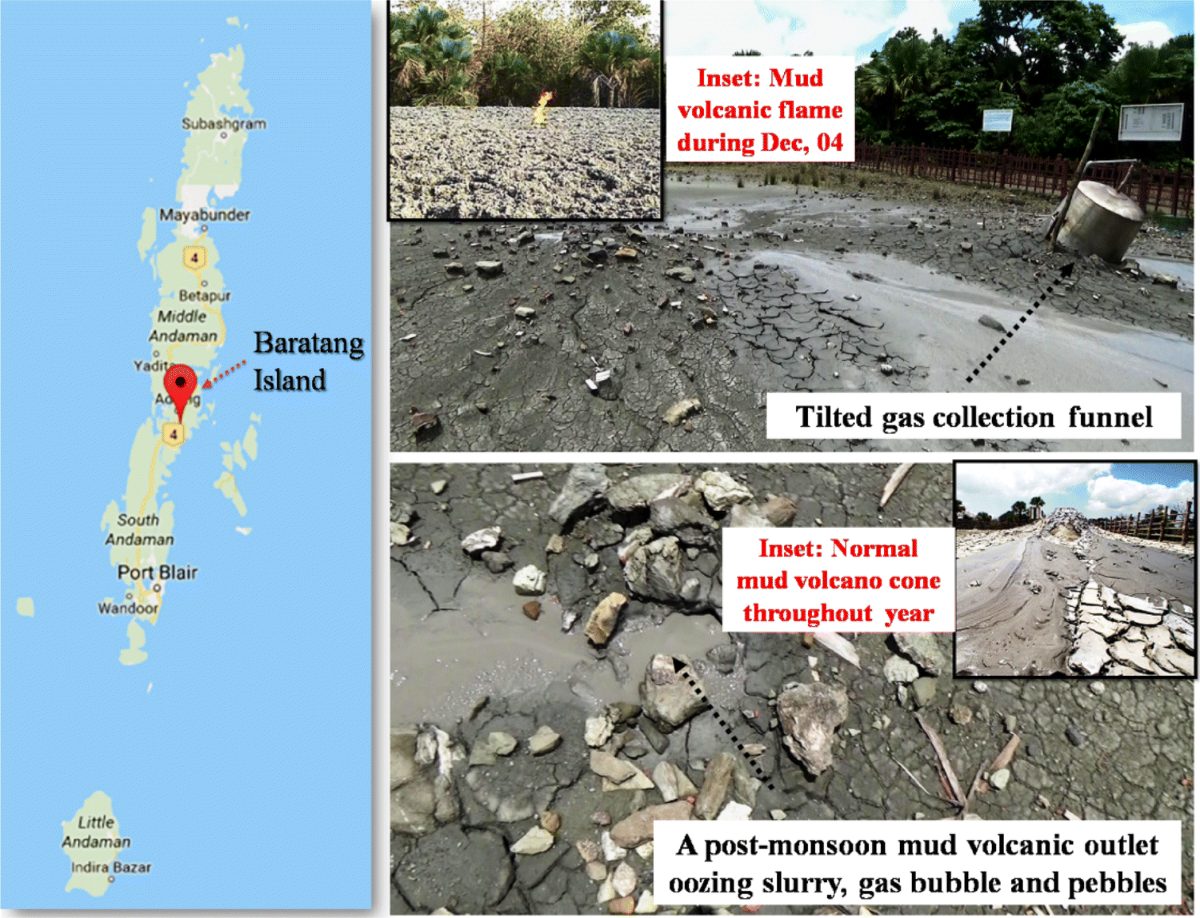
    India’s only Mud Volcano erupts after 20-years in Andamans

    Why in the News?

    India’s only mud volcano at Baratang Island in the Andaman and Nicobar Islands erupted after remaining dormant for over two decades.

    India's only Mud Volcano erupts after 20-years in Andamans

    Note: The Barren Island has erupted recently.

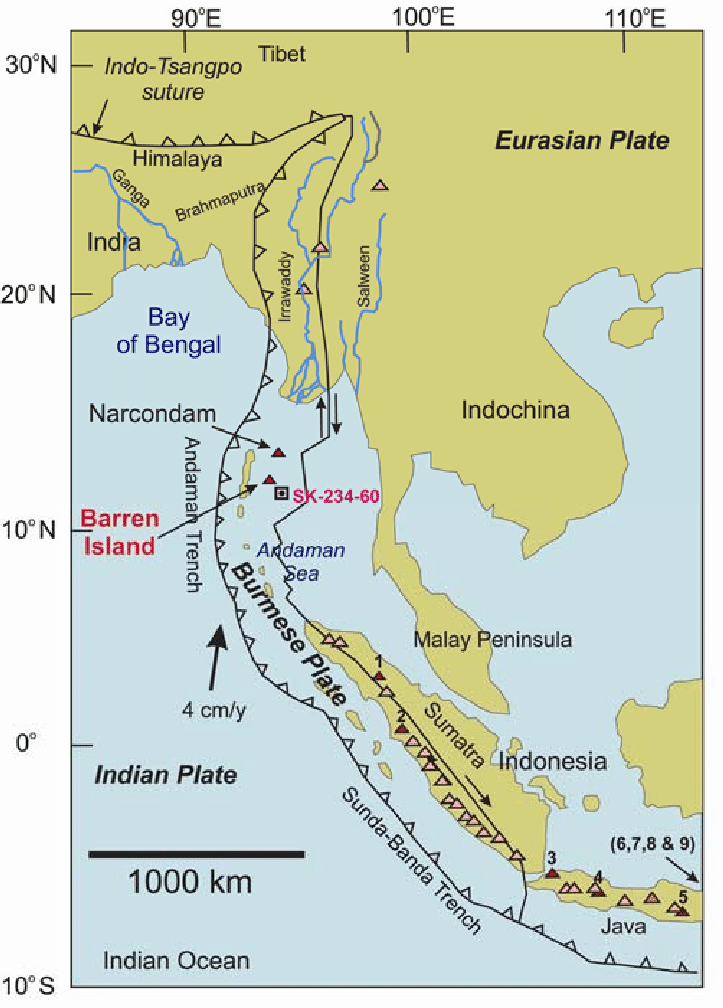
    • India’s only active lava volcano, located about 140 km from Port Blair.
    • Lies at the junction of the Indian and Burmese tectonic plates.
    • Eruption history: 1787 (first recorded), followed by episodes in 1991, 2005, 2017, November 2022, and September 2025.

    About the Baratang Mud Volcano:

    • Location: Baratang Island, around 100–150 km north of Port Blair, situated in the North and Middle Andaman district.
    • Uniqueness: It is India’s only collection of mud volcanoes — 11 in total across the archipelago, 8 of which are on Baratang and Middle Andaman.
    • Eruptions: Significant eruptions were last reported in 2005; the 2025 eruption marks the first major event in 20 years.
    • Composition & Nature:
      • Emits cool mud, water, and gases (methane, hydrogen sulfide) rather than lava or fire.
      • Creates mud cones, bubbling pools, or dried crater-like formations.
      • Eruptions are low in intensity, involving slow oozing and gas bubbling rather than violent explosions.
    • Accessibility: A short 160-metre walk from the nearest road; the site lies near the Jarawa Tribal Reserve, where photography is prohibited for ethical and legal reasons.

    Geological Formation and Features:

    • Tectonic Setting: Formed due to subduction of the Indian Plate beneath the Burmese Plate, leading to gas and fluid release from deep layers.
    • Mechanism:
      • Decomposition of organic matter underground produces gas pressure that pushes mud upwards.
      • These gases, along with water and sediments, escape to the surface, creating muddy eruptions and bubbling vents.
    • Temperature & Composition:
      • The expelled material is cool, unlike magmatic volcanoes.
      • Contains saline water, organic sediments, and gases, giving it a distinctive odour and appearance.
    • Earth Processes: The phenomenon helps scientists study fluid migration, methane emissions, and crustal deformation in active subduction zones.
    [UPSC 2018] Consider the following statements:

    1.The Barren Island volcano is an active volcano located in the Indian territory.

    2.Barren Island lies about 140 km east of Great Nicobar.

    3.The last time the Barren Island volcano erupted was in 1991 and it has remained inactive since then.

    Which of the statements given above is/are correct?

    Options: (a) 1 only * (b) 2 and 3 (c) 3 only (d) 1 and 3


  • Wetland Conservation

    Bihar adds 2 more Wetlands to Ramsar List

    Why in the News?

    India has added two new wetlands in Bihar, Gokul Jalashay (Buxar district) and Udaipur Jheel (West Champaran district), to the global Ramsar list of Wetlands of International Importance.

    Important Facts:

    • With this, India’s Ramsar sites rise to 93, consolidating its top rank in Asia and third in the world, after the UK (176) and Mexico (144).
      • Bolivia has the largest Ramsar wetland area (Llanos de Moxos wetlands – 6.9 million ha).
    • India’s Ramsar sites have expanded from 26 in 2012 to 93 in 2025, covering 13.6 lakh hectares, with 51 sites added since 2020.
    • Globally, there are 2,544 Ramsar sites.

    Facts about the two Wetlands:

    1. Gokul Jalashay (Buxar District):

      • Oxbow lake spread over 448 hectares on the southern edge of the Ganga River.
      • Acts as a flood buffer during high water events.
      • Supports 50+ bird species and provides livelihoods through fishing, farming, and irrigation.
    2. Udaipur Jheel (West Champaran District):

      • Oxbow lake covering 319 hectares, part of the Udaipur Wildlife Sanctuary ecosystem, formed by the Gandaki River.
      • Enhances ecological connectivity and supports the Central Asian Flyway for migratory birds.

    About the Ramsar Convention:

    • Establishment: Signed on 2 February 1971 in Ramsar, Iran.
    • Objective: Provide a framework for conservation and wise use of wetlands and their resources.
    • Functions:
      • Identify and designate wetlands of international importance.
      • Promote effective management of wetlands.
      • Foster international cooperation for conservation.
    • Members: 173 countries (as of 2025).
    • India and Ramsar:
      • India joined in 1982.
      • First Ramsar site: Chilika Lake, Odisha (1981).
      • Current total: 93 sites (Sept 2025), covering 13,60,718 hectares.
      • Growth: From 26 sites in 2012 to 93 in 2025 (51 added since 2020).
      • State-wise: Tamil Nadu has the highest (20), followed by Uttar Pradesh (10).
      • About 10% of India’s total wetland area is under Ramsar listing.
    • Montreux Record: List of Ramsar sites under threat of ecological change.
      • 48 sites globally (2025).
      • 2 Indian sites included: Keoladeo National Park (Rajasthan) and Loktak Lake (Manipur).
    • World Wetlands Day: Celebrated on February 2nd every year.
      • 2025 Theme: “Protecting Wetlands for Our Common Future”.

    Criteria for Declaration (9 Criteria):

    A wetland can be declared a Ramsar site if it meets at least one of these:

    1. Has unique, rare, or representative wetland types.
    2. Supports vulnerable, endangered, or endemic species.
    3. Provides critical habitat for waterfowl, especially during migration.
    4. Contains significant ecological, botanical, zoological, limnological, or hydrological features.
    5. Supports biodiversity conservation and scientific research.
    6. Provides ecosystem services like flood control, groundwater recharge, and water purification.
    7. Has cultural, spiritual, or recreational importance.
    8. Ensures sustainable livelihoods for local communities.
    9. Faces threats requiring international cooperation for conservation.
    [UPSC 2022] Consider the following pairs:

    Wetland/Lake Location

    1. Hokera Wetland — Punjab 2. Renuka Wetland — Himachal Pradesh

    3. Rudrasagar Lake — Tripura 4. Sasthamkotta Lake — Tamil Nadu

    How many pairs given above are correctly matched?

    Options: (a) Only one pair (b) Only two pairs* (c) Only three pairs (d) All four pairs


  • Forest Conservation Efforts – NFP, Western Ghats, etc.

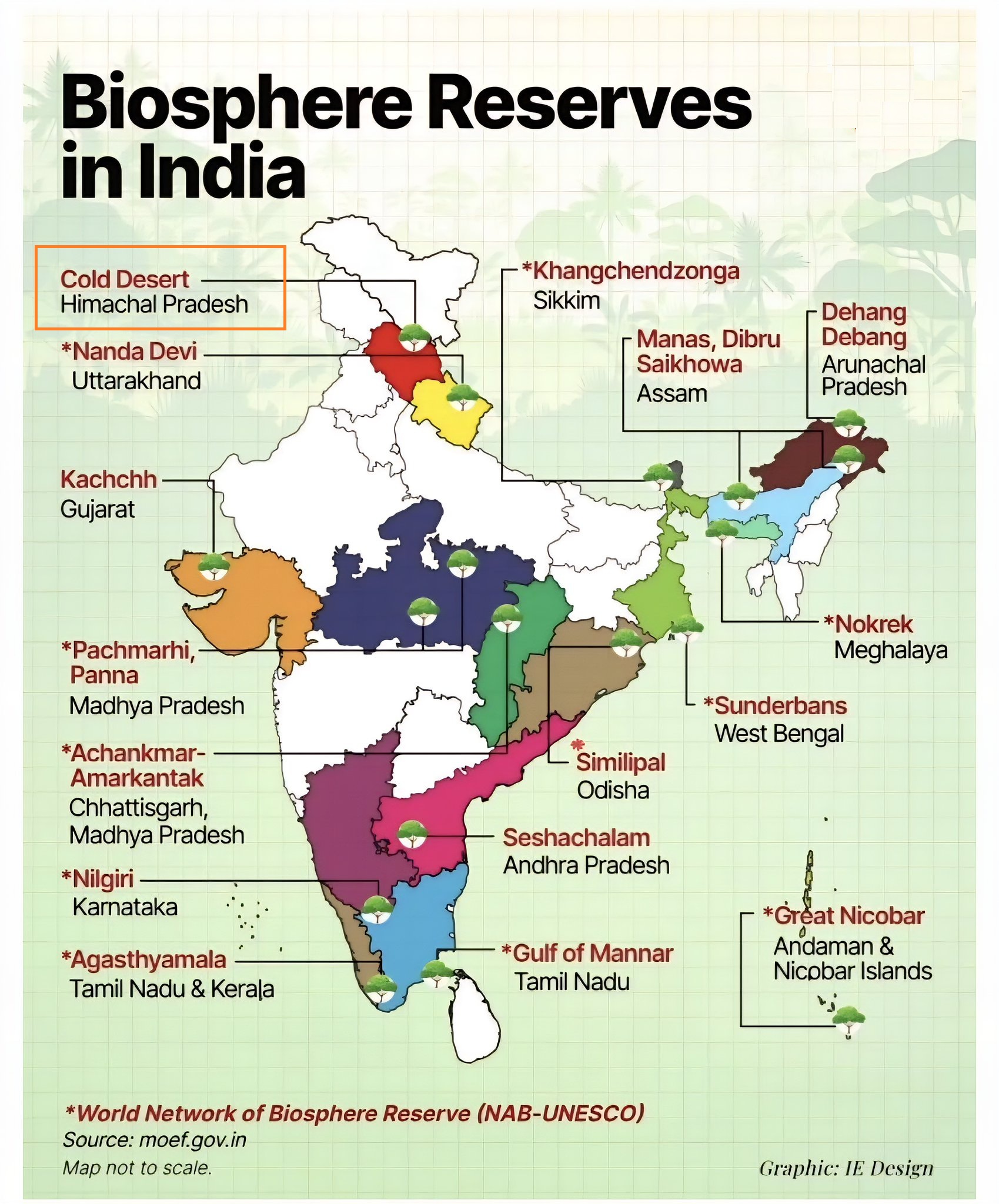
    Cold Desert named India’s 13th UNESCO Biosphere Reserve

    Why in the News?

    UNESCO added India’s Cold Desert Biosphere Reserve (CDBR) to the World Network of Biosphere Reserves (WNBR) under the Man and the Biosphere (MAB) programme.

    With this, India now has 13 UNESCO-recognized biosphere reserves out of 18 designated nationally.

    What are UNESCO Biosphere Reserves?

    • Overview: Sites integrating biodiversity conservation + cultural heritage + sustainable development.
    • Programme: MAB (1971).
    • Designation Criteria:
      • Must include a protected core zone.
      • Must represent a unique biogeographical unit.
      • Involve local communities in conservation.
      • Potential to preserve traditional lifestyles.
    • Functions: Conservation, Development, Logistic Support.
    • Global Network (WNBR): 785 sites, 142 countries (2025); 7.4 million sq. km (~5% Earth’s surface); home to 275 million people.

    About Cold Desert Biosphere Reserve (CDBR):

    • Location: Lahaul–Spiti (Himachal Pradesh), part of Trans-Himalayan biogeographic province.
    • Constituents: Includes Pin Valley National Park, Kibber Wildlife Sanctuary, Chandratal Wetland, Sarchu Plains.
    • Biodiversity:
      • Flora:  732 vascular plants, incl. 30 endemic, 47 medicinal plants (Amchi / Sowa Rigpa).
      • Fauna: Snow leopard (flagship), Tibetan wolf, Himalayan ibex, blue sheep (800+ in Spiti), Himalayan snowcock, golden eagle, bearded vulture.
    • Communities: ~12,000 people; practice yak & goat herding, barley/pea farming, Tibetan herbal medicine, Buddhist monastic councils.
    • Significance: Boosts eco-tourism, climate research, community-led conservation, sustainable livelihoods. Supports climate-resilient development in fragile ecosystems.

    cold desert biosphere reserve

    Biosphere Reserves in India:

    • Total: 18 designated, of which 13 in UNESCO-WNBR (as of 2025).
    • First: Nilgiri BR (1986); Largest: Gulf of Kachchh (Gujarat); Smallest: Dibru-Saikhowa (Assam).
    • Scheme: Launched 1986; implemented by MoEFCC under MAB Programme.
    • Three zones: Each biosphere reserve is organised into-
      1. Core zone (strictly protected),
      2. Buffer zone (limited human activity such as research, grazing, and tourism permitted), and
      3. Transition zone (sustainable human settlements and economic activities allowed).
    • Funding: 90:10 (NE & Himalayan states); 60:40 (others).
    [UPSC 2019] Which of the following are in Agasthyamala Biosphere Reserve?

    Options: (a) Neyyar, Peppara and Shendurney Wildlife Sanctuaries; and Kalakad Mundanthurai Tiger Reserve*

    (b) Mudumalai, Sathyamangalam and Wayanad Wildlife Sanctuaries; and Silent Valley National Park

    (c) Kaundinya, Gundla Brahmeswaram and Papikonda Wildlife Sanctuaries; and Mukurthi National Park

    (d) Kawal and Sri Venkateswara Wildlife Sanctuaries; and Nagarjunasagar-Srisailam Tiger Reserve


  • Global Geological And Climatic Events

    India’s only active volcano in Andaman’s Barren Island erupts

    Why in the News?

    Barren Island, which is not only India’s but South Asia’s only active volcano, has erupted twice in a span of eight days.

    barren island

    About Barren Island:

    • Location: In the Andaman Sea, about 138–140 km northeast of Port Blair, within the Andaman and Nicobar Islands (India).
    • Unique Status: The only confirmed active volcano in the Indian subcontinent and South Asia, lying on the volcanic arc between Sumatra (Indonesia) and Myanmar.
    • Geophysical Features: Roughly circular island (~3 km diameter); volcanic crater located 0.5 km from shore, rising to 354 m above sea level and classified as a stratovolcano made of lava, volcanic ash, and rock fragments.
    • Volcanic Activity
      • First Recorded Eruption: 1787.
      • Notable Eruptions: 1789, 1795, 1803–04, 1852, 1991, 2017, and minor eruptions in 2025.
      • 1991 Eruption: Lasted ~6 months, destructive to local fauna.
      • Volcanic Explosivity Index (VEI): Generally low, around 2.
    • Geological Significance:
      • Age of Flows: Oldest subaerial lava flows dated to 1.6 million years ago.
      • Crust: Built on 106 million-year-old oceanic crust.
      • Tectonics: Part of the subduction zone where the Indian Plate meets the Burmese Plate.
      • Research Value: Critical for geological and volcanic studies as India’s only active volcano.

    Note:

    Although there are no active volcanoes in mainland India, there are some extinct and dormant volcanoes in the country. These are: Narcondam Island (dormant, A&N Islands); Deccan Plateau (18.51°N 73.43°E; extinct, Maharashtra); Baratang Island (mud volcanoes; active, A&N Islands); Dhinodhar Hills (extinct, Gujarat); Dhosi Hill (extinct, Haryana–Rajasthan border); Tosham Hills (extinct, Haryana); and Loktak Lake (Supervolcanic caldera, Manipur).

    [UPSC 2018] Consider the following statements:

    1. The Barren Island volcano is an active volcano located in the Indian territory.
    2. Barren Island lies about 140 km east of Great Nicobar.
    3. The last time the Barren Island volcano erupted was in 1991 and it has remained inactive since then.

    Which of the statements given above is/are correct?

    (a) 1 only*

    (b) 2 and 3

    (c) 3 only

    (d) 1 and 3

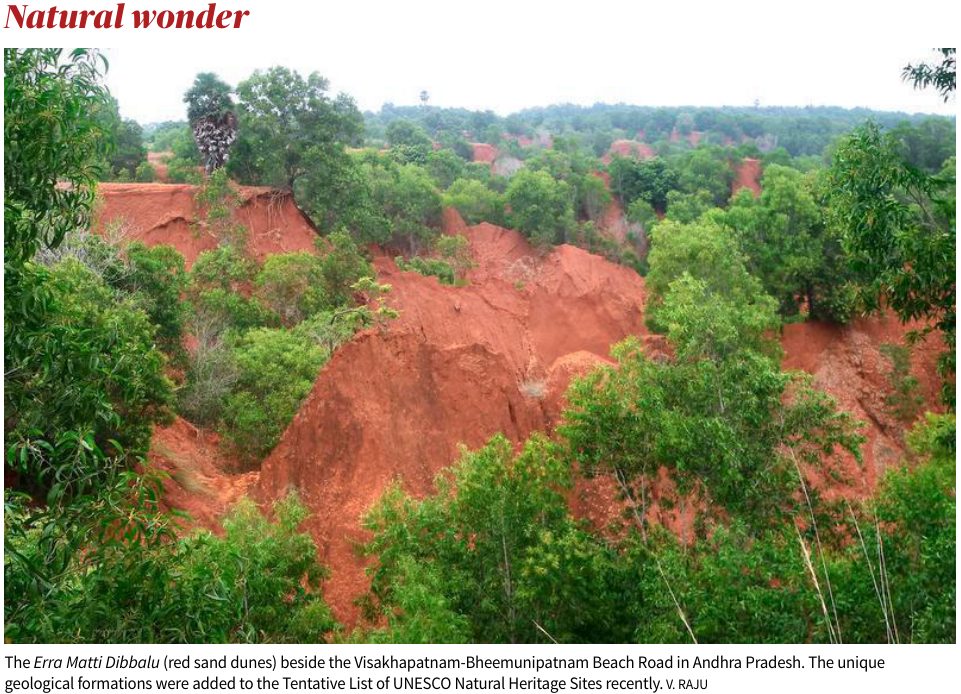
  • Places in news: Erra Matti Dibbalu

    Why in the News?

    This newscard is an excerpt from a photo published in ‘The Hindu’.

    About Erra Matti Dibbalu:

    • Location: Found between Visakhapatnam and Bheemunipatnam in Andhra Pradesh, stretching 5 km along the coast, with widths ranging from 200 m to 2 km.
    • Meaning: In Telugu, “Erra Matti” means red soil and “Dibbalu” means mounds, describing the reddish sand dunes.
    • Geological Heritage: Listed among the 34 National Geological Heritage Monument Sites of India by the Geological Survey of India (GSI).
    • Formation: Created around 12,000–18,500 years ago through the combined effect of tectonic activity (2.5 million–11,000 years ago), sea-level changes, monsoonal variability, and global climatic shifts.
    • Composition: Derived mainly from Khondalite rocks of the Eastern Ghats hinterland, with the red colour due to oxidation of iron-rich sediments.

    Significance:

    • Geological Value: Acts as a paleo-environment indicator, providing evidence of climate change, sea-level fluctuations, and coastal evolution during the late Quaternary period.
    • Archaeological Importance: Artefacts from Mesolithic and Neolithic periods and sediment layers dating back to the Late Pleistocene epoch have been found here.
    • Conservation Status: Declared a National Geo-heritage Monument (2016) and included in UNESCO’s Tentative List of World Heritage Sites (2025) for global recognition and protection.
    • Unique Landscape: Features badland topography with sand dunes, buried channels, gullies, and dendritic drainage patterns.
    • Rare Formation: Only two other similar red sand dune systems exist globally—the Teri dunes in Tamil Nadu and one site in Sri Lanka.
    [UPSC 2014] When you travel in Himalayas, you will see the following:

    1. Deep gorges 2. U-turn river courses 3. Parallel mountain ranges 4. Steep gradients causing land sliding

    Which of the above can be said to be the evidence for Himalayas being young fold mountains?

    Options: (a) 1 and 2 only (b) 1, 2 and 4 only (c) 3 and 4 only (d) 1, 2, 3 and 4*


  • Tiger Conservation Efforts – Project Tiger, etc.

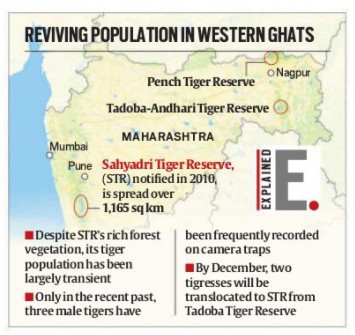
    In news: Sahyadri Tiger Reserve

    Why in the News?

    The Union Environment Ministry has approved the capture and translocation of eight tigers from Tadoba-Andhari and Pench reserves to the Sahyadri Tiger Reserve (STR) in western Maharashtra.

    In news: Sahyadri Tiger Reserve

    About Sahyadri Tiger Reserve (STR):

    • Overview: Situated in the Sahyadri Range, Western Ghats (Maharashtra), spanning districts of Satara, Sangli, Kolhapur, Ratnagiri.
    • Status: Declared Tiger Reserve (2010); part of UNESCO Western Ghats World Heritage Site (2012).
    • Geography: Dominated by Shivsagar (Koyna) and Vasant Sagar (Warana) reservoirs.
    • Vegetation: Moist evergreen, semi-evergreen, moist & dry deciduous forests; endemic trees like karvi, bamboo, Terminalia, Emblica.
    • Fauna: Bengal tiger, leopard, dhole, gaur, antelopes, mouse deer, giant squirrel. Birds include hornbills, vultures, river tern.
    • Tiger Status: Tigers absent for years; 5–9 present since 2018 (as per camera trap evidence).
    • Corridor Linkages: Connected to Radhanagari WLS (north) and Anshi–Dandeli TR (south, Karnataka), forming a key Western Ghats corridor.
    • Ecological Role: Secures catchments of Koyna & Warna rivers, crucial for farming and livelihoods.

    Need for Tiger translocation:

    • Prey base: Reserve has prey-rich habitat but lacks a stable breeding tiger population.
    • Other benefits: Prevents local extinction, strengthens corridor connectivity, supports Project Tiger, conserves biodiversity, and secures river watersheds.
    [UPSC 2017] From the ecological point of view, which one of the following assumes importance in being a good link between the Eastern Ghats and the Western Ghats?

    Options: (a) Sathyamangalam Tiger Reserve* (b) Nallamala Forest (c) Nagarhole National Park (d) Seshachalam Biosphere Reserve


  • Foreign Policy Watch: India-Sri Lanka

    Katchatheevu Island Dispute

    Why in the News?

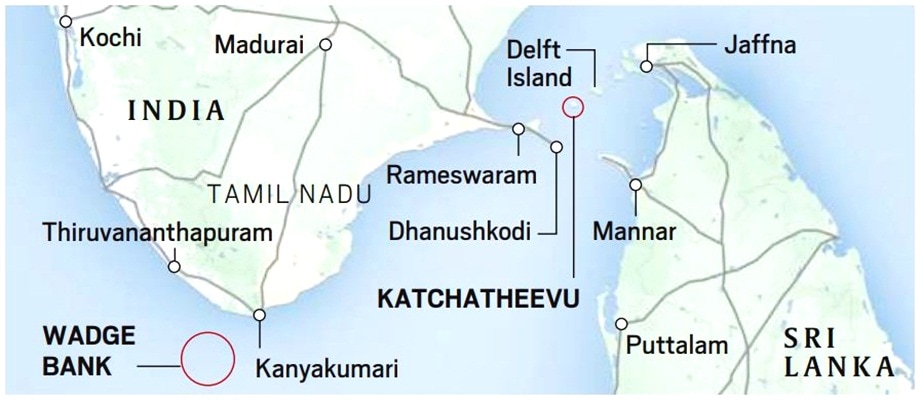
    Sri Lankan President Dissanayake’s visit to Katchatheevu Island, the first ever visit by a head of state, revived debates on the island’s history and ownership.

    Katchatheevu Island Dispute

    About Katchatheevu Island:

    • Overview: Small uninhabited island of about 285 acres in the Palk Strait, ~33 nautical miles from Jaffna (Sri Lanka) and close to Ramanathapuram (Tamil Nadu).
    • History: Once under the Raja of Ramnad (TN), later became disputed during British rule.
    • Agreements: Under 1974 and 1976 pacts, India (under Indira Gandhi govt.) recognised Sri Lanka’s sovereignty and gave up traditional fishing rights.
    • Religious Site: Home to St. Anthony’s Catholic Shrine, visited annually by Indian and Sri Lankan fishermen during a joint festival with visa waiver.
    • Ecology: Though barren and unsettled, serves as a resting point for fishermen and supports marine biodiversity.

    Disputes around Katchatheevu:

    • Fishing Conflicts: Tamil Nadu fishermen often cross into Sri Lankan waters due to declining catch in Indian waters, leading to frequent arrests by the Sri Lankan Navy.
    • Bottom-Trawling Issue: Indian trawlers use bottom-trawling, banned in Sri Lanka, which damages marine ecosystems and escalates tensions.
    • Political Demands: All TN political parties have demanded retrieval of the island.
    • National Politics: Issue often resurfaces during elections, with claims that earlier governments “easily gave away” Katchatheevu.
    • Official Position: India clarified in 2013–14 that no sovereign territory was ceded since the island was disputed, not fully under India’s control.
    • Core Problem: Lies not in sovereignty but in unsustainable bottom-trawling practices and the livelihood crisis faced by Tamil Nadu fishermen.
    [UPSC 2020] Consider the following statements:

    1. The value of Indo-Sri Lanka trade has consistently increased in the last decade.

    2. “Textile and textile articles” constitute an important item of trade between India and Bangladesh.

    3. In the last five years, Nepal has been the largest trading partner of India in South Asia.

    Which of the statements given above is/are correct? (2020)

    Options: (a) 1 and 2 only (b) 2 only* (c) 2 only (d) 3 only


  • Foreign Policy Watch: India-Nepal

    In news: Lipulekh Pass

    Why in the News?

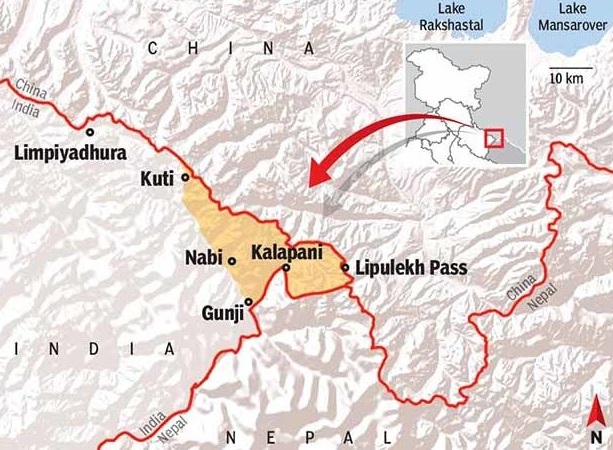
    India has rejected Nepal’s objection to resumption of India–China border trade through the Lipulekh Pass in Uttarakhand.

    About Lipulekh Pass:

    • Location: High-altitude Himalayan pass (~17,000 ft) near the trijunction of India, Nepal, and China (Tibet).
    • Connectivity: Links Uttarakhand’s Kumaon region with Taklakot in Tibet.
    • Cultural Role: Serves as the shortest route for the Kailash Mansarovar Yatra.
    • Trade Importance: Historic India–China trade route since 1954; disrupted during COVID-19 but later resumed.
    • Strategic Significance: Crucial for India due to its proximity to the India–China–Nepal border.

    What is Limpiyadhura–Lipulekh–Kalapani Dispute?

    • Origin: Rooted in the 1815 Treaty of Sugauli (Nepal–British East India Company), fixing Nepal’s western boundary at the Kali (Mahakali) River.
    • India’s Position: Claims Kali River originates near Lipulekh, placing Lipulekh and Kalapani within India.
    • Nepal’s Position: Claims Kali River originates at Limpiyadhura, extending Nepal’s boundary east to include Lipulekh and Kalapani.
    • Disputed Area: About 370 sq. km., under Indian administration since the 19th century.
    • Recent Development: In 2020, Nepal issued a new map showing Limpiyadhura, Lipulekh, and Kalapani as its territory; India rejected the claim citing lack of historical basis.

    Back2Basics: India–Nepal Border Disputes

    • Border Length: India and Nepal share a 1,770 km long open border across five Indian states – Uttarakhand, Uttar Pradesh, Bihar, West Bengal, and Sikkim.
    • Key Disputes:
      • Kalapani–Lipulekh–Limpiyadhura (Uttarakhand): Discussed above.
      • Susta (Uttar Pradesh–Nepal border): Caused by Gandak River’s shifting course, leading to encroachments and overlapping claims.
    • Tensions: Despite close ties, disputes often cause diplomatic strains.
    • Positions: India relies on historical treaties and long-standing administration, while Nepal asserts sovereignty and constitutional recognition of disputed territories.


    [UPSC 2007] Which one of the following Himalayan passes was reopened around in the middle of the year 2006 to facilitate trade between India and China?

    Options : (a) Chang La (b) Jara La (c) Nathu La* (d) Shipki La


  • Tiger Conservation Efforts – Project Tiger, etc.

    Sundarbans set to become India’s Second-Largest TR

    Why in the News?

    The proposal to expand the Sundarbans Tiger Reserve by 1,100 sq km has received clearance from the National Tiger Conservation Authority (NTCA) and awaits approval from National Board for Wildlife (NBWL).

    Sundarbans set to become India’s Second-Largest TR

    About Sundarbans Tiger Reserve (STR):

    • Location: Situated in South and North 24-Parganas districts, West Bengal; lies at the southern tip of the Gangetic Delta.
    • Area: Presently 2,585.89 sq km; expansion to 3,629.57 sq km under proposal.
    • Status: Notified as a Tiger Reserve, National Park, Biosphere Reserve; part of the UNESCO World Heritage Site.
    • Unique Feature: World’s only mangrove forest with a viable tiger population.
    • Tiger Count: Over 100 tigers – 80 in core area, 21 in adjoining forests.
    • Landscape: Interconnected estuaries, tidal creeks, and 105 mangrove-covered islands.
    • Flora: Dominated by mangrove species like Avicennia, Rhizophora, Heritiera.
    • Fauna: Includes Royal Bengal Tigers, Fishing Cats, Estuarine Crocodiles, Irrawaddy Dolphins, King Cobras, and endangered reptiles and birds.
    • Boundaries:
      • East: Bangladesh border (Raimangal, Harinbhanga rivers)
      • South: Bay of Bengal
      • North/West: Matla, Bidya, Gomdi Rivers

    Back2Basics: Tiger Reserves in India

    • Overview: A Tiger Reserve is a legally notified area under the Wildlife (Protection) Act, 1972 for the conservation of tigers and biodiversity.
    • Governing Authority: National Tiger Conservation Authority (NTCA), Ministry of Environment, Forest and Climate Change.
    • Origin: Initiated under Project Tiger, launched in 1973.
    • Structure:
      • Core Zone: Highly protected; no human activity allowed; declared as National Park or Sanctuary.
      • Buffer Zone: Surrounds core; allows regulated human use and supports conservation-compatible livelihoods.

    Tiger Reserve Landscape in India (as of 2025):

    • Total Reserves: 58 (up from 46 in 2014)
    • Largest Reserve: Nagarjunasagar-Srisailam, Andhra Pradesh – 3,727.82 sq km
    • Oldest Reserve: Corbett Tiger Reserve, Uttarakhand – established in 1973
    • Newest Reserves: Guru Ghasidas (Chhattisgarh), Ranipur (Uttar Pradesh), Ramgarh Vishdhari (Rajasthan)
    • Top State: Madhya Pradesh – 7 Tiger Reserves
    • Tiger Density: Bandipur TR > Corbett TR > Kaziranga TR (148, 18.6 tigers/sq. km.)
    • Global Tiger Day: Celebrated on 29th July every year


    [UPSC 2020] Among the following Tiger Reserves, which one has the largest area under “Critical Tiger Habitat”?”

    Options: (a) Corbett (b) Ranthambore (c) Nagarjunsagar-Srisailam* (d) Sunderbans