💥UPSC 2026, 2027, 2028 UAP Mentorship (March Batch) + Access XFactor Notes & Microthemes PDF

Type: India Mapping

  • Wildlife Conservation Efforts

    In news: Chincholi Wildlife Sanctuary

    Note4Students

    From UPSC perspective, the following things are important:

    Prelims level: Chincholi Wildlife Sanctuary

    Why in the News?

    The Kalaburagi Forest Division is working to relocate a hamlet within the Chincholi Wildlife Sanctuary on the Karnataka-Telangana border to a safer area.

    About the Chincholi Wildlife Sanctuary

    Details
    • Declared a wildlife sanctuary in 2011, covering 134.88 sq. km.
    • Recognized as the first dryland Wildlife Sanctuary in South India.
    • Located in the Kalaburagi District, renowned for its floristic diversity.
    • Contributes to the conservation of dryland ecosystems.
    Geographical Location
    • Situated in the Hyderabad Karnataka region.
    • Features the Chandrampalli Dam and four smaller dams within the sanctuary.
    Flora and Fauna
    • Flora: Rich in medicinal plants and tree species like Red Sanders, Sandalwood, Acacia, and Teak.
    • Fauna:
      • Mammals: Blackbuck, Common Fox, Four-horned Antelope, Indian Wolf, Hyena, and Fruit Bat.
      • Birds: Over 35 species, including Black Drongo, Black-winged Kite, Blossom-headed Parakeet, Blue Pigeon, Black-headed Oriole, and Grey Partridge.
    Climatic/Geographical Features
    • Comprises dry deciduous and moist deciduous forests.
    • Fringes are planted with Acacia and Teak.
    • Supports a dryland ecosystem with water bodies like the Chandrampalli Dam.
    • Features a mix of arid and semi-moist climatic conditions.


    PYQ:

    [2018] In which one of the following States is Pakhui Wildlife Sanctuary located?

    (a) Arunachal Pradesh

    (b) Manipur

    (c) Meghalaya

    (d) Nagaland

  • Wildlife Conservation Efforts

    Survey adds 24 new species to Munnar’s faunal stock

    Note4Students

    From UPSC perspective, the following things are important:

    Prelims level: Protected areas mentioned

    Survey adds 24 new species to Munnar’s faunal stock

    Why in the News?

    A recent faunal survey conducted in the Munnar Wildlife Division has documented 24 new species of birds, butterflies, and odonates, enriching its biodiversity checklist.

    Which are the surveyed sites?

    All the surveyed national parks and wildlife sanctuaries are located in Kerala, India, specifically in the Idukki district:

    • Mathikettan Shola National Park (MSNP): It is a biodiversity hotspot and part of the Western Ghats.
    • Pambadum Shola National Park (PSNP): It is Kerala’s smallest national park and home to unique flora and fauna.
    • Anamudi Shola National Park (ANP): Named after Anamudi, the highest peak in South India.
    • Kurinjimala Wildlife Sanctuary (KWLS): Located in Idukki, it protects the habitat of the Neelakurinji (Strobilanthes kunthiana), a flower that blooms once every 12 years.
    • Eravikulam National Park (ENP): Famous for the Nilgiri Tahr.
    • Chinnar Wildlife Sanctuary (CWLS): Situated in the rain-shadow region of the Western Ghats, near the Kerala-Tamil Nadu border in Idukki.

    Key Highlights of the Survey

    • New Species Added: 24 new species, including birds (11), butterflies (8), and odonates (5).
    • Total Documentation:
      • Birds: 217 species recorded; checklist updated to 258.
      • Butterflies: 166 species recorded; checklist updated to 246.
      • Odonates: 5 new records, checklist updated to 58 species.
    • Notable Wildlife Observed: Mammals like Nilgiri Tahr, tigers, leopards, and elephants; 12 species of reptiles and amphibians.

    About the Added Species

    • Birds:
      • New Additions: Brown Hawk Owl, Barred Buttonquail, Spotted Owlet, Mottled Wood Owl, Baya Weaver, Red Munia, Richard’s Pipit, Jerdon’s Bushlark, Golden-Headed Cisticola, Large Grey Babbler, Chestnut-Bellied Nuthatch.
      • Highlights: Nilgiri Wood Pigeon, Steppe Eagle, Peregrine Falcon, Indian Grey Hornbill, and Blue-eared Kingfisher.
    • Butterflies:
      • Endemic Species: Red-disc Bushbrown, Palni Fritillary, Nilgiri Tiger, Nilgiri Four-ring.
      • Unique Sightings: Grass Jewel (smallest butterfly in Kerala), Southern Birdwing (largest butterfly in India).
    • Odonates (flying insects):
      • New Records: Cratilla lineata calverti, Macrodiplax cora, Palpopleura sexmaculata, Tholymis tillarga, Lestes elatus.

    PYQ:

    [2020] With reference to India’s biodiversity Ceylon frogmouth, Coppersmith barbet, Gray-chinned minivet and White-throated redstart are:

    (a) Birds

    (b) Primates

    (c) Reptiles

    (d) Amphibans

  • Tiger Conservation Efforts – Project Tiger, etc.

    In news: Similipal Tiger Reserve

    Note4Students

    From UPSC perspective, the following things are important:

    Prelims level: Simlipal Tiger Reserve

    Why in the News?

    Tigress Zeenat, originally from Maharashtra’s Tadoba, was relocated to Odisha’s Similipal Tiger Reserve after straying through Jharkhand into West Bengal, complicating tracking efforts.

    In news: Similipal Tiger Reserve

    About Similipal Tiger Reserve (STR)

    Details
    Geographical Features
    • Situated in the Mayurbhanj District, Northern Odisha, surrounded by high plateaus and hills.
    • Twin peaks Khairiburu and Meghashini, rising to 1515 meters above mean sea level.
    • Undulating and hilly terrain, interspersed with open grasslands and wooded areas.
    • Inhabited by tribes like Kolha, Santhala, Bhumija, Gondas, Khadia, Mankadia, and Sahara.
    • Declared a Tiger Reserve in 1956; brought under Project Tiger in 1973.
    • Included in the World Network of Biosphere Reserves in 2009.
    Flora and Fauna
    • Flora: Home to 1078 species of plants, including 94 species of orchids, with Sal as the dominant tree species.
    • Fauna: Rich wildlife, including Leopards, Gaurs, Elephants, Langurs, Barking Deer, Spotted Deer, Sloth Bears, Mongoose, Flying Squirrels, Porcupines, Pythons, Sambar, Pangolins, and more.
    • It is critical habitat for birds, including migratory species like Bar-Headed Geese and Brahmini Ducks, and home to freshwater snails (Radix genus) in its water bodies.
    • Melanistic Tigers:
      • Similipal hosts 27 of Odisha’s 30 tigers (AOTE-2023-24), including 13 pseudo-melanistic tigers with unique black-striped patterns due to a mutation in the Taqpep gene.
      • It is the only wild habitat in the world with pseudo-melanistic tigers.


    PYQ:

    [2011] Two important rivers – one with its source in Jharkhand (and known by a different name in Odisha), and another, with its source in Odisha – merge at a place only a short distance from the coast of Bay of Bengal before flowing into the sea. This is an important site of wildlife and biodiversity and a protected area.

    Which one of the following could be this?

    (a) Bhitarkanika

    (b) Chandipur-on-sea

    (c) Gopalpur-on-sea

    (d) Simlipal

  • Tourism Sector

    In news: Pangong Lake

    Note4Students

    From UPSC perspective, the following things are important:

    Prelims level: Pangong Lake

    Why in the News?

    The Indian Army has installed a statue of Chhatrapati Shivaji Maharaj on the bank of Pangong lake at an altitude of 14,300 feet, a region that is close to the Line of Actual Control (LAC) with China in the eastern Ladakh sector.

    About Pangong Lake (Pangong Tso)

    • Its name is derived from the Tibetan term “Pangong Tso,” meaning “high grassland lake.” It is an endorheic (landlocked) lake with no outflow.
    • Location & Size:
      • Spans 134 km, divided between India (1/3) and the Tibetan Autonomous Region (2/3).
      • Situated at an altitude of 4,350 meters, covers 604 sq. km, and is 5 km wide at its broadest point.
    • Water & Climate:
      • Brackish water that completely freezes in winter.
      • The lake’s color shifts with sunlight and weather, displaying shades of blue, green, and red.
    • Wildlife: Acts as a breeding ground for Bar-Headed Geese, Brahmini Ducks, and Radix freshwater snails.
    • Strategic Importance: Located in the Chushul approach, a key route for potential Chinese offensives, and was a major site of conflict during the 1962 war.

    Political Features:In news: Pangong Lake

    • Border & Control: Lies on the Ladakh-China border, with the Line of Actual Control (LAC) passing through it.
    • Contested Terrain: The northern bank is a hotspot due to differing boundary perceptions; China has built roads highlighting the lake’s strategic value.
    • 1999 Incident: During Operation Vijay, China constructed a 5-km road inside Indian territory.
    • 2020 Standoff:
      • Began on May 5, 2020, following a clash in the Pangong Lake area.
      • Disengagement on the north and south banks concluded in 2021.
      • On October 21, 2024, India and China resolved the final friction points (Demchok, Depsang), ending a four-and-half-year border standoff.

    PYQ:

    [2020] Siachen Glacier is situated to the

    (a) East of Aksai Chin

    (b) East of Leh

    (c) North of Gilgit

    (d) North of Nubra Valley

  • Wildlife Conservation Efforts

    Amchang Wildlife Sanctuary

    Note4Students

    From UPSC perspective, the following things are important:

    Prelims level: Amchang Wildlife Sanctuary

    Why in the News?

    A decomposed carcass of an elephant was discovered in the Khanapara range of the Amchang Wildlife Sanctuary.

    About Amchang Wildlife Sanctuary:

    Details
    Location Eastern fringe of Guwahati, Assam.

    Extends from the Brahmaputra River in the north to the hilly forests of Meghalaya in the south.

    Formation Established in 2004 by combining Amchang, South Amchang, and Khanapara reserved forests
    Flora and Fauna Tropical moist deciduous forest, with semi-evergreen areas in valleys and river depressions.

    • Fauna: Asiatic elephants, Chinese pangolin, slow loris, Assamese macaque, rhesus monkey, hoolock gibbon, leopard,  Leopard cat, jungle cat, sambar, barking deer, red serow, Malayan giant squirrel, Himalayan porcupine.
    • Vultures and raptors: White-backed vulture, Slender-billed vulture, White-cheeked hill partridge, Grey peacock pheasant,
    • Birds: Kaleej pheasant, Greater adjutant stork, Great pied hornbill, Oriental pied hornbill, Green imperial pigeon.
    Conservation Status Recognized as an Important Bird & Biodiversity Area (IBA).


    PYQ:

    [2018] In which one of the following States is Pakhui Wildlife Sanctuary located?

    (a) Arunachal Pradesh

    (b) Manipur

    (c) Meghalaya

    (d) Nagaland

  • Tiger Conservation Efforts – Project Tiger, etc.

    Amangarh Tiger Reserve

    Note4Students

    From UPSC perspective, the following things are important:

    Prelims level: Amangarh Tiger Reserve

    Why in the News?

    The body of an eight-year-old tiger was found on the border of Amangarh Tiger Reserve of Bijnor and Jim Corbett National Park.

    About Amangarh Tiger Reserve

    Details
    Location Bijnor district, Uttar Pradesh, India
    Established 2012
    Area 80 square kilometers (approx.)
    Significance Part of the Corbett Tiger Reserve landscape (buffer zone of Jim Corbett National Park)
    Tiger Population Acts as a buffer zone for tigers migrating from Corbett Tiger Reserve
    Primary Fauna Tigers, leopards, elephants, deer, and several species of birds
    Flora Sal, teak, khair, and several other deciduous trees
    Rivers Ganga and Ramganga rivers flow near the reserve
    Significance in Conservation Part of “Project Tiger,” contributing to the national conservation strategy for tigers in India


    PYQ:

    [2012] Consider the following areas:

    1. Bandipur

    2. Bhitarkanika

    3. Manas

    4. Sunderbans

    Which of the above are Tiger Reserves?

    (a) 1 and 2 only

    (b) 1, 3 and 4 only

    (c) 2, 3 and 4 only

    (d) 1, 2, 3 and 4

  • Foreign Policy Watch: India-Sri Lanka

    Places in news: Palk Strait

    Note4Students

    From UPSC perspective, the following things are important:

    Prelims level: Palk Strait

    Why in the News?

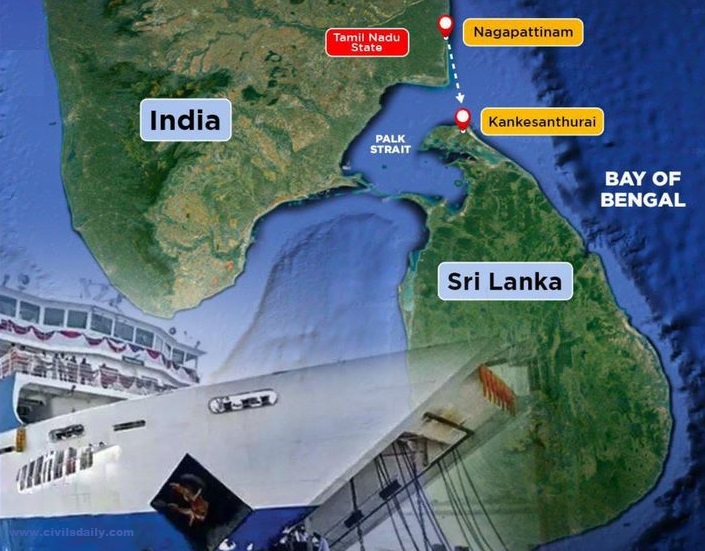
    The Nagapattinam-Kankesanthurai ferry service has been resumed along the Palk Strait between India and Sri Lanka after 40 years.

    About Palk Strait

    Location Narrow water body separating Tamil Nadu, India, and Sri Lanka.
    Name Origin Named after Robert Palk, a British Raj-era Governor of Madras Presidency (1755-1763).
    Geographic Boundaries Southern boundaries include Pamban Island (India), Adam’s Bridge (shoals), Gulf of Mannar, and Mannar Island (Sri Lanka).
    Connection Connects the Bay of Bengal in the northeast with the Gulf of Mannar in the southwest.
    Alternate Name Southwestern part of the strait is known as Palk Bay.
    Dimensions Width varies from 64 to 137 km, length is approximately 137 km, and depth is less than 330 feet (100 meters).
    River Inflows Vaigai River in Tamil Nadu flow into the Palk Strait.
    Historic Context
    • Key maritime link between India and Sri Lanka, facilitating trade, cultural exchanges, and religious pilgrimages.
    • Played a vital role in the British colonial trade routes, but ferry services were halted due to the 1964 cyclone and the Sri Lankan civil war in 1983.
    Present Significance Supports regional trade, tourism, and people-to-people connections, while fostering economic development in both India and Sri Lanka.
  • Wetland Conservation

    [pib] Bhoj Wetland

    Note4Students

    From UPSC perspective, the following things are important:

    Prelims level: Bhoj Wetland

    Why in the News?

    The Madhya Pradesh State Wetland Authority has reported that Bhoj Wetland in Bhopal is not at risk of being removed from the Ramsar Convention List of important international wetlands.

    About Bhoj Wetland

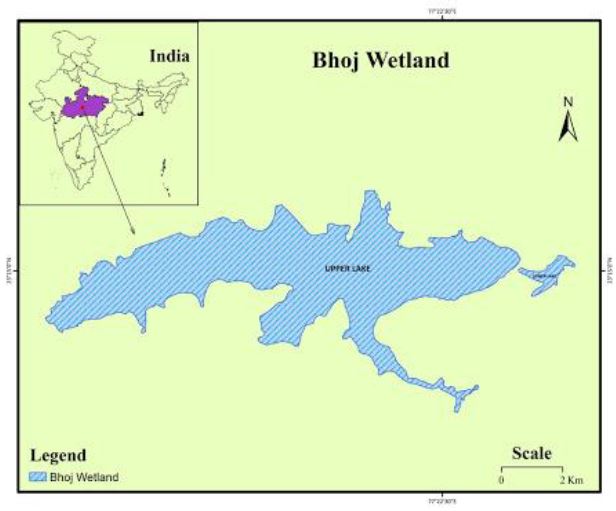
    • Bhoj Wetland is located in the center of Bhopal district in Madhya Pradesh.
    • The wetland includes two man-made lakes: the upper lake and the lower lake.
    • Since August 2002, they have been recognized as a wetland of international importance under the Ramsar Convention.
    • The upper lake, created by King Bhoj in the 11th century, is one of the oldest large man-made lakes in central India.
      • It was formed by building an earthen dam across the Kolans River, which used to be a tributary of the Halali River.
      • Now, the upper part of the Kolans River and the Bhojtal drain into the Kaliasot River through a diversion channel.
      • Bhadbhada Dam, built in 1965, controls the outflow to the Kaliasot River.
    • The lower lake was created in 1794 by Nawab Chhote Khan to beautify the city.
      • It also has an earthen dam and drains into the Halali River through the lower part of the Kolans River, now called the Patra Drain.
      • Both the Kaliasot and Halali Rivers flow into the Betwa River.

    Significance of Bhoj Wetland

    • The upper lake provides 40% of Bhopal’s drinking water, while the lower lake supplies raw water and enhances the city’s beauty.
    • It supports over 700 species of plants and animals, including zooplankton and phytoplankton.
    • Both lakes are rich in biodiversity, supporting various fish species, birds, insects, reptiles, and amphibians.

    PYQ:

    [2018] Which one of the following is an artificial lake?

    (a) Kodaikanal (Tamil Nadu)

    (b) Kolleru (Andhra Pradesh)

    (c) Nainital (Uttarakhand)

    (d) Renuka (Himachal Pradesh)

  • Wildlife Conservation Efforts

    In news: Gandhi Sagar Sanctuary

    Note4Students

    From UPSC perspective, the following things are important:

    Prelims level: Project Cheetah, Banni Grasslands, Gandhi Sagar WLS

    Why in the News?

    • The Gandhi Sagar sanctuary in Madhya Pradesh is the preferred location for the next batch of cheetah’s relocation plan.
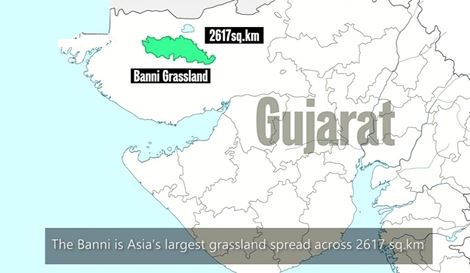
      • However, Banni in the Rann of Kutch, Gujarat is also being prepared to house some of them.

    Cheetah Reintroduction in India:

    • In India, cheetahs disappeared in the early 1950s due to hunting and the loss of their habitat.
    • The ‘Action Plan for Reintroduction of Cheetah in India /Project Cheetah (2022)’ aims to bring cheetahs from African countries to various national parks.
    • It is spearheaded by the National Tiger Conservation Authority (NTCA).
    • Recently, cheetahs from Namibia were reintroduced in Kuno National Park, Madhya Pradesh.
    • Cheetah are listed as VULNERABLE by the IUCN; Schedule II of the Wild Life (Protection) Act, 1972.
    • Kuno NP and Gandhi Sagar has an ideal habitat parallel to Maasai Mara (a National Park) in Kenya, suitable for cheetahs.

    About Gandhi Sagar Wildlife Sanctuary

    • It is located in western Madhya Pradesh and covers an area of 368.62 sq km.
    • It is a flat rocky plateau characterized by shallow topsoil and exposed sheetrock.
    • It is divided by the Chambal River, with the Gandhi Sagar dam and reservoir within its boundaries.
    • Flora and Fauna:
      • Flora: The sanctuary features a savannah ecosystem with open grasslands interspersed with dry deciduous trees. Riverine valleys within the sanctuary support evergreen vegetation.
      • Fauna: The sanctuary is home to a diverse range of wildlife, including species like leopards, sloth bears, striped hyenas, grey wolves, golden jackals, jungle cats, Indian foxes, and marsh crocodiles.

    About Banni Grasslands:

    • The Banni Grassland is located in the Kutch district of Gujarat, covering around 3,847 square km.
    • The climate is arid and semi-arid, with extremely hot summers (temperatures above 45°C) and mild winters (12°C to 25°C), receiving 300-400 mm of annual rainfall mainly during the monsoon.
      • Flora: Grasses such as Dichanthium, Sporobolus, and Cenchrus species, with salt-tolerant plants, shrubs, and trees like Acacia and the invasive Prosopis juliflora.
      • Fauna: Indian wolf, hyena, chinkara, Great Indian Bustard, flamingos, and various raptors, reptiles, and invertebrates.
    • It is inhabited by pastoral communities like the Maldharis, who rely on livestock grazing (cattle, buffalo, and sheep) for their livelihood.
    • Agriculture is limited due to arid conditions, with some areas used for salt production.

    PYQ:

    [2024]  Consider the following statements:

    1. Lions do not have a particular breeding season.

    2. Unlike most other big cats, cheetahs do not roar.

    3. Unlike male lions, male leopards do not proclaim their territory by scent marking.

    Which of the statements given above are correct?

    (a) 1 and 2 only

    (b) 2 and 3 only

    (c) 1 and 3 only

    (d) 1, 2 and 3

    [2012]  Consider the following: (2012)

    1. Black-necked crane
    2. Cheetah
    3. Flying squirrel
    4. Snow leopard

    Which of the above are naturally found in India?

    (a) 1, 2 and 3 only
    (b) 1, 3 and 4 only
    (c) 2 and 4 only
    (d) 1, 2, 3 and 4

  • Wildlife Conservation Efforts

    Reviving Gharials in Kaziranga

    Note4Students

    From UPSC perspective, the following things are important:

    Prelims level: Gharial and its conservation, Kaziranga NP

    Why in the News?

    In Kaziranga National Park and Tiger Reserve, a lone female gharial has emerged as a significant presence, marking a potential revival for the species in the Brahmaputra River.

    About Kaziranga National Park and Tiger Reserve:

    • Located in the state of Assam, Kaziranga is renowned for its biodiversity and conservation efforts.
    • Established in 1905 as a reserve forest and declared a national park in 1974.
    • Designated as a UNESCO World Heritage Site in 1985 for its unique natural environment and successful conservation of the Great One-Horned Rhinoceros.
    • Kaziranga is home to the highest density of tigers among protected areas in the world.
    • It hosts two-thirds of the world’s Great One-Horned Rhinoceros population, a significant conservation success story.
    • The park spans approximately 430 square kilometers (166 square miles) of grasslands, wetlands, and forests.

    One-Horned Rhinoceros:

    • OneHorned Rhinos: IUCN Red List Status: Vulnerable; CITES: Appendix I ; WPA, 1972: Schedule I.
    • Mainly found in Assam, West Bengal.
    • Assam hosts about 2,640 rhinos across Pobitora WLS, Rajiv Gandhi Orang NP, Kaziranga NP, and Manas NP.

    About Gharial

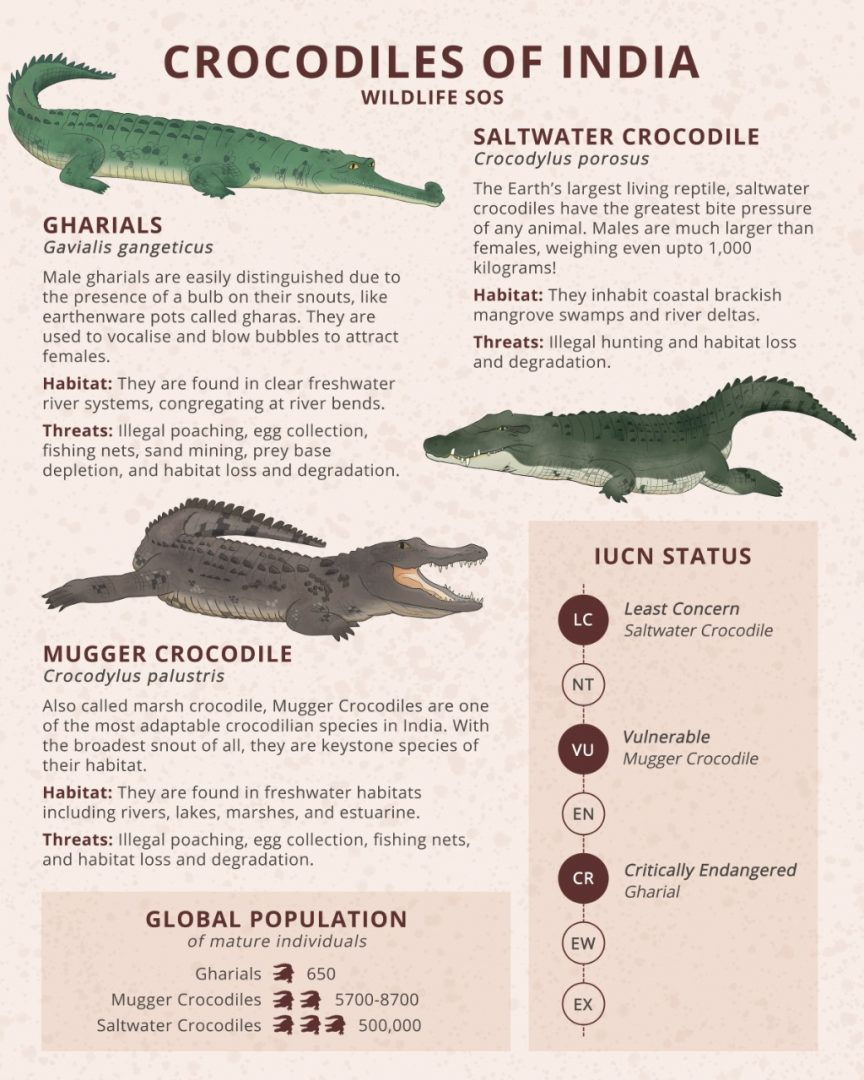
    • The Gharial is a fish-eating crocodile native to the Indian subcontinent.
    • They are a crucial indicator of clean river water.
    • It is also found in the rainforest biome of Mahanadi in Satkosia Gorge Sanctuary, Odisha.
    • Gharials are ‘Critically Endangered’ in the IUCN Red List of Species.
    • The species is also listed under Schedule I of the Wild Life (Protection) Act, 1972.
    • National Chambal Sanctuary along the river Chambal in Madhya Pradesh is the biggest protected area of the species.

    Recent findings of Gharial in Kaziranga

    • Gharials, distinguished by their long, narrow snouts, were believed to have disappeared from the Brahmaputra by the 1950s.
    • The female gharial, initially spotted in 2021, has grown to nearly adult size, providing hope for their reintroduction into the ecosystem.

    PYQ:

    [2013] Consider the following fauna of India :

    1. Gharial

    2. Leatherback turtle

    3. Swamp deer

    Which of the above is/are endangered?

    (a) 1 and 2 only

    (b) 3 only

    (c) 1, 2 and 3

    (d) None