💥UPSC 2026, 2027, 2028 UAP Mentorship (March Batch) + Access XFactor Notes & Microthemes PDF

Type: IOCR

  • New York Convention

    Note4Students

    From UPSC perspective, the following things are important:

    Prelims level: New York Convention

    Mains level: Not Much

    Cairn Energy has filed a case in a U.S. district court to enforce a $1.2 billion arbitration award it won in a tax dispute against India. Cairn aims to enforce the award under international arbitration rules, commonly called the New York Convention.

    New York Convention

    • The Convention on the Recognition and Enforcement of Foreign Arbitral Awards is commonly known as the New York Convention.
    • It was adopted by a UN diplomatic conference on 10 June 1958 and entered into force on 7 June 1959.
    • It requires courts of contracting states to give effect to private agreements to arbitrate and to recognize and enforce arbitration awards made in other contracting states.
    • Widely considered the foundational instrument for international arbitration, it applies to arbitrations that are not considered domestic awards in the state where recognition and enforcement are sought.

    What was the case?

    • The Indian government has lost an international arbitration case to energy giant Cairn Plc over the retrospective levy of taxes and has been asked to pay damages worth $1.2 billion to the UK firm.
    • The Permanent Court of Arbitration at The Hague has maintained that the Cairn tax issue is not a tax dispute but a tax-related investment dispute and, hence, it falls under its jurisdiction.
    • India’s demand in past taxes, it said, was in breach of fair treatment under the UK-India Bilateral Investment Treaty.

  • Human Rights Issues

    US moves to rejoin UN Human Rights Council

    Note4Students

    From UPSC perspective, the following things are important:

    Prelims level: UN HRC

    Mains level: US policies revision after regime change

    The Biden administration is set to reengage with the much-maligned UN Human Rights Council that former Donald Trump withdrew from almost three years ago.

    Try this PYQ:

    Q.Consider the following:

    1. Right to education.
    2. Right to equal access to public service.
    3. Right to food.

    Which of the above is/are Human Right/Human Rights under “Universal Declaration of Human Rights”?

    (a) 1 and 2 only

    (b) Only 1

    (c) 1, 2 and 3

    (d) Only 3

    Why did the US pulled-out earlier?

    • Trump pulled out of the world body’s main human rights agency in 2018 due to its disproportionate focus on Israel.
    • Israel had received by far the largest number of critical council resolutions against any country.
    • The Trump administration took issue with the body’s membership, which currently includes China, Cuba, Eritrea, Russia and Venezuela, all of which have been accused of human rights abuses.

    About UN Human Rights Council

    • The UNHRC describes itself as “an inter-governmental body within the UN system responsible for strengthening the promotion and protection of human rights around the globe.
    • It addresses situations of human rights violations and make recommendations on them.
    • The first session took place from June 19-30, 2006, three months after the Council was created by UN General Assembly Resolution 60/251 on March 15 that year.
    • The UNHRC has the ability to discuss all thematic human rights issues and situations that require its attention throughout the year.
    • The HRC replaced the former United Nations Commission on Human Rights (UNCHR).

    HRC Meetings

    • The Human Rights Council holds no fewer than three regular sessions a year, for a total of at least 10 weeks.
    • The meetings take place for four weeks in March, for three weeks in June, and for another three weeks in September.
    • The sessions are held at the UN Office in Geneva, Switzerland.
    • If one-third of the Member States so request, the HRC can decide at any time to hold a special session to address human rights violations and emergencies.

    Membership

    • The Council is made up of 47 UN Member States, which are elected by the UNGA through a direct and secret ballot.
    • The General Assembly takes into account the contribution of the candidate states to the promotion and protection of human rights, as well as their voluntary pledges and commitments in this regard.
    • Members of the Council serve for a period of three years and are not eligible for immediate re-election after serving two consecutive terms.
    • As of January 1, 2019, 114 UN Member States have served on the HRC. Both India and Pakistan are on this list.
    • The HRC has a Bureau of one President and four Vice-Presidents, representing the five regional groups. They serve for a year, in accordance with the Council’s annual cycle.

    Seat distribution

    • African States: 13 seats
    • Asia-Pacific States: 13 seats
    • Latin American and Caribbean States: 8 seats
    • Western European and other States: 7 seats
    • Eastern European States: 6 seats
  • Corruption Challenges – Lokpal, POCA, etc

    Highlights of the Corruption Perception Index, 2020

    Note4Students

    From UPSC perspective, the following things are important:

    Prelims level: CPI

    Mains level: Prevalence of corruption in India

    The Transparency International (TI)’s corruption perception index (CPI) was recently released for 2020.

    Another set of useful data in news to be noted by aspirants. Such data are essential and need to be memorized. One must note here. Such data recur every year. So it is not a big task to deal with such numbers along with other critical indices.

    About the Corruption Perception Index

    • The index ranks 180 countries and territories by their perceived levels of public sector corruption.
    • It uses a scale of 0 to 100, where 0 is highly corrupt and 100 is very clean.

    Global prospects

    • Denmark and New Zealand top the index, with 88 points. Syria, Somalia and South Sudan come last, with 14, 12 and 12 points, respectively.
    • Nearly half of countries have been stagnant on the index for almost a decade, indicating stalled government efforts to tackle the root causes of corruption.
    • More than two-thirds score below 50.

    India’s performance

    • The CPI score for India is constant this year as well as the previous year’s score.
    • India’s rank is 86 out of 180 nations with a score of 40.
    • It was ranked at 80th position out of 180 countries in 2019 with a score of 41.

    A comparison with neighbours

    • At 40, India’s score is below the average score of the Asia-Pacific region (31 countries) and global average, the CPI 2020 report stated.
    • India’s overall score is also two points less than that of China, which docked at 78th position, with a score of 42.
    • Pakistan, however, scored just 31 points, falling at the 144th position on the index.

    What does it mean for India?

    • India is still very low on corruption Index, the report said, noting that experts feel the CPI does not reflect the actual corruption level in any country.
    • The integrity score determines the corruption situation of a country.

    Recommendations made by TI

    To reduce corruption and better respond to future crises, Transparency International recommends that all governments:

    • Strengthen oversight institutions to ensure resources reach those most in need. Anti-corruption authorities and oversight institutions must have sufficient funds, resources and independence to perform their duties.
    • Ensure open and transparent contracting to combat wrong-doing, identify conflicts of interest and ensure fair pricing.
    • Defend democracy and promote civic space to create the enabling conditions to hold governments accountable.
    • Publish relevant data and guarantee accessto information to ensure the public receives easy, accessible, timely and meaningful information.
  • Digital India Initiatives

    What is EDISON Alliance?

    Note4Students

    From UPSC perspective, the following things are important:

    Prelims level: EDISON alliance

    Mains level: Global action against digital divide

    The World Economic Forum (WEF) has announced the launch of an Essential Digital Infrastructure and Services Network (EDISON) Alliance.

    The peculiarity of name ‘EDISON Alliance’ creates a hotspot here for prelims.  UPSC may either crate confusion over purpose or parent organization. The alliance is yet to take shape completely; hence there is an ambiguity over its members.

    EDISON Alliance

    • Geneva-based World Economic Forum (WEF), which describes itself as an international organization for public-private partnership, will serve as the secretariat and platform for the EDISON Alliance.
    • A wider group of ‘Champions Leaders’ will advise and support the Alliance, the WEF said while announcing the launch.
    • Alliance aims to work towards ensuring global and equitable access to the digital economy.
    • Its prime goal is to ensure an unprecedented level of cross-sectoral collaboration between the technology industry and other critical sectors of the economy, according to the WEF.

    Why need such an alliance?

    • Access to digital technologies has enabled many to work, learn and live during the COVID-19 pandemic.
    • However, the pandemic has exposed and exacerbated existing gaps and inequalities in almost half of the global population.
    • Some 3.6 billion people, remain offline and broadband services are too expensive for 50 percent of the population in developed countries, the WEF said.
    • This hampers access to health, education, and economic inclusion.
  • Foreign Policy Watch: India-United States

    US-Russia to extend New START Treaty

    Note4Students

    From UPSC perspective, the following things are important:

    Prelims level: OST, INF Treaty, New START policy

    Mains level: US-Russia power tussle

    The Russian lower house of Parliament, the Duma has ratified a new START nuclear treaty with the US.  Both countries had “agreed in principle” to extend the arms treaty by five years with Joe Biden swearing-in.

    The New START, INF and the Open Skies …. Be clear about the differences of these treaties. For example- to check if their inception was during cold war era etc.

    New START Treaty

    • The New Strategic Arms Reduction Treaty (New START) pact limits the number of deployed nuclear warheads, missiles and bombers and is due to expire in 2021 unless renewed.
    • The treaty limits the US and Russia to a maximum of 1,550 deployed nuclear warheads and 700 deployed missiles and bombers, well below Cold War caps.
    • It was signed in 2010 by former US President Barack Obama and then-Russian President Dmitry Medvedev.
    • It is one of the key controls on the superpower deployment of nuclear weapons.

    A reset to Trumps policies

    • In February 2020, the US withdrew from the 1987 Intermediate-Range Nuclear Forces Treaty (INF), accusing Moscow of violating the agreement.
    • Russian then had proposed a one-year extension without conditions of the last major nuclear arms reduction accord, the New START Treaty between Russia and the U.S.
    • If it had fallen, it could have been the second nuclear weapons treaty to collapse under the leadership of Trump.
  • Economic Indicators and Various Reports On It- GDP, FD, EODB, WIR etc

    ‘The Inequality Virus’ Report

    Note4Students

    From UPSC perspective, the following things are important:

    Prelims level: 'The Inequality Virus' Report

    Mains level: Economic implications of COVID

    The ‘Inequality Virus Report’ was recently released on the opening day of the World Economic Forum in Davos.

    About the report

    • The Inequality Virus Report was released by Oxfam.
    • It inquired into different forms of inequities, including educational, gender and health during the pandemic.

    Highlights of the report

    ‘Rise’ in wealth

    • Indian billionaires increased their wealth by 35% during the lockdown to ₹ 3 trillion, ranking India after the U.S., China, Germany, Russia and France.
    • The wealth of just the top 11 billionaires during the pandemic could easily sustain the MGNREGS or the Health Ministry for the next 10 years, stated the report.
    • A person (no citation needed!) who emerged as the richest man in India and Asia, earned ₹90 crores an hour during the pandemic when around 24% of the people in the country were earning under ₹ 3,000 a month during the lockdown.
    • The increase in his wealth alone could keep 40 crores, informal workers, out of poverty for at least five months, said the report.

    Observations made

    Health: Only 6% of the poorest 20% have access to non-shared sources of improved sanitation, compared to 93.4 % of the top 20 %.

    Education: Till October, 32 crores students were hit by the closure of schools, of whom 84 % resided in rural areas and 70 %attended government schools. Dalits, Adivasis and Muslims were likely to see a higher rate of dropout. Girls were also most vulnerable as they were at risk of early and forced marriage, violence and early pregnancies, it noted.

    Gender: Unemployment of women rose by 15% from a pre-lockdown level of 18 %, which could result in a loss of India’s GDP of about 8 % or ₹15 trillion. Women who were employed before the lockdown were also 23.5 percentage points less likely to be re-employed compared to men in the post lockdown phase.

    Recommendations

    • It recommended reintroducing the wealth tax and affecting a one-time COVID-19 cess of 4% on taxable income of over ₹10 lakh to help the economy recover from the lockdown.
    • According to its estimate, a wealth tax on the nation’s 954 richest families could raise the equivalent of 1% of the GDP.
  • India’s Bid to a Permanent Seat at United Nations

    Intergovernmental Negotiations (IGN) at UNSC

    Note4Students

    From UPSC perspective, the following things are important:

    Prelims level: IGN, UNSC

    Mains level: India's agenda at UNSC

    Seeking urgent reform of the United Nations Security Council (UNSC), India has highlighted the failure of the Intergovernmental Negotiations (IGN) since 13 years of its establishment.

    Note various countries in the various groups.

    What is the news?

    • India, along with Brazil, Japan and Germany are pressing for urgent reform of the UNSC and for a permanent seat in the reformed 15-member top organ of the world body.
    • India has said that the UNSC is finding itself unable to act effectively to address increasingly complex issues of international peace and security.
    • The UNSC lacks inclusivity of those who need to be members of the powerful organ of the world body.

    What is IGN?

    • The Intergovernmental Negotiations framework or IGN is a group of nation-states working within the United Nations to further reform of the UNSC.
    • The IGN is composed of several different international organizations, namely:
    1. African Union (55 member states)
    2. G4 nations (Brazil, Germany, India and Japan)
    3. Uniting for Consensus Group (UfC), also known as the “Coffee Club” (it aims to counter the bids for permanent seats proposed by G4 nations, includes Pakistan, Turkey, Canada, Spain and Italy)
    4. L69 Group of Developing Countries ( it includes developing countries from Africa, Latin America and the Caribbean, Asia and the Pacific)
    5. Arab League (six members: Egypt, Iraq, Jordan, Lebanon, Saudi Arabia, and Syria) and
    6. Caribbean Community ( a group of 15 member countries called CARICOM)
  • Economic Indicators and Various Reports On It- GDP, FD, EODB, WIR etc

    What is The Great Reset?

    Note4Students

    From UPSC perspective, the following things are important:

    Prelims level: WEF

    Mains level: The Great Reset

    This news card is an excerpt from the original article published in The Indian Express and is articulated by C. Raja Mohan.

    The Great Reset

    • The Great Reset is a proposal by the World Economic Forum (WEF) to rebuild the economy sustainably following the COVID-19 pandemic.
    • It was unveiled in May 2020 by the United Kingdom’s Prince Charles and WEF director Klaus Schwab.

    The basis for the said reset

    • It is based on the assessment that the world economy is in deep trouble.
    • Schwab has argued that the situation has been made a lot worse by many factors, including the pandemic’s devastating effects on global society, the un- folding technological revolution, and the consequences of climate change.
    • He demands that the world must act jointly and swiftly to revamp all aspects of our societies and economies, from education to social contracts and working conditions.
    • Every country must participate, and every industry, from oil and gas to tech, must be transformed.

    Agenda behind

    The agenda of The Great Reset touches on many key issues facing the world a/c to C Raja Mohan. Three of them stand out as:

    First is the question of reforming capitalism

    • The WEF has been at the forefront of calling for “stakeholder capitalism” that looks beyond the traditional corporate focus on maximizing profit for shareholders.

    Second, it is certainly right to focus on the deepening climate crisis

    • Climate skeptics have been ousted from Washington and President Biden has rejoined the 2015 Paris accord on mitigating climate change.

    The third is the growing difficulty of global cooperation

    • The era of great power harmony that accompanied the liberalization of the global economy at the turn of the 1990s has yielded place to intense contestation. The contestation is not just political but increasingly economic and technological.
  • Climate Change Impact on India and World – International Reports, Key Observations, etc.

    Global Climate Risk Index 2021

    Note4Students

    From UPSC perspective, the following things are important:

    Prelims level: Global Climate Risk Index 2021

    Mains level: Climate change vulnerability and the economics behind

    India was ranked the seventh worst-hit country in 2019 in the Global Climate Risk Index 2021.

    The report holds much significance for prelims as well as mains. Just for the sake of information, we must be aware of India’s performance.

    Global Climate Risk Index

    • The GCRI is released annually by the environmental think tank and sustainable development lobbyist Germanwatch.
    • It analyses to what extent countries have been affected by the impacts of weather-related loss events (storms, floods, heat waves etc.).
    • It pushes for the need to support developing countries in coping with the effects of climate change.

    Highlights of the 2020 year

    Global prospects

    • Mozambique, Zimbabwe and The Bahamas were the worst-affected countries in 2019.
    • While hurricane Dorian ravaged The Bahamas; Mozambique, Zimbabwe and Malawi were affected by the single extreme weather event of cyclone Idai.
    • Japan and Afghanistan were the other countries that fared worse than India on the Index, while South Sudan, Niger and Bolivia fared better in comparison but still made it to the top 10 worst-affected countries.

    The burden of development

    • Eight of the 10 countries most affected between 2000 and 2019 were developing countries with low or lower middle income per capita.
    • Vulnerable people in developing countries suffered most from extreme weather events like storms, floods and heatwaves, whereas the impact of climate change was visible around the globe.
    • Poorer countries are hit hardest because they are more vulnerable to the damaging effects of a hazard and have the lower coping capacity.

    Data about India

    • According to the Index floods caused by heavy rain in 2019 took 1,800 lives across 14 states in India and displaced 1.8 million people.
    • Overall, the intense monsoon season affected 11.8 million people, with the economic damage estimated to be $10 billion (Rs.72,900 crore at $1=INR 72.9).
    • A total of eight tropical cyclones meant that 2019 was one of the most active Northern Indian Ocean cyclone seasons on record. Six of them intensified to become “very severe”.
    • The worst was Cyclone Fani in May 2019 which affected a total of 28 million people, killing nearly 90 people in India and Bangladesh, and causing economic losses of $8.1 billion (Rs.59,066 crore).
  • G20 : Economic Cooperation ahead

    UK invites India to attend G7 Summit

    Note4Students

    From UPSC perspective, the following things are important:

    Prelims level: G7. G8, G20

    Mains level: G7 and its significance for India

    The United Kingdom has invited PM Modi to attend the G7 summit that is scheduled to be held in June.

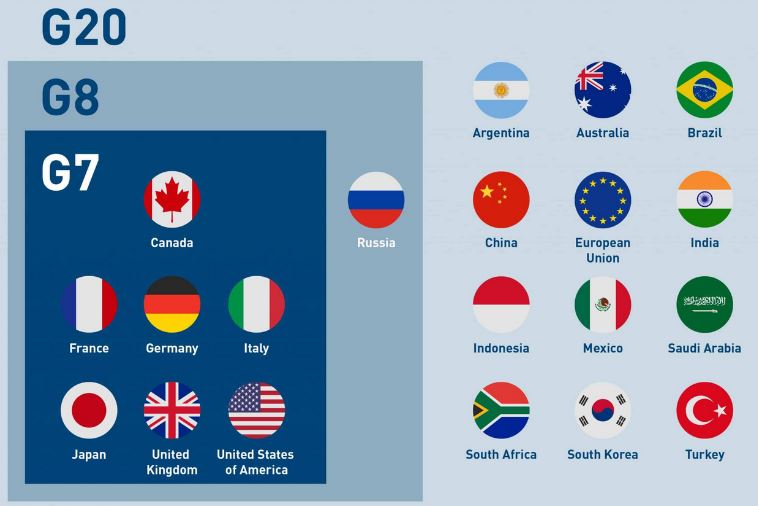
    Note the members of G7 and G20. UPSC may puzzle you asking which G20 nation isn’t a member of G7.

    G7 Countries

    • The G-7 or ‘Group of Seven’ includes Canada, France, Germany, Italy, Japan, the United Kingdom, and the United States.
    • It is an intergovernmental organisation that was formed in 1975 by the top economies of the time as an informal forum to discuss pressing world issues.
    • Initially, it was formed as an effort by the US and its allies to discuss economic issues.
    • The G-7 forum now discusses several challenges such as oil prices and many pressing issues such as financial crises, terrorism, arms control, and drug trafficking.
    • It does not have a formal constitution or a fixed headquarters. The decisions taken by leaders during annual summits are non-binding.
    • Canada joined the group in 1976, and the European Union began attending in 1977.

    Evolution of the G-7

    • When it started in 1975—with six members, Canada joining a year later—it represented about 70% of the world economy.
    • And it was a cozy club for tackling issues such as the response to oil shocks.
    • Now it accounts for about 40% of global GDP.
    • Since the global financial crisis of 2007-09, it has sometimes been overshadowed by the broader g20.
    • The G-7 became the G-8 in 1997 when Russia was invited to join.
    • In 2014, Russia was debarred after it took over Crimea.

    Significance of G7 for India

    • India will get more voice, more influence, and more power by entering the G7.
    • After the UN Security Council (UNSC), this is the most influential grouping.
    • If the group is expanded it will collectively address the humongous issues created by the Wuhan virus,
    • Diplomatically, a seat at the high table could help India further its security and foreign policy interests, especially at the nuclear club and UN Security Council reform as well as protecting its interests in the Indian Ocean.

    Back2Basics: The G-20

    • The G-20 is a larger group of countries, which also includes G7 members.
    • The G-20 was formed in 1999, in response to a felt need to bring more countries on board to address global economic concerns.
    • Apart from the G-7 countries, the G-20 comprises Argentina, Australia, Brazil, China, India, Indonesia, Mexico, Russia, Saudi Arabia, South Africa, South Korea, and Turkey.
    • Together, the G-20 countries make up around 80% of the world’s economy.
    • As opposed to the G-7, which discusses a broad range of issues, deliberations at the G-20 are confined to those concerning the global economy and financial markets.
    • India is slated to host a G-20 summit in 2022.