💥UPSC 2026, 2027, 2028 UAP Mentorship (March Batch) + Access XFactor Notes & Microthemes PDF

Type: Prelims Only

  • Judicial Reforms

    Use of Regional Languages in High Courts remains limited

    Note4Students

    From UPSC perspective, the following things are important:

    Prelims level: Article 348(1)(a), Article 348 (2)

    Why in the News?

    A growing movement in India is advocating for use of regional languages in High Court proceedings to make justice more accessible to the common citizen.

    Current Scenario: Regional Languages in High Courts

    • Out of India’s 25 High Courts, only 4Rajasthan, Madhya Pradesh, Uttar Pradesh, and Bihar — are authorized to use Hindi in their proceedings and legal documents.
      • Bihar HC was the last High Court to receive authorization to use Hindi in 1972.
    • A litigant possesses the fundamental right to comprehend and engage in courtroom proceedings, under Article 19 and Article 21.
      • She/ He is entitled to present their case in a language they understand before the magistrate.
    • Additionally, the “Right to Justice” is explicitly recognized under Article 21 of the Constitution.
    • Despite these provisions, the use of regional languages in High Courts remains limited.

    Constitutional Provisions for Regional Languages in Judiciary:

    Provision Details
    Article 348(1) (a) Language of Proceedings
    • English is the official language for proceedings in the Supreme Court, High Courts, and specified tribunals.
    • All records and orders must be in English.
    Purpose Ensures uniformity and consistency in legal proceedings and documentation at the highest judicial levels.
    Scope Applies to the Supreme Court, High Courts, and all authorities mentioned in Article 323A or Article 323B.
    Article 348(2) Use of Other Languages
    • The President may authorize the use of Hindi or any other regional language in addition to English.
    • Authorization is subject to conditions specified by the President.
    Purpose Allows for regional languages to be used in judicial proceedings, making the system more accessible to non-English speakers.
    Scope Can be applied in the Supreme Court, High Courts, and other authorities as mentioned in Article 323A or Article 323B.


    PYQ:

    [2021] Which one of the following in Indian polity is an essential feature that indicates that it is federal in character?

    (a) The Independence of the judiciary is safeguarded.

    (b) The Union Legislature has elected representatives from constituent units.

    (c) The Union Cabinet can have elected representatives from regional parties.

    (d) The Fundamental Rights are enforceable by Courts of Law.

  • J&K – The issues around the state

    Vision J&K @2047

    Note4Students

    From UPSC perspective, the following things are important:

    Mains level: Vision JK @2047

    Why in the News?

    The Ministry of Personnel, Public Grievances & Pensions has presented the Vision J&K @2047 describing it as an integral part of Vision India @2047.

    What is J&K @2047?

    • Vision J&K @2047 is a long-term strategic plan for Jammu and Kashmir (J&K).
    • It seeks to develop the region into a model of sustainable development, economic growth, and social harmony by the year 2047, coinciding with India’s 100th year of independence.

    Key features of Vision J&K @2047:

    • Vision J&K @2047 focuses on restoring democratic governance through Assembly elections and establishing Zilla Parishads.
    • It aims to enhance infrastructure, create job opportunities, and drive economic development in the region.
    • Significant improvements in education and healthcare are planned, along with empowerment initiatives for women and minorities.
    • Governance reforms aim to enhance administrative efficiency and reduce bureaucratic hurdles.
    • Promotion of local industries and entrepreneurship is a key component to achieve economic self-sufficiency.
  • Pharma Sector – Drug Pricing, NPPA, FDC, Generics, etc.

    Rule 170 of Drugs and Cosmetics Act, 2018

    Note4Students

    From UPSC perspective, the following things are important:

    Prelims level: Rule 170 of Drugs and Cosmetics Act, 2018

    Why in the News?

    The Supreme Court has raised concerns over the AYUSH ministry’s notification, which advised state licensing authorities not to take action under Rule 170 of the Drugs and Cosmetics Act in the context of the ongoing case against Patanjali Ayurved.

    Rule 170 of the Drugs and Cosmetics Act, 2018:

    Details
    What is it? Rule 170 was introduced in 2018 to regulate the manufacture, storage, and sale of Ayurvedic, Siddha, and Unani medicines, focusing on controlling misleading advertisements in the AYUSH sector.
    Requirements • AYUSH drug manufacturers must obtain approval and a unique identification number from state licensing authorities before advertising their products.
    • Required documentation includes textual references, rationale, indications for use, and evidence of safety, effectiveness, and quality.
    Key Provisions
    • Prohibits advertisement of AYUSH products without prior state authority approval.
    • Advertisements may be rejected if they:
      – Lack of contact details of the manufacturer.
      – Contain obscene or vulgar content.
      – Promote products for enhancing sexual organs.
      – Feature endorsements from celebrities or government officials.
      – Refer to government organizations.
      – Convey false impressions or make misleading or exaggerated claims.
    Rationale Behind   • Introduced following a parliamentary standing committee’s concerns about misleading claims in the AYUSH sector.
    • Aims to ensure proactive measures by the AYUSH ministry against such advertisements.
    Challenges   • AYUSH drug manufacturers are required to obtain licenses from drug controllers similar to allopathic medicines.
    • Unlike allopathic drugs, AYUSH drugs do not need to undergo Phase I, II, or III trials for approval.


    PYQ:

    [2019] How is the Government of India protecting traditional knowledge of medicine from patenting by pharmaceutical companies?

  • Electronic System Design and Manufacturing Sector – M-SIPS, National Policy on Electronics, etc.

    [pib] India Semiconductor Mission (ISM)

    Note4Students

    From UPSC perspective, the following things are important:

    Prelims level: India Semiconductor Mission

    Why in the News?

    The Union Cabinet has approved the proposal by Kaynes Semicon Pvt Ltd to establish a semiconductor unit in Sanand, Gujarat. This is the 5th semiconductor unit to be approved under the India Semiconductor Mission (ISM). 

    About India’s Semiconductor Mission (ISM):

    Details
    Launch Year 2021
    Financial Outlay ₹76,000 crore
    Backing by  Ministry of Electronics and IT (MeitY)
    Objective Develop a sustainable semiconductor and display ecosystem in India.
    Primary Goal Provide financial support to companies investing in semiconductor and display manufacturing and design ecosystem.
    Leadership Envisioned to be led by global experts in the Semiconductor and Display industry.
    Components
    • Scheme for Semiconductor Fabs: Fiscal support to set up semiconductor wafer fabrication facilities.
    • Scheme for Display Fabs: Fiscal support for setting up TFT LCD/AMOLED display fabrication facilities.
    • Scheme for Compound Semiconductors / Silicon Photonics / Sensors Fab and ATMP/OSAT: 30% fiscal support for setting up compound semiconductors, silicon photonics, sensors fabs, and ATMP/OSAT facilities.
    • Design Linked Incentive (DLI) Scheme: Financial incentives and design infrastructure support for semiconductor design for ICs, chipsets, SoCs, systems & IP cores.
    Vision To develop India into a global hub for semiconductor and display manufacturing and design.
  • Telecom and Postal Sector – Spectrum Allocation, Call Drops, Predatory Pricing, etc

    [pib] DoT notifies Telecommunications (Administration of Digital Bharat Nidhi) Rules, 2024

    Note4Students

    From UPSC perspective, the following things are important:

    Prelims level: Digital Bharat Nidhi Rules, 2024

    Why in the News?

    The Centre has published the first set of rules under the Telecommunications Act, 2023 (44 of 2023), titled ‘Telecommunications (Administration of Digital Bharat Nidhi) Rules, 2024.’

    About Telecommunications (Administration of Digital Bharat Nidhi) Rules, 2024:

    Description
    Legislation Introduced under the Telecommunications Act, 2023
    Fund Digital Bharat Nidhi (DBN): Replaces the Universal Service Obligation Fund (USOF) under the Indian Telegraph Act, 1885
    Role of Administrator Responsible for overseeing the implementation and administration of DBN
    Key Focus Areas • Enhancing telecommunication services in underserved and remote areas
    • Promoting access to mobile and broadband services
    • Improving telecom security
    • Supporting next-generation telecom technologies
    Target Beneficiaries • Marginalized groups (e.g., women, persons with disabilities, economically weaker sections)
    • Remote and underserved regions
    Project Criteria • Provision of telecom services and equipment
    • Enhancing telecom security
    • Improving access and affordability
    • Promoting innovation, R&D, and indigenous technology
    • Supporting start-ups
    • Encouraging sustainable and green technologies
    Funding Conditions Entities receiving DBN funding must provide telecom services on an open and non-discriminatory basis
    Vision Alignment Aligned with Viksit Bharat (Developed India) by 2047
    Sustainability Focus Emphasizes the promotion of green technologies in telecommunications


    PYQ:

    [2019] In India, which of the following review the Independent regulators in sectors like telecommunications, insurance, electricity, etc.?

    1. Ad Hoc Committees set up by the Parliament
    2. Parliamentary Department Related Standing Committees
    3. Finance Commission
    4. Financial Sector Legislative Reforms Commission
    5. NITI Aayog

    Select the correct answer using the code given below:

    (a) 1 and 2

    (b) 1, 3 and 4

    (c) 3, 4 and 5

    (d) 2 and 5

  • Agricultural Sector and Marketing Reforms – eNAM, Model APMC Act, Eco Survey Reco, etc.

    What is Digital Agriculture Mission?

    Note4Students

    From UPSC perspective, the following things are important:

    Prelims level: Digital Agriculture Mission

    Why in the News?

    The Union Cabinet has approved the “Digital Agriculture Mission” with a budget of ₹2,817 Crore, including ₹1,940 Crore as the central share.

    About Digital Agriculture Mission

    Category Details
    Historical Context Originally planned for the financial year 2021-22 but delayed due to the Covid-19 pandemic.

    Announced in the Union Budgets of 2023-24 and 2024-25.

    Funding Breakdown Total outlay: Rs 2,817 crore

    • Rs 1,940 crore from the Centre
    • Remaining amount from states and Union Territories (UTs)

    Objective To create Digital Public Infrastructure (DPI) in the agriculture sector, similar to other e-governance initiatives like Aadhaar, DigiLocker, eSign, UPI, and electronic health records.
    Major Components of DPI 1. AgriStack:
    – A comprehensive digital platform integrating various agricultural services.
    – Facilitates access to information, services, and benefits related to farming and agricultural practices.
    – Centralizes agricultural data to improve accessibility and efficiency.
    2. Krishi Decision Support System (DSS):
    – Provides data-driven insights and recommendations for farmers.
    – Assists in decision-making related to crop management, pest control, and resource optimization based on real-time data.
    – Utilizes advanced analytics to enhance productivity and mitigate risks.
    3. Soil Profile Maps:
    – Detailed digital maps on a 1:10,000 scale covering approximately 142 million hectares.
    – Provides comprehensive information about soil characteristics and health.
    – Supports precision agriculture by offering targeted soil data for optimal crop planning.
    Additional Component Digital General Crop Estimation Survey (DGCES):
    – A tech-based system to provide accurate estimates of agricultural production.
    – Aims to offer reliable data for policy decisions, agricultural planning, and resource allocation.
    Impact on Farmers The mission will enable farmers to access a range of digital services, improve decision-making through data analysis, enhance productivity with detailed soil information, and provide accurate crop estimations to better manage agricultural practices.
    Timeline Rolled out across the country over the next two years (until 2025-26).


    PYQ:

    [2020] In India, the term “Public Key Infrastructure” is used in the context of:

    (a) Digital security infrastructure

    (b) Food security infrastructure

    (c) Health care and education infrastructure

    (d) Telecommunication and transportation infrastructure

  • Climate Change Impact on India and World – International Reports, Key Observations, etc.

    Methane’s Contribution in Climate Change

    Note4Students

    From UPSC perspective, the following things are important:

    Prelims level: Methane emission

    Why in the News?

    The European Union introduced a new regulation in May 2024 requiring fossil fuel companies to routinely measure, report, and reduce methane emissions.

    About Methane Emissions:

    Details
    Nature Colorless, Odourless.

    Considered a short-lived climate pollutant due to its shorter atmospheric lifetime compared to CO2.

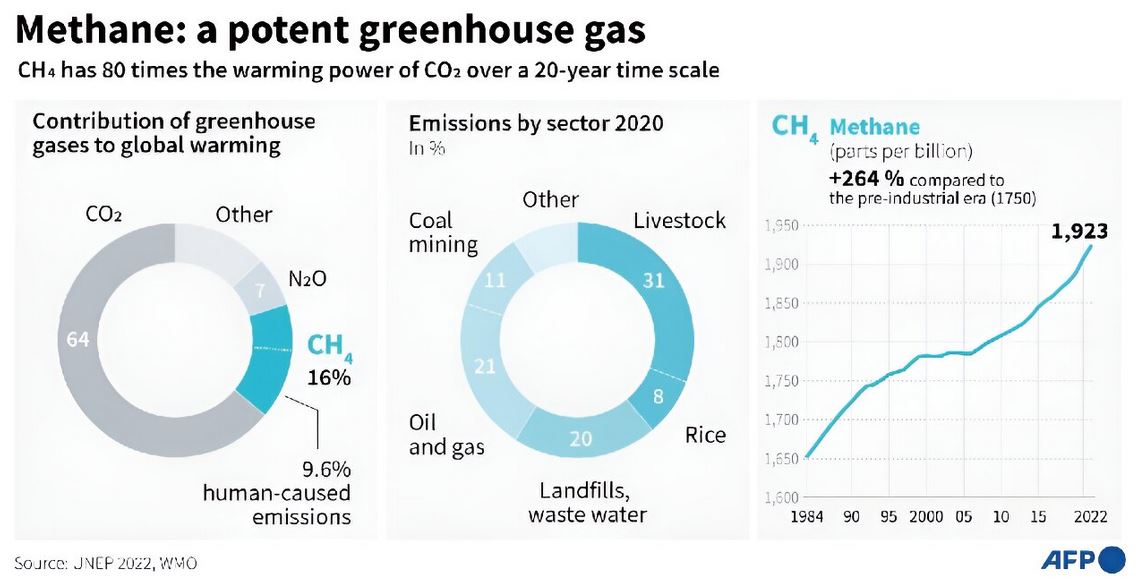
    Global Warming Potential (GWP) 80 times more potent than carbon dioxide over a short term.
    GWP100: 28 (over 100 years)Accounts for approximately 30% of global warming.
    Atmospheric Lifetime Breaks down in about 12 years; shorter-lived compared to CO2.
    Major Sources Cattle farming: 32% of human-caused methane emissions (includes manure and enteric fermentation)
    Landfills: Approximately 20%
    Wastewater treatment: Around 8%
    Rice cultivation: About 10%
    Industrial processes: Varied but significant
    Natural Non-Human Sources Includes wetlands and permafrost, which release methane through natural processes.
    Impact Compared to CO2 Traps 84 times as much heat as CO2 over a 20-year period.
    CO2 has a longer-term warming effect but is less potent.
    Key Initiatives Global Methane Pledge: Launched at UN COP26, signed by over 90 countries, led by the US and EU.

    India did not sign.


    PYQ:

    [2019] Consider the following:

    1. Carbon monoxide
    2. Methane
    3. Ozone
    4. Sulphur dioxide

    Which of the above are released into atmosphere due to the burning of crop/biomass residue?

    (a) 1 and 2 only

    (b) 2, 3 and 4 only

    (c) 1 and 4 only

    (d) 1, 2, 3 and 4

  • Innovations in Biotechnology and Medical Sciences

    Gut molecule in C. Elegans Worms slows fat burning

    Note4Students

    From UPSC perspective, the following things are important:

    Prelims level: C. Elegans Worm

    Why in the News?

    Researchers have discovered a mechanism in Caenorhabditis elegans (C. elegans) worms that explains why fat loss slows down during fasting.

    Fasting and Fat Metabolism

    • The brain is known to regulate fat production and breakdown in humans, other mammals, and model organisms like C. elegans.
    • In 2017, researchers identified FLP-7 hormone in the brain that triggers fat burning in the gut of C. elegans.
    • However, it was unclear how the gut communicates back to the brain, as C. elegans lacks sensory nerves in their intestines.
    • The study reveals that during fasting, the gut produces a form of insulin called INS-7, which signals the brain to halt fat burning.
    • Unlike traditional insulin, which activates insulin receptors, INS-7 blocks these receptors, leading to a cascade of events that stop the production of the fat-burning hormone FLP-7.

    About Caenorhabditis elegans (C. elegans):

    Details
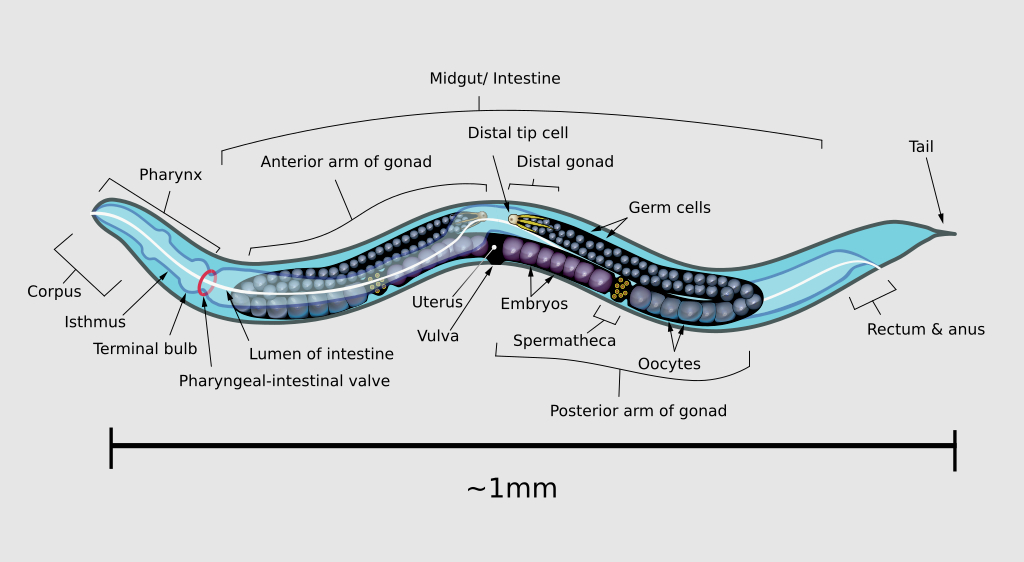
    Overview A small, free-living nematode (roundworm) used as a model organism in biological research.
    Size Approximately 1 millimeter in length.
    Habitat Found in soil environments worldwide.
    Reproduction Primarily self-fertilizing hermaphrodites; males make up a small percentage and can mate with hermaphrodites.
    Genome First multicellular organism to have its genome fully sequenced; about 20,000 genes.
    Chromosomes Six chromosomes (five autosomes, one sex chromosome).
    Body Plan Approximately 1,000 cells in an adult hermaphrodite; transparent body allows for easy microscopic observation.
    Lifespan Around 2 to 3 weeks under laboratory conditions.
    Research Contributions Instrumental in discoveries related to apoptosis, RNA interference, gene regulation, and human diseases.


    PYQ:

    [2013] Improper handling and storage of cereal grains and oilseeds result in the production of toxins known as aflatoxins which are not generally destroyed by normal cooking process. Aflatoxins are produced by:

    (a) Bacteria

    (b) Protozoa

    (c) Moulds

    (d) Viruses

  • Festivals, Dances, Theatre, Literature, Art in News

    In news: Thanjavur Veena

    Note4Students

    From UPSC perspective, the following things are important:

    Prelims level: Thanjavur Veena

    Why in the News?

    Thanjavur, Tamil Nadu, is renowned for making the Veena, the first musical instrument in India to receive a Geographical Indication (GI) tag.

    About Thanjavur Veena:

    Details
    Type Saraswati Veena (a classical stringed musical instrument)
    GI Tag Received in 2012.
    Crafting Materials Jackfruit wood, known for its resonance and tonal quality.
    Production Process – Wood is cut, carved, shaped, and assembled.
    – Takes 15-20 days to complete.
    – Involves three parts: resonator (kudam), neck (dandi), and tuning box.
    Other Types of Veena – Saraswati Veena (used in Carnatic classical music)
    – Rudra Veena and Vichitra Veena (used in Hindustani classical music)
    – Chitra Veena (used in Carnatic classical music)


    PYQ:

    [2021] With reference to India, the terms ‘Halbi, Ho and Kui’ pertain to​:

    (a) Dance forms of Northwest India​

    (b) Musical instruments​

    (c) Pre-historic cave paintings​

    (d) Tribal languages​

  • LGBT Rights – Transgender Bill, Sec. 377, etc.

    [pib] Measures taken by Govt. for LGBTQI+ Community

    Note4Students

    From UPSC perspective, the following things are important:

    Prelims level: Various schemes mentioned

    Why in the News?

    The Department of Social Justice and Empowerment has invited inputs to ensure that policies and initiatives regarding the LGBTQI+ community are inclusive and effective.

    Who are the LGBTQ+?

    • It is an umbrella term used to refer to lesbian, gay, bisexual, transgender, queer and intersex.
    • LGBTQI+ people represent a subset of individuals among the broader category of sexual and gender diverse individuals.
    • Sexual orientation, gender identity and expression (SOGIE) is diverse and spans cultures across the world.

    Various policy initiatives for LGBTQI+ Community:

    Policy/Scheme Details
    Supreme Court Judgment on Section 377 (2018) Decriminalized consensual same-sex relations by ruling that Section 377 of the Indian Penal Code, which criminalized such acts, was unconstitutional.
    • Affirmed the right to privacy and equality, marking a historic victory for LGBTQI+ rights in India.
    Transgender Persons (Protection of Rights) Act (2019) • Grants legal recognition to transgender individuals, prohibits discrimination in education, employment, and healthcare, and mandates the establishment of a national and state-level transgender welfare board.
    • Ensures protection of transgender rights, and access to welfare benefits, and facilitates legal recognition and equality.
    National Portal for Transgender Persons (2020) • An online platform launched by the Ministry of Social Justice and Empowerment for applying for a transgender certificate and identity card.
    • Streamlines the legal recognition process, enabling transgender individuals to obtain official documentation more easily.
    SMILE Scheme (2021) • “Support for Marginalized Individuals for Livelihood and Enterprises” Central Sector scheme.
    • Provides financial assistance and support for the livelihood and enterprise development of marginalized individuals and beggars, including members of the LGBTQI+ community. 


    PYQ:

    [2023] Explain the constitutional perspectives of Gender Justice with the help of relevant Constitutional Provisions and case laws.