💥UPSC 2026, 2027, 2028 UAP Mentorship (March Batch) + Access XFactor Notes & Microthemes PDF

Archives: News

  • Electoral Reforms In India

    What are Exit Polls and How are they Conducted?

    Why in the News?

    As Bihar Assembly Election 2025 concludes, media houses released the exit poll results after 6:30 pm, following Election Commission of India (ECI) restrictions.

    What are Exit Polls?

    • Overview: Exit polls are post-voting surveys conducted immediately after voters leave polling stations to find out how they voted and what influenced their choice.
    • Objective: To give an early indication of election outcomes and study voter behaviour, issues, and demographics before official results.
    • Origin in India: First conducted in 1957 by the Indian Institute of Public Opinion during the 2nd Lok Sabha elections.
    • Methodology: Randomly selected voters are interviewed anonymously after casting their vote; responses are aggregated and analysed statistically to predict seat shares and trends.

    How are Exit Polls conducted?

    • Sampling: Based on random or stratified sampling to reflect gender, caste, religion, and regional representation.
    • Questionnaires: Ask voters which party or candidate they chose and gather demographic or opinion data.
    • Data Collection: Conducted by trained field agents under strict non-interference rules at polling stations.
    • Data Analysis: Responses are weighted and adjusted for turnout and demographics before generating projections.
    • Confidentiality: All answers remain anonymous to preserve voting secrecy.

    Regulation of Exit Polls:

    • Constitutional Basis: Governed by Article 324, empowering the Election Commission of India (ECI) to ensure free and fair elections.
    • Statutory Law: Section 126A of the Representation of the People Act, 1951 bans conducting or publishing exit polls from start of the first phase till 30 minutes after last phase ends.
    • Penalties: Violation may lead to two years imprisonment, a fine, or both.
    • Media Rules: Must disclose sample size, method, and margin of error when publishing results.
    • Registration: Polling agencies must be registered with the ECI and follow official publication guidelines.

    Recent Amendments and Practices:

    • Monitoring: The ECI now closely monitors media and digital platforms to prevent early leaks of exit poll data.
    • Digital Coverage: Restrictions apply to social media and online news during multi-phase elections.
    • Publication Control: No state-wise or partial results can be released until polling ends nationwide.
    • Transparency: Media houses must submit methodology and get ECI clearance before publishing exit poll results.
    • Purpose: To prevent misinformation and voter influence during ongoing polling.

    Back2Basics: Difference Between Exit Polls and Opinion Polls

    • Timing: Exit polls are done after voting; opinion polls before voting.
    • Purpose: Opinion polls measure intentions; exit polls reflect actual behaviour.
    • Respondents: Opinion polls survey likely voters; exit polls survey actual voters.
    • Influence: Opinion polls can affect undecided voters; exit polls occur after voting, posing no influence risk.
    • Accuracy: Exit polls are generally more accurate as they are based on real votes.
    • Regulation: Opinion polls are advisory-guided; exit polls are strictly regulated under Section 126A of the RPA, 1951.
  • Modern Indian History-Events and Personalities

    New book reinterprets origins of the Indian National Army (INA)

    Why in the News?

    A recently launched book claims that the Indian National Army (INA) was not founded by Subhas Chandra Bose or Captain Mohan Singh.

    New Claims and the Caveats:

    • Author’s Proposition:
      • The INA was not originally founded by Subhas Chandra Bose, but by Japanese Army Intelligence in collaboration with Indian nationalists abroad before his arrival.
      • A pre-war agreement between Major Fujiwara Iwaichi (Japan) and Giani Pritam Singh (Bangkok, 1941) laid the INA’s groundwork, India’s liberation in exchange for aid to Japan’s campaign.
      • Captain Mohan Singh, not Bose, served as first commander, but his role was later overshadowed.
      • Bose took over in 1943, providing global visibility, structure, and leadership to the existing army.
    • Caution for students:
      • INA’s history is already complex and contested; this new interpretation adds another layer but does not necessarily overturn all accepted facts (e.g., Bose’s later leadership as per our standard references, the INA’s role in Indian nationalist memory).
      • Some aspects (e.g., precise agreements between Japanese intelligence and Indian nationalists) may remain debated or partially documented.

    About the Indian National Army (INA):

    • Origins: Formed during World War II to fight British rule, the INA emerged from collaboration between Japanese intelligence and Indian nationalists before Subhas Chandra Bose took command.
    • Initial Formation: Conceived in a 1938 Tokyo meeting between Rash Behari Bose; using Indian POWs in Southeast Asia to aid Japan’s war and India’s liberation.
    • Early Leadership: Captain Mohan Singh of the 14 Punjab Regiment became its first commander, recruiting about 40,000 POWs with Japanese support. Internal disputes led to his removal, after which Rash Behari Bose sustained the movement via the Indian Independence League (Tokyo, 1942).
    • Rise of Subhas Chandra Bose: Bose escaped British custody in 1941, travelled through Berlin and Japan, and reached Singapore in July 1943, where Rash Behari Bose handed him INA leadership.
    • Reorganization Under Netaji: On August 25, 1943, Bose became Supreme Commander and established the Provisional Government of Free India (Azad Hind) on October 21, 1943, recognized by nine countries including Japan and Germany. Under the “Chalo Delhi” campaign, INA forces entered Manipur, raising their flag at Moirang, but progress halted after Japan’s 1945 defeat.
    • Collapse and Trials: Following Japan’s surrender (August 15, 1945), the INA disbanded. Bose reportedly died in a plane crash (August 18, 1945). Captured INA officers were tried at the Red Fort (1945–46), the Sehgal–Dhillon–Khan trial became a symbol of unity, with Nehru, Bhulabhai Desai, and Asaf Ali defending them.

    Nationalist Uprisings and Impact:

    • Symbol of Unity: The INA represented armed nationalism and secular unity, transcending caste, region, and religion; the slogan “Jai Hind” became a national salute.
    • Mass Protests: The INA trials sparked nationwide agitation, uniting students, soldiers, and civilians in solidarity.
    • Key Confrontations:
      • Nov 21, 1945 – Calcutta police firing on INA protestors.
      • Feb 11, 1946 – Demonstrations against Rashid Ali’s sentencing.
      • Feb 18, 1946Royal Indian Navy (RIN) mutiny, with 20,000 sailors revolting in Bombay.
    • Impact on British Rule: The INA’s defiance shattered British confidence in Indian troops’ loyalty. Even Clement Attlee (1956) admitted the INA and postwar unrest accelerated British withdrawal.
    • Legacy: Unified militant and mass politics; inspired future Indian defense ethos; remains a symbol of courage and secular nationalism under Netaji’s leadership.
    [UPSC 2021] In the context of Colonial India, Shah Nawaz Khan, Prem Kumar Sehgal, and Gurbaksh Singh Dhillon are remembered as officers of the Indian National Army.

    Options: (a) Leaders of the Swadeshi and Boycott Movement

    (b) Members of the Interim Government in 1946

    (c) Members of the Drafting Committee in the Constituent Assembly

    (d) Officers of the Indian National Army*


  • Air Pollution

    India recorded the highest GHGs emissions for 2024

    Why in the News?

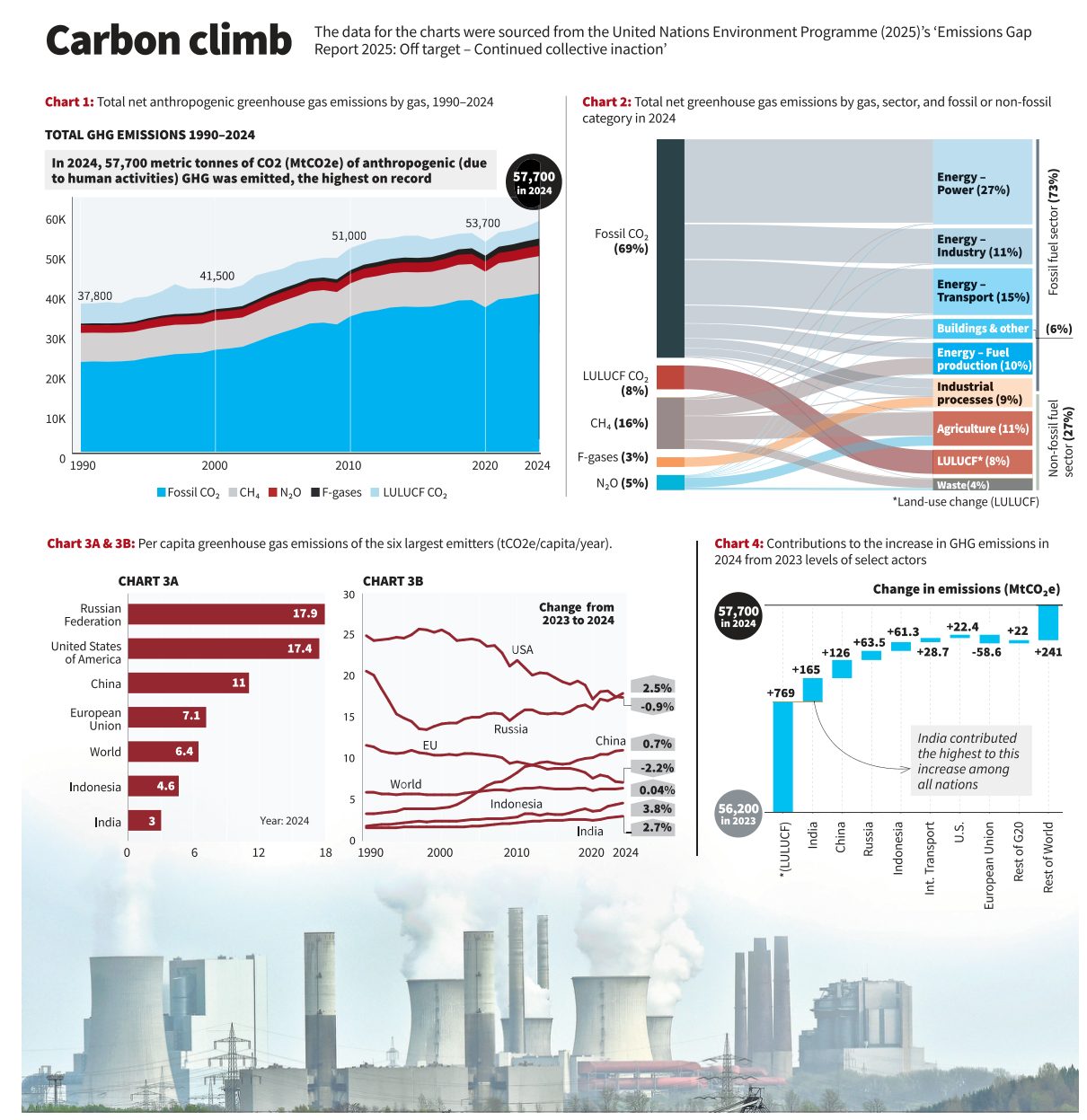
    The United Nations Environment Programme’s (UNEP) 2024 Emission Gap Report (“Off Target”) released before COP30, says India saw the world’s largest rise in greenhouse gas emissions in 2024, adding 165 MtCO₂e.

    India recorded the highest GHGs emissions for 2024

    About the Emission Gap Report:

    • Overview: It is an annual flagship publication by UNEP that measures the gap between current national emission pledges (NDCs) and the cuts required to meet the Paris Agreement goals of limiting global warming to 1.5°C or 2°C.
    • Purpose: Evaluates global progress, national commitments, and policy effectiveness, recommending actions to close the “emissions gap.”
    • Scope: Assesses emissions from energy, land use, and industry, comparing policy trajectories with required emission reduction pathways.

    Key highlights of the 2024 Edition- “Off Target”:

    • Core Message: Warns that the world remains far off track to achieve the 1.5°C limit.
    • Global Emissions: Hit a record 57.7 gigatonnes CO equivalent (GtCOe) in 2024, a 2.3% rise from 2023.
    • Warming Projections:
      • Current policies → ~2.8°C by 2100.
      • Full NDC implementation → only 2.3–2.5°C limit.
    • G20 Role: Account for 77% of global emissions, led by China, USA, India, EU, Russia, and Indonesia.
    • NDC Submission: Only 64 countries (63% of global emissions) updated their NDCs by 2024; most G20 nations off-track for 2030–2035 goals.
    • Sectoral Breakdown:
      • Fossil fuels – 69% of total emissions.
      • Methane – 16%.
      • Land-use change – significant share of increase.
    • Temperature Outlook: Predicts a temporary overshoot of 1.5°C by the early 2030s without rapid global action.

    India-Specific Findings:

    • Emission Growth: India saw the largest absolute rise in 2024, +165 MtCOe, the world’s highest single-country increase.
    • Growth Rate: 3.6%, second only to Indonesia (4.6%).
    • Per Capita Emissions: 3 tCO₂e, less than half the global average (6.4 tCO₂e).
    • Global Ranking: 3rd-largest emitter, after China and the USA.
    • NDC Commitments: Aims to reduce emission intensity by 45% (2005–2030) and achieve 50% non-fossil energy capacity by 2030.
    • Progress: Overachieved by 15% on emission intensity but has not submitted an updated 2025 NDC.
    • COP30 Outlook: India’s rapid emission rise and missed NDC update may invite scrutiny, though low per capita emissions and developmental equity support its climate position.
    [UPSC 2024] Consider the following statements:
    I. Carbon dioxide (CO₂) emissions in India are less than 0.5 t CO2/capita.
    II. In terms of CO2 emissions from fuel combustion, India ranks second in Asia-Pacific region.
    III. Electricity and heat producers are the largest sources of CO2 emissions in India.
    Which of the statements given above is/are correct?
    (a) I and III only (b) II only (c) II and III only * (d) I, II and III


  • What is the Rare Earth Hypothesis?

    Why in the News?

    This newscard is an excerpt from the original article published in The Hindu.

    What is the Rare Earth Hypothesis?

    • About: Proposed by Peter Ward (palaeontologist) and Donald Brownlee (astronomer) in 2000, it suggests that simple life (like microbes) may be common, but complex life (like plants and animals) is extremely rare in the universe.
    • Core Idea: Earth supports advanced life because of a unique mix of conditions such as a stable orbit, a protective magnetic field, active plate tectonics, and giant planets like Jupiter that shield it from asteroids.
    • Meaning: The Earth is not an ordinary planet; it is a special case where everything aligned perfectly to allow complex life to evolve.

    How does it differ from other Theories?

    • Drake Equation / Mediocrity Principle: Say that life should be common since there are billions of stars; the Rare Earth Hypothesis says complex life is rare even if basic life is not.
    • Fermi Paradox: Asks “Where is everybody?” The Rare Earth answer is that complex intelligent life is rare, so we don’t see others.
    • Copernican Principle: Claims Earth is ordinary; the Rare Earth Hypothesis argues Earth is extraordinary and rare in its conditions.

    Evidence supporting the Hypothesis:

    • Exoplanet Studies (Kepler Mission): Thousands of Earth-sized planets found, but few have stable climates or protective atmospheres like Earth.
    • M-dwarf Planets: Many orbit small stars and lose their atmospheres due to strong radiation.
    • No Alien Signals: Breakthrough Listen and other searches found no technosignatures from intelligent civilizations.
    • Earth’s Uniqueness: Plate tectonics and a carbon cycle help Earth keep a stable climate for billions of years; such conditions have not yet been found elsewhere.

    Scientific Outlook and Future Research:

    • Current View: Microbial life might exist on many planets, but stable, complex ecosystems like Earth’s are probably rare.
    • Ongoing Studies:
      • James Webb Space Telescope (JWST) searches for gases like oxygen, methane, and water on distant planets.
      • Planetary models test if other worlds have tectonics or internal heat for climate balance.
      • Technosignature surveys continue for traces of intelligent life.
    • Future Missions: Extremely Large Telescope (ELT) and Habitable Worlds Observatory (HWO) will study exoplanet atmospheres more closely.
    • Significance: The Rare Earth Hypothesis remains plausible but unproven, showing that life may be widespread, but Earth-like complexity could be one of the universe’s rarest achievements.
    [UPSC 2018] Which of the following phenomena might have influenced the evolution of organisms?

    1. Continental drift

    2. Glacial cycles

    Select the correct answer using the code given below.

    Options: (a) 1 only (b) 2 only (c) Both 1 and 2* (d) Neither 1 nor 2


  • Innovations in Sciences, IT, Computers, Robotics and Nanotechnology

    [pib] India’s First MWh-Scale Vanadium Redox Flow Battery at NTPC NETRA 

    Why in the News?

    The Union Ministry of Power has inaugurated India’s largest and first MWh-scale Vanadium Redox Flow Battery (VRFB) of 3 MWh capacity at NETRA, NTPC’s R&D Centre in Greater Noida.

    About the Vanadium Redox Flow Battery (VRFB):

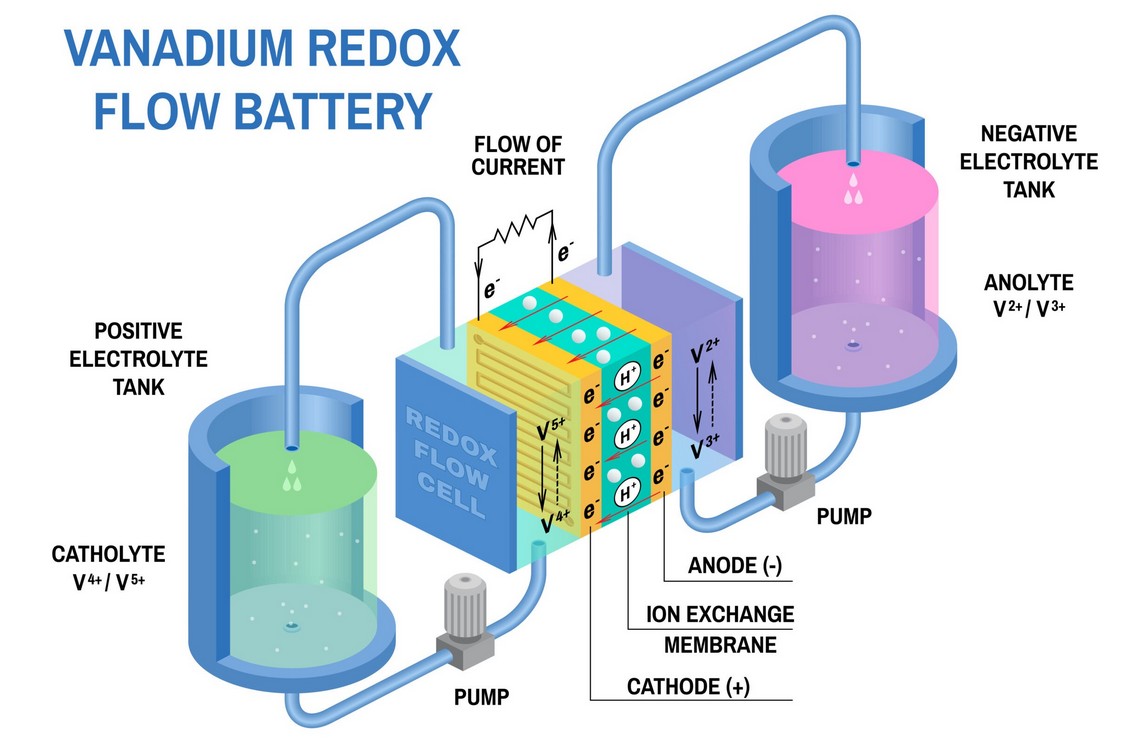
    • Overview: A rechargeable flow battery that stores energy in liquid electrolytes containing vanadium ions in different oxidation states.
    • Core Principle: Uses the same element vanadium for both electrolytes, preventing cross-contamination and extending operational life.
    • Working Mechanism: Energy is stored through oxidation and reduction reactions of vanadium ions, where electrons are exchanged between two electrolyte tanks.
    • Cell Design: Electrolytes circulate through a cell stack separated by an ion-selective membrane that enables ion movement while stopping mixing.
    • Scalability: Energy capacity depends on electrolyte volume, while power output depends on cell stack size, allowing flexible scaling.
    • Application Focus: Ideal for stationary, grid-scale energy storage, renewable energy integration, and backup power systems.

    Benefits over Conventional Batteries:

    • Independent Scalability: Energy and power can be scaled separately, perfect for large utility storage and renewable grids.
    • Extended Lifespan: Can endure thousands of cycles since vanadium electrolytes don’t degrade or mix.
    • Full Discharge Safety: Can be fully discharged (100%) without damaging capacity, unlike lithium-ion batteries.
    • High Safety Level: Uses non-flammable, water-based electrolytes, eliminating risk of fire or explosion.
    • Eco-Friendly: Recyclable and non-toxic electrolytes reduce environmental impact and support circular use.
    • Long-Duration Storage: Provides 6–10+ hours of continuous energy, ideal for stabilizing solar and wind supply.
    • Low Maintenance: Fewer mechanical parts and no thermal runaway risk ensure long-term durability.
    • Fast Response: Reacts quickly to grid fluctuations, improving power quality and reliability.

    Limitations:

    • High Initial Cost: Requires expensive vanadium electrolyte and specialized components, leading to higher upfront installation costs than lithium-ion systems.
    • Low Energy Density: Stores less energy per unit volume, making it unsuitable for mobile or space-constrained applications like electric vehicles.
    • Complex Infrastructure: Needs large storage tanks, pumps, and control systems, which increase operational complexity and land requirements.
    [UPSC 2025] In the context of electric vehicle batteries, consider the following elements:

    I. Cobalt II. Graphite III. Lithium IV. Nickel

    How many of the above usually make up battery cathodes?

    (a) Only one (b) Only two (c) Only three* (d) All the four


  • Foreign Policy Watch: India-ASEAN

    [11th November 2025] The Hindu Op-ed: A celebration of India-Bhutan ties

    PYQ Relevance

    [UPSC 2024] Discuss the geopolitical and geostrategic importance of Maldives for India with a focus on global trade and energy flows. Further, also discuss how this relationship affects India’s maritime security and regional stability amidst international competition.

    Linkage: This PYQ reflects the same strategic framework as India-Bhutan relations; where geography, stability, and mutual trust drive India’s Neighbourhood First and Security and Growth for All in the Region (SAGAR) vision.

    Mentor’s Comment

    The 70th birth anniversary of Jigme Singye Wangchuck, the fourth King of Bhutan, serves as a moment to celebrate not just a monarch’s life but the enduring India-Bhutan partnership that he helped shape. His leadership modernised Bhutan and deepened one of South Asia’s most stable and mutually respectful bilateral relationships built on trust, hydropower diplomacy, and shared values of sustainable development and cultural harmony.

    Introduction

    The former King of Bhutan, Jigme Singye Wangchuck, turned 70 on November 11, 2025. Revered by his people as a Bodhisattva King, he ruled Bhutan from 1972 until his abdication in 2006 in favour of his son, King Jigme Khesar Namgyel Wangchuck. Known for introducing the concept of Gross National Happiness (GNH) and steering Bhutan into the modern era, his legacy also symbolizes the deep and evolving friendship between India and Bhutan. Prime Minister Narendra Modi’s visit to Thimphu for the celebrations marks the continuation of this historic bond. This underlines India’s Neighbourhood First Policy and commitment to strengthening Himalayan partnerships.

    The Legacy of a Sage King

    1. Modernisation of Bhutan: King Jigme Singye Wangchuck guided Bhutan into the 21st century with policies balancing economic progress, environmental sustainability, and cultural preservation.
    2. Buddhist Leadership Ethos: Revered almost like a Buddha, he was loved for his humility and focus on inner happiness, embodied in the philosophy of Gross National Happiness.
    3. Abdication for Reform: His voluntary abdication in 2006 for his son represented a rare act of democratic foresight, leading Bhutan towards constitutional monarchy and parliamentary democracy.

    India-Bhutan Relations: A Model of Neighbourhood Diplomacy

    1. Neighbourhood First Priority: Bhutan was the first foreign country visited by PM Modi in 2014 after assuming office, highlighting Bhutan’s symbolic and strategic importance.
    2. Mutual Cultural Affinity: The relationship is grounded in shared civilizational ethos, Buddhism, and trust, rather than transactional diplomacy.
    3. Joint Celebrations: Modi’s participation in the birthday celebrations reflects India’s continued recognition of Bhutan as a trusted Himalayan partner.

    Hydropower Diplomacy: The Cornerstone of Economic Partnership

    1. Strategic Energy Partnership: India and Bhutan have developed one of South Asia’s most successful hydropower cooperation models, with electricity from Bhutan’s rivers exported to India.
    2. Economic Impact: Projects like the Punasangchhu-I and Punasangchhu-II hydropower projects contribute significantly to Bhutan’s GDP and India’s clean energy imports.
    3. Job Creation and Development: Revenue from hydropower has raised Bhutan’s per capita income, reflecting a sustainable model of bilateral interdependence.
    4. Private Sector Expansion: Future projects are likely to be developed by private Indian companies in collaboration with Bhutanese partners, expanding beyond state-led initiatives.

    Issues of National Security and Strategic Alignment

    1. Advisory Role of the King: Former King Jigme Singye Wangchuck continues to play a strategic advisory role (K4) on national security and foreign policy.
    2. Security Cooperation: India’s Royal Bhutan Army (RBA) works closely with Indian defence forces to secure borders and enhance counter-insurgency cooperation.
    3. Operation All Clear (2003): Bhutan’s successful military operation, supported by India, removed insurgent groups from its territory; a hallmark of trust-based defence partnership.
    4. Geopolitical Balance: Bhutan continues to balance relations with India while cautiously managing ties with China, guided by India’s support in maintaining sovereignty and stability.

    India’s Continued Developmental Support

    1. Hydropower Assistance: India remains Bhutan’s largest partner in hydropower development, ensuring energy security for both nations.
    2. Community Development Projects: Support extends to education, healthcare, and monastic infrastructure, reinforcing India’s soft power in the region.
    3. Trade and Connectivity: India’s assistance in roads, border management, and trade routes enhances regional connectivity under the BBIN framework.

    Conclusion

    The celebration of King Jigme Singye Wangchuck’s 70th birthday is more than an homage to a revered monarch, it is a testament to the unbroken trust, shared development, and mutual respect between India and Bhutan. The hydropower-driven partnership continues to set an example of how small states and large neighbours can coexist through equality, respect, and common vision. As India continues to invest in Bhutan’s progress, this Himalayan partnership stands as a model of enduring regional cooperation and spiritual kinship.

  • Air Pollution

    Clean air is not a privilege: Right to life begins with right to breathe

    Introduction

    Clean air is the first vaccine every child deserves. Yet, Delhi’s smog-choked skies and the government’s mechanical emergency responses have normalized a crisis that is eroding the right to life. The article captures how the denial, data manipulation, and ritualized policy measures have made air pollution a silent epidemic. It emphasizes that the right to breathe, embedded in Article 21, must move from rhetoric to enforceable action.

    Why in the News?

    In an unprecedented moment, hundreds of parents and citizens assembled at India Gate, not under any organization or political banner because their children could not breathe. This spontaneous protest symbolized a moral and civic awakening against the state’s apathy toward air pollution. Despite annual rituals of emergency plans, Delhi’s air quality remains among the world’s worst, turning the illusion of improvement into a cycle of helplessness.

    Why air pollution is no longer just an environmental issue

    1. Public Health Emergency: Pollution is now seen as a health crisis, not merely an environmental one. Respiratory illnesses have become endemic; every paediatrician in Delhi treats pollution-linked diseases daily.
    2. Missing Pillar in Policy Response: Despite its virulence, pollution lacks the same national urgency as communicable diseases. The Ministry of Health and Family Welfare plays a negligible role, leaving air quality in bureaucratic limbo.
    3. Denial and Normalization: Official classifications such as “very poor” mask the true toxicity levels. Citizens have adapted to smog-filled days as normal.

    How policy responses remain performative and cyclical

    1. Emergency Measures: Governments announce recurring “emergency” actions, smog guns, sprinklers, and odd-even traffic rules, once pollution peaks. These actions are reactive, not preventive.
    2. Illusion of Control: Each year’s Graded Response Action Plan (GRAP) triggers cosmetic responses without structural outcomes. Air quality monitors become symbolic instruments of denial.
    3. Absence of Data Transparency: Public access to real-time, verifiable air quality data remains limited. This creates a gap between recorded pollution levels and lived citizen experience.

    Why governance and accountability are failing

    1. Diffuse Responsibility: No single authority is answerable for air quality. Pollution control boards, municipal bodies, and ministries work in silos, diluting accountability.
    2. Lack of Continuous Governance: Pollution action is episodic, spiking in winter and fading later. There is need for “clean air by design” through governance that is transparent, continuous, and health-centred.
    3. Absence of Traceable Budgets: Public funds spent on air quality improvements lack traceability, leading to unmeasured outcomes and misplaced priorities.

    What citizens are demanding at the grassroots

    1. Unified Public Platform: Protesters demanded a platform like “Arogya Setu for Air”, a citizen-led app guiding mask use, indoor safety, and pollution alerts.
    2. Independent Accountability Body: They sought an autonomous Public Health and Air Quality Commission, answerable to Parliament, to set standards and audit outcomes.
    3. Moral Mobilization: Parents, not activists, led the movement shifting the tone from environmental advocacy to public outrage over children’s health and state indifference.

    How the right to breathe links to constitutional and moral rights

    1. Article 21 of the Constitution: The Right to Life includes the right to clean air and water. Citizens at India Gate invoked this right directly, marking a legal and moral inflection point.
    2. State’s Moral Duty: The silence of the state is described as corrosive, a betrayal of its constitutional duty.
    3. Justice and Equity Dimension: Air pollution disproportionately affects children, the elderly, and the poor, converting environmental degradation into a social justice issue.

    Conclusion

    India’s pollution crisis is not a matter of policy deficiency but moral and institutional inertia. The right to breathe must be treated with the same seriousness as epidemic control. Clean air governance must shift from symbolic emergency actions to continuous, accountable, and health-first systems. The movement at India Gate represents the awakening of civic morality, a reminder that the right to life begins with the right to breathe.

    PYQ Relevance

    [UPSC 2021] Describe the key points of the revised Global Air Quality Guidelines (AQGs) recently released by the WHO. How are these different from its last update in 2005? What changes in India’s National Clean Air Programme are required to achieve these revised standards?

    Linkage: This PYQ directly aligns with the article’s call for health-centric air governance and accountability in implementation. This highlights how India’s NCAP must evolve beyond reactive emergency plans to meet WHO’s stricter 2021 air quality benchmarks.

  • We need to move from a caste census with a capital C to one with a small c

    Introduction

    The government’s announcement of a caste census has reignited the social justice debate. After decades of delay, the exercise promises to redefine India’s path toward equality. However, scholars like Anand Teltumbde and sociologist Trina Vithayathil caution that unless thoughtfully designed, the census could become a token gesture perpetuating caste divisions instead of dismantling them.

    Why in the News?

    For the first time in over 90 years, India appears poised to conduct a comprehensive caste enumeration, a long-standing demand of social justice movements. The announcement marked a political and social milestone, yet it raised concerns over methodology, intent, and execution. The last major caste data collection was the Socio-Economic and Caste Census (SECC) 2011, whose data was never released. Hence, this move represents both continuity and rupture, an opportunity for social reform, but also a test of political sincerity.

    What is the significance of a caste census today?

    1. Historical Backdrop: The last caste enumeration occurred in 1931, and SECC 2011 failed to release its caste data.
    2. Social Justice Milestone: Seen as the next big step in India’s march toward reducing structural caste inequalities.
    3. Relevance to Policy: Data essential for designing targeted affirmative action and inclusive public welfare policies.

    The Peril of a Caste Census

    1. Tokenism Risk: Scholars warn against viewing the caste census as a panacea for social justice without structural reform.
    2. Reinforcement of Hierarchies: Poorly designed enumeration could re-entrench caste identity rather than diminish it.
    3. Ambedkarite Vision: Real emancipation lies in annihilating caste, not merely counting it.

    How do recent scholarly works shape the debate?

    1. Teltumbde’s “The Caste Conundrum”: Advocates linking caste enumeration with transformative social change.
    2. Vithayathil’s “Counting Caste”: Based on bureaucratic fieldwork, highlighting how technical details can determine whether enumeration promotes inclusion or exclusion.
    3. Common Ground: Both scholars stress reflection and purpose, not mechanical data gathering.

    What are the operational and moral questions involved?

    1. Scope and Inclusion: Full enumeration must include all religions (Hindus, Muslims, Christians) and not just OBC, SC, ST categories.
    2. Methodological Integrity: SECC 2011 was flawed, protocols discouraged recording caste among minorities.
    3. Question of Purpose: Census must ask not “what caste are you?” but “how do caste-based structures impact opportunity and power?”

    How can the census become a tool for transformation?

    1. Redesign for Equality: Move from a capital C Census (bureaucratic, divisive) to a small c census (reflective, reformist).
    2. Policy Integration: Use caste data to redesign reservation, education, and economic mobility programs.
    3. Ethical Imperative: Must ensure it does not become a tool to perpetuate caste privilege, but a means to dismantle inherited inequities.

    Conclusion

    The caste census, if executed thoughtfully, can become a historic step toward data-backed equality. But if reduced to political arithmetic, it risks becoming a bureaucratic ritual reinforcing caste privilege. The challenge is to move from enumeration to emancipation from a Census that counts people to one that makes people count.

    PYQ Relevance

    [UPSC 2018] Caste system is assuming new identities and associational forms. Hence, the caste system cannot be eradicated in India. Comment.

    Linkage: It reflects how caste persists through new political and institutional forms. The caste census debate illustrates this continuity between identity and policy in modern India.

  • Climate Change Negotiations – UNFCCC, COP, Other Conventions and Protocols

    Integrity Matters Checklist for Net-Zero Alignment

    Why in the News?

    The Global Reporting Initiative (GRI), in collaboration with the United Nations, has introduced the Integrity Matters Checklist to help companies and investors align their climate disclosures with the UN’s net-zero integrity standards.

    About the Integrity Matters Checklist:

    • Overview: Created by the GRI in collaboration with the United Nations.
    • Purpose: Helps companies and investors align their climate disclosures with the UN’s integrity standards for net-zero commitments.
    • Origin: Based on the UN High-Level Expert Group (HLEG) recommendations outlined in the Integrity Matters Report, first released at COP27 (2022) and updated in 2025.
    • Framework Integration: Aligns with the GRI 102: Climate Change 2025 Standard, providing a unified structure for sustainability and climate reporting.
    • Key Focus Areas: Guides disclosure of climate targets, transition plans, greenhouse gas (GHG) reduction pathways, and just transition principles.
    • Operational Aim: Strengthens corporate accountability and ensures commitments are science-based, transparent, and verifiable.
    • Endorsements: Supported by the UN Global Compact and the UN Climate Change Secretariat, affirming its role in implementing credible climate governance.

    Key Features:

    • Science-Based Targets: Encourages reporting consistent with Paris Agreement-aligned decarbonisation pathways.
    • Fossil Fuel Phase-Out: Calls for transparent reporting on divestment from fossil fuels and investment in renewables.
    • Just Transition Integration: Embeds social inclusion, equity, and worker protection in corporate climate strategies.
    • Investor-Ready Information: Produces comparable, decision-useful data for financial institutions and regulators.
    • Full GRI Compatibility: Seamlessly integrates with existing GRI standards to avoid duplication in ESG reporting.
    • Global Relevance: Applicable to all sectors and geographies, with focus on pre-COP30 adoption and accountability.
  • Innovations in Sciences, IT, Computers, Robotics and Nanotechnology

    Altermagnetism emerges as a new class of Magnetic Order

    Why in the News?

    Scientists discovered a new type of magnetism called altermagnetism, confirmed in 2024, which combines features of ferromagnetism and antiferromagnetism.

    What is Altermagnetism?

    • Overview: A new form of magnetism discovered in 2019 and proven experimentally in 2024; combines traits of ferromagnetism and antiferromagnetism.
    • Mechanism: Atoms have opposite (antiparallel) spins like in antiferromagnets, but their alignment follows mirror or rotational symmetry, not simple alternation.
    • Magnetic Effect: Although it has no external magnetic field, the electrons show different energy levels for spin-up and spin-down states.
    • Discovery: First observed in manganese telluride (MnTe) through photoemission and X-ray imaging techniques.
    • Scientific Relevance: Introduces a magnetically neutral but electronically active material class useful for next-generation electronics.

    Distinctive Properties:

    • Zero External Magnetism: Produces no external field but shows strong internal spin asymmetry.
    • Spin-Polarised Currents: Can carry magnetic-like electric currents without stray fields.
    • Ultrafast Response: Works at terahertz (THz) frequencies, about 1000× faster than conventional magnetic devices.
    • Stable Performance: Maintains stable magnetic order even under changing conditions.
    • Crystal-Based Symmetry: Magnetism arises from atomic structure, not external alignment.

    How does it differ from other Magnetisms?

    • Ferromagnetism: All spins align in the same direction, creating a strong external magnetic field.
    • Antiferromagnetism: Spins align in opposite directions, fully cancelling magnetism with equal spin energy.
    • Altermagnetism: Spins align oppositely but mirror-linked, giving energy difference between spins, no net field, yet internal magnetic effects.

    Applications:

    • Spintronics: Enables compact, energy-efficient data storage and logic devices.
    • Quantum Computing: Provides magnetically quiet materials for stable qubit performance.
    • High-Speed Electronics: Supports ultrafast processors operating at terahertz levels.
    • Advanced Sensors: Useful for precise, low-noise magnetic detection.

Join the Community

Join us across Social Media platforms.