💥UPSC 2026, 2027, 2028 UAP Mentorship (March Batch) + Access XFactor Notes & Microthemes PDF

Archives: News

  • Trade Sector Updates – Falling Exports, TIES, MEIS, Foreign Trade Policy, etc.

    How  do  SDRs  help maintain Balance of Payments (BoP)?

    A recent report by the RBI shows that India received support of $17.86 billion in August 2021 by way of Special Drawing Rights (SDRs) has helped cushion the worsening current account deficit.

    What are Special Drawing Rights (SDRs)?

    • SDRs, created by the IMF in 1969, are an international reserve asset and are meant to supplement countries’ reserves.
    • Adding SDRs to the country’s international reserves makes it more financially resilient.
    • Providing liquidity support to developing and low-income countries allows them to tide over the balance of payments (BOP) situations like the one India has been experiencing due to the pandemic and the one it faced earlier in 1991.
    • SDRs being one of the components of foreign exchange reserves (FER) of a country, an increase in its holdings is reflected in the BOP.

    What are the key components of BOP?

    The BOP divides transactions of a country with the rest of the world into two accounts:

    1. Current Account: It consists of net trade of exports and imports of products and services, net earnings on cross-border investments and net transfer payments.
    2. Capital Account: It constitutes a country’s transactions in financial instruments i.e. assets and liabilities constituting of direct investment, portfolio investment, loans, banking capital, and other capital.

    What does the SDR support signify?

    • Pandemic impact: Countries worldwide are going through one of the worst health and economic crises, and India has been no exception.
    • Domestic business underperformance: It is also indicative of the fact that the domestic business environment is failing to attract foreign direct investment.

    Is dependence on SDR a matter of concern?

    A BOP dependent on an SDR-dependent capital account surplus to cushion the country’s widening current account deficit is not a comfortable position to be in.

    • Compulsion for reforms: Importantly, IMF support comes with a baggage of conditions as was the case in 1991—the support came with the condition that India initiates big-ticket economic reforms.
    • Sovereign decisions: Any democratic country would be more comfortable with sovereign rights to design its policy strategy.

    Back2Basics:  Foreign Exchange Reserve

    • Foreign exchange reserves are important assets held by the central bank in foreign currencies as reserves.
    • They are commonly used to support the exchange rate and set monetary policy.
    • In India’s case, foreign reserves include Gold, Dollars, and the IMF’s quota for Special Drawing Rights.
    • Most of the reserves are usually held in US dollars, given the currency’s importance in the international financial and trading system.
    • Some central banks keep reserves in Euros, British pounds, Japanese yen, or Chinese yuan, in addition to their US dollar reserves.

    India’s forex reserves cover:

    1. Foreign Currency Assets (FCAs)
    2. Special Drawing Rights (SDRs)
    3. Gold Reserves
    4. Reserve position with the International Monetary Fund (IMF)

    Significance of these reserves

    • Import support: Holding liquid foreign currency provides a cushion against such effects and provides confidence that there will still be enough foreign exchange to help the country with crucial imports in case of external shocks.
    • USD reserves: All international transactions are settled in US dollars and, therefore, required to support India’s imports.
    • Exchange rate regulation: More importantly, they need to maintain support and confidence for central bank action, whether monetary policy action or any exchange rate intervention to support the domestic currency.
    • Cushion against inflation: It also helps to limit any vulnerability due to sudden disturbances in foreign capital flows, which may arise during a crisis.

    Initiatives taken by the government to increase forex

    • Self reliance: To increase the foreign exchange reserves, the GoI has taken many initiatives like Atmanirbhar Bharat, in which India has to be made a self-reliant nation so that India does not have to import things that India can produce.
    • Duty remission: The government has started schemes like Duty Exemption Scheme, Remission of Duty or Taxes on Export Product (RoDTEP), Nirvik (Niryat Rin Vikas Yojana) scheme, etc.
    • FDI and EoDB: Apart from these schemes, India is one of the top countries that attracted the highest amount of Foreign Direct Investment, thereby improving India’s foreign exchange reserves.


    UPSC 2022 countdown has begun! Get your personal guidance plan now! (Click here)

  • Festivals, Dances, Theatre, Literature, Art in News

    How Republic Day tableaux are designed and selected

    Recently, West Bengal’s tableau for the Republic Day parade was rejected without assigning any reasons or justifications.

    Who manages the R-Day Parade?

    • The Defence Ministry is the responsible authority for the Republic Day parade and the celebrations.
    • Around September, it invites all the states, the UTs, Central Government departments, and a few constitutional authorities to participate in the parade through tableaux.

    Managing Tableaux

    • The Defence Ministry shares the basic guidelines about what all the tableaux can or should include.
    • The tableaux of two different states/ UTs cannot be too similar, as the tableaux, together, should showcase the diversity of the country.
    • The tableaux cannot have any writing or use of logos, except for the name of the state/ UT/ department, which should be written in Hindi on the front, English on the back, and a regional language on the sides.
    • The Ministry also asks the participants to use eco-friendly material for the tableaux, and avoid the use of plastic or plastic-based products.

    How are the tableaux selected?

    • The selection process is elaborate and time-consuming.
    • The Defence Ministry constitutes an expert committee of distinguished persons from fields like art, culture, painting, sculpture, music, architecture, choreography, etc.

    Process of selection

    (1) Submission of sketches

    • First, the submitted sketches or designs of the proposals are scrutinised by this committee, which can make suggestions for any modifications in the sketch or design.
    • The sketch should be simple, colourful, easy to comprehend and should avoid unnecessary detail.
    • It should be self-explanatory, and should not need any written elaboration.

    (2) Music and Visuals

    • If there is a traditional dance involved with the tableau, it should be a folk dance, and the costumes and musical instruments should be traditional and authentic.
    • The proposal should include a video clipping of the dance.

    (3) 3D Models

    • Once approved, the next stage is for the participants to come up with three-dimensional models for their proposals.
    • These are again examined by the expert committee for final selection, taking in view several criteria.
    • In making the final selection the committee looks at a combination of factors, looking at the visual appeal, impact on the masses, idea/ theme of the tableaux, degree of detail involved.

    Do they have to be of a particular size?

    The Defence Ministry provides each participant with one tractor and one trailer, and the tableau should fit on that.

    • The ministry prohibits use of any additional tractor or trailer, or even any other vehicle to be part of it.
    • However, the participant can replace their ministry-provided tractor or trailer with other vehicles, but the total number should not be more than two vehicles.
    • The tractor has to be camouflaged in harmony with the tableau’s theme, and the ministry stipulates a distance of around six feet between the tractor and the trailer for turning and manoeuvering.
    • The dimensions of the trailer on which the tableau will be placed is 24 feet, 8 inches long; eight feet wide; four feet two inches high; with a load-bearing capacity of 10 tonnes.
    • The tableaux should not be more than 45 feet long, 14 feet wide and 16 feet high from the ground.

    (Republic Day celebrations from this year will start on January 23 instead of January 24 to include the birth anniversary of Netaji Subhas Chandra Bose.)


    UPSC 2022 countdown has begun! Get your personal guidance plan now! (Click here)

  • Festivals, Dances, Theatre, Literature, Art in News

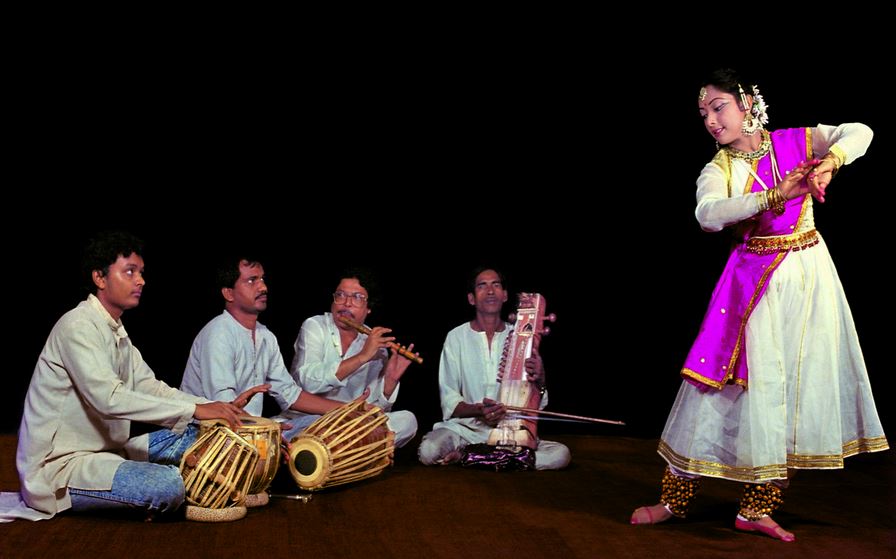
    Art-form in news: Kathak

    Kathak legend Pandit Birju Maharaj has recently passed away.

    About Kathak

    • Kathak is one of the eight major forms of Indian classical dance.
    • The origin of Kathak is traditionally attributed to the traveling bards in of ancient northern India known as Kathakars or storytellers.
    • The term Kathak is derived from the Vedic Sanskrit word Katha which means “story”, and Kathakar which means “the one who tells a story”, or “to do with stories”.
    • Wandering Kathakars communicated stories from the great epics and ancient mythology through dance, songs and music.

    Its origin

    • Kathak dancers tell various stories through their hand movements and extensive footwork, their body movements and flexibility but most importantly through their facial expressions.
    • It evolved during the Bhakti movement, particularly by incorporating the childhood and stories of the Hindu god Krishna, as well as independently in the courts of north Indian kingdoms.
    • Kathak is unique in having both Hindu and Muslim gharanas and cultural elements of these gharanas.
    • Kathak performances include Urdu Ghazals and commonly used instruments brought during the Mughal period.

    Major gharanas

    • Kathak is found in three distinct forms, called “gharanas”, named after the cities where the Kathak dance tradition evolved – Jaipur, Banaras and Lucknow.
    • While the Jaipur gharana focuses more on the foot movements, the Banaras and Lucknow gharanas focus more on facial expressions and graceful hand movements.

    Performance details

    • It involves both Nritta (pure dance) and Nritya (expressive dance).
    • Stylistically, the Kathak dance form emphasizes rhythmic foot movements, adorned with small bells (Ghungroo) and the movement harmonized to the music.
    • The legs and torso are generally straight, and the story is told through a developed vocabulary based on the gestures of arms and upper body movement, facial expressions, neck movements, eyes and eyebrow movement, stage movements, bends and turns.
    • The main focus of the dance becomes the eyes and the foot movements.
    • The eyes work as a medium of communication of the story the dancer is trying to communicate. With the eyebrows the dancer gives various facial expressions.
    • A Kathak performance can be solo, duo or team. In a technical performance, the speed and energy the dancers exchange with the audience increases in multiples, that is the tempo doubles or quadruples.


    UPSC 2022 countdown has begun! Get your personal guidance plan now! (Click here)
  • Foreign Policy Watch- India-Central Asia

    Domestic and geopolitical risks India faces in 2022

    Context

    Risks in 2022 could be both domestic and geopolitical, with many precepts that the world has been accustomed to being at risk. Democracy itself could face serious headwinds this year.

     Challenges to democracy

    • The world has recently seen the rise of authoritarian rulers in many countries.
    • What is worrisome is that democratic tenets which have been under attack in recent years appear set to face more onslaughts this year.
    • The United States, which was widely viewed as a major bulwark for democracy, appears to have developed certain pathological infirmities.

    Geopolitical challenges and risks

    [1] Disruption by China

    • The role of China is possibly the most disrupting one, given the challenge it poses to the existing international order.
    • Militarily, China is openly challenging U.S. supremacy in many areas, including ‘state-of-the-art weaponry’ such as hyper-sonic technology.
    • China is now threatening Taiwan, which could well become one of the flashpoints of conflict in 2022.
    • The dip in China’s economic profile in the past year and more could also lead to new tensions in the Asia-Pacific region in 2022.

    [2] Russia-Ukraine conflict

    • The other major risk of a war in 2022, stems from the ongoing conflict between Russia and Ukraine — the latter being backed by the U.S. and North Atlantic Treaty Organization (NATO) forces.
    • During the past three decades, NATO has expanded its reach almost a 1,000 miles to the east in violation of an earlier tacit understanding.
    • Russia appears determined that Ukraine should be the ‘last frontier’ and, if need be, ensure this through military force.
    • The situation has grave possibilities and could result in a series of cyclical outcomes with considerable damage potential.

    [3] Instability in the vast region

    • Unrest in Kazakhstan: The current unrest in Kazakhstan, which till recently was one of the more stable Central Asian nations, is perhaps symptomatic of what is in store.
    • Recent events in Kazakhstan demonstrates a sharper cleavage between the U.S.-led West and its principal opponents, Russia and China.
    • This is not a good sign for the world already wracked by a series of coups or internecine strife as in Ethiopia, Libya and certain regions of West Asia and North Africa.

    [4] Return of Taliban and security implications for India

    • Shift in balance of power: Of particular significance to India is that the Taliban’s return to power in Afghanistan has led to a material shift in the balance of power in India’s periphery.
    • Developments in Afghanistan have fuelled the ambitions of quite a few ‘anti-state militant groups’ across the region.
    • Even in Pakistan, the Tehrik-e-Taliban Pakistan (TTP) has become energised and is enlarging its sphere of action to other parts of Asia, notably Kazakhstan.
    • This will have an unsettling effect across large parts of Asia.
    • New evidence suggests that on India’s eastern flank, viz. Indonesia, a resurgence of radical Islamist activities is taking place.
    • The Jemaah Islamiyah has reportedly become more active in Indonesia.

    [5] India’s border issue with China

    • The most serious issue that India confronts today is how to deal with a China that has become more confrontational.
    • India’s membership of the Quad still rankles as far as China’s psyche is concerned, and during 2022, may well result in China embarking on new adventurist actions at many more points on the Sino-Indian border compelling India to react.
    • Additionally, India will need to determine how best to respond to China’s provocations.
    • Strengthen military posture: India would need to strengthen its military posture, both as a means to deter China and also to convince India’s neighbours that it can stand up to China.

    Challenges ahead for India

    • Challenge in Central Asia: Diplomatically, in 2022, India may find itself vulnerable in dealing with the turmoils which have occurred in two areas of strategic interest to it, viz. Central Asia and West Asia.
    • Challenge in West Asia: In West Asia, the challenge for India is how to manage its membership of the Second Quad (India, Israel, the United Arab Emirates and the U.S.) with the conflicting interests of different players in the region.
    • Limits to balancing: There is a limit to the kind of balancing act that India can perform, whether it be with regard to buying S-400 missile systems from Russia, risking potential sanctions from Washington under Countering America’s Adversaries Through Sanctions Act (CAATSA) or manoeuvering between the Arab States, Israel, Iran and the U.S. in West Asia.

    Conclusion

    Facing a host of unprecedented challenges, India’s leaders and diplomats must not only take stock of the dangers that exist but also be ready on how to manage the risks that are well evident.

    UPSC 2022 countdown has begun! Get your personal guidance plan now! (Click here)

  • Foreign Policy Watch: India-Japan

    India-Japan friendship can help global peace, prosperity

    Context

    The year 2022 marks the 70th anniversary of the establishment of diplomatic relations between Japan and India.

    Historical background of India-Japan relationship

    • We have a long history of people-to-people exchanges that can be traced back to the sixth century.
    • Buddhism was brought to Japan and, in 752.
    • During Meiji Restoration in the late 19th Century — Japan needed natural resources to modernise its industry.
    • Many Japanese travelled to India to purchase cotton, iron ore, etc.
    • Formal relations between Japan and India began in 1952.
    • After the Second World War, instead of signing the multilateral San Francisco Peace Treaty, India opted for concluding a bilateral peace treaty with Japan, considering that honour and equality should be ensured for Japan to rejoin the international community.
    • But even before the establishment of diplomatic relations, the goodwill between the people of the two countries was deeply rooted through business, academic and cultural exchanges.
    • After 70 years of multi-layered exchanges, the relationship between our two countries grew into a “Special Strategic and Global Partnership”. 

    Future possibilities

    [1] As democratic countries, contribute to global peace and prosperity

    • As democratic countries in Asia, India and Japan can cooperate to contribute to global peace and prosperity.
    • We share political, economic and strategic interests based on the firm foundations of common values and traditions.
    • We are continuing our efforts to build a rules-based free and open international order.

    [2] Cooperation in security

    • There are a plethora of fields that we can cooperate in security issues including cyber security, outer space and economic security.

    [3] Augmenting economic relations

    •  For long, Japan has been the largest ODA (Official Development Assistance) donor to India.
    • One of the most recent and ongoing examples of our collaboration is the Mumbai-Ahmedabad High-Speed Rail project.
    • Japan is also one of the largest investors in India.
    • Both countries have also promoted economic cooperation in other countries to enhance social infrastructure and connectivity.
    • Our economic partnership can further strengthen the economy of the Indo-Pacific, as well as the world economy.

    [4] Cultural exchange

    • Cultural exchanges including literature, movies, music, sports and academics are essential for our relations, enabling a better understanding.

    Consider the question “The year 2022 marks the 70th anniversary of the establishment of diplomatic relations between Japan and India. The future offers enormous possibilities for the partnership. In context of this, examine the future possibilities the two countries can explore.” 

    Conclusion

    India-Japan ties will continue to flourish. Our long history substantiates that.

    UPSC 2022 countdown has begun! Get your personal guidance plan now! (Click here)


    Meiji Restoration in Japan

    • In Japanese history, the political revolution in 1868 that brought about the final demise of the Tokugawa shogunate (military government)—thus ending the Edo (Tokugawa) period (1603–1867)—and, at least nominally, returned control of the country to direct imperial rule under Mutsuhito (the emperor Meiji).
    • In a wider context, however, the Meiji Restoration of 1868 came to be identified with the subsequent era of major political, economic, and social change—the Meiji period (1868–1912)—that brought about the modernization and Westernization of the country.
  • e-Commerce: The New Boom

    How predatory pricing is affecting distributors and traders

    Context

    Consumer goods distributors in Maharashtra has been protesting against Colgate’s alleged unfair treatment of traditional distributors vis-à-vis B2B (Business-to-Business) technology companies such as Reliance’s JioMart, Udaan and others.

    The disruption caused by B2B companies

    • Nearly half-a-million of India’s distributors pick up goods from consumer companies such as Colgate and deliver them to 13 million small local stores located in 7,00,000 villages and towns across the country through a web of millions of traders and other intermediaries.
    • Enter the new age technology B2B companies.
    • They have developed technologies to connect directly to the kirana store through a mobile phone app, bypassing the intermediaries.
    • They supply goods to the local store for lower prices than the charged by the distributor.
    • Unable to match such prices and facing the peril of losing business, India’s distributors claim these are unfair practices and want manufacturers such as to stop supplying goods to the technology companies.

    Issue of disruption caused by the pricing power and predatory pricing

    • Creative destruction: New innovations disrupting an existing process and rendering incumbents futile is generally a healthy process of ‘creative destruction’, as the Austrian economist, Joseph Schumpeter, postulated.
    • But this disruption in India is driven not entirely by technology innovation but also through pricing power.
    • These technology companies bear the loss on the products they sell to the local store.
    • Further, they offer extensive credit terms and working capital to the local stores.
    • In other words, these technology companies rely not just on their mobile phone app innovation but also steep price discounting and cheaper financing to win customers.
    • Evidently, these companies use the money to not only build new technologies but also to undercut competitors and steal market share. 
    • This practice, called predatory pricing, is illegal in most countries including India.
    • These companies are supplied with funds from foreign venture capital firms, which in turn are largely funded by American pension funds and university endowments.
    • The flip side is that India’s millions of distributors and intermediaries have no access to such finance.
    • These small companies are cut off from the endless stream of free foreign money that gushes into new age ‘startups’ and established large corporates.

    Problems created by predatory pricing

    • While consumers may benefit from lower prices, the livelihoods of millions of distributors, traders and their families suffer.
    • To be sure, this is not just an India problem but a global one.
    •  Social media companies such as Facebook give away their products for free and e-commerce companies such as Amazon sell at lower prices, benefiting consumers enormously, but also causing immense social strife and disharmony.
    • But in India’s case, there is an added complexity of foreign capital flows.
    • Access to this capital is only available to a tiny proportion of Indian businesses but threatens the livelihoods of millions of Indian families, as in the case of distributors, causing massive income and social disparities.
    • This unequal access to capital creates leads to anti-competitive behaviour.

    Consider the question “What is predatory pricing? What are the issues created by predatory pricing?”

    Conclusion

    To be clear, this is not a Luddite argument against e-commerce or technological innovations. The issue is about illegal predatory pricing and abuse of pricing power by startups and big corporates through preferential access to easy foreign money.

    UPSC 2022 countdown has begun! Get your personal guidance plan now! (Click here)

  • Agricultural Sector and Marketing Reforms – eNAM, Model APMC Act, Eco Survey Reco, etc.

    Opportunity for agri-reforms in Punjab

    Context

    It is no secret that Punjab, once the frontrunner of Indian agriculture, is struggling to retain its dynamism.

    Need to diversify

    • While Punjab ranked at the top of major Indian states in terms of per capita income during 1967-68 to 2002-03, it has slipped below the 13th position.
    • Punjab’s agricultural growth rate, at 5.7 per cent, was more than double the country’s average of 2.3 per cent during 1971-72 to 1985-86.
    • This has reversed between 2005 and 2019 with Punjab at 1.9 per cent and India at 3.7 per cent.
    • Agriculture least diversified state: With almost 85 per cent of the gross cropped area under wheat and rice, agriculture is least diversified in the state. 
    • Mandi transactions cost about 8.5 per cent of the MSP, the highest in the country, making Punjab wheat and rice less competitive.

    What explains low diversification in agriculture?

    • Policies: Guaranteed MSP for wheat and paddy, backed by assured procurement, free power and highly subsidised fertilisers, has disincentivised diversification.
    • Political economy: The political economy around wheat and rice is so intense that any effort to address its distortionary impact is met with fierce opposition by vested interest groups.

    How to recalibrate Punjab agriculture towards higher, sustainable growth?

    • Augment livestock and milk processing: While fruits and vegetables account for 7.4 per cent of the value of the output of agriculture and allied sectors, livestock accounts for 31.5 per cent and fisheries less than 1 per cent.
    • The state has the highest per capita availability of milk but it can process less than 20 per cent of it.
    •  Promoting mega parks for value addition in fruits and vegetables, milk, and other livestock products through medium and small enterprises will strengthen its competitiveness.
    • Strengthen market for seed potato: It is also a significant player in seed potato and with the right package of practices, traceability systems, and infrastructure, the market for Punjab seed potato can be strengthened.
    • Scaling up alternative marketing channel: Alternative marketing channels for fruits and vegetables such as direct marketing, contract farming, and exports have been in place but these models need to be scaled up with the right ecosystem.
    • Shift to demand-driven agriculture: Punjab needs to switch from supply-driven agriculture to demand-driven agriculture.
    • The demand for fisheries, poultry, dairy, and fruits and vegetables is increasing way faster than the demand for wheat and rice.
    • Rationalise mandi charges:  Rationalising mandi charges to not more than 3 per cent will attract private sector investments in building efficient value chains.
    • Rationalise subsidies: Time-bound incentives in the form of freight subsidies for exporters of high-value agri-produce, tax exemptions for the processing of perishable commodities for value chain players would be more rational than the overloaded subsidies of urea and free power.
    • Use technology and start-up revolution: Punjab should leverage the start-up revolution that is unfolding in India, and use technology to ensure optimal utilisation of resources, expand markets, and augment farmers’ income.
    • Geo-tagging of farms can address concerns related to long-term leasing of land that is critical for large-scale investments and enable vibrant agricultural land markets.
    • Innovations in supply chain management, be it automated grain silos or state-of-art herd management will not only optimise the use of resources but also bring in traceability of farms and animals, early monitoring and prevention of disease outbreaks, and contain value chain losses.

    How to manage financial resources?

    • Rationalise urea subsidy: It should rationalise its fertiliser subsidy regime by moving towards cash transfers on a per hectare basis and free up fertiliser prices.
    • Include urea in nutrient-based subsidy scheme: If that’s not possible, then urea should be included in the nutrient-based subsidy scheme.
    • Bring soluble fertiliser under subsidy: Bring soluble fertilisers under subsidy, which will enhance fertiliser use efficiency through fertigation.
    • This will also help reap environmental gains.
    • Rationalise food subsidy: Food subsidy can also be rationalised through direct cash transfers replacing PDS, as Punjab is a grain surplus state.

    Conclusion

    Both environmental and financial sustainability concerns related to business-as-usual farming in Punjab call for a rebooting strategy.

    UPSC 2022 countdown has begun! Get your personal guidance plan now! (Click here)

  • Trade Sector Updates – Falling Exports, TIES, MEIS, Foreign Trade Policy, etc.

    India to seal a Free Trade Agreement (FTA) with UK

    India and the United Kingdom have launched formal Free Trade Agreement (FTA) negotiations with the aim of concluding an early harvest trade agreement over the next few months.

    What is a Free Trade Agreement (FTA)?

    • A FTA is a pact between two or more nations to reduce barriers to imports and exports among them.
    • Under a free trade policy, goods and services can be bought and sold across international borders with little or no government tariffs, quotas, subsidies, or prohibitions to inhibit their exchange.
    • The concept of free trade is the opposite of trade protectionism or economic isolationism.

    Key benefits offered by FTA

    • Reduction or elimination of tariffs on qualified: For example, a country that normally charges a tariff of 12% of the value of the incoming product will rationalize or eliminate that tariff.
    • Intellectual Property Protection: Protection and enforcement of intellectual property rights in the FTA partner country is upheld.
    • Product Standards: FTA enhances the ability for domestic exporters to participate in the development of product standards in the FTA partner country.
    • Fair treatment for investors: FTA provides treatment as favourably as the FTA partner country gives equal treatment for investments from the partner country.
    • Elimination of monopolies: With FTAs, global monopolies are eliminated due to increased competition.

    How many FTAs does India have?

    • India has signed it’s first Free Trade Agreement (FTA) with Sri Lanka in 1998.
    • Likewise, India had FTAs with: Nepal, Bhutan, Thailand, Singapore, ASEAN, Japan and Malaysia.
    • The discussion is going for an FTA with Australia.
    • India has signed Preferential Trade Agreements such as:
    1. Asia Pacific Trade Agreement (APTA) with Bangladesh, China, India, Lao PDR, Republic of Korea, and Sri Lanka
    2. Global System of Trade Preferences (GSTP)
    3. India – MERCOSUR PTA etc. with South American countries

    Back2Basics: Types of Trade Agreements

    (1) Free Trade Agreement – discussed above

    (2) Preferential Trade Agreement

    • In this type of agreement, two or more partners give preferential right of entry to certain products.
    • This is done by reducing duties on an agreed number of tariff lines.
    • Here a positive list is maintained i.e. the list of the products on which the two partners have agreed to provide preferential access.
    • Tariff may even be reduced to zero for some products even in a PTA.
    • India signed a PTA with Afghanistan.

    (3) Comprehensive Economic Partnership Agreement

    • Partnership agreement or cooperation agreement are more comprehensive than an FTA.
    • CECA/CEPA also looks into the regulatory aspect of trade and encompasses and agreement covering the regulatory issues.
    • CECA has the widest coverage. CEPA covers negotiation on the trade in services and investment, and other areas of economic partnership.
    • It may even consider negotiation on areas such as trade facilitation and customs cooperation, competition, and IPR.
    • India has signed CEPAs with South Korea and Japan.

    (4) Comprehensive Economic Cooperation Agreement

    • CECA generally cover negotiation on trade tariff and Tariff rate quotas (TRQs) rates only.
    • It is not as comprehensive as CEPA.
    • India has signed CECA with Malaysia.

    (5) Framework Agreement

    • Framework agreement primarily defines the scope and provisions of orientation of the potential agreement between the trading partners.
    • It provides for some new area of discussions and set the period for future liberalisation.
    • India has previously signed framework agreements with the ASEAN, Japan etc.

    (6) Early Harvest Scheme

    • An Early Harvest Scheme (EHS) is a precursor to an FTA/CECA/CEPA between two trading partners. For example, early harvest scheme of RCEP has been rolled out.
    • At this stage, the negotiating countries identify certain products for tariff liberalization pending the conclusion of actual FTA negotiations.
    • An Early Harvest Scheme is thus a step towards enhanced engagement and confidence building.


    UPSC 2022 countdown has begun! Get your personal guidance plan now! (Click here)

  • Blockchain Technology: Prospects and Challenges

    Web 3.0: A vision for the future

    The concept of Web3, also called Web 3.0, used to describe a potential next phase of the internet, created quite a buzz in 2021.

    What is Web3?

    • The model, a decentralized internet to be run on blockchain technology, would be different from the versions in use, Web 1.0 and Web 2.0.
    • In web3, users will have ownership stakes in platforms and applications unlike now where tech giants control the platforms.

    Previous versions of Web

    To understand web3, we should start with Web 1.0 and Web 2.0.

    [1] Web 1

    • Web 1.0 is the world wide web or the internet that was invented in 1989. It became popular from 1993.
    • The internet in the Web 1.0 days was mostly static web pages where users would go to a website and then read and interact with the static information.
    • Even though there were e-commerce websites in the initial days it was still a closed environment and the users themselves could not create any content or post reviews on the internet.
    • Web 1.0 lasted until 1999.

    [2] Web 2

    • Web 2.0 started in some form in the late 1990s itself though 2004 was when most of its features were fully available. It is still the age of Web 2.0 now.
    • The differentiating characteristic of Web 2.0 compared to Web 1.0 is that users can create content.
    • They can interact and contribute in the form of comments, registering likes, sharing and uploading their photos or videos and perform other such activities.
    • Primarily, a social media kind of interaction is the differentiating trait of Web 2.0.

    What are some of the concerns?

    • In Web 2.0, most of the data in the internet and the internet traffic are owned or handled by very few behemoth companies ex. Google.
    • This has created issues related to data privacy, data security and abuse of such data.
    • There is a sense of disappointment that the original purpose of the internet has been distorted.
    • It is in this context that the buzz around Web3 is significant.

    Dawn of Web3

    • Gavin Wood, founder of Ethereum, a block chain technology company, used the term Web3 first in 2014 and in the past few years many others have added to the idea of Web3.
    • In 2021, owing to the popularity of crypto-currency, more discussions happened on Web3.

    How will Web3 address the problems of data monopoly?

    Web3 will deliver decentralized and fair internet where users control their own data.

    • Currently if a seller has to make a business to the buyer, both the buyer and seller need to be registered on a “shop” or “platform” like Amazon or Ebay or any such e-commerce portal.
    • What this “platform” currently does is that it authenticates that the buyer and seller are genuine parties for the transaction.
    • Web3 would try to remove the role of the “platform”.
    • For the buyer to be authenticated, the usual proofs aided by block chain technology will be used. The same goes for the seller.

    How is blockchain technology used here?

    • With block chain, the time and place of the transaction are recorded permanently.
    • Thus, Web3 enables peer to peer (seller to buyer) transaction by eliminating the role of the intermediary. This concept can be extended to other transactions also.
    • Consider a social media application where you want to share pictures with your followers.
    • It could be a broadcast operation from you aided by blockchain and you don’t need social media accounts for all the participants to be able to perform this.

    Another key feature: Decentralized Autonomous Organization

    • The key concepts in Web3 seen so far are peer to peer transaction and block chain.
    • The spirit of Web3 is Decentralized Autonomous Organization (DAO).
    • DAO is all about the business rules and governing rules in any transaction are transparently available for anyone to see and software will be written conforming to these rules.
    • Crypto-currency and block chain are technologies that follow the DAO principle.
    • With DAO, there is no need for a central authority to authenticate or validate.

    Will it take off?

    • We don’t know yet if Web3 will become the dominant mode of handling the internet but the questions it raises are relevant.
    • Web3 is in its very initial days and there is no consensus if it will take off like Web 1.0 or Web 2.0 did.
    • There is much skepticism from top tech brains in the industry and the academic community that Web3 does not solve the problems it purports to solve.


    UPSC 2022 countdown has begun! Get your personal guidance plan now! (Click here)

  • Innovations in Biotechnology and Medical Sciences

    Xeno-Transplantation and Related Issues

    Recently, the University Of Maryland School Of Medicine announced that it had successfully transplanted a genetically-modified pig heart into a patient with severe ailments.

    What is Xenotransplantation?

    • Xenotransplantation, or transplanting organs across different species, was first tried in humans in the 1980s.
    • The experiment was abandoned after the famous case of the American Baby Fae who was born with a congenital heart defect and received a baboon heart in 1984.
    • However, pig heart valves have been used for replacing damaged valves in humans for over 50 years now.
    • Nowadays, harvesting organs from genetically engineered pigs is seen as a viable alternative to meet organs shortage.

    How the pigs are genetically engineered?

    • The donor pig underwent 10 genetic modifications, by which the genes responsible for the rapid rejection of foreign organs by the human body were inactivated or knocked out.
    • Four pig genes were removed, and six human genes were added.
    • “GalSafe” pigs, or pigs that had undergone editing to knock out a gene that codes for Alpha-gal (a sugar molecule) were used.
    • Alpha-gal can elicit a devastating immune response in humans.
    • GalSafe pigs have been well studied, and are approved by the US Food and Drug Administration (FDA) for use in pharmacology.

    Why pursue xenotransplantation?

    • Modern scientific supporters of xenotransplantation argue that the potential benefits to society outweigh the risks, making pursuing xenotransplantation the moral choice.
    • None of the major religions object to the use of genetically modified pig organs for life-saving transplantation.

    A crucial case in India

    • Harvesting organs from genetically engineered pigs is seen as a viable alternative to meet organs shortage.
    • According to the health ministry, around 0.18 million people in India are estimated to suffer from renal failure every year, but only about 6,000 renal transplants are carried out in the country.
    • About 25,000-30,000 liver transplants are needed annually in India but only about 1,500 are being performed.
    • In the case of the heart, 50,000 people suffer from heart failure and are in need of a heart transplant.
    • Yet, only 10-15 heart transplants are carried out in India each year.

    Issues with Xenotransplantation

    Besides scientific challenges, there are several ethical challenges to overcome:

    • Animal rights: Many, including animal rights groups, strongly oppose killing animals to harvest their organs for human use.
    • Decreased life expectancy: In the 1960s, many organs came from the chimpanzees, and were transferred into people that were deathly ill, and in turn, did not live much longer afterwards.
    • Religious violations: Certain animals such as pork are strictly forbidden in Islam and many other religions.
    • Informed consent: Autonomy and informed consent are important when considering the future uses of xenotransplantation.
    • Threats of zoonosis: The safety of public health is a factor to be considered. We are already battling the biggest zoonotic disease threat.


    UPSC 2022 countdown has begun! Get your personal guidance plan now! (Click here)

Join the Community

Join us across Social Media platforms.