💥UPSC 2026, 2027, 2028 UAP Mentorship (March Batch) + Access XFactor Notes & Microthemes PDF

Archives: News

  • Climate Change Negotiations – UNFCCC, COP, Other Conventions and Protocols

    A planetary pressure-adjusted Human Development Index (HDI).

    Context

    Ever since the UNDP took up computation of the HDI in 1990, there have been adjustments such as inequality-adjusted HDI. The environment is one such issue now considered to be an essential component to be factored in to measure human development.

    Planetary pressure-adjusted Human Development Index

    • The purpose of the planetary pressure adjusted HDI, or PHDI, is to communicate to the larger society the risk involved in continuing with existing practices in our resource use and environmental management, and the retarding effect that environmental stress can perpetuate on development.
    • When planetary pressure is adjusted, the world average of HDI in 2019 came down from 0.737 to 0.683.
    • PHDI of India: In the case of India, the PHDI is 0.626 against an HDI of 0.645 with an average per capita CO2 emission (production) and material footprints of 2.0 tonnes and 4.6 tonnes, respectively.
    • India gained in global rankings by eight points (131st rank under HDI and 123rd rank under PHDI), and its per capita carbon emission (production) and material footprint are well below the global average.

    India’s twin challenge

    • India faces the twin challenges of poverty alleviation and environmental safeguarding.
    • India’s natural resource use is far from efficient, environmental problems are growing, and the onslaught on nature goes on unabated with little concern about its fallout.
    • At the same time, India has 27.9% people under the Multidimensional Poverty Index ranging from 1.10% in Kerala to 52.50% in Bihar, and a sizable section of them directly depend on natural resources for their sustenance.

    India’s performance on SDGs

    • The SDGs have acquired high priority in the context of the issue of climate change and its impact on society.
    • The Sixth Assessment Report (AR6) of IPCC 2021 laid stress on limiting global temperature rise at the 1.5° C level and strengthening the global response to the threat of climate change, sustainable development, and efforts to eradicate poverty.
    • ‘No poverty’ and ‘Zero hunger’ are the first and second SDGs.
    •  According to NITI Aayog (2020-21), out of 100 points set for the grade of Achiever, India scored 60 (Performer grade, score 50-64) for no poverty and 47 (Aspirant grade, score 0-49) for zero hunger, with wide State-level variations.
    • India’s score in the SDGs of 8, 9, and 12 (‘Decent work and economic growth’; ‘Industry, Innovation and Infrastructure’ and ‘Responsible Consumption and Production’, respectively) — considered for working out planetary pressure — are 61 (performer), 55 (performer) and 74 (front runner), respectively.

    Way forward

    • Nature-based solutions: It is now well established that there are interdependencies of earth system processes including social processes, and their relationships are non-linear and dialectic.
    • Therefore, the central challenge is to nest human development including social and economic systems into the ecosystem, and biosphere building on a systematic approach to nature-based solutions that put people at the core.
    • Integrated perspective and local level involvement: Social and environmental problems cannot be addressed in isolation anymore; an integrated perspective is necessary.
    • This can be conceived and addressed at the local level, for which India has constitutional provisions in the form of the 73rd and 74th Amendments.

    Conclusion

    An integrated perspective is necessary as social and environmental problems cannot be addressed in isolation anymore.

    UPSC 2022 countdown has begun! Get your personal guidance plan now! (Click here)

  • Goods and Services Tax (GST)

    Extending GST compensation as a reform catalyst

    Context

    In 2020-21, the compensation payment episode plunged the Union-State relationship to a new low, creating humongous mistrust.

    Background of the compensation to the States

    • To allay the fears of States of possible revenue loss by implementing GST in the short term, the Union government promised to pay compensation for any loss of revenue in the evolutionary phase of five years.
    • This was estimated by taking the revenue from the merged taxes in 2015-16 as the base and applying the growth rate of 14% every year.
    •  To finance the compensation requirements, a GST compensation cess was levied on certain items such as tobacco products, automobiles.
    • Period of five years: The agreement to pay compensation for the loss of revenue was for a period of five years which will come to an end by June 2022.
    • Mistrust between Centre and the State: In 2020-21, due to the most severe lockdown following the novel coronavirus pandemic, the loss of revenue to States was estimated at ₹3 lakh-crore of which ₹65,000 crore was expected to accrue from the compensation cess.
    • Of the remaining ₹2.35 lakh-crore, the Union government decided to pay ₹1.1 lakh-crore by borrowing from the Reserve Bank of India.
    • The entire compensation payment episode plunged the Union-State relationship to a new low, creating humongous mistrust.

    GST reform is still in transition

    • Misuse of input tax credit: The technology platform could not be firmed up for a long time due to which the initially planned returns could not be filed.
    • This led to large-scale misuse of input tax credit using fake invoices.
    • Revenue uncertainty faced by the States: This is the only major source of revenue for the States.
    • Considering their increased spending commitments to protect the lives and livelihoods of people, they would like to mitigate revenue uncertainty to the extent they can.
    • They have no means to cushion this uncertainty for the Finance Commission which is supposed to take into account the States’ capacities and needs in its recommendations has already submitted its recommendations.
    • Changes needed: More importantly, the structure of GST needs significant changes and the cooperation of States is necessary to carry out the required reforms.

    Changes needed in GST structure

    • Reducing exemption items: Almost 50% of the consumption items included in the consumer price index are in the exemption list; broadening the base of the tax requires significant pruning of these items.
    • Bringing petroleum products, real estate etc under GST: Sooner or later, it is necessary to bring petroleum products, real estate, alcohol for human consumption and electricity into the GST fold.
    • Single rate: The present structure is far too complicated with four main rates (5%, 12%, 18% and 28%).
    • This is in addition to special rates on precious and semi-precious stones and metals and cess on ‘demerit’ and luxury items at rates varying from 15% to 96% of the tax rate applicable which have complicated the tax enormously.
    •  Multiple rates complicate the tax system, cause administrative and compliance problems, create inverted duty structure and lead to classification disputes.

    Way forward

    • Extending the compensation period: Reforming the structure to unify the rates is imperative and this cannot be done without the cooperation of States.
    • Thus, extending the compensation payment for the next five years is necessary not only because the transition to GST is still underway but also to provide comfort to States to partake in the reform.
    • Reforming the structure is important not only to enhance the buoyancy of the tax in the medium term but also to reduce administrative and compliance costs to improve ease of doing business and minimise distortions.
    • New rate of compensation: It has been pointed out by many including the Fifteenth Finance Commission that the compensation scheme of applying 14% growth on the base year revenue provided for the first five years was far too generous.
    • The issue can be revisited and the rate of growth of reference revenue for calculating compensation can be linked to the growth of GSDP in States.

    Conclusion

    The transition to GST is still in progress and an extension will provide comfort to States to help roll out crucial changes.

    UPSC 2022 countdown has begun! Get your personal guidance plan now! (Click here)

  • Freedom of Speech – Defamation, Sedition, etc.

    Hate speech in the time of free speech

    Context

    The growing incidence of hate speeches, especially those targeting minorities, in combination with the judicial ambiguity has provided an opportunity to chart legislative reforms.

    Current legal provisions to deal with hate speech

    • Not defined in legal framework: Hate speech is neither defined in the Indian legal framework nor can it be easily reduced to a standard definition due to the myriad forms it can take.
    • The Supreme Court, in Pravasi Bhalai Sangathan v. Union of India (2014), described hate speech as “an effort to marginalise individuals based on their membership in a group” and one that “seeks to delegitimise group members in the eyes of the majority, reducing their social standing and acceptance within society.”
    • The Indian Penal Code illegalises speeches that are intended to promote enmity or prejudice the maintenance of harmony between different classes.
    • Specifically, sections of the IPC, such as 153A, which penalises promotion of enmity between different groups;
    • 153B, which punishes imputations, assertions prejudicial to national integration;
    • 505, which punishes rumours and news intended to promote communal enmity, and
    • 295A, which criminalises insults to the religious beliefs of a class by words with deliberate or malicious intention.
    • Summing up various legal principles, in Amish Devgan v. Union of India (2020), the Supreme Court held that “hate speech has no redeeming or legitimate purpose other than hatred towards a particular group”.
    • Lack of established legal standard: Divergent decisions from constitutional courts expose the lack of established legal standards in defining hate speech, especially those propagated via the digital medium.

    Suggestions

    • The Law Commission of India, in its 267th report, recommended the insertion of two new provisions to criminalise and punish the propagation of hate speech.
    • The 189th Report of the Parliamentary Standing Committee on Home Affairs, in 2015, recommended the incorporation of separate and specific provisions in the Information Technology Act to deal with online hate speech.
    • Specialised legislation for social media: Much of the existing penal provisions deal with hate speech belong to the pre-Internet era.
    • The need of the hour is specialised legislation that will govern hate speech propagated via the Internet and, especially, social media.
    • Recognise hate speech as reasonable restriction to free speech: Taking cue from best international standards, it is important that specific and durable legislative provisions that combat hate speech, especially that which is propagated online and through social media.
    • Ultimately, this would be possible only when hate speech is recognised as a reasonable restriction to free speech.

    Consider the question “What is hate speech? What are the challenges in dealing with hate speech? Suggest a way forward.”

    Conclusion

    It is important that specific and durable legislative provisions be enacted to combat hate speech.

    UPSC 2022 countdown has begun! Get your personal guidance plan now! (Click here)
  • Economic Indicators and Various Reports On It- GDP, FD, EODB, WIR etc

    Issues with India’s GDP data

    Context

    There are three major reasons why the GDP data, and hence any narrative of economic recovery based on it, are questionable.

    Background

    • The NSO released the current GDP series in 2015, using 2011-12 as its base year.
    • Some have argued that the problem in the new series is the real growth rate. This is debatable.
    • Scholars have pointed to measurement problems, both in the nominal and real GDP growth rates.

    Three issues with the GDP data, and  narrative of economic recovery based on it

    [1] Double deflation problem

    • The new series entailed a shift from a volume-based measurement system to one based on nominal values, thereby making the deflator problem more critical.
    • Simply put, the NSO calculates real GDP by gathering nominal GDP data in rupees and then deflating this data using various price indices.
    • The nominal data needs to be deflated twice: Once for outputs and once for inputs.
    • But the NSO — almost uniquely amongst G20 countries — deflates the nominal data only once.
    • It does not deflate the value of inputs.
    • To see why this is a problem, consider what happens when the price of imported oil goes down.
    • In that case, input costs will fall and the profits recorded by Indian firms will rise.
    • This increase in profits is merely the result of a fall in input prices, so it needs to be deflated away.
    • But the NSO doesn’t deflate away the increase in profits.
    • Since the cost of inputs is measured by the WPI (wholesale price index), a crude measure of the overestimation caused by the absence of “double deflation” is given by the gap between the WPI and the CPI (consumer price index).
    • In the 2014-2017 period, oil prices plunged, causing the WPI to fall sharply relative to the CPI.
    • This meant that real growth was probably overstated.
    • In the last few months, the exact opposite has been happening. WPI inflation is soaring.
    • The rapid increase in the WPI relative to the CPI is imparting an upward bias to the deflator.

    [2] Sectoral weight not updated

    • When it calculates GDP, it takes a sample of activity in each sector, then aggregates the figures by using sectoral weights.
    • To make sure that the weights are reasonably accurate, the NSO normally updates them once a decade.
    • It has now been more than 10 years since the weights were changed, and there are no signs of a base year revision.
    • As a result, the sectoral weights are still based on the structure of the economy in 2010-11, when in particular the information technology sector was much smaller.

    [3] Measurement of unorganised sector

    • Measurement of the unorganised sector has always been difficult in India.
    • Once in a while, the NSO undertakes a survey to measure the size of the sector.
    • In the meantime, it simply assumes that the sector has been growing at the same rate as the organised sector.
    • However, starting in 2016 the unorganised sector has been disproportionately impacted by a series of shocks.
    • In 2018, the NBFC sector reported serious problems, which in turn impacted unorganised sector firms since they were heavily dependent on NBFCs for funds.
    • From 2020 onwards, the pandemic has impacted the unorganised sector more than the organised sector enterprises.
    • Despite these shocks, the NSO does not seem to have made any adjustments to its methodology for estimating the growth of the unorganised sector.

    Consider the question “Elaborate the issues with India’s GDP data. Suggest the way forward.”

    Conclusion

    There are serious problems with India’s GDP data. Any analysis of recovery or growth forecast based on this data must be taken with a handful of salt.

    UPSC 2022 countdown has begun! Get your personal guidance plan now! (Click here)

  • WTO and India

    China’s disputed ‘Developing’ Country Status at WTO

    China’s status as a ‘developing country’ at the World Trade Organization (WTO) has become a contentious issue with a number of countries raising concerns.

    Defining a country’s ‘Development’

    • There are no WTO definitions of “developed” or “developing” countries.
    • Developing countries in the WTO are designated on the basis of self-selection although this is not necessarily automatically accepted in all WTO bodies.
    • The WTO however recognizes as least-developed countries (LDCs) those countries which have been designated as such by the United Nations.

    Benefits of ‘Developing Country’ tag

    • Special and differential treatment: Certain WTO agreements give developing countries special rights through ‘special and differential treatment’ (S&DT) provisions.
    • Preferential treatment: The classification also allows other countries to offer preferential treatment.
    • Longer timeframe for pacts: WTO can grant developing countries longer timeframes to implement the agreements and even commitments to raise trading opportunities for such countries.

    Issues with Chinese ‘Developing Country’ status

    • China has become an upper-middle-income country according to the World Bank.
    • It involves in unfair trade practices such as preferential treatment for state enterprises, data restrictions and inadequate enforcement of intellectual property rights.

    How has China responded?

    • China has consistently maintained that it is the “world’s largest developing economy”.
    • It has recently indicated that it may be willing to forego many benefits of being a developing country.

    What are the benefits of LDC classification?

    • The WTO recognizes LDCs relying on a classification by the UN based on criteria that is reviewed every three years. LDCs are often exempted from certain provisions of WTO pacts.
    • Bangladesh, currently classified as an LDC, receives zero duty, zero quota access for almost all exports to the EU.
    • It is, however, set to graduate from the LDC status in 2026 as its per capita GDP has risen sharply surpassing that of India in FY21.

    Try this question from CS Mains 2018:


    Q.What are the key areas of reform if the WTO has to survive in the present context of ‘Trade War’, especially keeping in mind the interest of India?


    Reference: https://www.civilsdaily.com/sansad-tv-perspective-wto-reforms/

    (Aspirants need not write whole answers. Just a quick summary with keywords would suffice.)


    UPSC 2022 countdown has begun! Get your personal guidance plan now! (Click here)

  • Citizenship and Related Issues

    MHA seeks more time to frame CAA rules

    The Ministry of Home Affairs (MHA) has sought another extension from parliamentary committees to frame the rules of the Citizenship (Amendment) Act (CAA), 2019.

    What is Citizenship Amendment Act (CAA), 2019?

    • The act is sought to amend the Citizenship Act, 1955 to make Hindu, Sikh, Buddhist, Jain, Parsi, and Christian illegal migrants from Afghanistan, Bangladesh, and Pakistan, eligible for citizenship of India.
    • In other words, it intends to make it easier for non-Muslim immigrants from India’s three Muslim-majority neighbours to become citizens of India.
    • Under The Citizenship Act, 1955, one of the requirements for citizenship by naturalization is that the applicant must have resided in India during the last 12 months, as well as for 11 of the previous 14 years.
    • The amendment relaxes the second requirement from 11 years to 6 years as a specific condition for applicants belonging to these six religions, and the aforementioned three countries.
    • It exempts the members of the six communities from any criminal case under the Foreigners Act, 1946 and the Passport Act, 1920 if they entered India before December 31, 2014.

    Key feature: Defining illegal migrants

    • Illegal migrants cannot become Indian citizens in accordance with the present laws.
    • Under the CAA, an illegal migrant is a foreigner who: (i) enters the country without valid travel documents like a passport and visa, or (ii) enters with valid documents, but stays beyond the permitted time period.
    • Illegal migrants may be put in jail or deported under the Foreigners Act, 1946 and The Passport (Entry into India) Act, 1920.

    Exceptions

    • The Bill provides that illegal migrants who fulfil four conditions will not be treated as illegal migrants under the Act.  The conditions are:
    1. they are Hindus, Sikhs, Buddhists, Jains, Parsis or Christians;
    2. they are from Afghanistan, Bangladesh or Pakistan;
    3. they entered India on or before December 31, 2014;
    4. they are not in certain tribal areas of Assam, Meghalaya, Mizoram, or Tripura included in the Sixth Schedule to the Constitution, or areas under the “Inner Line” permit, i.e., Arunachal Pradesh, Mizoram, and Nagaland.

    Controversy with the Act

    • Country of Origin: The Act classifies migrants based on their country of origin to include only Afghanistan, Pakistan and Bangladesh.
    • Other religious minorities ignored: It is unclear why illegal migrants from only six specified religious minorities have been included in the Act.
    • Defiance of purpose: India shares a border with Myanmar, which has had a history of persecution of a religious minority, the Rohingya Muslims.
    • Date of Entry: It is also unclear why there is a differential treatment of migrants based on their date of entry into India, i.e., whether they entered India before or after December 31, 2014.

    Way forward

    • India is a constitutional democracy with a basic structure that assures a secure and spacious home for all Indians.
    • Being partitioned on religious grounds, India has to undertake a balancing act for protecting the religious minorities in its neighbourhood.
    • These minorities are under constant threat of persecution and vandalism.
    • India needs to balance the civilization duties to protect those who are prosecuted in the neighbourhood.


    UPSC 2022 countdown has begun! Get your personal guidance plan now! (Click here)

  • Oil and Gas Sector – HELP, Open Acreage Policy, etc.

    Places in news: Darvaza Gas Crater

    Turkmenistan President has ordered experts to find a way to extinguish a fire in a huge natural gas crater, the Darvaza gas crater also known as the ‘Gateway to Hell’.

    Darvaza Gas Crater

    • Located in the Karakum desert, 260 kilometres away from Turkmenistan’s capital, Ashgabat, the crater has been burning for the last 50 years.
    • The crater is 69 metres wide and 30 metres deep.
    • While the details of the origin of the crater are contested but it has been said that the crater was created in 1971 during a Soviet drilling operation.
    • In 1971, Soviet geologists were drilling for oil in the Karakum desert when they hit a pocket of natural gas by mistake, which caused the earth to collapse and ended up forming three huge sinkholes.

    Why is it flamed?

    • This pocket of natural gas contained methane, hence to stop that methane from leaking into the atmosphere, the scientists lit it with fire, assuming the gas present in the pit would burn out within a few weeks.
    • The scientists seemed to have misjudged the amount of gas present in the pit, because the crater has been on fire for five decades now.

    A popular tourist attraction

    • The crater has become a significant tourist attraction in Turkmenistan.
    • In 2018, the country’s president officially renamed it as the “Shining of Karakum”.

    Why did Turkmenistan order to extinguish it?

    • Calling it a human-made crater, it has negative effects on both environment and the health of the people living nearby.
    • It also ends up losing valuable natural resources for which could fetch significant profits.

    How harmful are methane leaks?

    • Methane is the primary contributor to the formation of ground-level ozone, a hazardous air pollutant and greenhouse gas, exposure to which causes 1 million premature deaths every year.
    • Methane is also a powerful greenhouse gas. Over a 20-year period, it is 80 times more potent at warming than carbon dioxide.

    Back2Basics: TAPI Gas Pipeline

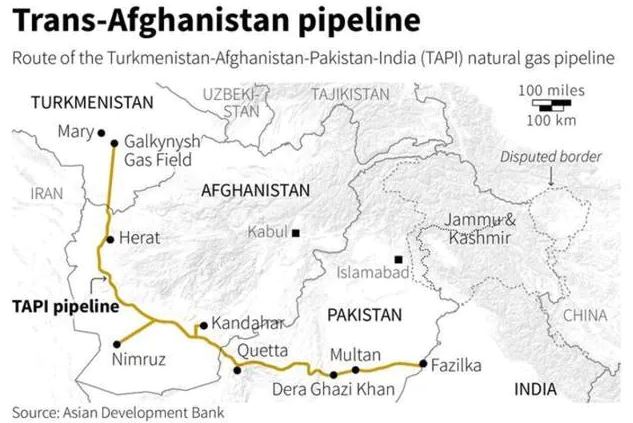
    • The Turkmenistan–Afghanistan–Pakistan–India (TAPI) Pipeline is a natural gas pipeline being developed with the participation of the Asian Development Bank.
    • It will be a 1,814km trans-country natural gas pipeline running across four countries.
    • It will transport natural gas from the Galkynysh Gas Field in Turkmenistan through Afghanistan into Pakistan and then to India.
    • The plan for the TAPI project was originally conceived in the 1990s to generate revenue from Turkmenistan’s gas reserves by exporting natural gas via Afghanistan to Pakistan and India.
    • Construction on the project started in Turkmenistan on 13 December 2015, work on the Afghan section began in February 2018, and work on the Pakistani section was planned to commence in December 2018.
    • Presently, the construction work has been stalled due to terror activities of Taliban in Afghanistan since few years.


    UPSC 2022 countdown has begun! Get your personal guidance plan now! (Click here)

  • Wildlife Conservation Efforts

    Red Sanders falls back in IUCN’s ‘endangered’ category

    Red Sanders (Red Sandalwood) has fallen back into the ‘endangered’ category in the International Union for Conservation of Nature’s (IUCN) Red List.

    A recently released and trending Telugu movie plot provides a fictional account of red sandal smuggling.

    About Red Sanders

    • The species, Pterocarpus santalinus, is an Indian endemic tree species, with a restricted geographical range in the Eastern Ghats.
    • It is endemic to a distinct tract of forests in Andhra Pradesh.
    • It is mainly found in Chittoor, Kadapa, Nandhyal, Nellore, Prakasam districts of Andhra Pradesh.
    • It was classified as ‘near threatened’ in 2018 and has now joined the ‘endangered’ list once again in 2021.
    • It is listed under Appendix II of CITES and is banned from international trade.

    Status of legal protection in India

    • The Union Environment Ministry had decided to keep Red Sanders (red sandalwood) OUT of the Schedule VI of Wild Life Protection Act, 1972, arguing that this would discourage the cultivation of the rare plant species.
    • Schedule VI regulates and restricts the cultivation, possession, and sale of a rare plant species.

    Significance of listing

    • It was a moment of celebration when the species was lifted off from the endangered category for the first time since 1997.
    • Over the last three generations, the species has experienced a population decline of 50-80 percent.
    • It is also scheduled in appendix II of the CITES and Wildlife Protection Act.

    Threats to this species

    • Red Sanders are known for their rich hue and therapeutic properties, are high in demand across Asia, particularly in China and Japan.
    • They are used in cosmetics and medicinal products as well as for making furniture, woodcraft and musical instruments.
    • Its popularity can be gauged from the fact that a tonne of Red Sanders costs anything between Rs 50 lakh to Rs 1 crore in the international market.

    Try this question from CSP 2016:

    Q.With reference to ‘Red Sanders’, sometimes seen in the news, consider the following statements:

    1. It is a tree species found in a part of South India.
    2. It is one of the most important trees in the tropical rain forest areas of South India.

    Which of the above statements is/are correct?

    (a) 1 only

    (b) 2 only

    (c) Both 1 and 2

    (d) Neither 1 nor 2


    Post your answers here.

    Back2Basics: Red List Categories of IUCN

    Species are classified by the IUCN Red List into nine groups specified through criteria such as rate of decline, population size, area of geographic distribution, and degree of population and distribution fragmentation. They are:

    • Extinct (EX) – beyond reasonable doubt that the species is no longer extant.
    • Extinct in the wild (EW) – survives only in captivity, cultivation and/or outside native range, as presumed after exhaustive surveys.
    • Critically endangered (CR) – in a particularly and extremely critical state.
    • Endangered (EN) – very high risk of extinction in the wild, meets any of criteria A to E for Endangered.
    • Vulnerable (VU) – meets one of the 5 red list criteria and thus considered to be at high risk of unnatural (human-caused) extinction without further human intervention.
    • Near threatened (NT) – close to being at high risk of extinction in the near future.
    • Least concern (LC) – unlikely to become extinct in the near future.
    • Data deficient (DD)
    • Not evaluated (NE)


    UPSC 2022 countdown has begun! Get your personal guidance plan now! (Click here)

  • Air Pollution

    National Ambient Air Quality Standards (NAAQS)

    Delhi and most of the other non-attainment cities under the National Clean Air Programme (NCAP) have shown only a marginal improvement, said a new analysis released.

    About NCAP

    • The NCAP was implemented across India in 2019 to reduce particulate matter levels in 132 cities by 20-30% in 2024.
    • Cities are declared non-attainment if they consistently fail to meet the National Ambient Air Quality Standards (NAAQS) over a five-year period.

    What are NAAQ standards?

    • The mandate provided to the Central Pollution Control Board (CPCB) under the Air (Prevention and Control of Pollution) Act empowers it to set standards for the quality of air.
    • Hence the current National Ambient Air Quality Standards were notified in November 2009 by the CPCB.
    • Prior to this, India had set Air Quality standards in 1994, and this was later revised in 1998.
    • The 2009 standards further lowered the maximum permissible limits for pollutants and made the standards uniform across the nation.
    • Earlier, less stringent standards were prescribed for industrial zones as compared to residential areas.

    Pollutants covered:

    • Sulphur Dioxide (SO2)
    • Nitrogen Dioxide (NO2),
    • Particulate Matter (size less than 10 µm) or PM 10
    • Particulate Matter (size less than 2.5 µm) or PM2.5
    • Ozone (O3)
    • Carbon Monoxide (CO)
    • Ammonia (NH3)

    (Air Pollutants that most of us NEVER heard of:)

    • Lead
    • Benzene (C6H6)
    • Benzo(a)Pyrene (BaP)
    • Arsenic(As)
    • Nickel (Ni)

    Source: Arthpaedia


    UPSC 2022 countdown has begun! Get your personal guidance plan now! (Click here)

  • Monsoon Updates

    What is Samba Cultivation?

    Around four lakh more acres have been brought under the Crop Insurance Scheme for the Samba Cultivation season of 2021-22 in Tamil Nadu.

    What is Samba Cultivation?

    • It is a Tamil name for paddy cultivation season.
    • Other paddy seasons in Tamil Nadu include:
    1. Kuruvai: June-July
    2. Samba: August
    3. Late Samba / Thaladi: September- October
    4. Navarai: December- January

    Back2Basics: Major crop seasons

    (1) Kharif Crop

    • Kharif crops, monsoon crops, or autumn crops are cultivated and harvested in the monsoon season.
    • The farmers sow seeds at the beginning of the monsoon season and harvest them at the end of the season. i.e., between September and October.
    • Kharif crops need a lot of water and hot weather for proper growth.
    • Examples: Rice, Maize, Millet, Soybean, Arhar, Cotton. etc.

    (2) Rabi Crop

    • Rabi means spring in Arabic. Crops grown in the winter season [October to December] and harvested in the spring season [Aril-May] are called Rabi crops.
    • These crops require a warm climate for germination and maturation of seeds and need a cold environment for their growth.
    • Rain in winter spoils the Rabi crop but is good for the Kharif crop.
    • Examples: Wheat, Gram, Barley, Peas, Oats, Chickpea, Linseed, Mustard, etc.

    (3) Zaid Crop

    • Zaid crops are grown between Kharif and Rabi Seasons, i.e., between March to June.
    • They require warm, dry weather as a vital growth period and longer day length for flowering.
    • Zaid crop is significant for farmers as it gives fast cash to the farmers and is also known as gap-filler between two chief crops, Kharif and Rabi.
    • Examples: Cucumber, Pumpkin, Bitter gourd, Watermelon, Muskmelon, Sugarcane, Groundnut, Pulses, etc.


    UPSC 2022 countdown has begun! Get your personal guidance plan now! (Click here)

Join the Community

Join us across Social Media platforms.