💥UPSC 2027,2028 Mentorship (April Batch) + Access XFactor Notes & Microthemes PDF

Archives: News

  • Electoral Reforms In India

    Right to Vote NOT same as Freedom of Voting: Centre

    Why in the News?

    The Union Government has submitted before the Supreme Court that the ‘right to vote’ is distinct from the ‘freedom of voting’.

    About the Case and Centre’s Affidavit:

    • Petition: Filed by Vidhi Centre for Legal Policy and the Association for Democratic Reforms (ADR).
    • Context: Concerns Section 53(2) of the Representation of the People Act (RPA), 1951, which allows uncontested candidates to be declared elected without polling.
    • Core Challenge: Argues that uncontested elections deny voters the right to dissent through NOTA, violating Article 19(1)(a) of the Constitution.
    • Centre’s Argument: Draws a distinction between the “Right to Vote” (statutory) and “Freedom of Voting” (fundamental right).
    • Legal Basis:
      • Right to Vote – Granted by Section 62 of RPA, 1951, subject to statutory limits.
      • Freedom of Voting – A form of free expression under Article 19(1)(a), as held in PUCL v. Union of India (2003).
    • Government’s Position: The freedom of voting exists only when a poll occurs; in uncontested elections, no poll means no expressive act under Article 19.

    Legal Reasoning by the Government:

    • Poll Dependency: Freedom of voting arises only during active polling; without a poll, no expressive right is engaged.
    • Statutory Framework:
      • Section 53(1) – Poll required when candidates exceed seats.
      • Sections 53(2) & 53(3) – If candidates ≤ seats, no poll needed; candidate declared elected.
    • NOTA’s Legal Status: NOTA is not a “candidate” under Section 79(b); it is merely an expression option, not an electoral participant.
    • Administrative Rationale: Holding polls solely to include NOTA would waste resources and delay electoral outcomes.
    • EC’s View: The Election Commission concurred, treating NOTA as a candidate would need legislative amendment.
    • Empirical Data: Only 9 uncontested elections since 1951, making such instances rare exceptions in Indian democracy.

    About Right to Vote in India:

    • Overview: It is also known as suffrage, allows citizens to elect their representatives in democratic institutions.
    • Constitutional Basis: Guaranteed under Article 326 of the Constitution of India, which provides for universal adult franchise.
    • Eligibility: Every citizen of India aged 18 and above is entitled to vote, unless disqualified by law.
    • Supervision: Organised and overseen by the Election Commission of India.
    • Supporting Laws:
      • Representation of the People Act, 1950: Defines voter eligibility and grounds for disqualification.
      • Representation of the People Act, 1951: Governs the procedures for conducting elections.
    • Current Legal Status: : It is legally a statutory right.
    • Constitutional Context: It is shaped by constitutional provisions but does not hold the status of a fundamental right.

    Judicial Interpretation:

    • N.P. Ponnuswami v. Returning Officer (1952): Declared the Right to Vote as a statutory right.
    • Jyoti Basu v. Debi Ghosal (1982): Reiterated that the Right to Vote is neither a fundamental right nor a common law right.
    • People’s Union for Civil Liberties v. Union of India (2003): Recognised the Right to Vote as at least a constitutional right.
    • Kuldip Nayar v. Union of India (2006): Held that the Right to Vote continues to be a statutory right.
    • Raj Bala v. State of Haryana (2015): Recognised the Right to Vote as a constitutional right.
    • Anoop Baranwal v. Union of India (2023):
      • Majority View: Right to Vote is a statutory right.
      • Dissenting Opinion by Justice Ajay Rastogi:
        • Linked the Right to Vote with the freedom of speech and expression under Article 19(1)(a).
        • Considered it essential to free and fair elections and thus part of the basic structure of the Constitution.

    Back2Basics: Other Types of Rights in India

    Description Enforceability
    Natural Rights Inherent and inalienable rights (e.g., life, liberty); not directly enforceable unless linked to fundamental rights. Indirectly through Fundamental Rights
    Fundamental Rights Guaranteed under Part III of the Constitution (e.g., right to equality, speech, life). Enforceable in Supreme Court under Article 32
    Constitutional Rights Rights given in the Constitution but outside Part III (e.g., property, trade). Enforceable under Article 226 via High Courts
    Statutory Rights Granted by ordinary laws (e.g., MGNREGA, Forest Rights Act, Food Security Act). Enforceable as per respective legislations


    [UPSC 2017] Right to vote and to be elected in India is a:

    Options: (a) Fundamental Right (b) Natural Right (c) Constitutional Right* (d) Legal Right


  • CAG plans to create two new cadres for more centralisation

    Why in the News?

    The Comptroller and Auditor General of India approved two new Indian Audit and Accounts Department (IA&AD) cadres, the Central Revenue Audit and Central Expenditure Audit, effective from 1 January 2026.

    About the New Cadres:

    • Objective: Designed to build deeper professional expertise in auditing Central receipts and expenditures, streamline manpower management, and reduce dependence on regional deployments.
      1. Central Revenue Audit (CRA): Focuses on auditing Central Government revenues, including direct taxes, indirect taxes, customs, excise, and non-tax receipts. It ensures compliance, accuracy, and transparency in revenue administration.
      2. Central Expenditure Audit (CEA): Concentrates on auditing Central Government expenditures, assessing legality, efficiency, and prudence in public spending across ministries and departments.
    • Impact: The reform consolidates around 4,000 audit professionals (out of a total CAG strength of ~42,000), improving manpower flexibility, domain expertise, and data-driven audit capabilities.
    • Significance: Marks a major shift toward centralised auditing, ensuring a uniform approach to the examination of national finances and reinforcing accountability in public administration.

    About the Comptroller and Auditor General (CAG) of India:

    • Overview: Established under Article 148, the CAG heads the Indian Audit and Accounts Department (IA&AD) and acts as guardian of public finance.
    • Legal Framework: Functions under the CAG (Duties, Powers and Conditions of Service) Act, 1971, amended in 1976, 1984, and 1987.
    • Appointment & Tenure:
      • Appointed by the President under warrant and seal.
      • Tenure – Six years or until age 65, whichever earlier.
      • Removal – Same as a Supreme Court judge, requiring special majority in Parliament.
    • Independence Safeguards:
      • Salary and expenses charged on the Consolidated Fund of India.
      • No reappointment to government posts after retirement.
      • No minister can defend the CAG in Parliament.
    • Duties & Powers:
      • Audits Consolidated Funds of the Union, States, and UTs.
      • Examines PSUs, autonomous bodies, and grant-in-aid institutions.
      • Submits reports to the President, later examined by the Public Accounts Committee (PAC).
    • Role & Importance: Serves as the watchdog of public finance, conducting regulatory and propriety audits to ensure legality and efficiency in expenditure.
    • International Role: Currently the External Auditor for IAEA (2022–2027) and FAO (2020–2025), enhancing India’s global audit leadership.
    [UPSC 2012] In India, other than ensuring that public funds are used efficiently and for intended purpose, what is the importance of the office of the Comptroller and Auditor General (CAG)?

    1. CAG exercises exchequer control on behalf of the Parliament when the President of India declares national emergency/financial emergency

    2. CAG reports on the execution of projects or programmes by the ministries are discussed by the Public Accounts Committee.

    3. Information from CAG reports can be used by investigating agencies to press charges against those who have violated the law while managing public finances.

    4. While dealing with the audit and accounting of government companies, CAG has certain judicial powers for prosecuting those who violate the law.

    Which of the statements given above is/are correct?

    (a) 1, 3 and 4 only  (b) 2 only  (c) 2 and 3 only * (d) 1, 2, 3 and 4


  • State of Food and Agriculture Report, 2025

    Why in the News?

    The State of Food and Agriculture (SOFA) Report 2025, released by the Food and Agriculture Organization (FAO) on 3 November 2025, highlights the alarming global impact of human-induced land degradation.

    About the SOFA Report:

    • Goal: Aims to help governments design sustainable land management and food security policies.
    • Publication: Released annually by the Food and Agriculture Organization (FAO) of the United Nations as one of its flagship analytical reports.
    • Focus (2025 Edition): Examines human-induced land degradation and its effects on agricultural productivity, poverty, and ecosystem stability.
    • Analytical Scope: Integrates soil data, land use patterns, crop yields, and socioeconomic indicators to identify global vulnerability hotspots.

    Key Global Findings (2025):

    • Population Exposure: Around 1.7 billion people live in land-degraded regions with declining agricultural output.
    • Deforestation Drivers: Agricultural expansion remains the cause of nearly 90% of global forest loss.
    • Land Use Trends (2001–2023): Global agricultural land shrank by 78 mha (–2%); cropland increased by 78 mha, while pastures declined by 151 mha.
    • Land Abandonment: About 3.6 mha of cropland is abandoned annually due to soil degradation.
    • Restoration Potential: Reversing 10% of degraded cropland could feed 154 million people yearly; restoring abandoned land could feed 476 million.
    • Vulnerability Hotspots: Sub-Saharan Africa and South Asia face the highest overlap of degradation, poverty, and child malnutrition.
    • Farm Structure Inequality: Small farms (<2 ha) constitute 85% of all farms but hold only 9% of farmland; large farms (>1,000 ha) control nearly 50% of it.
    • Degradation Masking: Large farms offset degradation through high input use, while smallholders face disproportionate yield losses.

    India-specific Insights:

    • Overview: India among countries with highest yield losses due to human-driven land degradation.
    • Regional Impact: Eastern and southern India worst affected owing to dense population and intensive cropping.
    • Major Causes: Include soil erosion, nutrient depletion, deforestation, and over-irrigation.
    • FAO Recommendations:
      • Scale up sustainable land management, soil health, and watershed programs.
      • Promote precision farming, agroforestry, and organic inputs for soil restoration.
      • Strengthen smallholder resilience through credit, technology, and market access.
      • Integrate land restoration with national missions like PM-KUSUM and PMKSY for long-term sustainability.
    [UPSC 2024] Consider the following statements:

    1. India is a member of the International Grains Council.

    2. The country needs to be a member of the International Grains Council for exporting or importing rice and wheat.

    Which of the statements given above is/are correct?

    Options: (a) 1 only* (b) 2 only (c) Both 1 and 2 (d) Neither 1 nor 2


  • Land Reforms

    Watandari System of Land Revenue

    Why in the News?

    An inquiry has been ordered into a Pune land deal over alleged irregularities and undervaluation of 40 acres of a Watandari land.

    What is the Watan / Watandari System?

    • Overview: A hereditary land tenure and revenue-rights system once prevalent in Maharashtra and the Deccan, granting Watan lands to individuals or families for performing state or village services.
    • Historical Origin: Evolved under the Rashtrakutas, Deccan Sultanates, and Mughals to institutionalise local governance through hereditary offices.
    • Purpose: Created to compensate local officials and functionaries (like village heads, accountants, or priests) through land revenue rights rather than direct salaries.
    • Administrative Role: Integrated local elite families into the state’s fiscal system, ensuring continuity of governance and tax collection.
    • Socio-Economic Character: Reflected the fusion of land, caste, and service, forming a semi-feudal agrarian order at the village level.

    Key Features of the Watan System:

    • Hereditary Tenure: Watan rights and duties passed from one generation to another, often within the same lineage.
    • Service-Based Grant: Land given as compensation for hereditary duties– administrative, military, or religious, performed for the state.
    • Watandars: Holders included Patils, Kulkarnis, Deshmukhs, Josis, and Purohits, each tied to specific village roles.
    • Non-Transferability: Watan lands were non-saleable and non-alienable, as tenure depended on continued public service.
    • Revenue Rights: Watandars retained a share of village revenue in lieu of fixed payment, ensuring local autonomy.
    • Caste-Linked Hierarchy: Reinforced hereditary privilege and caste dominance within village administration.
    • Decline and Inefficiency: Over time, hereditary claims caused disputes, mismanagement, and reduced accountability.
    [UPSC 2024] With reference to revenue collection by Cornwallis, consider the following statements:
    1. Under the Ryotwari Settlement of revenue collection, the peasants were exempted from revenue payment in case of bad harvests or natural calamities.
    2. Under the Permanent Settlement in Bengal, if the Zamindar failed to pay his revenues to the state on or before the fixed date, he would be removed from his Zamindari.
    Which of the statements given above is/are correct?
    Options: (a) 1 only (b) 2 only* (c) Both 1 and 2 (d) Neither 1 nor 2


  • Foreign Policy Watch: India-Africa

    Civil War in Sudan

    Why in the News?

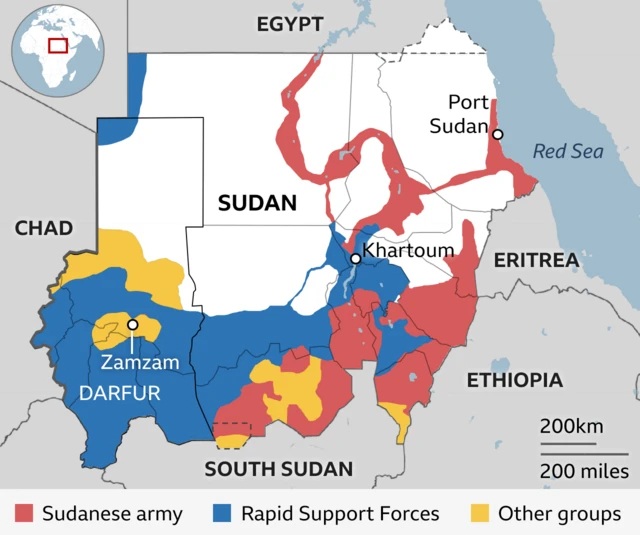
    The United Nations Secretary-General has warned that the civil war in Sudan is “spiralling out of control” after the Rapid Support Forces (RSF) seized the strategic Darfur city of El-Fasher.

    Civil War in Sudan

    About the Civil War in Sudan:

    • Outbreak: Began in April 2023 between the Sudanese Armed Forces (SAF) led by Gen. Abdel Fattah al-Burhan and the Rapid Support Forces (RSF) led by Gen. Mohamed Hamdan Dagalo (Hemedti).
    • Causes: Rooted in Sudan’s failed democratic transition after the 2019 overthrow of Omar al-Bashir and the October 2021 military coup.
    • Immediate Trigger: Power struggle over RSF integration into the national army under the proposed political framework agreement.
    • Conflict Spread: Fighting engulfed Khartoum, Omdurman, and Darfur, causing massive civilian casualties and infrastructure collapse.
    • Humanitarian Toll: Over 8.5 million displaced, famine conditions emerging, and public health systems near total breakdown.
    • Atrocities: Both sides accused of war crimes, ethnic killings, and looting, particularly in Darfur.
    • Territorial Shift: RSF’s capture of El-Fasher (2025) consolidated its control over western Sudan.
    • Foreign Actors: Egypt supports SAF; UAE and Russia’s Wagner Group back RSF, fuelling proxy dynamics.

    What Lies Ahead?

    • Risk of Partition: Sudan may split RSF holding the west, SAF dominating the northeast, leading to de-facto fragmentation.
    • Regional Destabilisation: Prolonged conflict could spill into the Horn of Africa and Red Sea corridor, worsening insecurity.
    • Political Outlook: Civilian transition appears remote; both factions remain focused on military dominance.
    • Economic Collapse: Inflation above 250%, agricultural failure deepening food insecurity.
    • Regional Impact: Refugee influx threatens Chad, South Sudan, and Ethiopia with cross-border instability.
    [UPSC 2024] Consider the following pairs: Country Reason for being in the news
    1. Argentina Worst economic crisis
    2. Sudan War between the country’s regular army and paramilitary forces
    3. Turkey Rescinded its membership of NATO
    How many of the pairs given above are correctly matched?
    Options: (a) Only one pair (b) Only two pairs* (c) All three pairs (d) None of the pairs


  • Global Study on Biomass Movement

    Why in the News?

    A new study published in Nature Ecology & Evolution highlights how species mobility, measured as biomass movement, shapes ecosystems and reflects human ecological dominance.

    About the Concept of Biomass Movement:

    • Overview: Biomass movement is the product of a species’ total biomass and the distance it travels annually, representing the mass of living matter displaced across ecosystems each year.
      • Biomass movement = (Total biomass of a species) × (Distance it travels annually).
    • Purpose: Quantifies how living organisms contribute to nutrient transport, seed dispersal, and energy flow through movement.
    • Comparative Metric: Enables cross-species comparison of ecological influence via mobility, bridging animal ecology and global biogeography.
    • Analytical Value: Provides a standardised ecological indicator to study both natural migrations and human-induced mobility patterns.
    • Anthropocene Context: Serves as a unified measure of ecological and energetic impact in a human-dominated epoch.
    • Scientific Basis: Concept explored in Nature Ecology & Evolution (2025) to assess species-level and anthropogenic movement on a global scale.

    Key Highlights with Example:

    • Arctic Tern: Weighing ~100 g, travels ~90,000 km annually (Arctic–Antarctica circuit), the longest animal migration known.
    • Collective Biomass Movement: Two million terns contribute only 0.016 gt/km/yr, due to low body mass despite vast distances.
    • Grey Wolf: Records 0.03 gt/km/yr, higher due to larger body size and wider terrestrial range.
    • Serengeti Migration: Over a million wildebeests, gazelles, and zebras generate biomass movement 20× greater than wolves.
    • Human Parallel: The total biomass moved in the FIFA World Cup equals that of major animal migrations, highlighting scale disparity between species.

    Human Biomass Movement and Its Consequences:

    • Magnitude: Humans move an estimated ~4,000 gt/km/yr, the largest on Earth, 40× greater than all wild land mammals combined.
    • Mobility Patterns: Average human travels 30 km/day, mostly motorised, 65% by cars/motorcycles, 10% by air, 5% by rail.
    • Economic Disparity: Two-thirds of total human mobility occurs in high- and upper-middle-income countries, reflecting global inequality.
    • Ecological Effects: Drives carbon emissions, urban sprawl, resource depletion, and land fragmentation.
    • Marine Decline: Marine animal mobility has halved since 1850 due to industrial fishing and whaling.
    • Livestock Factor: Domesticated cattle show biomass movement comparable to humans, indicating the ecological weight of livestock farming.
    • Wildlife Contrast: Combined biomass movement of all wild land mammals (excluding bats) is only 30 gt/km/yr, underscoring human dominance.
    • Anthropocene Insight: Demonstrates that human and domesticated animal mobility now defines Earth’s biogeochemical and ecological motion.
  • Electoral Reforms In India

    [6th November 2025] The Hindu Op-ed: The malleable Code of Conduct

    PYQ Relevance

    [UPSC 2022] Discuss the role of the Election Commission of India in the light of the evolution of the Model Code of Conduct.

    Linkage: It explores how the Election Commission’s authority evolved through the MCC. It assesses the effectiveness in upholding electoral fairness amid growing political violations.

    Mentor’s Comment

    The Model Code of Conduct (MCC) represents India’s democratic conscience. It is a self-imposed ethical framework ensuring that elections are fought on fairness, not power misuse. Yet, the political ingenuity in bypassing it reflects a deeper erosion of moral restraint in governance. With recent welfare disbursements in Bihar triggering debate, the MCC stands at a crossroads between relevance and redundancy.

    Introduction

    The Model Code of Conduct is an ethical framework evolved through consensus among political parties to ensure level competition during elections. It prevents the misuse of official machinery, state resources, and authority to influence voters. However, repeated violations especially by governments announcing pre-poll cash transfers or populist projects show that while the MCC binds in letter, its spirit is increasingly compromised.

    Why in the News

    The Mukhyamantri Mahila Rojgar Yojana (MMRY) launched in Bihar in August 2025 has reignited the debate over MCC violations. Cash disbursements continued into late October and early November, overlapping with the election schedule. Though legally permissible, the scheme’s timing tilted public perception toward favouring the ruling party, raising serious concerns about the sanctity of the electoral process. The controversy marks another instance where governments use public funds to gain electoral mileage, undermining the spirit of the MCC.

    Genesis and Purpose of the MCC

    1. Origin and Evolution: The MCC was first used during the 1960 Assembly elections in Kerala, and later adopted nationwide by the Election Commission of India (ECI) during the 1962 general elections.
    2. Consensus Document: It was not enacted by Parliament but evolved through agreement among political parties.
    3. Formal Enforcement: The Model Code of Conduct was first issued by the Election Commission of India under the title of ‘Minimum Code of Conduct’ on September 26, 1968 during the Mid-Term Elections 1968-69. The code was further revised in 1979, 1982, 1991 and 2013
    4. Core Purpose: Ensures free, fair, and peaceful elections by preventing misuse of government machinery and undue influence over voters.

    When It Is Applicable and Who Enforces It

    1. Trigger Point: The MCC comes into effect immediately from the date the Election Commission announces the election schedule.
    2. Duration: It remains in force until the declaration of election results.
    3. Enforcing Authority: The Election Commission of India is the sole authority for its enforcement and interpretation.
    4. Withdrawal: The MCC automatically ceases once the results are officially declared by the ECI.

    What Gets Suspended Under the MCC

    1. Policy Announcements: Ministers and authorities cannot announce new projects, financial grants, or inaugurate schemes that may influence voters.
    2. Public Advertisements: No use of government funds for publicity of achievements or campaigns during this period.
    3. Transfers and Appointments: Major administrative transfers or appointments in departments are prohibited unless approved by the EC.
    4. Use of Official Machinery: Government vehicles, buildings, and personnel cannot be used for electioneering.
    5. Foundation Stones or Inaugurations: These are disallowed if they could project partisan benefit.

    What Is Permitted During MCC

    1. Ongoing Projects: Continuing existing schemes and projects (initiated before MCC enforcement) is allowed if there’s no modification or new announcement.
    2. Routine Governance: Day-to-day administration and delivery of essential services can continue.
    3. Emergency Actions: Governments can act during natural disasters or emergencies with EC approval.
    4. Election Campaigning: Political parties are free to campaign, release manifestos, and address voters, provided they follow EC guidelines on ethics and expenditure.

    The Challenge of “Violations in Spirit”

    Despite the clarity of rules, violations persist:

    1. Cash Schemes: Governments frequently announce last-minute transfers to favourable groups.
    2. Symbolic Launches: Old projects are rebranded as new initiatives to gain media traction.
    3. Moral Erosion: Such acts violate the spirit of fairness, reducing elections to a contest of resource deployment rather than ideas.
    4. Quote Insight: As Shakespeare’s Hamlet said, the MCC is often “more honoured in the breach than in the observance.

    Legal Status and Enforcement Issues

    1. Voluntary Nature: The MCC is a moral code, not a legal statute.
    2. Legal Overlap: Specific violations may be prosecuted under the Representation of the People Act, 1951, or Indian Penal Code (IPC).
    3. 2013 Standing Committee View: Recommended making MCC legally binding, but EC preferred flexibility due to the short election window.
    4. Judicial Constraints: Courts find it difficult to act swiftly during elections, leaving real-time violations unchecked.

    Impact on Democratic Integrity

    1. Erosion of Level Playing Field: Pre-poll welfare schemes distort voter perception.
    2. Loss of Trust: Frequent violations weaken public confidence in EC neutrality.
    3. Ethical Degradation: Turning elections into transactional exercises undermines constitutional morality.
    4. Institutional Burden: Constant MCC imposition hampers governance continuity, hence the push for simultaneous elections.

    Way Forward

    1. Legal Backing with Flexibility: Grant partial statutory status to the MCC to enhance enforceability while retaining EC’s discretion for quick decisions during elections.
    2. Swift Adjudication Mechanism: Establish fast-track EC tribunals for resolving MCC violation complaints within days, not weeks.
    3. Transparent Public Disclosure: Mandate real-time publication of EC orders and violations to ensure accountability and deter misconduct.
    4. Institutional Empowerment: Strengthen EC’s independence by insulating it from executive interference in appointments and funding.
    5. Ethical Political Culture: Political parties should adopt internal codes of ethics and conduct public pledges to uphold MCC principles.
    6. Simultaneous Elections Debate: Explore synchronizing elections to reduce frequent MCC enforcement disruptions and policy paralysis.
    7. Civic Awareness: Promote voter education campaigns to build public pressure against MCC violations and ethical breaches.

    Conclusion

    The Model Code of Conduct is not just an election rulebook, it is a mirror reflecting the ethical health of Indian democracy. When leaders manipulate it, they erode not just electoral fairness but the foundational trust between citizen and state. The MCC must therefore be strengthened, through legal clarity, swift EC action, and moral political leadership, so that it remains a living instrument of democracy, not a symbolic ritual.

  • Artificial Intelligence (AI) Breakthrough

    India AI: Governance Guidelines

    Introduction

    Artificial Intelligence has evolved from an assistive tool to an autonomous decision-maker, influencing governance, economy, security, and social life. Recognizing both its potential and perils, the Government of India, through MeitY’s drafting committee (July 2025), released the India AI Governance Guidelines.It is  rooted in the vision of “AI for All”. The framework aims to foster inclusive growth, innovation, and ethical use of AI, ensuring that India’s AI journey is safe, transparent, and globally credible.

    Why in the News

    For the first time, India has articulated a unified, principle-based framework on AI governance, a techno-legal and institutional roadmap aligning AI with constitutional values and national priorities. It promotes voluntary frameworks over strict regulation marking a shift from restraint to responsible innovation.

    What are the Core Principles Guiding India’s AI Governance?

    1. Seven Sutras: Trust, People First, Innovation over Restraint, Fairness & Equity, Accountability, Understandable by Design, Safety, Resilience & Sustainability. These are adapted from the RBI’s FREE-AI Committee report and designed to be sector-neutral and technology-agnostic.
    2. Trust as Foundation: Builds confidence in AI systems by ensuring transparency, safety, and ethical use.
    3. People First: Emphasizes human oversight and empowerment, preventing machine dominance.
    4. Innovation over Restraint: Encourages experimentation with accountability, not prohibition.
    5. Fairness & Equity: Prevents algorithmic discrimination and digital exclusion.

    How Does the Framework Promote AI Development and Infrastructure?

    1. Compute Expansion: Over 38,000 GPUs made available to startups and researchers at subsidized rates.
    2. AIKosh Data Platform: Houses 1,500 datasets and 217 models from 20 sectors, ensuring data accessibility with privacy.
    3. Digital Public Infrastructure (DPI): Combines Aadhaar, UPI, and Bhashini for scalable, low-cost AI deployment.
    4. MSME Enablement: AI-linked loans via SIDBI & Mudra, tax rebates for certified AI adoption, and starter packs for sectors like textiles and logistics.

    How Does India Address Risk and Regulation in AI?

    1. Balanced Regulation: No separate AI law yet existing laws (IT Act, DPDP Act, Copyright Act, etc.) govern AI harms.
    2. Key Risk Areas: Deepfakes, data poisoning, discrimination, loss of control, national security threats.
    3. India-specific Risk Framework: Classifies harms empirically and promotes voluntary, proportionate compliance.
    4. Content Authentication: Suggests watermarking and provenance tools aligned with global C2PA standards.

    How Will Institutions Enforce AI Safety and Accountability?

    1. AI Governance Group (AIGG): Apex inter-ministerial body chaired by the Principal Scientific Adviser, coordinating AI policy across ministries.
    2. Technology & Policy Expert Committee (TPEC): Offers domain expertise on law, data, security, and governance.
    3. AI Safety Institute (AISI): Anchors technical safety, risk research, and international collaborations like the Global Network of AI Safety Institutes.
    4. Accountability Measures:
      • Graded Liability System based on role and risk.
      • Transparency Reports, Grievance Redressal Systems, Peer Monitoring, and Self-certifications for compliance.

    What is India’s Global and Long-term Vision for AI Governance?

    1. Foresight & Diplomacy: Positions India as a voice of the Global South in AI governance debates (G20, UN, OECD).
    2. AI Incident Reporting System: Centralised database tracking AI harms for national security and regulatory learning.
    3. Techno-Legal Architecture: Concepts like DEPA for AI Training embed consent and privacy by design.
    4. Action Plan:
      • Short-term: Build institutions and awareness.
      • Medium-term: Develop standards, risk frameworks, and legal clarity.
      • Long-term: Evolve global leadership and adaptive legal frameworks.

    Conclusion

    India’s AI Governance Guidelines represent a paradigm shift from regulation to enablement, balancing innovation with public trust. By rooting governance in human values, institutional cooperation, and digital infrastructure, India positions itself as a responsible AI power, one that prioritizes inclusivity, transparency, and resilience. The framework sets a precedent for the Global South, reflecting India’s vision of “AI for All, AI for Good”.

    PYQ Relevance

    [UPSC 2023] e-governance, as a critical tool of governance, has ushered in effectiveness, transparency and accountability in governments. What inadequacies hamper the enhancement of these features?

    Linkage: The AI Governance Guidelines integrate e-governance and AI to improve transparency, accountability, and citizen-centricity. This addresses the same governance challenges this question targets.

  • Freedom of Speech – Defamation, Sedition, etc.

    What constitutes Contempt of Court in India

    Introduction

    Recent remarks made against the Chief Justice of India and the Supreme Court have sparked nationwide debate on whether such statements amount to contempt of court. This incident is significant as it goes beyond personal criticism, it questions the authority of India’s top court and raises issues regarding the balance between free speech and judicial independence. The spread of such remarks through social media amplifies their impact, prompting discussions about protecting the dignity of the judiciary while upholding democratic accountability.

    Understanding the Concept of Contempt

    1. Constitutional Reference: The term ‘contempt of court’ appears in Article 19(2) as a valid ground for imposing reasonable restrictions on freedom of speech and expression.
    2. Lack of Procedural Guidelines: The Constitution does not specify how contempt proceedings should be initiated; these are governed by statutory provisions.
    3. Courts of Record: Under Articles 129 and 215, the Supreme Court and High Courts are designated as Courts of Record, implying their judgments serve as precedents and they possess the power to punish for contempt.

    Types of Contempt and Their Legal Basis

    1. Governing Law: The Contempt of Courts Act, 1971 provides the legal framework for contempt proceedings.
    2. Classification: Section 2(a) of the Act divides contempt into civil and criminal.
      • Civil Contempt: Wilful disobedience of any court judgment, decree, direction, or undertaking.
      • Criminal Contempt: Publication or act that:
        • Scandalizes or lowers the authority of any court.
        • Prejudices or interferes with judicial proceedings.
        • Obstructs the administration of justice.

    How Contempt Differs from Mere Disobedience

    1. Broader Implication: Contempt extends beyond disobedience. It encompasses disruption of justice delivery and diminishing public faith in the judiciary.
    2. Objective: Ensures that the judicial process remains uninfluenced and the authority of courts remains intact.
    3. Public Order Impact: Any act that weakens confidence in the justice system indirectly threatens the rule of law.

    Freedom of Criticism vs Judicial Dignity

    1. Legitimate Criticism: The law recognizes that fair criticism of judicial decisions is not contempt.
    2. Boundary of Legality: Criticism crosses into contempt when it transgresses limits of fairness, becomes malicious, or undermines the authority of the court.
    3. Balance Required: Maintaining equilibrium between transparency and respect for institutions is vital to constitutional morality.

    Significance of Recent Controversy

    1. Erosion of Judicial Authority: Remarks against the Chief Justice are not just personal; they symbolically attack the institution itself.
    2. Amplification via Social Media: Online circulation transforms isolated opinions into mass narratives, posing greater risks to judicial credibility.
    3. Trigger for Debate: Highlights the need for clear boundaries between criticism, activism, and contempt, particularly in digital public discourse.

    Conclusion

    Contempt of court serves as a constitutional safeguard for maintaining judicial integrity and authority. However, in a democracy, constructive criticism is vital for institutional reform. The challenge lies in ensuring that such criticism remains responsible, reasoned, and respectful. As public discourse migrates online, India’s legal system must re-examine the contours of contempt to preserve both judicial dignity and freedom of speech, two essential pillars of constitutional morality.

    PYQ Relevance

    [UPSC 2019] Do you think that the Constitution of India does not accept the principle of strict separation of powers rather it is based on the principle of checks and balances? Explain.

    Linkage: This topic is important for both Prelims and Mains. While direct questions can be asked in both, in the mains examination it can be well integrated into various judicial topics. Like in this 2019 question, contempt jurisdiction is part of this checks-and-balances system. Judicial contempt powers are mechanisms for internal checks within the democratic structure.

  • Panchayati Raj Institutions: Issues and Challenges

    Mayor in India

    Why in the News?

    Zohran Mamdani of Indian-origin has been elected as the mayor of New York City.

    Mayor in India:

    • Overview: The Mayor serves as the head of a Municipal Corporation, responsible for urban governance, civic infrastructure, and local service delivery in large cities.
    • Basis: Institutionalised under the 74th Constitutional Amendment Act, 1992, which gave constitutional status to Urban Local Bodies (ULBs) and transferred 18 functional subjects to them.
    • Administrative Framework: Municipal corporations function under state municipal laws, operating under the supervision of state urban development departments.
    • Historical Context: The first municipal corporation was created in Madras (1688), followed by Bombay and Calcutta (1762) under British rule.
    • Evolution of the office: The idea of an elected municipal President was first introduced through Lord Mayo’s Resolution (1870). The present form of local self-government was shaped by Lord Ripon’s Resolution (1882), earning him the title “Father of Local Self-Government in India.”
    • Election and Tenure:
      • Direct Election: Citizens directly elect the Mayor in cities like Bhopal, Indore, and Jaipur.
      • Indirect Election: Elected councillors choose the Mayor in cities like Mumbai, Delhi, and Bengaluru.
      • Tenure: Varies from 1 to 5 years, depending on state-specific legislation.
    • Powers and Functions:
      • Ceremonial Role: Acts as the first citizen of the city, representing it in official and public functions.
      • Presiding Officer: Chairs meetings of the Municipal Corporation and ensures smooth deliberations.
      • Limited Executive Power: Administrative authority lies with the Municipal Commissioner (IAS officer) appointed by the state government.
      • Policy and Representation: Serves as a political leader and civic advocate, voicing urban development concerns.

    How a Mayor in India differ from a Mayor in the U.S.?

    India U.S.
    System Type Parliamentary model under state supervision Executive or presidential city model
    Election Usually indirectly elected by councillors Directly elected by citizens
    Tenure 1–5 years, varies by state Fixed 4-year term, renewable once
    Administrative Power Ceremonial, executive power with Commissioner Full executive control over departments and budget
    Financial Authority Dependent on state approval Autonomous budgetary power (e.g., NYC manages $120+ bn)
    Legislative Role Chairs council meetings Can veto bills and issue executive orders
    Autonomy Subordinate to state Semi-autonomous, independent within city jurisdiction
    Nature of Office Symbolic and representational Powerful executive, city-level head of government


    [UPSC 2024] Consider the following statements:

    1. Powers of the Municipalities are given in Part IX A of the Constitution.

    2. Emergency provisions are given in Part XVIII of the Constitution.

    3. Provisions related to the amendment of the Constitution are given in Part XX of the Constitution.

    Select the answer using the code given below:

    (a) 1 and 2 only (b) 2 and 3 only (c) 1 and 3 only (d) 1, 2 and 3*


Join the Community

Join us across Social Media platforms.