💥UPSC 2026, 2027, 2028 UAP Mentorship (March Batch) + Access XFactor Notes & Microthemes PDF

Archives: News

  • [27th October 2025] The Hindu Op-ed: The contours of constitutional morality

    PYQ Relevance

    [UPSC 2021] Constitutional Morality’ is rooted in the Constitution itself and is founded on its essential facets. Explain the doctrine of ‘Constitutional Morality’ with the help of relevant judicial decisions.

    Linkage: This topic is highly significant for UPSC Mains, especially in GS Paper II (Polity & Governance) and GS Paper IV (Ethics), as it tests the understanding of how ethical governance aligns with constitutional principles.

    Mentor’s Comment

    Constitutional morality lies at the heart of India’s democratic ethos, acting as the invisible moral compass that guides law, governance, and justice. The article, written by Justice K. Anand Venkatesh, explores how morality is embedded within constitutional functioning. It is not embedded as a sentimental ideal, but as a living principle that upholds the dignity of institutions and individuals alike. In a time when popular morality often clashes with constitutional values, this debate assumes renewed urgency.

    Introduction

    The Supreme Court of India has repeatedly reaffirmed the link between law and morality, from P. Rathinam v. Union of India (1994) to the Indian Young Lawyers Association v. State of Kerala (2018). The concept of constitutional morality, originally discussed by Greek historian George Grote in 1846, has resurfaced as a vital restraint against arbitrary governance and populist impulses. It demands adherence to constitutional values, equality, liberty, justice, and fraternity, by all organs of the State and its citizens.

    Why in the News

    Recent judicial pronouncements have revived debates around constitutional morality as a guiding force for both lawmakers and administrators. Justice Venkatesh’s commentary highlights that democracy without moral discipline risks degenerating into majoritarian rule, where transient popular sentiments override fundamental rights. The renewed emphasis on cultivating constitutional morality reflects India’s struggle to reconcile ethical governance with political pragmatism.

    Evolution and Context of Constitutional Morality

    1. Historical Roots: Greek historian George Grote coined “constitutional morality” to describe citizens’ disciplined adherence to constitutional norms ensuring liberty and restraint in governance.
    2. Indian Adoption: The term entered Indian discourse through Dr. B.R. Ambedkar, who viewed it as essential for the successful working of democracy in a diverse society.
    3. Judicial Recognition: The Supreme Court acknowledged the interlinkage of law and morality in P. Rathinam (1994). It emphasized the law’s moral purpose , “to conserve not only the safety and order but also the moral welfare of the State.”
    4. Hart-Devlin Debate: In the 1960s, the famous Hart-Devlin debate discussed whether the law should enforce moral standards. This is an idea that continues to influence Indian jurisprudence.

    What Distinguishes Constitutional Morality from Popular Morality

    1. Constitutional Morality: Reflects adherence to constitutional principles such as rule of law, equality before law, and institutional propriety.
    2. Popular Morality: Represents transient societal opinions or majoritarian values, often inconsistent with constitutional ethics.
    3. Judicial Balancing: Courts have often upheld constitutional morality against majoritarian pressures, as seen in Navtej Singh Johar v. Union of India (2018), where decriminalization of homosexuality was justified on constitutional grounds rather than social acceptance.
    4. Outcome: Promotes stability, fairness, and inclusivity in democratic functioning.

    Judicial Approach and Key Judgments

    1. S.R. Bommai v. Union of India (1994): Reinforced secularism as a constitutional principle forming part of basic structure.
    2. Kesavananda Bharati v. State of Kerala (1973): Introduced the “basic structure doctrine,” embedding constitutional morality as a restraint on legislative excess.
    3. Indian Young Lawyers Association v. State of Kerala (2018): Stressed that constitutional morality must prevail over religious or social morality, allowing women’s entry into Sabarimala Temple.
    4. Navtej Singh Johar (2018): Affirmed that constitutional morality demands protection of individual autonomy and dignity, even if social morality disagrees.
    5. State (NCT of Delhi) v. Union of India (2018): Asserted that constitutional functionaries must act within “constitutional morality,” not political expediency.

    Challenges in Practising Constitutional Morality

    1. Institutional Erosion: Weakening of legislative debate and executive accountability dilutes constitutional culture.
    2. Majoritarian Pressures: Electoral populism often overrides institutional restraint and judicial independence.
    3. Moral Ambiguity: Absence of a codified moral code makes enforcement of constitutional morality subjective.
    4. Public Awareness: Limited civic understanding of constitutional ethics hampers its internalization at citizen level.

    Way Forward

    1. Cultivation of Ethical Citizenship: Strengthens democratic maturity through civic education and moral training.
    2. Institutional Accountability: Ensures public functionaries act within constitutional boundaries through transparent checks.
    3. Judicial Vigilance: Maintains the moral compass of the State through continued emphasis on rights-based interpretation.
    4. Political Restraint: Encourages lawmakers to prioritize constitutional conscience over populist demand.

    Conclusion

    Constitutional morality ensures that democracy functions not merely through elections but through adherence to constitutional ethics. It provides a moral foundation for governance, ensuring that justice, liberty, equality, and fraternity are lived realities, not abstract ideals. In an era of polarization, it acts as the Republic’s moral compass, binding the State and its citizens to the spirit of the Constitution.

  • Foreign Policy Watch: India-Nepal

    Winding up the clock of India-Nepal Ties

    Introduction

    On October 1, 2025, RBI Governor Shaktikanta Das unveiled steps to deepen INR–NPR linkages. This move signals India’s intent to make the rupee a regional trade and investment currency. These include:

    1. Allowing Authorised Dealer (AD) banks to lend INR to non-residents from Nepal, Bhutan, and Sri Lanka.
    2. Permitting Special Rupee Vostro Accounts for foreign banks to hold Indian bonds and corporate papers.
    3. Establishing a transparent reference rate for major trading partner currencies to facilitate INR-based transactions.

    This marks a strategic departure from decades of tightly controlled cross border monetary flows. It aligns with India’s ambition to make the rupee a “South Asian Settlement Currency” and deepen economic resilience across borders.

    The Significance of RBI’s Move:

    1. Internationalisation of INR: Strengthens INR’s role as a regional settlement currency, reducing dependence on the dollar.
    2. Cross border integration: Enables Nepal, Bhutan, and Sri Lanka to engage in INR based transactions, supporting regional financial stability.
    3. Investor confidence: Allows Nepalese investors to diversify holdings in Indian bonds and securities.
    4. Trade facilitation: Establishes a transparent mechanism for pricing and settlement of bilateral trade.

    The Hurdles in Nepal

    1. COVID-19 Economic Fallout: Nepal’s economy struggled with post-pandemic recovery as industrial performance remained weak.
    2. Credit Crunch: Low confidence among banks led to restricted lending, making it difficult for small businesses to sustain.
    3. Supply Chain Strain: Domestic credit shortages impacted internal supply chains and imports, amplifying inflationary pressures.
    4. Structural Weakness: Chronic trade deficit, narrow industrial base, and dependency on remittances limit growth resilience.
    5. Political Uncertainty: Frequent political instability has deepened investor hesitation.

    How India’s Lending Outreach Could Change the Game

    1. Rupee Lending Window: RBI’s INR credit facility allows Nepalese firms to access Indian capital markets, easing liquidity pressure.
    2. Reduced Dollar Dependence: Using INR for trade and lending could insulate both economies from dollar exchange fluctuations.
    3. Enhanced Trust: Transparent reference rates can reduce cross border settlement disputes and improve institutional confidence.
    4. Joint Ventures: Encourages cross border investments and participation in sectors like hydropower, manufacturing, and tourism.

    The Trade Equation Between India and Nepal

    1. High Interdependence: India remains Nepal’s largest trading partner, accounting for 65% of its total trade.
    2. FDI Flows: India is Nepal’s largest FDI source, contributing 33% of total foreign investment, worth nearly $670 million.
    3. Export–Import Composition: India imports billion dollar worth of goods from Nepal, including coffee, tea, and herbal products, while exporting essential commodities and petroleum.
    4. Monetary Peg: The INR–NPR peg (₹1 = NPR 1.6) has stabilised bilateral transactions for decades, but rising inflation and dollar volatility demand recalibration.

    Challenges to Implementation

    1. Institutional Compliance: Nepal Rastra Bank (NRB) must reform regulatory processes to align with RBI’s updated norms.
    2. Risk of Overdependence: Over reliance on INR could expose Nepal’s economy to India’s monetary shocks.
    3. Operational Barriers: Currency convertibility limits and legal harmonisation may delay smooth execution.
    4. Political Sensitivity: Perception of “rupee dominance” may spark internal opposition in Nepal’s political circles.

    Possible Multiplier Effects

    1. Stronger INR: If successfully implemented, the move can strengthen INR internationally while stabilising Nepal’s currency.
    2. Reduced Dollar Outflows: Bilateral INR use saves foreign exchange reserves, improving both nations’ current account positions.
    3. Boost to Trade Financing: Easier credit availability to Nepalese traders can expand import capacity for Indian goods.
    4. Regional Model: Success may inspire replication with Bhutan, Sri Lanka, and Bangladesh under the Neighbourhood First Policy.

    Conclusion

    The RBI’s initiative represents more than a banking reform, it is a strategic assertion of economic diplomacy in South Asia. By aligning monetary instruments with foreign policy, India aims to create a shared financial ecosystem that stabilises its neighbourhood while propelling the rupee towards international recognition. For Nepal, this marks a chance to integrate deeper into India’s growth story and move towards sustainable, confidence driven development.

    PYQ Relevance

    [UPSC 2018] How would the recent phenomena of protectionism and currency manipulations in world trade affect macroeconomic stability of India?

    Linkage: This question relates to currency stability and external sector management. The RBI–Nepal rupee measures reflect India’s proactive approach to enhance rupee resilience and reduce dollar dependence, aligning with UPSC’s recurring focus on monetary stability and economic diplomacy.

    Value Addition

    Internationalisation of the Indian Rupee (INR)

    • Definition: Internationalisation of the rupee refers to the increasing use of INR in cross-border trade, investment, and financial transactions, reducing reliance on foreign currencies like the US dollar.
    • Objective: Strengthen India’s economic sovereignty, reduce exchange rate risk, and enhance global confidence in the rupee as a settlement currency.
    • Recent Policy Measures:
      • RBI’s 2022 Circular: Allowed INR invoicing and settlement of international trade.
      • Special Vostro Accounts: Enabled partner nations (e.g., Russia, UAE, Nepal) to hold rupee balances for bilateral trade.
      • RBI–Nepal Measures (2025): Permitted INR lending, rupee-based bonds, and reference rate mechanisms.
      • INR–Dirham Linkage: Facilitated oil payments in rupees via UAE, strengthening South–South trade.
    • Benefits:
      • Reduces Forex Outflows: Decreases demand for dollars in trade settlements.
      • Improves External Stability: Mitigates impact of global currency volatility.
      • Boosts Trade Competitiveness: Simplifies invoicing for neighbouring countries.
      • Supports Regional Integration: Promotes South Asian financial architecture anchored in INR.
      • Enhances India’s Soft Power: Projects rupee as a symbol of economic strength and trust.
    • Challenges:
      • Limited convertibility of INR in capital account.
      • Regulatory asymmetry among trading partners.
      • Need for deep rupee-denominated financial markets abroad.
      • Possible geopolitical resistance to India’s monetary expansion.
    • Global Examples:
      • China’s Yuan (CNY): Integrated into IMF’s SDR basket (2016).
      • Euro (EUR): Serves as a model for regional monetary integration.
    • Reports & Committees:
      • RBI Inter-Departmental Group (2023): Highlighted steps for gradual and phased INR internationalisation.
      • IMF Report (2023): Identified INR among potential emerging reserve currencies.


  • Artificial Intelligence (AI) Breakthrough

    Governance, cybersecurity move to centrestage in AI conversations

    Introduction and Why in the News

    Artificial Intelligence, once hailed purely as an efficiency enhancer, is now at the centre of ethical, cybersecurity, and accountability debates. The AI@Work roundtable in Mumbai, moderated by industry and data leaders, highlighted that as organisations adopt AI to accelerate operations, they are simultaneously confronting unprecedented risks. These risks arise from data breaches and AI unpredictability to physical and digital intrusions. Globally, the scale of the threat is stark: over 36,000 AI-driven cyber incidents have been detected recently, revealing vulnerabilities that demand robust governance mechanisms. The focus is shifting from innovation for profit to AI for responsible, transparent, and accountable governance.

    How is AI reshaping governance and business operations?

    1. AI as a catalyst: AI is transforming industries, automating functions, and unlocking efficiency, especially in large corporations like HPCL.
    2. Governance shift: The emphasis is moving from using AI for automation to using it for secure, ethical, and explainable decision-making.
    3. Corporate accountability: Company Boards are now integrating AI risk management as part of business strategy and compliance mechanisms.

    What are the major cybersecurity challenges emerging from AI integration?

    1. Dual challenge: HPCL and similar enterprises face both digital intrusions and physical tampering, such as pipeline or fuel data manipulation.
    2. Data breaches and tampering: AI systems amplify vulnerabilities by collecting, analysing, and predicting based on sensitive data.
    3. AI unpredictability: As one executive noted, AI “can behave unpredictably”, even making errors like confusing CAPTCHA, reflecting how AI mimics but doesn’t fully understand human behaviour.
    4. Evolving threats: Traditional cybersecurity tools like SIEM systems are being replaced by AI-based predictive defence models.

    How are organisations building responsible AI frameworks?

    1. Ethical design: Companies are embedding AI hygiene protocols involving legal, ethical, and operational reviews.
    2. Cross-functional training: AI safety and compliance are being promoted through employee retraining and AI literacy initiatives.
    3. Accountability culture: “Who builds, who manages, and who owns AI” is now being formalised as part of corporate accountability structures.
    4. AI governance frameworks: Emphasis on explainability, transparency, and traceability of AI decisions.

    How is India’s corporate sector responding to data and cybersecurity concerns?

    1. AI-based monitoring: Firms like HPCL have set up ATOM – Autonomous Threat Operations Machines capable of detecting and neutralising threats within minutes.
    2. Prioritisation of data integrity: Secure perimeters, application firewalls, and endpoint safety are now standard.
    3. Rise of human-AI synergy: Human oversight remains essential even as AI automates responses.
    4. New compliance model: AI-driven auditing and data lineage tools enhance traceability and prevent tampering.

    Why is accountability and explainability central to future AI governance?

    1. Ownership and transparency: AI accountability now spans design to deployment stages.
    2. Explainability: Organisations must show how AI works, not just that it works, to maintain compliance.
    3. Ethical responsibility: AI ethics involves documenting data sources, audit trails, and decisions for regulatory and consumer trust.
    4. Broader awareness: Employees and consumers alike are being educated about AI literacy and bias detection.

    Conclusion

    The shift of AI conversations towards governance and cybersecurity signifies India’s entry into a new phase of responsible innovation. As AI pervades every domain, from finance to fuel, the focus must remain on trust, transparency, and traceability. Building ethical AI ecosystems that value both progress and protection is now essential for sustainable digital governance.

    PYQ Relevance

    [UPSC 2023] Introduce the concept of Artificial Intelligence (AI). How does AI help clinical diagnosis? Do you perceive any threat to privacy of the individual in the use of AI in healthcare?

    Linkage: Both the article and the question highlight how AI, while enhancing efficiency in fields like healthcare and governance, raises critical concerns over data privacy, transparency, and ethical accountability. 

  • Modern Indian History-Events and Personalities

    150 years of ‘Vande Mataram’

    Why in the News?

    In his Mann Ki Baat broadcast, Prime Minister Narendra Modi called upon citizens to commemorate 150 years of our national song “Vande Mataram”.

    About Vande Mataram:

    • Overview: Written by Bankim Chandra Chattopadhyay around 1875, originally in Sanskrit (Bengali script) and later included in his novel Anandamath (1882), depicting the Sannyasi Rebellion against British rule.
    • Meaning: It means “I bow to thee, Mother”, symbolising devotion to the motherland, unity, and the spirit of sacrifice.
    • First Rendition: First sung publicly by Rabindranath Tagore at the 1896 Indian National Congress Session, transforming it into a nationalist anthem.
    • Role in Freedom Struggle: Became a rallying cry for revolutionaries in Swadeshi Movement, sung in protests, prisons, and meetings representing Ma Bharati as a symbol of resistance and national pride.
    • Official Status: In 1937, the Indian National Congress adopted its first two stanzas as the National Song; on January 24, 1950, Dr. Rajendra Prasad granted it equal status with Jana Gana Mana in the Constituent Assembly.
    • Structure & Style: Comprises six stanzas, combining Sanskrit precision and Bengali rhythm, praising India’s nature, strength, and divinity.
    • Translations & Music: Sri Aurobindo translated it into English (Karmayogin, 1909); V.D. Paluskar and Ravi Shankar popularised musical renditions.
    • Cultural Symbolism: Personifies India as the Divine Mother, transcending religious and regional divides; played instrumentally at the end of Parliamentary sessions.
    [UPSC 2016] ‘Swadeshi’ and ‘Boycott’ were adopted as methods of struggle for the first time during the
    Options: (a) Agitation against the Partition of Bengal *
    (b) Home Rule Movement
    (c) Non-Cooperation Movement
    (d) Visit of the Simon Commission to India


  • Foreign Policy Watch: India-ASEAN

    East Timor: Asia’s youngest nation joins ASEAN

    Why in the News?

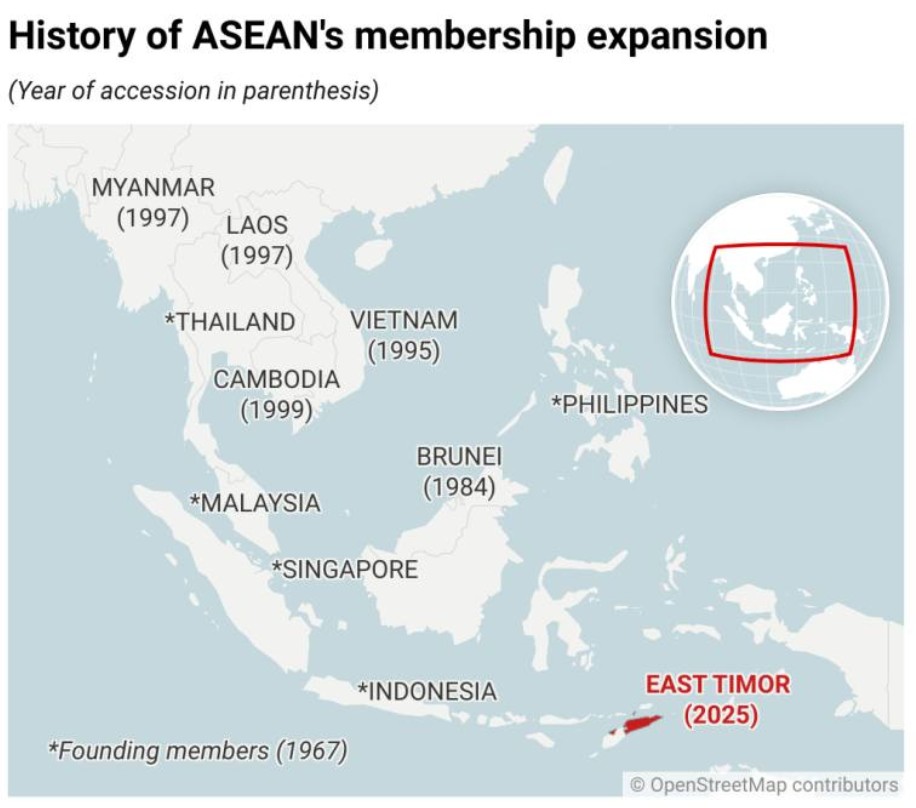
    East Timor (Timor-Leste) was formally admitted as the 11th member of the Association of Southeast Asian Nations (ASEAN) during the summit in Kuala Lumpur, Malaysia.

    East Timor: Asia’s youngest nation joins ASEAN

    What is the Association of Southeast Asian Nations (ASEAN)?

    • Establishment: Founded in 1967 by Indonesia, Malaysia, the Philippines, Singapore, and Thailand through the Bangkok Declaration.
    • Purpose: To promote economic growth, political stability, regional peace, and cultural cooperation in Southeast Asia.
    • Membership: 11 nations – Brunei, Cambodia, Indonesia, Laos, Malaysia, Myanmar, Philippines, Singapore, Thailand, Vietnam, and East Timor.
    • Institutional Pillars:
      • Political-Security Community,
      • Economic Community,
      • Socio-Cultural Community.
    • Legal Framework: The ASEAN Charter (2008) gave it a legal identity and deepened integration on the EU model.
    • Economic Scale: Represents 680 million people with a combined GDP > $3.8 trillion, making it a leading global growth hub.
    • External Partnerships: Engages India, China, Japan, USA, Australia, etc., through forums like the East Asia Summit (EAS) and ASEAN Plus Six.

    About East Timor (Timor-Leste):

    • Location: Situated in Southeast Asia, occupying the eastern half of Timor Island, bordered by Indonesia (west) and Australia (south).
    • Colonial History: A Portuguese colony for 400+ years until Indonesia’s invasion in 1975, shortly after a brief independence.
    • Independence: Achieved full sovereignty in 2002 following the UN-supervised 1999 referendum ending 24 years of occupation.
    • Demographics: Population ≈1.4 million; 42% below poverty line; two-thirds under age 30, making employment creation a core policy focus.
    • Economy: Dependent on oil and gas revenues, now diversifying toward agriculture, tourism, and digital infrastructure due to depleting reserves.
    • Political Leadership: Led by PM Xanana Gusmao and President Jose Ramos-Horta (1996 Nobel Peace Prize laureate).
    • Regional Integration: Became ASEAN’s 11th member in Oct 2025, marking the bloc’s first expansion since 1999.
    [UPSC 2009] Consider the following countries:

    1. Brunei Darussalam 2. East Timor 3. Laos Which of the above is/are member/members of ASEAN?

    Options: (a) 1 only (b) 2 and 3 only (c) 1 and 3 only* (d) 1,2 and 3


  • Wildlife Conservation Efforts

    Why has IUCN red-flagged the Western Ghats?

    Why in the News?

    The IUCN’s World Heritage Outlook 4 has downgraded India’s Western Ghats, Manas, and Sundarbans National Parks to “Significant Concern” due to climate change, tourism, invasive species, and road expansion.

    About IUCN World Heritage Outlook:

    • Overview: Launched in 2014 by the International Union for Conservation of Nature (IUCN) to evaluate the long-term conservation prospects of all natural and mixed UNESCO World Heritage Sites.
    • Cycle & Methodology: Conducted every three years (2014, 2017, 2020, 2025) using scientific data, field reports, remote-sensing, and expert review to assess retention of Outstanding Universal Value (OUV).
    • Coverage: The 2025 edition (World Heritage Outlook 4) assesses 200+ sites worldwide, measuring their state, threats, and management effectiveness.
    • Assessment Categories:
      1. Good – Values secure.
      2. Good with Some Concerns – Moderate threats.
      3. Significant Concern – Serious pressures.
      4. Critical – Imminent loss of key values.

    Key Findings World Heritage Outlook 4:

    • Global Trends: “Positive outlook” sites fell from 63 % (2020) to 57 % (2025); ≈40 % of sites now face significant or critical challenges.
    • Dominant Threats: Climate change has overtaken hunting and logging as the leading pressure, joined by tourism overload, invasive species, and infrastructure expansion.
    • Management Gaps: Only half of sites effectively funded or staffed; weak law enforcement and community participation slow recovery.
    • Positive Models: China (Mt Wuyi, Mt Huangshan) and Sri Lanka (Sinharaja) show improvement through youth involvement and sustainable tourism.
    • Policy Relevance: Serves as a “litmus test for global conservation”, informing the Kunming–Montreal Global Biodiversity Framework (2022) and supporting the 30×30 goal.

    Key Findings on India’s Western Ghats:

    • UNESCO Status: Inscribed in 2012 as a serial World Heritage Site; one of the world’s eight hottest biodiversity hotspots across six states (Gujarat → Tamil Nadu).
    • 2025 Outlook Rating: Classified as “Significant Concern” due to rising ecological stress and habitat fragmentation.
    • Biodiversity: Home to 325 globally threatened species; endemics include Nilgiri tahr, Malabar civet, Lion-tailed macaque, Nilgiri flycatcher.
    • Major Threats:
      1. Hydropower & Infrastructure – e.g., ₹ 5,843 crore Sillahalla Pumped Storage Project (1,000 MW) altering river systems.
      2. Unregulated Tourism – garbage, wildlife disturbance, elephant conflicts.
      3. Monoculture Expansion – tea, coffee, rubber replacing native forests.
      4. Climate Shift – upslope migration of species like the Black-and-Orange Flycatcher.
      5. Invasive Flora – eucalyptus and acacia reducing soil fertility.
    • Conservation Imperatives: Strengthen eco-sensitive zone rules, restore corridors, and expand community-based initiatives (Eco-Development Committees, MGNREGS).
    • Regional Significance: Regulates South India’s monsoon and river systems (Godavari, Krishna, Kaveri) sustaining 245 million people.
    • Outlook Note: Despite threats, recovery is achievable through landscape-level management, sustainable tourism, and native vegetation restoration.
  • Renewable Energy – Wind, Tidal, Geothermal, etc.

    Subansiri Lower Hydroelectric Project

    Why in the News?

    The National Hydroelectric Power Corporation (NHPC) has begun the wet commissioning of the first 250 MW unit of the Subansiri Lower Hydroelectric Project (SLHEP), India’s largest hydropower installation.

    About Subansiri Lower Hydroelectric Project (SLHEP):

    • Overview: A run-of-the-river hydroelectric project located on the Subansiri River at Gerukamukh, straddling Arunachal Pradesh and Assam in the Lower Subansiri district.
    • Developer: Implemented by the National Hydroelectric Power Corporation (NHPC) Limited, India’s leading central public-sector hydropower enterprise.
    • Installed Capacity: 2,000 MW (8×250 MW), the largest hydroelectric project in India upon completion.
    • Dam Structure: A concrete gravity dam, 116 m high from riverbed (130 m from foundation) and 284 m long, built to withstand high flood discharge and seismic activity of the Eastern Himalayas.
    • Reservoir & Components: Features a 34.5 km reservoir, five diversion tunnels, eight spillways, and a surface powerhouse on the right bank.
    • Power Output & Benefits: Expected to generate 7,500 MUs annually (90% dependable year), contributing to clean power supply, flood moderation, irrigation, and drinking water for downstream Assam.
    • Timeline: Construction began 2005, stalled 2011 due to environmental protests, resumed October 2019 after NGT clearance and PMO intervention.
    • Recent Milestone: In October 2025, NHPC began wet commissioning of the first 250 MW unit, marking the project’s operational phase.

    Back2Basics: Subansiri River

    • Overview: Arises in the Tibetan Himalayas, flows southeast through Miri Hills (Arunachal Pradesh), entering Assam, and joins the Brahmaputra at Lakhimpur.
    • Tributary Importance: Largest right-bank tributary of the Brahmaputra, contributing ~7.9% of total river flow.
    • Catchment Area: Covers 32,640 sq. km, combining steep Himalayan terrain and fertile plains.
    • Local Name: Known as the “Gold River” due to historic alluvial gold traces in its sands.
    • Ecological Significance: Supports endemic fish species, riparian forests, and floodplain livelihoods across Dhemaji and Lakhimpur.
    • Strategic Relevance: Its high gradient and perennial discharge make it ideal for renewable hydropower, central to Northeast India’s energy security.


    [UPSC 2024] Recently, the term “pumped-storage hydropower” is actually and appropriately discussed in the context of which one of the following? Options: (a) Irrigation of terraced crop fields

    (b) Lift irrigation of cereal crops

    (c) Long duration energy storage*

    (d) Rainwater harvesting system


  • Innovation Ecosystem in India

    Rashtriya Vigyan Puraskar (RVP)

    Why in the News?

    The Government of India has announced the Rashtriya Vigyan Puraskar as Padma-style national awards for excellence in science, technology, and innovation.

    Key Highlights of 2025 Awards:

    • Vigyan Ratna: Jayant Vishnu Narlikar (posthumously) – astrophysicist and cosmologist known for the Hoyle–Narlikar theory.
    • Vigyan Shri: Eight scientists including Gyanendra Pratap Singh, Yusuf M. Shaikh, K. Thangaraj, Pradeep Thapalil, A.B. Pandit, Venkata Mohan, Mahan Mj, and Jayan N.
    • Vigyan Yuva: Fourteen young scientists across biology, physics, and data science domains.
    • Vigyan Team: CSIR Aroma Mission – for contributions to India’s flavour and fragrance sector, enhancing rural livelihood and agro-innovation.

    About Rashtriya Vigyan Puraskar (RVP):

    • Establishment: Instituted in January 2024 as India’s national Padma-style award for science and technology excellence, recognising scientists, technologists, and innovators of Indian origin, in India or abroad.
    • Purpose: Created to replace legacy awards like the Shanti Swarup Bhatnagar Prize, ensuring transparency, inclusivity, and broader scientific domain coverage.
    • Governing Authority: Administered by the Rashtriya Vigyan Puraskar Committee (RVPC), chaired by the Principal Scientific Adviser (PSA) to the Government of India, comprising 17 members from major science ministries and research councils.
    • Award Calendar:
      • Announcement: Every May 11 on National Technology Day.
      • Conferment: Every August 23 on National Space Day at Rashtrapati Bhavan, by the President of India.
    • Award Categories:
      1. Vigyan Ratna (VR): For lifetime achievement; up to 3 awards annually.
      2. Vigyan Shri (VS): For distinguished contributions; up to 25 awards.
      3. Vigyan Yuva – Shanti Swarup Bhatnagar (VY-SSB): For scientists under 45 years; up to 25 awards.
      4. Vigyan Team (VT): For collaborative research groups (≥ 3 members); up to 3 awards.

    Coverage & Eligibility:

    • Scientific Domains: Thirteen fields including physics, chemistry, biology, mathematics, medicine, engineering, agriculture, space science, and innovation.
    • Eligibility: Open to Indian citizens and Persons of Indian Origin (PIOs); self-nominations not permitted only institutional, departmental, or peer nominations accepted.
    • Award Components: Each recipient receives a Sanad signed by the President, a medallion, and a citation booklet; posthumous awards transferred to next of kin.
    [UPSC 2014] For outstanding contribution to which one of the following’ fields is Shanti Swarup Bhatnagar Prize given?

    Options: (a) Literature (b) Performing Arts (c) Science* (d) Social Service


  • Artificial Intelligence (AI) Breakthrough

    Google’s C2S-Scale AI Model

    Why in the News?

    Google DeepMind and Google Research has unveiled Cell2Sentence-Scale 27B (C2S-Scale), an AI model based on the Gemma family, marking a major advance in scientific research.

    About C2S-Scale:

    • Overview: It is a large-language-model (LLM) foundation system created by Google Research, Google DeepMind, and Yale University, designed to interpret the language of cells by converting single-cell transcriptomic data into textual “cell sentences.”
    • Foundation & Architecture: Built on the Gamma family of open models with 27 billion parameters, it is among the world’s largest LLMs for biological data analysis.
    • Purpose: Bridges single-cell RNA sequencing (scRNA-seq) and natural-language reasoning, allowing biologists to query models conversationally and obtain mechanistic hypotheses instead of raw statistics.
    • Experimental Validation: Predicted a CK2-inhibition (silmitasertib + interferon) pathway that increases MHC-I antigen presentation in “cold” tumours, subsequently validated in live-cell assays.

    Key Features:

    • Parameter Scale: ~27 B parameters showing clear scaling-law gains in biological task performance.
    • Data Representation: Converts ranked gene-expression profiles into gene-name sequences, enabling LLMs to treat transcriptomes as text.
    • Multimodal Training: Trained on 50 million + single-cell profiles (human + mouse) plus metadata and scientific literature, aligning molecular data with context.
    • Functional Range: Performs cell-type identification, perturbation-response prediction, dataset summarisation, cluster captioning, and biological Q&A.
    • Reasoning Capability: Generates new, testable hypotheses, extending AI use from pattern detection to biological inference.
    • Open-Source Access: Model weights and code released via Hugging Face and partner labs for community replication and benchmarking.
    [UPSC 2025] Consider the following statements:

    I. It is expected that Majorana 1 chip will enable quantum computing.

    II. Majorana 1 chip has been introduced by Amazon Web Services (AWS).

    III. Deep learning is machine learning.

    How many of the statements given above are correct?

    (a) I and II only (b) II and III only (c) I and III only * (d) I, II and III


  • Mother and Child Health – Immunization Program, BPBB, PMJSY, PMMSY, etc.

    [25th October 2025] The Hindu Op-ed: Respect the health rights of India’s children

    PYQ Relevance

    [UPSC 2020] In order to enhance the prospects of social development, sound and adequate health care policies are needed particularly in the fields of geriatric and maternal health care. Discuss.

    Linkage: Just as maternal and geriatric health require targeted policies, this article highlights the urgent need for child specific pharmaceutical regulation, reinforcing that inclusive social development demands age-segmented health care frameworks addressing the unique vulnerabilities of each group.

    Mentor’s Comment

    The tragic deaths of 25 children in Madhya Pradesh due to contaminated cough syrup have reignited a critical debate on India’s regulatory failure in child health and pharmaceutical safety. The incident exposes deep gaps in monitoring, quality control, and the larger question of how India safeguards its youngest citizens’ right to health. For UPSC aspirants, this issue links to public health governance (GS-2), ethical administration (GS-4), and inclusive growth (GS-3), all central to understanding India’s social contract with its people.

    Why in the News?

    Twenty five children lost their lives after consuming contaminated cough syrup, a tragedy that shocked the nation. The pediatrician involved reportedly received a ₹2.54 lakh commission for prescribing the syrup, raising questions about medical ethics, accountability, and the systemic failure of regulation. This is not an isolated case, since 2022, contaminated syrups from India have caused deaths in Gambia, Uzbekistan, Indonesia, and Cameroon, denting India’s image as the “pharmacy of the Global South.” The issue marks a repeated failure of quality control and enforcement, despite India having one of the largest pharmaceutical industries in the world.

    Where the Focus Needs to Be

    1. Regulatory framework: The emphasis must shift from blame to building robust regulatory architecture for the distribution of pediatric medicines.
    2. Child health protection: India must uphold its constitutional commitment under Article 39(f), ensuring children’s right to health and development.
    3. Legal ecosystem: Existing laws, such as the Pre-Conception and Pre-Natal Diagnostic Techniques Act and National Policy for Children 2013, must evolve to cover medicine safety for children.

    How Inadequate Oversight Endangers Children

    1. Weak pharmacovigilance: Insufficient clinical data and lack of dedicated pediatric testing result in drugs for adults being extrapolated for children.
    2. Dosage disparity: Absence of age-specific dosage guidelines often leads to overmedication and severe side effects.
    3. Special needs ignored: Pediatric pharmacology demands unique formulations, but most drugs are designed with adults as the reference.
    4. Ethical breach: The commission based medical practice further erodes trust, especially when children’s lives are at stake.

    What the Global Framework Teaches India

    1. Regulatory precedents: The European Union’s Paediatric Use Marketing Authorisation and the U.S. Best Pharmaceuticals for Children Act (BPCA) mandate pediatric testing for all drugs.
    2. Holistic approach: These frameworks ensure drug safety through clinical data collection, financial incentives for manufacturers, and legal enforcement.
    3. Indian gap: India lacks such comprehensive laws; existing rules focus only on general health safety, not pediatric-specific provisions.

    Why Pediatric Medicines Need Special Policy Attention

    1. Essential medicine concept: The WHO defines essential medicines as those meeting priority health needs. Pediatric formulations should be an integral part of this.
    2. Affordability: Without public support, many families cannot afford safe alternatives, forcing them to buy untested drugs.
    3. Domestic R&D: India’s dependency on adult-tested formulations highlights the absence of child focused pharmaceutical innovation.
    4. Education and regulation: Pharmacists and caregivers need training to ensure proper dosage and drug choice.

    How India Can Reform Pediatric Drug Policy

    1. Zero tolerance on contamination: Strong penalties and criminal accountability for substandard and spurious drugs.
    2. Independent regulator: A separate Pediatric Drug Safety Division within CDSCO (Central Drugs Standard Control Organisation).
    3. Integrated surveillance: Real time data monitoring for adverse pediatric drug reactions through digital reporting.
    4. International benchmarking: Alignment of India’s pediatric drug policy with WHO and OECD standards.
    5. Public awareness: Dissemination of safety information to parents, caregivers, and schools.

    Need for India Data

    1. Evidence based policy: India must base its pediatric drug policy on domestic child health data rather than extrapolations from adult studies or foreign datasets.
    2. Malnutrition link: Toxicity of contaminated syrups is worsened by underlying malnutrition, emphasizing a multi sectoral child health approach.

    Conclusion

    India’s children represent 39% of its population, yet policy neglect leaves them vulnerable to unsafe drugs and unethical practices. The current crisis is not just about regulatory lapses but about violating the fundamental right to health and life under Article 21. India must institutionalize a child-specific pharmaceutical policy, backed by strict monitoring, ethical medical practices, and international standard oversight. Ensuring safe, affordable, and regulated pediatric medicines is not merely a policy choice, it is a moral obligation and constitutional duty.

Join the Community

Join us across Social Media platforms.