💥UPSC 2026, 2027, 2028 UAP Mentorship (March Batch) + Access XFactor Notes & Microthemes PDF

Archives: News

  • Coronavirus – Economic Issues

    Recovery takes more than reforms

    The article takes an overview of the impact of the second covid wave and suggests the need for more public spending.

    Impact of reforms in recovery

    • Overlapping State-level lockdowns that started in April have now lasted for almost as long as the nationwide lockdown of 2020, impacting the economy.
    • Output may well have contracted in the beginning of this year.
    • So, though recovery will eventually come, it could be W-shaped rather than V-shaped.
    • It is asserted that the economy will recover due to the reforms planned or already implemented by the government.
    • Since 1991, the term ‘reforms’ has been used to mean both policy changes that remove restrictions on private sector activity in certain areas and those that increase profits in existing lines of production.
    • Recent examples of such reforms include the Atmanirbhar Bharat Abhiyaan launched in 2020 and the significant lowering of corporate tax in 2019, respectively.
    • However, more reforms may be ineffective in spurring recovery.
    • Presently for the private sector is not undertaking investment given their expectation of the state of the economy in the near future, upon which their revenue will depend.

    Public expenditure

    • In February, believing that the peak of the epidemic had been crossed, the government reverted to fiscal consolidation or the paring down of the fiscal deficit.
    •  Accordingly, it raised its budgeted expenditure by less than 1% in the last Budget.
    • But now, with a possible further contraction of the economy, to continue with the frigid fiscal stance would be disastrous.
    • Data from the Centre for Monitoring Indian Economy show that unemployment has risen in May, indicating slack demand for output.
    • With this knowledge, the private sector is unlikely to respond with alacrity to liberalising reforms.

    Way forward

    • The objective is to revive the economy, public spending is the instrument and the funding must be found.
    •  It need not involve money creation.
    • India’s public debt is low by comparison with the OECD countries, and debt financing remains an option. 
    • Even if money financing is adopted, it need not cause accelerating inflation.
    • How the expansion is financed is less relevant for inflation at least in the near term. 

    Consider the question “Are the economic reforms enough to ensure the recovery of the economy? Also, examine the importance of public spending for economic recovery.”

    Conclusion

    Reforms albeit important for the economy in long run, may not be much effective in an economy battered by the pandemic. What we need is public spending and welfare measures.

  • Health Sector – UHC, National Health Policy, Family Planning, Health Insurance, etc.

    A place for disruptive technology in India’s health sector

    The adoption of technologies such as AI and blockchain has the potential to transform the medical sector. 

    How new technologies can play important role in medical sector

    1) Blockchain technology

    • Blockchain technology can help in addressing the interoperability challenges that health information and technology systems face.
    • The health blockchain would contain a complete indexed history of all medical data, including formal medical records and health data from mobile applications and wearable sensors.
    • This can also be stored in a secure network and authenticated, besides helping in seamless medical attention.

    2) Big data analytics

    • Big data analytics can help improve patient-based services tremendously such as early disease detection.
    • AI and the Internet of Medical Things, or IoMT are shaping healthcare applications.
    • IoMT is defined as a connected infrastructure of medical devices, software applications, and health systems and services.

    3) Medical autonomous system

    • Medical autonomous systems can also improve health delivery to a great extent and their applications are focused on supporting medical care delivery in dispersed and complex environments with the help of futuristic technologies.
    • This system may also include autonomous critical care system, autonomous intubation, autonomous cricothyrotomy and other autonomous interventional procedures.

    4) Cloud computing

    • Cloud computing is another application facilitating collaboration and data exchanges between doctors, departments, and even institutions and medical providers to enable best treatment.

    Challenges

    • The possible constraints in this effort are standardisation of health data, organisational silos, data security and data privacy, and also high investments.

    Using technology for Universal Health Coverage

    • According to the World Health Organization, Universal health coverage (UHC) is a powerful social equalizer and the ultimate expression of fairness.
    • Studies by WHO show that weakly coordinated steps may lead to stand-alone information and communication technology solutions.
    • India needs to own its digital health strategy that works and leads towards universal health coverage and person-centred care.
    • Such a strategy should emphasise the ethical appropriateness of digital technologies, cross the digital divide, and ensure inclusion across the economy.
    • ‘Ayushman Bharat’ and tools such as Information and Communication Technology could be be fine-tuned with this strategy to promote ways to protect populations.
    • Online consultation should be a key part of such a strategy.

    Using local knowledge

    • In addition to effective national policies and robust health systems, an effective national response must also draw upon local knowledge.
    • Primary health centres in India could examine local/traditional knowledge and experience and then use it along with modern technology.

    Way forward

    • Initial efforts in this direction should involve synchronisation and integration, developing a template for sharing data, and reengineering many of the institutional and structural arrangements in the medical sector.
    • Big data applications in the health sector should help hospitals provide the best facilities and at less cost, provide a level playing field for all sectors, and foster competition.

    Consider the question “Examine the role technologies such as AI and data analytics could play in the medical sector. What are the challenges in the adoption of such technologies?”

    Conclusion

    The above-discussed aspects highlight the potential benefits of the adoption of disruptive technologies in the healthcare system. India should embrace it while addressing the concerns with such technologies.

  • Modern Indian History-Events and Personalities

    National Maritime Heritage Complex

    In order to showcase the maritime heritage and history of India, a National Maritime Heritage Complex (NMHC) will be developed in the Lothal region of Gujarat.

    National Maritime Heritage Complex

    • It is to note that the National Maritime Heritage Complex will be made within the ASI site of Lothal that is located 80 km away from Ahmedabad in Gujarat.
    • The project, once completed, will be made an international tourist destination in India where people from across the countries can take a look at the maritime heritage of India from ancient to modern times.
    • The government is aiming to showcase this via an edutainment approach where the latest technology would be adopted to spread awareness.
    • The development will be done in an area expanding 400 acres.
    • The complex will have many offerings including National Maritime Heritage Museum, Heritage Theme Park, and Light House Museum.

    About Lothal

    • Lothal was one of the southernmost cities of the ancient Indus Valley Civilization located in Gujarat.
    • Construction of the city began around 2200 BCE.
    • According to the ASI, Lothal had the world’s earliest known dock, which connected the city to an ancient course of the Sabarmati river on the trade route between Harappan cities in Sindh and the peninsula of Saurashtra.
    • Lothal was a vital and thriving trade Centre in ancient times, with its trade of beads, gems, and valuable ornaments reaching the far corners of West Asia and Africa.
    • The techniques and tools they pioneered for bead-making and in metallurgy have stood the test of time for over 4000 years.
    • The Lothal site has been nominated as a UNESCO World Heritage Site, and its application is pending on the tentative list of UNESCO.

    Answer this question from CSP 2019 in the comment box:

    Q. Which one of the following is not a Harappan site?

    (a) Chanhudaro

    (b) Kot Diji

    (c) Sohgaura

    (d) Desalpur

  • Innovations in Sciences, IT, Computers, Robotics and Nanotechnology

    [pib] Space-time induces Neutrino Oscillations

    Indian scientists have shown that the geometry of space-time can cause neutrinos to oscillate.

    What are Neutrinos?

    • A neutrino is a subatomic particle that is very similar to an electron but has no electrical charge and a very small mass, which might even be zero.
    • Since neutrinos are electrically neutral, they are not affected by the electromagnetic forces which act on electrons. Hence, they are also called Ghost Particles.
    • Neutrinos are affected only by a “weak” sub-atomic force of a much shorter range than electromagnetism and are therefore able to pass through great distances in matter without being affected by it.
    • They are also one of the most abundant particles in the universe. As they have very little interaction with matter, however, they are incredibly difficult to detect.

    Answer this PYQ in the comment box:

    Q.The known forces of nature can be divided into four classes, viz, gravity, electromagnetism, weak nuclear force and strong nuclear force. With reference to them, which one of the following statements is not correct?

    (a) Gravity is the strongest of the four

    (b) Electromagnetism act only on particles with an electric charge

    (c) Weak nuclear force causes radioactivity

    (d) Strong nuclear force holds protons and neutrons inside the nuclear of an atom

    Finding of the new research

    • Neutrinos are mysterious particles, produced copiously in nuclear reactions in the Sun, stars, and elsewhere.
    • They “oscillate”- meaning that different types of neutrinos change into one another – as has been found in many experiments.
    • Probing of oscillations of neutrinos and their relations with mass are crucial in studying the origin of the universe.
    • Neutrinos interact very weakly with everything else – trillions of them pass through every human being every second without anyone noticing.
    • A neutrino’s spin always points in the opposite direction of its motion, and until a few years ago, neutrinos were believed to be massless.

    What makes this possible?

    • The geometry of space-time can cause neutrino oscillations through quantum effects even if neutrinos are massless.
    • Einstein’s theory of general relativity says that gravitation is the manifestation of space-time curvature.
    • Neutrinos, electrons, protons and other particles which are in the category of fermions show a certain peculiarity when they move in presence of gravity.
    • Space-time induces a quantum force in addition to gravity between every two fermions.
    • This force can depend on the spin of the particles and causes massless neutrinos to appear massive when they pass through matter, like the Sun’s corona or the Earth’s atmosphere.
    • Something similar happens for electroweak interactions, and together with the geometrically induced mass, it is enough to cause oscillation of neutrinos.
  • Forest Conservation Efforts – NFP, Western Ghats, etc.

    Desertification and Land Degradation Atlas of India

    The Union Environment Ministry has released the latest version of “Desertification and Land Degradation Atlas of India.

    Desertification and Land Degradation Atlas

    • It has been published by Space Application Centre, ISRO, Ahmedabad.
    • The Atlas provides a state-wise area of degraded lands for the time frame 2018-19.
    • It also provides the change analysis for the duration of 15 years, from 2003-05 to 2018-19.
    • It would provide important baseline and temporal data and technical inputs.

    Content of the atlas

    • This Atlas presents state-wise desertification and land degradation status maps depicting land use, the process of degradation, and severity level.
    • This was prepared using IRS Advanced Wide Field Sensor (AWiFS) data of 2011-13- and 2003-05-time frames in the GIS environment.
    • The area under desertification/land degradation for both time frames and changes are reported state-wise as well as for the entire country.
    • The outputs are helpful in prioritizing areas to be taken up for minimizing the impact of desertification and land degradation.

    India and desertification

    • Desertification and land degradation are major threats to agricultural productivity in our country.
    • India hosted the 14th session of the Conference of Parties (COP 14) of the United Nations Convention to Combat Desertification (UNCCD) in September 2019.
    • India is striving towards achieving the national commitments of Land Degradation Neutrality (LDN) and restoration of 26 million ha of degraded land by 2030.
    • India has been at the forefront of bringing the issue of land degradation to the core of relevant international alliances for the protection and conservation of the environment.
    • India has adopted a collective approach for making progress towards achieving the national commitments related to land restoration.

    Answer this PYQ from CSP 2016 in the comment box:

    Q.What is/are the importance/importances of the ‘United Nations Convention to Combat Desertification?

    1. It aims to promote effective action through innovative national programmes and supportive inter-national partnerships.
    2. It has a special/particular focus on South Asia and North Africa regions, and its secretariat facilitates the allocation of major portion of financial resources to these regions.
    3. It is committed to bottom-up approach, encouraging the participation of local people in combating the desertification.

    Select the correct answer using the code given below.

    (a) 1 only

    (b) 2 and 3 only

    (c) 1 and 3 only

    (d) 1, 2 and 3

  • Industrial Sector Updates – Industrial Policy, Ease of Doing Business, etc.

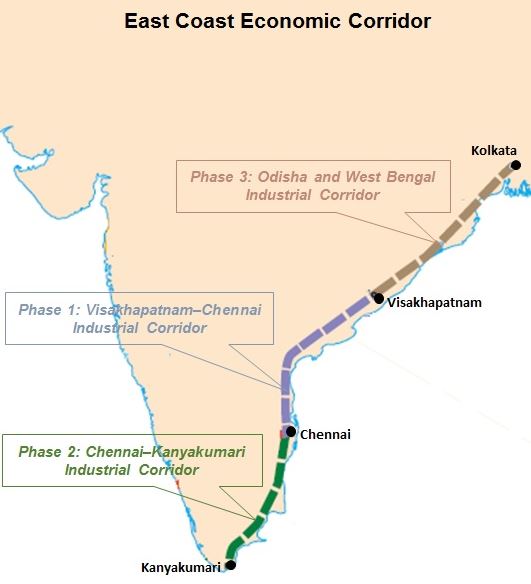
    [pib] Chennai–Kanyakumari Industrial Corridor (CKIC)

    The Asian Development Bank (ADB) and the Centre have signed a $484 million loan to improve transport connectivity and facilitate industrial development in the Chennai–Kanyakumari Industrial Corridor (CKIC).

    About CKIC

    • CKIC is part of India’s East Coast Economic Corridor (ECEC), which stretches from West Bengal to Tamil Nadu.
    • The project will upgrade about 590 km of state highways in the CKIC influence areas that cover 23 of the 32 districts between Chennai and Kanyakumari in Tamil Nadu.
    • It connects India to the production networks of South, Southeast, and East Asia.
    • ADB is the lead partner in developing ECEC.

    Answer this PYQ in the comment box:

    Q. With reference to Asian Infrastructure Investment Bank (AIIB), consider the following statements:

    1. AIIB has more than 80 member nations.
    2. India is the largest shareholder in AIIB.
    3. AIIB does not have any members from outside Asia.

    Which of the statements given above is/are correct?

    (a) 1 only

    (b) 2 and 3 only

    (c) 1 and 3 only

    (d) 1, 2 and 3

    Significance of CKIC

    • The project is part of the priority infrastructure projects identified for corridor development under the ADB-supported CKIC comprehensive development plan.
    • Enhanced connectivity of industrial hubs with hinterland and ports will particularly help increase the participation of Indian manufacturing in global production networks and global value chains.
    • The project will also strengthen road safety improvement programs through advanced technologies for road monitoring and enforcement.
    • In addition, the project will help improve the planning capacity of Tamil Nadu’s Highways and Minor Ports Department.

    Back2Basics: Asian Development Bank

    • The ADB is a regional development bank established on 19 December 1966 which is headquartered in the Ortigas Center located in the city of Mandaluyong, Metro Manila, Philippines.
    • The company also maintains 31 field offices around the world to promote social and economic development in Asia.
    • From 31 members at its establishment, ADB now has 68 members.
    • The ADB was modeled closely on the World Bank and has a similar weighted voting system where votes are distributed in proportion with members’ capital subscriptions.
  • A new era of partnership in social innovations that can benefit all South Asians

    Pandemic know no borders. So, dealing with it has necessited global cooperation. The article introduce us to some of the cross-country collaborations in dealing with the pandemic, igniting the hope for new era social partnership to the advantage of South Asia.

    Regionally-coordinated strategy against pandemic

    • Containing Covid pandemic has necessitated global cooperation.
    • The deadly pandemic surge in 2021 makes a regionally coordinated, evidence-driven strategy critical.
    • It is necessary to construct multi-stakeholder regional coalitions to devise new solutions and frugal innovations that can be applied across South Asia.
    • Given our shared and mostly similar social, economic and cultural contexts, local successes must be amplified across South Asia.
    • Despite wide variation in how nations have responded to the pandemic, the most successful strategies find commonality in their adherence to science and attention to local context.

    How successful interventions could be applied across the subcontinent

    • Beliefs, priorities, traditions and aversions to behavioural change are more similar across South Asia.
    • This means that interventions that are successful in changing behaviour in one place are highly likely applicable in other parts of the subcontinent.
    • For example, Community-Led Total Sanitation (CLTS) campaigns to solve the problem of open defecation, developed by Bangladeshi NGOs in partnership with an Indian consultant is now broadly applied across South Asia and beyond.
    • The Grameen Bank microcredit model was an indigenous South Asian innovation that spread rapidly.
    • India’s digitised social protection ecosystem with Aadhaar ids and Jan Dhan accounts serves as a model for the region.

    Changing social norm around mask-wearing

    • The new pan-South Asian consortium in response to Covid-19 evolved out of an experiment conducted in Bangladesh around mask-wearing in rural communities termed as NORM.
    • It was observed that a combination of no-cost distribution, information, reinforcing the message, modeling and endorsement by community leaders (NORM) leads to large, sustained increases in mask usage.
    • NORM implementation teams based in Lahore, Ahmedabad, Peshawar, Hyderabad, Dhaka, Kathmandu and Delhi are learning from each other’s successes and failures.
    • The Self-Employed Women’s Association (SEWA) quickly implemented the model to reach over one million members in Gujarat.
    •  Additional 1.5 million masks were shipped from Bangladesh to support SEWA’s outreach to other states.
    • Lahore’s commissioner worked with the research team to adapt the NORM model to an urban setting.
    • To manage mild and moderate cases of Covid-19 in rural India, where institutional health care access is limited a host of physicians, scientists and community-based organisations created the Swasth Community Science Alliance.
    • The Masking-Treatment-Vaccine Preparation (MTV) approach offers a sensible strategy to mitigate the pandemic until universal vaccination is achieved.

    Conclusion

    We need to come together to solve problems that affect us all. Let the lasting legacy of this pandemic be a new era of partnership in social innovations that can benefit all South Asians.

  • Important Judgements In News

    Balancing right to be forgotten with fair criticism and accountability

    The article discusses the interplay between right to be forgotten and the right of the public to access courts of record, concepts of fair criticism and accountability.

    Context

    The Delhi High Court recently ordered the removal of one of its own judgments from easy access. The High Court recognised that the petitioner may have a right to be forgotten, which must be balanced with the right of the public to access courts of record.

    Right to be forgotten

    • In 2017, the Supreme Court recognised the right to be forgotten as being under the ambit of the right to privacy (specifically, informational privacy) under the Constitution.
    • The Supreme Court observed that a lot of personal information may serve no “legitimate interest”, was “incorrect”, or was not “necessary” or “relevant”.
    • For now, individuals may request data hosts to take down some content, and it may be taken down based on the policies of the respective hosts.
    • There is a general consensus that people should be allowed to modify or delete information uploaded by themselves.
    • However, whether this extends to information uploaded by third parties is uncertain.
    • The right to be forgotten is, generally, the right to have information about a person removed from public access.

    Balancing between right of the public

    • The Delhi High Court recognised that the petitioner may have a right to be forgotten, which must be balanced with the right of the public to access courts of record.
    • Judgments are published for good reasons.
    • Trials held under public scrutiny act as a check against judicial caprices and help in enhancing the confidence of the public in the fairness and objectivity of the administration of justice.
    • The Supreme Court has made is clear that the right to be forgotten was subject to reasonable restrictions based on countervailing rights such as free speech.

    Consider the question “What is right to be forgotten and how it is related to the right to privacy? Examine the issues related to the implementation of the right to be forgotten.”

    Way forward

    • The High Court could have ordered that the name and personal details of the petitioner be redacted while maintaining public access to the judgment itself.

    Conclusion

    The right to be forgotten needs to be studied along with the concepts of fair criticism and accountability.

  • Economic Indicators and Various Reports On It- GDP, FD, EODB, WIR etc

    Direct Tax collections surge in 2021-22

    India’s direct tax collections in the first two and a half months of 2021-22 stand at nearly ₹1.86 lakh crore, double the collections over the same period of last year that was affected by the national lockdown.

    Surge in direct tax collections

    • The jump in the direct tax collections reflects healthy exports and a continuation of various industrial and construction activities.
    • This supports our expectation that GDP will record a double-digit expansion.

    What are Direct Taxes?

    • A type of tax where the impact and the incidence fall under the same category can be defined as a Direct Tax.
    • The tax is paid directly by the organization or an individual to the entity that has imposed the payment.
    • The tax must be paid directly to the government and cannot be paid to anyone else.

    Answer this PYQ in the comment box:

    Q.All revenues received by the Union. Government by way of taxes and other receipts for the conduct of Government business are credited to the:

    (a) Contingency Fund of India

    (b) Public Account

    (c) Consolidated Fund of India

    (d) Deposits and Advances Fund

    Types of Direct Taxes

    The various types of direct tax that are imposed in India are mentioned below:

    (1) Income Tax

    • Depending on an individual’s age and earnings, income tax must be paid.
    • Various tax slabs are determined by the Government of India which determines the amount of Income Tax that must be paid.
    • The taxpayer must file Income Tax Returns (ITR) on a yearly basis.
    • Individuals may receive a refund or might have to pay a tax depending on their ITR. Penalties are levied in case individuals do not file ITR.

    (2) Wealth Tax

    • The tax must be paid on a yearly basis and depends on the ownership of properties and the market value of the property.
    • In case an individual owns a property, wealth tax must be paid and does not depend on whether the property generates an income or not.
    • Corporate taxpayers, Hindu Undivided Families (HUFs), and individuals must pay wealth tax depending on their residential status.
    • Payment of wealth tax is exempt for assets like gold deposit bonds, stock holdings, house property, commercial property that have been rented for more than 300 days, and if the house property is owned for business and professional use.

    (3) Estate Tax

    • It is also called Inheritance Tax and is paid based on the value of the estate or the money that an individual has left after his/her death.

    (4) Corporate Tax

    • Domestic companies, apart from shareholders, will have to pay corporate tax.
    • Foreign corporations who make an income in India will also have to pay corporate tax.
    • Income earned via selling assets, technical service fees, dividends, royalties, or interest that is based in India is taxable.
    • The below-mentioned taxes are also included under Corporate Tax:
    1. Securities Transaction Tax (STT): The tax must be paid for any income that is earned via security transactions that are taxable.
    2. Dividend Distribution Tax (DDT): In case any domestic companies declare, distribute, or are paid any amounts as dividends by shareholders, DDT is levied on them. However, DDT is not levied on foreign companies.
    3. Fringe Benefits Tax: For companies that provide fringe benefits for maids, drivers, etc., Fringe Benefits Tax is levied on them.
    4. Minimum Alternate Tax (MAT): For zero tax companies that have accounts prepared according to the Companies Act, MAT is levied on them.

    (5) Capital Gains Tax:

    • It is a form of direct tax that is paid due to the income that is earned from the sale of assets or investments. Investments in farms, bonds, shares, businesses, art, and home come under capital assets.
    • Based on its holding period, tax can be classified into long-term and short-term.
    • Any assets, apart from securities, that are sold within 36 months from the time they were acquired come under short-term gains.
    • Long-term assets are levied if any income is generated from the sale of properties that have been held for a duration of more than 36 months.

    Advantages of Direct Taxes

    The main advantages of Direct Taxes in India are mentioned below:

    • Economic and Social balance: The Government of India has launched well-balanced tax slabs depending on an individual’s earnings and age. The tax slabs are also determined based on the economic situation of the country. Exemptions are also put in place so that all income inequalities are balanced out.
    • Productivity: As there is a growth in the number of people who work and community, the returns from direct taxes also increases. Therefore, direct taxes are considered to be very productive.
    • Inflation is curbed: Tax is increased by the government during inflation. The increase in taxes reduces the necessity for goods and services, which leads to inflation to compress.
    • Certainty: Due to the presence of direct taxes, there is a sense of certainty from the government and the taxpayer. The amount that must be paid and the amount that must be collected is known by the taxpayer and the government, respectively.
    • Distribution of wealth is equal: Higher taxes are charged by the government to the individuals or organizations that can afford them. This extra money is used to help the poor and lower societies in India.

    What are the disadvantages of direct taxes?

    • Easily evadable: Not all are willing to pay their taxes to the government. Some are willing to submit a false return of income to evade tax. These individuals can easily conceal their incomes, with no accountability to the law of the land.
    • Arbitrary: Taxes, if progressive, are fixed arbitrarily by the Finance Minister. If proportional, it creates a heavy burden on the poor.
    • Disincentive: If there are high taxes, it does not allow an individual to save or invest, leading to the economic suffering of the country. It does not allow businesses/industry to grow, inflicting damage to them.

  • Defence Sector – DPP, Missions, Schemes, Security Forces, etc.

    Ordinance Factory Board corporatization gets Cabinet approval

    Addressing a long-pending reform, the Union Cabinet has approved a plan to corporatize the Ordnance Factory Board (OFB).

    Ordnance Factory Board (OFB)

    • OFB consisting of the Indian Ordnance Factories is a government agency under the control of the department of defence production (DDP).
    • It is engaged in research, development, production, testing, marketing and logistics of a product range in the areas of air, land and sea systems.
    • OFB comprises 41 ordnance factories, nine training institutes, three regional marketing centres and four regional controllers of safety, which are spread all across the country.

    Why are OFBs significant?

    • OFB is the world’s largest government-operated production organization and the oldest organization in India.
    • It has a total workforce of about 80,000.
    • It is often called the “Fourth Arm of Defence” and the “Force Behind the Armed Forces” of India.
    • OFB is the 35th largest defence equipment manufacturer in the world, 2nd largest in Asia, and the largest in India.

    Why corporatization?

    • Once implemented, the OFB, the establishment of which was accepted by the British in 1775, will cease to exist.
    • It is a major decision in terms of national security and also make the country self-sufficient in defence manufacturing as repeatedly emphasized by PM.
    • This move would allow these companies autonomy and help improve accountability and efficiency.
    • This restructuring is aimed at transforming the ordnance factories into productive and profitable assets, deepening specialization in the product range, enhancing competitiveness, improving quality and achieving cost efficiency.

    Adhering to past recommendations

    • There have been several recommendations by high-level committees in the past for corporatising it to improve efficiency and accountability.

    What about employees?

    • All employees of the OFB (Group A, B and C) belonging to the production units would be transferred to the corporate entities on deemed deputation.
    • The pension liabilities of the retirees and existing employees would continue to be borne by the government.

    How would this be accomplished?

    • The 41 factories would be subsumed into seven corporate entities based on the type of manufacturing.
    • The ammunition and explosives group would be mainly engaged in producing ammunition of various calibre and explosives, with huge potential to grow exponentially.
    • Similarly, the vehicles group would mainly engage in producing defence mobility and combat vehicles such as tanks, trawls, infantry and mine protected vehicles.

Join the Community

Join us across Social Media platforms.