💥UPSC 2026, 2027, 2028 UAP Mentorship (March Batch) + Access XFactor Notes & Microthemes PDF

Archives: News

  • RBI Notifications

    RBI steps in to ease COVID-19 burden

    Term Liquidity Facility announced

    • Reserve Bank of India stepped in on Wednesday with measures aimed at alleviating any financing constraints for healthcare infrastructure and services reeling under the second Covid wave.
    • RBI Governor announced a Term Liquidity Facility of ₹50,000 crore with tenor of up to three years, at the repo rate, to ease access to credit for providers of emergency health services.
    • Under the scheme, banks will provide fresh lending support to a wide range of entities, including vaccine manufacturers, importers/suppliers of vaccines and priority medical devices, hospitals/dispensaries, pathology labs, manufacturers and suppliers of oxygen and ventilators, and logistics firms. 
    • These loans will continue to be classified under priority sector till repayment or maturity, whichever is earlier.

    Measures for individual and MSME borrowers

    • As part of a “comprehensive targeted policy response”, the RBI also unveiled schemes to provide credit relief to individual and MSME borrowers impacted by the pandemic.
    • RBI unveiled a Resolution Framework 2.0 for COVID-related stressed assets of individuals, small businesses and MSMEs.
    • To provide further support to small business units, micro and small industries, and other unorganised sector entities the RBI decided to conduct special three-year long-term repo operations (SLTRO) of ₹10,000 crore at the repo rate for Small Finance Banks.
    • The SFBs would be able to deploy these funds for fresh lending of up to ₹10 lakh per borrower.
    • In view of the fresh challenges brought on by the pandemic and to address the emergent liquidity position of smaller MFIs, SFBs are now being permitted to reckon fresh lending to smaller MFIs (with asset size of up to ₹500 crore) for onlending to individual borrowers as priority sector lending.

    Measure for States

    • To enable the State governments to better manage their fiscal situation in terms of their cash flows and market borrowings, maximum number of days of overdraft (OD) in a quarter is being increased from 36 to 50 days and the number of consecutive days of OD from 14 to 21 days, the RBI said.
  • Trade Sector Updates – Falling Exports, TIES, MEIS, Foreign Trade Policy, etc.

    Atmanirbhar Bharat & the informal sector

    The article highlights the important role the informal sector can play in the vision of Atmanirbhar Bharat.

    Economic development through Atmanirbhar Bharat

    • The vision of the Atmanirbhar Bharat is rooted in the classical paradigm of economic development, based on demand injection in the economy via two sources, domestic and external.
    • ‘Vocal for local’ exhorts a distinct and decisive shift in consumer preferences towards locally-produced goods and services.
    • ‘Make for the world’ is more ambitious and resembles the export-led growth strategy adopted in East Asia.
    • Thus, the Atmanirbhar Bharat categorically bestows the Indian economy with twin engines of growth.

    Important role informal sector can play

    • The strategy is based on an assumption of lack of adequate demand.
    • So a prognosis of supply side with respect to the ability of domestic producers of goods and services to seize the opportunity at the requisite scale and scope is pertinent.
    • The nature, character, structure and contributions of the informal sector require retrospection.
    • The size of India’s informal sector is massive, it accounts for about 50% of GVA and a major share in the export basket.
    • This position proffers it with growth opportunities emanating from domestic as well as external sources.

    Constraints faced by informal sector

    • Most firms are micro in size and deploy little capital.
    • They have a small scale of production, substandard/unbranded quality of products, and localised scope of procuring raw material and marketing their products.
    • They are vulnerable to business downturns and other market uncertainties, as reflected in high mortality.
    • Their access to cheap, reliable and long-term credit sources is highly restricted.
    • The sector also endures a lack of official identity and recognition of its existence and contribution.

    Three transformations informal sector need to adopt

    • Atmanirbhar Bharat promises enhanced demand for domestically-produced goods and services, but the exposure to stiff global competition, especially for informal sector units, is imminent.
    • In such a scenario, the informal sector must embrace for three tectonic shifts with respect to internal transformation, strategic positioning and labour-market dynamics.

    1)  Internal transformation

    • Enterprises must undergo drastic internal transformation, progressively converging at incremental formalisation through spontaneous and self-propelled transition into economically-viable units.
    • It requires infusion of capital to ensure enhanced labour productivity and higher wages.
    • A systemic disruption, fostering natural growth must be ushered in, which would also curb the birth of new informal enterprises.
    • Moreover, internal consolidation in the sector via merger and acquisitions of units would bring benefits accruing from scale economies.

    2) Strategic positioning

    • Two, because the vision of the Atmanirbhar Bharat exposes the informal sector to global competition, entrepreneurs must embrace the subtle art of strategic positioning in global mega-supply chains.
    • They must pick their products and markets with utmost care, and engrain two mantras of success at the global stage in the DNA of their business strategies.
    • Global mega-supply chains demand ultra-flexibility in production cycle in addition to heightened resilience to withstand headwinds emanating from not just domestic factors but also global.

    3) Labour market dynamics

    • The informal sector employs more than 80% of India’s workforce.
    • The changes in the first two spheres i.e. higher capital intensity-led enhanced labour productivity and ultra-flexibility in production cycles may have severe repercussions on the availability and quality of jobs in India.
    • To alleviate these concerns, the first assumption is that the proportionate increase in expected demand must be more than the enhanced labour productivity to at least retain the currently employed workers.
    • To generate good quality jobs, diversification (both horizontal and vertical) must be encouraged.
    • Vertical diversification entails products not just be partly produced or assembled in India, they must be the end-products of fully indigenised and integrated production and supply chains, from design to made in India.
    • Horizontal diversification involves expansion into newer products and markets, smartly aligning with India’s comparative advantage of surplus labour.

    Consider the question ” India’s vast informal sector is poised to play an instrumental, decisive and intriguing role in the vision of the Atmanirbhar Bharat.  But the sector, in its current form, appears severely constrained to harness the opportunities. In lights of this, examine the constraints faced by the sector and suggest the measures needed to transform the sector.” 

    Conclusion

    The vision of the Atmanirbhar Bharat is an inflexion point for India’s informal sector, which stipulates adroit manoeuvring between contrasting forces of continuity and change.

  • Coronavirus – Health and Governance Issues

    U.S. to support intellectual property waiver for COVID-19 vaccines

    US in support of TRIPS waiver

    • The United States announced its support to an initiative at the World Trade Organisation (WTO) to waive Trade Related Intellectual Property Rights (TRIPS) protection for COVID-19 vaccines.
    • The initiative was first floated by India and South Africa last October.
    • Over a 100 countries have supported the proposal, according to the Associated Press.

    Opposition to the move

    • Among the arguments proffered to retain IP protection are that biotech jobs will be transferred from the U.S. to foreign countries and that waiving IP still not does overcome bottlenecks like manufacturing capacity.
    • Twelve Republican Members of Congress wrote to Mr. Biden on Tuesday urging him to consider other means to increase vaccine access that did not involve weaking IP protections.
    • Weakening protections would hamper American competitiveness and innovation, they said.
  • Water Management – Institutional Reforms, Conservation Efforts, etc.

    [pib] Kerala presents its Annual Action plan under Jal Jeevan Mission

    Annual Action Plan presented

    • Annual Action Plan (AAP) on planning and implementation of Jal Jeevan Mission (JJM) in Kerala was presented.
    • Kerala State officials outlined the roadmap of the financial year 2021-2022 to the national committee via video conferencing.
    • The State plans to achieve the target of ‘Har Ghar Jal’ by 2024.
    • The State also plans to provide potable water in all quality-affected habitations by June 2021 through piped water supply or Community Water Purification Plants (CWPP).
    • The national committee analysed and advised on the plan presented by the State.
    • The committee emphasized the preparation of Village Action Plans and the constitution of Village Water &Sanitation Committee/ Pani Samiti as a sub-committee of Gram Panchayat with a minimum 50% of women members.
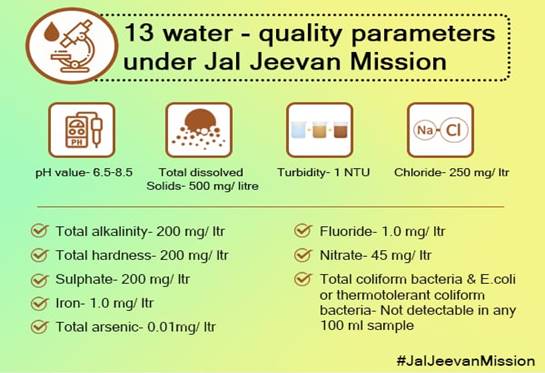
    • Also, emphasis is required on Water Quality Monitoring & Surveillance (WQM&S) activities to ensure Field Test Kit testing at Gram Panchayat level, Aanganwadi centres and schools.

    About Jal Jeevan Mission

    • Jal Jeevan Mission is the flagship programme of Government of India, which aims to provide household tap water connection to every rural household by 2024.
    • Since announcement of the mission in August 2019, 4.17 Core new tap connections have been provided in the rural areas of the country during this period.
    • As a result, 7.40 Crore (38.56%) rural households have tap water supply vis-à-vis 3.23 Crore (17%) in 2019.
    •  Efforts are made to dovetail all available resources by convergence of different programmes viz. MGNREGS, SBM, 15th Finance Commission Grants to PRIs, CAMPA funds, Local Area Development Funds, etc.

    Allocation for the JJM

    •  In 2021-22, Rs. 50,000 Crore budgetary allocation has been made for Jal Jeevan Mission.
    • In addition to this, there is also Rs. 26,940 Crore assured fund available under the 15th Finance Commission tied grants to RLBs/ PRIs for water & sanitation, matching State share and externally aided projects.
    • Thus, in 2021-22, more than Rs. 1 lakh Crore is planned to be invested in the country on ensuring tap water supply to rural homes.
    • This huge investment will give a boost to manufacturing activities, create employment opportunities in rural areas as well boost the rural economy.
  • Coronavirus – Health and Governance Issues

    The vaccine patent row

    What is the vaccine patent row about?

    • Medicines and other inventions are covered by patents which provide legal protection against being copied, and vaccines are no exception.
    • Patents give makers the rights to their discoveries as well as the means to make more money from them – which is an incentive to encourage innovation.
    • But these are not normal times.
    • Last autumn, developing nations led by India and South Africa proposed to the World Trade Organization (WTO) that the patents on vaccinations and other Covid-related items should be waived.
    • They argued that, given the extreme nature of the pandemic, the recipe for the life-saving jabs should be made widely available so they could be produced locally in bulk by other manufacturers.

    What’s the problem?

    • The proposals were met with immediate criticism from pharmaceutical companies and Western nations including the EU, UK and the US.
    • The obvious objection to lifting patents is that it could erode revenue and deter innovation.

    So, does this just come down to money?

    • The key argument from vaccine producers and their home countries is that waiving patents alone wouldn’t solve much. It would, they say, be like handing out a recipe without the ingredients or instructions.
    • The patent covers the bare bones of the blue print but not the precise production process. That’s crucial here. Vaccines of the mRNA type – such as Pfizer and Moderna – are a new breed and only a small number of people understand how to make them.
    • BioNTech, the German company which partnered with Pfizer, have said that developing the manufacturing process took a decade and validating production sites can take up to a year. The availability of the raw materials needed has also been an issue.
    • Industry bodies fear that without access to all the know-how and parts, a waiver could result in quality, safety and efficacy issues and possibly even counterfeits. They point out that Moderna has already said it would not prosecute those found to be infringing their patent – but no one has yet.

    What’s the alternative?

    • The EU says it is ready to talk, but it previously said the best short-term fix would be supply chain improvements and pushing richer countries to export more jabs.
    • The UK says it is one of the biggest donors to Covax, which is masterminding the rollout of vaccines to many poorer countries. It also favours voluntary licensing – such as collaborations between the Serum Institute of India and Oxford-AstraZeneca. It wants the WTO, which oversees the rules on global trade, to support more partnerships.
    • The WTO system allows for this licensing arrangement to go even further. Governments can impose compulsory licenses on vaccine makers, compelling them to share their know-how and overseeing the production process along the way. But those pharmaceutical companies would have to be compensated for doing so.

    Why did the US change its mind?

    The announcement came after the US Trade Representative Katharine Tai held meetings with the big vaccine makers in an effort to supercharge vaccine production.

    What happens next?

    • Now the discussions will continue at the WTO where decisions are made by consensus.
    • Without the backing of other key nations, the proposals may stall. But they may pave the way to a compromise that could boost production.
    • The key question is when – and by how much.

    Support grows for IP waiver

    • Attention is now turning to those richer nations, notably in the European Union — and France was the first to voice its support.
    • France joined the United States in supporting an easing of patent and other protections on COVID-19 vaccines that could help poorer countries get more doses and speed the end of the pandemic.
    • Russian President Vladimir Putin also said he supported the idea of a waiver on patent protections for coronavirus vaccines.


  • [pib] India-UK virtual summit strengthens STI cooperation

    Enhance partnership in science, education, research and innovation

    • The Prime Minister of India and the UK  met virtually on 4 May 2021 and emphasised their shared commitment to an enhanced partnership in science, education, research and innovation.
    • In keeping with this commitment, both the leaders welcomed the following:
    • The new MoU on Telecommunications/ICT and the Joint Declaration of Intent on Digital and Technology.
    • There was also the establishment of new high-level dialogues on tech.
    • A new joint rapid research investment into Covid19.
    • A new partnership to support zoonotic research,
    • New investment to advance understanding of weather and climate science.
    • There will be continuation of the UK-India Education and Research Initiative (UKIERI).

    Key points to strengthen STI cooperation

    • Enhance cooperation between India and the UK on strengthening the role of women in STEM at schools, universities, and research institutions through initiatives like Gender Advancement for Transforming Institutions (GATI) project.
    • Develop collaborations between Industry, Academia and the Government to foster innovation among school students by focusing on teacher training, mentoring and sharing of global best practices through initiatives like the India Innovation Competency Enhancement Program (IICEP)
    • Build on the two countries’ existing bilateral research, science and innovation infrastructure and governmental relationships to continue to support high-quality, high-impact research and innovation through joint processes.
    • Forge partnership across the pipeline of research and innovation activity, from basic research to applied and interdisciplinary research.
    • Leverage and build on existing, long-standing bilateral partnerships such as on education, research and innovation, to stimulate a joint pipeline of talent, excellent researchers and early-career innovators.
    • Work together to share knowledge and expertise regarding artificial intelligence, scientific support to policies and regulatory aspects including ethics, and promote a dialogue in research and innovation.
    • Through Tech Summits, bring together tech innovators, scientists, entrepreneurs and policy makers to work together on challenges including the norms and governance of future tech under the cross-cutting theme of ‘data’.
    •  Grow programmes such as the Fast Track Start-Up Fund to nurture innovation-led, sustainable growth and jobs, and tech solutions that benefit both countries.
  • Coronavirus – Health and Governance Issues

    What the easing of IP norms on Covid vaccines means for India

    Background of waiver proposal

    • U.S. President Joe Biden’s administration announced its support for waiving intellectual property protections for COVID-19 vaccines.
    • Following the onset of the pandemic, the World Health Organisation proposed a COVID-technology access pool as a knowledge sharing initiative to rapidly scale up vaccine output around the world.
    • As vaccine research progressed last year, wealthy and advanced countries, placed huge advance purchase orders for vaccines.
    • This meant that smaller, developing countries would take longer to get vaccines and find resources to pay for them.
    • In October 2020, India and South Africa floated a proposal at the World Trade Organisation’s TRIPS (Trade-Related Aspects of Intellectual Property Rights) Council to waive certain provisions of the WTO’s TRIPS pact till the pandemic subsides.
    • The proposal envisaged facilitating wider access to technologies necessary for the production of vaccines and medicines.
    • While a majority of the least developed countries backed the proposal, some like China, Turkey and Thailand sought more clarity.
    • However, the proposal was nixed with the E.U., the U.S., Switzerland, Norway, Australia, Canada, Japan and the U.K. rejecting it outright, along with Brazil.
    • Among other things, the argument was that such waivers could dampen innovation and research in areas such as pharmaceuticals and diagnostic technologies.

    What next

    • The WTO’s TRIPS Council is tentatively expected to hold a meeting on the waiver proposal again later this month.
    • If and when an agreement is reached here, the WTO’s Ministerial Council will also have to sign off.
    • Since WTO decisions are based on consensus, all 164 members need to agree on every single aspect of the negotiated waivers and conditions attached.

    Way forward for India

    • The Centre can take two steps immediately in consonance with its stance at the WTO, following the U.S.’ statement of support.
    • The Union government must issue notification under Sections 92 and 100 of the Patents Act to freely licence all patents necessary for vaccine and drug production to treat COVID-19.
    • Issues of the amount of royalties can be decided in due course as laid out in the Patents Act, but that should not come in the way of immediate licensing by the government.
    • The government need to provide full support to companies to scale up vaccine production.
    • Indian industry has a well-respected expertise and capability to rapidly manufacture raw materials, consumables and equipment necessary to produce drugs, vaccines, medical devices and equipment if Intellectual Property barriers are removed.

    ————————————————-//—————————————

    BACK2BASICS

    • COVID-19 Technology Access Pool (C-TAP) will compile, in one place, pledges of commitment made under the Solidarity Call to Action to voluntarily share COVID-19 health technology-related knowledge, intellectual property and data. C-TAP works through its implementing partners, the Medicines Patent Pool, Open COVID Pledge, UN Technology Bank-hosted Technology Access Partnership and Unitaid to facilitate timely, equitable and affordable access to COVID-19 health technologies.

    Understand how the story has progressed:

    India seeks TRIPS waiver for Vaccines

    How IPR served as barrier to the right to access healthcare

  • Trade Sector Updates – Falling Exports, TIES, MEIS, Foreign Trade Policy, etc.

    India should go all out in its Westward trade push

    After walking away from the RCEP, India needs to find alternative trading partners that can offer the potential for trade expansion. The article suggests a Westward trade push as an alternative.

    Forging trade deals with the Western countries

    • Our rejection of RCEP, which covers much of the eastern hemisphere, had exposed us to the risk of losing out on cross-border commercial relations in a highly dynamic part of the world.
    • To compensate for the opportunity cost of that decision, it was imperative to strike other alliances.
    •  As a part of this, India adopted a roadmap for the rest of this decade to elevate ties with the UK and also moving to revive free-trade talks with the EU.
    • An India-UK plan unveiled recently will raise our bilateral relationship to a ‘comprehensive strategic partnership in such areas as economic affairs, defence and health.
    • The two countries signed a £1-billion trade investment pact that is expected to generate jobs in both.
    • Separately, India and the EU are reportedly working out how to resume stalled negotiations for a trade deal.

    Issues India may face

    • The signing of pacts would involve mutual tariff reductions and the lowering of other barriers, both of which have proven thorny so far.
    • In general, while the West wants us to lower import duties, our negotiators have been citing India’s sovereign right to protect domestic businesses under World Trade Organization rules.
    • Globally, even before covid knocked the wind out of the sails of cargo ships, commerce across borders had been doing badly under the extended effects of a financial crisis that shook things up in 2008-09.
    • But world trade remains a reliable path to global prosperity and must therefore regain its gusto.
    • For us, deal-making would mean opening up markets to imports in lieu of easier access to foreign ones.

    Way forward

    • Concessions that cause very few job losses in India can easily be made. A broad cost-benefit analysis will have to guide our approach to talks, on complex issues like US visa rules which affect our software exports.
    • Since it is governments that thrash out deals, geopolitical convergences are often sought too.
    • We seem to be in a favourable position on this, given the West’s need to keep China’s rise in check.
    • The UK’s Rolls-Royce has just inked a memorandum with Hindustan Aeronautics Ltd for warship engines, a sign of our strategic ties.
    • Technology could come our way from the US, too.
    • If we can leverage an ability to play a role in Asia’s balance of power to our economic benefit, we should.

    Conclusion

    Mutually assured flexibility on tariff concessions would help India and its Western partners score economic gains and also counterbalance China’s growing dominance of world trade.

    —————————————————//———————————-

    B2B

    [pib] India-UK Virtual Summit

  • Important Judgements In News

    Reading Maratha quota verdict

    • A five-judge Constitution Bench of the Supreme Court on Wednesday struck down the Maharashtra law granting reservation to the Maratha community.
    • The court had framed six questions of law on the issue.
    • The court unanimously agreed on three of those issues, while the verdict was split 3:2 on the other three.

    Issue 1:  Whether Indra Sawhney judgment needs to be revisited

    • One of the key issues was to examine whether the 1992 landmark ruling by the nine-judge bench in Indra Sawhney v Union of India had to be revisited.
    • First, it said that the criteria for a group to qualify for reservation is “social and educational backwardness”.
    • Second, it reiterated the 50% limit to vertical quotas reasoning that it was needed to ensure “efficiency” in administration.
    • However, the court said that this 50% limit will apply unless in “exceptional circumstances”.
    • The Maratha quota exceeded the 50% ceiling. 
    • The arguments by state governments before the court was that the Indra Sawhney verdict must be referred to a 11-judge Bench for reconsideration since it laid down an arbitrary ceiling which the Constitution does not envisage.
    • The court said that the 50% ceiling, although an arbitrary determination by the court in 1992, is now constitutionally recognized and held that there is no need to revisit the case.

    Issue 2 and 3: Does Maratha quota law come under exceptional circumstances

    • The state government’s argument was that since the population of backward class is 85% and reservation limit is only 50%, an increase in reservation limit would qualify as an extraordinary circumstance.
    • All five judges disagreed with this argument.
    • The bench ruled that the above situation is not extraordinary.

    Issue 4,5 and 6: Validity of 102nd Amendment

    • The Constitution (One Hundred and Second Amendment) Act, 2018 gives constitutional status to the National Backward Classes Commission.
    • The Amendment also gives the President powers to notify backward classes.
    • The Bench unanimously upheld the constitutional validity of the 102nd Amendment but differed on the question of whether it affected the power of states to identify socially and economically backward classes (SEBCs).
    • Attorney General, appearing for the central government, clarified that this was not the intention of the law.
    • The Attorney General argued that it is inconceivable that no State shall have the power to identify backward class”.
    • The Attorney General explained that the state government will have their separate list of SEBCs for providing reservations in state government jobs and education.
    • The Parliament will only make the central list of SEBCs which would apply for central government jobs.
    • However, the Supreme Court held that “the final say in regard to inclusion or exclusion (or modification of lists) of SEBCs is firstly with the President, and thereafter, in case of modification or exclusion from the lists initially published, with the Parliament”.
    • This raises a question: How does this impact interventions by other states to provide reservations for other communities, for example Jats in Haryana and Kapus in Andhra?
    • The majority opinion essentially says that now the National Backward Classes Commission must publish a fresh list of SEBCs, both for states and the central list.
    • The Supreme Court also issued a direction under Article 142 of the Constitution of India which says that till the publication of the fresh list the existing lists will continue to operate.

    ————————————————-//————————————-

    BACK2BASICS

    • National Commission for Backward Classes is a constitutional body (102nd amendment 2018 in the constitution to make it a constitutional body) (Article 338B of the Indian Constitution).
    • It was constituted pursuant to the provisions of the National Commission for Backward Classes Act, 1993.
    • According to Article 338B, Commission shall consist of a Chairperson, Vice-Chairperson and three other Members and the conditions of service and tenure of office of the Chairperson, Vice-Chairperson and other Members so appointed shall be such as the President may by rule determine. The Chairperson, Vice-Chairperson and other Members of the Commission shall be appointed by the President by warrant under his hand and seal.
  • Tax Reforms

    Digital Service tax

    • Starting April 2022, overseas entities that don’t have a physical presence in India but derive significant financial benefit from Indian customers will come under the Indian tax net.
    • While the main legal provision was introduced in 2018, the revenue department notified the thresholds for the purposes of significant economic presence (SEP) on May 3.
    • The concept was introduced via Finance Act, 2018, to enlarge the scope of income of non-residents that accrues or arises in India, by establishing a “business connection” of the foreign entities.
    • The idea is to tax profits of those online and offline businesses that don’t have a physical presence in India but derive significant economic value from the country.
    • Only those entities will get impacted by the SEP provisions who come from non-treaty jurisdictions.
    • That’s because the treaties specify non-resident entities will come under the tax net only if they have a permanent establishment in India.
    • India currently has a Double Taxation Avoidance Agreement with 97 countries.

    Thresholds

    • Transaction Threshold: Any non-resident whose revenue exceeds Rs 2 crore for transactions in respect of goods, services or property with any person in India. This will include transactions on the download of data or software.
    • User Threshold: Any entity that systematically and continuously does business with more than 3 lakh users in India.

    ————————————//————————————————-

    BACK2BASICS

    Revision of this topic further:

    What are Digital Services Taxes?

Join the Community

Join us across Social Media platforms.
