💥UPSC 2026, 2027, 2028 UAP Mentorship (March Batch) + Access XFactor Notes & Microthemes PDF

Archives: News

  • Forest Conservation Efforts – NFP, Western Ghats, etc.

    CG HC upholds cancellation of Forest Rights of Villagers

    Why in the News?

    The Chhattisgarh High Court has dismissed a petition challenging the cancellation of Community Forest Rights (CFRs) granted to villagers of Ghatbarra in the Hasdeo Arand forest, an area where Adani Enterprises–linked coal mines operate.

    Background of the Case:

    • Dispute Origin: The District-Level Committee (DLC) revoked CFR titles in 2016, citing that the area had already been diverted for mining in 2012 with MoEF clearance.
    • Petitioners’ Claim: The Hasdeo Arand Bachao Sangharsh Samiti argued that the Forest Rights Act (FRA), 2006 provides no revocation clause and that villagers were not given a fair hearing before cancellation.
    • Court’s View: The High Court upheld the State’s decision, calling the 2013 CFR grant a “mistake” void ab initio, and legally cancellable.

    Key Judicial Findings:

    • Legality of Revocation: FRA lacks explicit revocation provision, but erroneous grants may be rectified; hence cancellation was valid.
    • Prior Approvals Prevail: 2012 MoEFCC mining clearance overrode subsequent CFR grants.
    • State Mineral Ownership: FRA does not affect the State’s control over minerals beneath forest land.
    • Locus Standi: Petitioners lacked standing after the Forest Rights Committee withdrew; no authorised village representation remained.
    • Suppression of Facts: Petitioners had earlier challenged land acquisition (case dismissed in 2022) but failed to disclose it.

    Significance:

    This ruling marks the first judicial interpretation of whether forest rights granted under the Forest Rights Act, 2006 (FRA) can be revoked or cancelled, despite the Act containing no explicit provision for cancellation.

    About the Forest Rights Act (FRA), 2006:

    • Overview: The Scheduled Tribes and Other Traditional Forest Dwellers (Recognition of Forest Rights) Act, 2006, commonly called the Forest Rights Act (FRA).
    • Purpose: Enacted to correct historical injustices faced by forest-dwelling communities deprived of traditional land and resource rights during colonial rule.
    • Core Objective: Ensures tenurial security, livelihood protection, and ecological stewardship of forest-dependent populations.
    • Beneficiaries: Covers Scheduled Tribes (STs) and Other Traditional Forest Dwellers (OTFDs) who have lived in and depended on forests for generations.
    • Scope: Recognises both individual and collective rights over forest land and produce, extending to cultivation, habitation, and minor forest produce use.
    • Governance Principle: Empowers Gram Sabhas as the central authority for recognising and managing forest rights, reinforcing local autonomy.
    • Integration Goal: Aligns forest governance with tribal self-rule, complementing the Panchayats (Extension to Scheduled Areas) Act, 1996 (PESA).

    Key Features of the FRA:

    • Individual & Community Rights: Legal recognition for occupation, cultivation, residence, and use/sale of minor forest produce.
    • Community Forest Resource (CFR) Rights: Grants Gram Sabhas control to protect, regenerate, and manage community forests.
    • Habitat Rights: Protects Particularly Vulnerable Tribal Groups (PVTGs) and pre-agricultural forest communities.
    • Governance Structure: Multi-level verification, Gram Sabha → Sub-Divisional Committee → District-Level Committee, for rights adjudication.
    • Development Provisions: Allows limited diversion of forest land for public utilities with Gram Sabha consent.
    • Eviction Safeguard: No eviction until claims are fully processed and rights recognised.
    • Decentralised Oversight: Empowers Gram Sabha as the final decision-making authority on forest rights and management.
    • Legal Integration: Reinforces PESA’s participatory governance and community-led conservation in Scheduled Areas.
    [UPSC 2021] At the national level, which ministry is the nodal agency to ensure effective implementation of the Scheduled Tribes and Other Traditional Forest Dwellers (Recognition of Forest Rights) Act, 2006?

    Options: (a) Ministry of Environment, Forest and Climate Change
    (b) Ministry of Panchayati Raj
    (c) Ministry of Rural Development
    (d) Ministry of Tribal Affairs*


  • Wetland Conservation

    Sustainable Aquaculture in Mangrove Ecosystems (SAIME) Initiative

    Why in the News?

    The SAIME Initiative, developed by the Nature Environment and Wildlife Society (NEWS) in the Sundarbans of West Bengal, has been conferred Global Technical Recognition by the Food and Agriculture Organization (FAO) of the United Nations.

    What is SAIME Initiative?

    • Concept: A multi-stakeholder partnership model integrating shrimp aquaculture with mangrove restoration in the Sundarbans.
    • Implementing Agencies: Developed by the Nature Environment and Wildlife Society (NEWS) with support from the Global Nature Fund (Germany), Naturland, and Bangladesh Environment & Development Society (BEDS).
    • Purpose: Promotes climate-adaptive, conservation-linked livelihoods balancing ecological health with local economic growth.
    • Implementation: Covers 29.84 hectares with 42 fish farmers, achieving 100% rise in net profits through low-input, eco-friendly methods.
    • Target Group: Focuses on climate-vulnerable coastal communities, encouraging chemical-free shrimp farming to build coastal resilience.

    Core Features and Approach:

    • Ecosystem Integration: Maintains 5–30% mangrove cover within aquaculture ponds, directly linking productivity with ecosystem restoration.
    • Community Participation: Adopts a bottom-up co-management model, involving local farmers in planning, monitoring, and benefit-sharing.
    • Sustainable Practices: Utilises mangrove litter as shrimp feed, cutting chemical dependence and improving natural nutrient cycles.
    • Climate Resilience: Mitigates cyclones, salinity intrusion, and erosion, functioning as a nature-based adaptation system.
    • Economic Efficiency: Promotes low-input, high-yield aquaculture, enhancing smallholder profitability and resource efficiency.
    • Environmental Benefits: Supports carbon sequestration, biodiversity conservation, and blue carbon economy objectives.
    • Global Alignment: Advances SDG-13 (Climate Action), SDG-14 (Life Below Water), and SDG-15 (Life on Land) through integrated coastal sustainability.

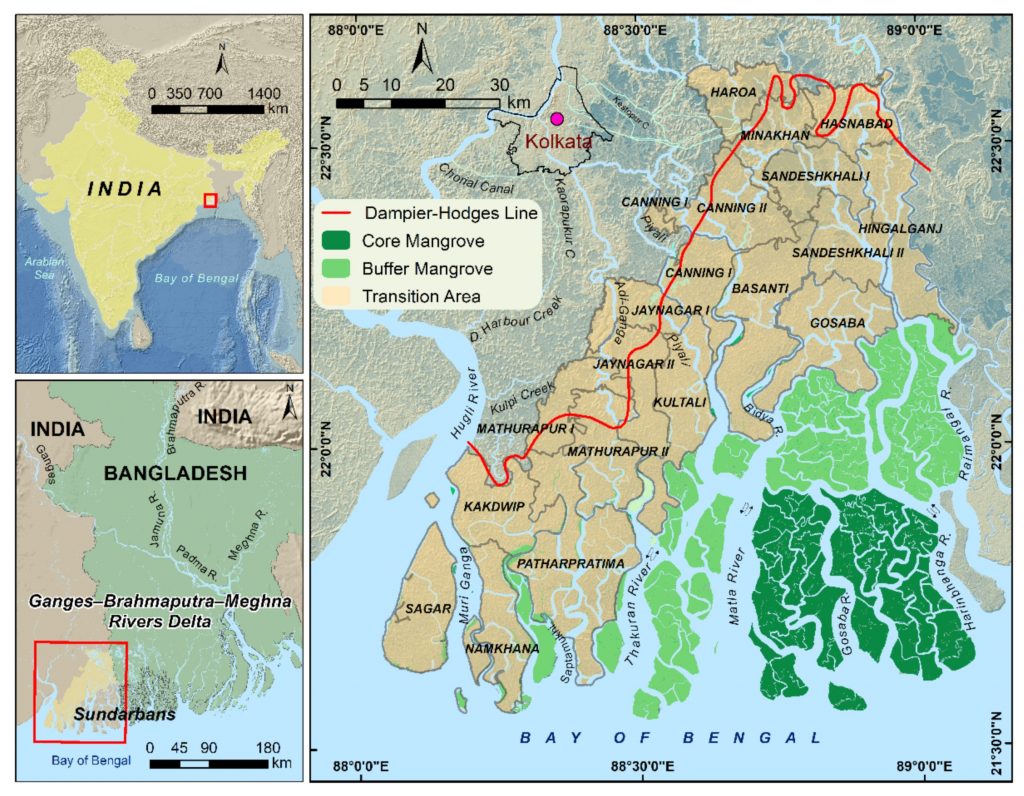
    About the Sundarbans:

    Sustainable Aquaculture in Mangrove Ecosystems (SAIME) Initiative

    • Location: Situated in the South and North 24-Parganas districts of West Bengal, at the southern tip of the Gangetic Delta, where the Ganga, Brahmaputra, and Meghna rivers meet the Bay of Bengal.
    • Area: Currently spans 2,585.89 sq km, with an expansion proposal to 3,629.57 sq km, making it the largest mangrove forest in the world.
    • Status: Designated as a Tiger Reserve, National Park, Biosphere Reserve, and a UNESCO World Heritage Site (since 1987).
    • Topography: Characterised by a dense network of tidal creeks, estuaries, and 105 mangrove-covered islands, influenced by daily tidal inundation.
    • Flora and Fauna:
      • Flora: Dominated by Avicennia, Rhizophora, Sonneratia, and Heritiera species.
      • Fauna: Includes Royal Bengal Tiger, Fishing Cat, Estuarine Crocodile, Irrawaddy Dolphin, King Cobra, and several endangered bird species.
    • Boundaries:
      • East: Bangladesh border (Raimangal & Harinbhanga rivers)
      • South: Bay of Bengal
      • North/West: Matla, Bidya, and Gomdi rivers
    • Ecological Importance: Acts as a natural shield against cyclones and tsunamis, a carbon-rich ecosystem, and a vital nursery ground for fisheries — forming the ecological heart of India’s blue economy and coastal resilience framework.


    [UPSC 2023] Which one of the following is the best example of repeated falls in sea level, giving rise to present-day extensive marshland?

    Options: (a) Bhitarkanika Mangroves

    (b) Marakkanam Salt Pans

    (c) Naupada Swamp

    (d) Rann of Kutch*


  • Indian Missile Program Updates

    Akash Missile System 

    Why in the News?

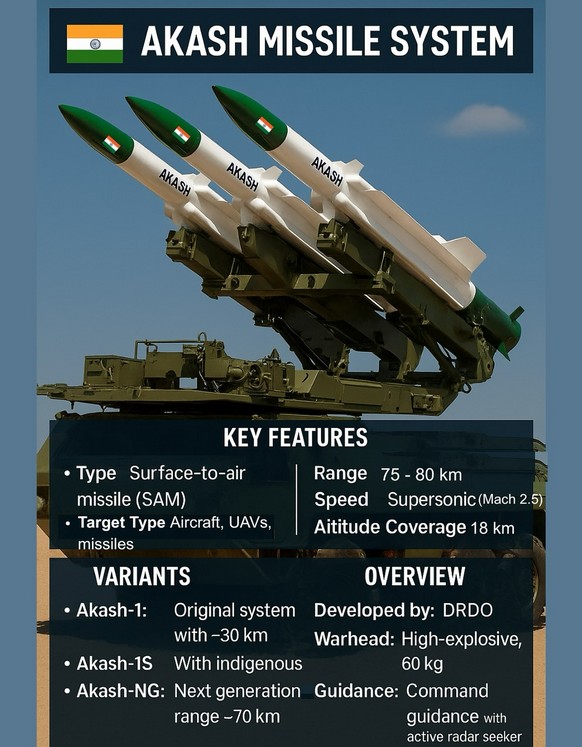
    India has pitched for the supply of the Akash missile system to Brazil.

    akash

    About Akash Missile System:

    • Overview: Developed by the Defence Research and Development Organisation (DRDO) and manufactured by Bharat Dynamics Ltd (BDL).
    • Type: A short-range Surface-to-Air Missile (SAM) designed to defend against aircraft, UAVs, and helicopters.
    • Operational Users: Inducted by both the Indian Army and the Indian Air Force, forming part of India’s layered air defence grid.
    • Purpose: Protects vital assets from aerial threats within the short to medium range segment.
    • Deployment Mode: Mounted on mobile launchers for rapid positioning, flexibility, and operational agility.
    • Comparison: Functionally comparable to Israel’s Iron Dome, though Akash focuses on intercepting larger aerial targets rather than small projectiles.

    Key Features:

    • Range & Altitude: Effective range 4.5–25 km; altitude coverage 100 m–20 km.
    • Engagement Capacity: A single firing unit can engage four targets simultaneously in both autonomous and group modes.
    • Speed & Accuracy: Capable of high-speed interceptions with radar-guided precision.
    • Propulsion & Dimensions: Length 5.87 m, diameter 350 mm, weight 710 kg; powered by solid-fuel propulsion.
    • Automation: Fully automated system ensuring rapid reaction time from detection to neutralization.
    • ECCM Capability: Built-in Electronic Counter-Counter Measures (ECCM) to resist enemy jamming
    [UPSC 2023] Consider the following statements:

    1. Ballistic missiles are jet-propelled at subsonic speeds throughout their fights, while cruise missiles are rocket-powered only in the initial phase of flight.

    2. Agni-V is a medium-range supersonic cruise missile, while BrahMos is a solid-fuelled intercontinental ballistic missile.

    Which of the statements given above is/are correct?

    Options: (a) 1 only (b) 2 only (c) Both 1 and 2 (d) Neither 1 nor 2*


  • Economic Indicators and Various Reports On It- GDP, FD, EODB, WIR etc

    [16th October 2025 ] The Hindu Op-ed: Navigating the global economic transformation

    PYQ Relevance

    [UPSC 2019] The long-sustained image of India as a leader of the oppressed and marginalised nations has disappeared on account of its new found role in the emerging global order.

    Linkage: The question reflects India’s shift from moral leadership to strategic pragmatism in global affairs. The article builds on this, urging India to reclaim that leadership by shaping a fair, inclusive global economic order for the Global South.

    Mentor’s Comment

    The tectonic shifts in the world economy today echo the reshaping of global power equations. Salman Khurshid’s article presents a comprehensive analysis of how populist politics, state capitalism, and digital colonialism are reshaping the global economic order. This piece unpacks those arguments and situates them in a UPSC-relevant analytical frame, connecting them to India’s strategic choices and the future of the Global South.

    Introduction: Why in the News

    The world economy is undergoing a seismic transformation, marked by the U.S.–China great-power rivalry, reshaped trade flows, and the rise of state-driven capitalism. This shift is more than cyclical; it is structural, redefining the principles of globalisation itself. For the first time in decades, both economic and political systems are converging towards protectionism and state control, breaking away from the neoliberal consensus that defined the post–Cold War era. The article underscores how these disruptions open a rare opportunity for India and the Global South to shape a fairer and more inclusive global economic order.

    Understanding the New Economic Paradigms

    How are populist autocrats reshaping capitalism?

    1. State–capital fusion: Populist autocrats have created a “state-capital Gordian knot”, replacing laissez-faire capitalism with systems that serve oligopolies in exchange for political loyalty.
    2. Corporate dominance: Crony-capitalists now influence state policies, prioritising corporate gains over citizen welfare — mortgaging public assets and weakening the social contract.
    3. Socio-political consequences: This model centralises power, marginalises public accountability, and distorts market competitiveness — leading to plutocracies, not democracies.

    Why are traditional power politics resurfacing in the economic sphere?

    1. Resurgent statecraft: America’s recalibration to “Make America Great Again” marks a return of economic nationalism.
    2. Strategic control: U.S. actions — shifting Taiwan’s chip manufacturing, securing Panama routes, weaponising rare earths, and asserting dominance in the Arctic — reflect geo-economic containment of China.
    3. Ecological imperialism: By controlling supply chains and energy corridors, global powers are expanding influence under the guise of “strategic autonomy.”
    4. Global instability: These assertive spheres of influence have led to conflicts and genocides, reigniting the dangers of zero-sum geopolitics.

    How is digital colonialism reshaping global economies?

    1. Big Tech dominance: Cloud capitalists have captured value chains and data flows, influencing politics and governance.
    2. Digital imperialism: Initiatives like the AI Action Plan, Cloud Act, and SWIFT weaponisation allow powerful states to dominate financial and cyber infrastructure.
    3. Erosion of sovereignty: Over 100 central banks are piloting state-backed digital currencies, which could ease transactions but risk undermining national autonomy.
    4. Political risks: Digital finance systems complicate political funding, giving populist regimes more tools for manipulation.

    How have aid withdrawals widened global inequalities?

    1. Funding collapse: G-7 nations’ $44 billion cuts in developmental aid could push 5.7 million Africans into poverty by 2026.
    2. Ripple effects: In Nepal, reduced grants for small enterprises led to eight lakh migrations, intensifying domestic dissatisfaction.
    3. Humanitarian fallout: 16.7 million people lost access to the World Food Programme in 2023, sparking recruitment into militias across the Sahel region.
    4. Moral crisis: Retrenchment of aid reflects a shift from shared prosperity to self-preservation, amplifying instability in the Global South.

    What challenges and opportunities emerge for India and the Global South?

    1. Debt and inequality: Neoliberal globalisation fostered sovereign debt traps and extreme wealth concentration in the Global North.
    2. Poverty crisis: The World Bank’s 2022 Poverty and Shared Prosperity Report notes 47% of humanity lives below the $6.85 poverty line, while 735 million suffer hunger.
    3. Collaborative alternatives: India and the Global South can construct a New Economic Deal through debt-relief frameworks, institutional reforms, and South–South cooperation.
    4. Strategic vision: Building bipartisan international ties and fair trade alliances through BRICS and regional groupings will ensure resilience against Western hegemony.

    How must India recalibrate its domestic policies to lead globally?

    1. State leadership: The government must play a commanding role in strategic sectors — energy, data, infrastructure, healthcare, and agriculture — as done by East Asian economies.
    2. Anti-monopoly mechanisms: Creating sovereign wealth funds (like Norway) and enforcing anti-trust norms can prevent oligarchic dominance.
    3. Reimagining PSUs: Instead of privatisation, redeploying PSUs like China’s state-owned enterprises can serve national and geopolitical goals.
    4. Knowledge economy: Heavy investment in research, education, and innovation will secure India’s place as a globally competitive power.
    5. True non-alignment: India’s foreign policy must remain substantive, not performative — driven by consensus and independence rather than partisan interests.

    Conclusion

    The global economic transformation is not merely about trade or finance; it is about who controls the architecture of global interdependence. As old hierarchies fracture and new alignments emerge, India stands at a crossroads, between aligning with entrenched powers or leading a new era of equitable globalization. The coming decade will test whether the Global South can collectively author a future defined by justice, sustainability, and shared prosperity. The moment is precarious, but also profoundly promising.

  • The Crisis In The Middle East

    The future of the IMEC

    Introduction

    In an era where connectivity defines power, the India–Middle East–Europe Economic Corridor (IMEC) emerged as a visionary project connecting India’s western ports with Europe via the Arabian Peninsula. Envisaged as a multi-modal corridor encompassing maritime, rail, energy, and digital infrastructure, IMEC sought to integrate economies across continents while promoting peace and prosperity in a historically volatile region.

    However, the optimism that surrounded IMEC’s launch quickly met the harsh reality of geopolitics. The October 7 Hamas attacks and subsequent Israel–Gaza war exposed the fragility of West Asian stability, placing IMEC’s implementation in question. Yet, beyond the uncertainty lies an opportunity for India to reshape its connectivity vision, adapting routes and partnerships to new global dynamics.

    Why in the News

    The IMEC has resurfaced in policy discussions as its viability faces uncertainty amid the deteriorating West Asian security environment. The October 7 Hamas–Israel conflict disrupted regional optimism nurtured by the Abraham Accords and slowed progress on IMEC’s proposed transnational links. At the same time, climate-driven Arctic trade routes and Red Sea disruptions by the Houthis are redrawing global shipping patterns, forcing India and its partners to reconsider IMEC’s configuration. The issue is critical as the corridor represents both an economic and strategic counterweight to China’s Belt and Road Initiative (BRI).
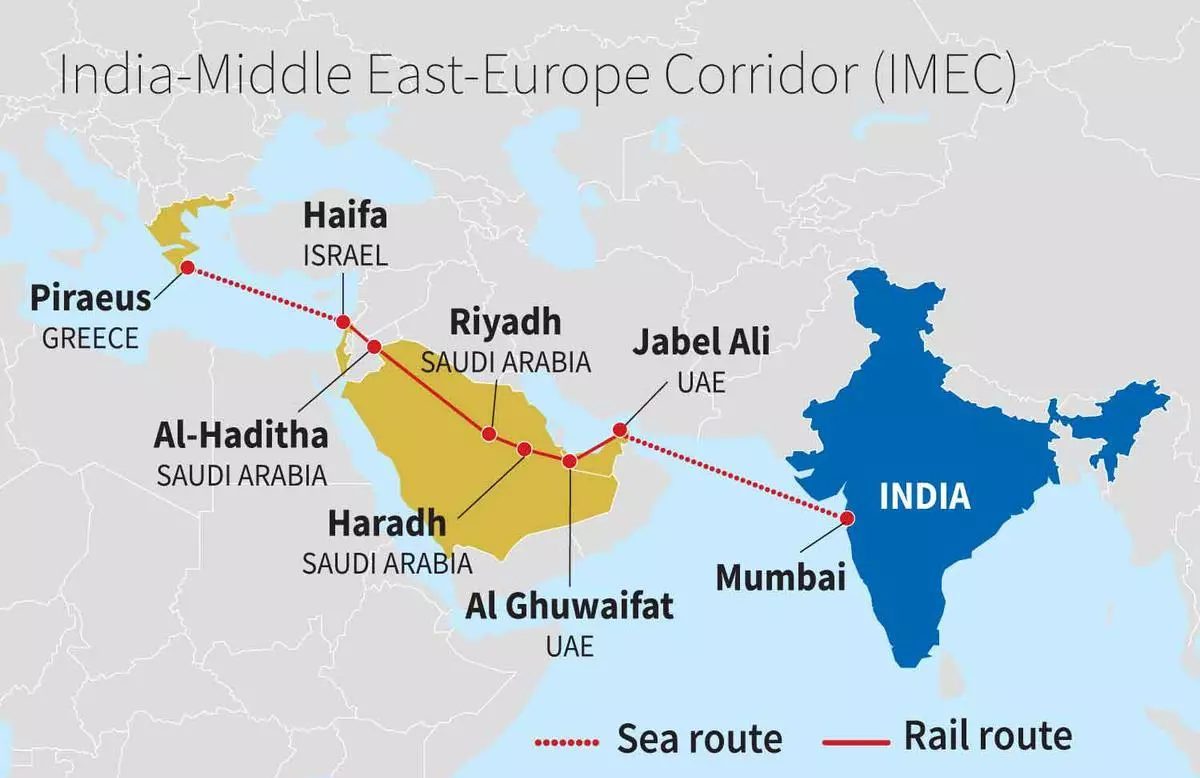
    The Strategic Vision Behind IMEC:

    1. Comprehensive Connectivity: IMEC aims to upgrade maritime routes between India and the Arabian Peninsula and establish high-speed rail links from UAE ports to Haifa, Israel, via Saudi Arabia and Jordan.
    2. Integration with Europe: From Haifa, goods would be shipped to Europe’s Mediterranean ports, ensuring faster, secure, and sustainable trade connectivity.
    3. Beyond Transport: The corridor also includes plans for a clean hydrogen pipeline, electricity cable, and high-speed undersea digital cable, linking energy and digital ecosystems across three continents.
    4. Strategic Objective: IMEC provides a non-Chinese, rules-based alternative to the Belt and Road Initiative (BRI), enhancing India’s strategic outreach and economic influence.

    The Geopolitical Context of 2023:

    1. Favourable Climate: The Abraham Accords (2020) created optimism for regional peace, bringing Israel and several Arab states closer. This atmosphere facilitated multilateral cooperation frameworks such as I2U2 (India, Israel, UAE, U.S.), paving the way for IMEC.
    2. India’s Upward Trajectory: India’s improving ties with Saudi Arabia and the UAE, coupled with strong U.S. relations, allowed it to play a central role in IMEC’s conception.
    3. Global Endorsement: The corridor was launched at the G-20 Summit in Delhi, with support from the EU, France, Germany, Italy, and Saudi Arabia, underscoring India’s emergence as a trusted global partner.

    The Security Setback and Regional Volatility

    1. Conflict Shock: Within weeks of IMEC’s announcement, the Hamas–Israel conflict erupted, reversing the post-Abraham optimism.
    2. Regional Fallout: Israel’s military operations strained ties with Arab countries, undermining cross-border infrastructure cooperation.
    3. Red Sea Disruptions: The Houthi attacks on cargo ships forced rerouting via the Cape of Good Hope, increasing transit time and cost.
    4. Lesson: The events underscore that geopolitical stability remains the cornerstone of connectivity, and corridors like IMEC must remain adaptable to shifting realities.

    Europe’s Changing Maritime Interests

    1. Arctic Openings: Climate change has opened new northern sea routes, shortening Asia–Europe shipping times. Beneficiaries include Russia, the U.S., China, and northern European nations.
    2. Mediterranean Anxiety: Countries like Italy, dependent solely on the Mediterranean, fear economic marginalisation if Arctic routes dominate trade.
    3. Strategic Importance of IMEC: Hence, Mediterranean states see IMEC as a means to sustain their maritime relevance and diversify trade partnerships.
    4. India’s Role: For India, the Mediterranean remains vital, as Arctic routes offer no immediate logistical advantage.

    Why IMEC Still Matters for India

    1. Economic Scale: With $136 billion in annual trade, the EU remains India’s largest trading partner, highlighting the need for resilient connectivity.
    2. Supply Chain Resilience: IMEC offers a secure, shorter route connecting India to Europe while reducing dependence on the Red Sea–Suez chokepoint.
    3. Strategic Leverage: Enhanced engagement with Arab economies can dilute Pakistan’s influence and integrate India deeper into West Asia’s economic architecture.
    4. Innovation Space: As a multi-member initiative, IMEC allows India to propose new routes via Saudi Arabia and Egypt, adapting to political flux.

    Challenges and the Way Forward

    1. Security Dependencies: Ongoing instability in Gaza and Israel poses a persistent threat.
    2. Financial and Political Coordination: Multi-country infrastructure projects face coordination delays, regulatory inconsistencies, and funding constraints.
    3. Need for Parallel Efforts: India must also upgrade domestic ports and logistics infrastructure, including Sagarmala and Dedicated Freight Corridors, to complement IMEC.
    4. Diplomatic Continuity: Sustaining dialogue through I2U2 and G-20 cooperation can help preserve IMEC’s spirit even if its routes evolve.

    Conclusion

    The IMEC’s future will depend not merely on the pacification of West Asia but on the political agility and diplomatic imagination of its members. While the corridor’s physical routes may shift, its strategic essence remains intact, to build resilient, diversified, and sustainable connectivity between India and Europe. For India, IMEC is more than an infrastructure project; it is a statement of intent, to be at the centre of global supply chains and a stabilising power in a fractured world.

    PYQ Relevance

    [UPSC 2018] The China-Pakistan Economic Corridor (CPEC) is viewed as a cardinal subset of China’s larger ‘One Belt One Road’ initiative. Give a brief description of CPEC and enumerate the reasons why India has distanced itself from the same.

    Linkage: While China’s CPEC runs through disputed territory, making India wary, the IMEC shows how India is building its own clean, safe, and cooperative route to connect with Europe. It’s India’s way of staying in the global connectivity game—on its own terms.

  • Renewable Energy – Wind, Tidal, Geothermal, etc.

    The critical factor in India’s clean energy ambition

    Introduction

    India’s ambition to achieve 500 GW of renewable energy by 2030 and net zero emissions by 2070 depends not just on sunlight and wind but on minerals buried beneath the earth’s surface. Lithium, cobalt, and REEs form the backbone of technologies driving the clean energy revolution. However, India imports almost all of these minerals, exposing its renewable future to external shocks. The article explores how India is gearing up to build a resilient supply chain, promote domestic mining, and move toward a circular economy, turning its green dreams into a self-reliant reality.

    India’s Clean Energy Journey and the Mineral Imperative

    1. Critical minerals as enablers: They power EV batteries, solar panels, and wind turbines, the pillars of the green transition.
    2. Explosive market growth: India’s EV market is projected to grow at a 49% CAGR from 2023 to 2030, driven by the Electric Mobility Promotion Scheme (EMPS) 2024.
    3. Battery boom: The battery storage market, valued at $2.8 billion in 2023, is set to surge with renewable energy integration.
    4. Import dependency: India currently imports nearly 100% of lithium, cobalt, and nickel, and over 90% of REEs, creating severe strategic vulnerabilities.

    Why Dependence is Dangerous: Global Supply Chain Vulnerabilities

    1. China’s dominance: Controls 60% of global REE production and 85% of processing capacity, giving it massive leverage.
    2. Geopolitical risks: Trade restrictions, conflicts, and supply disruptions can derail India’s energy transition plans.
    3. National security angle: Critical minerals are not just about clean energy,  they are strategic assets influencing defence, technology, and economic sovereignty.

    India’s Domestic Potential: A Hidden Treasure Beneath the Soil

    1. New discoveries: The Geological Survey of India (GSI) identified 5.9 million tonnes of inferred lithium in Jammu & Kashmir in 2023, a major breakthrough.
    2. Policy push: The National Mineral Exploration Policy (NMEP), 2016, and amendments to the Mines and Minerals (Development and Regulation) Act, 2021, opened up exploration to private players.
    3. Auctions driving interest: In 2023 alone, 20 critical mineral blocks (lithium, graphite, REEs) were auctioned, attracting domestic and multinational bidders.
    4. Potential-rich states: Jammu & Kashmir, Rajasthan (lithium), Odisha, and Andhra Pradesh (REEs) have emerged as mineral hotspots.

    From Discovery to Refinement: The Missing Link

    1. Production bottleneck: India contributes less than 1% of global REE production due to weak refining and processing infrastructure.
    2. Need for partnerships: Public-private collaborations can bring in advanced processing technologies and recycling systems.
    3. Government incentives: Subsidies, tax breaks, and R&D grants are critical to scale domestic lithium and cobalt pilot projects.

    Investment and Policy Momentum: Building the Foundation

    1. Regulatory reforms: The Mines and Minerals (Amendment) Act, 2023 allows private exploration but the sector faces high costs and environmental concerns.
    2. Economic potential: Mining contributes only 2.5% to India’s GDP, compared to 13.6% in Australia — signalling untapped opportunity.
    3. National Critical Mineral Mission (NCMM): With an outlay of ₹34,300 crore, it aims to strengthen the value chain — from exploration to recycling.

    Institutional efforts:

    1. NMDC diversifying through its Australian arm.
    2. IREL (India) Ltd. extracting REEs like neodymium, praseodymium, and dysprosium.
    3. KABIL (Khanij Bidesh India Ltd.), formed in 2019, tasked with overseas acquisitions of mineral assets.

    Moving Towards a Circular Economy

    1. E-waste as opportunity: India produces 4 million metric tonnes of e-waste annually, yet only 10% is formally recycled.
    2. Recycling policies: The Battery Waste Management Rules (2022) and E-Waste Management Rules (2022) aim to improve recovery of critical minerals.
    3. Challenges: Weak enforcement, poor infrastructure, and lack of awareness hinder progress.
    4. Way forward: Public-private recycling hubs can boost technology access, cut costs, and reduce environmental footprint, paving the way for a circular economy.

    Conclusion

    Critical minerals are the backbone of India’s clean energy transformation. Securing them is not just about green growth, but about economic independence and strategic security. India’s policy thrust through the National Critical Mineral Mission, domestic auctions, and recycling reforms signal intent, but execution remains key. A coherent strategy involving private investment, state backing, and global partnerships can ensure India does not just consume green technology, it creates it. The success of this mission will determine whether India emerges as a leader in the global clean energy race or remains dependent on others for its green dreams.

    PYQ Relevance

    [UPSC 2022] Do you think India will meet 50 percent of its energy needs from renewable energy by 2030? Justify your answer. How will the shift of subsidies from fossil fuels to renewables help achieve the above objective?

    Linkage: India’s ability to meet 50% of its energy needs from renewables by 2030 hinges on securing critical minerals like lithium and REEs that power solar, wind, and EV technologies. A shift of subsidies from fossil fuels to renewables will accelerate domestic mining, recycling, and innovation—building the self-reliant green infrastructure essential for achieving this target.

  • ISRO Missions and Discoveries

    Mission Drishti: World’s First Multi-sensor EO Satellite

    Why in the News?

    Indian space-tech start-up GalaxEye, based in Bengaluru, has announced the upcoming launch of Mission Drishti, the world’s first multi-sensor Earth Observation (EO) satellite, in the first quarter of 2026.

    About Mission Drishti:

    • Objective: To provide high-resolution, real-time geospatial intelligence for governments, defence, and industries across critical domains such as disaster management, infrastructure, agriculture, and national security.
    • Developer: Conceived by Bengaluru-based GalaxEye Space, an Indian space-tech start-up founded by IIT Madras alumni.
    • Nature: World’s first multi-sensor Earth Observation (EO) satellite, capable of integrating multiple imaging technologies on a single platform.
    • Launch Timeline: Scheduled for first quarter of 2026, serving as the first step in GalaxEye’s plan to deploy a constellation of 8–12 satellites by 2029.
    • Innovation: Combines Synthetic Aperture Radar (SAR) and optical sensors for multi-dimensional imaging across all weather and lighting conditions.
    • Significance: Marks India’s largest privately built satellite and establishes India’s position in the global EO market with indigenous, high-precision imaging technology.

    Key Features:

    • Multi-Sensor Payload: Integrates SAR and optical imaging systems on one platform, a first in global satellite technology.
    • Resolution and Capacity: Offers 1.5-metre resolution, providing ultra-clear imagery for tactical and analytical applications.
    • All-Weather Operation: SAR enables imaging day and night, through cloud cover and adverse weather, ensuring continuous monitoring capability.
    • Satellite Specifications: Weighs 160 kg, making it India’s heaviest privately developed EO satellite, designed for spatial, spectral, and temporal precision.
    • Constellation Vision: Part of GalaxEye’s long-term plan to deploy 8–12 satellites by 2029 for near-real-time global coverage.
    • Applications: Defence surveillance, disaster management, infrastructure auditing, agriculture analytics, and environmental monitoring.
    [UPSC 2019] For the measurement/estimation of which of the following are satellite images/remote sensing data used?

    1. Chlorophyll content in the vegetation of a specific location 2. Greenhouse gas emissions from rice paddies of a specific location 3. Land surface temperatures of a specific location

    Select the correct answer using the code given below.

    Options: (a) 1 only (b) 2 and 3 only (c) 3 only (d) 1, 2 and 3*


  • Wildlife Conservation Efforts

    IUCN Redlist Update of Indian Species

    Why in the News?

    In the latest State of India’s Birds (SoIB) 2025 report and IUCN assessment, four bird species dependent on these ecosystems have been uplisted, reflecting alarming habitat loss and population decline.

    Bird Species Uplisted by IUCN:

    1. Indian Courser (Cursorius coromandelicus):
      • Endemic to the Indian Subcontinent.
      • Uplisted from Least Concern → Near Threatened due to loss of grasslands and fallow land.
    2. Indian Roller (Coracias benghalensis): Uplisted to Near Threatened; impacted by habitat conversion and electrocution from power lines.
    3. Rufous-tailed Lark (Ammomanes phoenicura): Uplisted to Near Threatened; declining due to intensive agriculture and land-use change.
    4. Long-billed Grasshopper-Warbler (Locustella major): Uplisted to Endangered; severely impacted by loss of reedbeds and open scrub habitat.

    About State of India’s Birds (SoIB) Assessment:

    • Overview: SoIB is conducted by the State of India’s Birds Partnership, a consortium of 13 government and non-government institutions, including BNHS, WII, ZSI, SACON, WTI, WWF-India, ATREE, NCF, FES, Wetlands International – South Asia, NCBS, and NBA.
    • Coverage: Of 1,360 bird species assessed globally, 12 species were from India.
    • Findings:
      • 8 species downlisted (showing improved conservation trends).
      • 4 species uplisted, highlighting heightened risk of extinction.
    • The report underscores the fragility of India’s open-country habitats, which support a unique but shrinking avifaunal diversity.
  • Indian Missile Program Updates

    DRDO to extend Astra Mark 2’s range to 200 km

    Why in the News?

    The Defence Research and Development Organisation (DRDO) is developing an extended-range variant of the Astra Mark 2 beyond-visual-range (BVR) air-to-air missile.

    Astra Mark 2 Missile:

    • Overview: An indigenously developed Beyond Visual Range (BVR) air-to-air missile by the DRDO, enhancing the Indian Air Force’s long-range interception capability.
    • Lineage: Successor to Astra Mark 1 (range ~100 km); marks a leap in India’s self-reliance in advanced air combat systems.
    • Integration: Compatible with Su-30 MKI and LCA Tejas, with future integration planned for Rafale, AMCA, and TEDBF.
    • Industry Collaboration: Co-developed with over 50 industries, including Hindustan Aeronautics Limited (HAL) and Bharat Dynamics Limited (BDL).

    Key Features:

    • Dual-Pulse Propulsion: Incorporates dual-pulse solid rocket motor (vs. single-pulse in Mk-1) for sustained thrust and high terminal energy.
    • Range & Speed: Operational range of 150–200+ km, speed up to Mach 4.5, enabling engagement of fast aerial targets.
    • Guidance & Seeker: Equipped with indigenous RF seeker and Electronic Counter-Countermeasures (ECCM) for precision and survivability.
    • All-Weather & Agile: Works in day/night, adverse conditions; supports off-boresight targeting and mid-course data-link updates.
    • Stealth & Safety: Uses smokeless propulsion for reduced detectability during launch.

    Recent Upgrade:

    • Extended Range Variant: DRDO developing version exceeding 200 km, beyond initial 160 km design.
    • Strategic Parity: Comparable to Chinese PL-15 and US AIM-120D AMRAAM, reinforcing India’s deterrence capability.
    • Future Roadmap: Forms baseline for Astra Mark 3, featuring solid-fuel ducted ramjet propulsion, under Atmanirbhar Bharat in advanced missile systems.
    [UPSC 2023] Consider the following statements

    1. Ballistic missiles are jet-propelled at subsonic speeds throughout their fights, while cruise missiles are rocket-powered only in the initial phase of fight.

    2. Agni-V is a medium-range supersonic cruise missile, while BrahMos is a solid-fuelled intercontinental ballistic missile.

    Which of the statements given above is/are correct?

    (a) 1 only (b) 2 only (c) Both 1 and 2 (d) Neither 1 nor 2 *


  • Dams and Hydroprojects

    Naying Hydroelectric Project

    Why in the News?

    The Naying Hydroelectric Project (1000 MW), proposed on the Siyom (Yomgo) River in Shi-Yomi district, Arunachal Pradesh, represents a major addition to India’s clean energy expansion under the Decade of Hydro Power (2025–35).

    About Siyom (Yomgo) River:

    • Geography: A right-bank tributary of the Brahmaputra, flowing entirely within Arunachal Pradesh.
    • Origin & Course: Arises in West Siang, travels ~170 km, and joins the Brahmaputra near Assam.
    • Ecology: Basin supports rich biodiversity, agro-pastoral livelihoods, and lies within the Eastern Himalaya Biodiversity Hotspot.
    • Protected Areas: Mouling National Park lies on its eastern bank, part of the Dibang–Siang biosphere landscape.
    • Hydrological Role: Ensures irrigation, microclimate regulation, and provides run-of-the-river potential for clean energy, though demanding careful ecosystem balance.

    About Naying Hydroelectric Project:

    • Overview: A proposed 1,000 MW (4×250 MW) run-of-the-river project located in Shi-Yomi district, Arunachal Pradesh.
    • Developers: Jointly undertaken by North Eastern Electric Power Corporation (NEEPCO) and Arunachal Pradesh Hydropower Corporation Ltd (APHCL).
    • Design & Output: Features a concrete dam, underground powerhouse, and diversion tunnels, expected to generate 4,966.77 GWh annually.
    • Regulatory Approval: Received Central Electricity Authority (CEA) concurrence in 2013; progress slowed by environmental and social concerns.
    • Public Consultation: Environmental hearing scheduled for 12 November 2025 at Yapik Community Hall to assess ecological and community impacts.
    • Timeline: Construction targeted to start by 2028, with commissioning by 2032.
    • Policy Context: Forms part of the state’s Decade of Hydro Power (2025–2035), aiming for 19 GW capacity addition to support India’s net-zero goals.
    • Regional Linkages: Among five key hydel projects in the region – Heo (240 MW), Hirong (500 MW), Tato-I (186 MW), and Tato-II (700 MW).
    [UPSC 2022] Consider the following pairs:

    Reservoirs – States

    1. Ghataprabha — Telangana

    2. Gandhi Sagar — Madhya Pradesh

    3. Indira Sagar — Andhra Pradesh

    4. Maithon —Chhattisgarh

    Options:

    (a) Only one pair (b) Only two pairs (c) Only three pairs (d) All four pairs”


Join the Community

Join us across Social Media platforms.