💥UPSC 2027,2028 Mentorship (April Batch) + Access XFactor Notes & Microthemes PDF

Archives: News

  • Agricultural Sector and Marketing Reforms – eNAM, Model APMC Act, Eco Survey Reco, etc.

    Agriculture credit

    India’s agriculture credit increased by 500% in the last decade, however, this increase in the credit has not been reflected in the condition of the farmers. The article deals with the issues with the agri-credit in India.

    Impact of credit on agriculture

    • Providing credit to small farmers at a reasonable rate has been the agenda of the Centre, the States, and the Reserve Bank of India (RBI) for decades.
    • However, the volume of credit has improved over the decades, its quality and impact on agriculture have only deteriorated.
    • In 2011-12, the target was ₹4.75-lakh crore; now, agri-credit has reached the target of ₹15-lakh crore in 2020-21 with an allocated subsidy of ₹21,175 crores.
    • Agricultural credit has become less efficient in delivering agricultural growth.

    Issues with agri-credit: small farmers left-out

    • In the last 10 years, agriculture credit increased by 500% but has not reached even 20% of the 12.56 crore small and marginal farmers.
    •  95% of tractors and other agri-implements sold in the country are being financed by non-banking financial companies, or NBFCs, at an 18% rate of interest.
    • The RBI has also questioned agricultural households with up to two hectares getting only about 15% of the subsidized outstanding loan from institutional sources (bank, co-operative society).
    •  As per the Agriculture Census, 2015-16, the total number of small and marginal farmers’ households in the country stood at 12.56 crore which makes up 86.1% of the total holdings.
    • As in the Situation Assessment Survey of Agricultural Households by the National Sample Survey Office (NSSO), the share of institutional loans rises with an increase in land possessed.
    • This shows that the bulk of subsidized agri-credit is grabbed by big farmers and agri-business companies.

    What are the reasons

    • A loose definition of agri-credit has led to the leakage of loans at subsidized rates to large companies in agri-business.
    • The RBI had set a cap that out of a bank’s overall adjusted net bank credit, 18% must go to the agriculture sector, and within this, 8% must go to small and marginal farmers and 4.5% for indirect loans, bank advances routinely breach the limit.
    • A review by the RBI’s internal working group in 2019 found that in some States, credit disbursal to the farm sector was higher than their agriculture gross domestic product (GDP) and the ratio of crop loans disbursed to input requirement was very unevenly distributed.
    •  This shows the diversion of credit for non-agriculture purposes.
    • One reason for this diversion is that subsidized credit disbursed at a 4%-7% rate of interest is being refinanced to small farmers, and in the open market at a rate of interest of up to 36%.

    Way forward

    • The way forward is to empower small and marginal farmers by ‘giving them direct income support on a per hectare basis rather than hugely subsidizing credit.
    • Streamlining the agri-credit system to facilitate higher crop loans to farmer producer organizations, or the FPOs of small farmers against commodity stocks can be a win-win model to spur agriculture growth’.
    • With mobile phone penetration among agricultural households in India being as high as 89.1%, efforts to improve institutional credit delivery through technology-driven solutions can reduce the extent of the financial exclusion of agricultural households
    • There is a need to reforming the land leasing framework and creating a national-level agency to build consensus among States and the Centre concerning agriculture credit reforms.

    Consider the question “Growth in the agriculture sector in India has not been commensurate with the growth in the agriculture credit. What are the reasons for this disparity? Suggest the measures to deal with the challenges in agri-credit delivery.”

    Conclusion

    Improving the access to credit at a reasonable rate will help in increasing their income but to do that reforms in credit delivery is the need of the hour.

  • Economic Indicators and Various Reports On It- GDP, FD, EODB, WIR etc

    What is The Great Reset?

    This news card is an excerpt from the original article published in The Indian Express and is articulated by C. Raja Mohan.

    The Great Reset

    • The Great Reset is a proposal by the World Economic Forum (WEF) to rebuild the economy sustainably following the COVID-19 pandemic.
    • It was unveiled in May 2020 by the United Kingdom’s Prince Charles and WEF director Klaus Schwab.

    The basis for the said reset

    • It is based on the assessment that the world economy is in deep trouble.
    • Schwab has argued that the situation has been made a lot worse by many factors, including the pandemic’s devastating effects on global society, the un- folding technological revolution, and the consequences of climate change.
    • He demands that the world must act jointly and swiftly to revamp all aspects of our societies and economies, from education to social contracts and working conditions.
    • Every country must participate, and every industry, from oil and gas to tech, must be transformed.

    Agenda behind

    The agenda of The Great Reset touches on many key issues facing the world a/c to C Raja Mohan. Three of them stand out as:

    First is the question of reforming capitalism

    • The WEF has been at the forefront of calling for “stakeholder capitalism” that looks beyond the traditional corporate focus on maximizing profit for shareholders.

    Second, it is certainly right to focus on the deepening climate crisis

    • Climate skeptics have been ousted from Washington and President Biden has rejoined the 2015 Paris accord on mitigating climate change.

    The third is the growing difficulty of global cooperation

    • The era of great power harmony that accompanied the liberalization of the global economy at the turn of the 1990s has yielded place to intense contestation. The contestation is not just political but increasingly economic and technological.
  • Electric and Hybrid Cars – FAME, National Electric Mobility Mission, etc.

    Green Tax for personal vehicles older than 15 years

    The Union Minister for Road Transport and Highways has approved a proposal to levy a ‘green tax’ on old vehicles.

    Do read about Green Mobility, India’s FAME-I and II Scheme.

    Green Tax

    • Personal vehicles will be charged a tax at the time of renewal of Registration Certification after 15 years.
    • The policy will come into effect from April 1, 2022.
    • The levy may differ depending on fuel (petrol/diesel) and type of vehicle.
    • The proposal will now go to the States for consultation before it is formally notified.
    • It includes 10-25% of road tax on transport vehicles older than eight years at the time of renewal of fitness certificate.
    • The proposal on green tax also includes a steeper penalty of up to 50% of road tax for older vehicles registered in some of the highly polluted cities in the country.
    • Revenue collected from this tax will be kept in a separate account and will be used for tackling pollution, and for States to set up state-of-art facilities for emission monitoring.

    Why such a move?

    • To dissuade people from using vehicles which damage the environment
    • To motivate people to switch to newer, less polluting vehicles
    • Green tax will reduce the pollution level, and make the polluter pay for pollution

    Exemptions to this tax

    • Vehicles like strong hybrids, electric vehicles and alternate fuels like CNG, ethanol, LPG etc to be exempted;
    • Vehicles used in farming, such as tractor, harvester, tiller etc to be exempted;

    Other proposals

    • The Ministry also approved a watered-down policy of deregistration and scrapping of vehicles, bringing only those vehicles owned by government departments and PSUs and are older than 15 years under its ambit.
    • In 2016, the Centre had floated a draft Voluntary Vehicle Fleet Modernization Programme that aimed to take 28 million decade-old vehicles off the road.
  • Judicial Reforms

    Appointment of the Law Commission

    The Supreme Court has asked the Home and Law Ministries to explain the nearly three-year-long lapse in making appointments to the Law Commission.

    Try this PYQ:

    Q.The power to increase the number of judges in the Supreme Court of India is vested in

    (a) The President of India

    (b) The Parliament

    (c) The Chief Justice of India

    (d) The Law Commission

    What is the news?

    • The posts of Chairperson and Members have been vacant ever since the 21st Law Commission under the former Supreme Court judge, Justice B.S. Chauhan completed its tenure in August.
    • The government approved the constitution of the 22nd Law Commission on February 19 last.
    • However, it has not appointed the Chairperson and Members to date.

    What is the Law Commission?

    • It is an executive body established by an order of the Government of India. The first law commission of independent India was established post Independence in 1955
    • Tenure: 3 Years
    • Function: Advisory body to the Ministry of Law and Justice for “Legal Reforms in India”
    • Recommendations: NOT binding
    • First Law Commission was established during the British Raj in 1834 by the Charter Act of 1833
    • Chairman: Macaulay; It recommended for the Codifications of the IPC, CrPC etc.

    Composition

    The 22nd Law Commission will be constituted for a period of three years from the date of publication of its Order in the Official Gazette. It will consist of:

    1. a full-time Chairperson;
    2. four full-time Members (including Member-Secretary)
    3. Secretary, Department of Legal Affairs as ex-officio Member;
    4. Secretary, Legislative Department as ex officio Member; and
    5. not more than five part-time Members.

    Terms of reference

    • The Law Commission shall, on a reference made to it by the Central Government or suo-motu, undertake research in law and review of existing laws in India for making reforms therein and enacting new legislations.
    • It shall also undertake studies and research for bringing reforms in the justice delivery systems for elimination of delay in procedures, speedy disposal of cases, reduction in the cost of litigation, etc.

    The Law Commission of India shall, inter-alia: –

    • identify laws that are no longer needed or relevant and can be immediately repealed
    • examine the existing laws in the light of DPSP and Preamble
    • consider and convey to the Government its views on any subject relating to law and judicial administration that may be specifically referred to it by the Government through Ministry of Law and Justice (Department of Legal Affairs);
    • Consider the requests for providing research to any foreign countries as may be referred to it by the Government through the Ministry of Law and Justice (Department of Legal Affairs);
    • take all such measures as may be necessary to harness law and the legal process in the service of the poor;
    • revise the Central Acts of general importance so as to simplify them and remove anomalies, ambiguities, and inequities
  • Climate Change Impact on India and World – International Reports, Key Observations, etc.

    Global Climate Risk Index 2021

    India was ranked the seventh worst-hit country in 2019 in the Global Climate Risk Index 2021.

    The report holds much significance for prelims as well as mains. Just for the sake of information, we must be aware of India’s performance.

    Global Climate Risk Index

    • The GCRI is released annually by the environmental think tank and sustainable development lobbyist Germanwatch.
    • It analyses to what extent countries have been affected by the impacts of weather-related loss events (storms, floods, heat waves etc.).
    • It pushes for the need to support developing countries in coping with the effects of climate change.

    Highlights of the 2020 year

    Global prospects

    • Mozambique, Zimbabwe and The Bahamas were the worst-affected countries in 2019.
    • While hurricane Dorian ravaged The Bahamas; Mozambique, Zimbabwe and Malawi were affected by the single extreme weather event of cyclone Idai.
    • Japan and Afghanistan were the other countries that fared worse than India on the Index, while South Sudan, Niger and Bolivia fared better in comparison but still made it to the top 10 worst-affected countries.

    The burden of development

    • Eight of the 10 countries most affected between 2000 and 2019 were developing countries with low or lower middle income per capita.
    • Vulnerable people in developing countries suffered most from extreme weather events like storms, floods and heatwaves, whereas the impact of climate change was visible around the globe.
    • Poorer countries are hit hardest because they are more vulnerable to the damaging effects of a hazard and have the lower coping capacity.

    Data about India

    • According to the Index floods caused by heavy rain in 2019 took 1,800 lives across 14 states in India and displaced 1.8 million people.
    • Overall, the intense monsoon season affected 11.8 million people, with the economic damage estimated to be $10 billion (Rs.72,900 crore at $1=INR 72.9).
    • A total of eight tropical cyclones meant that 2019 was one of the most active Northern Indian Ocean cyclone seasons on record. Six of them intensified to become “very severe”.
    • The worst was Cyclone Fani in May 2019 which affected a total of 28 million people, killing nearly 90 people in India and Bangladesh, and causing economic losses of $8.1 billion (Rs.59,066 crore).
  • Health Sector – UHC, National Health Policy, Family Planning, Health Insurance, etc.

    Ayushman Bharat for CAPFs

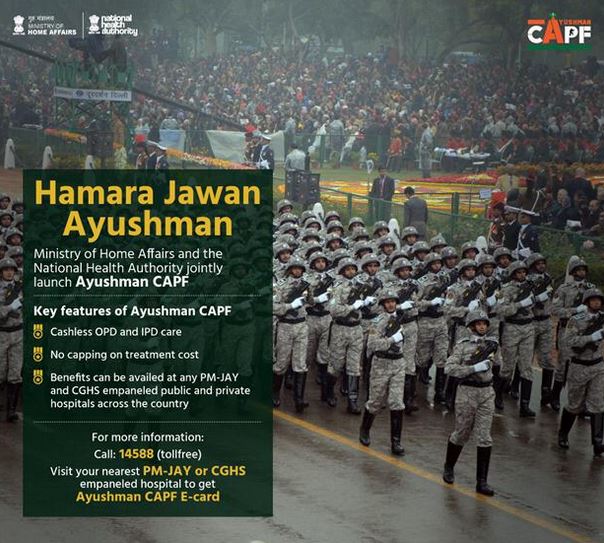
    Union Home Minister has rolled out the ‘Ayushman CAPF’ scheme, extending the benefit of the central health insurance programme to the personnel of all Central Armed Police Forces (CAPFs) in the country.

    Who are the CAPFs?

    • The CAPFs refers to uniform nomenclature of five security forces in India under the authority of the Ministry of Home Affairs.
    • Their role is to defend the national interest mainly against the internal threats.
    • They are the Border Security Force (BSF), Central Reserve Police Force (CRPF), Central Industrial Security Force (CISF), Indo-Tibetan Border Police (ITBP), Sashastra Seema Bal (SSB)

    Ayushman CAPF

    • Under this scheme, around 28 lakh personnel of CAPF, Assam Rifles and National Security Guard (NSG) and their families will be covered by ‘Ayushman Bharat: PM Jan Arogya Yojana’ (AB PM-JAY).
    • For the CAPF, the existing health coverage was not comprehensive as compared to other military forces.

    Do you know?

    The goal of universal health coverage (UHC) as stated in the UN Sustainable Development Goals (SDGs no. 3) is one of the most significant commitments to equitable quality healthcare for all.

    About Ayushman Bharat

    • PM-JAY aims to provide free access to healthcare for 40% of people in the country.
    • It is a centrally sponsored scheme and is jointly funded by both the union government and the states.
    • It was launched in September 2018 by the Ministry of Health and Family Welfare.
    • The ministry has later established the National Health Authority as an organization to administer the program.

    Key features:

    • Providing health coverage for 10 crores households or 50 crores Indians.
    • It provides a cover of 5 lakh per family per year for medical treatment in empanelled hospitals, both public and private.
    • Offering cashless payment and paperless recordkeeping through the hospital or doctor’s office.
    • Using criteria from the Socio-Economic and Caste Census 2011 to determine eligibility for benefits.
    • There is no restriction on family size, age or gender.
    • All previous medical conditions are covered under the scheme.
    • It covers 3 days of pre-hospitalization and 15 days of post-hospitalization, including diagnostic care and expenses on medicines.
    • The scheme is portable and a beneficiary can avail medical treatment at any PM-JAY empanelled hospital outside their state and anywhere in the country.

    Note these features. They cannot be memorized all of sudden but can be recognized if a tricky MCQ comes in the prelims.

    Must read:

    [Burning Issue] Ayushmaan Bharat

  • Wildlife Conservation Efforts

    Places in news: Sundarban Biosphere Reserve

    Indian Sunderbans, which is part of the largest mangrove forest in the world, is home to 428 species of birds, a recent publication of the Zoological Survey of India (ZSI) States.

    Sundarban Biosphere Reserve

    • Sundarbans is the largest delta and mangrove forest in the world.
    • The Indian Sunderbans, which covers 4,200 sq km, comprises of the Sunderban Tiger Reserve of 2,585 sq km is home to about 96 Royal Bengal Tigers (2020) is also a world heritage site and a Ramsar Site.
    • The Indian Sunderbans is bound on the west by river Muriganga and on the east by rivers Harinbhahga and Raimangal.
    • Other major rivers flowing through this eco-system are Saptamukhi, Thakuran, Matla and Goasaba.
    • Recent studies claim that the Indian Sundarban is home to 2,626 faunal species and 90% of the country’s mangrove varieties.

    What is the latest research?

    • The scientists have listed 428 birds, some, like the Masked Finfoot and Buffy fish owl, are recorded only from the Sunderbans.
    • India has over 1,300 species of birds and if 428 species of birds are from Sunderbans.
    • The area is home to nine out of 12 species of kingfishers found in the country as well rare species such as the Goliath heron and Spoon-billed Sandpiper.

    Try this PYQ:

    With reference to India’s biodiversity, Ceylon frogmouth, Coppersmith barbet, Gray-chinned miniyet and White-throated redstart are

    (a) Birds

    (b) Primates

    (c) Reptiles

    (d) Amphibians

  • Right To Privacy

    New WhatsApp Privacy Policy

    Privacy policy update by the WhatsApp recently led to widespread protest from the user forcing company to put the update on hold. If India had made Personal Protection Bill into the law, the privacy policy update would have been illegal. The article deals with this issue.

    About WhatsApp

    • WhatsApp’s unique blend of text, audio, and voice messaging and calling platform.
    • In November 2014, WhatsApp adopted the Signal protocol for end-to-end encryption after its acquisition by Facebook.
    • WhatsApp has two billion users worldwide, of which 400 million are in India, the largest in any country.

    What the privacy policy update is about

    • The updated policy seeks consent from users to allow the platform to share their data with Facebook and its companies,
    • It means that WhatsApp would share transaction data, mobile device information, IP addresses, and other metadata on how users interact with businesses on WhatsApp.
    • Such sharing would be done with the user being notified before the start of a chat if the business uses Facebook to store and analyze data and the user would have the option of blocking the business.
    • The update would defy the principle of purpose limitation that has been the yardstick of addressing privacy concerns at a global level.

    What is the principle of purpose limitation

    • The Indian government has also sent a strong note to WhatsApp, seeking the company’s response to 14 queries.
    • This note has sent a clear message to WhatsApp to not subject Indian users to greater information security risks and vulnerabilities with the consolidation of data from WhatsApp and Facebook.
    • In the note, the government referred to the principle of purpose limitation provisions in the Personal Data Protection Bill (PDPB) currently being discussed by a joint select committee.
    • Had the bill been passed by now, WhatsApp’s move would have been illegal.
    • Provisions in the bill required that every data intermediary has to take explicit permission from the user whose data would be harvested.
    • Even the method of data classification into sensitive personal data and critical data has been defined and their processing possibilities mentioned in the bill.

    Way forward

    • The government should make the Personal Data Protection Bill into law so that such restrictive practices can never be introduced in the first place.
    • It is due to such law, WhatsApp did make an exception for its users in the European Union.
    • The Competition Commission of India should take note that this is a classic case of an organization using its near-monopolistic power to push through something that is not in the consumer interest.

    Consider the question “What is the principle of purpose limitation in the Personal Data Protection Bill? How it can help user protect its privacy?”

    Conclusion

    As Digital India expands and brings in more users from the current base of 70 crores, and more take to social media for communications and business, they must be ensured a safer digital space, given that most wouldn’t be aware of the reach of the data being generated.

  • A new framework around caste and the census

    The article suggests the ways to make the most of the data collected through Census and the SECC.

    Census and issues with it

    • The synchronous decennial Census has evolved over time and has been used by the government, policymakers, academics, and others.
    • Though Census is both a data collection effort and a technique of governance, it is criticized for not being useful enough for a detailed and comprehensive understanding of a complex society.
    •  There is a lack of depth in the Census where some issues are concerned.

    The debate around full-scale Caste Census

    • Since Independence, aggregated Census data on the Scheduled Castes and Scheduled Tribes on certain parameters such as education have been collected.
    • There is a growing demand for a full-scale caste census to capture contemporary Indian society and to understand and remedy inequalities.
    • While others believe that this large administrative exercise of capturing caste and its complexities is not only difficult but also socially untenable.
    • There have been concerns that counting caste may help solidify or harden identities, or that caste may be context-specific, and thus difficult to measure.
    • The other concern is whether an institution such as a caste can even be captured completely by the Census.

    Socio-Economic Caste Census: how it is different from Census

    • Following debate over full-scale caste census, the Socio-Economic and Caste Census (SECC) was conducted in 2011.
    • The SECC, which collected the first figures on caste in Census operations since 1931, is the largest exercise of the enumeration of caste.
    • Questions remain on whether the SECC is able to cover the effects of caste as an aspect of Indian social structure.
    • This was a distinct exercise from the Census of 2011.
    • The Census and the SECC have different purposes.
    • Since the Census falls under the Census Act of 1948, all data are considered confidential, whereas the SECC data is open for use by Government departments to grant and/or restrict benefits to households.
    • The Census thus provides a portrait of the Indian population, while the SECC is a tool to identify beneficiaries of state support.

    Way forward

    • What is needed is a discussion on the caste data that already exists, how it has been used and understood by the government.
    • Linking and syncing aggregated Census data to other large datasets such as the National Sample Surveys or the National Family Health Surveys that cover issues that the Census exercises do not, such as maternal health, would be significant for a more comprehensive analysis.
    • This linking of the Census with the National Sample Survey data has been suggested in the past by scholars such as Mamta Murthi and colleagues.
    • Census operations across the world are going through significant changes, employing methods that are precise, faster, and cost-effective, involving coordination between different data sources.
    • Care must however be taken to ensure that digital alternatives and linking of data sources involving Census operations are inclusive and non-discriminatory, especially given the sensitive nature of the data being collected.
    • Delay in the release of data needs to be reduced.
    • There needs to be a closer and continuous engagement between functionaries of the Census and SECC, along with academics and other stakeholders concerned.

    Consider the question “How Socio-Economic and Caste Census is different from the Census? How linking and syncing of  these data with other databases could help in the governance?”

    Conclusion

    Data collected through both the exercises serve an important purpose in the governance of the country, however, there is scope to widen the use of data if the steps suggested here are implemented.

  • Parliament – Sessions, Procedures, Motions, Committees etc

    Making a Law ‘Operational’

    In the ongoing stalemate between protesting farmers and the Centre, the government has repeated its offer of keeping the three contentious farm laws on hold for one to one-and-a-half years.

    Bringing/removing a law

    • Parliament has the power to make a law and to remove it from the statute books (a law can be struck down by the judiciary if it is unconstitutional).
    • But the passing of a Bill does not mean that it will start working from the next day.
    • There are three more steps for it to become a functioning law.

    Try this PYQ:

    Q.Who/Which of the following is the custodian of the Constitution of India?

    (a) The President of India

    (b) The Prime Minister of India

    (c) The Lok Sabha Secretariat

    (d) The Supreme Court of India

    Making a law operational

    • The first step is the President giving his or her assent to the Bill.
    • Then the law comes into effect from a particular date. President Kovind signed the three farm Bills into law within a week of their passing in September 2020.
    • And finally, the government frames the rules and regulations to make the law operational on the ground.
    • The completion of these steps determines when the law becomes functional.

    Presidents’ actions

    • Article 111 of the Constitution specifies that the President can either sign off on the Bill or withhold his consent.
    • The President rarely withholds their assent to a Bill.
    • The last time it happened was in 2006 when President APJ Abdul Kalam refused to sign a Bill protecting MPs from disqualification for holding an office of profit.
    • A Bill is sent to Parliament for reconsideration if the President withholds his or her assent on it.
    • And if Parliament sends it back to the President, he or he has no choice but to approve it.

    A curious case of date of effect

    • The next step is deciding the date on which the law comes into effect.
    • In many cases, Parliament delegates to the government the power to determine this date.
    • The Bill states that the law “shall come into force on such date as the Central Government may, by notification in the Official Gazette, appoint and different dates may be appointed for different provisions of this Act”.

    Example:  Parliament passed the Recycling of Ships Act in December 2019. In October 2020, the government brought Section 3 of the law into force.  This section empowers the government to designate an officer to supervise all ship recycling activities in India.

    Giving effect to the implementation

    • There are also instances when the government does not bring a law into force for many years.
    • Two examples are the National Environment Tribunal Act and the Delhi Rent Control Act, which Parliament passed during PM P V Narasimha Rao’s tenure.
    • The government never brought these laws into force, which were passed in 1995 and cleared by the President.
    • The NGT Act finally repealed the environmental tribunal law in 2010. And a Bill to repeal the Delhi Rent Control Act introduced in 2013 is still pending in Rajya Sabha

    Rules & regulations to be made

    • For the law to start working on the ground, individuals need to be recruited or given the power, to administer it.
    • The implementing ministry also needs to finalise forms to gather information and provide benefits or services.
    • These day-to-day operational details are called rules and regulations. And Parliament gives the government the responsibility of making them. These regulations are critical for the functioning of law.
    • If the government does not make rules and regulations, law or parts of it will not get implemented.

    Example: The Benami Transactions Act of 1988 is an example of a complete law remaining unimplemented. For 25 years, such properties were immune from seizure in the absence of framing relevant government rules. The law was finally repealed in 2016 and replaced with a new one.

    A final word on implementation

    • Parliament has recommended that the government make rules within six months of passing a law.
    • But parliamentary committees have observed that this recommendation is being followed in breach by various ministries.
    • The government not only has the power to make rules but can also suppress rules made by it earlier.

Join the Community

Join us across Social Media platforms.