💥UPSC 2026, 2027, 2028 UAP Mentorship (March Batch) + Access XFactor Notes & Microthemes PDF

Archives: News

  • Coronavirus – Economic Issues

    Comparing fiscal responses to Covid on qualitative and quantitative basis

    For all the talks over the size of Atmanirbhar package, India’s response turns out to be inadequate when compared with the other countries with similar levels of per capita income. This article analyses the same.

    Context

    • India’s fiscal response is compared to countries which are similar in GDP per capita, state capacity, and structure of the labour force.
    • Before the Atmanirbhar Bharat package, India lagged significantly behind comparable developing countries.
    • As of early July, the gap seems to have narrowed.

    Comparison and challenges

    •  Due to the blurring of the distinction between fiscal and monetary components, ensuring comparable and accurate figures for fiscal responses is a challenge.
    • For example, the total Atmanirbhar package is billed at 10% of GDP by the government.
    • While the headline number for India’s fiscal response in international databases is around 4% of GDP.
    • But some estimated that the new fiscal outlay is around 1.7% of GDP.
    • Vietnam, Indonesia, Pakistan, and Egypt, all while averaging less stringent measures than those in India, have announced stimulus measures that are as large or more substantial, as a share of GDP.

    Demand-side interventions in the package

    • The one significant demand-side intervention in the Atmanirbhar Bharat package was ₹40,000 crore of additional outlay for the MGNREGA.
    • Most other demand-side measures involve the frontloading, consolidation, or rerouting of existing funds.

    How developing countries are financing responses

    • Developing countries are resorting to drastic means to finance COVID-19 responses.
    • Actions so far include the amendment of legal budget limits.
    • Some are also exploring enhanced issuance of bonds-including a ‘pandemic bond’ by Indonesia.
    • Central banks in many emerging economies are experimenting with purchases of public and private bonds in the secondary market (quantitative easing).
    • Or some are directly purchasing government bonds on the primary market (monetising the deficit).
    • In India, the debate continues over whether the Indian government should invoke the “escape cause” in the FRBM Act.
    • Escape clause will enable the central bank to directly finance the deficit.

    Cash transfer: Lessons for India

    • Demand-side interventions announced by other developing countries could provide lessons for additional measures in India.
    • Of the World Bank’s list of 621 measures across 173 countries, half were cash-based. 
    • While only 2% related to public works, a clear indication of the popularity of cash transfers over public works for income support,
    • Countries have also significantly expanded coverage of their cash transfer programmes from pre-COVID-19 levels.
    • Bangladesh and Indonesia have increased the number of beneficiaries by 163% and 111%, respectively.
    • Indonesia’s cash schemes now cover more than 158 million people or 60% of the population.
    • Additionally, the Indonesia central government has directed village authorities to focus their budgets on a cash-for-work programme.

    Suggestions for India

    • India could take these actions about cash transfers into account in decisions about expanding existing transfer programmes or even creating new ones.
    • India has been a leader in employment guarantee policies with its flagship MGNREGA programme.
    • This is the right time to expand entitlements MGNREGA.
    • There is a need to introduce an urban version of the MGNREGA.
    • In India, one reason for the subdued fiscal response and the resort to monetary measures is a concern with the debt-to-GDP ratio.
    • However, aggregate demand and confidence in the economy have slumped and may not recover for many months.
    • Additional fiscal outlay -would save lives and jobs today and might prevent a protracted slowdown.

    Consider the question “How India fares in comparison with other countries over its fiscal response to Covid? Also examine the utility of income support schemes related to public works against the cash transfer schemes adopted by the other countries.”

    Conclusion

    Not spending more now, therefore, might only worsen the debt-to-GDP ratio if growth remains depressed. The fiscal outlay in the form of cash and in-kind transfers and expanded public works schemes is the need of the hour.

    Original op-ed:

    https://www.thehindu.com/opinion/op-ed/the-covid-19-fiscal-response-and-indias-standing/article32154153.ece

  • Coronavirus – Health and Governance Issues

    What is a Serological Survey?

    A Serological Survey was recently conducted in New Delhi to determine the exposure of the novel coronavirus among the population.

    Try this question from CSP 2019:

    Which one of the following statements is not correct?

    (a) Hepatitis B virus is transmitted much like HIV.
    (b) Hepatitis B, unlike Hepatitis C, does not have a vaccine.
    (c) Globally, the number of people infected with Hepatitis B and C viruses is several times more than those infected with HIV.
    (d) Some of those infected with Hepatitis Band C viruses do not show the symptoms for many years.

    Serological Survey

    • A serological survey seeks to assess the prevalence of the disease in a population by detecting the presence of specific antibodies against the virus.
    • A serological test is performed to diagnose infections and autoimmune illnesses. It can also be conducted to check if a person has developed immunity to certain diseases.
    • The survey included the IgG Enzyme-Linked Immunosorbent Assay (ELISA) test which estimates the proportion of the population exposed to SARS-CoV-2 infection.
    • The IgG test is not useful for detecting acute infections, but it indicates episodes of infections that may have occurred in the past.
    • The test has been approved by ICMR for its high sensitivity and specificity.

    Highlights of the Survey

    • The study found the presence of antibodies in 22.86 percent of the people surveyed.
    • It indicated that a large number of infected persons remain asymptomatic.

    Why needed such survey?

    • Since it is not possible to test everyone in the population, serological studies are used as a tool to make an estimate of the extent of disease spread in the community.

    Conclusions from the survey

    • Results show that a significant proportion of the population is still vulnerable to contracting the novel coronavirus infection.
    • Containment measures need to continue with the same rigour.
    • Non-pharmacological interventions such as physical distancing, use of face mask/cover, hand hygiene, cough etiquette and avoidance of crowded places etc. must be followed strictly.
  • Urban Floods

    National Flood Commission

    At least 43 years after India’s first and last commission on floods was constituted, there is no national-level flood control authority in the country so far.

    Try this question for mains:
    Q. What are the various causes of urban floods in India?

    National Flood Commission

    • Rashtriya Barh Ayog or the National Flood Commission (NFC) was set up by the Ministry of Agriculture and Irrigation in 1976.
    • It aimed to study India’s flood-control measures after the projects launched under the National Flood Control Programme of 1954 failed to achieve much success.

    NFCs recommendation

    • In 1980, the NFC made 207 recommendations and four broad observations:
    • First, it said there was no increase in rainfall in India and, thus, the increase in floods was due to anthropogenic factors such as deforestation, drainage congestion and badly planned development works.
    • Second, it questioned the effectiveness of the methods adopted to control floods, such as embankments and reservoirs, and suggested that the construction of these structures be halted until their efficacy was assessed.
    • Third, it said there have to be consolidated efforts among the states and the Centre to take up research and policy initiatives to control floods.
    • Fourth, it recommended a dynamic strategy to cope with the changing nature of floods. An analysis of the report suggested that the problem began with the methods of estimating flood-prone areas of the country.

    Why revive NFC?

    • An accurate estimate is crucial for framing flood management programmes.
    • The NFC estimated that the total area vulnerable to floods in 1980 was around 40 million hectares.
    • There is another problem. The very definition of the flood-prone area does not reflect the effectiveness of the flood management works undertaken.
  • [pib] DDT and its impact on environment

    India has supplied 20.60 MT of DDT to South Africa for its Malaria control program.

    Try this question from CSP 2014:

    With reference to ‘Global Environment Facility’, which of the following statements is/are correct?
    (a) It serves as financial mechanism for ‘Convention on Biological Diversity’ and ‘United Nations Framework Convention on Climate Change’
    (b) It undertakes scientific research on environmental issues at global level
    (c) It is an agency under OECD to facilitate the transfer of technology and funds to underdeveloped countries with specific aim to protect their environment.
    (d) Both (a) and (b)

    What is DDT?

    • Dichloro-diphenyl-trichloroethane commonly known as DDT is a colorless, tasteless, and almost odorless crystalline chemical compound.
    • It was developed as the first of the modern synthetic insecticides in the 1940s.
    • It was initially used with great effect to combat malaria, typhus, and other insect-borne human diseases among both military and civilian populations.

    Why is it controversial?

    • DDT is a persistent organic pollutant that is readily adsorbed to soils and sediments, which can act both as sinks and as long-term sources of exposure affecting organisms.
    • Routes of loss and degradation include runoff, volatilization, photolysis and aerobic and anaerobic biodegradation.
    • Due to hydrophobic properties, in aquatic ecosystems DDT is absorbed by aquatic organisms and thus bio-accumulates in the food web.

    Threats of DDT

    • The bioaccumulation of DDT has caused eggshell thinning and population declines in multiple North American and European bird of prey species.
    • DDT is an endocrine disruptor. It is considered likely to be a human carcinogen.

    In use despite ban

    • A worldwide ban on agricultural use of DDT was formalized under the Stockholm Convention on Persistent Organic Pollutants.
    • But its limited and still-controversial use in disease vector control continues, because of its effectiveness in reducing malarial infections, balanced by environmental and other health concerns.

    Back2Basics: Stockholm Convention on POPs

    • Stockholm Convention is an international environmental treaty, signed in 2001 and effective from May 2004 that aims to eliminate or restrict the production and use of persistent organic pollutants (POPs).
    • In 1995, the United Nations Environment Programme (UNEP) called for global action to be taken on POPs.
    • POPs are defined by the UNEP as chemical substances that persist in the environment, bio-accumulate through the food web, and pose a risk of causing adverse effects to human health and the environment.

    Bioaccumulation and Biomagnification

    • Bioaccumulation and biomagnification are two different processes that often occur in tandem with one another.
    • Bioaccumulation is the process by which toxins enter the food web by building up in individual organisms.
    • Biomagnification is the process by which toxins are passed from one trophic level to the next (and thereby increase in concentration) within a food web.
  • Railway Reforms

    Privatisation of Indian Railways

    Indian Railways has launched the process of opening up train operations to private entities on 109 origin-destination (OD) pairs of routes using 151 modern trains.

    Objectives of privatisation

    • To introduce modern technology rolling stock with reduced maintenance.
    • Reduced transit time.
    • Boost job creation.
    • Provide enhanced safety.
    • Provide world-class travel experience to passengers.
    • Reduce demand-supply deficit in the passenger transportation sector.

    Issues with the move

    1) Responsibility issue

    •  Railway crew will work the trains (151 trains in 109 routes) which will be maintained by the private investor.
    • All the other infrastructure, track and associated structures, stations, signalling, security and their daily maintenance owned by the Railways will be fully utilised in running trains.
    • Thus, the responsibility of the private investor ends with investment in the procurement and maintenance of coaches.
    • Train operation, safety and dealing with every day problems rests with the Railways.
    • In case of an unfortunate event, fixing responsibility will be an issue.

    2) Day-to-day problems

    • Provision of an independent regulator to resolve disagreement, discords and disputes.
    • But this regulator will not be able to solve day-to-day problems of dichotomy unless the basic issue is resolved.

    3) Speed issue

    • Nearly all trunk routes in the existing network are speed limited to 110 kmph very few permit speeds of upto 120-130 kmph.
    • To raise it to 160 kmph, as proposed, there has to be track strengthening, elimination of curves and level crossing gates and strengthening of bridges.
    • There is no appreciable reduction in transit time for most proposed trains, when compared with the timings of the fastest train now operating on that route.

    4) Passenger fare issue

    • In the proposal, the Railways or government have no role in fixing passenger fares.
    • Fares will be beyond the common man’s reach.
    • Fare concessions extended to several categories of people will not be made available by the private investor.
    • The very objective of commissioning the Railways as a public welfare transport organisation is defeated.

    5) Reservation in Jobs

    • The private investor is not bound to follow reservation regulations in employment.
    • This, in turn, will deprive employment opportunities for those who are on the margins of society.

    6) Limited Coverage:

    • An advantage of Indian Railways being government-owned is that it provides nation-wide connectivity irrespective of profit.
    • Privatisation of railways would mean the railways will become a profit-making enterprise, this would lead to the elimination of railways routes that are less popular.
    • Thus, the privatisation of railways can have a negative impact on connectivity and further increase the rural-urban divide.

    7) Impact on the Economy:

    • Indian Railways is the backbone of India, it provides low fare transportation to agricultural and industrial trade.
    • Therefore, privatisation of Indian railways shall definitely affect the Indian economy at large.
    • Way forward
    • There should be no need for the government to take a dual role of a facilitator as well as a participant.
    • In the case of the metro railway services, Hyderabad, for example, an ideal PPP project, the concessionaire is solely responsible for daily maintenance, operation, passenger amenities and staff issues.
    • The State government steps in when it comes to land, power, permissions, law and order, etc. Fare determination is in consultation with the government.
    • Instead of a private entrepreneur, Indian Railway Catering and Tourism Corporation, a government undertaking which has gained experience in running the Tejas Express trains, could have been given the role.

    Consider the question “Indian Railways often hailed as the lifeline of the country continues suffering from several issues. In light of this, evaluate the pros and cons of the privatisation of railways.”

    Conclusion

    This project of privatisation of trains should not result in the common man being deprived of travel facilities. The Indian Railways is a strategic resource for the nation hence it should not be judged solely on its profit-generating capability or market-based return on investment.

  • Agricultural Sector and Marketing Reforms – eNAM, Model APMC Act, Eco Survey Reco, etc.

    APMC Act is not the main problem

    The APMC Act, which is often blamed for the woes of the farmers is not the main problem. This article argues that the root of the problems of Indian agriculture lies somewhere else.

    Agriculture post-1991

    • The priority post-1991 has been given to industry as well as services.
    • Middle-class consumers have been favoured by at the expense of farmers.
    • This neglect of agriculture resulted in an equally unprecedented gap between the standard of living in the rural and urban parts of the country.
    • As a result, the urban/rural ratio, in terms of monthly per capita expenditures, has jumped from 1.84 to 2.42 between 2012 and 2018.
    • This means that an average urban-dweller today can consume almost 2.5 times more than an average person in a village.

    Reforms by the government

    • Government has decided to liberalise India’s agriculture by amending the APMC Act and the Essential Commodities Act.
    • Contract farming will also be introduced in such a way that the buyer can assure a price to the farmer at the time of sowing.

     APMC Act in the context of Shanta Kumar Committee report

    • The argument against the APMC Act is that it does not allow the free market to function due to government intervention.
    •  It denies farmers the opportunity to determine the prices of crops in the marketplace.
    • In theory, this is a valid argument.
    • But, Shanta Kumar Committee observed in 2015 that only 6 per cent of farmers get the Minimum Support Price (MSP).
    • This is because of barriers to access for farmers as only 22 crops are procured under MSP.
    • Infrastructure is also inadequate as there are only an estimated 7,000 APMC mandis across India.
    • Procurement depends on the stocks required by the state.

    Why the APMC Act is not the problem

    1) Farm Pricing is the problem

    • The living costs of farmers was considered while determining agricultural pricing by the Agricultural Prices Commission (APC).
    • CACP that replaced the APC in 1985 added a 10 per cent mark-up over the MSP to account for entrepreneurial costs.
    • Such practices have been gradually eroded post-1991.
    • The problem, therefore, is not state intervention but the way the government deals with agriculture.

    2) APMC Act helped India build up food stocks

    • India managed to weather the 2008 global food crisis only because it had enough food stocks as Indian agriculture was not linked to the international futures market.
    • This was possible due to the procurement done through the APMC Act.

    3) APMC Act reformed already by States

    • Since agriculture is a state subject, the Act has been modified in 17 states.
    •  On the contrary, the condition of peasants has often been affected when the APMC Act has been diluted.
    • Bihar is a case in point.
    • The APMC Act was revoked in 2006 with the same rationale that further deregulation will attract private investment in infrastructure.
    • Not only has that not materialised, but the existing APMC market infrastructure was also dismantled.

    Reforms that Indian Agriculture needs

    1) Subsidy Reforms

    • Indian Agriculture is still too heavily subsidised in favour of the big players.
    • In the Union Budget 2019-20, the allocation for the Ministry of Agriculture was Rs 1,30,485 crore and the fertiliser subsidy alone was estimated at Rs 79,996 crore.
    • But these subsidies are concentrated on a few crops.
    • Agriculture economist Bruno Dorin has shown, only three crops receive more than 60 per cent of the so-called “non-product-specific” support to agriculture — rice, wheat and sugarcane.
    • This has led to environmental degradation like the depletion of groundwater levels and monocultures which are a threat to biodiversity.
    • It has also led to the industrialisation of agriculture, that results in the strengthening of a handful of multinational companies, which supply chemical inputs.
    • Liberalisation would only strengthen the role of large companies — including those in the agri-food sector.

    2) Agriculture needs to be ecologically viable

    • Structurally, farming needs to be made economically and ecologically viable in India.
    • State intervention for better pricing, investments in water harvesting and an agroecological transition could ensure a more resilient system to weather shocks like the current one.
    • The government could draw inspiration from the Andhra Pradesh Community Managed Farming model.
    • It promotes agroecological principles with the use of locally-produced, ecologically-sustainable inputs focusing on soil health..
    • Since the agro-ecological system of farming is more biodiverse in nature, it will make the system more resilient overall.
    • It will provide a safety net for farmers in case of crop damage due to various factors such as climate change or droughts.

    Consider the question “Though the APMC Act has been blamed for the farmers’ issues, it has historically been part of the solution. Critically analyse.”

    Conclusion

    By investing again in agriculture and following, at last, the recommendations of the M S Swaminathan Committee, the Government of India would also help bridge the drastic urban-rural divide.

    To read more about the issue:

    Marketing of Agricultural Produce in India: Definition; Role; APMC Act, Model APMC Act, 2003

    Original article:

    https://indianexpress.com/article/opinion/columns/rural-india-coronavirus-farm-trade-ordinance-apmc-act-6515414/

  • Foreign Policy Watch: India-Middle East

    Costs of neglecting new Arabian business

    The article contrasts the over-emphasis put on the ties with Iran with the neglect of ties with Arab countries in India’s foreign policy. It explores the inherent difficulties in dealing with Iran. And opportunities for India in Arab countries.

    Context

    • Iran is accorded high priority in India’s foreign policy.
    • This stands in stark contrast to the under-appreciation of relationship with Arab countries.

    Reasons for a special relationship with Iran

    • Historical connections.
    • Civilisational bonds.
    • Energy supplies.
    • Regional security.
    • Geographic and demographic size, the geopolitical location next door.
    • Natural resources and the extraordinary talents of its people.

    Importance of Arab countries for India

    • Millions of Indian immigrants in the Arab nations.
    • Massive hard currency remittances from them, and the density of commercial engagement with the Arab Gulf is important for India.
    • The UAE and Saudi Arabia have, in recent years, extended invaluable support in countering terrorism and blocked attempts to condemn India in the Muslim world.

    Let’s analyse the issue of railway contract in Iran

    • Large countries with major foreign investments and projects win some and lose some.
    • Then there is no escaping the political risk associated with foreign projects.
    • And politics, both domestic and international, is all-consuming in Iran.
    • The sanctions regime imposed by the US has crippled the Iranian economy.
    • India is careful not to attract the US sanctions.
    • India did gain an exemption from the US sanctions regime for its participation in the Chabahar port project in Iran.
    • But they don’t apply to some of the partners suggested by Iran in the railway project.
    • So, Iran would like India to break the US sanctions regime.
    • A prudent India is resisting that temptation.
    • It would rather lose the railway contract than get into the raging crossfire between the US and Iran.

    Issue of balancing the relations with Iran and U.S.

    • India’s Iran policy cannot be seen as a test of India’s “strategic autonomy”.
    • Some expect Delhi to conduct its relationship with Iran without a reference to either a cost-benefit calculus or Iran’s troubled relationship with others with whom India has important partnerships.
    • No government in Delhi can buy into that proposition.
    • Criticism of the government policy is similar to what happened in 2005 over India’s stance on Iran’s covert nuclear programme.
    • Delhi’s vote against Iran in the International Atomic Energy Agency drew criticism.
    • But governments stand proved right when Iran concluded a nuclear deal of its own with the US and major powers, a decade later.
    • Iran surely can take care of its own interests, and there is little reason why Delhi must back Tehran in every one of its fights with Washington.

    India should focus on Arab countries

    • The Arab world has had its doors open for political, economic and technological cooperation with India.
    • Three moderate Arab nations — Egypt, Saudi Arabia and the UAE — are confronting radical forces in the region and are valuable partners for India in countering forces of destabilisation.
    •  There is real Chinese economic action in the Arab world as the region embraces China’s Belt and Road Initiative.
    • India is no minor economic force in the Arab world, having had a much longer engagement with the region than China.
    • Delhi must up its own commercial game in the Arab world, and one of the new possibilities for India lies in the domain of new technologies.
    • There is emerging sentiment among the Gulf Arabs to reduce the over-dependence on oil, promote alternative energy sources, invest in higher education, and develop technology hubs.

    Consider the question “India’s relations with Iran has always been driven by the geopolitical contexts. This poses an inherent challenge for both countries. In light of this examine the importance of Iran for India and challenges India’s foreign policy faces in dealing with Iran.”

    Conclusion

    India must focus on elevating India’s economic partnership with the Arab world to the next level. For India, the costs of neglecting the new possibilities for wide-ranging Arabian business are far higher than a lost railway contract in Iran.

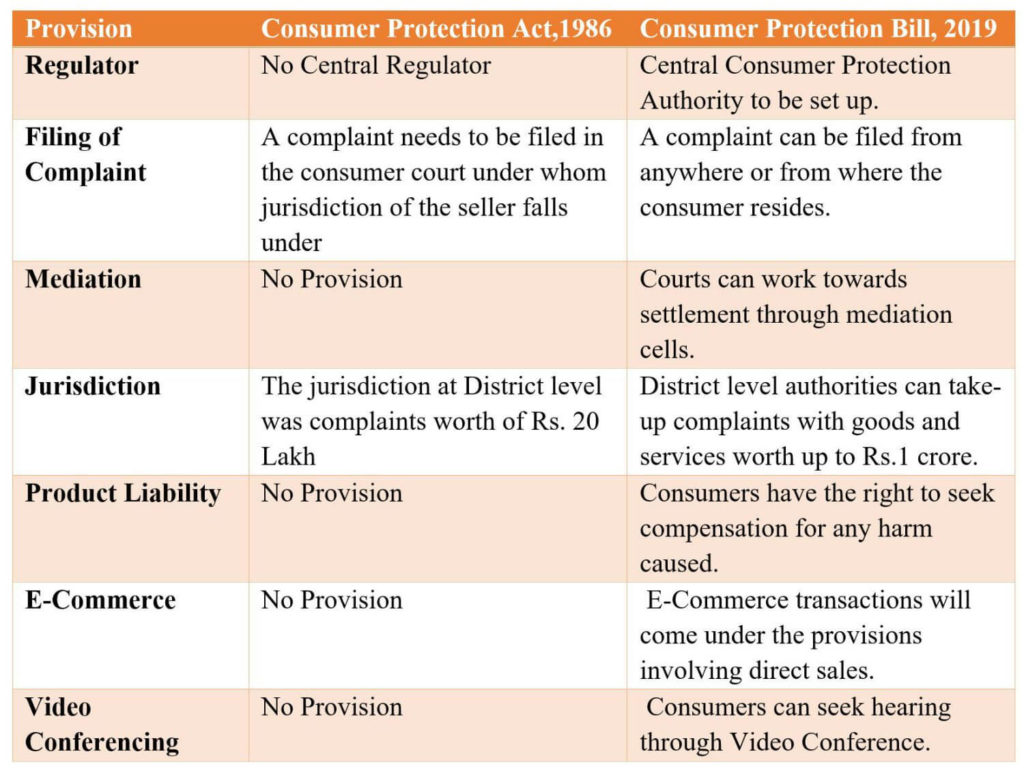
  • Explained: Consumer Protection Act, 2019

    The Consumer Protection Act, 2019 has come into effect from July 20, replacing the earlier Consumer Protection Act, 1986.

    Consumer Protection Act_Provisions of Consumer Protection Act 2019

    What are the Rights of the Consumers?

    Try this question from our AWE initiative 

    Compare and contrast the Consumer Protection Act 1986 with that of the Consumer Protection Bill 2018. How far do you think the changes made are consumer centric towards benefiting the consumer more? Examine. (250 W/ 15 M)

    Consumer Protection Act, 2019: Key Features

    1) Definition of consumer

    • A consumer is defined as a person who buys any good or avails a service for a consideration. 
    • It does not include a person who obtains a good for resale or a good or service for commercial purpose. 
    • It covers transactions through all modes including offline, and online through electronic means, teleshopping, multi-level marketing or direct selling.

    2) Rights of consumers

    The following consumer rights have been defined in the Act, including the right to:

    • be protected against marketing of goods and services which are hazardous to life and property;
    • be informed of the quality, quantity, potency, purity, standard and price of goods or services;
    • be assured of access to a variety of goods or services at competitive prices; and
    • seek redressal against unfair or restrictive trade practices.
       

    3) Establishment of Central Consumer Protection Authority

    • The central government will set up a CCPA to promote, protect and enforce the rights of consumers. 
    • It will regulate matters related to violation of consumer rights, unfair trade practices, and misleading advertisements. 
    • The CCPA will have an investigation wing, headed by a Director-General, which may conduct inquiry or investigation into such violations. 

    4) Penalties for misleading advertisement

    • The CCPA may impose a penalty on a manufacturer or an endorser of up to Rs 10 lakh and imprisonment for up to two years for a false or misleading advertisement. 
    • In case of a subsequent offence, the fine may extend to Rs 50 lakh and imprisonment of up to five years. 
    • CCPA can also prohibit the endorser of a misleading advertisement from endorsing that particular product or service for a period of up to one year.
    • For every subsequent offence, the period of prohibition may extend to three years.  

    5) Consumer Disputes Redressal Commission

    • CDRCs will be set up at the district, state, and national levels. 
    • A consumer can file a complaint with CDRCs in relation to: unfair or restrictive trade practices; defective goods or services etc.
    • Complaints against an unfair contract can be filed with only the State and National   Appeals from a District CDRC will be heard by the State CDRC. 
    • Appeals from the State CDRC will be heard by the National CDRC.  Final appeal will lie before the Supreme Court.

    6) Jurisdiction of CDRCs

    • The District CDRC will entertain complaints where value of goods and services does not exceed Rs one crore. 
    • The State CDRC will entertain complaints when the value is more than Rs one crore but does not exceed Rs 10 crore. 
    • Complaints with value of goods and services over Rs 10 crore will be entertained by the National CDRC.
       

    7) Product liability

    • Product liability means the liability of a product manufacturer, service provider or seller to compensate a consumer for any harm or injury caused by a defective good or deficient service. 
    • To claim compensation, a consumer has to prove any one of the conditions for defect or deficiency, as given in the Act.

    With inputs from: PRS

  • Ministry of External Affairs : Important Updates

    What is the Non-Aligned Movement (NAM)?

    Non-alignment is an old concept today, and India has adopted an approach of “issue-based alignment”, according to External Affairs Minister S. Jaishankar.

    Try this question for mains:

    Q.“The gradual exit of the US from institutional geopolitics has created an ocean of opportunity for small nations”. Discuss.

    What is the Non-Aligned Movement (NAM)?

    • The NAM is a forum of 120 developing world states that are not formally aligned with or against any major power bloc.
    • The group was started in Belgrade, Yugoslavia in 1961.
    • After the UN, it is the largest grouping of states worldwide.

    Its formation

    • NAM emerged in the context of the wave of decolonization that followed World War II.
    • It was created by Yugoslavia’s President, Josip Broz Tito, India’s first PM, Jawaharlal Nehru, Egypt’s second President Gamal Abdel Nasser, Ghana’s first president Kwame Nkrumah, and Indonesia’s first President, Sukarno.
    • All five leaders believed that developing countries should not help either the Western or Eastern blocs in the Cold War.
    • As a condition for membership, the states of the NAM cannot be part of a multilateral military alliance (such as the NATO) or have signed a bilateral military agreement with one of the “big powers” involved in Great Power conflicts.
    • However, its idea does not signify that a state ought to remain passive or even neutral in international politics.

    Its relevance today

    • One of the challenges of the NAM in the 21st century has been to reassess its identity and purpose in the post-Cold War era.
    • The movement has continued to advocate for international cooperation, multilateralism, and national self-determination, but it has also been increasingly vocal against the inequities of the world economic order.
    • On the contrary, from the founding of the NAM, its stated aim has been to give a voice to developing countries and to encourage their concerted action in world affairs.

    The geopolitics of opportunity

    • Non-alignment was a term of a particular era and geopolitical landscape. One aspect was independence, which remains a factor of continuity for India.
    • The consequences of global shifts, including the US and the assertiveness of China, are opening spaces for middle powers like India, Japan, the EU and others.

    US repositioning has impacted everyone

    • The consequence of repositioning of the US, that the big umbrella is now smaller than it used to be, has allowed many other countries to play more autonomous roles.
    • India needs to take more “risks”, as the world expected it to take a more proactive stance on various issues including connectivity, maritime security, terrorism, climate change and terrorism.
  • Telecom and Postal Sector – Spectrum Allocation, Call Drops, Predatory Pricing, etc

    Adjusted Gross Revenue (AGR) in Telecom Sector

    The Centre and telcos assured the Supreme Court that they would not conduct any re-assessment or re-calculation of the Adjusted Gross Revenue (AGR) dues, which now stands at ₹1.6 lakh crore.

    Try this question for mains:

    Q.What are the various challenges faced by India’s telecom before the upgradation to 5G technology?

    What is AGR?

    • Adjusted Gross Revenue (AGR) is the usage and licensing fee that telecom operators are charged by the Department of Telecommunications (DoT).
    • It is divided into spectrum usage charges and licensing fees, pegged between 3-5 per cent and 8 per cent respectively.

    What is the issue?

    • The Bench observed that 15 or 20 years was not a reasonable time period and the telcos must come forward with an appropriate time frame.
    • The Centre had earlier urged the court that up to 20 years be given to the firms for the payments.
    • The telcos said they were in no position to give fresh bank guarantees for the payments.

    Why is AGR important?

    • The definition of AGR has been under litigation for 14 years.
    • While telecom companies argued that it should comprise revenue from telecom services, the DoT’s stand was that the AGR should include all revenue earned by an operator, including that from non-core telecom operations.
    • The AGR directly impacts the outgo from the pockets of telcos to the DoT as it is used to calculate the levies payable by operators.

    Read the complete issue here at:

    https://www.civilsdaily.com/news/explained-adjusted-gross-revenue-agr-in-telecom-sector/

Join the Community

Join us across Social Media platforms.
