💥UPSC 2027,2028 Mentorship (April Batch) + Access XFactor Notes & Microthemes PDF

Archives: News

  • Solar Energy – JNNSM, Solar Cities, Solar Pumps, etc.

    What India should do to get its energy transition right

    The article analyses the problems renewable energy faces in India and suggests the pathways to overcome these challenges.

    India’s commitments and goals

    • India has committed in the 2015 Paris Agreement to reduce GHG emissions intensity by 33-35% below 2005 levels.
    • It also committed to achieve 40% of installed electric power capacity from non-fossil sources by 2030.
    • At the UN General Assembly in 2019, we announced a target of 450 GW of renewable energy (RE) by 2030.

    Let’s look into CEA study

    • The optimal electricity mix study of the Central Electricity Authority (CEA), estimated 430 GW non-hydro renewables (280 GW solar + 140 GW wind + 10 GW bio) by 2030.
    • Study put thermal capacity at 266 GW by 2030.
    • So, it puts the percentage of non-fossil fuel (RE + hydro + nuclear) in installed capacity by 2030 at 64%.
    • Which is much higher than India’s Paris commitment.

    Coal contradiction

    • The target for coal production at 1.5 billion tonnes, which was set in 2015, has been reinforced recently to be achieved by 2024.
    • Privatisation of coal mining and recent auctions have given a meaningful thrust to this.
    • Looked at the target set for renewable energy, targets for cola production convey contradictory signals.
    • The targeted coal production of 1.5 billion tonnes, even by 2030, would mean thermal generation capacity could double over the current 223 GW.
    • In that case, even with targeted RE capacity, we will not achieve our emissions intensity Paris commitment.
    • Can a global green champion announce doubling its coal production in five years?

    Problems with Renewables

    1. Policy Issues

    • Solar deployment has seen policy challenges both from Centre and states, these include-
    • Continuous changes in duty structure.
    • Renegotiation of PPAs.
    • Curtailment of solar power.
    • Extremely delayed payments in some states.
    • Policy flip-flops on open access and net metering.
    • Delays by state agencies and regulators.
    • Land possession difficulties.
    • Transmission roadblocks even in solar parks.

    2. Solar cell manufacturing constraints

    • Our capacity for cell manufacture is 3 GW, though workable capacity is actually around 2 GW.
    • Domestically manufactured cells are more expensive and less efficient.
    • There is little upgrade in a rapidly changing world of technology.
    •  90% of cells and 80% modules are imported largely from China or Chinese companies elsewhere.
    • Wafer imports are 100% as we don’t manufacture ingots/wafers.
    • For every GW with an average cost of Rs 5,000 crore in 2019, more than half goes to China.

    3. Storage constraints

    •  Hydro pump storage is limited in quantity and there will be an issue of costs.
    • The other project is a solar-wind hybrid with batteries installed after a few years.
    • Neither intends to meet peak power demand or even the baseload.
    • Forecasts suggest lowering of battery costs by 50% by 2030.
    • It makes sense to wait before we go for large-scale storage.

    Manufacturing domestically

    • 1) At the least plan to make 5 GW of ingot/wafer manufacturing capacity urgently.
    • We may require electricity supply at about Rs 3 per unit, and dedicated power plants.
    • The risk of technology obsolescence would need to be factored in.
    • Policy, fiscal and financial support prescriptions should aim at creating globally competitive industry.
    • 2) We need to develop batteries suitable for extreme Indian weather conditions but globally benchmarked.
    • This demands a mission approach, getting our best people and institutions together, properly funded and tasked to get a battery out in the next three years.
    • 3) We must also simultaneously launch a hydrogen mission—target heavy vehicle mobility through fuel cells.
    • It may become a solution for RE storage, too.

    The issue of supply-demand mismatch

    • In the last two decades, we have been overestimating demand and increasing supply.
    • Our demand projections for 2030 are wildly high.
    • PLF in 2018-19 was 60.30, declining to 56.08 in 2019-20 and hovering around 50% with the Covid-19 impact.
    • Even the latest CEA review of ‘optimal’ mix talks of thermal PLF of 59% in 2030!
    • This is inefficient and costly.
    • Thermal PLF must be taken to over 80%.

    The suggested pathways

    • 1. Build thermal capacity as per CEA estimates and quickly. None after 2030. Retire inefficient plants. Plan for miner rehabilitation.
    • 2. Accelerate RE after 2030 with storage. Aim for 10 GW solar and 5 GW wind annually.
    • 3. Develop 5-10 GW ingot/wafer manufacturing capacity urgently and diversify import sources even at some extra cost.
    • 4. Develop a battery for Indian conditions in three years; full battery manufacturing in India in five years.
    • 5. Revisit the manner of solar generation. Prioritise decentralised and solar agriculture.
    • 6. Plan for hydrogen economy with pilot projects and dedicated highways for long and heavy haul traffic.
    • 7. Put a strong energy demand management system into place with much stronger energy efficiency and the conservation movement.

    Consider the question “Central Electricity Authority finalised the optimal electricity mix study recently setting the targets for the future. Examine the constraints that expansion of solar energy faces and suggest the pathways to overcome the challenges.”

    Conclusion

    Embracing the RE will help India economically and strategically. It will also help it achieve its targets in its fight against climate change.


    Back2Basics: Central Electricity Authority

    • Central Electricity Authority (CEA) is an organization originally constituted under Section 3(1) of the repealed Electricity (Supply) Act, 1948, since substituted by Section 70 of the Electricity Act, 2003.
    • It was established as a part-time body in 1951 and made a full-time body in 1975.
    • The functions and duties of CEA are delineated under Section 73 of the Electricity Act, 2003

    Plant Load Factor (PLF)

    • Plant Load Factor (PLF) is the ratio of average power generated by the plant to the maximum power that could have been generated for a given time period.

    Original Op-ed

    https://www.financialexpress.com/opinion/what-india-should-do-to-get-its-energy-transition-right/2016648/

  • Issues over Kuwait Expat Bill

    A total of eight lakh Indians could be forced to leave Kuwait as it’s National Assembly committee has approved a draft expat quota bill seeking to reduce the number of foreign workers in the Gulf country.

    Do you know?

    India is the world’s top recipient of remittances with its diaspora sending a whopping $79 billion back home in 2018 a/c to the World Bank. It is followed by China (USD 67 billion), Mexico (USD 36 billion), the Philippines (USD 34 billion), and Egypt (USD 29 billion).

    What is the Expat Bill about?

    • Amid a slump in oil prices and the coronavirus pandemic, there has been a spike in anti-expat rhetoric as lawmakers and government officials call for reducing the number of foreigners in Kuwait.
    • According to the bill, Indians should not exceed 15% of the population.
    • The draft once turned to the law will impose a cap on the number of expats and gradually reduce them by almost 5% on a yearly basis.

    A demographic issue

    • Kuwait has a real problem in its population structure, in which 70% are expats.
    • The 1.3 million of the 3.35 million expats are either illiterate or can merely read and write.
    • Kuwait has also been working to reduce its dependence on foreign workers.

    A huge diaspora at stake

    • There are about 28,000 Indians working for the Kuwaiti Government in various jobs like nurses, engineers in national oil companies and a few as scientists.
    • The majority of Indians (5.23 lakh) are employed in private sectors. In addition, there are about 1.16 lakh dependents.
    • Out of these, there are about 60,000 Indian students studying in 23 Indian schools in the country.

    Impacts on Indians

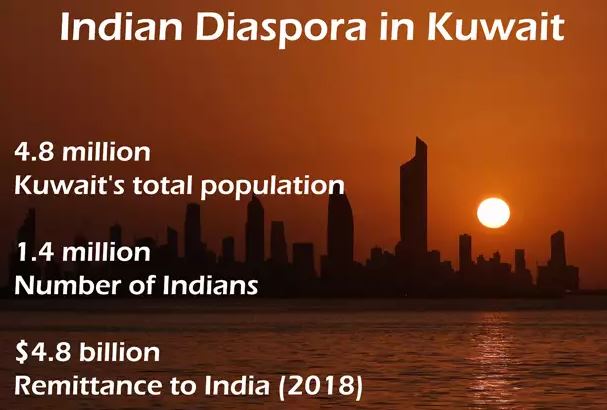
    • The current population of Kuwait is 4.3 million, with Kuwaitis making up 1.3 million of the population, and expats accounting for 3 million.
    • This bill would result in 8,00,000 Indians leaving Kuwait, as the Indian community constitutes the largest expat community in the country, totalling 1.45 million.
    • As the MEA says, Indians are present in all segments of society in Kuwait and are largely considered disciplined, hardworking and law-abiding.
    • India has often in the past played up the role of the Indian community in Kuwait as an important factor in bilateral ties.

    Must read:

    India’s rising Forex Reserves

  • Foreign Policy Watch: India-United States

    U.S. stance on CAATSA unchanged

    Recently India had planned for the purchase of Mig-19 fighter aircraft with Russia at an estimated Rs. 18,148 crore. The U.S has reacted to countries, including India, on sanctions for the purchase of Russian arms has not changed.

    Practice question for mains:

    Q.What is CAATSA law? Discuss how it will impact India’s ties with Russia.

    About CAATSA

    • CAATSA stands for Countering America’s Adversaries through Sanctions Act (CAATSA).
    • It is a US federal law that imposed sanctions on Iran, North Korea, and Russia.
    • The bill provides sanctions for activities concerning:

    (1) cybersecurity, (2) crude oil projects, (3) financial institutions, (4) corruption, (5) human rights abuses, (6) evasion of sanctions, (7) transactions with Russian defence or intelligence sectors, (8) export pipelines, (9) privatization of state-owned assets by government officials, and (10) arms transfers to Syria.

    A cause of worry

    • While the US has become its second-largest defence supplier, mainly of aircraft and artillery, India still relies heavily on Russian equipment, such as submarines and missiles that the US has been unwilling to provide.
    • Seventy per cent of Indian military hardware is Russian in origin.
    • India is set to receive the S-400 Triumf air defence system.

    Is India the only country facing CAATSA sanctions?

    • Notably, Russia is India’s major defence supplier for over 6 decades now, and Iran is India’s second-largest oil supplier.
    • By coincidence, CAATSA has now been invoked by the US twice already, and both times for countries buying the Triumf system from Russia.
    • In September 2018, the US announced sanctions for the procurement of the S-400 Triumf air defence system and Sukhoi S-35 fighter aircraft.
    • Washington expelled Turkey from the F-35 fighter jet programme in July this year after the first delivery of S-400s was received.
    • India is neither like China, which has an inimical relationship with the U.S., and hence not bound by its diktats, nor like Turkey which is a NATO ally of the US.
  • Foreign Policy Watch: India-China

    De-escalation begins on LAC

    Three weeks after the worst military clashes in decades, India and China have begun the process of disengagement at contentious locations along the Line of Actual Control (LAC).

    Must read:

    [Burning Issue] India-China Skirmish in Ladakh

    China is moving back

    • In the Galwan Valley, Chinese troops have shifted 2 kilometres from the site violent clashes while some tents had been removed by the PLA in the Finger 4 area of Pangong Tso.
    • India’s claim is till Finger 8 as per the alignment of the LAC.
    • Some rearward movement of vehicles was seen at the general area of Galwan, Hotsprings and Gogra.
    • Without giving the specific distances moved, the source said the pullback at each location would be confirmed after verification.

    Lessons learnt

    • The lesson for us in Doklam is that disengagement is not enough in order to declare an end to tensions at the LAC.
    • It is necessary that we define endpoints up to where the troops must withdraw to and no understanding should be reached without the restoration of status quo ante.
    • Endpoint variances reflect the potential for future troubles along the LAC.
  • New Species of Plants and Animals Discovered

    Species in news: Golden Birdwing

    A Himalayan butterfly named golden birdwing is now India’s largest recorded butterfly.

    Try this MCQ:

    Q.The Himalayan Golden Birdwing recently seen in news is a:

    a)Biggest butterfly

    b)Smallest avian specie

    c)Biggest freshwater fish

    d)Honeybee

    Golden Birdwing

    • A Himalayan butterfly named golden birdwing is now India’s largest, a record the southern birdwing held for 88 years.
    • The male golden birdwing is much smaller at 106 mm.
    • With a wingspan of 194 mm, the female of the species is marginally larger than the southern birdwing (190 mm) that Brigadier William Harry Evans, a British military officer and lepidopterist, recorded in 1932.
    • It was an individual of the southern birdwing which was then treated as a subspecies of the common birdwing.

    Other butterflies in news

    • The Malabar Banded Peacock or the Buddha Mayoori which was recently declared the ‘State Butterfly’ of Kerala will have a dedicated butterfly park in Kochi.
    • Tamil Nadu has also recently declared Tamil Yeoman (Cirrochroa Thais)as its state butterfly to symbolise its rich natural and cultural heritage, in a move aimed at boosting the conservation efforts of the attractive insects.
    • Other states to have state butterflies are Maharashtra (Blue Mormon), Uttarakhand (Common peacock), Karnataka (Southern birdwings).
  • Foreign Policy Watch: India-China

    Sakteng Wildlife Sanctuary

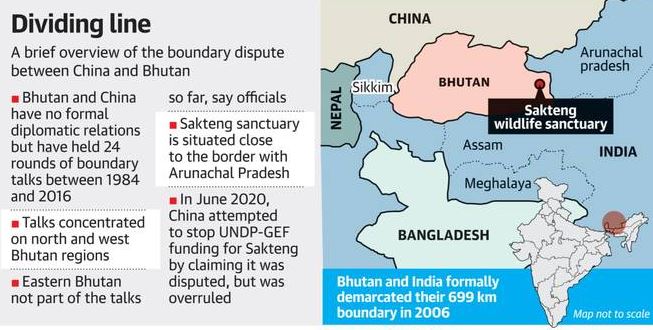
    In a bid to further its territorial ambitions, China has recently claimed the Sakteng wildlife sanctuary in Eastern Bhutan as its own territory.

    Practice question for mains:

    Q.What are the various fronts of Chinese imperial expansionism across the South Asian Region?

    About the Sakteng WLS

    • Sakteng is a wildlife sanctuary located mostly in Trashigang District and just crossing the border into Samdrup Jongkhar District, Bhutan.
    • It is one of the country’s protected areas.
    • It is listed as a tentative site in Bhutan’s Tentative List for UNESCO inclusion.

    Certain unresolved issues

    • The boundary between China and Bhutan has never been delimited.
    • There have been disputes over the eastern, central and western sectors for a long time.
    • China last month attempted to stop funding for the Sakteng sanctuary from the U.N. Development Programme’s Global Environment Facility (GEF) on the grounds that it was “disputed” territory.

    Reasons for the dispute

    • According to written records, there has been no mention of Eastern Bhutan, or Trashigang Dzongkhag (district), where Sakteng is based as per boundary negotiations held between the two countries between 1984 and 2016.
    • The negotiations have not been held since the Doklam standoff between Indian and Chinese troops in 2017.
    • Bhutan has always maintained a discreet silence on its boundary negotiations with China, and it does not have any formal diplomatic relations with Beijing.
  • World Drug Report: India in top five list

    According to the latest World Drug Report of the United Nations Office on Drugs and Crime (UNODC), the fourth highest seizure of opium in 2018 was reported from India, after Iran, Afghanistan and Pakistan.

    Drug seizures in India and neighbourhood

    • The maximum of 644 tonnes of opium was seized in Iran, followed by 27 tonnes in Afghanistan and 19 tonnes in Pakistan.
    • In India, the figure stood at four tonnes in 2018.

    Heroin

    • Heroin is manufactured from the morphine extracted from the seed pod of opium poppy plants.
    • Iran reported the highest seizure of heroin (25 tonnes), followed by Turkey, United States, China, Pakistan and Afghanistan.
    • India was at the 12th position in the world.

    Global pattern

    • 97% of the total global production of opium in the past five years came from only three countries.
    • About 84% of the total opium was produced in Afghanistan, from where it is supplied to neighbouring countries, Europe, west Asia, south Asia and Africa.
    • From Myanmar, which accounts for 7% of the global opium production, and Laos, where 1% of the opium is produced, it is supplied to east and south-east Asia and Oceania.
    • Mexico accounts for 6% of the global opium production, while Colombia and Guatemala account for less than 1% of global production.

    Some other details

    • The report said that the global area under opium poppy cultivation declined for the second year in a row in 2019.
    • It went down by 17% in 2018 and by 30% in 2019.
    • Despite the decline in cultivation, opium production remained stable in 2019, with higher yields reported in the main opium production areas.
    • Quantities of seized opiates remained concentrated in Asia, notably in south-west Asia (70%).
    • Asia is host to more than 90% of global illicit opium production.
    • Also, it is the world’s largest consumption market for opiates and also accounts for almost 80% of all opiates seized worldwide in 2018.

    Consider the question asked in 2018 “India’s proximity to two of the world’s biggest illicit opium-growing states has enhanced her internal security concerns. Explain the linkages between drug trafficking and other illicit activities such as gunrunning, money laundering and human trafficking. What countermeasures should be taken to prevent the same?”

  • Railway Reforms

    Railways to become Net Zero Carbon Emission Mass Transport by 2030

    A new dawn ushers on Indian Railways as it endeavors to be self-reliant for its energy needs as directed by the Prime Minister and solarise railway stations by utilizing its vacant lands for Renewable Energy (RE) projects.

    Moving towards ‘Net Zero’ Carbon Emission Railways

    • The Ministry of Railways has decided to install solar power plants on its vacant unused lands on mega-scale.
    • The use of solar power will accelerate the mission to achieve a conversion of Indian Railways to ‘Net Zero’ Carbon Emission Railway.
    • Railway Energy Management Company Ltd. (REMCL) is working to further proliferate the use of solar energy on mega scale.
    • It has already floated tenders for 2 GW of solar projects for Indian Railways to be installed on unutilised railway lands.

    Projects along operational railway lines

    • Indian Railways is also adopting an innovative concept of installation of solar projects along operational railway lines.
    • This will help in preventing encroachment, enhancing the speed and safety of trains and reduction of infrastructure costs due to direct injection of solar power into the traction network.
    • With these mega initiatives, Indian Railways is leading India’s fight against climate challenge.
    • These are significant steps towards meeting its ambitious goal of being a net zero carbon emissions organisation and meeting India’s Intended Nationally Determined Contributions (INDC) targets.


  • Industrial Sector Updates – Industrial Policy, Ease of Doing Business, etc.

    Agreement for Emergency Response Programme for MSME

    The World Bank and the Government of India signed the $750 million agreement for the MSME Emergency Response Programme to support increased flow of finance into the hands of micro, small, and medium enterprises (MSMEs), severely impacted by the COVID-19 crisis.

    How will the agreement protect the MSME sector

    1. Unlocking liquidity

    • The Government is focused on ensuring that the abundant financial sector liquidity available flow to NBFCs and that banks.
    • Banks and NBFCs have turned extremely risk-averse.
    • This project will support the Government in providing targeted guarantees to incentivize NBFCs.
    • Project will also support banks to continue lending to viable MSMEs to help sustain them through the crisis.
    • It will be achieved by de-risking lending from banks and Non-Banking Financial Companies (NBFCs) to MSMEs.
    • This derisking will be done through a range of instruments, including credit guarantees.

    2. Strengthening NBFCs and SFBs

    • Improving the funding capacity of the NBFCs and Small Finance Bank (SFBs), will help them respond to the urgent and varied needs of the MSMEs.
    • This will include supporting government’s refinance facility for NBFCs.
    • In parallel, the IFC is also providing direct support to SFBs through loans and equity.

    3. Enabling financial innovation

    • Only about 8 percent of MSMEs are served by formal credit channels.
    • The program will incentivize and mainstream the use of fintech and digital financial services in MSME lending and payments.
    • Digital platforms will play an important role by enabling lenders, suppliers, and buyers to reach firms faster and at a lower cost.
    • The digital platform will be helpful especially to small enterprises who currently may not have access to the formal channels.
  • Innovations in Sciences, IT, Computers, Robotics and Nanotechnology

    Explaining Lithium increase in the Universe

    In a study recently published in Nature Astronomy scientists from Indian Institute of Astrophysics (IIA) along with their international collaborators have provided a robust observational evidence for the first time that Li production is common among low mass Sun-like stars during their He-core burning phase.

    Importance of lithium in our life

    • Light inflammable, metal lithium (Li) has brought about transformation in modern communication devices and transportation.
    • A great deal of today’s technology is powered by lithium in its various shades [remember Li-ion battery!].
    • But where does the element come from?
    • The origin of much of the Li can be traced to a single event, the Big-Bang that happened about 13.7 Billion years ago, from which the present-day Universe was also born.

    Why lithium was thought to be different?

    • Li content in the physical Universe has increased by about a factor of four over the life of the Universe.
    • However, the rest of the elements carbon, nitrogen, oxygen, iron, nickel and so on which grew about a million times over the lifetime of the Universe.
    • Li, however, understood to be an exemption!
    • Current understanding is that lithium in stars like our Sun only gets destroyed over their lifetime.
    • As a matter of fact, the composition of all the elements in the Sun and the Earth is similar.
    • But, the measured content of Li in the Sun is a factor of 100 lower than that of the Earth, though both are known to have formed together.

    So, what the new finding suggests?

    • This discovery challenges the long-held idea that stars only destroy lithium during their lifetime.
    • It implies that the Sun itself will manufacture lithium in the future.
    • This is not predicted by models, indicating that there is some physical process missing in stellar theory.
    • Further, the authors identified “He flash”.
    • “He flash” is an on-set of He-ignition at the star’s core via violent eruption at the end of the star’s core hydrogen-burning phase, as the source of Li production.
    • Our Sun will reach this phase in about 6-7 billion years.

Join the Community

Join us across Social Media platforms.