💥UPSC 2026, 2027, 2028 UAP Mentorship (March Batch) + Access XFactor Notes & Microthemes PDF

Archives: News

  • Innovations in Biotechnology and Medical Sciences

    ‘Zombies’ in our Genes helped us evolve      

    Why in the News?

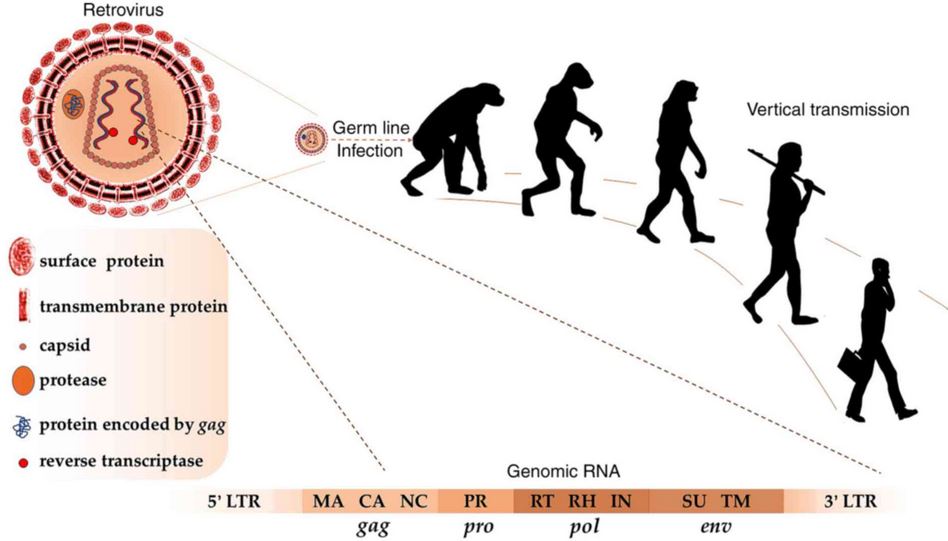
    Research suggests that around 8% of the human genome is composed of Endogenous Retroviruses (ERVs) often referred to as ‘zombie’ regions.

    Retroviruses and Human Genome Integration

    • Most viruses can’t affect the human genome, but retroviruses are an exception.
    • Retroviruses can integrate and reshape the genomes of their hosts.
    • They have an RNA genome and can reverse-transcribe it to DNA, inserting it into the host’s genome.
    • This process is facilitated by the enzyme reverse transcriptase.
    • Discovered by Howard Temin and David Baltimore in 1971, this enzyme converts the virus’s RNA into a corresponding DNA sequence.
    • Historical Discoveries:
      • Viral causes of cancer were known even before the mechanism was understood.
      • In 1908, Oluf Bang and Vilhelm Ellermann discovered the viral cause of chicken leukosis.
      • In 1957, Ludwik Gross isolated a leukaemia-causing virus in mice.

    What are Endogenous Retroviruses (ERVs)?

    • ERVs are remnants of ancient viral infections that have integrated into the genome of the host species.
    • When these retroviruses infect germ cells (sperm or egg cells), their genetic material can be passed down to the next generation, becoming a permanent part of the host’s DNA.
    • Zombie Regions:
      • They refer to inactive viral sequences within the genome that no longer produce functional viruses but remain as embedded genetic fossils.
      • These regions are a result of retrovirus integration that has lost its ability to replicate and produce proteins, yet they persist in the host’s DNA.

    Evolutionary Significance of ERVs:

    • In the life cycle of a retrovirus, reverse-transcribed DNA is integrated into the host’s DNA with the help of integrase.
    • The viral DNA, called a provirus, hijacks human cells, turning them into virus-making factories.
    • Over tens of thousands of years, many retroviruses have left genomic elements in human genome, contributing to evolutionary processes.
    • Example:
      • Syncytins are genes thought to have descended from ERVs and are crucial for placental development. These genes originally came from viruses and were acquired during mammalian evolution.

    Their Contribution to Human Biology

    • ERVs are highly expressed in the placenta and may influence conditions like preeclampsia.
    • Researchers found that a particular RNA derived from an ERV is dysregulated in early-onset preeclampsia, suggesting it could be used as a biomarker for the condition.
    • ERVs play a role in cell-type differentiation during embryo development.
    • A protein called MERVL-gag is derived from an ERV. This transition is crucial for producing pluripotent stem cells capable of forming different cell types.
    • Researchers also found that a human ERV element LTR10 affects tumour formation in colorectal cancer.

    PYQ:

    [2021] Consider the following statements :​

    1. Adenoviruses have single-stranded DNA genomes whereas retroviruses have double-stranded DNA genomes.​

    2. Common cold is sometime caused by an adenovirus whereas AIDS is caused by a retrovirus.​

    Which of the statements given above is/are correct?

    (a) 1 only

    (b) 2 only

    (c) Both 1 and 2

    (d) Neither 1 nor 2

  • Government Budgets

    On discarding indexation for LTCG    

    Why in the news?

    Finance Minister Nirmala Sitharaman’s decision to eliminate indexation for calculating long-term capital gains (LTCG) tax in the Union Budget has received a lukewarm response from stakeholders.

    Changes in the LTCG Regime

    • The new LTCG regime removes the indexation benefit for property, gold, and other unlisted assets.
    • The LTCG tax rate is reduced from 20% to 12.5%.
    • For assets purchased before 2001, the fair market value as of April 1, 2001, is considered the cost of acquisition.

    What is long-term capital gains (LTCG) tax? 

    • LTCG refers to the profit realized from the sale of an asset that has been held for more than one year. This includes various types of assets such as stocks, bonds, real estate, and mutual funds. 
    • If an asset is sold before this holding period, the gains are classified as short-term capital gains (STCG) and are taxed at different rates.

    Why has the Union Finance Minister done away with indexation for computing long-term capital gains (LTCG) tax?

    • Simplification of Tax Computation: The Finance Minister proposed the change to “ease computation of capital gains for the taxpayer and tax administration.” The intention is to simplify the tax process.
    • Uniform Tax Rate: Long-term gains on all financial and non-financial assets would now be taxed at a flat rate of 12.5%, replacing the previous tiered structure.
    • High real estate return: The Income Tax department believes that the real estate returns (12-16% per annum) are higher than indexation for inflation (4-5%). Thus, it predicts “substantial tax savings” for a “vast majority” of taxpayers under the new system.

    What is indexation?

    • Indexation is a mechanism used to adjust the original purchase price of an asset to account for inflation. It helps in calculating the real gains and prevents inflation from inflating the tax liability. The adjusted purchase price is called the indexed cost of acquisition.

    How does Indexation help in Tax Savings?

    • Adjusts the purchase price for inflation: Indexation increases the original purchase price of an asset to account for inflation between the time of purchase and sale. This results in a lower taxable capital gain.
    • Reduces the taxable capital gains: By revising the purchase price upwards using the Cost Inflation Index, indexation reduces the difference between the sale price and purchase price. This lowers the taxable capital gains amount.
    • Leads to lower tax liability: With a reduced taxable capital gain, the tax payable on it also decreases. For example, on a ₹48 lakh gain from selling a house, indexation can bring down the taxable gain to ₹28.6 lakh, saving ₹4,264 in tax (assuming 20% LTCG rate).

    What has been the feedback from corporates and industry regarding the move?

    • Concerns Over Increased Tax Liability: Many stakeholders expressed apprehension that the removal of indexation would lead to higher tax obligations for ordinary investors, particularly in the real estate sector.
      • There are fears that this might encourage the undervaluation of properties to reduce capital gains tax and potentially increase black money transactions in real estate.
    • Mixed Reactions from Realty Players: While some real estate developers and consultants indicated that the removal of indexation might not significantly impact demand and prices, especially for primary home buyers, they noted that high-end properties could see a drop in demand.
      • Some developers viewed the changes positively and said that the lowered tax rate (from 20% to 12.5%) could make real estate a more attractive long-term investment.
    • Government Justifications and Clarifications: The government has argued that the new tax regime simplifies the capital gains tax structure and is beneficial for most taxpayers.

    Way forward: 

    • Transitional Provisions: Govt. should implement transitional provisions for existing investments to ease the shift from the old system to the new one.
    • Strengthen the monitoring system: Need to strengthen monitoring mechanisms to prevent the undervaluation of properties and reduce black money transactions.

    Mains PYQ: 

    Q Comment on the important changes introduced in respect of the Long-term Capital Gains Tax (LCGT) and Dividend Distribution Tax (DDT) in the Union Budget for 2018-2019. (UPSC IAS/2018)

  • Artificial Intelligence (AI) Breakthrough

    AI needs cultural policies, not just regulation    

    Why in the news?

    Only by providing fair and broad access to data can we unlock AI’s full potential and ensure its benefits are shared equitably.

    Present Scenario of ‘Data Race vs. Ethics’

    • Data Demand vs. Quality: The race for data has intensified as AI systems, particularly Large Language Models (LLMs), require vast amounts of high-quality data for training. 
      • However, there is a growing concern that this demand may compromise ethical standards, leading to the use of pirated or low-quality datasets, such as the controversial ‘Books3’ collection of pirated texts.

    What are Large Language Models (LLMs)?

    Large Language Models (LLMs) are advanced AI systems that can understand and generate human-like text by learning from vast amounts of data, enabling a wide range of language-related applications.


    • Feedback Loops and Bias Amplification: The reliance on existing datasets can create feedback loops that exacerbate biases present in the data.
      • As AI models are trained on flawed datasets, they may perpetuate and amplify these biases, resulting in skewed outputs that reflect an unbalanced and often Anglophone-centric worldview.
    • Ethical Considerations: The urgency to acquire data can overshadow ethical considerations. This raises questions about the fairness and accountability of AI systems, as they may be built on datasets that do not represent the diversity of human knowledge and culture.

    Challenges towards the Sources

    • Lack of Primary Sources: Current LLMs are primarily trained on secondary sources, which often lack the depth and richness of primary cultural artefacts.
      • Important primary sources, such as archival documents and oral traditions, are frequently overlooked, limiting the diversity of data available for AI training.
    • Underutilization of Cultural Heritage: Many repositories of cultural heritage, such as state archives, remain untapped for AI training.
      • These archives contain vast amounts of linguistic and cultural data that could enhance AI’s understanding of humanity’s diverse history and knowledge.
    • Digital Divide: The digitization of cultural heritage is often deprioritized, leading to a lack of access to valuable data that could benefit AI development.
      • This gap in data availability disproportionately affects smaller companies and startups, hindering innovation and competition with larger tech firms.

    Case Studies from Italy and Canada

    • Italy’s Digital Library Initiative: Italy allocated €500 million from its ‘Next Generation EU’ package to develop a ‘Digital Library’ project aimed at making its rich cultural heritage accessible as open data. However, this initiative has faced setbacks and deprioritization, highlighting the challenges of sustaining investment in cultural digitization.
    • Canada’s Official Languages Act: This policy, once criticized for being wasteful, ultimately produced one of the most valuable datasets for training translation software.

    Conclusion: There is a need to implement robust ethical guidelines and standards for data collection and usage in AI training. These standards should ensure that datasets are sourced legally, represent diverse cultures and perspectives, and minimize biases. Encourage collaborations between tech companies, governments, and cultural institutions to develop and adhere to these guidelines.

  • Capital Markets: Challenges and Developments

    SEBI’s proposed measures to curb F&O speculation    

    Why in the news?

    SEBI has proposed a series of measures to curb speculative trading in the index derivatives segment due to concerns over the exponential increase in trading volumes in futures and options, especially among individual investors.

    What are the different types of derivatives?  

    Note: Derivatives are financial contracts deriving their value from an underlying asset such as stocks, commodities, or currencies.
    • Futures: 
        • Futures are standardized contracts obligating the buyer to purchase an underlying asset (such as stocks, commodities, or currencies) at a predetermined price on a specified future date. They are traded on exchanges, with daily settlements based on market price changes.
        • Futures contracts have margin requirements and are marked to market daily, ensuring liquidity and reducing credit risk.
    • Options: 
        • Options give the buyer the right, but not the obligation, to buy (call option) or sell (put option) an underlying asset at a predetermined price within a specified time frame. Unlike futures, options are not obligatory; the buyer can choose whether to exercise the option.
        • Options can be traded on exchanges or over-the-counter (OTC) and require the payment of a premium by the buyer.
    • Forwards: 
        • Forward contracts are similar to futures but are privately negotiated agreements between two parties to buy or sell an asset at a future date and price. They are customizable and traded over the counter, which allows for flexibility but introduces counterparty risk.
        • Settlement occurs at the maturity date, and forward contracts do not have standardization like futures.
    • Swaps: 
      • Swaps involve the exchange of cash flows or financial instruments between two parties, often based on interest rates or currencies. Common types include interest rate swaps and currency swaps, which allow participants to manage exposure to interest rate fluctuations or gain access to different currencies.
      • Swaps are typically traded over the counter and can be tailored to meet the specific needs of the parties involved.

    What measures have the SEBI proposed?

    • Increase in minimum contract size for index derivatives from Rs 5-10 lakh to Rs 15-20 lakh, which can be further increased to Rs 20-30 lakh after six months.
    • Upfront collection of option premiums by brokers from clients.
    • Intraday monitoring of position limits for index derivative contracts by Market Infrastructure Institutions (MIIs).
    • Providing only one weekly options contract on a single benchmark index of an exchange.
    • Removal of calendar spread benefits on the expiry day for positions involving any of the contracts expiring on the same day.
    • Rationalisation of options strikes, with a uniform interval up to a fixed coverage of 4% near the prevailing index price and an increased interval as the strikes move away from the prevailing price.
    • Increasing margins on the expiry day and the previous day to address the issue of high implicit leverage in options contracts near expiry.

    Why have these measures been proposed?

    • The measures aim to enhance investor protection and promote market stability in the derivative markets, amidst concerns about an exponential rise in the volume of trade in the futures and options (F&O) segment, particularly by individual investors.
    • In the Union Budget 2024-25, the Securities Transaction Tax (STT) on F&O of securities was doubled to 0.02% and 0.1%, respectively, effective October 1, 2024.
    • Data shows that in FY 2023-24, 92.50 lakh unique individuals and proprietorship firms traded in the NSE index derivatives segment and cumulatively incurred a trading loss of Rs 51,689 crore, with only 14.22 lakh investors (about 15%) making a net profit.

    Way forward: 

    • Enhancing Investor Education and Awareness: To mitigate the risks associated with speculative trading in index derivatives, it is essential to implement comprehensive investor education programs.
    • Strengthening Regulatory Oversight and Compliance: SEBI should enhance its regulatory framework by implementing robust monitoring systems that ensure compliance with the proposed measures.
  • Russian Invasion of Ukraine: Global Implications

     Why the Ukraine war makes India and Europe important for each other?    

    Why in the news?

    Prime Minister Narendra Modi’s anticipated visit to Ukraine next month should signify a reconfiguration of India’s strategy towards European security.

    European Scenario

    • The war in Ukraine has put the question of Europe right at the top of India’s international agenda, necessitating a reconfiguration of India’s approach to European security.
    • India should see the war in Ukraine as an imperative for long overdue re-engagement with European peace and security, moving beyond treating it as a “pressure point” from the West or a moment for solidarity with Russia.
    • Europe is facing hard geopolitical dilemmas, torn between criticizing China, pleasing the US, and dealing with a resentful Russia willing to restructure the European security order.
    • India’s peace diplomacy in Ukraine, even in a limited way, would be worthwhile given the implications of the war for the Indian economy and security, as history shows that China benefits from conflicts between Russia and the West.

    India’s Priorities

    • Re-engagement with European Security: The war in Ukraine has prompted India to reassess its approach to European geopolitics, which has been largely neglected in recent decades. India aims to strengthen its political and diplomatic ties with Europe, recognizing it as a crucial economic partner and a significant source of technology.
    • Balancing Relations with Russia and the West: India has maintained a careful balance in its relations with Russia while also courting Western powers. The historical ties with Russia, particularly in defence and energy, remain vital for India, especially as it increases its imports of discounted Russian oil.
    • Addressing Security Challenges: The ongoing conflict in Ukraine has complicated India’s security landscape, particularly with China’s growing ties to Russia and its strategic manoeuvres in Europe. India should navigate these complexities while ensuring its own security interests are safeguarded.
    • Promoting Peace Diplomacy: India is positioning itself as a mediator in the Ukraine conflict, emphasizing the importance of peace and dialogue. This diplomatic role not only enhances India’s global standing but also aligns with its long-term interests in promoting stability in a multipolar world.

    Future outlook

    • India’s evolving global priorities reflect its ambition to assert itself as a significant player in international affairs, pursuing economic growth, security, and sustainable development while contributing to the emergence of a multipolar world order.
    • India’s role in shaping the future of global governance will continue to evolve as it navigates complex geopolitical dynamics and works towards its national interests and the common good of the international community.
    • Prime Minister Narendra Modi’s likely visit to Ukraine next month should mark a reconfiguration of India’s approach to European security, as the return of war to Europe has created multiple economic challenges for India and complicated its security challenges.

    Way forward: 

    • Proactive Diplomacy: India should actively engage with European countries and institutions to strengthen political and diplomatic ties.
    • Peace Mediation Efforts: India can leverage its neutral stance and diplomatic relations to facilitate peace dialogues and mediation efforts in the Ukraine conflict.
  • Foreign Policy Watch: India-Myanmar

    The different armed groups of Myanmar     

    Why in the news?

    On July 25, Myanmar’s junta and an ethnic group both claimed control of Lashio’s military command after clashes began on July 3.

    Background

    • The 2021 Military coup in Myanmar triggered sustained violent resistance which undermined military control.
    • Ethnic Armed Organisations (EAOs) and resistance groups, including the People’s Defence Forces (PDFs) and the Brotherhood Alliance, have made significant territorial gains. 
    • The military’s fragile ceasefires have collapsed, leading to a loss of control in strategic areas, including Lashio, with reinforcements now concentrated near Mandalay.

    The dominance of the Arakan Army

    • Large parts of Rakhine province have fallen under the control of the Arakan Army, an ethnic Rakhine Buddhist armed group.
    • The Arakan Army has seized territories on the borders with Bangladesh, including towns like Buthidaung, and is advancing towards important port cities on the Bay of Bengal coast like Kyauk Phyu, Sittwe, and Ngapali.
    • Control over these coastal areas gives the Arakan Army leverage to impact the implementation of infrastructure projects like China’s Belt and Road Initiative in Kyauk Phyu and India’s Kaladan project in Sittwe.

    Objectives of Ethnic Armed Organizations (EAOs)

    • Major EAOs have refrained from declaring independence or creating new sovereign states, likely to avoid rallying renewed support for the military.
    • EAOs aim to establish a genuine federal democratic structure with maximum autonomy for provinces, with some advocating for a confederation.
    • Carving out new nation-states is challenging due to complex ethnic geographies and overlapping claims over homelands.

    China’s Influence

    • China has engaged with multiple actors, including the military and various EAOs, to protect its massive investments and economic interests in the region.
    • Beijing has facilitated temporary ceasefires between the military and EAOs and maintains substantive relations with armed groups like the Brotherhood Alliance and United Wa State Army.
    • China has reportedly supplied defence equipment to both the military and EAOs, ensuring fragmented sovereignty in Myanmar

    India’s role

    • India can share its experiences and institutional frameworks on federalism with stakeholders in Myanmar to help establish a new constitutional framework based on the principles of federalism and democracy.
    • Example: Despite the ongoing civil war, India has successfully constructed massive infrastructure projects in neighbouring Afghanistan, demonstrating its potential to contribute to regional peace and prosperity in Myanmar.

    Way forward

    • Facilitate Dialogue and Mediation: To address the ongoing conflict in Myanmar, it is crucial for regional powers, including India and China, to facilitate dialogue between the military junta, Ethnic Armed Organizations (EAOs), and the National Unity Government (NUG).
    • Enhance Humanitarian Support and Development Initiatives: In parallel with diplomatic efforts, there should be an increase in humanitarian assistance to affected populations in conflict zones, particularly in Rakhine State and areas controlled by the Arakan Army.

    Mains PYQ: 

    Q Examine the scope of Fundamental Rights in the light of the latest judgement of the Supreme Court on the Right to Privacy. (2020)

  • Parliament – Sessions, Procedures, Motions, Committees etc

    The case for a Legal Advisory Council  

    Why in the news?

    Legal insights from well-structured think tanks can be crucial in clarifying the true intent of specific legislation for the government.

    Scope to Review the Process of Legal Consultancy

    • Need for Structured Legal Inputs: The handling of legal issues by the National Democratic Alliance has been inadequate. There is a need for continuous, informed, and empirically valid legal inputs from structured think tanks to clarify legislative intents.
    • Proposal for a Legal Advisory Council (LAC): Establishing a LAC akin to the Economic Advisory Council could provide the Prime Minister with timely legal analysis and insights, helping to preempt legal challenges and enhance the legislative process.

    Need of Think Tank: 

    • Expert Legal and Policy Analysis: Well-structured think tanks provide informed and empirical legal analysis that can enhance the legislative process.
    • Facilitation of Evidence-Based Decision Making: Think tanks can contribute to evidence-based decision-making by conducting research and providing data-driven insights on complex legal and social issues.

    Recent Legal Issues and the Puttaswamy Case Judgment

    • Electoral Bonds Scheme: The Supreme Court recently ruled the electoral bonds scheme unconstitutional for violating voters’ right to information. This decision highlights the importance of conducting proportionality tests before implementing laws to balance privacy rights with transparency.
    • Aadhaar Act Intervention: A similar legal examination prior to the implementation of the Aadhaar Act could have prevented the Supreme Court’s intervention in the K.S. Puttaswamy v. Union of India case, which addressed privacy concerns.
    • Transporter Strike: Concerns over the hit-and-run provisions in the Bharatiya Nyaya Sanhita, 2023, led to nationwide protests by transporters, indicating the need for thorough legal viability assessments before introducing potentially problematic legislation.

    Anticipating Challenges

    • Proactive Legal Analysis: The proposed LAC would conduct legal analyses of issues referred by the government and perform suo motu research on contemporary legal matters, allowing for proactive identification of potential legal challenges.
    • Engagement with National Law Universities: Leveraging the expertise of national law universities can enhance the legal consultancy process, ensuring that laws are constitutionally viable and socially acceptable. Regular research inputs from these institutions can aid in formulating better legislation and addressing legal challenges before they escalate.

    Way forward: 

    • The LAC should comprise legal experts, eminent jurists, academicians, and researchers with specializations in various fields frequently legislated upon by the government, such as criminal law, trade law, international law, business laws, and taxation laws.
    • Establish formal mechanisms for collaboration, such as the Committee for Reforms in Criminal Laws at the National Law University Delhi set up by the Ministry of Home Affairs, to facilitate the exchange of ideas and research between the government and academia.
  • The Crisis In The Middle East

    Why Israel-Hezbollah conflict is heating up?   

    Why in the news?

    Israel has announced that it would retaliate strongly against Hezbollah, accusing the group of being responsible for a rocket attack that killed 12 children and teenagers at a football field in the Israeli-occupied Golan Heights.

    Background of Golan Heights: 

    • The Golan Heights was captured by Israel during the Six-Day War in 1967 from Syria and has since been a point of contention between the two nations. In 1981, Israel effectively annexed the territory, a move not recognized by the international community.
    • Strategic Importance: The Golan Heights offers a commanding view of northern Israel and southern Syria, making it a critical military and strategic area. Its elevation allows for surveillance and control over surrounding regions, including the ability to monitor movements from Syria.

    Causes of the conflict:

    • Support for Palestinians: Hezbollah’s attacks on Israel are framed as support for Palestinians facing Israeli bombardment in Gaza, particularly following the Hamas attacks on October 7, 2023. Hezbollah, as a member of the Iran-backed Axis of Resistance, has aligned itself with Hamas and other militant groups in the region.
    • Historical Hostilities: The conflict is rooted in a long history of hostility between Israel and Hezbollah, which was founded in 1982 to combat Israeli forces in Lebanon. Hezbollah views Israel as an illegitimate state and seeks its removal, which fuels ongoing tensions and military engagements.
    • Escalating Military Capabilities: Hezbollah has significantly enhanced its military capabilities since the 2006 war, possessing a large arsenal of rockets and advanced weaponry. This includes the ability to strike deep into Israeli territory, increasing the stakes for both sides in any conflict.

    Implications of the Conflict

    • Humanitarian Impact: The ongoing hostilities have resulted in significant civilian casualties and displacement on both sides of the border. Israeli airstrikes in Lebanon have killed Hezbollah fighters and civilians, while Hezbollah’s attacks have resulted in Israeli casualties. The humanitarian toll is exacerbated by the broader context of the Gaza war.
    • Regional Stability: The conflict poses a risk of broader regional destabilization, potentially drawing in other actors and escalating into a full-scale war.
    • Political Ramifications: The conflict has significant political implications for both Israel and Lebanon. In Israel, the displacement of civilians has become a pressing political issue, while Hezbollah’s actions may influence its standing within Lebanon and the broader Shiite community.

    How escalation can be avoided on the Global Stage?

    • Diplomatic Engagement: The United States and other international actors must continue to engage in diplomatic efforts aimed at de-escalating tensions. This includes facilitating dialogue between Israel and Hezbollah, as well as addressing the underlying issues related to the Gaza conflict. A ceasefire in Gaza could help reduce hostilities in Lebanon.
    • Regional Agreements: Need to make efforts to establish regional agreements that address territorial disputes and security concerns that can mitigate the risk of conflict.
    • Monitoring and Mediation: International bodies, including the United Nations, should increase their monitoring of the situation and mediate discussions between the conflicting parties. This can help prevent misunderstandings and miscalculations that could lead to escalated military responses.

    Role of India in this situation: (Way forward)

    • Engaging with Arab Nations: India should also maintain and strengthen its relationships with Arab nations, including Lebanon, to ensure a balanced approach. This engagement can help India navigate the complexities of the situation and position itself as a neutral party that seeks to promote peace and stability in the region.
    • Facilitating Dialogue: By promoting dialogue between the conflicting parties, India can help de-escalate tensions and work towards a peaceful resolution.

    Mains PYQ: 

    Q India’s relations with Israel have, of late, acquired a depth and diversity, which cannot be rolled back.” Discuss. (2018)

  • Oil and Gas Sector – HELP, Open Acreage Policy, etc.

    US overtaskes UAE as India’s second largest LNG supplier   

    Why in the news?

    In 2023, the US surpassed the UAE to become India’s second-largest supplier of liquefied natural gas (LNG), providing 3.09 million tonnes (MT).

    World LNG Report 2024 by International Gas Union (IGU)

    • US as a Major Supplier: The report highlights that the United States has displaced the UAE to become India’s second-largest supplier of liquefied natural gas (LNG) in 2023, with shipments reaching 3.09 million tonnes (MT).
    • Trade Growth: The US supplied India with 1.8 MT of LNG in 2019, which increased to 3.86 MT in 2021, indicating a significant rise in trade volume despite a decrease in 2022 due to rising prices.
    • Qatar’s Dominance: Qatar remained India’s largest LNG supplier from 2019 to 2023, with shipments peaking at 10.92 MT in 2023, reflecting its consistent role in India’s energy supply.
    • The decline of African Suppliers: The report notes a significant decline in LNG shipments from African nations, particularly Nigeria and Angola, which saw their exports to India drop from pre-pandemic levels of around 2.7 MT and 2.9 MT, respectively, to just 0.73 MT each in 2023.

    Present trade dynamics

    • Price Sensitivity: Indian companies remain price-sensitive, with LNG imports being contingent on competitive pricing. Analysts suggest that if LNG prices stay below $12 per mBtu, there could be significant growth in imports.
    • Geographical Advantage: The proximity of US LNG cargoes to India via the Cape of Good Hope makes it more cost-effective for sellers to export to India compared to North Asia.
    • Long-term Contracts: Ongoing long-term contracts signed by Indian entities with US suppliers continue to underpin LNG consumption, despite fluctuations in global prices.

    Use of LNG in India: 

    • Fertilizer Sector: The fertilizer sector remains the largest consumer of LNG in India, contributing to 32% of the total natural gas consumption.
    • Power Sector:  The power sector accounted for 12% of the total natural gas consumption in India.
    • City Gas Distribution (CGD) Sector: CGD entities accounted for 19% of the total natural gas consumption in India

    What can be done?

    • Strengthening Domestic Policies: India could benefit from reforms in domestic gas policies, including greater transparency over LNG inventory levels and improvements in gas pipeline capacity, to enhance the efficiency of LNG imports and distribution.
    • Creating Price Stability: The need to establish a stronger index link between LNG import prices and domestic gas prices could mitigate price risks for LNG importers, ensuring that long-term contracts remain aligned with market conditions.
    • Enhancing Infrastructure: Govt. should invest in LNG infrastructure, including regasification terminals and transportation networks, which can facilitate increased imports and improve supply chain efficiency.
    • Diversifying Supply Sources: To reduce dependency on specific regions, India should explore diversifying its LNG supply sources, including potential agreements with emerging suppliers in different regions.
  • Pharma Sector – Drug Pricing, NPPA, FDC, Generics, etc.

    [pib] National Pharmaceutical Pricing Authority (NPPA)

    Why in the News?

    The NPPA monitors the prices of scheduled as well as non-scheduled medicines under Drugs (Prices Control) Order, 2013 (DPCO, 2013), informed the Union Minister of State for Chemicals and Fertilizers.

    What are Scheduled and Non-Scheduled Formulations?

    [A] Scheduled Formulations:

    • Defined as formulations listed in Schedule-I of the Drugs (Prices Control) Order, 2013 (DPCO, 2013).
    • Ceiling prices of these formulations are revised annually based on the Wholesale Price Index (WPI) for the preceding calendar year.
    • National Pharmaceutical Pricing Authority (NPPA) is responsible for revising and notifying these prices.

    [B] Non-Scheduled Formulations:

    • Defined as formulations not included in Schedule-I of the DPCO, 2013.
    • Prices of these formulations can be increased by manufacturers, but the Maximum Retail Price (MRP) cannot be increased by more than 10% during the preceding 12 months.
    • NPPA also monitors the prices of non-scheduled formulations to ensure compliance.

    Action is taken against companies selling formulations at prices higher than permissible, and overcharged amounts are recovered.

    About National Pharmaceutical Pricing Authority (NPPA)

    • NPPA was set up as an independent regulator on August 29, 1997, for drug pricing and ensuring affordable access to medicines.
    • It is an attached office of the Department of Pharmaceuticals (DoP), Ministry of Chemicals & Fertilizers.
    • NPPA is not a Statutory or Constitutional Body.
    • It is responsible for implementing and enforcing the provisions of the DPCO.

    Functions of NPPA:

    • Fixation and revision of prices of ‘Scheduled’ drugs under Drug (Price Control) Orders.
      • Scheduled drugs (15% of the pharma market) are allowed an increase based on WPI.
      • Non-scheduled drugs (85% of the pharma market) are allowed an automatic 10% increase annually.
    • Monitoring and enforcement of drug prices.
    • Ensuring availability and accessibility of all medicines and medical devices, including non-scheduled drugs.
    • Undertaking or sponsoring studies on drug pricing.
    • Collecting and maintaining data on production, exports, imports, market share, and profitability of pharmaceutical companies.
    • Advising the Central Government on changes or revisions in drug policy.

    Back2Basics: Drugs (Prices Control) Order (DPCO)

    • The DPCO is an order issued by the Government of India under Sec. 3 of Essential Commodities Act, 1955 to regulate the prices of drugs.
    • The Order provides the list of price controlled drugs, procedures for fixation of prices of drugs, method of implementation of prices fixed by Govt., penalties for contravention of provisions etc.
    • Under the provisions of DPCO 2013, only the prices of drugs that figure in the National List of Essential Medicines (NLEM) are monitored and controlled by the regulator, the National Pharmaceutical Pricing Authority.
      • Essential medicines are those that satisfy the priority healthcare needs of the majority of the population.


    PYQ:

    [2019] How is the Government of India protecting traditional knowledge of medicine from patenting by pharmaceutical companies?

Join the Community

Join us across Social Media platforms.

