💥UPSC 2027,2028 Mentorship (April Batch) + Access XFactor Notes & Microthemes PDF

Archives: News

  • Quantum Technology : Next generation Computers are achievible

    QuantumContext

    • The Nobel Prize committee decided to honour three scientists Alain Aspect of France, John Clauser of the US, and Anton Zeilinger of Austria for their work in domain quantum physics.

    What is the contribution of these three scientists?

    • Together, these three have made seminal contributions to not just the foundations of quantum theory but also to efforts that have now enabled the possibility of a wide range of applications.
    • Their experiments have conclusively established that the ‘entanglement’ phenomenon observed in quantum particles was real, not a result of any ‘hidden’ or unknown forces.

    What is the Significance of this Discovery?

    • Wide applications: It could be utilised to make transformative technological advances in computing, hack-free communications, and science fiction-like concept of ‘teleportation’.

    Quantum What is Quantum Theory?

    • Subatomic level: Quantum theory is a fundamental theory in physics that provides a description of the physical properties of nature at the scale of atoms and subatomic particles.It is the foundation of all quantum physics including quantum chemistry, quantum field theory, quantum technology, and quantum information science.
    • Different from conventional physics: Quantum mechanics differs from classical physics in that energy, momentum, angular momentum.

    Development in Quantum Theory so far

    • Planck’s assumption: In 1900, Planck made the assumption that energy was made of individual units, or
    • Albert Einstein’s theory : In 1905, Albert Einstein theorized that not just the energy, but the radiation itself was quantized in the same manner.
    • Louis de Broglie theory: In 1924, Louis de Broglie proposed that there is no fundamental difference in the makeup and behaviour of energy and matter; on the atomic and subatomic level either may behave as if made of either particles or waves. This theory became known as the principle of wave-particle duality: elementary particles of both energy and matter behave, depending on the conditions, like either particles or waves (wave-particle duality).
    • Heisenberg proposed: In 1927, Werner Heisenberg proposed that precise, simultaneous measurement of two complementary values – such as the position and momentum of a subatomic particle – is impossible. Contrary to the principles of classical physics, their simultaneous measurement is inescapably flawed; the more precisely one value is measured, the more flawed will be the measurement of the other value. This theory became known as the uncertainty principle, which prompted Albert Einstein’s famous comment, “God does not play dice.”

    QuantumWhat is Entanglement?

    • Entanglement was another of several weird properties exhibited by these tiny particles. Two particles, having ‘interacted’ with each other at some stage, were found to have got ‘entangled’ in a way that the behaviour of one produced an instantaneous reaction in the other even if the two were no longer connected in any way and were separated by very large distances.
    • The entanglement property to open up new technological possibilities. first time that it was possible to ‘teleport’ the quantum states of a particle to another location without the particle moving anywhere and without a medium.

    What is Superposition?

    • It’s a phenomenon where, a particle exists simultaneously at multiple locations, known as superposition. The chance of finding the particle at any given place was dictated by probabilistic calculations, and once it was found, or observed, at one location, it ceased to exist at all other places.

    What was the Einstein’s assessment?

    • Special theory of relativity: Einstein’s Special Theory of Relativity prohibited any signal from travelling faster than the speed of light. The seemingly instantaneous communication due to entanglement had the danger of further unravelling the foundations of physics.
    • Spooky behaviour: Einstein describes the strange behaviour by quantum particles as ‘spooky’.
    • Speed of light: One major concern of Einstein, that entanglement allows for transmission of information at speeds faster than light, was not entirely accurate.When an operation is performed on one of the entangled particles, there is an instantaneous reaction in the other.
    • Communication problem: There is no way for the observer at the other end to know the reaction has happened. The observer has to be made aware of the operation having been performed, and this happens only through classical communication channels limited by the speed of light restriction.

    QuantumConclusion

    • The entanglement property is now being utilised to build the next generation of computers, called quantum computers, which exploit the quantum behaviour of particles to overcome challenges considered as unsurmountable. It is being used to create secure communication algorithms that would be immune to hacking.

    Mains Question

    Q.What is the quantum theory? How it is different from classical theory of physics? How entanglement property is used in various applications?

    UPSC 2023 countdown has begun! Get your personal guidance plan now! (Click here)

  • Indian Army Updates

    India-China Relations

    ChinaContext

    • The National Congress of the Chinese Communist Party (CCP), scheduled in October, promises to deliver important outcomes, which will impact not just China but affairs of other nations, neighbour and beyond. A look into India-china Relationship as china has always been hostile towards its neighbours.

    Background of Indo-China Relations

    • 1950
      • India and China established diplomatic relations on 1st April 1950.
      • India was the first non-socialist country to establish relations with the People’s Republic of China and the catchphrase ‘Hindi Chini Bhai Bhai’ became famous.
    • 1955
      • Both countries attended the Asian-African Conference in which 29 countries participated in Bandung, Indonesia and jointly advocated the Bandung Spirit of solidarity, friendship and cooperation.
      • It has led to the decolonisation of the whole of Asia and Africa and to the formation of a Non-Aligned Movement as the third Way between the Two Blocs of Superpowers.
      • The First NAM Summit Conference took place in Belgrade, Yugoslavia, in September 1961.
    • 1962
      • The border conflict led to a serious setback in bilateral relations.
    • 1976
      • China and India restored ambassadorial relations and bilateral ties improved gradually.
    • 1988
      • Indian Prime Minister Rajiv Gandhi visited China, initiating the process of normalization of bilateral relations.
      • The two sides agreed to look forward and develop bilateral relations actively in other fields while seeking a mutually acceptable solution to boundary questions.

    Areas of Cooperation between India and China

    1.Political Relations between India and China

    • In 1993, Agreement on the Maintenance of Peace and Tranquility along the Line of Actual Control (LAC) on the India-China Border Areas was signed to bring stability and substance in bilateral ties.
    • In 2008, two countries have also extended their strategic and military relations.
    • MoU was signed to open an additional route for Kailash Mansarovar Yatra through Nathu La.
    • India and China have also established a High Level Dialogue Mechanism on Counter Terrorism and Security
    • To facilitate exchanges between Indian states and Chinese provinces, States/Provincial Leaders Forum was established

     2.Commercial and Economic Relations between Indo-China

    • China will establish two Industrial Parks in India and expressed their intention to enhance Chinese investment in India
    • India extended e-visa facility to Chinese nationals
    • Trade and Economic Relationship are shaped through various dialogue mechanism
    • Joint Economic Group led by the Commerce Ministers of both sides
    • Strategic Economic Dialogues led by the Vice Chairman of NITI Aayog and the Chairman of National Development and Reform Commission of China

     3.Cultural Relations between India and China

    • India and China have entered into an agreement on co-production of movies
    • Yoga is becoming increasingly popular in China. China was one of the co-sponsors to the UN resolution designating June 21 as the International Day of Yoga

     4.Education Relations between India and China

    • India and China signed Education Exchange Programme (EEP), which is an umbrella agreement for educational cooperation between the two countries.
    • Chinese students are also annually awarded scholarships to study Hindi at Kendriya Hindi Sansthan, to learn Hindi

     5.Indian Community

    • Presently around 35,500 Indians are staying in China, students and working professional form a major part of it.
    • PICFA” Pondicherry India China friendship association is an NGO dedicated for developing people-to-people relation between India and China in areas of education, culture and tourism.

    What are the recent anti- India moves by China?

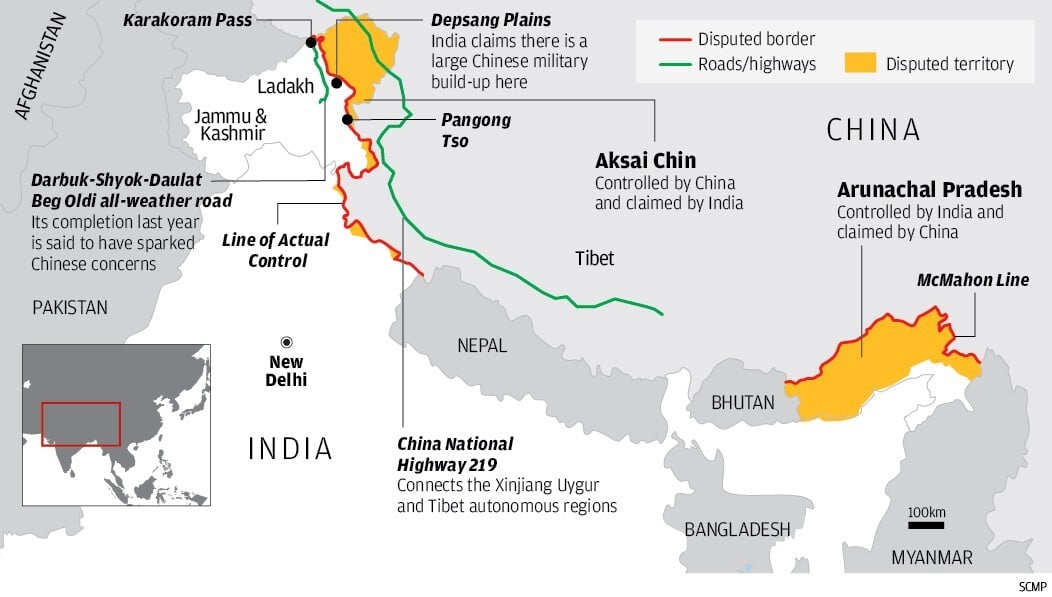
    • China continues to stake its claim to Arunachal Pradesh as Southern Tibet.
    • Beijing recently renamed 15 places in Arunachal Pradesh, following the six it had done in 2017.
    • China justifies the renaming as being done on the basis of its historical, cultural and administrative jurisdiction over the area — these old names existed since ancient times which had been changed by India with its “illegal occupation”.
    • On January 1, 2022, Beijing’s new land border law came into force, which provides the People’s Liberation Army (PLA) with full responsibility to take steps against “invasion, encroachment, infiltration, provocation” and safeguard Chinese territory

    China

    What is the present situation of Indo-China relations?

    • Troops in Ladakh: We have been on tenterhooks since the sanguinary Galwan clash of 2020, and borne a heavy cost for the “mirror-deployment” of 50,000-60,000 additional troops in Ladakh.
    • LAC negotiations: Sino-Indian diplomatic parleys having been suspended, the task of LAC negotiations has been foisted on local military commanders.
    • Truce for SCO: The 16th successive commanders’ meeting would have seen yet another futile conclusion, but for compulsions of the impending Shanghai Cooperative Organisation, which apparently led to a modest breakthrough. Consequently, the third round of troop disengagement and the creation of another buffer zone has taken place in Siachen, this time in the area of Gogra-Hot Springs.
    • Bilateral Trade: The India-China trade is on course to cross USD 100 billion for the second consecutive year as it has gone up to USD 67.08 billion in the first half of this year amid a big surge of Chinese exports.
    • “According to the statistics of Chinese competent authorities, bilateral trade volume between China and India stood at USD 125.66 billion in 2021.China remains the largest trade partner of India and for the first time the bilateral trade exceeded USD 100 billion in 2021.

    China

    Issue of concerns in India-China relations:

    China-India border dispute: history shows solution may lie with Xi Jinping and Narendra Modi | South China Morning Post

    • Belt Road Initiative: India has objected this, since its inception on grounds of violating its sovereignty pointing to China Pakistan Economic Corridor.
    • India’s support to China on global issues has not led to Beijing’s reciprocation for instances: China opposed India’s permanent membership to UN Security Council and entry into NSG.
    • India faces trade imbalance heavily in some favor of China. In 2017-18, trade deficit has gone wide to US$62.9 billion in China’s favor.
    • Two countries failed to resolve their border dispute and steadily established military infrastructure along border areas Indian media outlets have repeatedly reported Chinese military incursions into Indian territory
    • China has expressed concerns about Indian military and economic activities in the disputed South China Sea. Same way India is also concerned about rising Chinese activities in Indian Ocean.
    • China’s strong strategic bilateral relations with Pakistan and other neighboring countries like Nepal and Bhutan is cause of concern as these countries act as buffer states.

    China

    What are the options for India to learn from the past and see what lies ahead in India-China relations?

    • Inevitable Race: The prevailing tension on the China-India border is a symptom of the broader strategic competition between the two Asian neighbors.
    • Quad grouping: Immediately after the clashes, India leaned toward the Quad a grouping of the United States, Australia, Japan, and India with multiple summit meetings and other engagements. Until that point, India was unwilling to refer to the Quad as the Quad, instead using the cumbersome India-Australia-Japan-United States grouping.
    • Equal seriousness: Both sides should treat the military escalation in eastern Ladakh with equal seriousness.
    • Armed coexistence: Even after the resolution of the present standoff in eastern Ladakh, both sides may be in a prolonged period of armed coexistence as a new normal. As the forces on both sides are likely to be relatively balanced, it would be advantageous for both to return to the agreements and understandings from 1993 onward and improve upon them. Clarifying the LAC is a crucial step in this effort.
    • Address trade imbalance: India has flagged the unsustainable trade imbalance at the front and centre of the relationship, and this has gone unaddressed. China will need to work on resolving the trade deficit with India. At any rate, decoupling will happen selectively, in the same way and for the same reasons that China is choosing to decouple from the United States. A balanced trade and economic relationship might lay a solid foundation for future relations, given the size of both economies.
    • Dialogue is necessary: Better understanding of each other’s regional initiatives through open dialogue is important to build trust. The Indo-Pacific vision is as much a developmental necessity for India as the BRI may be to China. Part of building trust must be an open discussion on each other’s intentions in key regions South Asia and the northern Indian Ocean and East Asia and the western Pacific as well as respect for each other’s special positions in the western Pacific and northern Indian Oceans.
    • Protect the core interest: The two sides would need to accommodate the legitimate interests of the other side on key partnerships: China’s with Pakistan and India’s with the United States. These may not be desirable, but in the current circumstances neither will give up its partners, and both India and China could talk through a modus vivendi on the red lines of concern.

    Conclusion

    • The two countries are standing at a crossroads, and this might be the final chance to take the path to coexistence of cooperation and competition. If not, a new phase of antagonistic rivalry may be starting, with the countries sliding into possible confrontation as the strategic periphery of China collides with the strategic backyard of India in the Indian Ocean region.

    UPSC Mains Question

    Q.India and China are the two Asian giants aspiring for regional supremacy and global influence, clash is unavoidable. Discuss how India and china can coexist together.


  • Right To Privacy

    Is Draft Telecommunications Bill, 2022 Flawless?

    Draft Telecommunications Bill, 2022Context

    • Keeping an eye on the telecommunication regulatory framework Supreme Court issued substantive legal reform on surveillance laws in India. Union government has published the Draft Telecommunications Bill, 2022 to replace the Telegraph Act, 1885.

    Background

    • Over two decades ago, allegations of surveillance against politicians led to a CBI inquiry and report against V P Singh’s government. The allegations revealed that imaginary reasons were given for ordering phone tapping without authorization.
    • Last years, many publications reported that phones of several dozen Indian journalists, lawyers and human rights activists had been compromised using an invasive Israeli-developed malware called Pegasus.

    Draft Telecommunications Bill, 2022What is Draft Telecommunications Bill, 2022?

    • The draft Indian Telecommunication Bill, 2022 is an attempt by the Department of Telecommunications (DoT) to consolidate various legislations presently governing the telecommunication landscape in India.
    • The Bill seeks to replace three laws, the Indian Telegraph Act, 1885, the Indian Wireless Telegraphy Act, 1933 and the Telegraph Wires (Unlawful Possession) Act, 1950.
    • The new regulatory framework is to bring the law at par with technological advancements and remove obsolete provisions from the colonial era laws.

    What are the current laws governing communication surveillance in India?

    Communication surveillance in India takes place primarily under two laws:

    • Telegraph Act, 1885: It deals with interception of calls.
    • Call interception:Under Section 5(2) of this law, the government can intercept calls only in certain situations.
    • For sovereignty:They include the interests of the sovereignty and integrity of India, the security of the state, friendly relations with foreign states or public order, or for preventing incitement to the commission of an offense.
    • Free speech restrictions:These are the same restrictions imposed on free speech under Article 19(2) of the Constitution.
    • Exceptions for journalists:A provision in Section 5(2) states that even this lawful interception cannot take place against journalists.
    • Information Technology Act, 2000: It was enacted to deal with surveillance of all electronic communication, following the Supreme Court’s intervention in 1996.
    • Electronic surveillance:Section 69 of the IT Act and the IT (Procedure for Safeguards for Interception, Monitoring, and Decryption of Information) Rules, 2009 were enacted to further the legal framework for electronic surveillance.
    • Data interception:Under the IT Act, all electronic transmission of data can be intercepted.
    • Section 69 of the IT Act adds another aspect that makes it broader — interception, monitoring, and decryption of digital information “for the investigation of an offense”.

    Draft Telecommunications Bill, 2022How the loopholes in the current system breaching the Data Privacy?

    • No comprehensive data Protection Law:
    • No comprehensive data protection law leaving ambiguities over several laws.
    • A comprehensive data protection law to address the gaps in existing frameworks for surveillance is yet to enact.
    • Unaccountable, opaque exercise of surveillance:
    • The Telegraph Act contains broad and excessive powers of interception and surveillance of communications carried out through any telegraph.
    • The surveillance power is principally contained under Section 5(2), and has resulted in an unaccountable, opaque and unconstitutional exercise of surveillance that has led to accusations across the political spectrum.
    • Less transparency:
    • Ministry of Home Affairs refuses to disclose even aggregate data on the number of surveillance orders issued by it each year illegally gathered evidence is being sought to prosecute people.
    • For instance, the Bombay High Court about three years ago noted in a case that premier investigating agencies such as the CBI have used, interception orders (that) neither have sanction of law nor issued for legitimate aim.

    Draft Telecommunications Bill, 2022Key features of the Draft Telecommunications Bill, 2022

    • Broad Definitions:
    • The Bill introduces a broad definition of ‘telecommunication services’.
    • It now includes internet-based services, in-flight and maritime connectivity, interpersonal communications services, machine to machine communication services, and over-the-top (OTT) based communication services that are made available to users by telecommunication
    • KYC and caller id requirements:
    • The Bill requires licensed entities to ensure that they identify the persons to whom they provide telecommunication services.
    • The Bill places an obligation on telecommunication service providers to do this through a ‘verifiable mode’, as prescribed by the government.
    • Licensing, registration, and authorization:
    • Under the Bill, four types of permissions are identified – license, registration, authorization and assignment.
    • While the Bill does not differentiate between the four types of permissions, it clarifies that a license is only required for providing telecommunication services or operating telecommunication networks
    • Wide ranging powers of Central Government:
    • The Bill includes wide-ranging powers for the central and state governments in the event of a public emergency or in interest of public safety.
    • These powers include taking temporary possession of any telecommunication services, suspension of transmission in cases of public emergency, interception/detainment/disclosure of messages, suspension of communications, or otherwise transmit certain announcements for public safety and national security purposes.
    • User protection and duties: User has been declared as an important policy objective of the Government. It places a duty on users to not furnish false information, suppress material information or impersonate others when proving identity to avail telecommunication services.
    • Offences and penalties: Any offence under the Bill may be punished with a fine, imprisonment, suspension of telecommunication services or a combination of the above. For companies, the employees who were responsible for the conduct or the business relating to the offence at the time the offence was committed will be punished.
    • Dispute resolution mechanism: The Bill provides for the right of appeal before the appellate authority. It also creates an enabling provision for the Central Government to set up an alternate dispute resolution mechanism such as arbitration, mediation or other processes of dispute resolution

    What are Concerns over the Draft Telecommunication bill, 2022?

    • Regulatory overlaps:The broad of the definition of ‘telecommunication services’ include OTT communication platforms such as WhatsApp, Telegram, Signal among others, may potentially lead to regulatory or jurisdictional overlaps.
    • Unchecked use of State powers:The Bill gives broad powers to the central government in prescribed situations without any accompanying checks and balances. The Bill empowers the central and state government to intercept messages in the interest of public safety and emergency without the providing clearly defined guardrails for it.
    • Undefined National security: The term, national security is left undefined and does not match constitutional precedent or text which instead uses the phrase,in the interests of the security of state
    • Users Less choice in the privacy and security of their digital footprint:
    • Power to prescribe standards under Clause 23, which may result in regulations as recently issued by the Computer Emergency Response Team (CERT-In) that have resulted in the closure of servers or services by leading, global VPN providers such as Proton and TunnelBear.
    • All of this practically means that users will have less choice in the privacy and security of their digital footprint, as these powers will lead to requirements to locally register and host data, and comply with requirements to identify users (KYC requirements).

    Conclusion

    • There should be some reasonable basis or some tangible evidence to initiate or seek approval for interception by State authorities. Any digression from the ethical and legal parameters set by law would be tantamount to a deliberate invasion of citizens.

    Mains Question

    Q. Any deviation from the moral and legal parameters set by the law would amount to a deliberate attack on citizens. In this context discuss the data privacy of citizens in the era of massive expansion of internet and mobile usage.

    UPSC 2023 countdown has begun! Get your personal guidance plan now! (Click here)


  • Terrorism and Challenges Related To It

    Home Ministry designates 10 individuals as Terrorists

    A total of 10 members of Hizbul Mujahideen (HM), Lashkar-e-Taiba (LeT) and other proscribed outfits have been designated as terrorists by the Union Ministry of Home Affairs (MHA) under the Unlawful Activities (Prevention) Act (UAPA).

    What is Unlawful (Activities) Prevention Act (UAPA)?

    • The UAPA is aimed at effective prevention of unlawful activities associations in India.
    • Its main objective was to make powers available for dealing with activities directed against the integrity and sovereignty of India
    • It is an upgrade on the Terrorist and Disruptive Activities (Prevention) Act TADA, which was allowed to lapse in 1995 and the Prevention of Terrorism Act (POTA) was repealed in 2004.
    • It was originally passed in 1967 under the then Congress government led by former Prime Minister Indira Gandhi.
    • Till 2004, “unlawful” activities referred to actions related to secession and cession of territory. Following the 2004 amendment, “terrorist act” was added to the list of offences.

    Designation of Terrorists

    • The Centre had amended UAPA, 1967, in August 2019 to include the provision of designating an individual as a terrorist.
    • Before this amendment, only organisations could be designated as terrorist outfits.
    • Section 15 of the UAPA defines a “terrorist act” as any act committed with intent to threaten or likely to threaten the unity, integrity, security, economic security, or sovereignty of India or with intent to strike terror or likely to strike terror in the people or any section of the people in India or in any foreign country.
    • The original Act dealt with “unlawful” acts related to secession; anti-terror provisions were introduced in 2004.

    Who makes such designation?

    • The UAPA (after 2019 amendment)seeks to empower the central government to designate an individual a “terrorist” if they are found committing, preparing for, promoting, or involved in an act of terror.
    • A similar provision already exists in Part 4 and 6 of the legislation for organizations that can be designated as a “terrorist organisations”.

    How individuals are declared terrorists?

    • The central government may designate an individual as a terrorist through a notification in the official gazette, and add his name to the schedule supplemented to the UAPA Bill.
    • The government is not required to give an individual an opportunity to be heard before such a designation.
    • At present, in line with the legal presumption of an individual being innocent until proven guilty, an individual who is convicted in a terror case is legally referred to as a terrorist.
    • While those suspected of being involved in terrorist activities are referred to as terror accused.

    What happens when an individual is declared a terrorist?

    • The designation of an individual as a global terrorist by the United Nations is associated with sanctions including travel bans, freezing of assets and an embargo against procuring arms.
    • The UAPA, however, does not provide any such detail.
    • It also does not require the filing of cases or arresting individuals while designating them as terrorists.

    Removing the terrorist tag

    • The UAPA gives the central government the power to remove a name from the schedule when an individual makes an application.
    • The procedure for such an application and the process of decision-making will is decided by the central government.
    • If an application filed by an individual declared a terrorist is rejected by the government, the UAPA gives him the right to seek a review within one month after the application is rejected.
    • The central government will set up the review committee consisting of a chairperson (a retired or sitting judge of a High Court) and three other members.
    • The review committee is empowered to order the government to delete the name of the individual from the schedule that lists “terrorists”, if it considers the order to be flawed.
    • Apart from these two avenues, the individual can also move the courts to challenge the government’s order.


    UPSC 2023 countdown has begun! Get your personal guidance plan now! (Click here)

  • District formation in India

    This newscard is an excerpt from the original article published in the DownToEarth.

    What are Districts?

    • India’s districts are local administrative units inherited from the British Raj.
    • They generally form the tier of local government immediately below that of India’s subnational states and territories.
    • A district is headed by a Deputy Commissioner/ Collector, who is responsible for the overall administration and the maintenance of law and order.
    • The district collector may belong to IAS (Indian Administrative Service).
    • Districts are most frequently further sub-divided into smaller administrative units, called either tehsils or talukas or mandals, depending on the region.

    How are new districts carved?

    • The power to create new districts or alter or abolish existing districts rests with the State governments.
    • This can either be done through an executive order or by passing a law in the State Assembly.
    • Many States prefer the executive route by simply issuing a notification in the official gazette.

    Does the Central government have a role to play here?

    • The Centre has no role to play in the alteration of districts or creation of new ones. States are free to decide.
    • The Home Ministry comes into the picture when a State wants to change the name of a district or a railway station.
    • The State government’s request is sent to other departments and agencies such as the Ministry of Earth Sciences, Intelligence Bureau, Department of Posts, Geographical Survey of India Sciences and the Railway Ministry seeking clearance.
    • A no-objection certificate may be issued after examining their replies.

    Why create districts?

    • A district enjoys multiple benefits in terms of endowments from the government for local administration and development.
    • The formation of districts leads to the development of infrastructure, including transportation, telecommunication, water, sanitation, health, education and power facilities.
    • A good infrastructure attracts potential investors and investments.
    • New businesses and industries emerge and existing ones expand.
    • This generates employment opportunities for the citizens in and around the district.

    Challenges

    • The question that arises is what limits a state to declare each place a district.
    • The answer lies in the cost associated with the formation of a district.
    • A district requires installing administrative offices and deploying officers and public servants.
    • This adds to the burden on the government exchequer.

    Way forward

    • It is also essential to consult the local people who are the end beneficiaries of the decision to understand their aspirations and win their confidence.
    • This will potentially mitigate the issues and conflicts between people and government and thereby satisfy the people’s needs at large, which is essential for inclusive growth of state and nation.

    Conclusion

    • In sum, any political change regarding the formation of a district in a state comes with its own advantages and challenges.
    • Thus, the government and policymakers must mull over the decision and perform a cost-benefit analysis before district formation.


    UPSC 2023 countdown has begun! Get your personal guidance plan now! (Click here)

  • Women empowerment issues – Jobs,Reservation and education

    Abortion Right extends to the Cisgenders: SC

    In a significant judgment, the Supreme Court said it was unconstitutional to distinguish between married and unmarried women while allowing abortion when the foetus is between 20-24 weeks.

    What is the news?

    • Going a step further, the court said the term ‘woman’ in the judgment included persons other than cisgender women.

    What is cisgender?

    • The term cisgender is used to define people whose gender identity and expression match the identity assigned to them at birth.
    • When a child is born, it is assigned a gender identity based on its physical characteristics.
    • Many believe that gender is a social construct, and growing up, the child may or may not confirm to the birth identity.
    • For transgender people, their sense of gender identity does not match the one assigned to them at birth.
    • Thus, a cisgender woman is a person who was assigned female at birth and continues to identify as a woman.
    • On the other hand, a child assigned female at birth can feel it identifies more authentically as a man as it grows up.

    Use of gender-inclusive vocabularies in official documents

    • Before India’s Supreme Court used ‘cisgender’ in the context of reproductive rights, last year in June, the US government had replaced the word ‘mothers’ with ‘birthing people’.
    • Those who advocate the use of ‘birthing people’ say it is not just women who give birth.
    • Transmen — a person assigned the female gender at birth but who identifies as a man – and genderqueer people – who identify as neither man nor woman – also give birth.

    Why the word cisgender is important?

    • If there are ‘transgender’ people, there should be a word for those who are not.
    • Giving a label to only one section of the population, especially when that is in the minority, implies that the others are default, ‘normal’, and only that section needs to be labelled.
    • Having distinct words for transgender and cisgender people denotes that both are equally valid, neutral experiences, with neither being an aberration.
    • Also, cis and trans are not the only gender identifiers in use.
    • There are many other terms, such as gender-queer, gender fluid and gender variant.
    • Some also choose not to use the traditionally gender-tied pronouns of he/she/her/his, and go for they/them.

    Criticism of the term

    • Some people, including those working on trans rights, feel terms like ‘cisgender’ belong in the realm of gender theory alone.
    • They feel that their usage can be counterproductive – people are less likely to grasp a message if they have to look up the individual words that make up the message.
    • Others feel that ‘cisgender’ as a counter to ‘transgender’ is restrictive – reinforcing a binary of genders that many choose to reject.


    UPSC 2023 countdown has begun! Get your personal guidance plan now! (Click here)

  • Historical and Archaeological Findings in News

    Ponniyin Selvan and the Cholas

    In all the buzz around the Tamil film Ponniyin Selvan: 1 or PS1, a fictional period drama, a point of focus has been the Chola dynasty that the film is based on.

    Why in news?

    • A notable actor has spoke about the progressiveness of the Chola era.
    • He mentioned the architectural marvels and temples, the social setup of the time, and how cities were named after women.

    Behind the name- PS1

    • The fictional account of the Chola kingdom appeared in a weekly journal in the early 1950s and garnered popularity.
    • These were later compiled into a novel called ‘Ponniyin Selvan’, which became the inspiration for the movie, whose second part is due for release in 2023.

    Who were the Cholas?

    • The Chola kingdom stretched across present-day Tamil Nadu, Kerala, and parts of Andhra Pradesh and Karnataka around 9th to 12th century AD.
    • The dynasty was founded by the king Vijaylaya, described as a “feudatory” of the Pallavas.
    • Despite being a relatively minor player in the region among giants, Vijaylaya laid the foundation for a dynasty that would rule a major part of southern India.

    Might of the Cholas

    (1) Defense

    • One of the biggest achievements of the Chola dynasty was its naval power, allowing them to go as far as Malaysia and the Sumatra islands of Indonesia in their conquests.
    • The domination was such that the Bay of Bengal was converted into a “Chola lake” for some time.

    (2) Economy

    • While the extent of this domination is disputed, the Cholas had strong ties with merchant groups and this allowed them to undertake impressive naval expeditions.
    • In general, even merchant guilds, which had close ties to the court, had to hire their own guards because roads could be dangerous.

    (3) Culture

    • Another feature is how the practice of building grand temples, common to the dynasties of the region around this time, was ramped up in an unprecedented way by the Cholas, according to Kanisetti.
    • The grand Brihadeeswara temple of Thanjavur, built by the Cholas, was the largest building in India in that period.
    • Additionally, artworks and sculptures were commissioned by Chola kings and queens, including the famous bronze Nataraja idols.

    Women under the Cholas

    • The role of women in the royal family is being brought to focus given their impact on public life.
    • But that is not to suggest that ordinary women wielded equal power as men.
    • The royal women’s proximity to male power was valued, rather than women in general.

    Local annexations

    • When the Chola King Rajadhiraja came to power in 1044, he was able to “subdue” Pandyan and Kerala kings, and presumably to celebrate these victories performed the Ashvamedha sacrifice.
    • The Chola rulers sacked and plundered Chalukyan cities including Kalyani and massacred the people, including Brahmans and children.
    • They destroyed Anuradhapura, the ancient capital of the rulers of Sri Lanka.


    UPSC 2023 countdown has begun! Get your personal guidance plan now! (Click here)

  • Foreign Policy Watch: United Nations

    International Day of Non-Violence event at UN

    International

    The International Day of Non-Violence event, held at the UN headquarters in New York, saw a life-size hologram of Gandhi displayed.

    International Day of Non-Violence

    • Every year, since 2007, the day is observed on October 2, the birth anniversary of Mahatma Gandhi.
    • Iranian Nobel Laureate Shirin Ebadi, in January 2004, first proposed the idea of dedicating a day to non-violence, around the world.
    • In 2007, the UN General Assembly (UNGA) passed a resolution to commemorate October 2 as the International Day of Non-Violence, with the core objective to “disseminate the message of non-violence, including through education and public awareness.”

    What does the term “non-violence” stand for?

    • The UN defines the term as a rejection of the use of physical violence in order to achieve social or political change.
    • The UNGA resolution reaffirms the universal relevance of the principle of non-violence and establishes a desire to secure a culture of peace, tolerance, understanding and non-violence.
    • The theory emphasises that the power of rulers depends on the consent of the populations, and non-violence therefore seeks to undermine such power through withdrawal of the consent and cooperation of the populace.


    UPSC 2023 countdown has begun! Get your personal guidance plan now! (Click here)

  • Hunger and Nutrition Issues – GHI, GNI, etc.

    Free Breakfast Scheme,Healthy Children: Healthy Nation

    Free breakfast schemeContext

    • Under the free breakfast scheme of Tamil Nadu Government, children in government schools from Class I to Class V will get nutritious breakfast provided in their schools every morning. The scheme is aimed at encouraging more children to continue to come to school and help prevent dropouts in primary level.

    CM’s Breakfast Scheme

    • The scheme covers around 1.14 lakh students in 1,545 schools which include 417 municipal corporation schools, 163 municipality schools and 728 taluk and village panchayat-level schools.
    • The inauguration of the scheme marks an important milestone in the State’s history of providing free meals to school students.

    What is the approach for breakfast scheme?

    • Morning Breakfast: Under the morning breakfast scheme, every student is to be provided a cooked meal of 150-500 grams breakfast with sambar with vegetables. With a budget outlay of Rs33.5 crore in the initial phase, the new scheme caters to 1,14,095 primary school students from1,545 government schools.
    • Micronutrients deficiency: School administration will serve hot breakfasts to schoolchildren by 8:30 am before their classes begin. Students will be served upma, kichadi or Pongal from Monday to Friday, while rava kesari or semiya kesari will be added to the menu on Fridays.The local millets available in the area will also be part of the menu for at least two days a week.
    • Aim of the scheme: The scheme mainly aims to help students attend school hunger free and improve their nutritional status.

    Free breakfast schemeWhat do the Critics of the scheme argue?

    • Freebies: The scheme stands at the confluence of three socio-political developments: a fierce but murky political debate on freebies.
    • Mid-day meal scheme: There was no need to supplement the existing mid-day meal scheme. But going by the content of the scheme, it seems unlikely that it will bring any substantial or sustained improvements in the above mentioned aspects of nutrition, especially since T.N. is already doing well in this regard.
    • Populism: This is just a populist scheme by state government for vote bank politics.
    • Questionable outcomes: Though the scheme has the potential to ensure that children attend classes hunger free, reliable and representative data on what proportion of them attend school without having breakfast regularly is scarce. Though the State acknowledges that students tend to skip breakfast because of the school timing and their financial situation, it is important to identify which among these is the significant contributor. The present approach does not distinguish between the two.

    What the Defenders of the scheme argue?

    • Positive outcomes: Studies from other countries suggest that free breakfast schemes might help increase educational outcomes through a likely increase in school attendance and improved concentration on studies.
    • On freebies: The freebie debate strategically deploys fiscal burden as a potent tool to possibly constrain States from discharging this responsibility.

    Free breakfast schemeWhy feeding children in school is important?

    • Welfare state: The States have a responsibility to promote welfare and minimise inequalities in income as well as in facilities and opportunities among individuals and groups (Article38).
    • Global Food Security Index: The welfare responsibility of the States remains undiminished, especially since India is ranked 71out of 113 countries on the Global Food Security Index.
    • Global Hunger Index: India ranked 101 out of 116countries on the Global Hunger Index.
    • Human development index: 132 out of 191 countries on the Human Development Index. India’s mean years of schooling stood at just 6.7 years in 2020-21.
    • Inequality: Additionally, India has among the highest levels of inequality in education. This responds closely with the rising wealth inequality, as brought out by the recent Credit Suisse report.
    • Stunting and wasting: Malnourishment in children (stunting, wasting and underweight) under 5 years has reduced as per National family health survey-5 (2019-21) from 38.4% to 35.5%, 21.0% to 19.3% and 35.8% to 32.1% respectively as compared to NHFS-4 (2015-16). However present scenario is not good as compare to other developing nations in south Asia.

    Free breakfast schemeWhat are the different Existing Scheme?

    • The Midday Meal Scheme: The Midday meal is a school meal programme in India designed to better the nutritional standing of school-age children nationwide.
    • The programme supplies free lunches on working days for children in primary and upper primary classes in government, government aided, local body, Education Guarantee Scheme, and alternate innovative education centres, Madrasa supported under Sarva Shiksha Abhiyan, and National Child Labour Project schools run by the ministry of labour.
    • Serving 120 million children in over 1.27 million schools and Education Guarantee Scheme centres, the Midday Meal Scheme is the largest of its kind in the world.
    • PM-POSHAN: The name of the scheme has been changed to PM-POSHAN (Pradhan Mantri Poshan Shakti Nirman) Scheme, in September 2021, by MoE (Ministry of Education), which is nodal ministry for the scheme.
    • The Central Government also announced that an additional 24 lakh students receiving pre-primary education at government & government-aided schools would also be included under the scheme by 2022.

    Conclusion

    • India’s spending in human development enhancing welfare schemes has been very dismal. There is an urgent need for implementing innovative and effective welfare schemes to address the disruptions caused by the pandemic in the education and nutrition sectors and strengthen these sectors.

    Mains Question

    Q.Malnutrition, under-nutrition and micro-nutrition requires a different approach. Distinguish and suggest the existing policy gaps to address them.

    UPSC 2023 countdown has begun! Get your personal guidance plan now! (Click here)

  • Parliament – Sessions, Procedures, Motions, Committees etc

    The Mediation Bill,2021: Needs And Concerns

    MediationContext

    • The Mediation Bill, 2021 was introduced in the Rajya Sabha on December20, 2021,with the Parliamentary Standing Committee being tasked with a review of the Bill. The committee’s report to the Rajya Sabha was submitted on July 13, 2022. In its report, the Committee recommends substantial changes to the Mediation Bill, aimed at institutionalising mediation and establishing the Mediation Council of India.

    What is mean by mediation?

    • Mediation: Mediation is a process wherein the parties meet with a mutually selected impartial and neutral person who assists them in the negotiation of their differences.
    • Brings Parties Together: Parties can save and sometimes rebuild their relationship like during a family dispute or commercial dispute.
    • Very Convenient: The parties can control the time, location, and duration of the proceedings to large extent. Scheduling isn’t subject to the convenience of courts

    MediationWhy does India need mediation?

    • No separate law: While there is no standalone legislation for mediation in India, there are several statutes containing mediation provisions,such as the Code of Civil Procedure, 1908,the Arbitration and Conciliation Act, 1996,the Companies Act, 2013, the Commercial Courts Act, 2015, and the Consumer Protection Act, 2019.
    • Supreme Court mandate: The Mediation and Conciliation Project Committee of the Supreme Court of India describes mediation as a tried and tested alternative for conflict resolution.
    • Being an international signatory: As India is a signatory to the Singapore Convention on Mediation (formally the United Nations Convention on International Settlement Agreements Resulting from Mediation), it is appropriate to enact a law governing domestic and international mediation.

    What are the Key features of the Mediation bill?

    • Promote mediation: The Bill aims to promote, encourage, and facilitate mediation, especially institutional mediation, to resolve disputes, commercial and otherwise.
    • Mandatory Mediation: The Bill further proposes mandatory mediation before litigation. At the same time, it safeguards the rights of litigants to approach competent adjudicatory forums/courts for urgent relief.
    • Confidentiality: The mediation process will be confidential and immunity is provided against its disclosure in certain cases.
    • Legally binding: The outcome of the mediation process in the form of a Mediation Settlement Agreement (MSA) will be legally enforceable and can be registered with the State district or taluk legal authorities within 90days to ensure authenticated records of the settlement.
    • Mediation Council of India: The Bill establishes the Mediation Council of India and also provides for community mediation.
    • Services of Mediator: If the parties agree, they may appoint any person as a mediator. If not, they may apply to a mediation service provider to appoint a person from its panel of mediators.
    • Disputes where no mediation required: The Bill lists disputes that are not fit for mediation (such as those involving criminal prosecution, or affecting the rights of third parties). The central government may amend this list.
    • Time bound process: The mediation process must be completed within 180 days, which may be extended by another 180 days by the parties.

    MediationWhat are the Concerns over the bill?

    • Mandatory provision: According to the Bill, pre-litigation mediation is mandatory for both parties before filing any suit or proceeding in a court,whether or not there is a mediation agreement between them.
    • Monetary punishment: Parties who fail to attend pre-litigation mediation without a reasonable reason may incur a cost. However,as per Article 21 of the Constitution,access to justice is constitutional right which cannot be fettered or restricted. Mediation should just be voluntary and making it otherwise would amount to denial of justice.
    • Clause 26: According to Clause26 of the Bill, court annexed mediation, including pre-litigation mediation, will be conducted in accordance with the directions or rules framed by the Supreme Court or High Courts. However, the Committee objected to this. It stated that Clause26 went against the spirit of the Constitution.In countries that follow the Common Law system, it is a healthy tradition that inthe absence of statutes, apex court judgments and decisions carry the same weight. The moment a law is passed however, it becomes the guiding force rather than the instructions or judgments given by the courts. Therefore, Clause 26 is unconstitutional.
    • Lack of international enforceability: Bill considers international mediation to be domestic when it is conducted in India with the settlement being recognised as a judgment or decree ofa court. The Singapore Convention does not apply to settlements that already have the status of judgments or decrees. As a result, conducting cross border mediation in India will exclude the tremendous benefits of worldwide enforceability.

    MediationConclusion

    • In order to enable a faster resolution of disputes,the Bill should be implemented after discussion with stakeholders and resolve the issues in an amicable manner. It’s a good opportunity for India to become an international mediation hub for easy business transactions.

    Mains Question

    Q.Address the key concerns in the mediation bill 2021 and how India can become the centre of international dispute resolutions.Discuss.

    UPSC 2023 countdown has begun! Get your personal guidance plan now! (Click here)

Join the Community

Join us across Social Media platforms.