💥UPSC 2026, 2027, 2028 UAP Mentorship (March Batch) + Access XFactor Notes & Microthemes PDF

Type: DOMR

  • Swachh Bharat Mission

    [pib] Highlights of the Swachh Survekshan 2020

    Note4Students

    From UPSC perspective, the following things are important:

    Prelims level: Swachh Survekshan 2020

    Mains level: Success of SBM

    Image Source: TH

    Indore was declared the cleanest city in India for the fourth consecutive time in the Swachh Survekshan, 2020 — India’s annual survey on cleanliness.

    Note the following things about Swachh Survekshan:

    1) Nodal Ministry (It is Ministry of Housing & Urban Affairs)

    2) Authority carrying out the survey

    3) Various parameters of the survey

    Swachh Survekshan

    • It is an annual survey of cleanliness, hygiene and sanitation in cities and towns across India.
    • It ranks India’s cities, towns and states based on sanitation, waste management and overall cleanliness.
    • It was launched as part of the Swachh Bharat Abhiyan, which aimed to make India clean and free of open defecation by 2 October 2019.
    • The first survey was undertaken in 2016 and covered 73 cities; by 2019 the survey had grown to cover 4237 cities and was said to be the largest cleanliness survey in the world.

    Survey methodology

    • The surveys are carried out by the Quality Council of India. The criteria and weightage for different components of sanitation-related aspects used for the survey were:

    a) Municipal documentation (solid waste management including door-to-door collection, processing, and disposal, and open defecation free status. These carried 45 per cent of the total 2,000 marks.

    b) Citizen feedback – 30 per cent (450 + 150 marks)

    c) Independent observation – 25 per cent (500 marks)

    Highlights of the 2020 Rankings

    • Surat in Gujarat and Navi Mumbai in Maharashtra bagged the second and third spot respectively among the cleanest cities with more than a million populations.
    • Maharashtra’s Karad, Saswad and Lonavala bagged the first three positions for cities having a population less than one lakh.
    • Among the cities with a population between one and 10 lakh, Chhattisgarh’s Ambikapur was declared the cleanest, followed by Mysore in Karnataka.
    • In fact, Chhattisgarh has ranked the cleanest state in the category of states having more than 100 Urban Local Bodies (ULB). It was followed by Maharashtra and Madhya Pradesh.
    • In 2019, Chhattisgarh was in the third position in the category. The survey found that Chhattisgarh is the first and only state where every city achieved Open Defecation Free (ODF)++ status.

  • Labour, Jobs and Employment – Harmonization of labour laws, gender gap, unemployment, etc.

    Job Losses during Lockdown

    Note4Students

    From UPSC perspective, the following things are important:

    Prelims level: Not Much

    Mains level: Coronovirus induced job-losses

    The data by the Centre for Monitoring Indian Economy (CMIE) briefs us about the job losses due to lockdown restrictions imposed because of the COVID pandemic.

    We can utilize this data as examples for answer writing.

    CMIE data on job losses

    • Salaried jobs: They suffered the biggest hit during the lockdown, with a total loss estimated to be at 18.9 million during April-July.
    • Informal and non-salaried jobs: They have shown improvement during the same period increasing to 325.6 million in July from 317.6 million last year, an increase of 2.5 per cent.
    • Small traders, hawkers and daily wage labourers: They were the worst hit by the lockdown in April, comprising 91.2 million of the jobs lost from the total loss of 121.5 million in that month.
    • Farm employment: A sharp rise was seen in June to 130 million, with good rains and the consequent sowing absorbing a lot of the labour that was lost in non-farm sectors.

    About CMIE

    • CMIE, or Centre for Monitoring Indian Economy, is a leading business information company.
    • It was established in 1976, primarily as an independent think tank.
    • CMIE produces economic and business databases and develops specialised analytical tools to deliver these to its customers for decision making and for research.
    • It analyses the data to decipher trends in the economy.
  • Higher Education – RUSA, NIRF, HEFA, etc.

    [pib] Atal Ranking of Institutions on Innovation Achievements (ARIIA) 2020

    Note4Students

    From UPSC perspective, the following things are important:

    Prelims level: ARIIA 2020

    Mains level: Not Much

    The Vice-President has released the Atal ranking ‘ARIIA 2020’.

    Note the indicators on which the ARIIA ranking is based.  Also try this PYQ:

    Q. Which one of the following is not a sub-index of the World Bank’s ‘Ease of Doing Business Index’? (CSP 2019)

    (a) Maintenance of law and order

    (b) Paying taxes

    (c) Registering property

    (d) Dealing with construction permits

    Highlights of the ARIIA 2020

    • The Indian Institute of Technology (IIT) Madras has topped the ARIIA 2020 under the ‘Best Centrally Funded Institution’ category.
    • Last year too, the institute emerged as the top innovative institution in the country.
    • IIT Bombay and Delhi have secured the second and third spots, respectively.

    About ARIIA

    • ARIIA is an initiative of erstwhile Ministry of HRD, implemented by AICTE and Ministry’s Innovation Cell.
    • It systematically ranks all major higher educational institutions and universities in India on indicators related to “Innovation and Entrepreneurship Development” amongst students and faculties.
    • ARIIA 2020 will have six categories which also includes special category for women only higher educational institutions to encourage women and bringing gender parity in the areas of innovation and entrepreneurship.
    • The other five categories are 1) Centrally Funded Institutions 2) State-funded universities 3) State-funded autonomous institutions 4) Private/Deemed Universities and 5) Private Institutions.

    Major Indicators for consideration

    • Budget & Funding Support.
    • Infrastructure & Facilities.
    • Awareness, Promotions & support for Idea Generation & Innovation.
    • Promotion & Support for Entrepreneurship Development.
    • Innovative Learning Methods & Courses.
    • Intellectual Property Generation, Technology Transfer & Commercialization.
    • Innovation in Governance of the Institution.
  • RBI Notifications

    How are inflation rate and interest rate linked?

    Note4Students

    From UPSC perspective, the following things are important:

    Prelims level: Monetary Policy tools

    Mains level: Not Much

    The Monetary Policy Committee of the RBI has decided to keep the benchmark interest rates of the economy unchanged.

    Try this PYQ:

    Q.Which one of the following is not the most likely measures the Government/RBI takes to stop the slide of Indian rupee? (CSP 2019)

    (a) Curbing imports of non-essential goods and promoting exports

    (b) Encouraging Indian borrowers to issue rupee-denominated Masala Bonds

    (c) Easing conditions relating to external commercial borrowing

    (d) Following an expansionary monetary policy

    What is the link between growth, inflation and interest rates?

    • In a fast-growing economy, incomes go up quickly and more and more people have the money to buy the existing bunch of goods.
    • As more and more money chases the existing set of goods, prices of such goods rise.
    • In other words, inflation (which is nothing but the rate of increase in prices) spikes.

    How interest rates dominate?

    • To contain inflation, a country’s central bank typically increases the interest rates in the economy.
    • By doing so, it incentivizes people to spend less and save more because saving becomes more profitable as interest rates go up.
    • As more and more people choose to save, money is sucked out of the market and inflation rate moderates.

    What happens when growth rate decelerates or contracts?

    • When growth contracts or when its growth rate decelerates, people’s incomes also get hit.
    • As a result, less and less money is chasing the same quantity of goods.
    • These results in either the inflation rate decline.
    • In such situations, a central bank cuts down the interest rates so as to incentivise spending and by that route boost economic activity in the economy.
    • Lower interest rates imply that it is less profitable to keep one’s money in the bank or any similar saving instrument.
    • As a result, more and more money comes into the market, thus boosting growth and inflation.

    Why has RBI not raised interest rates this quarter?

    • RBI is facing an odd situation at present: GDP is contracting even as inflation is rising.
    • This is happening because the pandemic has reduced demand, on the one hand, and disrupted supply on the other.
    • As a result, both things are happening — falling growth and rising inflation.
    • It is true that for containing inflation, RBI should raise interest rates.
    • And under normal circumstances, it would have done just that. But raising interest rates at this stage would be catastrophic for India’s GDP growth.

    Risks of altering interest rates

    • If the RBI cuts the interest rate, it may be fuelling retail inflation further. It must be remembered that inflation hits the poor the hardest.
    • So, the RBI has chosen to do what many expected it to do: stay put and waits for another couple of months to figure out how growth and inflation are shaping up.

    Back2Basics: Monetary Policy Committee (MPC)

    • The RBI Act, 1934 (RBI Act) was amended by the Finance Act, 2016,  to provide for a statutory and institutionalized framework for an MPC, for maintaining price stability, while keeping in mind the objective of growth.
    • The MPC is entrusted with the task of fixing the benchmark policy rate (repo rate) required to contain inflation within the specified target level.
    • The meetings of the MPC are held at least 4 times a year and it publishes its decisions after each such meeting.
    • As per the provisions of the RBI Act, out of the six members of the committee, three members are from the RBI and the other three Members of MPC are appointed by the Central Government.
    • Governor of the RBI is ex officio Chairman of the committee.

    Economics | Monetary Policy Explained with Examples

  • Tiger Conservation Efforts – Project Tiger, etc.

    Report of the All India Tiger Estimation 2020

    Note4Students

    From UPSC perspective, the following things are important:

    Prelims level: Project Tiger

    Mains level: Tiger conservation

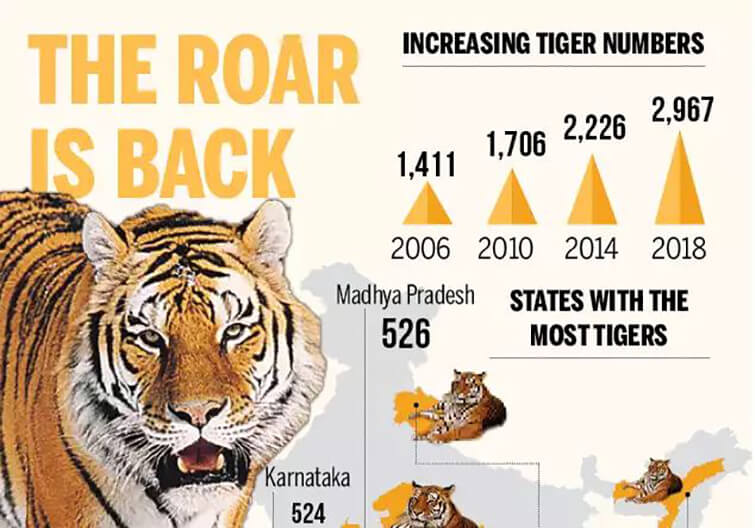
    India’s tiger population has reached a new high at 2,367.

    Before reading this newscard, try these PYQs:

    1. The term ‘M-STrIPES’ is sometimes seen in the news in the context of: (CSP 2017)

    (a) Captive breeding of Wild Fauna

    (b) Maintenance of Tiger Reserves

    (c) Indigenous Satellite Navigation System

    (d) Security of National Highways

    Q.Consider the following protected areas: (CSP 2012)

    1. Bandipur
    2. Bhitarkanika
    3. Manas
    4. Sunderbans

    Which of the above are declared Tiger Reserves?

    (a) 1 and 2 only

    (b) 1, 3 and 4 only

    (c) 2, 3 and 4 only

    (d) 1, 2, 3 and 4

    All India Tiger Estimation

    MP-tops-country-with-526-tigers-as-per-All-India-Tiger-Estimation-2018
    • The tiger count is prepared after every four years by the National Tiger Conservation Authority (NTCA) provides details on the number of tigers in the 18 tiger reign states with 50 tiger reserves.
    • However, this time, the census also included data collected from the rough terrains of north-eastern states which were not possible due to logistic constraints before.
    • The entire exercise spanned over four years is considered to be the world’s largest wildlife survey effort in terms of coverage and intensity of sampling.
    • Over 15, 000 cameras were installed at various strategic points to capture the movement of tigers. This was supported by extensive data collected by field personnel and satellite mapping.

    Details of the report

    • India has 70% of the world’s tigers, says the report.
    • Madhya Pradesh has the highest number of tigers at 526, closely followed by Karnataka (524) and Uttarakhand (442).
    • Chhattisgarh and Mizoram saw a decline in tiger population and all other States saw a “positive” increase, according to a press statement.

    Implementing CATS frameworks

    • India had embarked upon assessing management interventions through the globally developed Conservation Assured | Tiger Standards (CA|TS) framework.
    • This framework will now be extended to all fifty tiger reserves across the country.

    Back2Basics: Project Tiger

    • Project Tiger is a tiger conservation programme launched in April 1973 during PM Indira Gandhi’s tenure.
    • In 1970 India had only 1800 tigers and Project Tiger was launched in Jim Corbett National Park.
    • The project is administrated by the National Tiger Conservation Authority (NTCA).
    • It aims at ensuring a viable population of Bengal tigers in their natural habitats, protecting them from extinction etc.
    • Under this project the govt. has set up a Tiger Protection Force to combat poachers and funded relocation of villagers to minimize human-tiger conflicts.
  • Coronavirus – Health and Governance Issues

    In news: National Centre for Disease Control (NCDC)

    Note4Students

    From UPSC perspective, the following things are important:

    Prelims level: NCDC and its formation

    Mains level: Institutional failures in NCDC

    India’s premier organisation mandated to collect data about diseases, the NCDC is failing in its task as the spread of COVID-19 continues unabated.

    Practice question for mains:

    Q. Health infrastructure in India is hardly capable of handling any pandemic. Critically comment.

    About the National Centre for Disease Control

    • The NCDC carries out nationwide disease surveillance through its Integrated Disease Surveillance Programme (IDSP).
    • It is a vertical programme under Directorate General of Health Services.

    Its formation

    • This programme has been present in the country in different avatars since 1997 when the National Surveillance Programme for Communicable Diseases was set up.
    • This was upscaled to the Integrated Disease Surveillance Project in 2004, with assistance from the World Bank, to address the demands of the WHO’s International Health Regulations, 2005.
    • Under this, each country had to assess public health emergencies of international concern within 48 hours and report them to WHO within the next 24 hours.
    • It was then included in the 12th Plan (2012-17) under the Union Health Ministry and renamed IDSP.

    Mandate of the NCDC

    To aid the process of an investigation, NCDC has put down 10 steps that need to be followed for each outbreak:

    • Determine the existence of an outbreak
    • Confirm the diagnosis
    • Define a case
    • Search for cases
    • Generate hypothesis using descriptive findings
    • Test hypothesis with the analytical study
    • Draw conclusions
    • Compare hypothesis with established facts
    • Communication of findings
    • Execute preventive measures

    Why did NCDC fail?

    • IDSP’s manual says weekly and monthly updates are mandatory for each State and UTs even if no outbreaks are reported.
    • But this has never been observed to date.
    • There is an overlap between the diseases being followed by IDSP and other agencies like the National Vector Borne Disease Control Programme
    • The fact that IDSP does not collect mortality data was also a concern. Moreover, the IDSP was not investigating zoonotic diseases.
  • Foreign Policy Watch: United Nations

    [pib] India’s Voluntary National Review (VNR) of SDGs

    The NITI Aayog has recently presented India’s second Voluntary National Review at the UN’s High-Level Political Forum (HLPF) on Sustainable Development, 2020.

    Practice question for mains:

    Q.Discuss the institutional approach adopted by NITI Aayog for the 2030 Agenda of the Sustainable Development Goals (SDGs) of the United Nations.

    About the UN Forum on SDGs

    • The HLPF is the foremost international platform for follow-up and review of progress on the 17 Sustainable Development Goals (SDGs).
    • The HLPF meets annually in July for eight days under the auspices of the Economic and Social Council (ECOSOC) of the UN.
    • The VNRs presented by the Member States at the HLPF are a critical component of the review of progress and implementation of the 2030 Agenda and the SDGs.
    • The reviews are voluntary and state-led and are aimed at facilitating the sharing of experiences, including successes, challenges and lessons learned.

    India VNR 2020

    • NITI Aayog prepared and presented India’s first VNR in 2017.
    • The report is a comprehensive account of the adoption and implementation of the 2030 Agenda in India.
    • India’s VNR this year has undertaken a paradigm shift in terms of embodying a “whole-of-society” approach in letter and spirit.
    • Apart from presenting a review of progress on the 17 SDGs, the report discusses at length the policy and enabling environment, India’s approach to localizing SDGs, and strengthening means of implementation.
    • Leveraging science, technology and innovation for SDGs, and costing and financing of SDGs are the two levers of strengthening means of implementation which have been introduced this year.

    Consultations made for the VNR 2020

    From Global to Local -key steps of localisation of SDGs in India


  • Tiger Conservation Efforts – Project Tiger, etc.

    [pib] India’s Tiger Census sets a New Guinness Record

    Note4Students

    From UPSC perspective, the following things are important:

    Prelims level: All India Tiger Estimation 2018 results

    Mains level: Tiger conservation

    The fourth cycle of the All India Tiger Estimation 2018, results of which were declared to the nation on Global Tiger Day last year has entered the Guinness World Record for being the world’s largest camera trap wildlife survey.

    Before reading this newscard, try these PYQs:

    Q. The term ‘M-STrIPES’ is sometimes seen in the news in the context of: (CSP 2017)

    (a) Captive breeding of Wild Fauna

    (b) Maintenance of Tiger Reserves

    (c) Indigenous Satellite Navigation System

    (d) Security of National Highways

    Q.Consider the following protected areas: (CSP 2012)

    1. Bandipur
    2. Bhitarkanika
    3. Manas
    4. Sunderbans

    Which of the above are declared Tiger Reserves?

    (a) 1 and 2 only

    (b) 1, 3 and 4 only

    (c) 2, 3 and 4 only

    (d) 1, 2, 3 and 4

    About All India Tiger Estimation

    • The tiger count is prepared after every four years by the National Tiger Conservation Authority (NTCA) provides details on the number of tigers in the 18 tiger reign states with 50 tiger reserves.
    • However, this time, the census also included data collected from the rough terrains of north-eastern states which were not possible due to logistic constraints before.
    • The entire exercise spanned over four years is considered to be the world’s largest wildlife survey effort in terms of coverage and intensity of sampling.
    • Over 15, 000 cameras were installed at various strategic points to capture the movement of tigers. This was supported by extensive data collected by field personnel and satellite mapping.

    Highlights of the 2018 estimation

    • India has 2,967 tigers, a third more than in 2014, according to results of a tiger census.
    • India has achieved the target of doubling tiger population four years before the 2022 deadline.
    • According to the census, Madhya Pradesh saw the highest number of tigers at 526, closely followed by Karnataka at 524 and Uttarakhand at number 3 with 442 tigers.
    • While Pench Tiger Reserve in Madhya Pradesh recorded the highest number of tigers, Sathyamangalam Tiger Reserve in Tamil Nadu registered the “maximum improvement” since 2014.
    • Chhattisgarh and Mizoram saw a decline in their tiger numbers while tiger numbers in Odisha remained constant. All other states witnessed a positive trend.

    Back2Basics: Project Tiger

    • Project Tiger is a tiger conservation programme launched in April 1973 during PM Indira Gandhi’s tenure.
    • In 1970 India had only 1800 tigers and Project Tiger was launched in Jim Corbett National Park.
    • The project is administrated by the National Tiger Conservation Authority (NTCA).
    • It aims at ensuring a viable population of Bengal tigers in their natural habitats, protecting them from extinction etc.
    • Under this project the govt. has set up a Tiger Protection Force to combat poachers and funded relocation of villagers to minimize human-tiger conflicts.
  • ISRO Missions and Discoveries

    IN-SPACe: Future forerunner for India’s space economy

    Note4Students

    From UPSC perspective, the following things are important:

    Prelims level: IN-SPACE, ANTRIX, NSIl

    Mains level: ISRO and India's space economy

    • The government approved the creation of Indian National Space Promotion and Authorisation Centre (IN-SPACe) to ensure greater private participation in India’s space activities.
    • This decision is described as historic being part of an important set of reforms to open up the space sector and make space-based applications and services more widely accessible to everyone.

    Practice question for mains:

    Q. What is IN-SPACe? Discuss how it would benefit ISRO and contribute to India’s space economy.

    What is IN-SPACe?

    • IN-SPACe is supposed to be a facilitator, and also a regulator.
    • It will act as an interface between ISRO and private parties and assess how best to utilise India’s space resources and increase space-based activities.
    • IN-SPACe is the second space organisation created by the government in the last two years.
    • In the 2019 Budget, the government had announced the setting up of a New Space India Limited (NSIL), a public sector company that would serve as a marketing arm of ISRO.

    Confusion over NSIL and ANTRIX

    • NSIL’s main purpose is to market the technologies developed by ISRO and bring it more clients that need space-based services.
    • That role, incidentally, was already being performed by Antrix Corporation, another PSU working under the Department of Space, and which still exists.
    • It is still not very clear why there was a need for another organisation with overlapping function.
    • The government now had clarified the role of NSIL that it would have a demand-driven approach rather than the current supply-driven strategy.
    • Essentially, what that means is that instead of just marketing what ISRO has to offer, NSIL would listen to the needs of the clients and ask ISRO to fulfil those.

    Then, why was IN-SPACe needed?

    (1) ISRO and its limited resources

    • It is not that there is no private industry involvement in India’s space sector.
    • In fact, a large part of the manufacturing and fabrication of rockets and satellites now happens in the private sector. There is increasing participation of research institutions as well.
    • Indian industry, however, is unable to compete, because till now its role has been mainly that of suppliers of components and sub-systems.
    • Indian industries do not have the resources or the technology to undertake independent space projects of the kind that US companies such as SpaceX have been doing or provide space-based services.

    (2) India and the global space economy

    • Indian industry had a barely three per cent share in a rapidly growing global space economy which was already worth at least $360 billion.
    • Only two per cent of this market was for rocket and satellite launch services, which require fairly large infrastructure and heavy investment.
    • The remaining 95 per cent related to satellite-based services, and ground-based systems.

    (3) Catering to domestic demands

    • The demand for space-based applications and services is growing even within India, and ISRO is unable to cater to this.
    • The need for satellite data, imageries and space technology now cuts across sectors, from weather to agriculture to transport to urban development and more.
    • If ISRO is to provide everything, it would have to be expanded 10 times the current level to meet all the demand that is arising.

    (4) Promoting other private players

    • Right now, all launches from India happen on ISRO rockets, the different versions of PSLV and GSLV.
    • There were a few companies that were in the process of developing their own launch vehicles, the rockets like ISRO’s PSLV that carry the satellites and other payloads into space.
    • Now ISRO could provide all its facilities to private players whose projects had been approved by IN-SPACe.

    How ISRO gains from all these?

    • There are two main reasons why enhanced private involvement in the space sector seems important.
    • One is commercial, and the other strategic. And ISRO seems unable to satisfy this need on its own.
    • Of course, there is a need for greater dissemination of space technologies, better utilization of space resources, and increased requirement of space-based services.
    • The private industry will also free up ISRO to concentrate on science, research and development, interplanetary exploration and strategic launches.
    • Right now too much of ISRO’s resources are consumed by routine activities that delay its more strategic objectives.

    A win-win situation for all

    • ISRO, like NASA, is essentially a scientific organisation whose main objective is the exploration of space and carrying out scientific missions.
    • There are a number of ambitious space missions lined up in the coming years, including a mission to observe the Sun, a mission to the Moon, a human spaceflight, and then, possibly, a human landing on the Moon.
    • And it is not that private players will wean away from the revenues that ISRO gets through commercial launches.
    • The space-based economy is expected to “explode” in the next few years, even in India, and there would be more than enough for all.
    • In addition, ISRO can earn some money by making its facilities and data available to private players.
  • Higher Education – RUSA, NIRF, HEFA, etc.

    National Institutional Ranking Framework (NIRF) ‘India Rankings 2020’

    Note4Students

    From UPSC perspective, the following things are important:

    Prelims level: NIRF

    Mains level: Not Much

    The National Institute Ranking Framework (NIRF) ranking list has been released by the Ministry of Human Resource Development (MHRD).

    Practice question for mains:

    Q. What is NIRF? Discuss the parameters and methodology used in the ranking. Also, discuss its key features and limitations.

    About NIRF

    • The NIRF is a methodology adopted by the Ministry of HRD to rank institutions of higher education in India.
    • The Framework was approved and on 29 September 2015.
    • There are separate rankings for different types of institutions depending on their areas of operation like universities and colleges, engineering institutions, management institutions, pharmacy institutions and architecture institutions.
    • The ranking framework evaluates institutions on five broad generic groups of parameters, i.e. Teaching, Learning and Resources (TLR), Research and Professional Practice (RP), Graduation Outcomes (GO), Outreach and Inclusivity (OI) and Perception (PR).

    Why need such rankings?

    • Rankings help universities to improve their performance on various ranking parameters and identify gaps in research and areas of improvement.
    • The ranking is necessary for transparency and healthy competition.

    Highlights of the 2020 rankings

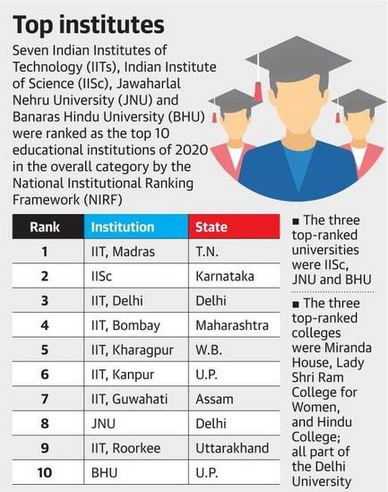
    • IIT Madras retains 1st Position in Overall Ranking as well as in Engineering,
    • Indian Institute of Science, Bengaluru tops the University list.
    • IIM Ahmedabad tops in Management Category and AIIMS occupies the top slot in Medical category for a third consecutive year.
    • Miranda College retains 1st position amongst colleges for a third consecutive year.
    • Maulana Azad Institute of Dental Sciences, Delhi secures 1st position in “Dental” category, dental institutions included for the first time in India Rankings 2020.