💥UPSC 2026, 2027, 2028 UAP Mentorship (March Batch) + Access XFactor Notes & Microthemes PDF

Type: Explained

  • Tobacco: The Silent Killer

    Vasco da Gama’s toxic legacy is now a ‘pandemic’ that kills 8 million globally   

    Note4Students

    From UPSC perspective, the following things are important:

    Prelims level: Tobacoo industry in India

    Mains level: CRISPR can reduce the impact of Tobacoo

    Why in the news? 

    On July 8th, 1497, Vasco da Gama’s historic voyage began, reshaping global maritime routes and leaving a lasting impact on trade and culture. This era of exploration introduced and disseminated tobacco, profoundly affecting societies in numerous ways.

    Cultivation and Production of Tobacco

    • Historical Introduction: Tobacco was originally cultivated by Native Americans and brought to Europe in the 16th century. It was introduced to South Asia by European traders and colonizers, notably the Portuguese, Dutch, and British.
    • Economic Significance: Tobacco is a drought-tolerant crop providing livelihoods to many. It accounts for about 2% of India’s agricultural exports and employs over 45 million people.
    • Revenue Generation: The tobacco industry is a major source of revenue through taxation and exports, generating over ₹22,000 crores annually.

    Implications on Human Health

    • Health Issues: Tobacco use contributes to various cancers (lung, mouth, throat, oesophagus, pancreas, and bladder), respiratory diseases (COPD, emphysema, chronic bronchitis), cardiovascular problems (heart disease, stroke, hypertension), and other conditions like diabetes, infertility, weakened immune system, and complications in pregnancy.
    • Addiction: Nicotine, a highly addictive substance in tobacco, alters brain function leading to severe addiction.
    • Health Crisis: In India, tobacco use causes over 1.2 million deaths annually. It is responsible for 27% of all cancers and adds significant costs to healthcare and productivity losses, totaling approximately ₹1.82 trillion annually.

    Ethical and Revenue Considerations

    • Economic Benefits vs. Health Costs: While tobacco provides economic benefits and employment, it comes with tremendous human and financial costs due to tobacco-related illnesses.
    • Constitutional Provisions: Under Article 21 of the Indian Constitution guarantees the right to life and health. The Directive Principles of State Policy mandate the state to improve public health and living standards.So,Govt. has responsibility to prevent tobacoo consumption.

    Indian needs to Stack Up Its Priorities

    • Institutional Conflict: The Indian Council of Medical Research (ICMR) focuses on eliminating tobacco to mitigate health impacts, while the Indian Council of Agricultural Research (ICAR) aims to increase tobacco crop yields.
    • Policy and Ethical Dilemma: The conflicting priorities between ICMR and ICAR create significant policy challenges. The constitutional mandate to prioritize public health should guide policy decisions.

    Will CRISPR make a difference?

    • Gene Editing Potential: CRISPR technology offers potential solutions by developing genetically modified tobacco plants with reduced nicotine content.
    • Research Developments: Studies have shown promise in using CRISPR to significantly lower nicotine levels in tobacco plants. However, further characterization is needed to ensure these modifications do not negatively impact other important traits.
    • Collaborative Efforts: Collaboration between ICMR and ICAR is crucial to align scientific advancements with public health goals and agricultural sustainability.

    The Tobacco Lobby and Surrogate Advertising

    • Circumventing Regulations: The tobacco industry employs surrogate advertising to promote its products despite stringent advertising bans. These tactics perpetuate tobacco consumption, especially among youth, undermining public health efforts.
    • Aggressive Lobbying: The tobacco industry has a large network of 1,027 registered lobbyists at the state level in 2024, many of whom are former government employees. They engage in extensive lobbying to weaken, delay or block life-saving tobacco control measures.

    Way forward: 

    • Implement Stricter Regulations: Enforce stringent regulations on tobacco advertising, including surrogate advertising, and ensure compliance through regular monitoring and penalties.
    • Ban on Public Smoking: Implement and strictly enforce smoking bans in public places to reduce exposure to second-hand smoke.

    Mains PYQ: 

    Q What are the research and developmental achievements in applied biotechnology? How will these achievements help to uplift the poorer sections of the society? (UPSC IAS/2021)

  • Citizenship and Related Issues

    How do Assam’s Foreigners Tribunals function? 

    Note4Students

    From UPSC perspective, the following things are important:

    Prelims level: About Foreigners Tribunals

    Mains level: Decision-Making Process of Foreigners Tribunals

    Why in the news? 

    On July 5, the Assam government instructed the Border wing of the State police not to refer cases of non-Muslims who entered India illegally before 2014 to the Foreigners Tribunals (FTs).

    About Foreigners Tribunals: 

    • Foreigners Tribunals are quasi-judicial bodies established to determine if a person staying illegally in India is a “foreigner” or not.
    • They were set up under the Foreigners (Tribunals) Order, 1964, enacted by the central government under the Foreigners Act, 1946.
    • Initially, only the central government could set up these tribunals. But a 2019 amendment empowered district magistrates in all states and UTs to establish Foreigners Tribunals.
    • The tribunals have the powers of a civil court to summon witnesses, require document production, and examine evidence.

    Decision-Making Process of Foreigners Tribunals:

    • Referral: Individuals suspected of being foreigners are referred to FTs by local authorities or border police. This referral can be based on various factors, including lack of documentation or doubtful voter status.
    • Notice Issuance: Upon receiving a reference, the FT issues a notice to the person alleged to be a foreigner. This notice is served in English or the state’s official language.The person has 10 days to respond to the notice and an additional 10 days to submit evidence supporting their claim of citizenship.
    • Submission of Evidence: The individual must present evidence to prove their Indian citizenship. This may include documents like birth certificates, school certificates, land records, or other official records.
    • Verification: The tribunal examines the documents and evidence provided, and may call witnesses or seek additional information if necessary.
    • Hearing: The FT has the authority to summon and examine the individual on oath, and to require the production of additional documents. The tribunal operates with certain powers of a civil court.
    • Judgment: If the evidence provided is deemed insufficient to prove citizenship, the individual may be declared a foreigner. If evidence is adequate, the person is recognized as an Indian citizen.
    • Detention and Deportation: If declared a foreigner and unable to appeal successfully, the person may be sent to a detention center (transit camp) for deportation.

    Role of Border Police:

    • Detection and Referral: The Assam Police Border Organisation is responsible for detecting illegal foreigners and referring suspicious cases to FTs.
    • Patrolling and Defence: They patrol the India-Bangladesh border, work with the Border Security Force, and maintain a second line of defense.
    • Monitoring: They monitor people settled in riverine and char (sandbar) areas.
    • Cases of ‘D’ Voters: They refer cases of ‘D’ (doubtful) voters to FTs as directed by the Election Commission of India.
    • NRC Appeals: People excluded from the NRC can appeal to the FTs through this wing to prove their citizenship.

    Challenges and Criticisms:

    • Supreme Court Rulings: The Supreme Court has overturned FT orders citing grave miscarriages of justice, such as the wrongful declaration of a deceased farmer, Rahim Ali, as a foreigner.
    • Corruption and Malpractice: Observations have been made about corruption within the system, with allegations of notices being improperly served.

    Conclusion: Need to Implement stricter oversight and auditing of Foreigners Tribunals to ensure fairness and adherence to legal procedures. Regular reviews and monitoring can help prevent corruption and malpractice, ensuring that notices are properly served and tribunal processes are transparent.

    Mains PYQ: 

    Q How far are India’s internal security challenges linked with border management particularly in view of the long porous borders with most countries of South Asia and Myanmar? (UPSC IAS/2013)

  • Forest Conservation Efforts – NFP, Western Ghats, etc.

    The issue with India’s tree planting schemes

    Note4Students

    From UPSC perspective, the following things are important:

    Prelims level: Initiative related to Tree plantation

    Mains level: India's accountability and challenges toward environmental Goals

    Why in the news? 

    India’s tree planting schemes have garnered attention as part of the country’s efforts to combat climate change and restore degraded ecosystems. However, these initiatives face several challenges and criticisms.

    Recent Trends of Special Conservation Drives:

    • Increased Initiatives: There has been a surge in global and national tree planting drives, such as the “One Trillion Project” by the World Economic Forum, Pakistan’s “10 Billion Tree Tsunami,” China’s “Great Green Wall,” and the “Bonn Challenge” to restore degraded landscapes.
    • High Media Attention: These drives often feature catchy slogans and glamorous campaigns that attract substantial media attention and public involvement.
    • Annual Events: India celebrates Van Mahotsava annually in July, aiming to promote tree planting and environmental conservation.

    Issues Associated with These Drives:

    • Limited Community Participation: Many programs lack significant involvement from local communities, affecting their effectiveness and sustainability.
    • Post-Planting Measures: Insufficient focus on post-planting care and monitoring hinders the success of tree planting efforts.
    • Monoculture Risks: Some drives promote monoculture, which can be detrimental to biodiversity and carbon sequestration.
    • Ecological Impact: Inappropriate tree planting in non-deforested areas like grasslands or animal habitats can damage ecosystems, increase wildfire risk, and exacerbate global warming.

    India’s Accountability and Challenges Toward Environmental Goals:

    • Achievements: India claims to have fulfilled its Paris Agreement commitments and achieved an additional carbon sink of 1.97 billion tonnes of CO2 equivalent.
    • Encroachment and Loss: Approximately 10 million hectares of Indian forests are under encroachment, and about 5.7 million hectares have been lost for non-forestry purposes.
    • Dependence on Forests: Nearly 27.5 crore people rely on forests for subsistence, highlighting the importance of sustainable management.
    • Restoration Goals: India aims to restore 26 million hectares of degraded forests by 2030, but faces challenges such as encroachment and the need for effective tree planting strategies.

    Way forward: 

    • Community Involvement: Need to foster local participation in tree planting drives by involving communities in planning, execution, and ongoing maintenance.
    • Monitoring and Maintenance: Try to implement robust post-planting monitoring and care systems to ensure the survival and growth of planted trees.
    • Policy and Strategy Improvements: To address criticism of mass planting drives, India needs to prioritize adequate financing, active community participation, and technical considerations in forestry and restoration strategies.
  • e-Commerce: The New Boom

    The State of India’s Informal Economy    

    Note4Students

    From UPSC perspective, the following things are important:

    Prelims level: About NSSO

    Mains level: Key highlight of recent survey by NSSO

    Why in the news? 

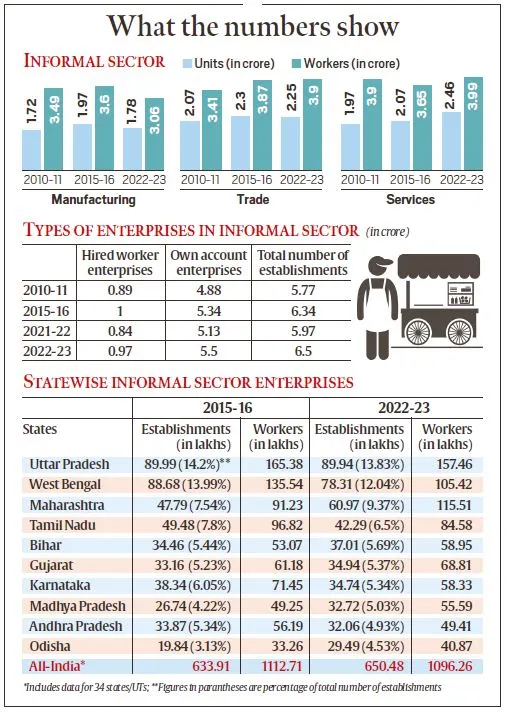
    The NSSO’s 2021-22 and 2022-23 survey outcomes reveal effects of significant economic shocks due to demonetisation, GST implementation, and the COVID-19 pandemic on India’s economy.

    About NSSO: 

    • The NSSO is India’s premier agency for conducting large-scale nationwide sample surveys on socio-economic aspects that collects data on employment, consumption, health, education, and other areas to provide essential inputs for policy and planning.
    • The NSSO was merged with the Central Statistical Office in 2019 to form the National Statistical Office.

    Key highlight as per the recent survey by NSSO   

    • Impact of Economic Shocks: The surveys reflect the aftermath of major economic events such as demonetisation (November 2016), the rollout of GST (July 2017), and the COVID-19 pandemic (starting March 2020).
    • Employment Trends: There has been a noticeable decline in employment within the informal sector over the past seven years, with around 16.45 lakh jobs lost.
    • Sectoral Dynamics: The unincorporated manufacturing sector saw a significant contraction, with the number of enterprises declining by 9.3% from 19.7 million in 2015-16 to 17.82 million in 2022-23.

    What are unincorporated enterprises?  

    • Unincorporated enterprises are informal businesses not legally registered as companies.
    • They include MSMEs, household units, own-account enterprises, and partnerships, operating outside formal regulatory frameworks but contributing significantly to employment and economic activity.

    Why are these survey results important and what do they represent?  

    • Timely Insights: These survey results offer current data crucial for understanding the evolving role of the informal sector in job creation, particularly during economic slowdowns when formal sector employment may decline.
    • Impact Assessment: They provide a detailed analysis of how significant economic events like demonetisation, GST implementation, and the COVID-19 lockdowns have affected the informal sector, highlighting vulnerabilities and resilience.
    • Policy Relevance: The findings inform policymaking aimed at supporting and regulating the informal sector, ensuring that measures address its unique challenges and contributions to overall economic stability and inclusivity.

    What has been the pattern of ‘Informal Employment’ across states?

    • The data shows a mixed pattern across states, with 16 out of 34 states/UTs recording a decline in informal sector workers in 2022-23 compared to 2015-16.
    • Around 63 lakh informal enterprises shut down due to GST between 2015-16 and 2022-23, resulting in a loss of about 1.6 crore jobs.
    • The number of informal enterprises plunged from 50.32 lakh with 85.6 lakh workers in April-June 2021 at the peak of the COVID-19 second wave, to 1.91 crore firms with 3.12 crore employees in January-March 2022.

    Way Forward: 

    • The government should provide targeted support and incentives to help informal enterprises adapt to the post-GST and post-pandemic environment.
    • Policymakers should aim to facilitate a gradual transition of informal enterprises to the formal sector.

    Mains PYQ: 

    Q How globalization has led to the reduction of employment in the formal sector of the Indian economy? Is increased informalization detrimental to the development of the country? (UPSC IAS/2016)

  • Women empowerment issues – Jobs,Reservation and education

    On political representation of women  

    Note4Students

    From UPSC perspective, the following things are important:

    Prelims level: About 106th Amendment Act

    Mains level: Quota should be provided in political parties for women

    Why in the News?

    In the recently concluded general elections in the U.K., a record 263 women MPs, making up 40% of the total, have been elected to the House of Commons.

    Political representation of Women in the world: 

    Have women been fairly represented in Parliament in independent India?

    Women were granted the right to vote from the First General Elections in 1952, yet their representation in the Lok Sabha has been low.

    • Statistics about women’s representation: The women’s representation in Lok sabha in between of  1952 and 2004 was about ranged from 5% to 10%.
      • The percentage women’s representation had increased to 12% in 2014 and stands at 13.6% in the 18th Lok Sabha while in the Rajya Sabha (upper house), the figure is 13%.
    • Constitutional Amendments: The 73rd and 74th amendments in 1992/1993 provided one-third reservation for women in panchayats and municipalities, but similar reservations for the Lok Sabha and State assemblies have not been successful until recently.

    Note: The global average of 26.9% of women in National parliaments.

    Women’s Representation in State Legislatures:

    • No state has more than 20% women representation in its legislative assembly.
    • Chhattisgarh has the highest representation with 18% women MLAs.
    • Himachal Pradesh has just one woman MLA and Mizoram has none.

    Should political parties provide internal reservations to increase women’s political participation?

    • Globally, higher representation for women is achieved through voluntary or legislated compulsory quotas for candidates within political parties or reserved seats in parliament.
    • So, quotas within political parties offer more democratic choices to voters and flexibility in candidate selection. It means quota in Political parties could be the most important step to increase women’s representation in Parliament.
    • Some parties, like Naam Tamilar Katchi in Tamil Nadu, have adopted voluntary quotas (50% for women candidates), but such measures alone have not significantly improved overall representation.

    When will the 106th constitutional amendment be implemented?

    • The 106th Amendment Act provides for 33% reservation for women in the Lok Sabha and state legislative assemblies, including the Delhi Legislative Assembly.
    • The reservation will come into effect after an exercise of delimitation is undertaken following the first census conducted after the commencement of the 106th Amendment Act.
    • The women’s reservation will be in operation for a period of 15 years from its commencement.

    Way Forward: 

    • Public Awareness and Advocacy: Need to conduct widespread awareness campaigns to highlight the importance of gender equality in political representation.
    • Capacity Building and Support Mechanisms: Need to implement comprehensive capacity-building programs aimed at empowering women politically. For example,provide training in leadership skills, campaign management, and legislative processes.

    Mains PYQ: 

    Q The reservation of seats for women in the institutions of local self-government has had a limited impact on the patriarchal character of the Indian Political Process.” Comment. (UPSC IAS/2019)

  • Agricultural Sector and Marketing Reforms – eNAM, Model APMC Act, Eco Survey Reco, etc.

    Choosing the right track to cut post-harvest losses

    Note4Students

    From UPSC perspective, the following things are important:

    Prelims level: Agronomy; Food production;

    Mains level: Challenges in Farm Sector; Value Chains;

    Why in the News? 

    India holds the position of the second-largest agricultural producer globally however, it only accounts for 2.4% of global agricultural exports, ranking eighth worldwide due to the post-harvest loss.

    A closer look at India’s post-harvest loss:

    • Economic Impact: India faces annual post-harvest losses amounting to approximately ₹1,52,790 crore, significantly impacting farmer incomes and the agricultural economy.
    • Perishable Commodities: The biggest losses occur in perishable commodities like livestock produce (22%), fruits (19%), and vegetables (18%). Export processes further add to these losses, particularly at the import-country stage.
    • Supply Chain Inefficiencies: There is Inefficiencies in storage, transportation, and marketing, alongside a lack of assured market connectivity, contribute to significant post-harvest losses. Small and marginal farmers, who make up 86% of the farming community, struggle with economies of scale and market access.

    Initiatives taken by the Railways Department:

    • Truck-on-Train Service: Indian Railways introduced the truck-on-train service, allowing loaded trucks to be transported on railway wagons. This service has been expanded following successful trials with commodities like milk and cattle feed.
    • Parcel Special Trains: During the COVID-19 pandemic, the Railways introduced parcel special trains to transport perishables and seeds between producers and markets, ensuring timely delivery and reducing post-harvest losses.
      • The DFI (Doubling farmers’ income) committee recommends streamlining loading and unloading processes to minimize transit times and address staffing shortages through recruitment and training initiatives.
    • Kisan Rail Scheme: It was launched to connect production surplus regions with consumption regions. This scheme facilitates the transportation of perishables (including milk, meat, and fish) more efficiently.
    • Specialized Wagons and Facilities: Investment in specialized wagons for temperature-controlled transport and establishing rail-side facilities for safe cargo handling are essential steps taken by the Railways.

    Way for Untapped Opportunities:

    • Enhanced Environmental Benefits: Rail transport generates up to 80% less carbon dioxide for freight traffic compared to road transport.
    • Public-Private Partnerships: The private sector can play a crucial role in enhancing operational efficiency and strengthening rail infrastructure through public-private partnerships, thereby improving the overall logistics ecosystem for agricultural produce.
    • Budgetary Support and Infrastructure Development: The budgetary allocation for agriculture in 2024 aims to bridge the farm-to-market gap with modern infrastructure and value-addition support.
    • Technology Integration: Incorporating advanced technologies like real-time tracking, temperature monitoring, and automated loading/unloading systems.

    Way forward: 

    • Expand climate-controlled storage facilities and cold storage capacity to accommodate a larger share of agricultural produce.
    • Provide small and marginal farmers access to storage facilities through cooperatives or subsidies.
    • Invest in specialized rail wagons for temperature-controlled transport and establish rail-side cargo handling facilities.

    Mains PYQ: 

    Q How do subsidies affect the cropping pattern, crop diversity and economy of farmers? What is the significance of crop insurance, minimum support price and food processing for small and marginal farmers? (UPSC IAS/2017)

  • Minority Issues – SC, ST, Dalits, OBC, Reservations, etc.

    The problems with sub-caste reservations

    Note4Students

    From UPSC perspective, the following things are important:

    Prelims level: Population of SC and ST in India

    Mains level: Objective of reservation

    Why in the News?

    The Supreme Court has reserved its decision on sub-caste reservations for SC/STs. Any ruling on this matter must be substantiated not only legally but also academically.

    What is the Sub-categorization of castes?

    It refers to the practice of further dividing larger caste categories into smaller groups or sub-groups based on specific criteria such as socio-economic status, geographical location, historical background, or specific needs for policy implementation.

    Background of the Case:

    • The case involves the validity of sub-classification within the SC and ST categories for providing reservations in government jobs and education.
    • In 2004 Supreme Court strikes down Andhra Pradesh Scheduled Castes (Rationalisation of Reservations) Act, 2000, citing violation of the right to equality in the E.V. Chinnaiah v State of Andhra Pradesh case and emphasised that the SC list should be treated as a single, homogeneous group
      • Only Parliament has the power to sub-classify SCs and STs for reservations
      • The Supreme Court is now considering whether states have the power to create sub-classifications within these reserved categories.
    • The case stems from a 1975 Punjab government notification that divided its 25% reservation for SCs into two categories: half for Balmikis (Valmikis) and Mazhabi Sikhs, and the other half for the remaining groups within the SC category.

    Objectives behind the implementation of reservations and present SC scenario:

    • Objective of Reservations: The primary objective of reservations, as advocated by Dr. B.R. Ambedkar, is to ensure equitable representation and opportunities for historically marginalized communities, particularly Scheduled Castes (SCs).
    • Present SC scenario: Despite reservations, certain sub-castes within SCs continue to face challenges in securing adequate representation in jobs and education. This under-representation is often attributed to factors such as inadequate educational opportunities, economic disparities, and historical discrimination.

    The policy of economic empowerment in India and its associated challenges:

    • Policies for Economic Empowerment: These policies complement reservations by focusing on enhancing the ownership of capital assets (like land and businesses) and improving educational attainment among SC individuals
      • For example, Self-Employment Scheme for Rehabilitation of Manual Scavengers (SRMS), National Scheduled Castes Finance & Development Corporation (NSFDC) and National Safai Karamcharis Finance & Development Corporation (NSKFDC).
      • These policies are aimed at building capabilities and enabling greater participation in economic activities.
    • Challenges: There are challenges in implementing economic empowerment policies including inadequate access to credit and financial resources, lack of skill development initiatives, and persistent socio-economic barriers that hinder the upward mobility of SC communities.
      • Intersection with Reservations: Integrating economic empowerment with reservations is crucial to ensure that individuals from SC backgrounds not only secure reserved positions but also have the necessary skills and resources to thrive in competitive environments.

    What must be our focus? (Way Forward)

    • Holistic Approach: There is a need for a holistic approach that combines reservations with targeted economic and educational interventions. This approach should address both systemic discrimination and socio-economic barriers faced by SC communities.
    • Capacity Building: There should be emphasis on enhancing the educational infrastructure and skill development programs tailored to the needs of SC individuals.
    • Data-Driven Policy: The policy decisions related to sub-caste reservations should be informed by empirical data that assesses the actual impact of discrimination versus socio-economic factors on under-representation.

    Mains PYQ: 

    Q Whether National Commission for Scheduled Castes (NCSC) can enforce the implementation of constitutional reservation for the Scheduled Castes in the religious minority institutions? Examine (UPSC IAS/2018)

  • Electoral Reforms In India

    ECI’s technical SOP for EVM verification is out: why verify and how? 

    Note4Students

    From UPSC perspective, the following things are important:

    Prelims level: Burnt Memory of EVM

    Mains level: Process to be followed for the verification of EVMs and VVPATs

    Why in the News?

    The ECI released a technical Standard Operating Procedure (SOP) on July 16 for verifying burnt memory in EVMs and VVPATs, following an April Supreme Court verdict.

    What is the Burnt Memory of EVM?

    • “Burnt memory” in Electronic Voting Machines (EVMs) refers to the firmware or software program permanently written onto the microcontroller’s memory during the manufacturing process.
    • This memory controls the EVM’s operations, and “burnt” implies it is fixed and cannot be altered or reprogrammed easily.

    What was the case before the Supreme Court, and what did it order?  

    Case Before the Supreme Court:

    • The Supreme Court was hearing a challenge to the reliability of Electronic Voting Machines (EVMs). The judgment was delivered on April 26, 2024, during the Lok Sabha election.
    • The Supreme Court upheld the EVM-VVPAT system and rejected the plea for a return to paper ballots and for 100% counting of VVPAT slips.
    • The court directed the Election Commission of India (ECI) to allow second and third-placed candidates to seek verification of burnt memories of EVMs and VVPATs of up to 5% of machines in an Assembly constituency or an Assembly segment of a Lok Sabha constituency.

    Court’s Orders:

    • The burnt memory/microcontroller in 5% of the EVMs (control unit, ballot unit, and VVPAT) per assembly constituency/assembly segment of a parliamentary constituency shall be checked and verified for tampering or modification.
    • Candidates who are at Sl. No. 2 or Sl. No. 3 behind the highest polled candidate can request verification in writing.
    • Candidates or their representatives have the option to be present during the verification process. Requests for verification must be made within seven days of the declaration of the result.
    • The actual cost or expenses for the verification will be notified by the ECI, and the candidate requesting the verification will bear the expenses. These expenses will be refunded if tampering is found.

    What is the process to be followed for the verification of EVMs and VVPATs? 

    Technical SOP by ECI:

    • Mock Poll: A mock poll of up to 1,400 votes per machine will be conducted in the presence of candidates or their representatives.
    • Result Comparison: If the results of the machines and VVPAT slips match, it will be concluded that the burnt memory or microcontrollers have not been tampered with.
    • Selection of Machines: Candidates can select the polling stations, EVMs, BUs, CUs, and VVPATs they want checked.
    • Verification Team: Trained engineers from the EVM manufacturers, Bharat Electronics Ltd (BEL) and Electronics Corporation of India Ltd (ECIL) will perform the checks.
    • Technical Methods: Various technical methods will be used to verify the fidelity of firmware burnt into a microcontroller through a public process.

    When will this process of checking start?

    • Preliminary Step: Verification will commence after it is confirmed by the High Courts of the respective states that no Election Petitions have been filed regarding the constituencies in question.
    • Election Petitions: Petitions challenging the election outcome can be filed within 45 days of the results being declared. Since the results were announced on June 4, petitions can be filed until July 19.
    • Applications Received: Eleven applications cover 118 polling stations or sets of EVMs and VVPATs. Applications have been received from candidates from BJP, Congress, DMDK, and YSRCP.

    Way forward: 

    • Enhanced Transparency and Confidence: Conduct regular and public verification processes of EVMs and VVPATs with involvement from political parties and independent observers to build public trust and confidence in the electoral system.
    • Technological Upgradation and Training: Invest in upgrading EVM technology and provide comprehensive training for election officials and engineers to ensure efficient and accurate verification and operation of voting machines.
  • Telecom and Postal Sector – Spectrum Allocation, Call Drops, Predatory Pricing, etc

    ‘Telecom sector awaits next frontier in communications via policy reform’  

    Note4Students

    From UPSC perspective, the following things are important:

    Prelims level: Staus of digital Infrastructure of India

    Mains level: Digital Infrastructure;

    Why in the News?

    The telecom industry has proposed several policy recommendations to the Ministry of Communications that are essential to realize the Government’s vision of promoting digital empowerment and inclusivity.

    Present global status of the Indian market: 

    • Digital Connectivity Advancements: India has made significant strides in digital connectivity, positioning itself as the third-largest digitized country globally, following the USA and China.
    • Telecommunications Infrastructure: The telecommunications infrastructure in India serves as a cornerstone for digital transformation, facilitating connectivity across various devices and applications, thereby contributing to higher standards of living and economic growth.
    • Policy Reforms: Ambitious policy reforms have been implemented to elevate India’s status as a leading digital economy. These reforms aim at fostering digital empowerment and inclusivity, crucial for sustaining growth and competitiveness in the global market.

    Recommendations submitted by the telecom industry   

    • Reduction in Levy and Tax Burden:
      • Abolishment of the USOF (Universal Service Obligation Fund) levy because of  imposes a burden on telecom service providers (TSPs), diverting resources that could be invested in newer technologies such as 5G and network upgrades
        • USOF is the pool of funds generated by 5% Universal Service Levy that is charged upon all the telecom fund operators on their Adjusted Gross Revenue (AGR).
      • Reduction of the license fee from 3% to 1%.
      • Clarity in the definition of Gross Revenue (GR) to exclude non-telecom activities from tax calculations.
    • Exemption and Duty Reductions:
      • Exemption of Service Tax on additional Adjusted Gross Revenue (AGR) liabilities is demanded because it is crucial for the recovery of the industry’s financial health and ensuring efficient 5G rollout.
        • AGR has resulted in massive dues of over ₹1.5 lakh crore that telecom companies like Bharti Airtel, Vodafone Idea, and others have to pay.
      • Reduction of Customs Duty to zero for telecom manufacturing, with gradual increases for 4G and 5G products.
      • Urgency in renewing Customs Duty exemptions for submarine cable vessels to prevent future cost increases.
    • Spectrum Allocation:
      • Prioritization of 6 GHz spectrum for 5G deployment in India.
      • Strategic planning of 6 GHz spectrum for future 6G technologies, aiming at enhancing network quality, coverage, and supporting a range of advanced applications like telemedicine and smart cities.
    • Telecommunications Act 2023:
      • Introduction of the Telecommunications Act 2023, addressing critical issues such as Right of Way (RoW) for telecom infrastructure.
      • Standardization of RoW rules across states, simplification of licensing processes, and delinking telecom infrastructure from property taxes to facilitate faster deployment of 5G services.
    • Implementation of Reforms:
      • Emphasis on the swift implementation of regulatory reforms to minimize bureaucratic delays and operational hurdles.
      • Creation of a conducive environment for telecom investments by ensuring clarity and uniformity in RoW regulations, thereby improving the Ease of Doing Business (EoDB) in the sector.

    Conclusion: The Government should prioritize the swift implementation of proposed policy reforms, including the reduction of levies and taxes, clarity in revenue definitions, and spectrum allocation for 5G and future 6G technologies. Timely execution will bolster investor confidence, accelerate infrastructure development, and enhance digital connectivity nationwide.

    Mains PYQ:

    Q Cyber warfare is considered by some defence analysts to be a larger threat than even Al Qaeda or terrorism. What do you understand by Cyberwarfare? Outline the cyber threats which India is vulnerable to and bring out the state of the country’s preparedness to deal with the same. (2013)

  • Innovations in Sciences, IT, Computers, Robotics and Nanotechnology

    As thoughts become digitised, who will protect our Neurorights? 

    Note4Students

    From UPSC perspective, the following things are important:

    Prelims level: What is EEG?

    Mains level: Ethics; Concerns and opportunities related to digitisation of neuro-data;

    Why in the News?

    Many researchers anticipate the imminent development of wearable EEGs capable of enhancing human cognitive functions directly.

    • Elon Musk’s Neuralink has also sparked optimism by exploring brain-computer interfaces to potentially restore lost functions in physically impaired individuals.
    • Neuralink is a company founded by Elon Musk in 2016 that’s developing a brain-computer interface called “the Link,” which is a surgically embedded neural-chip implant designed to decode and stimulate brain activity.
    • Neuralink implanted its first device in a patient’s brain in January 2024.

    What is EEG?

    EEGs refer to electroencephalograms, which are devices used to record electrical activity in the brain. These devices are valuable in neuroscience for monitoring brain functions and diagnosing various neurological conditions.

    What is Neuroscience?

    Neuroscience is the scientific study of the nervous system, which includes the brain, spinal cord, and peripheral nerves. It is a multidisciplinary field that combines various approaches to understand the structure, function, and disorders of the nervous system.

    What is Neuro data?

    Neuro-data refers to data related to the nervous system, particularly the brain. It encompasses various types of data collected through neuroscience research and clinical studies.

    Significance of Neurodata:

    • Medical Advancements: It has the potential to provide precise diagnosis and personalized treatment of neurological disorders. It facilitates the continuous monitoring of brain health and early detection of abnormalities.
    • Technological Innovation: It supports the development of brain-computer interfaces (BCIs) and wearable neurodevices. It would enhance rehabilitation options for individuals with neurological impairments.
    • Research and Insights: It can provide data for studying brain functions, cognition, and behaviour. It fuels advancements in neuroscience, leading to new therapies and interventions.

    What are your neurorights?

    • Right to Mental Privacy: Individuals have the right to privacy concerning their neural activities and cognitive processes. This includes protection against unauthorized access to neural data and ensuring confidentiality in the use of neurotechnologies.
    • Right to Neurological Integrity: Individuals possess the right to autonomy over their neurological functions and activities. This entails the freedom from undue manipulation or coercion through neurotechnological interventions, ensuring that such technologies respect and preserve individuals’ neurological integrity.

    What is Neuroethics?

    Neuroethics is a field that addresses the ethical, legal, and social implications of advancements in neuroscience and neurotechnologies. It aims to ensure that the development and application of these technologies benefit humanity while minimising harm.


    The digitisation of neuro-data raises great opportunities as well as concerns  

    • Opportunities:

      • Enhanced Cognitive Assistance: Wearable EEGs and other neurotech devices can directly aid cognitive functions. For example, Brain-computer interfaces (BCIs) like Neuralink could help physically impaired individuals restore lost functions.
      • Medical Advancements: It provides Real-time health monitoring and personalized healthcare options. For example, Improved diagnosis and treatment of brain disorders through detailed neuro-data.
      • Commercial and Research Value: It provides Valuable insights for neuromarketing to understand and influence consumer behaviour.
      • Integration with Daily Life: It can be used in daily life by using Smartwatches and apps that can track physiological activities and emotions, integrating neurotech into everyday activities.
    • Concerns:

      • Surveillance Risks: It has a potential misuse of neuro data for monitoring by employers, governments, and private companies.
      • Privacy and Security: It may threaten mental privacy and autonomy with the collection and analysis of sensitive neuro data.
      • Ethical and Legal Challenges: It has the potential for ethical dilemmas in mental privacy, consent, and the use of neurotech in various societal contexts.
      • Impact on Individual Rights: The right to think freely and safeguard one’s mental state from monitoring could be compromised. For example, Digitized health data’s commercial value could lead to exploitation and loss of personal control.

    Initiatives related to neuroethics: 

    • Institutional Efforts:
      • U.S. Presidential Commission on Bioethics: In 2015, it published the ‘Gray Matters’ report, addressing cognitive enhancement, consent capacity, and the legal implications of neuroscience.
    • Global Initiatives:
      • OECD Recommendations: In 2019, the OECD recommended principles such as safeguarding personal brain data and monitoring potential misuse of neurotechnologies.
      • UNESCO’s Concerns: In 2022, UNESCO highlighted issues related to human identity, freedom of thought, and privacy, emphasizing the risks of unauthorized access to neural data.
    • Research and Training:
      • Institute of Neuroethics: In 2023, researchers emphasized the need for proactive consideration of the implications of scientific advances and incorporating ethics into research training.

    Conclusion: Governments and international bodies should collaborate to create robust regulations that govern the collection, use, and sharing of neuro data. These regulations should ensure that neurotechnologies are used ethically, protecting mental privacy, consent, and individual rights.

    Mains PYQ: 

    Q Discuss the advantages and security implications of cloud hosting of servers vis-a-vis in-house machine-based hosting for government business. (2015)
