💥UPSC 2026, 2027, 2028 UAP Mentorship (March Batch) + Access XFactor Notes & Microthemes PDF

Type: Explained

  • Genetically Modified (GM) crops – cotton, mustards, etc.

    Can GM Crops promise Food Security?

    Note4Students

    From UPSC perspective, the following things are important:

    Prelims level: GM crop in India

    Mains level: Are Non-GM Ecological Crops Also a Food Security Solution?

    Why in the news?

    A new “gene revolution” is being promoted as a solution to increasing global food demand and the impact of climate change on agriculture.

    What does the World Economic Forum (WEF) say?

    • The WEF supports GM technology and believes it can help ensure food security for a global population expected to reach 10 billion by 2050.
    • Research into new strains of rice, maize, wheat, potato, and cassava can help these staples survive extreme weather and new climate-induced diseases.
    • Latest bioengineering technologies can help plants and soils capture and store atmospheric carbon, potentially reducing planet-heating carbon.
    • Projects are optimizing photosynthesis in crops like maize and rice to improve yields and reduce atmospheric carbon.

    Industrial-Scale GMOs Perpetuate Climate Change

    • Critics argue that GM crops sustain an “agro-industrial system” responsible for significant greenhouse gas emissions. Current food systems contribute to around one-third of global greenhouse gas emissions.
    • GMOs often involve large-scale monocultures requiring significant amounts of artificial fertilizers, pesticides, and irrigation.
    • This system is criticized for being energy-intensive and unsustainable, benefiting large agro-industrial companies that dominate the seed, food, pesticide, and fertilizer markets.

    What is the Present Scenario?

    • Over half of harvested cropland in the US uses genetically modified seeds.
    • Despite the proliferation of GM crops, food insecurity remains widespread, with 250 million people in nearly 60 countries experiencing crisis-level food insecurity.
    • Successful campaigns, like in the Philippines, have led to production moratoriums on certain GM crops due to health and ecological concerns.

    Are Non-GM Ecological Crops Also a Food Security Solution?

    • Resistance to GMOs persists, with scepticism about their safety and ecological impact.
    • Non-GM ecological approaches face challenges due to limited research support, as most funding comes from large agri-biotech companies.
    • Ecological, non-GM crops aim to produce toxic-free food and nurture biodiverse ecosystems that can resist and mitigate climate change.
    • There is ongoing development of ecological, non-GM seed, food, and nutrition systems to address food security in a warming world.

    Way forward:

    • Enhanced Regulatory Oversight and Support for Ecological Practices: Strengthen regulations to ensure the safe development, testing, and deployment of GM crops while supporting research and development of non-GM ecological farming practices.
    • Public Awareness and Inclusive Research Funding: Launch comprehensive public education campaigns to inform communities about the benefits and risks of GM and non-GM crops, promoting informed decision-making.

    Note:  India has approved the commercial cultivation of only one GM crop, Bt cotton. No GM food crop has been approved for commercial cultivation in the country.

    Mains PYQ:

    Q What are the present challenges before crop diversification? How do emerging technologies provide an opportunity for crop diversification? (UPSC IAS/2021)

  • Sri Lanka’s Constitution – Strides in the Right Direction

    A story of displacement to one of empowerment

    Note4Students

    From UPSC perspective, the following things are important:

    Mains level: Issues related to Sri Lankan Tamils

    Why in the news?

    Over 45% of Sri Lankan Tamils in Tamil Nadu’s rehabilitation camps were born in India, per a recent interim report by a State government panel.

    Causes of Tamilian Displacement

    • Ethnocentric Violence: The primary cause of displacement was the ethnocentric violence in Sri Lanka, particularly against the Tamil population. The violence led to significant loss of life and property, forcing Tamils to flee for their safety.
    • Proximity and Linguistic Commonality: Many Tamils chose India, particularly Tamil Nadu, due to its geographical proximity and the shared Tamil language, making it a more accessible and familiar refuge.

    Government Initiatives

    • Provision of Basic Amenities: Refugees receive free housing, electricity, water, and monthly food rations. Additionally, they get a monthly cash dole.
    • Educational Support: Access to government schools is provided, along with a monthly stipend of ₹1,000 for those pursuing higher education. One-time educational support includes ₹12,000 for arts and science students and ₹50,000 for engineering students.
    • Welfare Schemes: Refugees are eligible for various welfare schemes available to the people of Tamil Nadu, including the women’s rights scheme providing ₹1,000 per month.
    • New Housing: Recently, the Government of Tamil Nadu has constructed new homes for about 5,000 Sri Lankan Tamils.
    • Renaming Camps: In an effort to destigmatise, the refugee camps were renamed as Sri Lankan Tamil Rehabilitation Camps in a government order dated October 28, 2021.

    Bringing Back Dignity

    • Educational Achievements: The welfare schemes have led to 100% school enrollment and over 4,500 graduates from the camps.
    • Breaking Caste Barriers: As refugees, Sri Lankan Tamils are categorized under the Refugee category, which has helped in break free from caste barriers.
    • Government Recognition: The renaming of refugee camps to Sri Lankan Tamil Rehabilitation Camps is a step towards restoring the dignity of the displaced population.
    • Advocacy and Support: Continuous advocacy by organizations like OfERR, support from donors, and political parties have facilitated the patronage extended by the Government of Tamil Nadu and the Government of India.
    • Potential for Future Contribution: The transformation of refugees into resource persons capable of contributing to nation-building when they return to Sri Lanka.

    Current Challenges

    • Legal Limitations: Indian laws currently do not permit local integration by granting citizenship to Sri Lankan refugees.
    • Economic and Health Crises: The COVID-19 pandemic and the economic crisis in Sri Lanka have slowed down the process of refugees returning to their homeland.
    • Uncertain Future: Despite the improvements in their living conditions and dignity, Sri Lankan Tamils in India continue to live with uncertainty about their long-term future.

    Way forward:

    • Amend Legal Frameworks: Advocate for amendments in Indian laws to allow for local integration and citizenship for long-term refugees, providing them with a secure legal status and equal rights.
    • Strengthen Economic Opportunities: Develop targeted economic empowerment programs, including vocational training and employment initiatives, to enhance self-sufficiency and reduce dependency on state support, ensuring a sustainable livelihood for the refugees.

    Mains PYQ: 

    Q ‘India is an age-old friend of Sri Lanka.’ Discuss India’s role in the recent crisis in Sri Lanka in the light of the preceding statement. (UPSC IAS/2022)

  • Rohingya Conflict

    Invisible suffering of Rohingya refugees

    Note4Students

    From UPSC perspective, the following things are important:

    Mains level: Rohingya and Tibetan issue

    Why in the news?

    International attention is urgently needed to address the worsening mental health crisis among Rohingya refugees in India.

    About Rohingya Sufferings

    • Trauma and Mental Health: Rohingya refugees in Delhi experience severe trauma, including anxiety, dissociative episodes, and depression, often due to past experiences in Myanmar and ongoing re-traumatization from living conditions and violence in India.
    • Living Conditions: Rohingya refugees live in shanty-like huts prone to accidental and intentionally set fires, leading to constant fear and re-traumatization.
    • Discrimination and Legal Status: Officially labelled as “illegal immigrants,” Rohingya refugees face severe discrimination in India. They are denied full access to education, healthcare, legal services, and formal employment opportunities.
    • Detention and Deportation: Fear of arbitrary detention and deportation is widespread, despite many having UNHCR refugee cards. At least 500 Rohingya, including women and children, are detained in centres across India without criminal charges, some for decades.
    • Civil Society and Funding: Civil society organizations working with Rohingya refugees face funding challenges due to cancelled FCRA licenses. Many support programs have shut down or reduced operations, leaving few UNHCR-supported organizations to cautiously continue their work.

    About unsolved Tibetan issue

    The Tibetan issue in India is a complex and contentious topic with historical, cultural, and political implications.

    Historical Background

    • Pre-20th Century: Tibet recognized itself as an autonomous nation under Chinese protection, while China claimed formal incorporation into its borders during the Yuan Dynasty.
    • 20th Century: The relationship between Tibet and China became increasingly strained, culminating in the 1950 Chinese invasion of Tibet and the subsequent annexation of the region.

    Ongoing Challenges

    • Tibetan Independence Movement: The Tibetan independence movement continues to push for greater autonomy and recognition of Tibet as a sovereign nation.
    • Chinese Censorship and Suppression: The Chinese government maintains strict control over information and suppresses any dissent or opposition to its rule in Tibet.

     Current Situation

    • Declining Refugee Numbers: Over the last seven years, the Tibetan refugee community in India has dropped by 44 percent, from around 150,000 in 2011 to 85,000, according to Indian government data.
    • Economic Uncertainty: Many Tibetans face economic uncertainty due to limited job opportunities and restrictions on property ownership and bank credit.
    • Lack of Recognition: Tibetans are not officially recognized as refugees in India, instead being designated as “foreigners” under Indian law.
    • No National Refugee Law: India has no national refugee law, and its policies are not in accordance with international standards.

    Way forward: 

    • Implement National Refugee Law: Advocate for the establishment of a comprehensive national refugee law in India that aligns with international standards, ensuring legal recognition, protection, and access to basic rights and services for all refugees, including Rohingya and Tibetans.
    • Enhance Mental Health Support: Develop and fund specialized mental health programs for refugees, focusing on trauma-informed care. This includes training local healthcare providers, increasing access to mental health services, and creating safe spaces for refugees to receive consistent psychological support.

    Mains PYQ:

    Q Refugees should not be turned back to the country where they would face persecution or human right violation”. Examine the statement with reference to the ethical dimension being violated by the nation claiming to be democratic with an open society. (UPSC IAS/2021)

  • Climate Change Impact on India and World – International Reports, Key Observations, etc.

    What are the findings of the 2024 Hindu Kush Himalayas snow update? | Explained

    Note4Students

    From UPSC perspective, the following things are important:

    Prelims level: Data related to Low snow persistence

    Mains level: Role of climate change in low levels of snowmelt this year

    Why in the news?

    In 2024, the Hindu Kush Himalaya snow update from the International Centre for Integrated Mountain Development (ICIMOD) reported that the Ganga River basin, India’s largest, experienced its lowest recorded snow persistence.

    What does the report by the International Centre for Integrated Mountain Development highlight?

    • Record Low Snow Persistence: The Ganga River basin, along with the Brahmaputra and Indus basins, reached record low snow persistence in 2024.
    • Significant Declines: The Ganga basin recorded its lowest snow persistence in 22 years, 17% below the long-term historical average. The Brahmaputra basin was 14.6% below normal, and the Indus basin fell 23.3% below normal.
    • Broader Impacts: Similar low snow persistence was recorded in the Amu Darya and Helmand river basins, significantly below normal levels.

    How important is snow persistence?

    • Water Supply: Snow persistence, the fraction of time snow is on the ground, is crucial as its melt provides significant water to streams and ecosystems.
    • Runoff Contribution: Snowmelt contributes 23% of the runoff to the HKH region’s 12 major river basins, supporting nearly one-fourth of the world’s population.
    • Regional Significance: The HKH mountains, known as the “water towers of Asia,” are vital for 10 major river systems, including the Ganga, Brahmaputra, and Indus, which are essential freshwater sources for millions.

    How much of a role does climate change play in river basins receiving low levels of snowmelt this year?

    • Weak Western Disturbances: Lower persistence in 2024 was primarily due to weak Western disturbances, which are low-pressure systems bringing rain and snow to the HKH region.
    • Global Warming Effects: Climate change and global warming destabilize weather patterns, exacerbating prolonged La Niña–El Niño conditions, and influencing the arrival and intensity of western disturbances.
    • High Sea-Surface Temperatures: Persistently high sea-surface temperatures in the regions where western disturbances originate disrupt their formation, leading to reduced snowfall.
    •  Changed the weather system: The pattern of high temperatures and altered weather systems explains both the record low snow persistence in 2024 and similar historical records.

    Way forward:

    • Integrated Water Management: Develop comprehensive water management plans that incorporate predictions of reduced snowmelt. This includes optimising reservoir operations, prioritising water allocation, and implementing efficient irrigation practices to mitigate water scarcity risks.
    • Transboundary Collaboration: Foster regional cooperation among countries sharing river basins affected by declining snow persistence. Develop joint strategies for sustainable water management, disaster risk reduction, and climate change adaptation. This includes sharing hydrological data, coordinating emergency responses, and implementing mutual benefit agreements.
    • Reducing Greenhouse Gas Emissions: Strengthen efforts to mitigate climate change by reducing greenhouse gas emissions at local, national, and international levels. Promote renewable energy sources and sustainable practices to curb global warming, thereby stabilising weather patterns crucial for snowfall.

    Mains PYQ:

    Q Climate change’ is a global problem. How India will be affected by climate change? How Himalayan and coastal states of India will be affected by climate change? (15) (UPSC IAS/2017)

  • LGBT Rights – Transgender Bill, Sec. 377, etc.

    Thailand to become third Asian country to legalize Same-sex Marriage  

    Note4Students

    From UPSC perspective, the following things are important:

    Mains level: Legalisation of same-sex marriage in Asian countries

    Why in the News?

    On Tuesday, June 18, the Marriage Equality Bill was approved by the Thai Senate, the upper house of Thailand’s National Assembly, with overwhelming support.

    What does the Bill entail? 

    • Gender-Neutral Language: The bill replaces gender-specific terms such as “husbands” and “wives” in Thai marriage laws with gender-neutral terms like “spouse” and “person”. This change allows any two individuals, regardless of their gender, to marry each other.
    • Equal Rights: Same-sex couples will have the same rights as heterosexual couples in various legal and practical aspects, including:
      • Adoption rights: Same-sex couples can adopt children.
      • Inheritance rights: They are entitled to inherit property from their spouses.
      • Tax benefits: They will receive similar tax benefits as heterosexual married couples.
      • Legal decision-making: They can make legal decisions on behalf of their spouses, such as consenting to medical treatment.
    • Recognition and Protection: The bill ensures that same-sex marriages are legally recognised and protected, providing stability and legal security to LGBTQ+ couples in Thailand.
    • Public Support: The bill’s passage reflects growing societal acceptance and support for LGBTQ+ rights in Thailand. Public opinion has been largely positive, with significant cross-party support in the Thai Senate and lower house of the National Assembly.

    What about other Asian countries?

    • Criminalization: Many Asian countries, beyond those mentioned (Thailand, Taiwan, Nepal), still criminalize same-sex sexual activity. This includes countries like Malaysia, Myanmar, Pakistan, and Sri Lanka, where laws derived from colonial-era penal codes often penalize homosexuality with imprisonment or fines.
    • Lack of Legal Recognition: Most Asian nations do not legally recognize same-sex marriages or partnerships.
      • Even in countries where same-sex relations are not explicitly criminalized, there is often no legal framework for marriage or civil unions for LGBTQ+ individuals.
    • Legal Battles: In countries like India, legal battles continue as activists seek to overturn discriminatory laws and secure legal recognition for same-sex relationships, including marriage.
    • International Pressure: International human rights organizations and diplomatic efforts sometimes exert pressure on Asian governments to improve LGBTQ+ rights. However, progress is often slow and faces strong domestic resistance.

    Note: Currently, same-sex marriage is legal in 36 countries (not including Thailand) globally, according to LGBTQ+ rights advocacy Human Rights Campaign.

    Way forward: 

    • Legal Challenges and Reform: Support ongoing legal challenges in courts across Asia to overturn discriminatory laws and promote legal recognition of same-sex relationships. This includes advocating for legislative reforms that protect LGBTQ+ rights, including the recognition of same-sex marriages or civil unions.
    • International Pressure and Diplomacy: Encourage international human rights bodies, governments, and diplomatic missions to engage with Asian countries diplomatically, urging them to uphold international human rights standards, including LGBTQ+ rights.
  • Electric and Hybrid Cars – FAME, National Electric Mobility Mission, etc.

    The high cost of a Global Economic Decoupling

    Note4Students

    From UPSC perspective, the following things are important:

    Mains level: Long-term Effects of tariffs

    Why in the News?

    The announcement by United States President Joe Biden in May to impose a new set of tariffs on various Chinese imports has reignited concerns about a new phase of economic decoupling globally.

    • According to the World Economic Forum, Economic Decoupling is a policy change that raises barriers to trade in goods and services where firms respond to these changes. If policy decoupling occurs despite the efforts of economic agents, the global economy is negatively affected.

    Latest Tariff on Chinese Electric Vehicles (EV) by USA:

    • Reason for Tariff: The U.S. imports few EVs from China, and the decision to impose high tariffs on them reinforces President Biden’s pro-union stance and support for the United Auto Workers (UAW) efforts to increase domestic EV manufacturing.
    • Tariff Increase: The tariffs on Chinese EVs have been quadrupled from 25%.
    • Pre-emptive Measure: This tariff acts as a pre-emptive measure to protect the American auto industry from the fast-growing Chinese car and battery industry. The tariff aims to support traditional domestic automakers and the American auto union against competition from China.

    Significant Observations of these decisions made by the USA on Global Geo-politics:

    • Firstly, the latest tariffs imposed by the USA which include steep increases for several other products, ranging from semiconductors to needles and syringes are the final nail in the coffin of US-China trade cooperation. The US and China are now in a full-blown economic war which will have far-reaching geopolitical consequences.
    • Secondly, the tariffs signal defeat. Biden and his political party feel obliged to join the anti-China, anti-trade fervor that has emerged as one of the very few unifying issues in a polarized country. Moreover, the tariffs, combined with US complaints that China is producing too much and putting pressure on the global economic system, speak to a deep-seated anxiety about America’s international competitiveness.

    Long-term Effects

    • Protectionism: Continued tariffs may lead to a vicious cycle of tit-for-tat measures, exacerbating protectionism worldwide.
    • Global Green Transition: New import restrictions on Chinese clean energy products could delay global green transition targets and the expansion of renewables.
    • Economic Impact on Multinationals: Western multinationals dependent on China’s consumer market may see a dip in earnings due to China’s slowing growth and rising household debts.
    • Impact on Resource-rich Countries: Countries like Australia and Brazil, heavily reliant on exports to China, may face economic challenges due to a slowing Chinese economy and falling commodity prices.
    • Supply Chain Risks: The European Union’s de-risking strategy might lead to China tightening its control over critical raw mineral supply chains, complicating the global value chain of rare earths.
    • Southeast Asia’s Challenges: Despite potential benefits from shifting production and investment from China, Southeast Asia remains highly dependent on Chinese technology and investment.
    • India’s Manufacturing Struggles: India’s prospects of benefiting from decoupling dynamics are uncertain due to competition from neighboring countries and deep economic ties with China.

    Potential Crisis

    • Psychological Impact on Investors: The cycle of escalation in tariffs and decoupling creates significant psychological effects on global investors.
    • Distance from WTO: The U.S. strategy involves deliberate distancing from the World Trade Organization (WTO), evidenced by blocking the appointment of judges to the WTO Appellate Body.
    • Geopolitical Rivalry: The intensifying geopolitical rivalry and fragmentation of the global economy pose a high risk to the liberal international order.
    • Risk to Global Stability: The ongoing decoupling strategy is likely to benefit neither the U.S., China, nor the rest of the world, leading to potential global instability.

    Conclusion: The new tariffs and decoupling strategies, while aiming to protect domestic interests, risk escalating global protectionism and instability, highlighting the need for balanced, multilateral trade policies.

    Mains PYQ:

    Q What are the key areas of reform if the WTO has to survive in the present context of ‘Trade War’, especially keeping in mind the interest of India? (15M) (UPSC IAS/2018)

  • Zoonotic Diseases: Medical Sciences Involved & Preventive Measures

    Does H5N1 pose a threat for humans? | Explained

    Note4Students

    From UPSC perspective, the following things are important:

    Prelims level: Concept of ‘One Health’

    Mains level: How is Kerala using it to limit the spread of avian influenza?

    Why in the news?

    The highly pathogenic avian influenza (HPAI) H5N1’s spread to cattle and first human cases in U.S. dairy workers heighten fears of wider human transmission.

    Can the highly pathogenic avian influenza H5N1 strain spread from cattle to humans?

    • Recent Infections: Three cases of human infection in dairy farm workers were reported in the U.S., indicating the potential for the virus to spread from cattle to humans.
    • Transmission: The virus appears to spread to humans who are in close interaction with infected birds or animals without adequate personal protection.
    • Current Risk Level: Scientists note that the virus currently lacks changes that would make it better adapted to human-to-human transmission, keeping the risk to human health low. However, the potential for the virus to rapidly evolve remains a concern.

    What is the strategy to identify and contain the spread of the virus?

    • Surveillance in Kerala: Kerala has implemented a community-based disease surveillance network involving 2.5 lakh volunteers trained in the ‘One Health’ concept across four districts: Alappuzha, Pathanamthitta, Kottayam, and Idukki.
    • Early Warning System: These volunteers report any unusual events or deaths of animals/birds in their locality, allowing for early warning and prompt preventive or control measures.
    • Global Coordination: There is a call for a robust and coordinated response to H5N1, as emphasized in a recent editorial by The Lancet.

    What is the concept of ‘One Health’ 

    • ‘One Health’ Concept: ‘One Health’ is an approach that recognizes the interconnection between people, animals, plants, and their shared environment, emphasizing the need for collaborative efforts across different sectors to achieve optimal health outcomes.

    How is Kerala using it to limit the spread of avian influenza?

    • Implementation of the ‘One Health’ concept in Kerala: Kerala has operationalized the ‘One Health’ concept through the World Bank-aided ‘Rebuild Kerala’ project. This involves a community-based disease surveillance network where volunteers are trained to monitor and report on animal and bird health, ensuring early detection and response to potential outbreaks.
    • Other Operational Measures: The state has taken proactive steps beyond the conceptual framework of ‘One Health’ by establishing an on-ground, volunteer-driven network for disease monitoring and control.

    Way forward:

    • Strengthen Global Surveillance and Collaboration: Enhance international cooperation for surveillance, data sharing, and rapid response mechanisms to monitor and control the spread of H5N1, leveraging the ‘One Health’ approach for coordinated action across human, animal, and environmental health sectors.
    • Implement Rigorous Biosecurity and Safety Protocols: Ensure strict biosecurity measures and personal protective equipment (PPE) for workers in close contact with animals, particularly in high-risk areas, to prevent zoonotic transmission and reduce the potential for human infections.

    Mains PYQ: 

    Q The public health system has limitations in providing universal health coverage. Do you think that the private sector can help in bridging the gap? What other viable alternatives do you suggest? (UPSC IAS/2015)

  • Minority Issues – SC, ST, Dalits, OBC, Reservations, etc.

    Why caste should inform debates on inequality in the country?

    Note4Students

    From UPSC perspective, the following things are important:

    Mains level: Disparities in consumption patterns among different socioeconomic groups

    Why in the News?

    A recent working paper from the World Inequality Lab has sparked renewed debate about the growing divide between the rich and the poor.

    Disparities in Consumption Patterns:

    • Population vs. Consumption Share: Scheduled Tribes (ST): Despite making up 9% of the population, their consumption share is only 7%. Scheduled Castes (SC): Represent 20% of the population but have a consumption share of 16%. Other Backward Classes (OBC): Align more closely with their population percentage, constituting 43% of the population and a 41% consumption share.General Category: Comprises 28% of the population but commands a significantly higher consumption share of 36%.
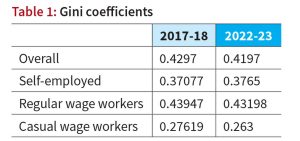
    • Reduction in Consumption Inequality: The overall Gini coefficient decreased from 0.359 in 2017-18 to 0.309 in 2022-23. Gini coefficients for ST, SC, OBC, and General categories also saw reductions, indicating a slight improvement in the equitable distribution of consumption within these communities.

    • Economic Disparities Among Social Groups: The bottom 20% decile experienced a decrease in consumption levels for ST, SC, and OBC groups, although marginally. The General category saw a more pronounced decrease in consumption levels among the poorest segment, highlighting a relative decline in consumption among this group.
    • Concentration of Wealth in Higher Deciles: Consumption has increased for all social groups in the top 20% decile. The General category experienced a significant 10% points surge in consumption between 2017-18 and 2022-23, implying a potential concentration of wealth among high-caste elites and persistent economic disparities.

    Efforts to Augment Income Generation Abilities:

    • Targeted Policies:
      • Reservation: Affirmative action programs to improve opportunities for SCs, STs, and OBCs.
      • Rural Development Initiatives: Policies aimed at enhancing infrastructure, education, and healthcare in rural areas.
      • Direct Benefit Transfers (DBT): Financial aid is directly transferred to beneficiaries to ensure they receive the intended benefits without middlemen.
    • Focus on Lower Deciles: Emphasis on increasing income generation and consumption abilities, particularly within the lower deciles of SC, ST, and OBC communities—the importance of fostering social harmony and economic stability through equitable income distribution.
    • Monitoring and Intervention: Continuous monitoring of consumption trends and economic disparities. They are implementing targeted interventions addressing the specific socio-economic challenges faced by different groups to ensure sustained progress towards economic equity.

    Way forward:

    • Strengthen and Expand Affirmative Action Programs: Enhance and rigorously implement affirmative action policies such as reservations in education and employment for SCs, STs, and OBCs. This should include increasing access to quality education, vocational training, and skill development programs to empower these communities economically and socially
    • Promote Inclusive Economic Development Initiatives: Implement comprehensive rural development initiatives that focus on improving infrastructure, healthcare, and education in marginalized areas.

    Mains PYQ: 

    Q What are the main factors responsible for gender inequality in India? Discuss the contribution of Savitribai Phule in this regard.(UPSC IAS/2020)

  • Climate Change Negotiations – UNFCCC, COP, Other Conventions and Protocols

    The last continent must remain a pristine wilderness

    Note4Students

    From UPSC perspective, the following things are important:

    Prelims level: 46th Antarctic Treaty Consultative Meeting (ATCM-46)

    Mains level: Gaps in the Antarctics' Regulatory Framework

    Why in the news?

    The 46th Antarctic Treaty Consultative Meeting (ATCM-46), held in Kochi, Kerala last month, brought attention to the ongoing debate regarding Antarctic tourism.

    Highlights of the 46th Antarctic Treaty Consultative Meeting (ATCM-46) in Kerala

    • Focus on Developing a Regulatory Framework: ATCM-46 emphasized the need for a comprehensive, flexible, and dynamic framework for regulating tourism and non-governmental activities in Antarctica. A new working group was established to lead this effort over the next year, highlighting a renewed commitment to addressing tourism challenges in the region.
    • Recognition of Environmental Concerns: The meeting acknowledged the significant environmental impacts of increasing tourism, including disruptions to wildlife, ecosystem damage, and pollution. There was a consensus on the urgency of mitigating these impacts through stronger regulatory measures and enhanced monitoring programs.
    • India’s Proactive Stance: India played a crucial role in emphasizing the importance of monitoring tourism impacts on Antarctic research, conservation, and the environment. India supported measures against constructing tourism-related structures with significant environmental impacts and showcased its commitment by enacting its own Antarctic Law in 2022 to regulate activities and protect the Antarctic environment.

    Gaps in the Regulatory Framework

    • Lack of Specific Regulations: The current governance framework for Antarctic tourism is fragmented and lacks specific regulations. The Antarctic Treaty (1961) prioritises peaceful use and scientific research, while the Madrid Protocol offers broad environmental guidelines but lacks detailed tourism regulations.
    • Self-Regulation by IAATO: The International Association of Antarctica Tour Operators (IAATO), a self-regulatory industry body, is primarily responsible for the day-to-day management of tourism. Many believe that IAATO’s guidelines are inadequate to address the growing environmental pressures.
    • Consensus Rule Limitations: The requirement for unanimous agreement from all consultative parties often slows down decision-making and allows national interests to impede progress. This has resulted in non-binding guidelines rather than comprehensive regulation.
    • Failed to make consensus on tourism: Discussions on tourism regulation have been ongoing since the 1960s. A proposed tourism annexe in 1991 failed to gain consensus, leading to the current reliance on IAATO’s self-regulation. Despite the increasing frequency of discussions since a 2004 expert meeting, comprehensive regulation has remained elusive.

    India’s Stand on Tourism Issues

    • Emphasis on Monitoring: India has consistently emphasised the importance of monitoring the impacts of tourism on Antarctic research, conservation, and the environment. This was highlighted at ATCM 44 (2022) and reinforced at ATCM-46.
    • Opposition to Environmental Impact: India supported Resolution 5 (2022), which advised against building tourism-related structures with significant environmental impacts. This stance reflects India’s commitment to minimising the environmental footprint of tourism in Antarctica.
    • Call for Comprehensive Debate: Between ATCM 44 and ATCM 45, India continued to call for a comprehensive debate on Antarctic tourism, stressing the need for governance action.
    • Enactment of Antarctic Law: Despite the lack of international consensus, India took proactive steps by enacting its own Antarctic Law in 2022. This law aims to regulate activities and safeguard the Antarctic environment from the impacts of tourism.
    • Focus on Sustainable Future: At ATCM-46, India advocated for a multi-pronged approach to ensure a sustainable future for Antarctic tourism. This includes strengthening environmental protection, implementing robust monitoring programs, and fostering international cooperation to preserve Antarctica’s pristine wilderness.

    Conclusion: Countries need to work together to create a robust international regulatory framework that addresses the unique challenges of Antarctic tourism. This involves building on the efforts initiated at ATCM-46 and ensuring that the newly established working group develops comprehensive, binding regulations that all parties can agree upon and implement.

    Mains PYQ:

    Q The states of Jammu and Kashmir, Himachal Pradesh and Uttarakhand are reaching the limits of econological carrying capacity due to tourism. Critically evaluate.(UPSC IAS/2015)

  • Wildlife Conservation Efforts

    World Crocodile Day 2024: In 50th year of India’s saurian conservation 

    Note4Students

    From UPSC perspective, the following things are important:

    Prelims level: IUCN Status of Crocodiles of India

    Mains level: Crocodile Conservation Project

    Why in the news?

    The successful Crocodile Conservation Project in Bhitarkanika National Park is escalating the human-crocodile conflicts affecting local communities.

    About the Crocodile Conservation Project

    • Launch and Objective: The Crocodile Conservation Project was launched in 1975 in Bhitarkanika National Park, Odisha. The main objective was to protect the crocodiles’ natural habitat and revive the population through captive breeding due to the low survival rate of hatchlings in nature.
    • Historical Context: Initiated barely three years after the Wild Life (Protection) Act, 1972. The project was launched due to the threat of extinction from indiscriminate killing for commercial purposes and severe habitat loss.
    • Implementation and Success: Centers for breeding and rearing saltwater crocodiles, muggers, and gharials were started in 34 locations across various states in India under the guidance of HR Bustard. The project in Bhitarkanika, started by Sudhakar Kar and HR Bustard, has been the most successful, increasing the population from 95 in 1975 to 1,811 in the latest reptile census.
    • Ongoing Efforts: Sudhakar Kar continues to provide technical expertise and methodology for the annual census of saltwater crocodiles even after retirement. Conservation of crocodiles is described as a lifelong mission by Kar.

    IUCN Status of Crocodiles of India

    • The three crocodiles of India, the Saltwater Crocodile, Mugger Crocodile, and Gharial, are listed as Least Concern, Vulnerable, and Critically Endangered respectively on the IUCN Red List of Threatened Species.

    Bhitarkanika National Park 

    • Bhitarkanika National Park is a 145 km² (56 sq mi) protected area in Odisha, eastern India. It was designated as a national park in 1998 and obtained the status of a Ramsar site in 2002.
    • The park is known for its unique mangrove ecosystem, which is the second largest in India. It is home to a variety of flora and fauna, including the endangered saltwater crocodile, Indian python, king cobra, black ibis, and darters.

    About the Issues Faced by Bhitarkanika

    • Human-Crocodile Conflict: The increasing crocodile population has led to rising human-crocodile conflicts. Sudhakar Kar expressed concern over the conflicts, warning locals to avoid entering rivers, creeks, and waterbodies inhabited by estuarine crocodiles.
    • Impact on Local Communities: Conflicts have led to 50 deaths since 2014. Local villagers have criticized politicians for not addressing the safety issues adequately, affecting political outcomes.
    • Preventive Measures: Forest officials have erected barricades around 120 river ghats in and around Bhitarkanika to prevent crocodile attacks on humans.
    • Political Implications: The human-crocodile conflict has influenced local political dynamics, with villagers expressing dissatisfaction with incumbents over safety concerns related to crocodile attacks.

    Conclusion: Construct and maintain more robust protective barriers around water bodies, such as reinforced barricades and secure river ghats. Additionally, create safe, designated areas for water-related activities to minimize the risk of crocodile attacks.

    Mains PYQ:

    Q How does biodiversity vary in India? How is the Biological Diversity Act,2002 helpful in the conservation of flora and fauna? (UPSC IAS/2018)
