💥UPSC 2026, 2027, 2028 UAP Mentorship (March Batch) + Access XFactor Notes & Microthemes PDF

Type: India Mapping

  • Wildlife Conservation Efforts

    150 years of Jim Corbett

    Why in the News?

    As India marks Jim Corbett’s 150th birth anniversary (1875–2025), it reflects on his legacy as a hunter, naturalist, author, and conservationist—after whom Corbett National Park is named.

    https://www.downtoearth.org.in/wildlife-biodiversity/150-years-of-jim-corbett-will-the-real-carpet-sahib-please-stand-up 

    Who was Jim Corbett?

    • Full Name: Edward James Corbett (1875–1955), nicknamed Carpet Sahib in Kumaon.
    • Profession: British hunter, naturalist, author, and later a wildlife conservationist.
    • Famous Books: Man-Eaters of Kumaon, The Man-Eating Leopard of Rudraprayag, My India, Jungle Lore, Tree Tops.
    • Hunter Turned Hero:
      • Known for tracking and killing man-eating tigers and leopards in Kumaon and Garhwal.
      • Used patient observation and deep knowledge of terrain and animal behaviour.
    • Shift to Conservation:
      • Grew concerned about dwindling tiger numbers and deforestation.
      • Advocated for wildlife protection and ecological balance.
    • Commemoration: India’s first national park was renamed Jim Corbett National Park in 1957 in his honour.

    Back2Basics: Jim Corbett National Park

    • Established: 1936 as Hailey National Park; later renamed in 1957.
    • Location: Nainital district, Uttarakhand; core of Corbett Tiger Reserve.
    • Historical Importance:
      • Launch site of Project Tiger in 1973, India’s flagship tiger conservation programme.
    • Geography:
      • Lies in Shivalik and Outer Himalayan foothills.
      • Rivers: Ramganga, Sonanadi, Mandal, Palain, and Kosi.
      • Area: Over 500 sq km (includes Sonanadi Wildlife Sanctuary as buffer).
    • Biodiversity:
      • Flora: Moist deciduous forest with Sal, Khair, and Sissoo; 600+ plant species.
      • Fauna: Over 230 tigers (highest density in the world), elephants, leopards, deer (sambar, chital, barking), sloth bears, wild boars, birds, and reptiles.


    [UPSC 2013] Consider the following pairs : National Park River flowing through the Park

    1. Corbett National Park : Ganga

    2. Kaziranga National Park : Manas

    3. Silent Valley National Park : Kaveri

    Which of the above pairs is/are correctly matched?

    (a) 1 and 2 (b) 3 only (c) 1 and 3 (d) None*


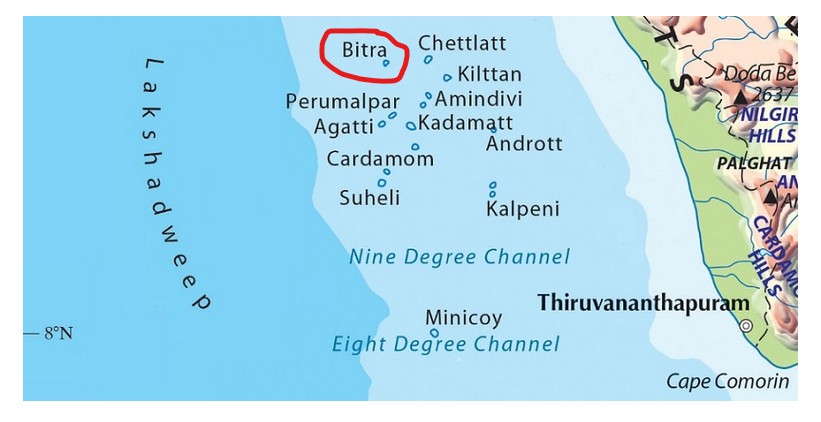
  • Places in news: Bitra Island

    Why in the News?

    The Lakshadweep administration has proposed the acquisition of Bitra Island, the smallest inhabited island in the archipelago, for national defence purposes.

    bitra

    About Bitra Island:

    • Location: Situated in the Arabian Sea; part of the Amindivi subgroup of the Lakshadweep archipelago
    • Distance from Mainland: ~483 km west of Kochi  
    • Land Area: 0.10–0.18 square kilometres
    • Population: ~271–350 (as of 2025)
    • Language and Livelihood
      • Languages Spoken: Malayalam, Mahl, and English
      • Economic Activities: Fishing, coconut farming, and emerging ecotourism (birdwatching, snorkeling, diving)
    • Climate:
      • Type: Tropical monsoon (similar to Kerala)
      • Temperature Range: 25–35°C
      • Annual Rainfall: ~1600 mm
      • Monsoon Season: Mid-May to mid-September; sea access is limited
    • Historical and Cultural Significance:
      • History: Populated around 1945
      • Pilgrimage Site: Hosts a shrine to Arab saint Malik Mulla

    Strategic Importance:

    • Location: Close to key international shipping lanes in the Arabian Sea
    • Surveillance Advantage: Ideal point for maritime monitoring
    • Military Utility: Suitable for naval installations and coastal defence
    • Maritime Awareness: Enhances India’s preparedness in the western seaboard
    [UPSC 2014] Which one of the following pairs of islands is separated from each other by the ‘Ten Degree Channel’?

    Options: (a) Andaman and Nicobar* (b) Nicobar and Sumatra (c) Maldives and Lakshadweep (d) Sumatra and Java


  • Climate Change Impact on India and World – International Reports, Key Observations, etc.

    Places in News: Kariyachalli Island

    Why in the News?

    The Tamil Nadu government, with World Bank support, has launched a ₹50 crore restoration project for the sinking Kariyachalli Island.

    About Kariyachalli Island:

    • Overview: Kariyachalli Island is one of the 21 uninhabited islands in the Gulf of Mannar Marine National Park.
    • Geographic Location: It lies 4 km south of Sippikulam and 20 km northeast of Thoothukudi, between Rameswaram and Thoothukudi.
    • Made of Reef Sediments: The island is a low-lying landform made of reef debris, sand dunes, spits, and sandy plains.
    • Biodiversity Hotspot: Located in India’s coral reef zone, it supports 4,300+ marine species, including 132 coral types and the endangered dugong.
    • Ecological Importance: It has seagrass beds and coral reefs that provide food and shelter for marine life.
    • Natural Coastal Shield: Kariyachalli acts as a barrier against cyclones and tsunamis, helping protect the Tamil Nadu coast.
    • Historical Significance: It played a role in mitigating the 2004 Indian Ocean tsunami impact.

    Why is it sinking?

    • Rapid Land Loss: The island has shrunk by over 70%, from 20.85 ha in 1969 to under 6 ha in 2024.
    • High Tide Erosion: At high tide, only 3.14 ha remains, per an IIT Madras (2025) study.
    • Wave and Sediment Pressure: Wave action, sediment loss, and lack of natural shoreline defense are accelerating erosion.
    • Climate Change Impact: Rising sea levels and coral bleaching have weakened the island’s natural protection.
    • Seagrass Depletion: Loss of seagrass beds has reduced the island’s ability to hold sediments and resist erosion.
    • Extreme Weather Events: Frequent cyclones and storms are making the island more vulnerable.
    • Future Risk: If the current trend continues, Kariyachalli may vanish by 2036.
    [UPSC 2023] Which one of the following is the best example of repeated falls in sea level, giving rise to present-day extensive marshland?

    Options: (a) Bhitarkanika Mangroves (b) Marakkanam Salt Pans (c) Naupada Swamp (d) Rann of Kutch*


  • Tourism Sector

    Shipki La Mountain Pass opened for Tourists

    Why in the News?

    For the first time since India’s independence, the Shipki La pass in Himachal Pradesh has been opened to domestic tourists, marking a historic shift in India’s border tourism strategy.

    About Shipki La Pass:

    • It is a high-altitude mountain pass at 3,930 meters in the Kinnaur district of Himachal Pradesh, on the India–Tibet (China) border.
    • It is one of only 3 official border trading points between India and Tibet, along with Nathu La (Sikkim) and Lipulekh (Uttarakhand).
    • The Sutlej River (called Langqen Zangbo in Tibet) enters India near Shipki La, adding geographical importance to the area.
    • The pass lies along National Highway 5 (NH5) and is considered one of the highest motorable roads in India.
    • Historically, it served as a major trade route, enabling exchange of salt, wool, spices, yak tails, and tea between India and Tibet.
    • Trade was stopped in 1962 after the India-China war, resumed in 1992, but was halted again during COVID-19.
    • On June 9, 2025, Himachal Pradesh opened the pass to Indian tourists for the first time since Independence.
    • The initiative is part of a “Border Tourism” strategy, which includes the launch of the Sarhad Van Udyan (Border Forest Park).
    • It is also being considered as an alternate route for the Kailash Mansarovar Yatra.

    Other Important Himalayan Passes:

    • Ladakh and Jammu & Kashmir:
      • Khardung La (5,359 m) – Among the highest motorable passes; connects Leh with Nubra Valley.
      • Zoji La – Links Srinagar with Leh; vital for year-round Ladakh access.
      • Chang La, Baralacha La, Umling La (5,798 m) – Crucial for Leh connectivity and defense.
      • Rezang La – Famous for the 1962 India-China war battle.
      • Karakoram Pass, Aghil Pass, Demchok Pass – Strategic India-China border passes.
    • Himachal Pradesh:
      • Rohtang Pass – Connects Kullu with Lahaul-Spiti; key for tourism and logistics.
      • Parang La – Links Spiti Valley and Parvati Valley; used by trekkers and herders.
      • Shipki La – Now open to tourists; historical Indo-Tibetan trade route.
    • Uttarakhand:
      • Lipulekh Pass (5,632 m) – Used for Kailash Mansarovar Yatra.
      • Mana Pass – One of the highest vehicle-accessible passes; connects to Tibet.
      • Niti Pass, Milam Pass, Kuthi Pass – Historical trade and pilgrimage routes.
    • Sikkim:
      • Nathu La – Major border trade route; part of the ancient Silk Route.
      • Jelep La – Historical route linking Sikkim with Lhasa via Chumbi Valley.
    • Arunachal Pradesh:
      • Se La, Bum La – Connect to Tawang and Bhutan border.
      • Pangsau Pass, Diphu Pass – Connect Arunachal with Myanmar; important for WWII history and connectivity.
    [UPSC 2007] Which one of the following Himalayan passes was reopened around in the middle of the year 2006 to facilitate trade between India and China?

    Options: (a) Chang La (b) Jara La (c) Nathu La (d) Shipki La


  • Wildlife Conservation Efforts

    Greater Flamingo Sanctuary at Dhanushkodi

    Why in the News?

    The Tamil Nadu government has officially notified a Greater Flamingo Sanctuary at Dhanushkodi in Ramanathapuram district.

    Greater Flamingo Sanctuary at Dhanushkodi

    What is a Bird Sanctuary?

    • India’s bird sanctuaries are established under the Wildlife (Protection) Act, 1972 (WLPA).
    • Section 18 of the WLPA empowers State governments to declare wildlife or bird sanctuaries based on ecological or zoological importance.
    • The law prohibits hunting of protected birds and prescribes penalties for violations, including fines and imprisonment.

    About Greater Flamingo (Phoenicopterus roseus):

    • Overview: It is the largest and most widespread flamingo species, found across Africa, southern Europe, and South and Southeast Asia, including India and Pakistan.
    • Presence in India: India hosts both Greater and Lesser Flamingos. Greater Flamingo is the state bird of Gujarat.
    • Behaviour and Diet: These birds form monogamous pairs and get their pink coloration from a diet rich in brine shrimp and algae. They are omnivores, feeding on invertebrates, small fish, algae, and decaying plant matter.
    • Habitat: They prefer saltwater lagoons, mudflats, and saline lakes, and are important indicators of wetland health.
    • Migration Pattern: Every year, 100,000–150,000 flamingos migrate from Gujarat to Mumbai, typically arriving in November and settling in the Thane Creek Flamingo Sanctuary.
    • Migration Triggers: Their movement depends on food availability, water levels, and colony crowding.
    • Conservation Status:
      • IUCN Red List: Least Concern (LC) (species is widespread and abundant)
      • Wildlife Protection Act, 1972: Schedule II (protected but with lesser penalties than Schedule I)
      • CMS (Convention on Migratory Species): Appendix II (species need international cooperation for conservation)
      • CITES (Convention on International Trade in Endangered Species): Appendix II (trade is regulated to avoid overexploitation)

    About the Flamingo Sanctuary at Dhanushkodi:

    • Location: The sanctuary lies in the Gulf of Mannar Biosphere Reserve, spanning 524.7 hectares in Rameshwaram taluk.
    • Habitat: It includes mangroves, sand dunes, mudflats, and marshes, supporting migratory birds, marine life, and sea turtles.
    • Flyway Connection: The site falls along the Central Asian Flyway, a key route for wetland migratory birds.
    • Bird Census: The 2023–24 wetland bird survey recorded over 10,700 birds, including herons, egrets, sandpipers, and both flamingo species.
    • Ecological Importance: Mangrove species like Avicennia and Rhizophora dominate the area, offering breeding grounds and coastal protection.
    [UPSC 2015] With reference to an organization known as ‘BirdLife International’, which of the following statements is/are correct?

    (1) It is a Global Partnership of Conservation Organizations. (2) The concept of ‘biodiversity hotspots’ originated from this organization. (3) It identifies the sites known/referred to as ‘Important Bird and Biodiversity Areas’.

    Select the correct answer using the code given below:

    Options: (a) 1 only (b) 2 and 3 only (c) 1 and 3 only * (d) 1, 2 and 3


  • Wetland Conservation

    Two New Ramsar Sites in Rajasthan

    Why in the News?

    India has added two new wetlands—Khichan in Phalodi and Menar in Udaipur, both located in Rajasthan—to the Ramsar List of Wetlands of International Importance. With these additions, India’s total number of Ramsar sites has reached 91.

    Khichan and Menar Wetlands:  

    • Khichan (Phalodi District):
      • It is internationally famous for hosting thousands of migratory Demoiselle cranes, making it a major birdwatching destination.
      • The wetland supports biodiversity, acting as a crucial habitat for migratory birds and maintaining ecological balance.
    • Menar (near Udaipur):
      • It is known as Rajasthan’s “Bird Village”, celebrated for its community-led conservation efforts.
      • It hosts rare birds like the cinereous vulture, Himalayan griffon, Dalmatian pelican, and black-tailed godwit.

    About the Ramsar Convention:

    • It is an international treaty for the conservation and sustainable use of wetlands.
    • It was established on February 2, 1971, in the city of Ramsar, Iran.
    • The convention focuses on:
      • Identifying and designating wetlands of global importance.
      • Ensuring effective management of these wetlands.
      • Promoting international cooperation for wetland protection.
    • India and the Ramsar Convention:
      • India became a signatory in 1982.
      • The first Site in India was Chilika Lake in Odisha, designated in 1981.
      • As of now, India has 91 Ramsar sites, covering around 13.58 lakh hectares.
      • Wetlands listed under Ramsar make up about 10% of India’s total wetland area.
      • Tamil Nadu has the highest number of Ramsar sites (20), followed by Uttar Pradesh (10).

    9 Criteria for Declaring Ramsar Sites:

    A wetland can be declared a Ramsar Site by a signatory country if it meets one or more of the following criteria:

    1. It has unique, rare, or representative wetland types.
    2. It supports vulnerable, endangered, or endemic species.
    3. It is a habitat for waterfowl, especially during migration.
    4. It holds significant ecological, botanical, zoological, limnological, or hydrological features.
    5. It supports scientific research and promotes biodiversity conservation.
    6. It provides ecosystem services like flood control, water purification, and groundwater recharge.
    7. It has cultural, spiritual, or recreational value.
    8. It supports sustainable livelihoods for local communities.
    9. It faces threats requiring international cooperation for conservation.

    Other Key Facts:

    • 171 countries are currently part of the Ramsar Convention.
    • The United Kingdom has the highest number of Ramsar sites (175); Mexico follows with 142 sites.
    • Bolivia has the largest wetland area under protection, covering 148,000 sq. km.
    • World Wetlands Day is celebrated every year on February 2, to commemorate the signing of the Ramsar Convention and raise awareness about the importance of wetlands.
    • The Montreux Record is a list of Ramsar sites that require urgent conservation attention due to human-induced threats.


    [UPSC 2022] Consider the following pairs:

    Wetland/Lake Location

    1. Hokera Wetland — Punjab

    2. Renuka Wetland — Himachal Pradesh

    3. Rudrasagar Lake — Tripura

    4. Sasthamkotta Lake — Tamil Nadu

    How many pairs given above are correctly matched?

    Options: (a) Only one pair (b) Only two pairs* (c) Only three pairs (d) All four pairs.


  • Wildlife Conservation Efforts

    In news: Valley of Flowers National Park

    Why in the News?

    The Valley of Flowers in Uttarakhand opened to tourists on June 1 for its annual four-month window.

    Valley of Flowers National Park

    About the Valley of Flowers National Park:

    • Location: The park is in Chamoli district, Uttarakhand, within the Nanda Devi Biosphere Reserve.
    • Altitude and Size: It covers 87 square kilometres and lies at 3,352 to 3,658 metres above sea level.
    • Protected Status: Declared a National Park in 1980 and became a UNESCO World Heritage Site in 1988.
    • Natural Features: Known for its colourful meadows, dense forests, waterfalls, and snow-capped mountains.
    • Mountain Range: Lies in the transition zone between the Zanskar and Great Himalaya ranges.
    • River System: The Pushpawati River, from the Tipra Glacier, flows through the valley into the Alaknanda River.
    • Ecosystem: It is part of the Nanda Devi Biosphere Reserve, which was named a UNESCO Man and Biosphere (MAB) Reserve in 2004.

    Flora and Fauna of the Valley:

    • Plant Diversity: The valley has over 520–650 species of flowers like orchids, primulas, poppies, daisies, and the sacred brahmakamal.
    • Flora by Altitude Zones:
      1. Sub-alpine (3,200–3,500 m): Trees like maple, fir, birch, and rhododendron.
      2. Lower alpine (3,500–3,700 m): Shrubs like junipers, willows, and geraniums.
      3. Higher alpine (above 3,700 m): Mosses, lichens, and the blue Himalayan poppy.
    • Animal Life: Includes rare species like the Asiatic black bear, snow leopard, musk deer, brown bear, red fox, and the Himalayan monal bird.
    [UPSC 2019] Which one of the following National Parks lies completely in the temperate alpine zone?

    Options: (a) Manas National Park (b) Namdapha National Park (c) Neora Valley National Park (d) Valley of Flowers National Park*


  • Tiger Conservation Efforts – Project Tiger, etc.

    Jharkhand to set up its first Tiger Safari near Palamau TR

    Why in the News?

    The Jharkhand government has announced to establish its first tiger safari in the fringe area of the Barwadih Western Forest Range in Latehar district, which is part of the Palamau Tiger Reserve (PTR).

    What is a Tiger Safari?

    • About: A tiger safari is a tourist activity where visitors observe tigers in natural-like habitats, usually around tiger reserves.
    • Legal Status: The Wildlife Protection Act, 1972 does NOT define tiger safaris but restricts construction in protected areas unless approved by the National Board for Wildlife.
    • Policy Origin: The idea was formally introduced in 2012 by the National Tiger Conservation Authority (NTCA) under its tourism guidelines.
    • Rules on Tiger Inclusion (2016): Initially, safaris were allowed only in buffer or fringe zones and could host rescued or conflict tigers, not zoo-bred ones.
    • Amended Rules (2019): The NTCA later allowed even zoo-bred tigers, with Central Zoo Authority (CZA) in charge of animal welfare.
    • Supreme Court Ruling (2024): The court ordered that safaris must be built outside core and buffer zones to protect wild habitats.

    About Jharkhand’s Tiger Safari Project:

    • Location: Planned in the Barwadih Western Range, outside core and buffer zones of Palamau Tiger Reserve (PTR), in line with the Supreme Court’s order.
    • Animal Inclusion: Will house only rescued, injured, or orphaned tigers from various reserves and zoos — not wild tigers from PTR.
    • Tourism and Employment: The project aims to boost tourism and create jobs for around 200 locals as guides and staff.
    • Approval Process: The plan is still in early stages. After state Forest Department approval, a Detailed Project Report (DPR) will go to NTCA and CZA.

    Back2Basics: Palamu Tiger Reserve

    • It is located in Jharkhand’s Latehar and Garhwa districts, is one of India’s oldest tiger reserves, established under Project Tiger in 1973.
    • Spanning over 1,014 sq. km, it features a diverse landscape of valleys, hills, plains and is nourished by rivers like the North Koel, Auranga, and Burha.
    • The reserve is rich in moist and dry deciduous forests, dominated by Sal and bamboo.
    • It is home to key wildlife species, including tigers, Asiatic elephants, leopards, and sloth bears.


    [UPSC 2020] Among the following Tiger Reserves, which one has the largest area under “Critical Tiger Habitat”?

    Options: (a) Corbett (b) Ranthambore (c) Nagarjunsagar-Srisailam* (d) Sunderbans


  • In news: Haji Pir Pass

    Why in the News?

    The recent Pahalgam terror attack has revived debates on India’s 1966 decision to surrender the Haji Pir Pass to Pakistan during Tashkent Agreement of 1966.

    This move is compared to the Soviet Union’s 1954 transfer of Crimea, which created lasting security challenges.

    About Haji Pir Pass:

    • The Haji Pir Pass is located in the Pir Panjal Range of Jammu and Kashmir, at an altitude of 2,637 meters (8,652 feet).
    • It connects Poonch in India to Rawalakot in Pakistan-occupied Kashmir (PoK).
    • Historically, it was a vital route for connecting Jammu to the Kashmir Valley before 1947, making it an essential part of India’s transportation network.
    • Post-partition, it became part of PoK and, during the 1965 Indo-Pak War, India recaptured it under Operation Bakshi.
    • However, it was returned to Pakistan following the Tashkent Agreement in 1966, a decision criticized by many experts.

    How Haji Pir Pass is a Chokepoint?

    • Strategic Military Route: The pass provides Pakistan with the ability to control and monitor the Kashmir Valley from a high-altitude position, serving as a key route for military logistics and infiltration.
    • Gateway for Infiltration: Historically, it has been used for militant infiltration into India, fuelling insurgency and instability in Kashmir.
    • Shortened Military Access: Retaining the pass would have reduced the distance between Poonch and Uri from 282 km to 56 km, improving India’s military logistics and rapid deployment.
    • Control over Key Terrain: Controlling the pass enables domination of the surrounding hills, limiting Pakistan’s ability to sustain military pressure and infiltration.
    [UPSC 2007] Which one of the following Himalayan passes was reopened around in the middle of the year 2006 to facilitate trade between India and China?

    (a) Chang La (b) Jara La (c) Nathu La* (d) Shipki La


  • Tiger Conservation Efforts – Project Tiger, etc.

    Sariska TR’s Critical Tiger Habitat to grow by 4.5k Hectares

    Why in the News?

    The Critical Tiger Habitat (CTH) of Sariska Tiger Reserve (STR) in Rajasthan is set to expand by approximately 4,500 hectares.

    What is Critical Tiger Habitat (CTH)?

    • CTHs are designated under the Wildlife Protection Act (WLPA), 1972, to conserve tiger populations, keeping areas inviolate for tiger conservation.
    • The core areas of tiger reserves, where human activities are prohibited, serve as Critical Tiger Habitats.
    • Surrounding buffer zones allow sustainable human activities like eco-tourism and regulated resource use, supporting conservation efforts.
    • These areas are scientifically identified based on studies of tiger movement, breeding patterns, and environmental needs, ensuring long-term survival and ecological balance.
    • Scheduled Tribes and other forest dwellers’ rights are respected within the legal framework, making conservation inclusive.
    • The largest critical tiger habitat in India is the Nagarjunasagar-Srisailam Tiger Reserve (NSTR) spanning 5937 square kilometers.

    About Sariska Tiger Reserve (STR):

    • STR is located in Alwar district, Rajasthan, about 107 km from Jaipur, and is one of India’s most important tiger reserves.
    • Initially a royal hunting preserve, it became a sanctuary in 1955 and upgraded to a national park in 1979.
    • STR was one of the first tiger reserves under the Project Tiger initiative.
    • In 2008, after the tiger population was wiped out due to poaching and human encroachment, tigers were successfully relocated to the reserve, marking a world-first for tiger reintroduction.
    • Flora: STR has semi-deciduous forests, grasslands, rocky landscapes, and cliffs. The park is primarily dominated by dhok trees, covering around 90% of the area, alongside other species like salar, kadaya, and gol trees.
    • Fauna: The reserve is home to species like tigers, leopards, sambhar deer, nilgai, wild boars, rhesus macaques, and hyenas.
    • Ruparel River flows through STR, contributing to its ecological richness by supporting wildlife and plant species.
    [UPSC 2020] Among the following Tiger Reserves, which one has the largest area under “Critical Tiger Habitat”?

    Options: (a) Corbett (b) Ranthambore (c) Nagarjunsagar-Srisailam* (d) Sunderbans