💥UPSC 2026, 2027, 2028 UAP Mentorship (March Batch) + Access XFactor Notes & Microthemes PDF

Type: IOCR

  • [pib] SDG Investor Map for India

    Note4Students

    From UPSC perspective, the following things are important:

    Prelims level: SDGs

    Mains level: India's measure for SDGs

    Sustainable development is development that meets the needs of the present without compromising the ability of future generations to meet their own needs.

    UNDP and Invest India have launched the SDG Investor Map for India, laying out 18 Investment Opportunities Areas (IOAs) in six critical SDG (Sustainable Development Goals) enabling sectors.

    Try this PYQ:

    Q.The Partnership for Action on Green Economy (PAGE), a UN mechanism to assist countries transition towards greener and more inclusive economies, emerged at:

    (a) The Earth Summit on Sustainable Development 2002, Johannesburg

    (b) The United Nations Conference on Sustainable Development 2012, Rio de Janeiro

    (c) The United Nations Framework Convention on Climate Change 2015, Paris

    (d) The World Sustainable Development Summit 2016, New Delhi

    SDG Investor Map for India

    • SDG Finance Facility platform at UNDP in partnership with Invest India, the investment promotion arm of the Government of India has developed this Map.
    • The map will help public and private sector stake-holders direct capital towards IOAs, and White Spaces (Areas of Potential) that can contribute to the sustainable development needs of the country.
    • The map has identified 18 IOAs and 8 White Spaces across 6 Priority Sectors including Education, Healthcare, Agriculture and Allied Services, Financial Services, Renewable Energy and Alternatives, and Sustainable Environment.

    Utility of this map

    • Investing in the SDGs at this point is crucial to ‘Building Back Better’ and making the economy and our societies more resilient and sustainable.
    • With the COVID-19 pandemic, the financing gap for the SDGs in India has only widened further and decades of development progress is nearly on the verge of reversal.
    • Enhanced productivity, technology adoption and increased inclusion are all critical factors that this map uses to identify the most attractive sectors for investors.

    Back2Basics: What are SDGs?

    • The SDGs or Global Goals are a collection of 17 interlinked goals designed to be a “blueprint to achieve a better and more sustainable future for all”.
    • They were set in 2015 by the United Nations General Assembly and are intended to be achieved by the year 2030.
    • They are included in a UN Resolution called the 2030 Agenda or what is known as Agenda 2030.
    • Countries are expected to take ownership and establish a national framework for achieving these Goals.
    • Implementation and success will rely on countries’ own sustainable development policies, plans and programmes.

  • Foreign Policy Watch: India-SAARC Nations

    South Asian University

    Note4Students

    From UPSC perspective, the following things are important:

    Prelims level: South Asian University

    Mains level: SAARC and its fading relevance

    The Delhi-based South Asian University, established by all eight SAARC countries, has not had a president for over a year, while its executive council and governing board have not met for almost two and three years respectively.

    Note the features of SAARC, ASEAN and East Asia Summit.

    South Asian University

    • South Asian University (SAU) is an International University sponsored by the eight Member States of the South Asian Association for Regional Cooperation (SAARC).
    • The eight countries are Afghanistan, Bangladesh, Bhutan, India, Maldives, Nepal, Pakistan and Sri Lanka.
    • India, as the host and the largest country in the SAARC group, bore the entire capital cost for setting up the university, and also pays 50% of the operational costs.
    • SAU attracts students predominantly from all the eight SAARC countries, although students from other continents also attend.
    • There is a country quota system for admission of students. Every year SAU conducts admission test at multiple centres in all the eight countries.
    • The degrees of the university is recognised by all the member nations of the SAARC according to an inter-governmental agreement signed by the foreign ministers of the eight-member states.

    Institution on failure

    • After a decade of existence, the university has yet to appoint a non-Indian president, despite rules stipulating a rotation among the member countries.
    • At a time when the Union government is trying to encourage international education in India, an existing international institution is facing a crisis of leadership.

    A matter of reluctance

    • According to the agreement signed by all the SAARC countries, the first president should have been from India, and then rotated among the other countries in alphabetical order.
    • So the next president should be from the Maldives.
    • But the MEA has put an advertisement calling only for Indian applicants, but there has been no appointment after one year.
  • Regional Comprehensive Economic Partnership (RCEP)

    China-led RCEP takes off without India

    Note4Students

    From UPSC perspective, the following things are important:

    Prelims level: RCEP

    Mains level: RCEP and its economy

    The Regional Comprehensive Economic Partnership (RCEP), a mega trade bloc comprising 15 countries led by China has come into existence.

    Try answering this:

    Q.Signing the Regional Comprehensive Economic Partnership (RCEP) agreement would have given more substance to India’s Act East policy. Analyse.

    About RCEP

    • Regional Comprehensive Economic Partnership (RCEP) is a free trade agreement (FTA) between –
    1. The 10 members of ASEAN
    2. Additional members of ASEAN +3 = China, Japan, South Korea
    3. Members with which ASEAN countries have FTA = Australia, New Zealand
    • The group is expected to represent at least 30% of the global GDP and will emerge as the largest free trade agreement in the world.
    • It includes more than 3 billion people, has a combined GDP of about $17 trillion, and accounts for about 40 per cent of world trade.

    India’s reluctance

    • India’s ties with China in recent months have been disturbed by the military tension in eastern Ladakh along the LAC.
    • In the meantime, India has also held a maritime exercise with Japan, Australia, and the United States for the “Quad” that was interpreted as an anti-China move.
    • However, these moves did not influence Japanese and Australian plans regarding RCEP.

     Leverage for China

    • Despite the pandemic, the RCEP is certainly leverage for China and shows the idea of decoupling from China is not a substantive issue in a regional sense.
    • The agreement means a lot for China, as it will give it access to Japanese and South Korean markets in a big way, as the three countries have not yet agreed on their FTA.
  • Foreign Policy Watch: India-SCO

    Shanghai Cooperation Organisation (SCO)

    Note4Students

    From UPSC perspective, the following things are important:

    Prelims level: SCO

    Mains level: SCO and India

    In an indirect reference to the Chinese infrastructure projects in PoK, our PM has urged members of the Shanghai Cooperation Organisation (SCO) to respect “territorial integrity” and “sovereignty”.

    What is SCO?

    • After the collapse of the Soviet Union in 1991, the then security and economic architecture in the Eurasian region dissolved and new structures had to come up.
    • The original Shanghai Five were China, Kazakhstan, Kyrgyzstan, Russia and Tajikistan.
    • The SCO was formed in 2001, with Uzbekistan included. It expanded in 2017 to include India and Pakistan.
    • Since its formation, the SCO has focused on regional non-traditional security, with counter-terrorism as a priority.
    • The fight against the “three evils” of terrorism, separatism and extremism has become its mantra. Today, areas of cooperation include themes such as economics and culture.

    Try this PYQ now:

    Q. In the context of the affairs of which of the following is the phrase “Special Safeguard Mechanisms” mentioned in the news frequently?

    (a) United Nations Environment Programme

    (b) World Trade Organization

    (c) ASEAN- India Free Trade Agreement

    (d) G-20 Summits

    India’s entry to the SCO

    • India and Pakistan both were observer countries.
    • While Central Asian countries and China were not in favour of expansion initially, the main supporter — of India’s entry in particular — was Russia.
    • A widely held view is that Russia’s growing unease about an increasingly powerful China prompted it to push for its expansion.
    • From 2009 onwards, Russia officially supported India’s ambition to join the SCO. China then asked for its all-weather friend Pakistan’s entry.

    Tap to read more about SCO

  • Oil and Gas Sector – HELP, Open Acreage Policy, etc.

    What is OPEC+?

    Note4Students

    From UPSC perspective, the following things are important:

    Prelims level: OPEC + members

    Mains level: Global oil price dynamics

    Oil prices jumped by close to 10% for its biggest daily gain in almost six months after news of a highly effective vaccine against COVID-19 and Saudi Arabia’s assurance that an OPEC+ oil output deal could be adjusted to balance the market.

    About OPEC

    • OPEC stands for Organization of the Petroleum Exporting Countries.
    • It is a permanent, intergovernmental organization, created at the Baghdad Conference in 1960, by Iran, Iraq, Kuwait, Saudi Arabia, and Venezuela.
    • It aims to manage the supply of oil in an effort to set the price of oil in the world market, in order to avoid fluctuations that might affect the economies of both producing and purchasing countries.
    • It is headquartered in Vienna, Austria.
    • OPEC membership is open to any country that is a substantial exporter of oil and which shares the ideals of the organization.
    • Today OPEC is a cartel that includes 14 nations, predominantly from the middle east whose sole responsibility is to control prices and moderate supply.

    What is OPEC+?

    • The non-OPEC countries which export crude oil along with the 14 OPECs are termed as OPEC plus countries.
    • OPEC plus countries include Azerbaijan, Bahrain, Brunei, Kazakhstan, Malaysia, Mexico, Oman, Russia, South Sudan and Sudan.
    • Saudi and Russia, both have been at the heart of a three-year alliance of oil producers known as OPEC Plus — which now includes 11 OPEC members and 10 non-OPEC nations — that aims to shore up oil prices with production cuts.

    Why OPEC plus came into existence?

    • When Russia concluded the Vienna Agreement in 2016, the Russian leadership believed that it would help prepare the country for the Russian presidential elections in March 2018.
    • Higher oil prices ensured the Kremlin’s financial capacity to lead a successful electoral campaign.
    • This changed the regime’s priorities – from satisfying the needs of the general population to ensuring the sustainability of the Kremlin’s alliance with powerful tycoons, including that controlling oil production.
    • For Saudi Arabia, turning what had been an ad hoc coalition into a formal group provides a hedge (protection) against future oil-market turbulence.
    • For Russia, the formalization of the group helps expand Putin’s influence in the Middle East
    • However, both reportedly aimed at causing a drop in oil prices in order to hit US shale producers, who have continued to benefit from OPEC production cuts by expanding their market share.
  • Foreign Policy Watch: United Nations

    UN Advisory Committee on Administrative and Budgetary Questions (ACABQ)

    Note4Students

    From UPSC perspective, the following things are important:

    Prelims level: UN ACABQ

    Mains level: Success and failures of United Nations

    In a significant victory for India at the United Nations, Indian diplomat Vidisha Maitra was elected to the U.N. Advisory Committee on Administrative and Budgetary Questions (ACABQ).

    Try this PYQ:

    Which one of the following is not related to the United Nations?
    (a) Multilateral Investment Guarantee Agency
    (b) International Finance Corporation
    (c) International Centre for Settlement of Investment Disputes
    (d) Bank for International Settlements

    About UN- ACABQ

    • It is a subsidiary organ of the General Assembly. The 193-member Assembly appoints members of the Advisory Committee.
    • ACABQ consists of 16 members appointed by the Assembly in their individual capacity.
    • Members are selected on the basis of broad geographical representation, personal qualifications and experience.

    Its functions

    • ACABQ ensures that fund contributions to the U.N. system are put to good effect and that mandates are properly funded.
    • It examines, on behalf of the General Assembly, the administrative budgets of the specialised agencies and proposals for financial arrangements with such agencies; and to consider and report to the General Assembly on the auditors’ reports on the accounts of the UN and of the specialised agencies.

    Why is the seat given to India?

    • India has a stellar record of bringing professional auditing experience to the U.N. and contributing outstanding professionals to U.N. bodies.
    • With India’s rising obligations in both assessed as well as voluntary contributions to the U.N., India holds key responsibility of administrative and budgetary management of U.N.

    Significance of the move

    • The victory gives a strong display of support by U.N. member states for India.
    • It comes as India gets ready to sit in the U.N. Security Council as a non-permanent member for a two-year term beginning January 2021.
  • Water Management – Institutional Reforms, Conservation Efforts, etc.

    WWF Water Risk Filter

    Note4Students

    From UPSC perspective, the following things are important:

    Prelims level: WWF Water Risk Filter

    Mains level: Water scarcity in urban India

    Nearly a third of the 100 cities in the world susceptible to ‘water risk’ — defined as losses from battling droughts to flooding — are in India, according to the WWF Water Risk Filter.

    Try this question for mains:

    Q.For Indian cities to break away from the vicious loop of flooding and water scarcity, nature-based solutions like restoration of urban watersheds and wetlands could offer an alternative. Examine.

    What is Water Risk Filter?

    • This is an online tool, co-developed by the Worldwide Fund for Nature that helps evaluate the severity of risk places faced by graphically illustrating various factors that can contribute to water risk.
    • Launched in 2012, it is a practical online tool that helps companies and investors assess and respond to water-related risks facing their operations and investments across the globe.
    • After a major upgrade in 2018, the Water Risk Filter 5.0 enables companies and investors to Explore, Assess, Value and Respond to water risks.
    • Lately, the Water Risk Filter provides scenarios of water risks for 2030 and 2050, integrating climate and socio-economic changes in different pathways.

    Highlights of the recent analysis

    • It reported 30 Indian cities that would face a ‘grave water risk’ by 2050 due to a dramatic increase in their population percentage to 51 per cent by 2050, from 17 per cent in 2020.
    • Jaipur topped the list, followed by Indore and Thane. Mumbai, Kolkata and Delhi also featured on the list.
    • The global list includes cities such as Beijing, Jakarta, Johannesburg, Istanbul, Hong Kong, Mecca and Rio de Janeiro. China accounts for almost half the cities.

    Major recommendations

    • The future of India’s environment lies in its cities. As India rapidly urbanizes, cities will be at the forefront both for India’s growth and for sustainability.
    • For cities to break away from the current vicious loop of flooding and water scarcity, nature-based solutions like restoration of urban watersheds and wetlands could offer solutions.
    • Urban watersheds and wetlands are critical for maintaining the water balance of a city, flood cushioning, micro-climate regulation and protecting its biodiversity, the report notes.
  • Foreign Policy Watch: India-United States

    In news: International Labour Organization

    Note4Students

    From UPSC perspective, the following things are important:

    Prelims level: ILO

    Mains level: India and ILO

    After 35 years, India has assumed the Chairmanship of the Governing Body of International Labour Organization (ILO).

    Try this PYQ:

    Q.The Partnership for Action on Green Economy (PAGE), a UN mechanism to assist countries transition towards a greener and more inclusive economies, emerged at:

    (a) The Earth Summit on Sustainable Development 2002, Johannesburg

    (b) The United Nations Conference on Sustainable Development 2012, Rio de Janeiro

    (c) The United Nations Framework Convention on Climate Change 2015, Paris

    (d) The World Sustainable Development Summit 2016, New Delhi

    About the International Labour Organization

    • The ILO is a UN agency whose mandate is to advance social and economic justice through setting international labour standards.
    • Founded in 1919 under the League of Nations, it is the first and oldest specialised agency of the UN.
    • The ILO has 187 member states: 186 out of 193 UN member states plus the Cook Islands.
    • The ILO’s international labour standards are broadly aimed at ensuring accessible, productive, and sustainable work worldwide in conditions of freedom, equity, security and dignity.

    About its Governing Body

    • The Governing body is the apex executive body of the ILO which decides policies, programmes, agenda, budget and elects the Director-General.
    • It meets three times a year, in March, June and November.

    Significance for India

    • India will be presiding over the upcoming meeting of the Governing Body to be held in November 2020.
    • India would have the opportunity to interact with the senior officials and social partners of the member states.
    • It will also provide a platform to apprise participants of the transformational initiatives taken by the Government in removing the rigidities of the labour market.
  • Women empowerment issues – Jobs,Reservation and education

    UN Report on Gender Gap in Labour Market

    Note4Students

    From UPSC perspective, the following things are important:

    Prelims level: Not Much

    Mains level: Gender gap in labor market

    Gender equality across the world remains a far-fetched goal and no country has achieved it so far, according to the 2020 edition of the United Nations report on the state of gender equality in the world.

    Try this question for mains:

    Q.Discuss how marriage age and women’s health are linked with each other?

    About the Report

    • The report titled “World’s Women: Trends and Statistics” was released by the UN-DESA.
    • The report provided a reality-check on the global status of women 25 years since the world adopted the Beijing Declaration and Platform for Action.
    • It presented the global state of gender equality in six critical areas: Population and families; health; education; economic empowerment and asset ownership; power and decision-making; and violence against women and the girl child as well as the impact of COVID-19.

    Highlights on status of women

    • The gender gap in the labour market, for example, has not budged a bit since 1995.
    • While the status of women has improved with regard to education, early marriage, childbearing and maternal mortality, the progress has stagnated in other areas.

    Participation in the labour market

    • The gender gap in the labour market has remained as it was since 1995: The gap of 27 percentage points has barely changed since then, the report showed.
    • Only 47 per cent women of working age participated in the labour market, compared to around 74 per cent men, according to the report.
    • The largest gender gap in labour force participation was observed in the prime working age (25-54).
    • This gap has remained unaddressed since 1995 and was at 32 percentage points as of 2020, according to the report. It was 31 percentage points in 1995.
    • In India, the ratio of female-to-male labour force participation rate was 29.80 in 2019 as against the desired ratio of 50 per cent.

    Working for free

    • The data in the interactive UN report showed how women remained under the burden of unpaid domestic and care work.
    • On an average day, women globally spent about three times (4.2 hours) as many hours on unpaid domestic and care work as men (1.7 hours).
    • Unpaid domestic work includes activities related to the maintenance of the household, including food preparation, upkeep of the home, caring for pets etc.

    Family responsibilities

    • Family responsibilities and unequal distribution of unpaid domestic and care workers were among the primary reasons for women not joining the labour force.
    • Their participation depended on their liabilities and responsibilities in their household, noted UN. It found that women living alone were more likely to be in the labour market.
    • On an average, 82 per cent women of prime working-age living alone were in the labour market, compared to 64 per cent women living with a partner and 48 per cent living with a partner and children.
    • Their participation rates in the economy were found to improve in the latter part of their lives after their responsibilities reduced — when their children grew older.
  • Air Pollution

    State of Global Air Report, 2020

    Note4Students

    From UPSC perspective, the following things are important:

    Prelims level: Particulate Matter

    Mains level: Pollution induced mortality in India

    Air pollution now biggest health risk in India, says the State of Global Air 2020 Report.

    State of Global Air Report

    • The State of Global Air report brings into one place the latest information on air quality and health for countries around the globe.
    • It is produced annually by the Health Effects Institute and the Institute for Health Metrics and Evaluation’s Global Burden of Disease project.

    India’s exposure to pollution

    • Long-term exposure to outdoor and household air pollution contributed to over 1.67 million annual deaths from stroke, heart attack, diabetes, lung cancer, chronic lung diseases and neonatal diseases in India in 2019.
    • Overall, air pollution was now the largest risk factor for death among all health risks, the report noted.
    • Outdoor and household particulate matter pollution also contributed to the deaths of more than 1,16,000 Indian infants in their first month of life last year.
    • For the youngest infants, most deaths were related to complications from low birth weight and preterm birth.

    A comparison with peers

    • India faced the highest per capita pollution exposure — or 83.2 μg/cubic metre — in the world.
    • It is followed by Nepal at 83.1 μg/cubic metre and Niger at 80.1.
    • Countries with the least population exposure are below 8 micrograms (μg) per cubic metre.

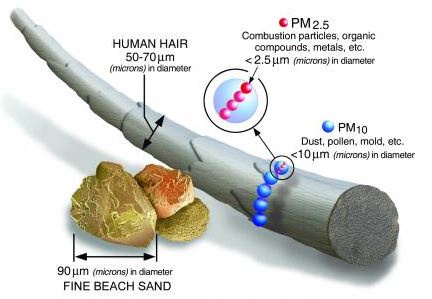
    Back2Basics: Particulate Matter

    • PM is the term for a mixture of solid particles and liquid droplets found in the air. Some particles, such as dust, dirt, soot, or smoke, are large or dark enough to be seen with the naked eye.
    • Others are so small they can only be detected using an electron microscope.
    • Particle pollution includes:
    1. PM10 : inhalable particles, with diameters that are generally 10 micrometres and smaller; and
    2. PM2.5: fine inhalable particles, with diameters that are generally 2.5 micrometres and smaller.

    Sources of PM

    • These particles come in many sizes and shapes and can be made up of hundreds of different chemicals.
    • Some are emitted directly from a source, such as construction sites, unpaved roads, fields, smokestacks or fires.
    • Most particles form in the atmosphere as a result of complex reactions of chemicals such as sulfur dioxide and nitrogen oxides, which are pollutants emitted from power plants, industries and automobiles.

    Harmful effects of PM

    • Particulate matter contains microscopic solids or liquid droplets that are so small that they can be inhaled and cause serious health problems.
    • Some particles less than 10 micrometres in diameter can get deep into your lungs and some may even get into your bloodstream.
    • Of these, particles less than 2.5 micrometres in diameter, also known as fine particles or PM2.5, pose the greatest risk to health.