💥UPSC 2026, 2027, 2028 UAP Mentorship (March Batch) + Access XFactor Notes & Microthemes PDF

Type: IOCR

  • Indian Ocean Power Competition

    Indian Ocean Commission

    Note4Students

    From UPSC perspective, the following things are important:

    Prelims level: IOC

    Mains level: Indian ocean security

    India was accepted as an observer in the Indian Ocean Commission getting a seat at the table of the organization that handles maritime governance in the western Indian Ocean.

    Indian Ocean Commission

    • The Indian Ocean Commission is an intergovernmental organization that was created in 1982 at Port Louis, Mauritius and institutionalized in 1984 by the Victoria Agreement in Seychelles.
    • The COI is composed of five African Indian Ocean nations: Comoros, Madagascar, Mauritius, Réunion (an overseas region of France), and Seychelles.
    • These five islands share geographic proximity, historical and demographic relationships, natural resources and common development issues.

    Aims and Objectives of IOC

    • COI’s principal mission is to strengthen the ties of friendship between the countries and to be a platform of solidarity for the entire population of the African Indian Ocean region.
    • COI’s mission also includes development, through projects related to sustainability for the region, aimed at protecting the region, improving the living conditions of the populations and preserving the various natural resources that the countries depend on.
    • Being an organisation regrouping only island states, the COI has usually championed the cause of small island states in regional and international fora.

    India and IOC

    • India’s entry is a consequence of its deepening strategic partnership with France as well as its expanding ties with the Vanilla Islands.
    • India had made the application to be an observer. The IOC has four observers — China, EU, Malta and International Organisation of La Francophonie (OIF).

    Significance

    • For India, the importance of joining this organization lies in several things.
    • First, India will get an official foothold in a premier regional institution in the western Indian Ocean, boosting engagement with islands in this part of the Indian Ocean.
    • These island nations are increasingly important for India’s strategic outreach as part of its Indo-Pacific policy.
    • This move would enhance ties with France which is the strong global power in the western Indian Ocean.
    • It lends depth to India’s SAGAR (security and growth for all in the region) policy unveiled by PM Modi in 2015.
    • The move, India hopes, would lead to greater security cooperation with countries in East Africa.

  • Freedom of Speech – Defamation, Sedition, etc.

    Freedom in the World 2020

    Note4Students

    From UPSC perspective, the following things are important:

    Prelims level: Freedom in the World Report

    Mains level: Read the attached story


    India has become one of the world’s least free democracies, according to a global survey.

    Freedom in the World Report

    • It is a yearly survey and report by the U.S. based non-governmental organization Freedom House.
    • It measures the degree of civil liberties and political rights in every nation and significant related and disputed territories around the world.
    • The report derives its methodology from the Universal Declaration of Human Rights, adopted by the UN General Assembly in 1948.
    • It covers 195 countries, awarding scores based on political rights indicators such as the electoral process, political pluralism and participation and government functioning, as well as civil liberties indicators related to freedom of expression and belief associational and organisational rights, the rule of law and personal autonomy and individual rights.

    Highlights of the report


    Deteriorating freedom in India

    • The report ranks India at the 83rd position, along with Timor-Leste and Senegal.
    • This is near the bottom of the pile among the countries categorised as “Free”.
    • India’s score fell by four points to 71, the worst decline among the world’s 25 largest democracies this year.
    • India scored 34 out of 40 points in the political rights category, but only 37 out of 60 in the civil liberties category, for a total score of 71, a drop from last year’s score of 75.
    • The report treats “Indian Kashmir” as a separate territory, which saw its total score drop precipitously from 49 to 28 this year, moving it from a status of “Partly Free” to “Not Free”.

    Reason for the downfall

    • The annulment of autonomy and the subsequent shutdown of Kashmir, the NRC and the CAA, as well as the crackdown on mass protests, have been listed as the main signs of declining freedom in the report.
    • These three actions have shaken the rule of law in India and threatened the secular and inclusive nature of its political system said the report.
    • The report slammed the internet blackout in Kashmir terming it the longest shutdown ever imposed by democracy.
    • It said freedom of expression was under threat in India, with journalists, academics and others facing harassment and intimidation when addressing politically sensitive topics.
    • It warned that the Indian government’s alarming departures from democratic norms under present govt. could blur the values-based distinction between Beijing and New Delhi.
  • Higher Education – RUSA, NIRF, HEFA, etc.

    World University Rankings by Subject 2020

    Note4Students

    From UPSC perspective, the following things are important:

    Prelims level: Highlights of the report

    Mains level: State of higher education in India


    Indian higher-education institutes have improved their performance on the global stage, with a greater number getting ranked in the top-100 programs, according to the latest edition of the Quacquarelli Symonds (QS) World University Rankings by Subject 2020.

    Major findings of the report

    • IIT Bombay (44), IIT Delhi (47), IIT Kharagpur (86), IIT Madras (88) and IIT Kanpur (96) found place in top 100 of this category.
    • In the Natural Sciences category, three Indian institutions made it to the top 200: IIT-Bombay at 108th rank closely followed by the IISc, Bangalore at the 111th position, while IIT-Madras scraped in at the 195th rank.
    • Jawaharlal Nehru University remained the country’s top institution in the Arts and Humanities category, with a global ranking of 162, followed at a distance by Delhi University at 231.
    • Delhi University topped the Social Sciences and Management category, with a global ranking of 160, followed by IIT-Delhi at 183.
    • There are no Indian institutions in the world’s top 200 when it comes to Life Sciences and Medicine.
    • The top institution in the country is the All India Institute of Medical Sciences, which had a global ranking of 231.
    • Other top subjects included physics & astronomy with 18 Indian institutes, biological sciences (16), electrical engineering (15), chemical engineering (14) and mechanical engineering (14).
    • MIT, Stanford University and the University of Cambridge has secured top three positions in the Engineering and Technology category.
  • Air Pollution

    World Air Quality Report, 2019

    Note4Students

    From UPSC perspective, the following things are important:

    Prelims level: PM 2.5

    Mains level: World Air Quality Report, 2019


    The 2019 World Air Quality Report was recently released

    World Air Quality Report

    • The World Air Quality Report is released by the pollution tracker IQAir and Greenpeace.
    • The report focuses on PM2.5 as a representative measure of air pollution.

    Highlights of the report

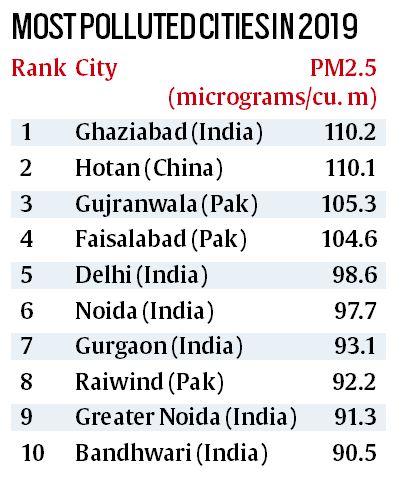
    • India accounts for two-thirds of the world’s most polluted cities — 21 of the most polluted 30 cities; 14 of the highest 20; and 6 of the highest 10 — in the report.
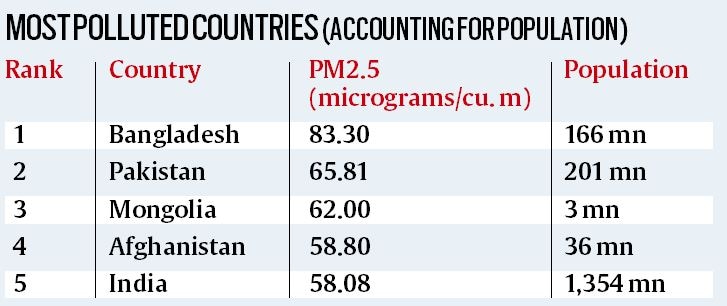
    • Among countries, when population is taken into account, average PM2.5 pollution is highest in Bangladesh, followed by Pakistan, while India is at number 5.
    • China is at number 11 in the list of countries affected by population, with population factored in. Chinese cities achieved a 9% average decrease in PM2.5 levels in 2019.
    • While cities in India, on average, exceed the WHO target for annual PM2.5 exposure by 500%, national air pollution decreased by 20% from 2018 to 2019, with 98% of cities experiencing improvements.
    • It said 90% of the global population breathing unsafe air.

    Top polluted Indian Cities


    Back2Basics

    PM 2.5

    • PM 2.5 refers to particulate matter (ambient airborne particles) which measure up to 2.5 microns in size and has a range of chemical makeups and sources.
    • It is widely regarded as the pollutant with the most health impact of all commonly measured air pollutants.
    • Due to its small size PM2.5 is able to penetrate deep into the human respiratory system and from there to the entire body, causing a wide range of short- and long-term health effects.
    • Particulate matter is also the pollutant group which affects the most people globally. It can come from a range of natural as well as man-made sources.
    • Common sources of PM include combustion (from vehicle engines, industry, wood and coal burning), as well as through other pollutants reacting in the atmosphere.
  • Child Rights – POSCO, Child Labour Laws, NAPC, etc.

    Future for the World’s Children Report 2020

    Note4Students

    From UPSC perspective, the following things are important:

    Prelims level: Future for the World’s Children Report 2020 and indices mentioned

    Mains level: Ensuring sustainable development worldwide

    The Future for the World’s Children Report 2020 was recently released.

    About the report

    • The report was released by a commission of over 40 child and adolescent health experts from around the world after assessing 180 countries.
    • It was commissioned by the World Health Organization (WHO), UN Children’s Fund (UNICEF) and The Lancet medical journal.

    What is Flourishing Index?

    • Flourishing is the geometric mean of Surviving and Thriving.
    • For Surviving, the authors selected maternal survival, survival in children younger than 5 years old, suicide, access to maternal and child health services, basic hygiene and sanitation, and lack of extreme poverty.
    • For Thriving, the domains were educational achievement, growth and nutrition, reproductive freedom, and protection from violence.

    Threats to Children

    • The report highlights the distinct threat posed to children from harmful marketing.
    • Evidence suggests that children in some countries see as many as 30,000 advertisements on television alone in a single year, while youth exposure to vaping (e-cigarettes) advertisements increased by more than 250% in the U.S. over two years, reaching more than 24 million young people.
    • Studies in Australia, Canada, Mexico, New Zealand and the U.S. — among many others — have shown that self-regulation has not hampered commercial ability to advertise to children.
    • Children’s exposure to commercial marketing of junk food and sugary beverages is associated with the purchase of unhealthy foods and overweight and obesity, linking predatory marketing to the alarming rise in childhood obesity.
    • The number of obese children and adolescents increased from 11 million in 1975 to 124 million in 2016 — an 11-fold increase, with dire individual and societal costs, the report said.

    What is Sustainability Index?

    • Under the Sustainability Index, the authors noted that promoting today’s national conditions for children to survive and thrive must not come at the cost of eroding future global conditions for children’s ability to flourish.
    • It ranks countries on excess carbon emissions compared with the 2030 target.
    • This provides a convenient and available proxy for a country’s contribution to sustainability in future.

    Highlights of the SI

    • The report noted that under realistic assumptions about possible trajectories towards sustainable greenhouse gas emissions, models predict that global carbon emissions need to be reduced from 39·7 gigatonnes to 22·8 gigatonnes per year by 2030 to maintain even a 66% chance of keeping global warming below 1·5degrees C.
    • No country in the world is currently providing the conditions we need to support every child to grow up and have a healthy future alarmed the report.

    India’s performance

    India ranked 77th on a sustainability index that takes into account per capita carbon emissions and ability of children in a nation to live healthy lives and secures 131st spot on a flourishing ranking that measures the best chance at survival and well-being for children.

    Performance of nations in SI

    •  Norway leads the table for survival, health, education and nutrition rates – followed by South Korea and the Netherlands.
    • The central African Republic, Chad and Somalia come at the bottom.
    • However, when taking into account per capita CO2 emissions, these top countries trail behind, with Norway 156th, the Republic of Korea 166th and the Netherlands 160th.
    • Each of the three emits 210 per cent more CO2 per capita than their 2030 target, the data shows, while the U.S., Australia, and Saudi Arabia are among the 10 worst emitters.
    • The lowest emitters are Burundi, Chad and Somalia.
    • According to the report, the only countries on track to beat CO2 emission per capita targets by 2030, while also performing fairly — within the top 70 — on child flourishing measures are Albania, Armenia, Grenada, Jordan, Moldova, Sri Lanka, Tunisia, Uruguay and Vietnam.
  • Higher Education – RUSA, NIRF, HEFA, etc.

    Worldwide Educating for the Future Index (WEFFI) 2019

    Note4Students

    From UPSC perspective, the following things are important:

    Prelims level: WEFFI

    Mains level: Need for internationalization of Indian education system


    India has jumped five ranks in the Worldwide Educating for the Future Index (WEFFI) 2019.

    About WEFFI

    • The report is published by The Economist Intelligence Unit. The report and index were commissioned by the Yidan Prize Foundation.
    • The index ranks countries based on their abilities to equip students with skill-based education.
    • The report analyses the education system from the perspective of skill-based education “in areas such as critical thinking, problem-solving, leadership, collaboration, creativity and entrepreneurship, as well as digital and technical skills.”

    Global scenario

    • Among the world’s largest economies, the US, UK, France and Russia all fell back in the index, while China, India and Indonesia took steps forward.
    • Finland was at the apex of the index, with strengths across each category followed by Sweden.

    India’s performance

    • India ranked 35th on the overall index in 2019 with a total score of 53, based on three categories – policy environment, teaching environment and overall socio-economic environment.
    • India scored 56.3 in policy environment falling from a 61.5 score in 2018.
    • India’s score of 52.2 in the teaching environment category and 50.1 in the socio-economic environment category increased significantly from 32.2 and 33.3 in 2018 respectively.
    • Earlier, India ranked 40th with an overall score of 41.2 across categories in 2018.

    What made India progress?

    • The report attributed India’s growth to the new education policy introduced by the government.
    • India’s Finance Minister Nirmala Sitharaman, in the Union Budget 2020, had highlighted a
    • The New Education Policy announced in this year budget under ‘Aspirational India’ will focus on “greater inflow of finance to attract talented teachers, innovate and build better labs.
    • The policy will focus further on skill-based education.

    Various shortcomings highlighted

    • The 2018 WEFFI report had highlighted the shortcomings in India’s education system emphasizing upon its inability to utilise the opportunity of internationalizing its higher education system.
    • A decentralized education system is another shortcoming of India’s education policy according to the 2019 report.
    • Well-intentioned policy goals relating to future skills development often do not get filtered downward, a hazard in economies such as the US and India that have large, decentralized education systems, the report said.
  • International Mother Language Day

    Note4Students

    From UPSC perspective, the following things are important:

    Prelims level: Read the attached story

    Mains level: NA


    Friday, February 21 was International Mother Language Day.

    International Mother Language Day

    • It has been observed since 1999 to promote “linguistic and cultural diversity and multilingualism”, according to the UN.
    • Of the world’s 6,000 languages, 43% are estimated as endangered, according to the UN.
    • On the other hand, just 10 languages account for as many as 4.8 billion speakers — over 60% of the world population.
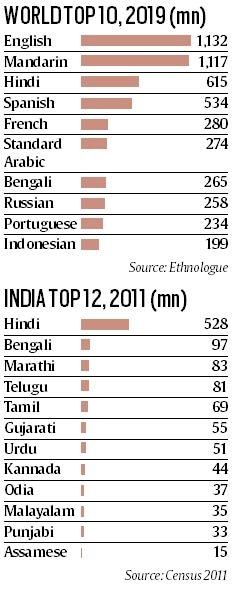
    • Globally, English remains the most widely spoken language with 1.13 billion speakers in 2019, followed by Mandarin with 1.17 billion, according to the online database Ethnologue.

    Why February 21?

    • UNESCO declared International Mother Language Day in 1999, to commemorate a 1952 protest against West Pakistan’s imposition of Urdu as the official language of East Pakistan (present-day Bangladesh).
    • According to a report, police opened fire on demonstrating Dhaka University students and “some people were killed”.
    • When thousands thronged the university the next day, police fired again, killing more people.
    • In Bangladesh, since 1953, February 21 is observed as Ekushe Day, after the Bengali word for twenty-one.
    • According to the South Asia Democratic Forum, five among those killed were recognised as “language martyrs — Abul Barkat, Abdul Jabbar, Rafiquddin Ahmad, Abdus Salman and Shafiur Rahman.

    Data on Indian languages

    • Hindi is third with 615 million speakers while Bengali is seventh with 265 million.
    • In India, Hindi is the most spoken language with over 528 million speakers in 2011, as per the Census.
    • Bengali had 97.2 million speakers in 2011, followed by Marathi (83 million), while other languages with over 50 million speakers are Telugu (81 million), Tamil (69 million), Gujarati (55.5 million) and Urdu (50.8 million).
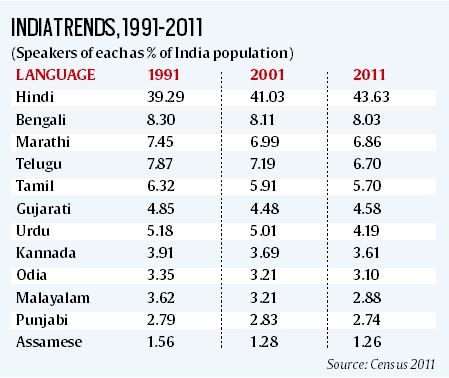
    • Percentage trends from 1991 to 2011 underline the growth of the most widely spoken language, Hindi, which was spoken by 39.29% of the Indian population in 1991, and whose share grew to 43.63% in 2011.
    • For other languages in India’s top 12, the 2011 percentage share has fallen when compared to that in 1991.
  • Air Pollution

    Global cost of air pollution from fossil fuels


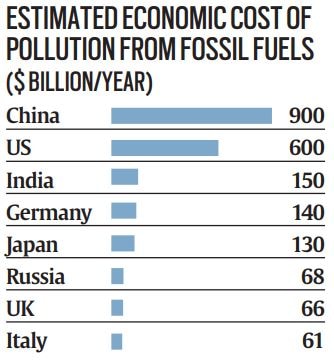
    A new Greenpeace report has estimated the global cost of air pollution from fossil fuels at around $2.9 trillion per year, or $8 billion per day — 3.3% of the world’s GDP.

    Cost of air pollution

    India is estimated to bear a cost of $150 billion, or 5.4% of the country’s GDP, which is the third-highest absolute cost from fossil fuel air pollution worldwide.

    China and the US are estimated to bear the highest absolute costs from fossil fuel air pollution, respectively at $900 billion and $600 billion.

    Loss of lives

    • Globally, air pollution is estimated to cause 4.5 million premature deaths each year.
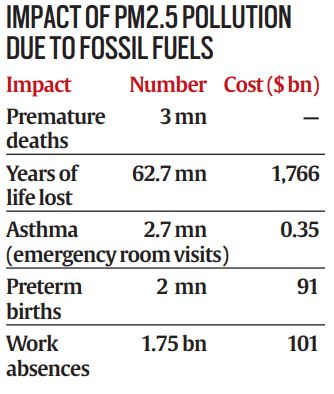
    • This includes 3 million deaths attributable globally to PM2.5, which is one of the principal pollutants in northern Indian cities including Delhi.
    • Globally, PM2.5 is also estimated to cause the loss of 62.7 million years of life, 2.7 million emergency room visits due to asthma, 2 million preterm births and 1.75 billion work absences.
    • The 2 million preterm births include 981,000 in India and over 350,000 in China.

    Economic cost

    In India, exposure to fossil fuels also leads to a loss of around 490 million workdays, the report said.

  • Human Rights Issues

    ‘2 Billion Kilometers to Safety’ campaign

    Note4Students

    From UPSC perspective, the following things are important:

    Prelims level: '2 Billion Kilometers to Safety' campaign

    Mains level: Refugees issue across the world


    The UN Refugee Agency UNHCR has announced a new global campaign urging people worldwide to cover the total distance travelled by refugees each year – 2 billion kilometers – by running, jogging or walking.

    About the campaign

    • The “2 Billion Kilometers to Safety” campaign vies to encourage people to support refugees by championing individual acts of solidarity.
    • The goal is to acknowledge the resilience and strength of refugees.
    • It calls on the public to show their solidarity with refugees by running, walking or cycling to collectively cover two billion kilometers.
    • Participants can use their fitness apps or the campaign website to log the kilometers and contribute to the global total.

    Distance covered by refugees 

    • UNHCR traced the journeys of refugees around the world and calculated that, collectively, people forced to flee travel approximately two billion kilometers every year to reach the first point of safety.
    • This is roughly the distance that separates Earth from somewhere between the planets Saturn and Uranus.
    • According to UNHCR estimates, Syrian refugees travelled over 240 kilometers each to reach Turkey.
    • South Sudanese refugees travelled more than 640 kilometers to reach Kenya. Rohingya refugees from Myanmar travelled approximately 80 kilometers to reach Bangladesh.
  • Wildlife Conservation Efforts

    [pib] 13th COP of the Convention on the Conservation of Migratory Species of Wild Animals (CMS)

    Note4Students

    From UPSC perspective, the following things are important:

    Prelims level: CMS, Central Asian Flyway

    Mains level: Conservation of migratory species


    The 13th Conference of Parties (COP) of the Convention on the Conservation of Migratory Species of Wild Animals (CMS) is going to be hosted by India at Gandhinagar in Gujarat.

    13th COP of CMS

    • The theme of CMS COP13 in India is, “Migratory species connect the planet and we welcome them home.
    • The CMS COP 13 logo is inspired by ‘Kolam’, a traditional artform from southern India.
    • In the logo of CMS COP-13, Kolam art form is used to depict key migratory species in India like Amur falcon, humpback whale and marine turtles.
    • The mascot for CMS COP13, “Gibi – The Great Indian Bustard” is a critically endangered species which has been accorded the highest protection status under the Wildlife Protection Act, 1972.

    About CMS

    • CMS is an international treaty concluded under aegis of UN Environment Programme (UNEP), concerned with conservation of wildlife and habitats on a global scale.
    • It is commonly abbreviated as Convention on Migratory Species (CMS) or the Bonn Convention.
    • It aims to conserve terrestrial, marine and avian migratory species throughout their range.
    • It was signed in 1979 in Bonn (hence the name), Germany and entered into force in 1983.
    • Its headquarters are in Bonn, Germany.
    • CMS is only global and UN-based intergovernmental organization established exclusively for conservation and management of terrestrial, aquatic and avian migratory species throughout their range.

    Prospects for India

    • As the host, India shall be designated the President for the next three years.
    • India is Signatory to the CMS since 1983.
    • India has been taking necessary actions to protect and conserve migratory marine species.
    • Seven species that include Dugong, Whale Shark, Marine Turtle (two species), have been identified for preparation of Conservation and Recovery Action Plan.

    Other facts

    • The Indian sub-continent is also part of the major bird flyway network, i.e, the Central Asian Flyway (CAF) that covers areas between the Arctic and Indian Oceans, and covers at least 279 populations of 182 migratory water bird species, including 29 globally threatened species.
    • India is home to several migratory species of wildlife including snow leopard, Amur falcons, bar headed Geese, black necked cranes, marine turtles, dugongs, humpbacked whales, etc.
    • It has signed non legally binding MOU with CMS on the conservation and management of Siberian Cranes (1998), Marine Turtles (2007), Dugongs (2008) and Raptors (2016).