💥UPSC 2026, 2027, 2028 UAP Mentorship (March Batch) + Access XFactor Notes & Microthemes PDF

Type: op-ed snap

  • Coronavirus – Health and Governance Issues

    South Asia’s healthcare burden

    Note4Students

    From UPSC perspective, the following things are important:

    Prelims level: Not much

    Mains level: Paper 2- Need for investment in public healthcare in South Asia

    The article contrasts the public healthcare system in South Asian countries with that of their Southeast Asian peers and highlights the shortcomings.

    Subpar public healthcare system

    • Super spreader events, a fragile health infrastructure neglected for decades, citizens not following health protocols, and logistical mismanagement were the factors responsible for the destruction in the second Covid-19 wave.
    • What has exacerbated the situation is a subpar public healthcare system running on a meagre contribution of a little over 1% of India’s Gross Domestic Product (GDP).
    • While the private medical sector is booming, the public healthcare sector has been operating at a pitiful 0.08 doctors per 1,000 people, World Health Organization’s (WHO) prescribed standard ois1:1000.
    • India has only half a bed available for every 1,000 people, which is a deficient figure even for normal days.
    • Bangladesh and Pakistan fare no better, with a bed to patient ratio of 0.8 and 0.6, respectively, and a doctor availability of less than one for every 1,000 people.
    • While ideally, out-of-pocket expenditure should not surpass 15% to 20% of the total health expenditure, for India, Bangladesh and Pakistan, this figure stands at an appalling 62.67%, 73.87% and 56.24%, respectively.

    Lack of investment in healthcare

    • Major public sector investments by the ‘big three’ of South Asia, i.e., India, Pakistan, and Bangladesh, are towards infrastructure and defence, with health taking a backseat.
    • While India has the world’s third-largest military expenditure, its health budget is the fourth-lowest.
    • Indian government in this year’s budget highlighted an increase of 137% in health and well-being expenditure, a closer look reveals a mismatch between facts and figures.
    • In Pakistan, even amidst the pandemic, the defence budget was increased while the spending on health remained around $151 million.
    • Not too far behind is Bangladesh, with decades of underfunding culminating in a crumbling public healthcare system.
    • Major public sector investments by the ‘big three’ of South Asia, i.e., India, Pakistan, and Bangladesh, are towards infrastructure and defence, with health taking a backseat.
    • A quick look at pre-pandemic sectoral allocations explains the chronically low status of human development indicators in the three countries.

    Learning from Southeast Asia

    • Southeast Asia has prioritised investments in healthcare systems while broadening equitable access through universal health coverage schemes.
    • Vietnam’s preventive measures focused on investments in disease surveillance and emergency response mechanisms.
    • Even countries like Laos and Cambodia are making a constant effort towards improving the healthcare ecosystem.
    • All have done much better than their South Asian peers.

    Conclusion

    Learning from the devastation unleashed by the pandemic, South Asian countries must step up investment in their public healthcare sectors to make them sustainable, up to date and pro-poor; most importantly, the system should not turn its back on citizens.

  • Parliament – Sessions, Procedures, Motions, Committees etc

    Holding states to account

    Note4Students

    From UPSC perspective, the following things are important:

    Prelims level: Not much

    Mains level: Paper 2- Scrutinising the States

    The article highlights the excessive focus on the Union government and the lack of scrutiny of the functioning of the States in various areas.

    Need for focus on the States

    • In discussions on reforms or debates about public expenditure, there is an excessive focus on the Union government.
    • This focus reflects our mindset that there is a “Centre”, though constitutionally, there is no “Centre”. There is the Union government.
    • There is not as much interest in State Finance Commissions and their recommendations as it is in the Union Finance Commission’s recommendations.
    • Alternatively, there is limited scrutiny of state-level expenditure, or fiscal devolution and decentralisation of decision-making within states, or tracking functioning of state legislatures.
    • Most factor markets we seek to reform are on the concurrent list or the state list.

    The Annual Review of State Laws 2020: Key findings

    • PRS Legislative Research published this report and it focuses on the legislative work performed by states in the calendar year 2020.
    • The annual review has been done in the pandemic year as 2020 saw the first wave of the pandemic.
    • It covers 19 state legislatures, including the Union territory of Delhi, which together accounts for 90 per cent of the population of the country.

    1) Low Productivity

    • As a benchmark, the Parliament met for 33 days in 2020.
    • Pre-2020, these 19 states met for an average of 29 days a year.
    • In 2020, they met for an average of 18 days.
    • When they met in 2020, States passed an average of 22 Bills (excluding Appropriation Bills).
    • Karnataka passed 61 Bills, the highest in the country.
    • The lowest was Delhi which passed one Bill, followed by West Bengal and Kerala, which passed two and three Bills respectively.

    2) States pass Bills without scrutiny

    • The report states that the State legislatures pass most Bills without detailed scrutiny.
    • In 2020, 59 per cent of the Bills were passed on the same day that they were introduced in the legislature.
    • A further 14 per cent were passed within a day of being introduced.
    • In Parliament, Bills are often referred to Parliamentary Standing Committees for detailed examination.
    • In most states, such committees are non-existent.

    3) Information not shared by the legislature

    • Information and data on state legislatures is not easily available.
    • While some state legislatures publish data on a regular basis, many do not have a systematic way of reporting legislative proceedings and business.”
    • Typically, information becomes available when countervailing pressure is generated.
    • Reports like this help to do that.

    Consider the question “In discussions on reforms, or debates about public expenditure, there is an excessive focus on the Union government. However, on reforms and public expenditures, we also need to focus on scrutinising the states”. Comment.


    Conclusion

    Scrutinising States on various areas of their functioning is important to hold them accountable. The availability of data from state legislatures is an opportunity to monitor them better.


  • Freedom of Speech – Defamation, Sedition, etc.

    Protecting human rights in digital era

    Note4Students

    From UPSC perspective, the following things are important:

    Prelims level: Not much

    Mains level: Paper 2- Tackling disinformation

    The article highlights the issues mentioned in the UNHRC report on disinformation and freedom of expression.

    UNHRC Report: Upholding human rights helps dealing with falsehood

    • The UN Human Rights Council (UNHRC) Special Rapporteur  submitted her report on “Disinformation and Freedom of Opinion and Expression” recently.
    • The UNHRC report specifically speaks of information disorder that arises from disinformation.
    • Impact of disinformation: Such information disorder leads to politically polarisation, hinders people from meaningfully exercising their human rights, and destroys their trust in governments and institutions.
    • Human rights provide a powerful and appropriate framework to challenge falsehoods and present alternative viewpoints.
    • Upholding human rights is useful in dealing with falsehood in two ways:
    • 1) Freedom of opinion and expression enables governance and development.
    • 2) Civil society, journalists and others are able to challenge falsehoods and present alternative viewpoints.
    • So, the report says that human rights friendly governance is both possible and doable; it is also desirable, as it protects political power against itself.

    Review of the business model needed

    • The report asserts that reactive content moderation efforts” are unlikely to make any worthwhile difference in the absence of a serious review of the business model that underpins much of the drivers of disinformation and misinformation.
    • Problems of inconsistent application of companies’ terms of service, inadequate redress mechanisms and a lack of transparency and access to data re-emerge constantly.
    • Aalthough the platforms are global businesses, they do not appear to apply their policies consistently across all geographical areas or to uphold human rights in all jurisdictions to the same extent.

    Need for legislative clarity on twin concept of misinformation and disinformation

    • The report highlights the lack of legislative and judicial clarity on the twin concepts of “disinformation” and “misinformation”.
    • It emphasises that the intention to harm is decisive to the disinformation.
    • “Disinformation” is false information disseminated intentionally to cause serious social harm.
    • In contrast, misinformation consists in the dissemination of false information unknowingly.
    • Nor are these terms to be used interchangeably.
    • Acknowledging the fact that “extremist or terrorist groups” frequently engage in the dissemination as part of their propaganda to radicalise and recruit members, the report disfavours any state response that adds to human rights concerns.

    Other factors contributing to growth of disinformation

    • The growth of disinformation in recent times cannot be attributed solely to technology or malicious actors, according to the report.
    • Other factors such as digital transformation and competition from online platforms, state pressure, the absence of robust public information regimes, and digital and media literacy among the general public also matter.
    • Moreover, disinformation enhance the frustrations and grievances such as economic deprivation, market failures, political disenfranchisement, and social inequalities.
    • Disinformation is thus not the “cause but the consequence of societal crises and the breakdown of public trust in institutions”.
    • Strategies to address disinformation will succeed only when these underlying factors are tackled.

    Issue of use of disinformation by states

    • A 2020 Oxford study of “Industrialised Disinformation” mentions that as many as “81 governments” use “social media to spread computational propaganda and disinformation about politics”.
    • Some authoritarian countries like Russia, China and Iran capitalised on coronavirus disinformation to amplify anti-democratic narratives.
    • Online disinformation also results in offline practices of violent social excursion on actually existing individuals and communities such as ethnic, gender, migrant, sexual minorities.

    Consider the question “Reactive content moderation efforts are simply inadequate without a serious review of the business model that underpins much of the drivers of disinformation and misinformation on the social media platforms.” Critically examine.”

    Conclusion

    Will future itineraries of human rights in the digital era repeat past mistakes? The report offers grist to the mill for profound thought and conscientious action.

  • Zoonotic Diseases: Medical Sciences Involved & Preventive Measures

    Bring genomic sequencing into the pandemic fight

    Note4Students

    From UPSC perspective, the following things are important:

    Prelims level: Variants of coronavirus

    Mains level: Paper 3- Importance of genomic sequencing in dealing with the pandemic

    The article highlights the importance of genomic sequencing in dealing effectively with the pandemic and suggest the scaling up of genomic sequencing.

    Why genomic sequencing is important

    • An effective COVID-19 pandemic response requires, inter alia, keeping track of emerging variants and then conducting further studies about their transmissibility, immune escape and potential to cause severe disease.
    • The success of the United States and the United Kingdom in containing the virus also goes to scaled-up genomic sequencing, tracking the emerging variants and using that evidence for timely actions.
    • The data from genomic sequencing has both policy and operational implications.
    • Our scientific knowledge and understanding about emerging strains is going to be the key to deploy public health interventions (vaccines included) to fight the pandemic.
    • The emerging variants — with early evidence of higher transmissibility, immune escape and breakthrough infections — demand continuous re-thinking and re-strategising of the pandemic response by every country.

    Insufficient genomic sequencing in India

    • Though the procedural steps such as setting up the Indian SARS-CoV2 Genomic Consortia, or INSACOG have been taken, the sequencing has remained at a very low level of a few thousand cases only.
    • The challenge of insufficient genomic sequencing is further compounded by slow pace of data sharing.

    Steps need to be taken

    • 1) Scale-up genomic sequencing: India needs to scale up genomic sequencing, across all States.
    •  More genomic sequencing is needed from large urban agglomerations.
    • A national-level analysis of collated genomic sequencing data should be done on a regular basis and findings shared publicly.
    • 2) Research on vaccine effectiveness: The Indian government needs to invest and support more scientific and operational research on vaccine effectiveness.
    • Rethink vaccine policy: There are early indications of immune escape and reduced vaccine effectiveness against the Delta variant (especially after one-shot).
    • These are the questions that experts need to deliberate and come up with the answers.

    Consider the question “What is genomic sequencing and how it could help in dealing with the Covid-19 pandemic? Suggest the steps India need to take to use genomic sequencing in curbing the pandemic.”

    Conclusion

    As India prepares for the third wave, increasing genomic sequencing and use of scientific evidence for decision making are not a choice but an absolute essential.

  • Foreign Policy Watch: India-China

    Pushback against China more likely as Quad gains momentum

    Note4Students

    From UPSC perspective, the following things are important:

    Prelims level: Quad

    Mains level: Paper 2- Pushback against China

    The article discusses the future pushback against China in South Asia and Indo-Pacific as Quad gains more momentum. 

    Context

    Recently, the Chinese Ambassador to Bangladesh, Li Jiming, warned Dhaka that there will be “substantial damage” in bilateral ties between China and Bangladesh if the latter joins the Quad.

    Bangladesh’s reaction

    • Bangladesh Foreign Minister A.K. Abdul Momen promptly and publicly challenged the Chinese envoy’s statement, underlining categorically that Dhaka pursues an independent foreign policy. 
    • That China’s remarks would reverberate far beyond South Asia was expected and perhaps intended.
    • The spokesperson of U.S. State Department remarked, “What we would say is that we respect Bangladesh’s sovereignty and we respect Bangladesh’s right to make foreign policy decisions for itself.”

    Implications for South Asia and Info-Pacific

    • With its message to Bangladesh, Beijing was laying down a marker that nations should desist from engaging with the Quad.
    • This episode captures the emerging fault lines in South Asia and the wider Indo-Pacific.
    • For all its attempts to play down the relevance of the Quad, Beijing realises that the grouping, with all its weaknesses, is emerging as a reality and there is little it can do to prevent that.
    • And so, it is agitated about Quad’s future role and its potential success in offering the regional states an alternative to its own strong-arm tactics.

    About Quad’s agenda

    • The Quad member states are figuring out a cohesive agenda amongst themselves and there are no plans for an expansion.
    • There is a desire to work with like-minded nations but that can only happen if the four members of the Quad can build a credible platform first.
    • Quad has not asked any country to join and no one has shown an interest.
    • But China wants to ensure that after failing in its initial attempt to prevent the Quad from gaining any traction.
    • Its message is well understood by other states who may harbour any desire of working closely with the Quad members.

    Way forward

    • Beijing has failed to prevent nations from the West to the East from coming out with their Indo-Pacific strategies.
    • It has failed to prevent the operationalisation of the Quad, and now it might be worried about other nations in the region thinking of engaging with the Quad more proactively.
    • Even Bangladesh is planning to come out with its own Indo-Pacific strategy and Beijing has now warned Dhaka that a close cooperation with the Quad should not be part of the policy mix.
    •  As the Quad gains more momentum and the churn in the waters of the Indo-Pacific leads to new countervailing coalitions against China, Beijing’s belligerence can only be expected to grow.

    Conclusion

    Beijing is more likely to demand clear-cut foreign policy choices from its regional interlocutors, as its warning to Bangladesh underscores. But as Dhaka’s robust response makes it clear, states are more likely to push back than become subservient to Chinese largesse.

  • Foreign Policy Watch: India-United States

    Opportunity to expand ties with West

    Note4Students

    From UPSC perspective, the following things are important:

    Prelims level: Not much

    Mains level: Paper 2- Opportunity for India to expand ties with the West

    The article takes an overview of the growing convergence of India’s interest with the West in the changing geopolitical scenario and opportunities it offers to India.

    Significance of G-7 Summit for India

    • Summit of the G-7, the Group of Seven industrial countries, will be hosted by the United Kingdom this week.
    • Prime Minister Narendra Modi will participate digitally in this summit.
    • This participation also marks an important step towards a new global compact between India and the West.
    • The global financial crisis of 2008, the rapid rise of China, divisions within the West during the Trump years, and the chaotic response in North America and Europe to the Covid-19 pandemic, were the factors that indicated the decline of the West.
    • In his first tour abroad as the US president wants to demonstrate that the collective West is an enduring force to reckon with under renewed American leadership.
    • For India, the G-7 summit is an opportunity to expand the global dimension of India’s growing partnerships with the US and Europe.

    Convergence of interests between India and the West

    • The challenges from an increasingly aggressive China, the urgency of mitigating climate change, and the construction of a post-pandemic international order are generating convergence between the interests of India and the West.
    • India’s current engagement with the G-7 is about global issues.
    • The idea of a global democratic coalition that is based more broadly than the geographic West has gained ground in recent years.
    • And India is at the very heart of that Western calculus.
    • For India, too, the G-7summit comes amidst intensifying strategic cooperation with the West.
    • This includes strong bilateral strategic cooperation with the US, France, UK as well as the Quad and the trilateral partnerships with France and Australia as well as Japan and Australia.
    • India has also stepped up its engagement with the European Union.

    China factor

    • India’s increasing engagement with the US and the West has been triggered in part by the continuous deterioration of the relationship with China.
    • Besides the threat to territorial security, India finds that its hopes for strong global cooperation with China have taken a big beating in recent years.
    • China is the only great power that does not support India’s permanent membership of the UN Security Council and blocks India’s membership of the Nuclear Suppliers Group.
    • At the end of the Cold War, India believed that China was a natural partner in the construction of a multipolar world.
    • India now can’t escape the conclusion that China is the greatest obstacle to India’s global aspirations and the West is an emerging partner.
    •  India has relied on Western support to fend off China’s effort to internationalise the Kashmir question after the 2019 constitutional changes.
    • India walked away from RCEP due to the growing trade imbalance with China and the negative impact of Chinese imports on India’s domestic manufacturing.
    • After China’s aggression in Ladakh last April, India has also sought to actively limit its exposure to Chinese investments and technology.

    Way forward

    • The convergence of interests between India and the West does not mean the two sides will agree on everything.
    •  There are many areas of continuing divergence within the West — from the economic role of the state to the democratic regulation of social media and the technology giants.
    • It will surely not be easy translating the broad convergences between India and the West into tangible cooperation.
    • That would require sustained negotiations on converting shared interests.

    Consider the question “The idea of a global democratic coalition that is based more broadly than the geographic West has gained ground in recent years. This offers India an opportunity to expand the global dimension of India’s growing partnerships with the US and Europe. Comment.”

    Conclusion

    While India continues to strengthen its partnerships in Asia and the global south, a more productive partnership with the West helps secure a growing array of India’s national interests and adds a new depth to India’s international relations.

  • Economic Indicators and Various Reports On It- GDP, FD, EODB, WIR etc

    7 Years of UPA Government vs 7 Years of NDA Government

    Note4Students

    From UPSC perspective, the following things are important:

    Prelims level: Not much

    Mains level: Paper 3- Performance of the current government in the past seven years

    The article compares the performance of the present government under Prime Minister Modi with the first seven years of the Manmohan Singh government on various fronts.

    Context

    The current government completed seven years at the Centre recently. It is time to reflect and look back at its performance on basic economic parameters over the last seven years. It may also be interesting to compare and see how it fared vis-à-vis the first seven years of UPA government (2004-05 to 2010-11) under Manmohan Singh.

    Analysing the progress by studying key economic indicator

    1)  GDP growth

    • One of the key economic parameters is GDP growth.
    • It is not the most perfect one, as it does not capture specifically the impact on the poor, or on inequality.
    • But higher GDP growth is considered central to economic performance as it enlarges the size of the economic pie.
    • The average annual rate of growth of GDP under the Modi government so far has been just 4.8 per cent compared to 8.4 per cent during the first seven years of the Manmohan Singh government.
    • If this continues as business as usual, the dream of a $5 trillion economy by 2024-25 is not likely to be achieved.

    2) Inflation

    • The Modi government scores much better on the inflation front with CPI (rural and urban combined) rising at 4.8 per cent per annum.
    • It is well within the tolerance limits of RBI’s targeted inflation band and also much lower than 7.8 per cent during the first seven years of the Manmohan Singh government.

    3) Forex reserves

    • Also, at macro level, foreign exchange reserves provide resilience to the economy against any external shocks.
    • On this score too, the Modi government fares quite well with forex reserves rising from $313 billion on May 23, 2014 to $593 billion on May 21, 2021.

    4) Food and agriculture

    • It engages the largest share of the workforce in the economy and matters most to poorer segments.
    • On the agri-front, both governments recorded an annual average growth of 3.5 per cent during their respective first seven years.
    • However, on the food and fertiliser subsidy front, the Modi government broke all records in FY21, by spending Rs 6.52 lakh crore and accumulating grain stocks exceeding 100 million tonnes in May end, 2021.
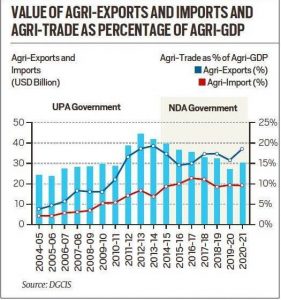
    • One area in which the Modi government performed very poorly is agri-exports.
    • In 2013-14 agri-exports had crossed $43 billion while during all the seven years of the Modi government agri-exports remained below this mark of $43 billion.
    • Sluggish agri-exports with rising output put downward pressure on food prices.
    • It helped contain CPI inflation, but subdued farmers’ incomes.

    5) Infrastructure development

    • The Modi government has done better in power generation by increasing it from 720 billion units per annum to 1,280 billion units per annum.
    • Similarly, road construction too has been at least 30 per cent faster under the Modi government.

    6) Social sector

    • Based on an international definition of extreme poverty (2011 PPP of $ 1.9 per capita per day), the World Bank estimated India’s extreme poverty in 2015 to be about 13.4 per cent, down from 21.6 per cent in FY 2011-12.
    • Even the incidence of multidimensional poverty hovered around 28 per cent in 2015-16.
    • Three key indicators can be used to assess performance on this front:
    • One, average annual person days generated under MGNREGA in the first five years since this programme started under the UPA in 2006-07 to 2010-11, which was 200 crore, and under Modi government it improved to 230 crore.
    • Two, average annual number of houses completed under the Indira Awaas Yojana and PM Awaas Yojana-Gramin, which improved from 21 lakhs to 30 lakhs per annum.
    • Three, open defecation free (ODF) which was only 38.7 per cent on October 2, 2014 and shot up to 100 per cent by October 2, 2019, as per government records.

    Conclusion

    The current government has turned out to be more welfare-oriented than reformist in revving up GDP growth. How long this welfare approach is sustainable without enlarging the size of GDP pie is an open question.

  • Electoral Reforms In India

    Simultaneous Elections in India

    Note4Students

    From UPSC perspective, the following things are important:

    Prelims level: Not much

    Mains level: Paper 2- One nation one election

    The article deals with the issue frequent elections in the country and highlights the need for debate on the idea of “one nation, one election”.

    Need for debate on one nation one election

    The idea has been around since at least 1983, when the Election Commission first mooted it. The concept needs to be debated mainly around five issues.

    1) Financial costs of  conducting elections

    • The costs of conducting each assembly or parliamentary election are huge and, in some senses, incalculable.
    • Directly budgeted costs are around Rs 300 crore for a state the size of Bihar.
    • But there are other financial costs, and incalculable economic costs.
    • Before each election, a “revision” of electoral rolls is mandatory.
    • The costs of the millions of man-hours used are not charged to the election budget.
    • The economic costs of lost teaching weeks, delayed public works, badly delivered or undelivered welfare schemes to the poor have never been calculated.

    2) Cost of repeated administrative freezes

    • The Model Code of Conduct (MCC) has economic costs too.
    • Works may have been announced long before an election is announced, but tenders cannot be finalised, nor work awarded, once the MCC comes into effect.
    • Time overruns translate into cost overruns.
    • But the huge costs of salaries and other administrative expenditures continue to be incurred.
    • Add to this the invisible cost of a missing leadership.
    • Important meetings and decisions get postponed, with costs and consequences that are difficult to calculate.
    • A NITI Aayog paper says that the country has at least one election each year.

    3) Visible and invisible costs of repeatedly deploying security forces

    • There are also huge and visible costs of deploying security forces and transporting them, repeatedly.
    • A bigger invisible cost is paid by the nation in terms of diverting these forces from sensitive areas.

    4)  Campaign and finance costs of political parties

    • There is little doubt that the fiscal and economic costs of an election are not trivial, and that two elections, held separately, will almost double costs, including those incurred by political parties themselves.

    5) Question of regional/smaller parties having a level playing field

    • There are fears about the Centre somehow gaining greater power, or regional parties being at a disadvantage during simultaneously held elections.
    • However, fixed five-year terms for state legislatures in fact take away the central government’s power to dissolve state assemblies.
    •  Until 1967 when simultaneous elections were the norm.
    • The Constitution and other laws would need to be amended is obvious, but that is hardly an argument against the proposal.

    Consider the question “There are huge costs associated with the frequent elections in the country. Is simultaneous elections a solution? What are the issues involved?”

    Conclusion

    As the elections in four states and one Union territory in March-April are suspected to have contributed to the second wave of Covid infections, a well-reasoned debate on a concept as important as “one nation, one election” is called for.

  • Goods and Services Tax (GST)

    Need to deal with distortions built into GST

    Note4Students

    From UPSC perspective, the following things are important:

    Prelims level: GST council decision making

    Mains level: Paper 3- Issues with one state one vote system in GST council

    The article highlights the issues with the one state one vote system adopted in the GST Council decision making.

    Context

    The Goods and Services Tax (GST) Council in India is still engaged in a discussion on whether life-saving and hard-to-come-by products should be taxed. Such delay in decision-making can largely be explained by the distorted design and incentive structure of the GST itself.

    Imbalance in collection and distribution of taxes

    • The taxes collected under GST are accumulated by the Union government and a portion is transferred back to each state under a formula.
    • As is the case with most federal countries, there is a large imbalance in the collection and distribution of taxes between states.
    • this holds true also for income accrued to, and distributed, from the GST pool.
    • Four states — Maharashtra, Tamil Nadu, Karnataka, and Gujarat contribute nearly as much as the remaining 27 states combined.
    • Most federal countries exhibit this characteristic where a few large, rich, provinces or states contribute disproportionately.

    Variation in dependence of States on transfers from the Union government

    • Only about 30 per cent of the overall revenue of the states mentioned above — Maharashtra, Tamil Nadu, Gujarat, and Karnataka — comes from the Union government.
    • But for the remaining 27 states, roughly 60 per cent of their revenues are obtained through transfers from the Union government.
    • For the smaller Northeastern states, these transfers from the Union government constitute 80-90 per cent of their total revenues.
    •  In effect, the states that contribute the most to the GST pool are the least dependent on transfers from the Union government while the ones that contribute the least are the most dependent.

    Two problems in net-transfers in India

    1) One-sided transfers

    •  In almost every federal union, net-transfers work to reduce differences in development between states over time.
    • However, Over the last 25 years or so, net transfers have become increasingly one-sided in India.
    • That is, the quantum of net-transfers diminishes, as states become more equal through such transfers.
    • But in India, the opposite has occurred.

    2) Indirect taxes and cess

    • The Union government of the last seven years has greatly exacerbated this problem through two actions.
    • First, it has reconstructed the composition of taxation away from the fair and progressive channel of direct taxation towards the inherently regressive and unfair channel of indirect taxes.
    • Second, the Union has shifted a large proportion of taxation roughly 18 per cent of its overall revenues into cesses, a special form of taxes that remain outside the GST pool and hence do not have to be shared with the states.
    • Since 2014, cess revenues grew 21 per cent every year leading to a doubling in terms of its share of GDP.

    Implications of these two problems for fiscal federalism

    • The combined effect of these problems is that all states (collectively) get a lower share of overall revenues.
    • Individual states face an ever-increasing disparity in the ratio of funds received from the Union as a proportion of taxes collected by the Union from that state.
    • This is an affront to fiscal federalism and an assault on “cooperative federalism”.

    Issue of ‘one state one vote’ system

    • States that are more dependent on transfers from the Union want to maximise GST collections while states that are less dependent can afford to be more sensitive to citizens’ concerns.
    • The case of taxes on Covid products is perhaps the starkest instance of such differences.
    • Most large states are ready to forego this tax revenue for humanitarian considerations.
    • But 19 states representing the remaining 30 per cent of the population seem keen to continue to levy GST on Covid products.
    •  These are mostly smaller states.
    • Given the smaller population of such states, the adverse impact of Covid taxes will be minimal for them.
    • But they will reap the benefits of additional revenues from GST on Covid products levied on the much larger populations of the bigger states.

    Conclusion

    When direct tax policy decisions are legislated by Parliament, which has proportional representation from states according to their size of the population, indirect tax policy decisions should not be subject to one state one vote system.

  • Important Judgements In News

    Verdict on Maratha reservation ignores inequality within intermediate castes

    Note4Students

    From UPSC perspective, the following things are important:

    Prelims level: Not much

    Mains level: Paper 2- Reservation debate

    The article highlights the issues with Maratha reservation judgement delivered by the Supreme Court which rejected the positive discrimination of lower classes of dominant caste.

    About the verdict

    • The Supreme Court rendered a unanimous verdict on the validity of the SEBC Act, 2018 that was to grant reservation to Marathas.
    • The court held that the classification of Marathas as a socially and educationally backward class was unreasonable.
    • Court held that Maratha belonged to a politically dominant caste with significant economic resources.

    Justification for 50% limit

    • The court also concluded that the majority opinion in the Indra Sawhney case was correct and that the limit of 50 per cent for caste-based reservation did not need consideration by a larger bench.
    • The court justified the fixed quantitative limit on caste-based reservation by postulating that it was intrinsic to the fundamental principle of equality.
    • The court highlighted the need to safeguard the interests of unreserved sections and said that all sections have progressed after 70 years of independence.
    • Based on this, the court rejected the state’s argument that the breach of the limit was necessitated by the fact that the population of backward classes was over 80 per cent.

    Missed opportunity to acknowledge growing socio-economic differentiation within the dominant castes

    Growing income difference

    • If in 2011-12, the average per capita income of the Marathas was second only to the Brahmins at Rs 36,548, against Rs 47,427.
    • Their highest quintile -20 per cent of the caste group- got 48 per cent of the total income of the Marathas with a mean per capita income of Rs 86,750.
    • The lowest quintile earned 10 times less (Rs 7,198) and the 40 per cent poorest got less than 13 per cent of the total income of the caste — and were lagging behind the Scheduled Castes elite.
    • In fact, the mean incomes of the highest Dalit quintile, Rs 63,030, and that of the second-highest, Rs 28,897, were above those of the three lowest quintiles of the Marathas.

    What explains growing income difference

    • This is partly due to changes on the education front. 
    • The percentage of graduates among Dalits in 2004-05 was 1.9 per cent and has more than doubled to 5.1 per cent in 2011-12.
    • The corresponding figure for the OBCs was 3.5 per cent and has doubled to 7.6 per cent, while for the Marathas it was 4.6 per cent in 2004-05 and has come up to 8 per cent in 2011-12.
    • Correlatively, the percentage of salaried people among the Dalits was about 28 per cent in Maharashtra in 2011-12, as against 30 per cent among the Marathas.

    Issues with the Maratha quota judgment

    •  The Court refused to recognise the need for positive discrimination of the lower classes of the dominant castes which continue to be seen as a dominant bloc.
    • It fails to admit the complexity that the role of class has introduced in post-liberalisation India.
    • This is unequivocal confirmation of a dated approach to social realities and a purely arithmetic limit that finds no expression in the Constitution.
    • The judgement also raises the issue of judicial supremacy in the broad area of social policy as it could lead to undesirable exclusion of beneficiaries.
    • The court seems to have forgotten its own observation in NM Thomas case that functional democracy postulates participation of all sections of the people and fair representation in administration is an index of such participation.

    Conclusion

    The Supreme Court has rejected the determination of Marathas as backward by holding that their relative deprivation and under-representation with regard to other sections of the general category did not entitle them to affirmative action.