💥UPSC 2026, 2027, 2028 UAP Mentorship (March Batch) + Access XFactor Notes & Microthemes PDF

Type: Prelims Only

  • Differentiated Banks – Payment Banks, Small Finance Banks, etc.

    [pib] Digital Payments Index (DPI)

    Why in the News?

    According to the Reserve Bank of India (RBI), digital payments registered a 12.6% year-on-year rise as of March 31, 2024, as measured by the RBI’s Digital Payments Index (DPI).

    About RBI’s Digital Payments Index (DPI):

    • Launched by: Reserve Bank of India (RBI) in January 2021
    • Purpose: Measures the extent of digital payment adoption across India
    • Base Period: March 2018 (Index value = 100)
    • Release Frequency: Semi-annually (with a 4-month lag)
    • Objective: Track usage, infrastructure, and growth in digital payments
    • Key Parameters (with Weightage): These evaluate infrastructure readiness, transaction volume, user adoption, and innovation.
      1. Payment Enablers – 25%
      2. Payment Infrastructure – Demand Side – 10%
      3. Payment Infrastructure – Supply Side – 15%
      4. Payment Performance – 45%
      5. Consumer Centricity – 5%

    Growth Highlight:

    • Growth Trends in RBI-DPI: DPI grew nearly 5 times from 100 in March 2018 to 493.22 in March 2025, reflecting India’s rapid digital payment adoption.
    • Nearly 5× increase from the base value in 7 years
    • Driven by rapid expansion of Unified Payments Interface (UPI), mobile wallets, and QR code infrastructure
    [UPSC 2024] Consider the following countries:

    I. United Arab Emirates II. France III. Germany IV. Singapore V. Bangladesh

    How many countries amongst the above are there other than India where international merchant payments are accepted under UPI?”

    Options: (a) Only two (b) Only three* (c) Only four (d) All the five

    Answer: (b) Only three (UAE, France, Singapore)


  • NGOs vs. GoI: The Conflicts and Scrutinies

    National Cooperation Policy (NCP), 2025

    Why in the News?

    The National Cooperation Policy (NCP) 2025 recently unveiled by Union Home and Cooperation Minister Amit Shah has drawn criticisms from SKM (Samyukt Kisan Morcha).

    Also in news:

    • The Union Cabinet has also approved a ₹2,000 crore Central Sector Scheme to aid National Cooperative Development Corporation (NCDC) from 2025–26 to 2028–29.
    • NCDC was established in 1963 as a statutory Corporation under Ministry of Agriculture & Farmers Welfare (now functions under the Ministry of Cooperation since 2021).


    About Cooperatives in India:

    • What is it: A cooperative is a voluntary, autonomous association of individuals who unite to meet common economic, social, or cultural needs through a jointly-owned and democratically-controlled enterprise.
    • Key Principles:
      • One member, one vote: Equal say in governance, regardless of financial contribution.
      • Based on collective benefit, democratic control, and mutual aid.
    • Historical Evolution:
      • 1904 & 1912: Cooperative Acts laid the foundation for the cooperative movement in India.
      • Post-independence: Emphasis on rural credit, dairy, and agriculture cooperatives (e.g., Amul).
      • Key Institutions: NABARD (National Bank for Agriculture and Rural Development), NCDC (National Cooperative Development Corporation).
    • Constitutional & Legal Backing:
      • 97th Constitutional Amendment (2011):
        • Article 19(1)(c): Right to form cooperative societies.
        • Article 43B: Directive Principle promoting cooperative societies.
        • Part IXB (Articles 243ZH to 243ZT): Provides governance framework.
      • MSCS Act, 2002: Governs multi-state cooperatives (under Central Registrar).
      • State List (Entry 32): State legislatures regulate intra-state cooperatives.
    • Scale:
      • India has over 8.42 lakh cooperatives with 29 crore members (~27% of global total).
      • Leading states: Maharashtra, Gujarat, Telangana, MP, Karnataka.
      • Notable cooperatives: IFFCO, Amul — ranked among top 300 cooperatives globally.

    National Cooperation Policy (NCP) 2025:

    • Launch: Introduced by Union Minister Amit Shah on July 24, 2025.
    • Vision: “Sahakar se Samriddhi” — promoting prosperity through cooperatives.
    • Objective:
      • Establish a comprehensive national framework for cooperative growth (2025–2045).
      • Replace the 2002 policy and drive inclusive development through grassroots cooperatives.
    • Key Features:
      • 2 lakh new Primary Agricultural Credit Societies (PACS) in 5 years
      • Scheme convergence: e.g., PM Matsya Sampada Yojana, NPDD
      • Inclusive focus: Women, Dalits, Adivasis, youth
      • Sector expansion: Into 25+ areas—dairy, fisheries, exports, technology
      • Education: First cooperative university—Tribhuvan Sahkari University
      • Export support: Through National Cooperative Exports Limited (NCEL)
      • Digital thrust: Emphasis on digitisation and platform integration

    Issues with NCP, 2025:

    • Federalism Undermined
      • Entry 32: Cooperatives are a State Subject
      • SC Verdict (2021): Centre cannot regulate intra-state cooperatives
      • Criticism: Policy lacks ratification by half the states (Article 368(2))
    • Corporate Entry Fears
      • Emphasis on digital platforms may enable indirect corporatisation
      • Potential marginalisation of small farmers and FPOs
    • Weak Social Inclusion
      • Lacks focus on Minimum Support Price (MSP), surplus sharing
      • No robust support for producer cooperatives or fair wages
      • Inclusion of tribals, Dalits, women remains rhetorical
    [UPSC 2021] With reference to ‘Urban Cooperative banks’ in India, consider the following statements:

    1. They are supervised and regulated by local boards set up by the State Governments.

    2. They can issue equity shares and preference shares.

    3. They were brought under the purview of the Banking Regulation Act, 1949 through an Amendment in 1966.

    Which of the statements given above is/are correct?”

    Options: (a) 1 only (b) 2 and 3 only* (c) 1 and 3 only (d) 1, 2, and 3


  • Global Geological And Climatic Events

    Tsunami Waves triggered by quakes in Kamchatka Peninsula

    Why in the News?

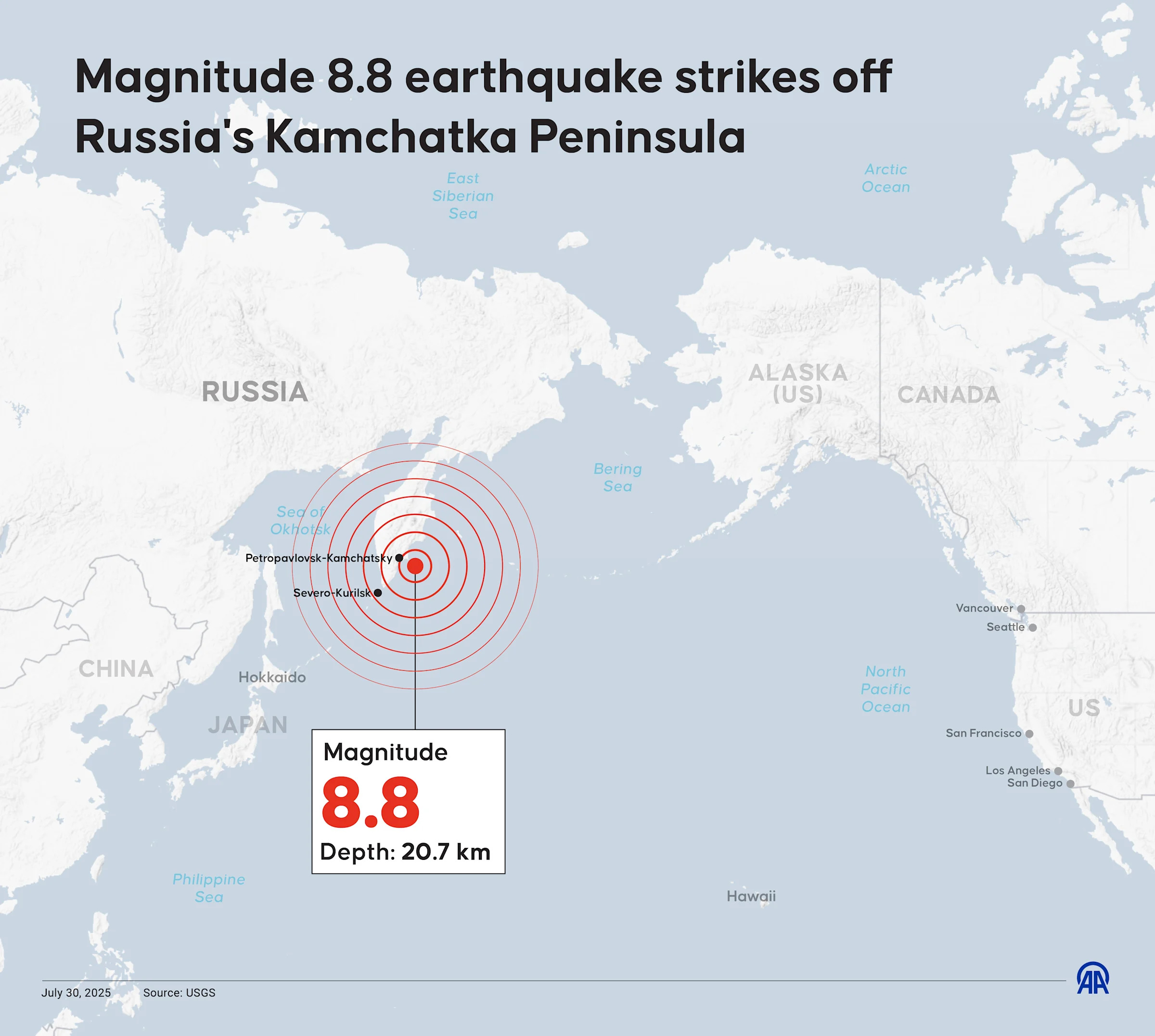
    An 8.8 magnitude earthquake hit off Russia’s Kamchatka Peninsula, triggering 16-foot tsunamis that reached Hawaii and northern California in the US.

    About Earthquakes:

    • Overview: Sudden ground shaking caused by release of stored energy in Earth’s crust due to tectonic stress.
    • Cause: Occurs when tectonic plates slip at fault lines where stress had built up due to friction.
    • Seismic Waves: Energy travels as:
      • Primary Waves (P-waves): Fastest, compressional.
      • Secondary Waves (S-waves): Slower, shear motion.
    • Key Terms:
      • Focus (Hypocenter): Underground origin point.
      • Epicenter: Surface point directly above the focus.
    • Measurement:
      • Magnitude: Energy released (Richter Scale, logarithmic).
      • Intensity: Observed ground shaking (varies by location).
      • Seismograph: Records seismic wave activity.

    How Earthquakes Trigger Tsunamis?

    • Underwater Epicenter: Must occur beneath oceans to displace water.
    • Shallow Depth: Quakes at <70 km transfer energy more efficiently to water surface.
    • Reverse Faulting: One tectonic plate pushes over another, vertically shifting the seafloor.
    • Rapid Displacement: Sudden seafloor uplift/downthrust generates massive water waves.
    • High Magnitude: Quakes >7.0 (especially >8.0) likely to trigger tsunamis.

    About the Kamchatka Region:

    • Overview: Russian Far East; borders the North Pacific Ocean.
    • Tectonic Zone: Sits on the Kuril-Kamchatka Trench—Pacific Plate subducting under Okhotsk Plate at ~86 mm/year.
    • Seismic Hotspot: Historical major quakes in 1841, 1923, 1952, 2006, and 2020.
    • Ring of Fire: Part of the 40,000 km Pacific Ring of Fire , known for quakes and volcanoes.
    • 2025 Earthquake:
      • Depth:3 km (shallow)
      • Impact: Triggered tsunami waves up to 16 ft—one of the strongest earthquakes since 1900.
    [UPSC 2004] Consider the following geological phenomena:

    1. Development of a fault 2. Movement along a fault 3. Impact produced by a volcanic eruption 4. Folding of rocks

    Which of the above cause earthquakes?

    Options: (a) 1, 2 and 3 (b) 2 and 4 (c) 1, 3 and 4 (d) 1, 2, 3 and 4*


  • Waste Management – SWM Rules, EWM Rules, etc

    New Guidelines for Management of Contaminated Sites

    Why in the News?

    The Union Environment Ministry has notified the Environment Protection (Management of Contaminated Sites) Rules, 2025 under the Environment (Protection) Act, 1986.

    About the Environment Protection (Management of Contaminated Sites) Rules, 2025:

    • Nodal Agency: Ministry of Environment, Forest and Climate Change (MoEFCC).
    • Legal Basis: Framed under the Environment (Protection) Act, 1986.
    • Purpose: India’s first dedicated legal framework to identify, clean up, and monitor contaminated sites.
    • Goal: Prevent environmental degradation, enforce clean-up, and ensure polluter accountability.
    • Funding Pattern:
      • Himalayan & Northeast states: 90% Centre – 10% State
      • Other states: 60% Centre – 40% State
      • Union Territories: 100% Centre

    Key Features:

    • Site Classification: Sites categorized as suspected, potentially contaminated, or confirmed, based on scientific evidence.
    • Exclusions: Sites involving radioactive waste, mining, marine oil spills, or municipal solid waste (regulated separately).
    • Transparency & Tracking: Central Pollution Control Board (CPCB) to maintain a real-time online portal with public access.
    • Public Participation:
      • 60-day window for stakeholder feedback post-listing.
      • Final site lists must be published in regional newspapers.
    • Polluter Pays Principle:
      • Identified polluters must bear full remediation cost and repay within 3 months.
      • Land use changes or ownership transfers restricted during/post clean-up.
    • Orphan Sites (No Known Polluter): Clean-up funded through:
      • Environment Relief Fund
      • Environmental violation penalties
      • Government budgetary support
    • Voluntary Remediation: Private entities with technical capacity may remediate sites with landowner consent.
    • Monitoring Committees: State and Central-level bodies to oversee implementation and submit annual compliance reports.

    Back2Basics: Environment (Protection) Act, 1986

    • Enactment: In response to the Bhopal Gas Tragedy; derives authority from Article 253 of the Constitution.
    • Objective: To protect and improve the environment and prevent hazards to life and property.
    • Significance: Acts as India’s umbrella environmental legislation, coordinating with the Water Act (1974) and Air Act (1981).
    • Key Provisions:
      • Pollution standards via Environment (Protection) Rules.
      • Hazardous Waste Rules, 1989 – manage toxic waste.
      • Chemical Safety Rules – control handling of hazardous chemicals.
      • Cells Rules, 1989 – govern gene tech and genetically modified organisms.
    • Power: Empowers the Central Government to act directly for environmental protection.


    [UPSC 2019] Consider the following statements:

    The Environment Protection Act, 1986 empowers the Government of India to:

    1. State the requirement of public participation in the process of environmental protection, and the procedure and manner in which it is sought.

    2. Lay down the standards for emission or discharge of environmental pollutants from various sources.

    Which of the statements given above is/are correct?

    Options: (a) 1 only (b) 2 only* (c) Both 1 and 2 (d) Neither 1 nor 2


  • Wildlife Conservation Efforts

    Grassland Bird Census in Kaziranga

    Why in the News?

    The Prime Minister recently highlighted a first-of-its-kind grassland bird census in Kaziranga National Park, Assam.

    About the Bird Census:

    • Significance: India’s first-ever dedicated census of grassland birds
    • Led by: Chiranjib Bora (PhD scholar), supported by INSPIRE Fellowship from the Department of Science & Technology
    • Organised by: Park authorities, scientists, and conservationists
    • Objective:
      • Document rare, endemic, and threatened grassland bird species
      • Focused on 10 priority species endemic to the Brahmaputra floodplains

    Methodology Used:

    • Passive Acoustic Monitoring (PAM):
      • Recording devices placed in tall trees during breeding season
      • Recordings captured across 29 locations over 3 days
      • Ideal for detecting small, shy, camouflaged birds not easily visible
    • Sound Identification Tools:
      • BirdNet: Machine learning tool used to identify bird calls
      • Spectrograms: Visual analysis of sound patterns; Final identifications verified by ornithologists

    Key Findings:

    • Total Species Recorded: 43 grassland bird species
    • Priority Species Identified: Bengal Florican, Swamp Francolin, Finn’s Weaver, Jerdon’s Babbler, Black-breasted Parrotbill, among others
    • Major Discovery: A breeding colony of over 85 Finn’s Weaver nests—first-ever documentation
    [UPSC 2014] If you walk through countryside, you are likely to see some birds stalking alongside the cattle to seize the insects disturbed by their movement through grasses. Which of the following is/are such bird/birds?

    1. Painted Stork  2. Common Myna  3. Black-necked Crane

    Options: (a) 1 and 2 (b) 2 only* (c) 2 and 3 (d) 3 only


  • Cyber Security – CERTs, Policy, etc

    CERT-In makes Annual Cybersecurity Audit Mandatory for Companies

    Why in the News?

    The Indian Computer Emergency Response Team (CERT-In) has mandated annual third-party cybersecurity audits for both private and public-sector organisations operating digital infrastructure.

    Cybersecurity Directive: Key Highlights:

    • Annual third-party cyber audits are mandatory for all digital infrastructure.
    • Sectoral regulators may require more frequent checks based on risk.
    • Audits must be risk-based, domain-specific, and aligned with business context.

    About the Indian Computer Emergency Response Team (CERT-In):

    • Parent Ministry: Ministry of Electronics and Information Technology
    • Established: January 2004
    • Constituency: All entities operating in Indian cyberspace
    • Core Responsibilities:
      • Collect, analyse, and disseminate cybersecurity incident data
      • Forecast and alert about emerging cyber threats
      • Provide emergency response support to affected entities
      • Issue security guidelines, advisories, and best practices
    • International Role: Signs MoUs with other countries to:
      • Share real-time cyber threat intelligence
      • Collaborate on incident response and recovery
      • Exchange knowledge on global cybersecurity practices

    India’s Cybersecurity Ecosystem:

    • Institutional Framework:
      • National Critical Information Infrastructure Protection Centre (NCIIPC): Protects key sectors like telecom, banking, and power
      • National Cyber Coordination Centre (NCCC): Monitors real-time cyber threats across public and private domains
      • National Cyber Security Coordinator (NCSC): Ensures coordination across ministries and departments
      • Sector-Specific Response Teams (CSIRTs): For domains like finance (CSIRT-Fin), power (CSIRT-Power)
    • Legal and Policy Measures:
      • Information Technology Act, 2000: Core law for cybercrime and electronic governance
      • National Cyber Security Policy, 2013: Strategic vision for securing cyberspace
      • Digital Personal Data Protection Act, 2023: Ensures privacy, mandates breach reporting
      • Cyber Crisis Management Plan: Framework for cyber incident response in government agencies
    • Capacity Building Programs:
      • Pradhan Mantri Gramin Digital Saksharta Abhiyan (PMGDISHA): Promotes digital literacy in rural areas
      • Cyber Surakshit Bharat Initiative: Trains Chief Information Security Officers of public sector organisations
      • Indian Cyber Crime Coordination Centre (I4C): Multi-agency platform to handle cybercrimes
    [UPSC 2017] In India, it is legally mandatory for which of the following to report on cyber security incidents? 1. Service providers 2. Data Centres 3. Body corporate Select the correct answer using the code given below:

    Options: (a) 1 only (b) 1 and 2 only (c) 3 only (d) 1, 2 and 3*


  • Cuvette Centrale: World’s Largest Tropical Peatland Complex

    Why in the News?

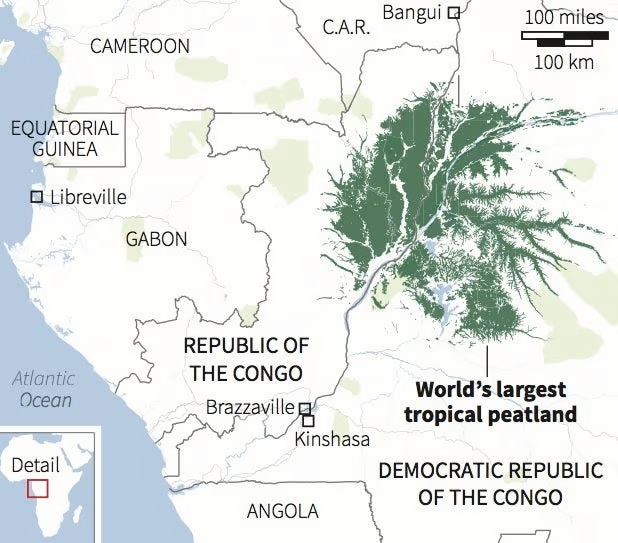
    The Democratic Republic of the Congo (DRC) has launched oil exploration over 124 million hectares of the Cuvette Centrale peatlands raising global ecological risk.

    About the Cuvette Centrale Peatland Complex:

    • Location: Central Congo Basin, spanning the Democratic Republic of the Congo and the Republic of Congo.
    • Size: Covers approximately 145,000–167,600 sq. km—larger than England and about 10% of the Congo Basin.
    • Peat Coverage: Around 40% of the region is underlain by peat—formed over 10,000 years due to flat terrain, rainforest climate, and slow-moving water.
    • Landscape: Features a mosaic of seasonal lakes, floating prairies, swamp forests, rivers, and grasslands.
    • Global Status: The world’s largest near-contiguous tropical peatland complex.

    Ecological Significance:

    • Carbon Storage: Holds about 30–30.6 gigatonnes of carbon—
      • Equal to 3 years of global fossil fuel emissions.
      • Nearly 15 years of U.S. emissions.
      • About 28% of global tropical peat carbon stock.
    • Climate Impact: Acts as a major carbon sink, critical for regulating global temperatures and mitigating climate change.
    • Biodiversity: Habitat for forest elephants, lowland gorillas, and rare plant species.
    • Local Importance: Sustains indigenous livelihoods and maintains regional water cycles.
    • Conservation Status: Recognized as a transnational Ramsar wetland site, highlighting its international ecological value.
    [UPSC 2024] One of the following regions has the world’s largest tropical peatland, which holds about three years’ worth of global carbon emissions from fossil fuels, and the possible destruction of which can exert a detrimental effect on the global climate. Which one of the following denotes that region?

    Options: (a) Amazon Basin (b) Congo Basin* (c) Kikori basin (d) Rio De La Plata Basin


  • Climate Change Negotiations – UNFCCC, COP, Other Conventions and Protocols

    In news: Kyoto Protocol

    Why in the News?

    Vijai Sharma, a 1974-batch IAS officer and architect of India’s climate diplomacy, who helped shape the Kyoto Protocol for safeguarding the interests of developing countries like India, has passed away.

    About Kyoto Protocol:

    • Adopted: 11 December 1997 (UNFCCC COP-3, Kyoto, Japan); Came into Force: 16 February 2005
    • Legal Status: Legally binding on developed (Annex I) countries
    • Parent Treaty: United Nations Framework Convention on Climate Change (1992)
    • Objective: Reduce greenhouse gas emissions and address climate change
    • Principle: Common but Differentiated Responsibilities and Respective Capabilities (CBDR-RC)
    • Parties: 192 ratified; key non-parties include United States and Canada

    Key Features:

    • Emission Targets:
      • Annex B nations to cut emissions by 5% below 1990 levels (2008–2012)
      • Doha Amendment (2012): 18% cut for 2013–2020
    • Greenhouse Gases Covered:
      • Carbon dioxide, Methane, Nitrous oxide, Hydrofluorocarbons, Perfluorocarbons, Sulfur hexafluoride
    • Market Mechanisms:
      • Clean Development Mechanism (CDM): Carbon credits via projects in developing nations
      • Joint Implementation (JI): Emission reduction between Annex I countries
      • International Emissions Trading: Trade surplus emission units
    • Monitoring and Enforcement:
      • Mandatory reporting and independent verification
      • Compliance Committee oversight
      • Land Use, Land-Use Change and Forestry (LULUCF) included; aviation/shipping excluded
    • Equity Element:
      • No binding targets for developing nations like India and China
      • Developed nations held accountable for historical emissions

    Vijai Sharma’s Contributions:

    • Climate Negotiations Leader: India’s chief negotiator (1995–2001), led G77+China, defended equity and exemptions for developing nations
    • Policy Architect: Helped shape CDM governance, promoted India’s clean-tech access
    • Environmental Reformer: As Environment Secretary (2008–2010), improved clearance processes
    • Legacy: Called “Sir Humphrey Sharma” for his sharp wit and bureaucratic skill; key figure in India’s Kyoto-era climate diplomacy
    [UPSC 2016] Consider the following pairs:

    Terms sometimes seen in the news : Their origin

    1. Annex-I Countries : Cartagena Protocol

    2. Certified Emissions Reductions : Nagoya Protocol

    3. Clean Development Mechanisms : Kyoto Protocol

    Which of the pairs given above is/are correctly matched?

    Options: (a) 1 and 2 only (b) 2 and 3 only (c) 3 only* (d) 1, 2 and 3


  • ISRO Missions and Discoveries

    NASA-ISRO Synthetic Aperture Radar (NISAR)

    Why in the News?

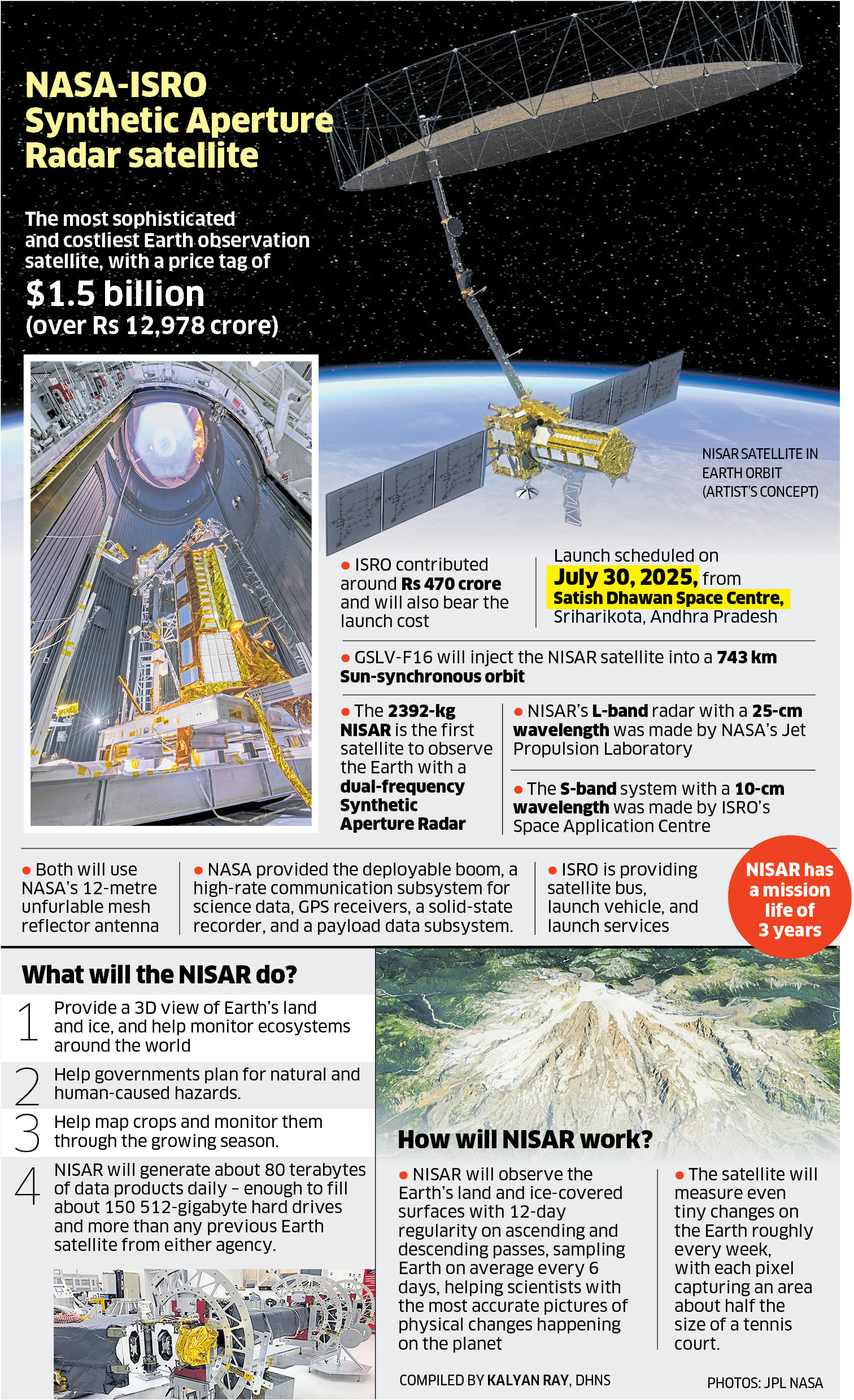
    The NASA-ISRO Synthetic Aperture Radar (NISAR) has been successfully launched from Sriharikota using GSLV Mk-II.

    NASA-ISRO Synthetic Aperture Radar (NISAR)

    About NISAR (NASA–ISRO Synthetic Aperture Radar):

    • Launch Vehicle: GSLV Mk-II | Launch Site: Sriharikota, India
    • Mission Life: 3 years (planned); 5+ years (design)
    • Orbit: Sun-synchronous polar orbit at 747 km with 98.4° inclination
    • Objective: High-precision monitoring of Earth’s surface changes—tectonics, agriculture, ecosystems, ice, floods, and landslides
    • Data Access: Free and near real-time; disaster maps delivered in under 5 hours
    • Hardware Contributions:
      • NASA: L-band SAR, 12m antenna, avionics
      • ISRO: S-band SAR, satellite bus, launch services
    • Development and Collaboration:
      • Initial Concept: 2007 (NASA); ISRO joined in 2012
      • Formal Agreement: 2014
      • Investment: NASA – ~$1.16 billion; ISRO – ~$90 million

    Key Features of NISAR:

    • What is Synthetic Aperture Radar (SAR)?
      • Operates day/night, all-weather
      • Simulates large radar antenna via motion
      • Penetrates clouds, vegetation, and soil
    • Dual-Band SAR:
      • L-band SAR (1.257 GHz):
        • Deeper penetration; ideal for forests, tectonic shifts, permafrost
      • S-band SAR (3.2 GHz):
        • Surface details; supports agriculture, flood mapping, biomass tracking
    • Radar Antenna:
      • 12-meter deployable mesh reflector
      • Resolution: 3–10 m spatial; cm-level vertical
      • Swath Width: 240 km
    • Imaging Frequency:
      • Global land/ice coverage every 12 days
      • Less frequent in polar zones
    • Data Output: Generates 80 TB/day (3x current Earth observatories):
      • Biomass and cropland maps
      • High-resolution flood and infrastructure data

    Applications and Impact:

    • Disaster Relief: Before-and-after imagery for planning
    • Climate Monitoring: Glacier melt, forest degradation
    • Agriculture: Crop health, rotation, food security
    • Infrastructure: Detects land subsidence (dams, cities)
    • Strategic Value:
      • Most powerful Earth-observing radar satellite
      • First with dual SAR payload
      • Strengthens India–US space partnership (Artemis, human spaceflight)
    [UPSC 2010] Question: In the context of space technology, what is Bhuvan, recently in the news ?

    Options: (a) A mini satellite launched by ISRO for promoting the distance education in India (b) The name given to the next Moon Impact Probe, for Chandrayaan-II (c) A geoportal of ISRO with 3D imaging capabilities of India* (d) A space telescope developed by  India


  • Primary and Secondary Education – RTE, Education Policy, SEQI, RMSA, Committee Reports, etc.

    Five years of National Education Policy (2020)

    Why in the News?

    It has been five years since the introduction of the National Education Policy (NEP) 2020 which replaced the 1986 National Policy on Education.

    About the National Education Policy, 2020:

    • Origin: Drafted by a committee chaired by Dr. K. Kasturirangan under the Ministry of Education.
    • 5 Core Pillars: Based on Access, Equity, Quality, Affordability, and Accountability.
    • Vision: Seeks to build a knowledge society by unlocking every learner’s potential.
    • Global Link: Aligned with the UN Sustainable Development Goal (SDG) 4 (Education for All).

    Key Provisions:

    • [A] School Education:
      • Curriculum Structure: Introduces 5+3+3+4 design (Foundational to Secondary), replacing 10+2.
      • ECCE Focus: Early Childhood Care and Education via Jaadui Pitara kits and play-based learning.
      • Vocational Training: Begins from Grade 6 with internships.
      • Basic Literacy & Numeracy: Achieved through National Initiative for Proficiency in Reading with Understanding and Numeracy.
      • Language Medium: Emphasis on mother tongue/regional language up to Grade 5.
      • Assessment Reform: Launch of Performance Assessment, Review and Analysis of Knowledge for Holistic Development (PARAKH) as a national evaluation centre.
    • [B] Higher Education:
      • Four-Year Degree: Multidisciplinary courses with multiple exit points.
      • Credit Bank: Academic Bank of Credit ensures credit mobility across institutions.
      • Research Boost: National Research Foundation supports innovation and research.
      • Single Regulator: Higher Education Commission of India proposed (pending law) to replace multiple bodies.
      • Language Promotion: Establishment of Indian Institute of Translation and Interpretation for Indian languages.

    Implementation Initiatives:

    • Foundational Mission: NIPUN Bharat aims to achieve basic literacy and numeracy by Class 3.
    • Unified Credit System: Rollout of Academic Bank of Credit and National Credit Framework.
    • Common Entrance: Common University Entrance Test introduced for fair UG admissions.
    • Early Prep: Vidya Pravesh – a 3-month play-based module for Grade 1 entrants.
    • Tech Education in Regional Languages: Promoted by the All-India Council for Technical Education.
    • Digital Backbone: National Digital Education Architecture launched to support e-learning.
    • SAFAL Assessments: Structured competency-based testing in Grades 3, 5, and 8 by Central Board of Secondary Education.

    Key Achievements:

    • Curriculum and Textbooks: NCERT released new content for Classes 1–8.
    • ECCE Adoption: Early childhood curriculum implemented in several states.
    • Language Expansion: Regional language instruction expanded at foundational levels.
    • Academic Flexibility: Credit-based transfer systems in use via Academic Bank of Credit and National Credit Framework.
    • Global Presence: Indian Institutes such as Indian Institute of Technology (Zanzibar) and Indian Institute of Management (Dubai) now abroad.
    • International Collaboration: Foreign universities invited to set up campuses under new regulations.
    [UPSC 2016] “SWAYAM’, an initiative of the Government of India, aims at

    Options:

    (a) promoting the Self-Help Groups in rural areas

    (b) providing financial and technical assistance to young start-up entrepreneurs

    (c) promoting the education and health of adolescent girls

    (d) providing affordable and quality education to the citizens for free*