💥UPSC 2026, 2027, 2028 UAP Mentorship (March Batch) + Access XFactor Notes & Microthemes PDF

Archives: News

  • Electoral Reforms In India

    [6th November 2025] The Hindu Op-ed: The malleable Code of Conduct

    PYQ Relevance

    [UPSC 2022] Discuss the role of the Election Commission of India in the light of the evolution of the Model Code of Conduct.

    Linkage: It explores how the Election Commission’s authority evolved through the MCC. It assesses the effectiveness in upholding electoral fairness amid growing political violations.

    Mentor’s Comment

    The Model Code of Conduct (MCC) represents India’s democratic conscience. It is a self-imposed ethical framework ensuring that elections are fought on fairness, not power misuse. Yet, the political ingenuity in bypassing it reflects a deeper erosion of moral restraint in governance. With recent welfare disbursements in Bihar triggering debate, the MCC stands at a crossroads between relevance and redundancy.

    Introduction

    The Model Code of Conduct is an ethical framework evolved through consensus among political parties to ensure level competition during elections. It prevents the misuse of official machinery, state resources, and authority to influence voters. However, repeated violations especially by governments announcing pre-poll cash transfers or populist projects show that while the MCC binds in letter, its spirit is increasingly compromised.

    Why in the News

    The Mukhyamantri Mahila Rojgar Yojana (MMRY) launched in Bihar in August 2025 has reignited the debate over MCC violations. Cash disbursements continued into late October and early November, overlapping with the election schedule. Though legally permissible, the scheme’s timing tilted public perception toward favouring the ruling party, raising serious concerns about the sanctity of the electoral process. The controversy marks another instance where governments use public funds to gain electoral mileage, undermining the spirit of the MCC.

    Genesis and Purpose of the MCC

    1. Origin and Evolution: The MCC was first used during the 1960 Assembly elections in Kerala, and later adopted nationwide by the Election Commission of India (ECI) during the 1962 general elections.
    2. Consensus Document: It was not enacted by Parliament but evolved through agreement among political parties.
    3. Formal Enforcement: The Model Code of Conduct was first issued by the Election Commission of India under the title of ‘Minimum Code of Conduct’ on September 26, 1968 during the Mid-Term Elections 1968-69. The code was further revised in 1979, 1982, 1991 and 2013
    4. Core Purpose: Ensures free, fair, and peaceful elections by preventing misuse of government machinery and undue influence over voters.

    When It Is Applicable and Who Enforces It

    1. Trigger Point: The MCC comes into effect immediately from the date the Election Commission announces the election schedule.
    2. Duration: It remains in force until the declaration of election results.
    3. Enforcing Authority: The Election Commission of India is the sole authority for its enforcement and interpretation.
    4. Withdrawal: The MCC automatically ceases once the results are officially declared by the ECI.

    What Gets Suspended Under the MCC

    1. Policy Announcements: Ministers and authorities cannot announce new projects, financial grants, or inaugurate schemes that may influence voters.
    2. Public Advertisements: No use of government funds for publicity of achievements or campaigns during this period.
    3. Transfers and Appointments: Major administrative transfers or appointments in departments are prohibited unless approved by the EC.
    4. Use of Official Machinery: Government vehicles, buildings, and personnel cannot be used for electioneering.
    5. Foundation Stones or Inaugurations: These are disallowed if they could project partisan benefit.

    What Is Permitted During MCC

    1. Ongoing Projects: Continuing existing schemes and projects (initiated before MCC enforcement) is allowed if there’s no modification or new announcement.
    2. Routine Governance: Day-to-day administration and delivery of essential services can continue.
    3. Emergency Actions: Governments can act during natural disasters or emergencies with EC approval.
    4. Election Campaigning: Political parties are free to campaign, release manifestos, and address voters, provided they follow EC guidelines on ethics and expenditure.

    The Challenge of “Violations in Spirit”

    Despite the clarity of rules, violations persist:

    1. Cash Schemes: Governments frequently announce last-minute transfers to favourable groups.
    2. Symbolic Launches: Old projects are rebranded as new initiatives to gain media traction.
    3. Moral Erosion: Such acts violate the spirit of fairness, reducing elections to a contest of resource deployment rather than ideas.
    4. Quote Insight: As Shakespeare’s Hamlet said, the MCC is often “more honoured in the breach than in the observance.

    Legal Status and Enforcement Issues

    1. Voluntary Nature: The MCC is a moral code, not a legal statute.
    2. Legal Overlap: Specific violations may be prosecuted under the Representation of the People Act, 1951, or Indian Penal Code (IPC).
    3. 2013 Standing Committee View: Recommended making MCC legally binding, but EC preferred flexibility due to the short election window.
    4. Judicial Constraints: Courts find it difficult to act swiftly during elections, leaving real-time violations unchecked.

    Impact on Democratic Integrity

    1. Erosion of Level Playing Field: Pre-poll welfare schemes distort voter perception.
    2. Loss of Trust: Frequent violations weaken public confidence in EC neutrality.
    3. Ethical Degradation: Turning elections into transactional exercises undermines constitutional morality.
    4. Institutional Burden: Constant MCC imposition hampers governance continuity, hence the push for simultaneous elections.

    Way Forward

    1. Legal Backing with Flexibility: Grant partial statutory status to the MCC to enhance enforceability while retaining EC’s discretion for quick decisions during elections.
    2. Swift Adjudication Mechanism: Establish fast-track EC tribunals for resolving MCC violation complaints within days, not weeks.
    3. Transparent Public Disclosure: Mandate real-time publication of EC orders and violations to ensure accountability and deter misconduct.
    4. Institutional Empowerment: Strengthen EC’s independence by insulating it from executive interference in appointments and funding.
    5. Ethical Political Culture: Political parties should adopt internal codes of ethics and conduct public pledges to uphold MCC principles.
    6. Simultaneous Elections Debate: Explore synchronizing elections to reduce frequent MCC enforcement disruptions and policy paralysis.
    7. Civic Awareness: Promote voter education campaigns to build public pressure against MCC violations and ethical breaches.

    Conclusion

    The Model Code of Conduct is not just an election rulebook, it is a mirror reflecting the ethical health of Indian democracy. When leaders manipulate it, they erode not just electoral fairness but the foundational trust between citizen and state. The MCC must therefore be strengthened, through legal clarity, swift EC action, and moral political leadership, so that it remains a living instrument of democracy, not a symbolic ritual.


  • Artificial Intelligence (AI) Breakthrough

    India AI: Governance Guidelines

    Introduction

    Artificial Intelligence has evolved from an assistive tool to an autonomous decision-maker, influencing governance, economy, security, and social life. Recognizing both its potential and perils, the Government of India, through MeitY’s drafting committee (July 2025), released the India AI Governance Guidelines.It is  rooted in the vision of “AI for All”. The framework aims to foster inclusive growth, innovation, and ethical use of AI, ensuring that India’s AI journey is safe, transparent, and globally credible.

    Why in the News

    For the first time, India has articulated a unified, principle-based framework on AI governance, a techno-legal and institutional roadmap aligning AI with constitutional values and national priorities. It promotes voluntary frameworks over strict regulation marking a shift from restraint to responsible innovation.

    What are the Core Principles Guiding India’s AI Governance?

    1. Seven Sutras: Trust, People First, Innovation over Restraint, Fairness & Equity, Accountability, Understandable by Design, Safety, Resilience & Sustainability. These are adapted from the RBI’s FREE-AI Committee report and designed to be sector-neutral and technology-agnostic.
    2. Trust as Foundation: Builds confidence in AI systems by ensuring transparency, safety, and ethical use.
    3. People First: Emphasizes human oversight and empowerment, preventing machine dominance.
    4. Innovation over Restraint: Encourages experimentation with accountability, not prohibition.
    5. Fairness & Equity: Prevents algorithmic discrimination and digital exclusion.

    How Does the Framework Promote AI Development and Infrastructure?

    1. Compute Expansion: Over 38,000 GPUs made available to startups and researchers at subsidized rates.
    2. AIKosh Data Platform: Houses 1,500 datasets and 217 models from 20 sectors, ensuring data accessibility with privacy.
    3. Digital Public Infrastructure (DPI): Combines Aadhaar, UPI, and Bhashini for scalable, low-cost AI deployment.
    4. MSME Enablement: AI-linked loans via SIDBI & Mudra, tax rebates for certified AI adoption, and starter packs for sectors like textiles and logistics.

    How Does India Address Risk and Regulation in AI?

    1. Balanced Regulation: No separate AI law yet existing laws (IT Act, DPDP Act, Copyright Act, etc.) govern AI harms.
    2. Key Risk Areas: Deepfakes, data poisoning, discrimination, loss of control, national security threats.
    3. India-specific Risk Framework: Classifies harms empirically and promotes voluntary, proportionate compliance.
    4. Content Authentication: Suggests watermarking and provenance tools aligned with global C2PA standards.

    How Will Institutions Enforce AI Safety and Accountability?

    1. AI Governance Group (AIGG): Apex inter-ministerial body chaired by the Principal Scientific Adviser, coordinating AI policy across ministries.
    2. Technology & Policy Expert Committee (TPEC): Offers domain expertise on law, data, security, and governance.
    3. AI Safety Institute (AISI): Anchors technical safety, risk research, and international collaborations like the Global Network of AI Safety Institutes.
    4. Accountability Measures:
      • Graded Liability System based on role and risk.
      • Transparency Reports, Grievance Redressal Systems, Peer Monitoring, and Self-certifications for compliance.

    What is India’s Global and Long-term Vision for AI Governance?

    1. Foresight & Diplomacy: Positions India as a voice of the Global South in AI governance debates (G20, UN, OECD).
    2. AI Incident Reporting System: Centralised database tracking AI harms for national security and regulatory learning.
    3. Techno-Legal Architecture: Concepts like DEPA for AI Training embed consent and privacy by design.
    4. Action Plan:
      • Short-term: Build institutions and awareness.
      • Medium-term: Develop standards, risk frameworks, and legal clarity.
      • Long-term: Evolve global leadership and adaptive legal frameworks.

    Conclusion

    India’s AI Governance Guidelines represent a paradigm shift from regulation to enablement, balancing innovation with public trust. By rooting governance in human values, institutional cooperation, and digital infrastructure, India positions itself as a responsible AI power, one that prioritizes inclusivity, transparency, and resilience. The framework sets a precedent for the Global South, reflecting India’s vision of “AI for All, AI for Good”.

    PYQ Relevance

    [UPSC 2023] e-governance, as a critical tool of governance, has ushered in effectiveness, transparency and accountability in governments. What inadequacies hamper the enhancement of these features?

    Linkage: The AI Governance Guidelines integrate e-governance and AI to improve transparency, accountability, and citizen-centricity. This addresses the same governance challenges this question targets.

  • Freedom of Speech – Defamation, Sedition, etc.

    What constitutes Contempt of Court in India

    Introduction

    Recent remarks made against the Chief Justice of India and the Supreme Court have sparked nationwide debate on whether such statements amount to contempt of court. This incident is significant as it goes beyond personal criticism, it questions the authority of India’s top court and raises issues regarding the balance between free speech and judicial independence. The spread of such remarks through social media amplifies their impact, prompting discussions about protecting the dignity of the judiciary while upholding democratic accountability.

    Understanding the Concept of Contempt

    1. Constitutional Reference: The term ‘contempt of court’ appears in Article 19(2) as a valid ground for imposing reasonable restrictions on freedom of speech and expression.
    2. Lack of Procedural Guidelines: The Constitution does not specify how contempt proceedings should be initiated; these are governed by statutory provisions.
    3. Courts of Record: Under Articles 129 and 215, the Supreme Court and High Courts are designated as Courts of Record, implying their judgments serve as precedents and they possess the power to punish for contempt.

    Types of Contempt and Their Legal Basis

    1. Governing Law: The Contempt of Courts Act, 1971 provides the legal framework for contempt proceedings.
    2. Classification: Section 2(a) of the Act divides contempt into civil and criminal.
      • Civil Contempt: Wilful disobedience of any court judgment, decree, direction, or undertaking.
      • Criminal Contempt: Publication or act that:
        • Scandalizes or lowers the authority of any court.
        • Prejudices or interferes with judicial proceedings.
        • Obstructs the administration of justice.

    How Contempt Differs from Mere Disobedience

    1. Broader Implication: Contempt extends beyond disobedience. It encompasses disruption of justice delivery and diminishing public faith in the judiciary.
    2. Objective: Ensures that the judicial process remains uninfluenced and the authority of courts remains intact.
    3. Public Order Impact: Any act that weakens confidence in the justice system indirectly threatens the rule of law.

    Freedom of Criticism vs Judicial Dignity

    1. Legitimate Criticism: The law recognizes that fair criticism of judicial decisions is not contempt.
    2. Boundary of Legality: Criticism crosses into contempt when it transgresses limits of fairness, becomes malicious, or undermines the authority of the court.
    3. Balance Required: Maintaining equilibrium between transparency and respect for institutions is vital to constitutional morality.

    Significance of Recent Controversy

    1. Erosion of Judicial Authority: Remarks against the Chief Justice are not just personal; they symbolically attack the institution itself.
    2. Amplification via Social Media: Online circulation transforms isolated opinions into mass narratives, posing greater risks to judicial credibility.
    3. Trigger for Debate: Highlights the need for clear boundaries between criticism, activism, and contempt, particularly in digital public discourse.

    Conclusion

    Contempt of court serves as a constitutional safeguard for maintaining judicial integrity and authority. However, in a democracy, constructive criticism is vital for institutional reform. The challenge lies in ensuring that such criticism remains responsible, reasoned, and respectful. As public discourse migrates online, India’s legal system must re-examine the contours of contempt to preserve both judicial dignity and freedom of speech, two essential pillars of constitutional morality.

    PYQ Relevance

    [UPSC 2019] Do you think that the Constitution of India does not accept the principle of strict separation of powers rather it is based on the principle of checks and balances? Explain.

    Linkage: This topic is important for both Prelims and Mains. While direct questions can be asked in both, in the mains examination it can be well integrated into various judicial topics. Like in this 2019 question, contempt jurisdiction is part of this checks-and-balances system. Judicial contempt powers are mechanisms for internal checks within the democratic structure.

  • Panchayati Raj Institutions: Issues and Challenges

    Mayor in India

    Why in the News?

    Zohran Mamdani of Indian-origin has been elected as the mayor of New York City.

    Mayor in India:

    • Overview: The Mayor serves as the head of a Municipal Corporation, responsible for urban governance, civic infrastructure, and local service delivery in large cities.
    • Basis: Institutionalised under the 74th Constitutional Amendment Act, 1992, which gave constitutional status to Urban Local Bodies (ULBs) and transferred 18 functional subjects to them.
    • Administrative Framework: Municipal corporations function under state municipal laws, operating under the supervision of state urban development departments.
    • Historical Context: The first municipal corporation was created in Madras (1688), followed by Bombay and Calcutta (1762) under British rule.
    • Evolution of the office: The idea of an elected municipal President was first introduced through Lord Mayo’s Resolution (1870). The present form of local self-government was shaped by Lord Ripon’s Resolution (1882), earning him the title “Father of Local Self-Government in India.”
    • Election and Tenure:
      • Direct Election: Citizens directly elect the Mayor in cities like Bhopal, Indore, and Jaipur.
      • Indirect Election: Elected councillors choose the Mayor in cities like Mumbai, Delhi, and Bengaluru.
      • Tenure: Varies from 1 to 5 years, depending on state-specific legislation.
    • Powers and Functions:
      • Ceremonial Role: Acts as the first citizen of the city, representing it in official and public functions.
      • Presiding Officer: Chairs meetings of the Municipal Corporation and ensures smooth deliberations.
      • Limited Executive Power: Administrative authority lies with the Municipal Commissioner (IAS officer) appointed by the state government.
      • Policy and Representation: Serves as a political leader and civic advocate, voicing urban development concerns.

    How a Mayor in India differ from a Mayor in the U.S.?

    India U.S.
    System Type Parliamentary model under state supervision Executive or presidential city model
    Election Usually indirectly elected by councillors Directly elected by citizens
    Tenure 1–5 years, varies by state Fixed 4-year term, renewable once
    Administrative Power Ceremonial, executive power with Commissioner Full executive control over departments and budget
    Financial Authority Dependent on state approval Autonomous budgetary power (e.g., NYC manages $120+ bn)
    Legislative Role Chairs council meetings Can veto bills and issue executive orders
    Autonomy Subordinate to state Semi-autonomous, independent within city jurisdiction
    Nature of Office Symbolic and representational Powerful executive, city-level head of government


    [UPSC 2024] Consider the following statements:

    1. Powers of the Municipalities are given in Part IX A of the Constitution.

    2. Emergency provisions are given in Part XVIII of the Constitution.

    3. Provisions related to the amendment of the Constitution are given in Part XX of the Constitution.

    Select the answer using the code given below:

    (a) 1 and 2 only (b) 2 and 3 only (c) 1 and 3 only (d) 1, 2 and 3*


  • Indian Navy Updates

    [pib] Indian Navy commissions INS Ikshak

    Why in the News?

    The Indian Navy has commissioned INS Ikshak, the third Survey Vessel (Large) (SVL) and the first to be based at the Southern Naval Command, at Naval Base Kochi.

    About INS Ikshak:

    • Overview: It is the third vessel of the Survey Vessel (Large) [SVL] class and the first to be based at the Southern Naval Command.
    • Series Lineage: Third ship in the SVL series, following INS Sandhayak and INS Nirdeshak, replacing older Sandhayak-class vessels.
    • Builder & Origin: Constructed by Garden Reach Shipbuilders & Engineers (GRSE) Ltd., Kolkata, under Aatmanirbhar Bharat, with over 80% indigenous content sourced from Indian MSMEs.
    • Name Meaning: Means ‘Guide’ in Sanskrit – symbolising its role in charting unexplored waters and strengthening maritime safety in the Indian Ocean Region (IOR).
    • Mission Role: Designed primarily for hydrographic surveys but also configured for Humanitarian Assistance and Disaster Relief (HADR) operations and can serve as a hospital ship during crises.

    Key Features:

    • Dimensions & Displacement: 110 m long, 16 m wide, 3,400-ton displacement, with crew capacity of ~231 personnel.
    • Propulsion & Speed: Powered by twin main engines and twin-shaft configuration; achieves 14 knots cruising speed, 18 knots maximum.
    • Survey Systems: Equipped with multi-beam echo sounder, Autonomous Underwater Vehicle (AUV), Remotely Operated Vehicle (ROV), four Survey Motor Boats (SMBs), and advanced oceanographic sensors for coastal and deep-water mapping.
    • Aviation Facility: Features a helicopter deck, extending its range, reconnaissance, and operational versatility.
    • Dual Role Capability: Convertible for HADR and medical missions, enhancing naval disaster-response capability.
    • Gender-Inclusive Design: India’s first survey vessel with dedicated accommodation for women officers and sailors.
    [UPSC 2016] Which one of the following is the best description of ‘INS Astradharini’, that was in the news recently?
    Options: (a) Amphibious warfare ship
    (b) Nuclear-powered submarine
    (c) Torpedo launch and recovery vessel *
    (d) Nuclear-powered aircraft carrier


  • Gravitational Wave Observations

    Clearest Black Hole Merger signal allows probe of Hawking’s Law

    Why in the News?

    Researchers have detected the clearest gravitational wave signal, GW250114, from merging black holes, confirming Stephen Hawking’s 1971 Black Hole Area Theorem.

    Clearest Black Hole Merger signal allows probe of Hawking’s Law

    About GW250114:

    • Overview: GW250114 is the clearest gravitational wave signal ever detected, observed on January 14, 2025, by LIGO (US), Virgo (Italy), and KAGRA (Japan).
    • What Happened: It came from the collision of two black holes, each about 30 times the Sun’s mass, located 1.3 billion light-years away.
    • Importance: Published in Physical Review Letters (Sept 2025), it gave the strongest proof of Stephen Hawking’s Black Hole Area Theorem (1971) and confirmed Einstein’s General Theory of Relativity.

    Back2Bascis: Black Holes

    • Overview: A black hole is a region in space where gravity is so strong that even light cannot escape.
    • Formation: Created when a massive star collapses after using up its fuel.
    • Types:
    1. Stellar Black Holes – formed from dead stars.
    2. Supermassive Black Holes – at the centre of galaxies.
    3. Intermediate or Primordial – smaller or early-universe types.
    • Properties: Defined by mass, spin, and charge; grow by absorbing matter or merging with other black holes.

    What is a Black Hole Merger?

    • Process: Two black holes orbit each other, come closer, and finally collide to form a bigger black hole.
    • Phases:
    1. Inspiral – they lose energy and move inward.
    2. Merger – they collide, sending out gravitational waves.
    3. Ringdown – the new black hole settles down.
    • Observation: These mergers create powerful ripples in spacetime called gravitational waves, first detected by LIGO in 2015.

    What is the Hawking’s Black Hole Area Theorem (1971)?

    • Idea: The total surface area of black holes never decreases — it can only stay the same or increase.
    • Analogy: Similar to the Second Law of Thermodynamics, where disorder (entropy) always increases.
    • Meaning: When two black holes merge, the new black hole’s surface area is greater than or equal to the combined areas of the originals.
    • Proof: The GW250114 event (2025) confirmed this by showing that the total area increased, just as Hawking predicted.
    [UPSC 2019] Recently, scientists observed the merger of giant ‘blackholes’ billions of light-years away from the Earth. What is the significance of this observation?

    Options: (a) Higgs boson particles’ were detected.

    (b) Gravitational waves’ were detected. *

    (c) Possibility of inter-galactic space travel through ‘wormhole’ was confirmed.

    (d) It enabled the scientists to understand ‘singularity’.


  • Industrial Sector Updates – Industrial Policy, Ease of Doing Business, etc.

    Govt panel working on New SEZ Norms for Exporters to Access Domestic Market

    Why in the News?

    A government panel comprising officials from the Commerce and Industry Ministry, NITI Aayog, and exporters is drafting new Special Economic Zone (SEZ) norms to revive manufacturing and support exporters hit by steep U.S. tariffs in 2025.

    Back2Basics: Special Economic Zones (SEZs) in India

    • Overview: Duty-free enclaves treated as foreign territory for trade, designed to boost exports, investment, and employment.
    • Legal Framework: Governed by the SEZ Act, 2005 and SEZ Rules, 2006 with single-window clearances and liberal FDI norms.
    • Policy Evolution: Introduced in 2000, replacing Export Processing Zones (EPZs) to strengthen export-led industrialization.
    • Objectives: Promote export growth, foreign and domestic investment, and infrastructure creation.
    • Incentives: Include duty-free imports, tax holidays, zero-rated GST, and ECB up to $500 million annually.
    • Scale: As of 2025, India has 276 operational SEZs– notably GIFT City (Gujarat), SEEPZ (Mumbai), and Noida SEZ.
    • Reform Outlook: The Development of Enterprise and Service Hubs (DESH) Bill 2022 aims to evolve SEZs into flexible, multi-use economic hubs linking domestic and global value chains.

    Need for SEZ Norms Revision:

    • U.S. Tariff Impact: Recent U.S. tariff hikes on gems, jewellery, and textiles have reduced price competitiveness of India’s SEZ-based exporters, leading to production losses.
    • Export Decline: SEZ exports dropped to $172 billion (FY25), with domestic sales stagnating at 2%, exposing overdependence on foreign markets.
    • Idle Capacity & Job Losses: Fluctuating export demand left labour and machinery underutilised; reforms aim to let SEZs meet domestic orders during downturns.
    • Global Benchmarking: Indian SEZs lag China and Vietnam in scale, policy stability, and productivity, prompting structural reform for competitiveness.
    • Revenue Balance: The government seeks industry relief while safeguarding tax revenues, given SEZs’ extensive tax exemptions.

    Proposed SEZ Reforms under Review:

    • Reverse Job Work Permission: SEZs may be allowed to accept domestic processing contracts to use idle capacity during off-peak seasons.
    • DTA Sales Flexibility: Partial permission for direct domestic sales, with duty adjustments to protect local manufacturers.
    • Simplified De-notification Rules: Faster conversion of non-performing SEZs into industrial parks or enterprise hubs.
    • Sectoral Support: Gems and jewellery exporters seek moratoriums, longer export obligations, and interest relief.
    • Integration with DESH Bill (2022): Adoption of hybrid zone model for both exports and domestic production under the Development of Enterprise and Service Hubs framework.
    [UPSC 2010] The SEZ Act, 2005 which came into effect in February 2006 has certain objectives. In this context, consider the following:
    1. Development of infrastructure facilities. 2. Promotion of investment from foreign sources. 3. Promotion of exports of services only.
    Which of the above are the objectives of this Act?
    Options: (a) 1 and 2 only* (b) 3 only (c) 2 and 3 only (d) 1,2 and 3

    [UPSC 2016] Recently, India’s first ‘National Investment and Manufacturing Zone’ was proposed to be set up in-
    Options: (a) Andhra Pradesh* (b) Gujarat (c) Maharashtra (d) Uttar Pradesh


  • Wetland Conservation

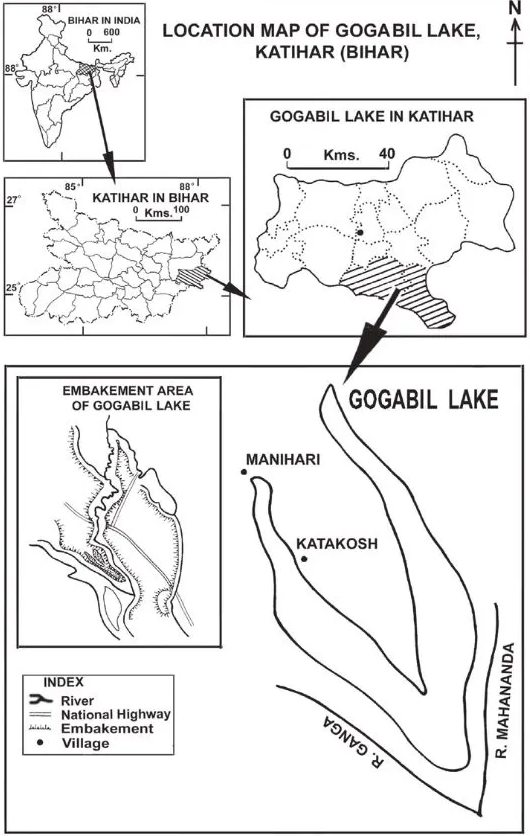
    Bihar’s Gogabeel Lake declared India’s 94th Ramsar Site

    Why in the News?

    Gogabeel Lake, located in Katihar district, Bihar, has been officially designated as India’s 94th Ramsar Site and sixth from Bihar.

    Bihar's Gogabeel Lake declared India's 94th Ramsar Site

    About Gogabeel Lake:

    • Overview: An oxbow lake situated in Katihar district, Bihar, within the Trans-Gangetic Plains, formed between the Ganga and Mahananda rivers.
    • Hydrological Nature: Connects to both rivers during monsoon floods, functioning as a dynamic floodplain wetland.
    • Legal Status: Declared Bihar’s first community reserve, co-managed by local communities and forest authorities.
    • Ecological Significance: Serves as a key habitat for migratory birds and a breeding site for vulnerable species such as the Lesser Adjutant Stork, Black-necked Stork, and Smooth-coated Otter.
    • Biodiversity: Hosts 90+ bird species (including 30 migratory), wetland flora, and fish species like Helicopter Catfish (Wallago attu).
    • Ecosystem Services: Provides flood mitigation, groundwater recharge, carbon storage, and climate regulation, contributing to the Gangetic ecosystem’s stability.
    • Cultural Linkages: Integral to local festivals like Sirva, Adra, and Chhath, symbolising people–nature harmony in rural Bihar.
  • Forest Conservation Efforts – NFP, Western Ghats, etc.

    [5th November 2025] The Hindu Op-ed: India’s forests hold the future

    PYQ Relevance

    [UPSC 2024] Environmental pollution is a major environmental issue in India. Discuss the various mitigation measures to deal with this problem and also the government’s initiatives in this regard.

    Linkage: Even though no direct linking PYQ is found. But here forest restoration and carbon sink creation are key mitigation measures in controlling pollution and ensuring ecosystem resilience.

    Mentor’s Comment

    India’s revised Green India Mission (GIM) signals a decisive shift in the nation’s ecological vision from expanding forest area to restoring ecosystem resilience. The article examines the ambitious plan to restore 25 million hectares by 2030, challenges in afforestation design, and how India can convert green cover into genuine carbon and community assets.

    Introduction

    India stands at the crossroads of economic growth and ecological sustainability. The recent revision of the Green India Mission (GIM) underscores the goal of restoring 25 million hectares of degraded forest and non-forest land by 2030, directly linked to India’s climate pledge of creating a carbon sink of 3.39 billion tonnes of CO₂ equivalent. The central question now is not just how much land India restores, but how well it does so.

    Why in the News

    The release of the revised Green India Mission blueprint (2025) marks a crucial development in India’s environmental policy. For the first time, the emphasis shifts from mere tree planting to ecological restoration and community participation. With India’s forests showing a 12% decline in photosynthetic efficiency (IIT Kharagpur-BITS Pilani, 2025), the focus on quality over quantity becomes imperative. The GIM’s success or failure will significantly impact India’s climate commitments and rural livelihoods dependent on forests.

    Afforestation in India: From Quantity to Quality

    1. New Scientific Evidence: A 2025 IIT Kharagpur study found a 12% decline in photosynthetic efficiency of dense forests due to rising temperatures and soil drying.
    2. Beyond Canopy Cover: The discovery challenges the old assumption that “more trees mean more carbon sinks” and instead emphasizes ecological resilience.
    3. Shift in Mission Focus: Between 2015-2021, ₹575 crore was disbursed for afforestation; forest and tree cover rose from 21.16% to 25.17% by 2023 yet qualitative degradation persists.

    What Are the Core Gaps in India’s Afforestation Strategy?

    1. Community Participation: Despite the Forest Rights Act (2006) empowering local communities, many plantation drives bypass their consent, eroding trust and legitimacy.
    2. Ecological Design: Monoculture plantations of eucalyptus and acacia reduce biodiversity, leaving forests vulnerable to drought and pests.
    3. Financing and Implementation: The Compensatory Afforestation Fund Management and Planning Authority (CAMPA) holds ₹95,000 crore, but fund utilization remains inconsistent. Delhi, for instance, used only 23% of funds between 2019-2024.

    What Are the Emerging Success Stories?

    1. Odisha: Joint Forest Management Committees are now part of revenue-sharing and planning processes.
    2. Chhattisgarh: Forest departments are experimenting with biodiversity-sensitive plantations and promoting village carbon markets.
    3. Himachal Pradesh: Launched biochar programmes to reduce fire risk and generate carbon credits.
    4. Tamil Nadu: Nearly doubled mangrove cover in three years, advancing coastal carbon storage.

    How Can India Finance and Implement Effective Restoration?

    1. Utilizing CAMPA Funds: Efficient allocation and transparent dashboards can ensure accountability.
    2. Innovative Tools: Integration of carbon markets, adaptive management, and public dashboards can align national and state-level efforts.
    3. Technical Training: Expanding institutes like IIFM Bhopal or the upcoming Byrnihat Ecological Institute to train field staff in ecological design.
    4. Public-Community Collaboration: Linking local monitoring with national reporting systems will enhance ground-level legitimacy and data reliability.

    What Lies Ahead for India’s Forest Future?

    1. Smarter Restoration: Focus must shift from planting to ecological engineering using native species and local hydrology.
    2. Inclusive Climate Action: Empowering communities ensures climate justice and sustainable forest governance.
    3. National Movement Approach: Collaboration between civil society, research institutions, and local communities can transform GIM from a government scheme to a people’s mission.

    Conclusion

    India’s forests are more than carbon sinks, they are the nation’s ecological infrastructure. The revised Green India Mission represents a shift from greenwashing metrics to resilient ecosystems. With rigorous monitoring, community inclusion, and scientific restoration, India can make its forests not only a tool for carbon sequestration but a foundation for climate-resilient growth.

  • Electoral Reforms In India

    A nationwide SIR

    Introduction

    India’s Election Commission (ECI) has launched the Special Intensive Revision (SIR 2.0) of electoral rolls to address a persistent issue, duplicate and multiple voter entries across constituencies and states. As the electoral roll forms the foundation of Indian democracy, its accuracy directly determines the legitimacy of elections. The initiative represents a nationwide, paperless, tech-driven approach that seeks to align the voter database with digital verification systems, ensuring that every vote counts once and only once.

    Understanding the SIR and its Objective

    1. Definition: The Special Intensive Revision (SIR), under the Representation of the People (RPA) Act, 1950, aims to ensure the integrity of electoral rolls and prevent duplication and impersonation.
    2. Objective: To update, verify, and purify the voter database by leveraging technology, interlinked databases, and field-level verification.
    3. Legal Basis: Under Section 22 and 23 of the RPA, 1950, corrections, deletions, and transfers of voter entries are authorized to maintain roll accuracy.
    4. Context: This follows recent legal scrutiny and concerns raised after instances of double voting and duplicate EPIC numbers across states.

    Why Duplicate Entries Are a Major Concern

    1. Erosion of Electoral Integrity: Duplicate or multiple entries lead to bogus voting, undermining free and fair elections.
    2. Systemic Weakness: Failures in linking EPIC (Elector Photo Identity Card) data and inter-state coordination have enabled repeated entries.
    3. Case Example: In Prashant Kishor’s case, the same EPIC number was found in two constituencies, revealing system-level flaws.
    4. Administrative Burden: Duplicate entries strain the ECI’s verification apparatus, consuming time, manpower, and digital resources.
    5. Loss of Public Confidence: Recurring discrepancies in electoral lists weaken voter faith in institutional fairness and neutrality.

    How the Electoral Roll is Being Purified

    1. Tech Integration: The Electoral Registration Officers (EROs) use National Voters’ Service Portal (NVSP), AI-driven duplicate detection, and data cross-verification through NIC and CDAC systems.
    2. Field-Level Verification: Enumerators conduct doorstep distribution and validation of forms to identify discrepancies.
    3. Automated Detection: Use of Common Photo Identity Card (EPIC) data and facial/ID match algorithms ensures high accuracy in identifying duplication.
    4. Legal Safeguards: Voters are given an opportunity to rectify records within six months under the law before deletion.
    5. Accountability Mechanism: EROs are held responsible for false deletion or oversight in duplication verification.

    How Technology is Transforming Voter Verification

    1. Digital Synchronization: SIR 2.0 uses centralized databases for unified record-keeping across states.
    2. EPIC-Database Linkage: Integration with Aadhaar and other ID repositories facilitates cross-verification while preventing fraudulent entries.
    3. Machine Learning Models: These identify patterns of duplication and commonalities across datasets.
    4. Paperless Process: Transition from manual to cloud-based verification reduces procedural errors.
    5. Accountability Enhancement: Real-time dashboards enable monitoring of deletions, corrections, and transfers.

    Challenges and Procedural Gaps

    1. Administrative Lapse: Failures stem not from technology but from poor implementation and follow-up by EROs.
    2. Inconsistent Updates: Delay in updating inter-constituency migration data leads to overlapping entries.
    3. Procedural Redundancy: Revisions often become ritualistic exercises without systemic correction mechanisms.
    4. Accountability Deficit: Lack of penal action against negligent officials reduces deterrence.
    5. Digital Divide: Areas with limited connectivity face challenges in real-time digital verification.

    Way Forward

    1. Institutional Accountability: Make EROs answerable for errors through performance audits.
    2. Continuous Roll Updating: Transition from annual revision to dynamic roll management.
    3. Citizen Participation: Introduce crowdsourced error reporting through verified portals.
    4. Data Integration: Extend linkage with Aadhaar, PAN, and DigiLocker for authentication.
    5. Transparency Mechanism: Establish public dashboards for tracking deletion and addition records.
    6. Legal Framework: Consider amending the RPA to provide statutory backing for digital roll management.

    Conclusion

    The Special Intensive Revision (SIR 2.0) symbolizes India’s move towards a digitally verifiable democracy, but its success depends on administrative accountability as much as on technology. Ensuring a clean, accurate, and dynamic electoral roll is not a technical formality, it is a democratic imperative. Only a transparent, error-free voter database can sustain public faith in India’s electoral integrity.

    PYQ Relevance

    [UPSC 2024] Examine the need for electoral reforms as suggested by various committees with particular reference to the “one nation-one election” principle.

    Linkage: It addresses electoral reform as a structural and procedural issue under the Representation of the People Act (RPA, 1950), the same law governing the SIR initiative. It connects with the broader reform drive for efficient, error-free elections.

Join the Community

Join us across Social Media platforms.