💥UPSC 2026, 2027, 2028 UAP Mentorship (March Batch) + Access XFactor Notes & Microthemes PDF

Archives: News

  • NAM at 60 marks an age of Indian alignment

    Context

    The birth anniversary of Jawaharlal Nehru this month and the 60th anniversary of the Non-Aligned Movement prompt reflection on Nehru’s major contribution to the field of international relations.

    Background of NAM

    • In 1946, six days after Nehru formed the national government, he stated, “we propose… to keep away from the power politics of groups aligned against one another… it is for One World that free India will work.”
    •  Nehru was opposed to the conformity required by both sides in the Cold War, and his opposition to alliances was justified by American weapons to Pakistan from 1954 and the creation of western-led military blocs in Asia.
    •  Non-alignment was the least costly policy for promoting India’s diplomatic presence, a sensible approach when India was weak and looked at askance by both blocs, and the best means of securing economic assistance from abroad.
    • India played a lone hand against colonialism and racism until many African states achieved independence after 1960.
    • India played a surprisingly prominent role as facilitator at the 1954 Geneva Peace Conference on Indochina, whereafter non-alignment appeared to have come of age.
    •  Indian equidistance to both Koreas and both Vietnams was shown by India recognising neither; yet it recognised one party in the two Chinas and two Germanies.
    • The Treaty of peace, friendship and cooperation between India and the Union of Soviet Socialist Republics of 1971, fashioned with the liberation war of Bangladesh in view, come dangerously close to a military alliance.

    Failures of NAM

    • Only two members of Summit Conference of the Non-Aligned Movement, Cyprus and Ethiopia, supported India in the war with China.
    • Among the Non-Aligned Movement’s members was a plenitude of varying alignments, a weakness aggravated by not internalising their own precepts of human rights and peaceful settlement of disputes on the grounds of not violating the sacred principle of sovereign domestic jurisdiction.
    • Other failures were lack of collective action and collective self-reliance, and the non-establishment of an equitable international economic or information order.
    • The Movement could not dent, let alone break, the prevailing world order.

    Conclusion

    In essence, Indian non-alignment’s ideological moorings began, lived and died along with Nehru’s idealism, though some features that characterised his foreign policy were retained to sustain diplomatic flexibility and promote India while its economic situation improved sufficiently to be described as an ‘emerging’ power.

    UPSC 2022 countdown has begun! Get your personal guidance plan now! (Click here)

  • Minority Issues – SC, ST, Dalits, OBC, Reservations, etc.

    Dalit capitalism and Dalit entrepreneurship

    Context

    In a departure from the fixation on traditional parameters for the study of Dalit rights and empowerment, there is now a focus on how market forces can be expanded to address social exclusion.

    How Dalit entrepreneurship can help in Dalit entrepreneurship

    • While entrepreneurship alone isn’t the panacea to caste-based exclusion or marginalisation, Dalit entrepreneurship is the new narrative changing the discourse of Dalit empowerment.
    • Entrepreneurship can shape access to rights and push against entrenched social hierarchies.
    • The circulation of material benefits and the relative autonomy that comes with entrepreneurship are added advantages.
    • As per the reports by the MSME ministry, Dalit-owned ventures are still minimal in terms of numbers as well as revenue.
    • To overcome hindrances to the establishment of networks across various social groups, Dalit entrepreneurs take recourse to their internal ties and use them to sustain their economic gains.
    • It is increasingly becoming clear that supporting Dalits entrepreneurs is integral to the nation’s inclusive development and this is why institutional aid is required in this regard.

    Steps taken so far

    • The District Industries Centre (DIC) stipulates that to nurture entrepreneurs, the government must increase the share of goods produced by Dalits in its procurement.
    • State financial corporations have also been instructed to increase financial support to Scheduled Caste entrepreneurs.
    • The Andhra Pradesh Industrial Infrastructure Corporation has allocated 16.2 per cent of plots to SC entrepreneurs, while the Small Industries Development Bank of India offers an additional subsidy to them.
    • One of the focussed financial interventions for SC/ST entrepreneurs is the Stand Up India initiative, guaranteeing credit up to Rs 1 crore.

    Challenges

    • Stand Up India initiative failed to deliver the expected results due to the unavailability of so-called eligible SC/ST entrepreneurship, with most of the fund lying unutilised.
    • This was primarily due to the apathy of loaning branches and officials towards proposals by Dalit entrepreneurs.
    • It is evident that despite the existence of government schemes and policies to support such initiatives, the actual benefit could never reach the beneficiaries due to the artificial inaccessibility created by inherent social and caste biases.

    Way forward

    • There is a need for Dalit-focussed alternate investment finance (AIF) and private equity (PE) funds to create a vibrant and inclusive MSME ecosystem.
    • It is evident that despite the existence of government schemes and policies to support such initiatives, the actual benefit could never reach the beneficiaries due to the artificial inaccessibility created by inherent social and caste biases.
    • There is a need to formulate multiple credit guarantee trusts by raising contributions from MNCs, FDIs, portfolio investors, corporates, etc.
    • A social vulnerability index also needs to be introduced, addressed and assessed.

    Conclusion

    Dalit entrepreneurship today holds the promise of an exciting and uncharted future for social transformation.

    UPSC 2022 countdown has begun! Get your personal guidance plan now! (Click here)

  • Air Pollution

    Graded Response Action Plan (GRAP)


    States in the National Capital Region were directed to be ready to implement actions under the ‘emergency’ category of the Graded Response Action Plan (GRAP) to control air pollution, said an official order.

    Graded Response Action Plan (GRAP)

    • In 2014, when a study by the WHO found that Delhi was the most polluted city in the world, panic spread in the Centre and the state government.
    • Approved by the Supreme Court in 2016, the plan was formulated after several meetings that the Environment Pollution (Prevention and Control) Authority (EPCA) held with state government and experts.
    • The result was a plan that institutionalized measures to be taken when air quality deteriorates.
    • GRAP works only as an emergency measure.

    How does it work?

    • As such, the plan does not include action by various state governments to be taken throughout the year to tackle industrial, vehicular and combustion emissions.
    • When the air quality shifts from poor to very poor, the measures listed under both sections have to be followed since the plan is incremental in nature.
    • If air quality reaches the severe+ stage, GRAP talks about shutting down schools and implementing the odd-even road-space rationing scheme.

    Measures taken under GRAP

    1) Severe+ or Emergency

    (PM 2.5 over 300 µg/cubic metre or PM10 over 500 µg/cu. m. for 48+ hours)

    • Stop entry of trucks into Delhi (except essential commodities)
    • Stop construction work
    • Introduce odd/even scheme for private vehicles and minimise exemptions
    • Task Force to decide any additional steps including shutting of schools

    2) Severe

    (PM 2.5 over 250 µg/cu. m. or PM10 over 430 µg/cu. m.)

    • Close brick kilns, hot mix plants, stone crushers
    • Maximise power generation from natural gas to reduce generation from coal
    • Encourage public transport, with differential rates
    • More frequent mechanized cleaning of road and sprinkling of water

    3) Very Poor

    (PM2.5 121-250 µg/cu. m. or PM10 351-430 µg/cu. m.)

    • Stop use of diesel generator sets
    • Enhance parking fee by 3-4 times
    • Increase bus and Metro services
    • Apartment owners to discourage burning fires in winter by providing electric heaters during winter
    • Advisories to people with respiratory and cardiac conditions to restrict outdoor movement

    4) Moderate to poor

    (PM2.5 61-120 µg/cu. m. or PM10 101-350 µg/cu. m.)

    • Heavy fines for garbage burning
    • Close/enforce pollution control regulations in brick kilns and industries
    • Mechanized sweeping on roads with heavy traffic and water sprinkling
    • Strictly enforce a ban on firecrackers

    Has GRAP helped?

    • The biggest success of GRAP has been in fixing accountability and deadlines.
    • For each action to be taken under a particular air quality category, executing agencies are clearly marked.
    • In a territory like Delhi, where a multiplicity of authorities has been a long-standing impediment to effective governance, this step made a crucial difference.


    UPSC 2022 countdown has begun! Get your personal guidance plan now! (Click here)
  • Primary and Secondary Education – RTE, Education Policy, SEQI, RMSA, Committee Reports, etc.

    First National Achievement Survey (NAS) held

    The first National Achievement Survey (NAS) in four years was conducted, in a bid to assess the competencies of children in Class 3, 5 and 8.

    National Achievement Survey (NAS)

    • NAS is a nationally representative large-scale survey of students’ learning undertaken by the Ministry of Education.
    • It is implemented on a sample size aiming to assess students of 3rd, 5th, 8th and 10th
    • It gives a system level reflection on effectiveness of school education.
    • The NCERT has developed the Assessment Framework for gauging the competencies attained by the student’s vis-a-vis learning outcomes.

    Features of the Survey

    • The Survey goes beyond the scorecard and includes the background variables to correlate student’s performance in different learning outcomes vis-a-vis contextual variables.
    • The Survey was conducted in a monitored environment in the sampled schools.
    • Selection of sampled schools was based on UDISE+ (Unified District Information System for Education) 2019-20 data.

    Significance of NAS

    • NAS findings would help diagnose learning gaps of students and determine interventions required in education policies, teaching practices and learning.
    • Through its diagnostic report cards, NAS findings help in capacity building for teachers, officials involved in the delivery of education.
    • This will help to assess the learning interruptions and new learnings during the COVID pandemic and help to take remedial measures.


    UPSC 2022 countdown has begun! Get your personal guidance plan now! (Click here)

  • Modern Indian History-Events and Personalities

    Mosques to honour 1921 Malabar Rebellion martyrs

    Granite plaquettes featuring the names of Variamkunnathu Kunjahamad Haji, Ali Musliyar, and other martyrs of the 1921 Malabar Rebellion will be put up at the precincts of a few mosques in Ernakulam.

    Malabar Rebellion

    • The Malabar Rebellion in 1921 started as resistance against the British colonial rule and the feudal system in southern Malabar but ended in communal violence between Hindus and Muslims.
    • There were a series of clashes between Mappila peasantry and their landlords, supported by the British, throughout the 19th and early 20th centuries.
    • It began as a reaction against a heavy-handed crackdown on the Khilafat Movement, a campaign in defence of the Ottoman Caliphate by the British authorities in the Eranad and Valluvanad taluks of Malabar.
    • The Mappilas attacked and took control of police stations, British government offices, courts and government treasuries.

    Who was Variyankunna Kunjahammed Haji?

    • He was one of the leaders of the Malabar Rebellion of 1921.
    • He raised 75000 natives, seized control of large territory from the British rule and set up a parallel government.
    • In January 1922, under the guise of a treaty, the British betrayed Haji through his close friend Unyan Musaliyar, arresting him from his hideout and producing him before a British judge.
    • He was sentenced to death along with his compatriots.


    UPSC 2022 countdown has begun! Get your personal guidance plan now! (Click here)

  • Terrorism and Challenges Related To It

    UAPA enacts process as punishment

    Context

    Application of the UAPA in certain cases has caused concerns regarding its alleged “misuse”, and the rational answer would be to find ways to check “misuse”.

    Issues with UAPA

    • The police often use Section 13 in conjunction with other sections of the law.
    • Vague and undefined terms: Besides the usual inventory of well-defined verbs in S.13(1), such as “commits”, “advocates”, “abets”, “advises”, “incites” or “takes part”, there is S.13(2) which reads: “Whoever, in any way, assists any unlawful activity of any association declared unlawful… shall be punished.”
    • What does “in any way” mean? S.2(o), which defines “unlawful activity” does so in even more vague terms, as anything done by a person, whether as an act, or words, verbally, through signs or otherwise.
    • What does “otherwise” mean? Likewise, S.39 criminalises support to a terrorist organisation, where “support” is not even defined!
    • Wide and arbitrary powers: The semantic slippages are politically convenient as the UAPA vests extremely wide and arbitrary powers in the government to label something an “unlawful activity”.
    •  The political “use” of UAPA is scripted into the law itself, and the question of “misuse” does not arise.
    • Application of UAPA triggers a host of draconian procedures effectively barring bail, reversing burden of proof.

    Conclusion

    The conviction rate of 2.2 per cent testifies to how the UAPA enacts the process as punishment. It is time for political parties to eschew their blinkered approach and make an effort to repeal this unlawful law.

    UPSC 2022 countdown has begun! Get your personal guidance plan now! (Click here)

  • Urban Floods

    Recurring urban floods point to need for moving away from land-centric urbanism

    Context

    Flood in Chennai has revived memories of the devastating Chennai floods of 2015, a collective trauma that its residents are yet to outlive.

    Role of climate change

    • In August this year, as monsoon floods raged across the subcontinent, IPCC’s 6th Assessment Report (AR6) was published.
    • The report noted the increasing frequency of heavy precipitation events since the 1950s and inferred that they were being driven by human-induced climate change.
    • The climate crisis, is here.
    • It has made extreme rainfall events more severe and unpredictable than ever before.

    Role of poor planning and encroachment

    • In 2015, the National Green Tribunal in India formed a committee to report on the status of natural stormwater drains in Delhi.
    • On inspection, out of the 201 “drains” recorded in 1976, 44 were found to be “missing.
    • Geospatial imaging established that 376 km of natural storm drains — encroached on and paved over — had disappeared from Bengaluru.
    • In both cases, these “missing” waterways were either encroached and built over or connected to sewage drains.
    • Poor design and corruption significantly contribute to urban floods.
    • By violating environmental laws and municipal bye-laws, open spaces, wetlands and floodplains have been mercilessly built over, making cities impermeable and hostile to rainwater.

    Way forward

    • We need to move away from land-centric urbanisation and recognise cities as waterscapes.
    • We need to let urban rivers breathe by returning them to their floodplains.
    • The entire urban watershed needs to heal, and for that to happen, we need less concrete and more democracy and science at the grassroots.

    Conclusion

    Ever since concretisation became shorthand for urbanisation, rainfall in a changing climate no longer finds its way towards subterranean capillaries or surface water bodies.

    UPSC 2022 countdown has begun! Get your personal guidance plan now! (Click here)

  • Parliament – Sessions, Procedures, Motions, Committees etc

    What is Privilege Motion?

    A chief whip of the largest party in opposition in the Rajya Sabha has moved a privilege motion against Culture Minister over the appointment of the chairperson of the National Monuments Authority.

    What is Parliamentary Privilege?

    • Parliamentary privilege refers to the right and immunity enjoyed by legislatures.
    • The legislators are granted protection against civil or criminal liability for actions done or statements made in the course of their legislative duties.
    • They are granted so that the MPs/MLAs can effectively discharge their functions.
    • The powers, privileges and immunities of either House of the Indian Parliament and of its members and committees are laid down in Article 105 of the Constitution.
    • Article 194 deals with the powers, privileges and immunities of the State Legislatures, their members and their committees.

    What is a privilege motion?

    • When any of the rights and immunities are disregarded, the offence is called a breach of privilege and is punishable under law of Parliament.
    • A notice is moved in the form of a motion by any member of either House against those being held guilty of breach of privilege.
    • Each House also claims the right to punish as contempt actions which, while not breach of any specific privilege, are offences against its authority and dignity.

    What are the rules governing privilege?

    • Rule No 222 in Chapter 20 of the Lok Sabha Rule Book and correspondingly Rule 187 in Chapter 16 of the Rajya Sabha rulebook govern privilege.
    • It says that a member may, with the consent of the Speaker or the Chairperson, raise a question involving a breach of privilege either of a member or of the House or of a committee thereof.
    • The rules however mandate that any notice should be relating to an incident of recent occurrence and should need the intervention of the House.
    • Notices have to be given before 10 am to the Speaker or the Chairperson.

    What is the role of the Speaker/Rajya Sabha Chair?

    • The Speaker/RS chairperson is the first level of scrutiny of a privilege motion.
    • The Speaker/Chair can decide on the privilege motion himself or herself or refer it to the privileges committee of Parliament.
    • If the Speaker/Chair gives consent under Rule 222, the member concerned is given an opportunity to make a short statement.

    What is the privileges committee?

    • In the Lok Sabha, the Speaker nominates a committee of privileges consisting of 15 members as per respective party strengths.
    • A report is then presented to the House for its consideration. The Speaker may permit a half-hour debate while considering the report.
    • The Speaker may then pass final orders or direct that the report be tabled before the House.
    • A resolution may then be moved relating to the breach of privilege that has to be unanimously passed.
    • In the Rajya Sabha, the deputy chairperson heads the committee of privileges, which consists of 10 members.

    Answer this PYQ in the comment box:

    Q.With reference to the Parliament of India, which of the following Parliamentary Committees scrutinizes and reports to the House whether the powers to make regulations, rules, sub-rules, by-laws etc. conferred by the constitution of delegated by the Parliament are being properly exercised by the Executive within the scope of such delegation?

    (a) Committee on Government Assurances

    (b) Committee on Subordinate Legislation

    (c) Rules Committee

    (d) Business Advisory Committee


    Post your answers here.


    UPSC 2022 countdown has begun! Get your personal guidance plan now! (Click here)

  • Mumbai-Karnataka Region renamed as Kittur Karnataka

    Karnataka has renamed the Mumbai-Karnataka region, consisting of seven districts, as Kittur Karnataka.

    What is the Mumbai-Karnataka Region?

    • The erstwhile Mumbai-Karnataka region consisted of Uttara Kannada, Belagavi, Dharwad, Vijayapura, Bagalkote, Gadag and Haveri districts.

    Reasons behind renaming

    • The Karnataka government has meant to dissociate itself from any ties with the erstwhile Presidency or colonial-era nomenclature in regions that came under the newly formed state of Karnataka in 1956.
    • The renaming is also to detach itself from any ties with Maharashtra.

    Claims made by Maharashtra

    • Maharashtra has staked claim to an area of over 7,000 sq. km along its border with Karnataka.
    • It comprised 814 villages in the districts of Belagavi, Uttara Kannada, Bidar and Gulbarga, and the towns of Belagavi, Karwar and Nippani.
    • Maharashtra wants to annex all these areas.
    • The erstwhile Bombay Presidency, a multilingual province, included present-day Karnataka districts of Vijayapura, Belagavi, Dharwad and Uttara Kannada.
    • The States Reorganisation Act of 1956 made Belagavi and 10 talukas of Bombay State a part of the then Mysore State (which was renamed Karnataka in 1973).

    A case pending in the Supreme Court

    • Successive governments in Maharashtra have demanded their inclusion within the state– a claim that Karnataka contests.
    • In 2004, the Maharashtra government moved the Supreme Court for a settlement of the border dispute under Article 131(b) of the Constitution.
    • It demanded 814 villages from Karnataka on the basis of the theory of village being the unit of calculation, contiguity and enumerating linguistic population in each village.
    • The case is pending in the apex court.


    UPSC 2022 countdown has begun! Get your personal guidance plan now! (Click here)

  • Roads, Highways, Cargo, Air-Cargo and Logistics infrastructure – Bharatmala, LEEP, SetuBharatam, etc.

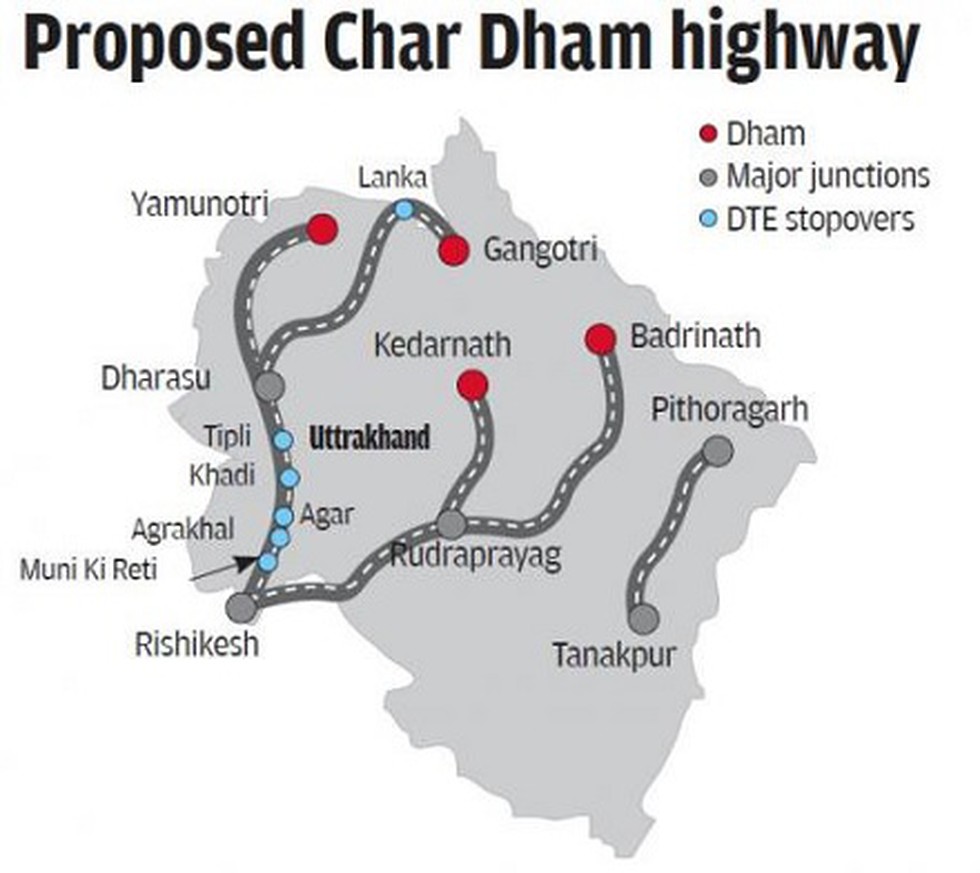
    Char Dham Road Project

    The needs of defence and environment have to be balanced and a “nuanced” approach is required, said the Supreme Court while hearing an appeal against the widening of roads in Uttarakhand hills for the “Char Dham project”.

    What is Char Dham?
    • The Char Dham is a set of four pilgrimage sites in India.
    • It is believed that visiting these sites helps achieve moksha (salvation).
    • The four Dhams are, Badrinath, Dwaraka, Puri and Rameswaram.

    The highway project

    • The Char Dham highway project connects the four himalayan shrines of Gangotri, Yamunotri, Kedarnath and Badrinath in Garhwal Himalayas.
    • It has 899-km road which the Centre wants to broaden near Dehradun.

    What is the controversy?

    The Supreme Court formed a high-powered committee (HPC) to examine the issues. In July 2020, the HPC submitted two reports after members disagreed on the ideal width for hill roads.

    • Deforestation: In 2018, the road-expansion project was challenged by an NGO for its potential impact on the Himalayan ecology due to felling trees, cutting hills and dumping muck (excavated material).
    • Terrain damage: It was observed that a wider road requires additional slope cutting, blasting, tunnelling, dumping and deforestation.
    • Increasing vulnerability: All of this will further destabilise the Himalayan terrain, and increase vulnerability to landslides and flash floods.

    Criticism of the Project

    • Work without clearance: Project work and felling of trees on different stretches, adding up to over 250 km, has been continuing illegally since 2017-18.
    • Misusing old clearance: Work started on stretches adding up to over 200 km on the basis of old forest clearances issued to the Border Roads Organisation during 2002-2012.
    • False declaration: The work began by falsely declaring that these stretches did not fall in the Eco Sensitive Zones of Kedarnath Wildlife Sanctuary, Rajaji National Park, Valley of Flowers National Park etc.

    The defence angle

    • Even as the project grappled to come clean, it garnered support from the MoD seeking a double-lane road to meet the requirement of the Army.
    • The project always had a strategic angle to it as the highways would facilitate troop movement to areas closer to the China border.
    • Suddenly, this became the sole justification for building wider roads.


    UPSC 2022 countdown has begun! Get your personal guidance plan now! (Click here)

Join the Community

Join us across Social Media platforms.