💥UPSC 2027,2028 Mentorship (April Batch) + Access XFactor Notes & Microthemes PDF

Archives: News

  • Electric and Hybrid Cars – FAME, National Electric Mobility Mission, etc.

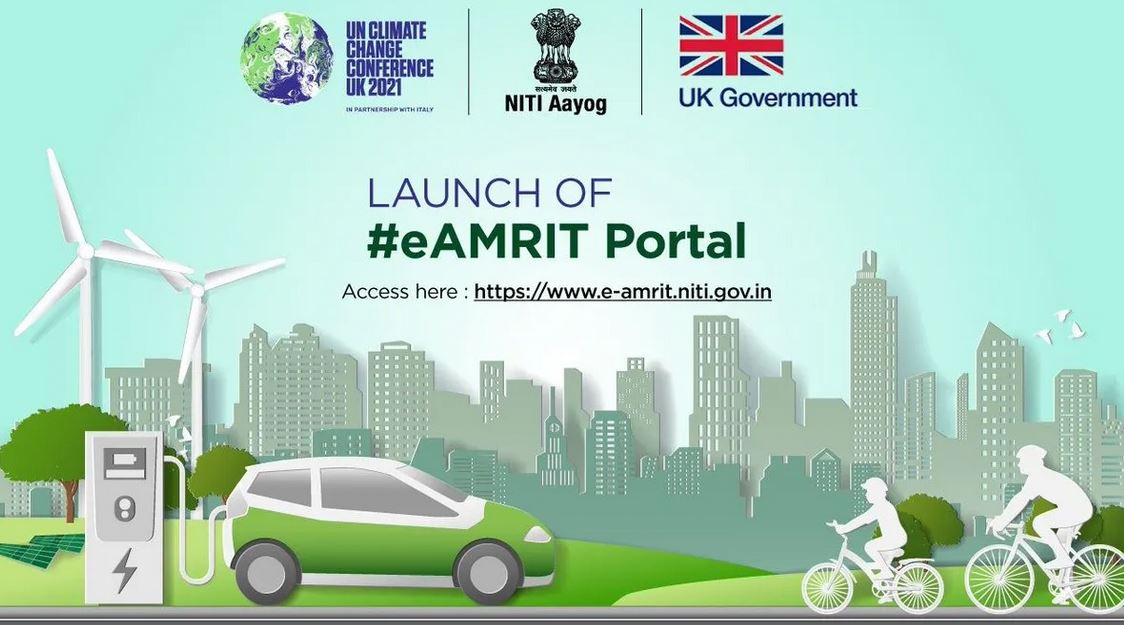
    [pib] E-Amrit Portal for E-Vehicles

    India today launched ‘E-Amrit’, a web portal on electric vehicles (EVs), at the ongoing COP26 Summit in Glasgow, UK.

    It is a must-go portal for every aspirant. Click here to visit E-Amrit.

    E-Amrit Portal

    • E-Amrit is a one-stop destination for all information on electric vehicles—busting myths around the adoption of EVs, their purchase, investment opportunities, policies, subsidies, etc.
    • The portal has been developed and hosted by NITI Aayog under a collaborative knowledge exchange programme with the UK government.

    Features of the portal

    • It intends to complement initiatives of the government on raising awareness about EVs.
    • It aims to sensitize consumers on the benefits of switching to electric vehicles.

    Need for E-Amrit

    • In the recent past, India has taken many initiatives to accelerate the decarbonization of transport and adoption of electric mobility in the country.
    • Schemes such as FAME and PLI are especially important in creating an ecosystem for the early adoption of EVs.


    UPSC 2022 countdown has begun! Get your personal guidance plan now! (Click here)

  • RBI Notifications

    [pib] Reserve Bank – Integrated Ombudsman Scheme

    The PM will launch two innovative customer-centric initiatives of the Reserve Bank of India.

    What are the schemes?

    [A] Integrated Ombudsman Scheme

    • It aims to further improve the grievance redress mechanism for resolving customer complaints against entities regulated by RBI.
    • The central theme of the scheme is based on ‘One Nation-One Ombudsman’ with one portal, one email and one address for the customers to lodge their complaints.
    • There will be a single point of reference for customers to file their complaints, submit the documents, track status and provide feedback.
    • A multi-lingual toll-free number will provide all relevant information on grievance redress and assistance for filing complaints.

    [B] RBI Retail Direct Scheme

    • It is aimed at enhancing access to government securities market for retail investors.
    • It offers them a new avenue for directly investing in securities issued by the Government of India and the State Governments.
    • Investors will be able to easily open and maintain their government securities account online with the RBI, free of cost.


    UPSC 2022 countdown has begun! Get your personal guidance plan now! (Click here)

  • Wildlife Conservation Efforts

    India’s first Fishing Cat Collaring Project

    The Wildlife Institute of India (WII-Dehradun) Conservation Biologists will begin collaring ten Fishing Cats (Prionailurus viverrinus) in the Coringa Wildlife Sanctuary (CWS) in Andhra Pradesh.

    About Fishing Cats

    • About twice the size of a typical house cat, the fishing cat is a feline with a powerful build and stocky legs.
    • It is an adept swimmer and enters water frequently to prey on fish as its name suggests.
    • It is known to even dive to catch fish.
    • It is nocturnal and apart from fish also preys on frogs, crustaceans, snakes, birds, and scavenges on carcasses of larger animals.
    • It is capable of breeding all year round but in India its peak breeding season is known to be between March and May.

    Conservation status

    • IUCN Red List: Endangered
    • CITES: Appendix II
    • Indian Wildlife (Protection) Act, 1972: Schedule I

    Various threats

    • One of the major threats facing the fishing cat is the destruction of wetlands, which is its preferred habitat.
    • As a result of human settlement, drainage for agriculture, pollution, and wood-cutting most of the wetlands in India are under threat of destruction.
    • Another threat to the fishing cat is the depletion of its main prey-fish due to unsustainable fishing practices.
    • It is also occasionally poached for its skin.


    UPSC 2022 countdown has begun! Get your personal guidance plan now! (Click here)

  • Minority Issues – SC, ST, Dalits, OBC, Reservations, etc.

    There are shades of equality

    Context

    On October 29, the Supreme Court issued notice on an appeal of the Kerala government against a High Court order directing it to award the scholarships by the proportion of minorities in the overall population of the State. This case will be significant for constitutional law.

    Background

    • The Kerala government passed an executive order in 2015 prescribing that minority communities will be entitled to scholarships.
    •  Of the scholarships, 80% were distributed to Muslim students.
    •  In Justine Pallivathukkal v. State of Kerala (2021), the Kerala High Court set aside this order holding that all minorities must be treated alike. 
    • The government argued that its policy was based on the findings of the Sachar Committee report and the Kerala Padana report on the disadvantages faced by Muslims.
    •  It pointed out that Muslims were far behind Christians, Dalits and Adivasis in college enrolment, just as they are in employment and land ownership.

    Justification

    • The different kinds of backwardness of a community must be considered while awarding scholarship schemes.
    • Any other scheme defeats the purpose of offering scholarships to students from minority communities.
    • The High Court prohibited an allocation sensitive to social realities by adopting a form of blind equality approach.
    • It is important, therefore, that the Supreme Court corrects the error of the High Court.
    • The High Court’s reasoning suggests that access to the benefits of affirmative action must follow an approach which is blind to the relative backwardness of different communities.

    Conclusion

    Even when we identify disadvantaged castes or communities, we need to remember the forms of inequality and hierarchy among them. The logic of the High Court’s judgment forbids this.

    UPSC 2022 countdown has begun! Get your personal guidance plan now! (Click here)

  • Climate Change Negotiations – UNFCCC, COP, Other Conventions and Protocols

    Net-zero presents many opportunities for India — and challenges

    Context

    India joined the other G20 countries in making a “net-zero” commitment, setting 2070 as its target year.

    Why was it important to sign up for net-zero?

    • India’s topography — its 7,000 km-long coastline, the Himalayan glaciers in the north, and its rich forest areas which house natural resources like coal and iron ore — make the country uniquely vulnerable to climate change.
    • An IMF study suggests that if emissions continue to rise this century, India’s real GDP per capita could fall by 10 per cent by 2100.
    • India’s traditional position has been that since its per capita energy use is only a third of the global average, and it needs to continue to grow to fight poverty, costly energy reduction targets should not be applied to it.

    Opportunities presented by India’s net-zero approach

    •  It could give a clear signal of India’s intentions and provide better access to international technology, funding and markets.
    • We estimate that 60 per cent of India’s capital stock — factories and buildings that will exist in 2040 — is yet to be built.
    • The country can potentially leapfrog into new green technology, rather than being overburdened with “re-fitting” obligations.
    • If India can now transition to green growth, it could create a more responsible and sustainable economy.
    • If India’s exports achieve a “green stamp”, they may find better market access, especially if the world imposes a carbon tax on exports.
    • Around 2-2.5 million additional jobs can be created in the renewables sector by 2050, taking the total number of people employed there to over 3 million.

    Challenges

    • The finances of power distribution companies need to be improved to fund the grid upgrades necessary for scaling up renewables.
    • India needs a coordinated institutional framework that can help overcome multiple levels of complexity like federalism, fiscal constraints and bureaucracy.
    • The energy investment requirement will be high, rising from about $70-80 billion per year now to $160 billion per year.
    •  While the private sector will be required to fund much of this, the government can play a pivotal role, especially in the early days.
    • The transition years will be bumpy.
    • Inflation could be volatile till renewables reached their full potential.

    Conclusion

    India is on the right track but needs to redouble its efforts to remove the obstacles.

    UPSC 2022 countdown has begun! Get your personal guidance plan now! (Click here)

  • Mother and Child Health – Immunization Program, BPBB, PMJSY, PMMSY, etc.

    Project Sampoorna: A successful measure against malnutrition

    Project Sampoorna’s success in reducing child malnutrition is a model that can be easily implemented anywhere.

    What is Project Sampoorna?

    • Project Sampoorna has been implemented in the Bongaigaon district of Assam.
    • It aims to target Severe Acute Malnutrition (SAM) and Moderate Acute Malnutrition (MAM).
    • It was launched to target the mothers of SAM/ MAM children with the tagline being ‘Empowered Mothers, Healthy Children’.
    • It was based on the success of the community-based COVID-19 management model (Project Mili Juli).

    Key features of the project

    • Under this project, the mother of a healthy child of an Anganwadi Centre was paired with the target mother and they would be Buddy Mothers.
    • They were usually neighbours and shared similar socioeconomic backgrounds.
    • They were given diet charts to indicate the daily food intake of their children and would have discussions on all Tuesdays at the Anganwadi centres.
    • 100 millilitres of milk and an egg on alternate days for the children for the first 3 months were provided so that their mothers could stabilise themselves in the newly found jobs.
    • Children who had not improved were checked and treated by doctors under the Rashtriya Bal Swasthya Karyakram (RBSK).

    Success of the project

    • This project has prevented at least 1,200 children from becoming malnourished over the last year.
    • National Nutrition Mission and the State government recognised this project in the ‘Innovation Category’.
    • The mothers were enrolled in Self Help Groups (SHGs) under the National Rural Livelihoods Mission (NRLM) and were thus working.


    UPSC 2022 countdown has begun! Get your personal guidance plan now! (Click here)

  • Pharma Sector – Drug Pricing, NPPA, FDC, Generics, etc.

    Global Drug Policy Index inaugurated

    The first-ever Global Drug Policy Index was recently inaugurated.

    Global Drug Policy Index

    • It is released by the Harm Reduction Consortium, ranks Norway, New Zealand, Portugal, the UK and Australia as the five leading countries on humane and health-driven drug policies.
    • It is a data-driven global analysis of drug policies and their implementation.
    • It is composed of 75 indicators running across five broad dimensions of drug policy:
    1. Criminal justice
    2. Extreme responses
    3. Health and harm reduction
    4. Access to internationally controlled medicines and
    5. Development

    Highlights of the 2021 ranking

    • The five lowest-ranking countries are Brazil, Uganda, Indonesia, Kenya, and Mexico.
    • Norway, despite topping the Index, only managed a score of 74/100.
    • And the median score across all 30 countries and dimensions is just 48/100.

    India’s performance

    • India’s rank is 18 out of 30 countries
    • It has an overall score of 46/100.


    UPSC 2022 countdown has begun! Get your personal guidance plan now! (Click here)

  • Roads, Highways, Cargo, Air-Cargo and Logistics infrastructure – Bharatmala, LEEP, SetuBharatam, etc.

    Logistics Ease Across Different States (LEADS) Report, 2021

    The Logistics Ease Across Different States (LEADS) 2021 Index Rankings has been recently released.

    About LEADS

    • The LEADS index was launched in 2018 by the Commerce and Industry Ministry and Deloitte.
    • It ranks states on the score of their logistics services and efficiency that are indicative of economic growth.
    • States are ranked based on quality and capacity of key infrastructure such as road, rail and warehousing as well as on operational ease of logistics.

    Highlights of the 2021 report

    • India’s logistics costs account for 13-14 per cent of GDP, compared to 7-8 per cent in developed countries.
    • Gujarat, Haryana and Punjab have emerged as the top performers in the LEADS 2021 index respectively.
    • West Bengal, Rajasthan, Madhya Pradesh, Goa, Bihar, Himachal Pradesh and Assam were ranked 15th, 16th, 17th, 18th, 19th, 20th and 21st respectively.
    • North Eastern States, and J&K and Ladakh have been considered a separate group for LEADS rankings.


    UPSC 2022 countdown has begun! Get your personal guidance plan now! (Click here)

  • Climate Change Negotiations – UNFCCC, COP, Other Conventions and Protocols

    Climate Change Performance Index, 2021

    The 17th edition of the Climate Change Performance Index (CCPI) 2021 was released recently.

    It’s a very rare feat that India has performed so better in any climate-related index. We can use this data to highlight India’s dedicated efforts for Paris Agreement.

    About CCPI

    • The CCPI is an independent monitoring tool for tracking countries’ climate protection performance. It has been published annually since 2005.
    • It is compiled by Germanwatch, the New Climate Institute, and the Climate Action Network.
    • It evaluates 57 countries and the European Union, which together generate 90%+ of global greenhouse gas emissions.

    Parameters of the index

    • The CCPI looks at four categories, with 14 indicators: Greenhouse Gas Emissions (40% of the overall score), Renewable Energy (20%), Energy Use (20%), and Climate Policy (20%).
    • The CCPI’s unique climate policy section evaluates countries’ progress in implementing policies working towards achieving the Paris Agreement goals.

    Highlights of the 2021 report

    • The first three ranks of the overall rankings were kept empty because no country had performed well enough in all index categories to achieve an overall very high rating.
    • The 2021 report places Sweden on top, while countries such as Morocco and the UK are also ranked high.
    • The bottom-ranked country, the United States, therefore, was placed at 61.

    Low performers

    • Iran and Russia are ranked the lowest in this category.
    • Overall, Australia, South Korea and Russia are among the lowest performing countries along with Kazakhstan and Saudi Arabia.
    • China is ranked 33 overall and has an overall rating of “low”.

    India’s performance

    • In the overall rankings, India is at number 10 with a score of 63.98.
    • It is a high performer except in the renewable energy category, in which it is ranked “medium”.
    • The report says that India is benefiting from its relatively low per-capita emissions.
    • In terms of greenhouse gas emissions, Sweden, Egypt, Chile and the UK are in the top 7. India is ranked 12.


    UPSC 2022 countdown has begun! Get your personal guidance plan now! (Click here)

  • Global Geological And Climatic Events

    What is Leonid’s Meteor Shower?

    The annual Leonid’s Meteor Shower has begun.

    Try this question from CSP 2014:

    Q.What is a coma, in the content of astronomy?

    (a) Bright half of material on the comet

    (b) Long tail of dust

    (c) Two asteroids orbiting each other

    (d) Two planets orbiting each other


    Post your answers here.

    What is Leonid Meteor Shower?

    • Meteor showers are named after the constellation they appear to be coming from.
    • The Leonids originate from the constellation Leo the Lion– the groups of stars that form a lion’s mane.
    • They emerge from the comet Tempel-Tuttle, which requires 33 years to revolve once around the Sun.
    • These meteors are bright and among the fastest moving– travelling at speeds of 71 km per second.
    • During this year’s showers, peaks of around 10 to 15 meteors are expected to be seen every hour.
    • The Leonid showers include fireballs– bright and large meteors than can last longer than average meteors, and “earthgazers”– meteors which appear close to the horizon with colourful and long tails.

    What is a meteor shower?

    • On its journey around the Sun, the Earth passes through large swathes of cosmic debris.
    • The debris is essentially the remnants of comets — great frigid chunks of matter that leave behind dirty trails of rocks and ice that linger long after the comets themselves have passed.
    • As the Earth wades through this cloud of comet waste, the bits of debris create what appears from the ground to be a fireworks display in the sky — known as a meteor shower.
    • Several meteor showers can be seen around the year. According to NASA, over 30 meteor showers occur annually and are observable from the Earth.

    Back2Basics:

    UPSC 2022 countdown has begun! Get your personal guidance plan now! (Click here)

Join the Community

Join us across Social Media platforms.