💥UPSC 2027,2028 Mentorship (April Batch) + Access XFactor Notes & Microthemes PDF

Archives: News

  • Primary and Secondary Education – RTE, Education Policy, SEQI, RMSA, Committee Reports, etc.

    Kasturirangan panel for National Curriculum Framework

    The Centre has started the process to revise school textbooks by appointing former Indian Space Research Organisation (ISRO) chairman K. Kasturirangan as the head of a 12-member steering committee responsible for developing a new National Curriculum Framework (NCF).

    National Curriculum Framework (NCF)

    • The new NCF is in line with the National Education Policy (NEP) 2020.
    • The committee will be headed by K Kasturirangan, who had also led the NEP 2020 drafting committee.
    • The national curriculum framework serves as a guideline for syllabus, textbooks, teaching and learning practices in the country.
    • India is currently following its fourth national curriculum framework that was published by the NCERT in 2005.

    What was the last NCF?

    • The last such framework was developed in 2005.
    • It is meant to be a guiding document for the development of textbooks, syllabi and teaching practices in schools across the country.

    Why revamp NCF?

    • The subsequent revision of textbooks by the National Council of Educational Research and Training will draw from the new NCF.
    • In fact, the steering committee will develop four such frameworks, one each to guide the curriculum of school education, teacher education, early childhood education, and adult education.

    UPSC 2022 countdown has begun! Get your personal guidance plan now! (Click here)

  • Solar Energy – JNNSM, Solar Cities, Solar Pumps, etc.

    Rooftop Solar Scheme

    India has added 521 megawatts (MW) of rooftop solar capacity in the second quarter (Q2) of the calendar year (CY) 2021, a 53% increase than earlier quarter showing good signs of popularity.

    What is Solar Rooftop?

    • A solar photovoltaic (PV) system mounted on a rooftop of a building is a mini-power requirement or feed into the grid.
    • The size of the installation varies significantly depending on the availability of space, amount of electricity consumed by the property and the ability or willingness of the owner to invest the capital required.

    Why rooftop?

    • Rooftop solar with a storage system is a benefit for both, end consumers as well as discoms (power distribution companies).
    • A one-kilowatt (kW) rooftop system can produce three to five units of electricity a day.
    • The combination increasingly becomes cost-effective for electricity generation compared to the traditional grid supply and diesel generators.
    • In 2021, solar and storage will be cheaper than grid supply for most commercial and industrial (C&I) customers.
    • The increase in penetration of rooftop solar in the distribution grid will have a significant impact on the stability of the grid.

    A viable alternative

    • Most housing societies in urban India rely on diesel generators for power backup. However, as power availability improves in the country, diesel generators will become redundant.
    • The operational cost of diesel generators is quite high— R16-18 per unit against Rs 5-6 a unit for solar rooftop systems. So rooftop solar power makes financial sense.Solar rooftop is also a perfect solution for commercial and institutional buildings that operate mostly during the day.
    • Their rooftops can be utilized to generate electricity, and they can, partially or completely, replace diesel generators. This would also help them reduce their electricity bills.

    Question of energy storage

    • In order to integrate rooftop solar and electric vehicles, the grid needs to be flexible and smart.
    • Energy storage systems will play a key role in providing this flexibility by acting as a load when there is a surplus generation, as well as generating sources when there is a supply shortage.
    • There are two major methods of integrating battery storage into the electric grid:
    1. Front-of-the-meter (FTM): It is implemented at the utility scale, wherein the battery system is connected to the transmission or distribution network that ensures grid reliability. This happens on a considerably large scale (~MWh scale).
    2. Behind-the-meter (BTM): The other method is implemented at the residential and commercial/industrial level, mainly to provide backup during a power failure or to store excess locally generated energy from solar rooftop photovoltaic (PV) systems.

    India’s storage capacity

    • About 34 GW / 136 GWh of battery storage is expected to be installed by 2030, according to the Central Electricity Authority of India.
    • This capacity would be used for RE integration, demand-side and peak load management services.

    Storage challenges

    • The solar segment offers a huge market opportunity for advanced battery technologies.
    • However, manufacturers have some ground to cover in addressing technical limitations of batteries, such as charging characteristics, thermal performance and requirement of boost current to charge deep cycle batteries.
    • Since solar companies may directly procure batteries from manufacturers and require after-sale services and technical support, battery companies should have wider a presence to address these expectations.

    Other key challenges

    • Rooftop solar source doesn’t match the rise in renewable energy in India.
    • While industrial and commercial consumers account for 70% of total installed capacity residential consumers remain a big untapped potential to give the boost
    • Solar rooftops also face several challenges such as little consumer awareness, lack of innovative government policies or attention, bureaucratic hassles, and limited support from discoms.

    Way forward

    • Supportive policies and innovative technological approaches are needed for the sector to achieve its potential.
    • Indian policymakers need to plan for rooftop solar plus storage, rather than rooftop solar alone with the grid as storage (net / gross metering).
    • The declining cost of storage solutions, along with that of rooftop solar solutions, is likely to change the future of the Indian power sector.
    • Several countries such as Australia, the United States, Germany, among others have already endorsed solar power with battery storage.
    • Energy storage, therefore, represents a huge economic opportunity for India.
    • The creation of a conducive battery manufacturing ecosystem on a fast track could cement India’s opportunity for radical economic and industrial transformation in a critical and fast-growing global market.

    UPSC 2022 countdown has begun! Get your personal guidance plan now! (Click here)

  • Minority Issues – SC, ST, Dalits, OBC, Reservations, etc.

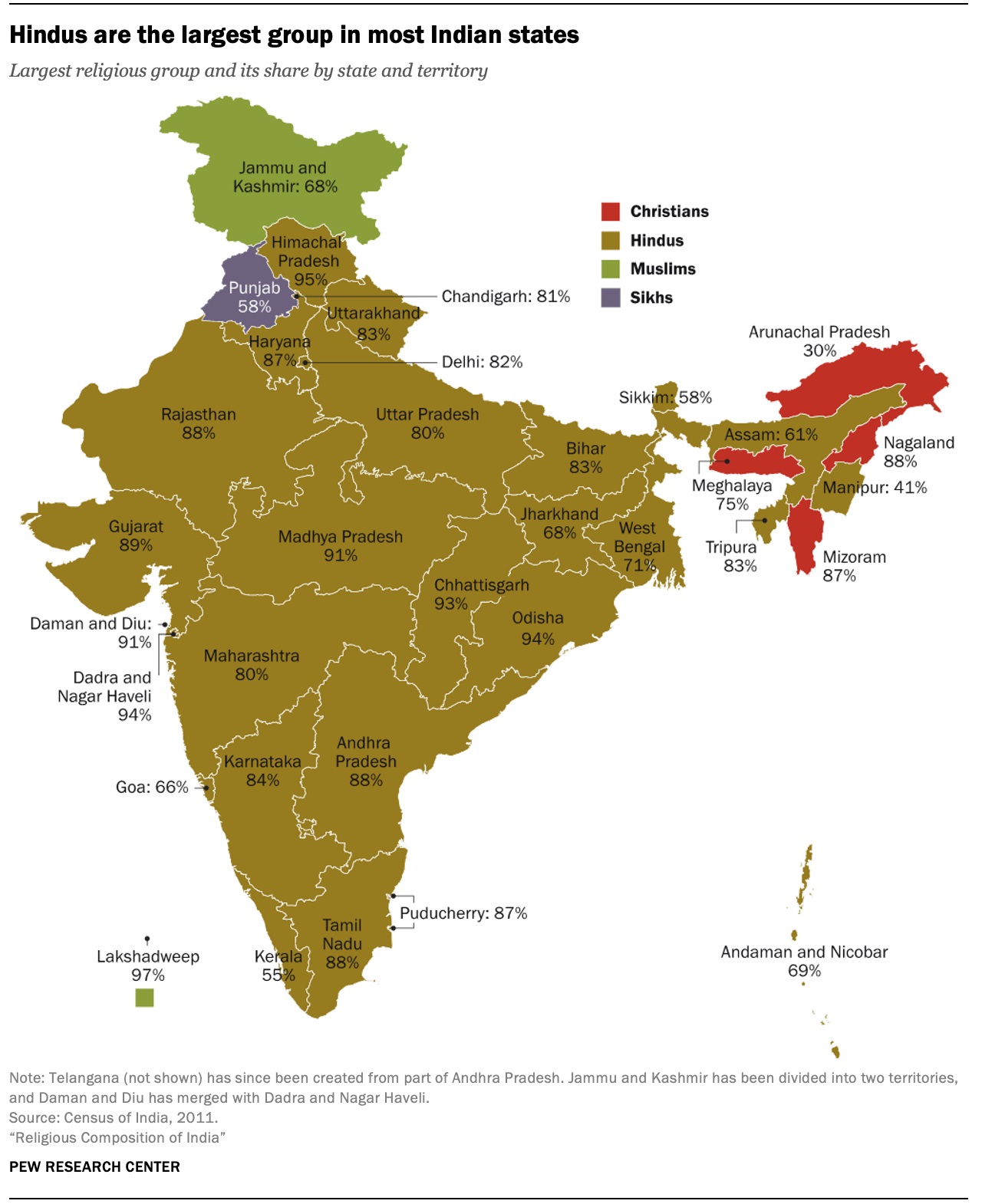
    Key Findings about the Religious Composition of India

    The religious composition of India’s population since Partition has remained largely stable according to a new study published by the Pew Research Centre, a non-profit based in Washington DC.

    About the report

    • The study, based on data sourced from India’s decennial census and the National Family Health Survey (NFHS), looked at the three main factors that are known to cause changes in the religious composition of populations — fertility rate, migration, and conversions.
    • Both Hindus and Muslims, the two largest religious groups, shown not only a marked decline but also a convergence in fertility rates.
    • In terms of absolute numbers, every major religion in India saw its numbers rise.

    Significance of the report

    • These findings, which come as a complement on religious tolerance and segregation in India.
    • It is significant in the context of two major issues that have occupied centre stage in recent times — the controversy over the Citizenship Amendment Act (CAA) and the National Register of Citizens (NRC).
    • This report also gives a strong message to those fundamentalists who perceive India as a living hell for minorities.

    Key findings

    (a) Fertility Rates are declining

    • With regard to fertility rates, the study found that Muslims, who had the highest fertility rate, also had the sharpest decline in fertility rates.
    • From 1992 to 2015, the total fertility rates of Muslims declined from 4.4 to 2.6, while that of Hindus declined from 3.3 to 2.1.
    • This indicates that the gaps in childbearing between India’s religious groups are much smaller than they used to be.
    • The average fertility rate in India today is 2.2, which is higher than the rates in economically advanced countries such as the U.S. (1.6), but much lower than what it was in 1992 (3.4) or 1951 (5.9).

    (b) Marked slowdown

    • Although growth rates have declined for all of India’s major religious groups, the slowdown has been more pronounced among religious minorities, who outpaced Hindus in earlier decades.
    • From 2001 to 2011, the difference in growth between Muslims (24.7%) and Indians overall (17.7%) was 7 percentage points.
    • India’s Christian population grew at the slowest pace of the three largest groups in the most recent census decade — gaining 15.7% between 2001 and 2011, a far lower growth rate than the one recorded in the decade following Partition (29.0%).

    (c) ‘No’ Religions group

    • Interestingly, out of India’s total population of 1,200 million, about 8 million did not belong to any of the six major religious groups.
    • Within this category, mostly comprising adivasi people, the largest grouping was of Sarnas (nearly 5 million adherents), followed by Gond (1 million) and Sari Dharma (5,10,000).

    (d) Migration

    • The study says that since the 1950s, migration has had only a modest impact on India’s religious composition.
    • More than 99% of people who live in India were also born in India, and migrants leaving India outnumber immigrants three-to-one, with “Muslims more likely than Hindus to leave India”, while “immigrants into India from Muslim-majority counties are disproportionately Hindu.”

    (e) Religious conversions

    • Religious conversion has also had a negligible impact on India’s overall composition, with 98% of Indian adults still identifying with the religion in which they were raised.

    UPSC 2022 countdown has begun! Get your personal guidance plan now! (Click here)

  • Foreign Policy Watch: India-United States

    What is Havana Syndrome?

    A US intelligence officer traveling with CIA director William Burns has reported symptoms of Havana Syndrome.

    What is Havana Syndrome?

    • Havana Syndrome refers to a set of mental health symptoms that are said to be experienced by US intelligence and embassy officials in various countries.
    • It typically involves symptoms such as hearing certain sounds without any outside noise being present, nausea, vertigo and headaches, memory loss and issues with balance.
    • As the name suggests, it traces its roots to Cuba.
    • In late 2016, US officials in embassy began experiencing sudden bursts of pressure in their brain followed by persistent headaches, feeling of disorientation and insomnia.

    How severe is it?

    • In 2018, at least three CIA officers working under diplomatic cover in Cuba had reported troubling sensations that seemed to leave serious injuries.
    • Some officers are being compulsorily retired for their inability to coherently discharge his duty and another needing a hearing aid.

    Has Havana Syndrome been reported anywhere else?

    • Since the Cuban incident, American intelligence and foreign affairs officials posted in various countries have reported symptoms of the syndrome.
    • In early 2018, similar accusations began to be made by US diplomats in China.
    • The US media has reported around 130 such attacks across the world including at Moscow in Russia, Poland, Georgia, Taiwan, Colombia, Kyrgyzstan, Uzbekistan, and Austria, among others.

    What are the causes of Havana Syndrome?

    • No one is entirely sure. But it is speculated to be a “sonic attack”.
    • Medical examination of the victims began to suggest that the victims may have been subjected to high-powered microwaves that either damaged or interfered with the nervous system.
    • It was said to have built a pressure inside the brain that generated the feeling of a sound being heard.
    • Greater exposure to high-powered microwaves is said not only to interfere with the body’s sense of balance but also impact memory and cause permanent brain damage.
    • It is suspected that beams of high-powered microwaves are sent through a special gadget that Americans have begun calling “microwave weapon”.

    Who is doing this in India?

    • Sources in the Indian security establishment say they are not aware of any such weapon being in the possession of an Indian agency.
    • Even if there was one, it is unlikely the government would admit to having acquired such counter-espionage technology given the sensitive nature of intelligence work.

    UPSC 2022 countdown has begun! Get your personal guidance plan now! (Click here)

  • Wildlife Conservation Efforts

    Rhino Horn Reverification Exercises

    Assam will mark World Rhino Day — September 22 — with a special ceremony by burning a stockpile of nearly 2,500 horns of the one-horned rhinoceros.

    Rhino Horn Reverification

    • The public ceremony — scheduled at Bokakhat in Kaziranga National Park (KNP) has been publicized as a “milestone towards rhino conservation” aimed at “busting myths about rhino horns”.
    • It’s a loud and clear message to the poachers and smugglers that such items have no value.
    • Thus the case for the destruction of horns — a process that is in compliance with Section 39(3)(c) of the Wildlife (Protection) Act of 1972.

    Why are Rhinos poached for horns?

    • Ground rhino horn is used in traditional Chinese medicine to cure a range of ailments, from cancer to hangovers, and also as an aphrodisiac.
    • In Vietnam, possessing a rhino horn is considered a status symbol.
    • Due to demand in these countries, poaching pressure on rhinos is ever persistent against which one cannot let the guard down.

    Try this PYQ:

    Consider the following statements:

    1. Asiatic lion is naturally found in India only.
    2. Double-humped camel is naturally found in India only.
    3. One-horned rhinoceros is naturally found in India only.

    Which of the statements given above is/are correct?

    (a) 1 only

    (b) 2 only

    (c) 1 and 3 only

    (d) 1, 2 and 3


    Post your answers here.

    (Note: Comment feature is not available on the app.)


    Back2Basics: Indian Rhino

    • The Indian rhinoceros also called the greater one-horned rhinoceros and great Indian rhinoceros is a rhinoceros native to the Indian subcontinent.
    • It is listed as Vulnerable on the IUCN Red List and Schedule I animal in the Wildlife Protection Act, 1972.
    • It once ranged across the entire northern part of the Indian Subcontinent, along the Indus, Ganges and Brahmaputra River basins, from Pakistan to the Indian-Myanmar border.
    • Poaching for rhinoceros horn became the single most important reason for the decline of the Indian rhino.
  • Coastal Zones Management and Regulations

    [pib] Kovalam & Eden Beaches gets Blue Fag Certification


    The international eco-label “Blue Flag”, has accorded the Blue Flag Certification for 2 new beaches this year –Kovalam in Tamil Nadu and Eden in Puducherry beaches.

    With this India now has 10 International Blue Flag beaches.

    Which are the other 8 beaches?

    1. Shivrajpur (Dwarka-Gujarat)
    2. Ghoghla (Diu)
    3. Kasarkod (Karnataka) [NOT Kasargod which is in Kerala] and
    4. Padubidri (Karnataka)
    5. Kappad (Kerala)
    6. Rushikonda (AP)
    7. Golden Beach (Odisha) and
    8. Radhanagar (A&N Islands)

    Blue Flag Beaches

    • The ‘Blue Flag’ beach is an ‘eco-tourism model’ and marks out beaches as providing tourists and beachgoers clean and hygienic bathing water, facilities/amenities, a safe and healthy environment, and sustainable development of the area.
    • The certification is accorded by the Denmark-based Foundation for Environment Education.
    • It started in France in 1985 and has been implemented in Europe since 1987, and in areas outside Europe since 2001 when South Africa joined.
    • It has 33 stringent criteria under four major heads for the beaches, that is, (i) Environmental Education and Information (ii) Bathing Water Quality (iii) Environment Management and Conservation and (iv) Safety and Services.

    UPSC 2022 countdown has begun! Get your personal guidance plan now! (Click here)

  • Foreign Policy Watch: India – EU

    Is there a role for India in divided AUKUS?

    Context

    France recalled its ambassadors to the US and Australia in a diplomatic slap intended to convey its anger over a deal forged in secrecy that saw Paris lose a multi billion dollar submarine contract.

    Depth and diversity of India’s relations

    • That Delhi today is a part of a difficult conversation between the US, UK, France, Europe, and Australia points to the growing depth and diversity of India’s relations with different parts of the West.
    • Popular and academic discourse on India’s foreign policy has been obsessed with the concept of “non-alignment” —was about keeping distance from the West as a whole.
    • India’s contemporary diplomacy, in contrast, takes a nuanced view of internal dynamics in the West, and recognises the political agency of individual states, and develops wide-ranging relationships with the Western nations.

    Relations with France

    • Paris has always taken an independent view of the world, while remaining within the broad framework of the American alliance.
    •  In the 1990s, Paris championed the construction of a multipolar world to constrain American “hyperpower” but India did not join it.
    • The last few years, however, have seen an intensification of India’s strategic engagement with France.
    • For example, India has overcome the earlier reluctance to work with France on Indian Ocean security.

    Engagement as collective and sub-region

    • The government has also stepped up on the political engagement with Europe as a collective as well as its sub-regions — from Baltics to the Balkans and from Iberia to Mitteleuropa.
    •  As India discovers that every European nation, from tiny Luxembourg to a rising Poland, has something to offer, Europe has become a thriving hub of India’s international relations.

    Relations with the UK

    • Due to the bitter colonial legacy, relations between India and UK have always been underdeveloped.
    • In the last couple of years, India has made a determined effort to build a new partnership with Britain, which is the fifth-largest economy in the world, a leading financial hub, a technological powerhouse, and punches well above its weight in global affairs.

    Relations with “Anglosphere”

    • India’s neglect of London also meant Delhi had no time for the “Anglosphere” that binds the UK to Australia, Canada, and New Zealand.
    • Many had presumed that the Anglosphere was irrelevant — AUKUS, however, is a reminder that Anglo-Saxon political bonds endure.
    • Instead of treating the Anglosphere with scepticism, India has begun to vigorously engage with the “settler colonies” that have so much to offer India — from natural resources to higher education and critical technologies.
    • The UK and its settler colonies have long been the preferred destination for the Indian diaspora (besides the US).
    • Leveraging diaspora politics: While the diaspora tends to connect the domestic politics of the Anglosphere with that of India, Delhi is figuring out that the diaspora politics can be played both ways.

    Relations with Japan and Australia

    • The transformation of India’s relations with Australia has occurred despite entrenched scepticism in the foreign policy bureaucracy.
    • Finally, Japan has been a part of the West in the post-War era and Delhi’s relations with Tokyo have never been as rounded as they are today. They are also fellow members of the Quad.

    Way forward for India

    • This wide-ranging engagement with the West should help Delhi convey two important messages to its partners this week.
    • Not undermining the larger goal: India needs to remind France, Australia, the UK and US of the shared interests in securing the Indo-Pacific and the dangers of letting the current quarrel undermine that larger goal.
    • Effective deterrence in Indo-Pacific: The other is to highlight the region’s vast requirements for effective deterrence in the Indo-Pacific;
    • And that there is enough room for the US, UK, France, and Europe to collaborate with Indo-Pacific partners in overlapping coalitions to develop high technology and defence-industrial cooperation in all the areas highlighted by AUKUS — effective underwater capabilities to AI, quantum computing and cyber warfare.
    • Deeper cooperation: India’s interests lie in deeper strategic cooperation with France and Europe as well as the Quad and the Anglosphere.

    Conclusion

    India’s diverse relationships in the West must be deployed in full measure to prevent a split in the Indo-Pacific coalition.

    UPSC 2022 countdown has begun! Get your personal guidance plan now! (Click here)

  • Capital Markets: Challenges and Developments

    SEBI introduces T+1 Settlement System

    The Capital markets regulator Securities and Exchange Board of India (SEBI) has introduced T+1 settlement cycle for completion of share transactions on optional basis in a move to enhance market liquidity.

    What is T+1 Settlement System?

    • T+1 means that settlements will have to be cleared within one day of the actual transactions taking place.
    • Currently, trades on the Indian stock exchanges are settled in two working days after the transaction is done (T+2).
    • In April 2002, stock exchanges had introduced a T+3 rolling settlement cycle. This was shortened to T+2 from April 1, 2003.

    What has Sebi allowed?

    • SEBI has allowed stock exchanges to start the T+1 system as an option in place of T+2.
    • If it opts for the T+1 settlement cycle for a scrip, the stock exchange will have to mandatorily continue with it for a minimum 6 months.
    • Thereafter, if it intends to switch back to T+2, it will do so by giving one month’s advance notice to the market.
    • Any subsequent switch (from T+1 to T+2 or vice versa) will be subject to a minimum period.
    • A stock exchange may choose to offer the T+1 settlement cycle on any of the scrips, after giving at least one month’s advance notice to all stakeholders, including the public at large.

    Why T+1 settlement?

    • Reduced settlement time: A shortened cycle not only reduces settlement time but also reduces and frees up the capital required to collateralize that risk.
    • Quick settlement: T+1 also reduces the number of outstanding unsettled trades at any instant, and thus decreases the unsettled exposure to Clearing Corporation by 50%.
    • Speedy recovery of assets: The narrower the settlement cycle, the narrower the time window for a counterparty insolvency/bankruptcy to impact the settlement of a trade.
    • Risk reduction: Systemic risk depends on the number of outstanding trades and concentration of risk at critical institutions such as clearing corporations, and becomes critical when the magnitude of outstanding transactions increases.

    How does T+2 work?

    • If an investor sells shares, settlement of the trade takes place in two working days (T+2).
    • The broker who handles the trade will get the money, but will credit the amount in the investor’s account only.
    • In effect, the investor will get the money only after three days.
    • In T+1, settlement of the trade takes place in one working day and the investor will get the money on the following day.
    • The move to T+1 will not require large operational or technical changes by market participants, nor will it cause fragmentation and risk to the core clearance and settlement ecosystem.

    Why are foreign investors opposing it?

    • Foreign investors operating from different geographies would face time zones, information flow process, and foreign exchange problems.
    • Foreign investors will also find it difficult to hedge their net India exposure in dollar terms at the end of the day under the T+1 system.
    • In 2020, SEBI had deferred the plan to halve the trade settlement cycle to one day (T+1) following opposition from foreign investors.

    UPSC 2022 countdown has begun! Get your personal guidance plan now! (Click here)


    Back2Basics: SEBI

    • The SEBI is the regulatory body for securities and commodity market in India under the jurisdiction of Ministry of Finance Government of India.
    • It was established on 12 April 1988 and given Statutory Powers on 30 January 1992 through the SEBI Act, 1992.

    Jurisdiction of SEBI

    • SEBI has to be responsive to the needs of three groups, which constitute the market:
    1. Issuers of securities
    2. Investors
    3. Market intermediaries

    SEBI has three powers rolled into one body: quasi-legislative, quasi-judicial and quasi-executive.

    • It drafts regulations in its legislative capacity, it conducts investigation and enforcement action in its executive function and it passes rulings and orders in its judicial capacity.
    • Though this makes it very powerful, there is an appeal process to create accountability.
    • There is a Securities Appellate Tribunal which is a three-member tribunal and is currently headed by Justice Tarun Agarwala, former Chief Justice of the Meghalaya High Court.
    • A second appeal lies directly to the Supreme Court.

    UPSC 2022 countdown has begun! Get your personal guidance plan now! (Click here)

  • Industrial Sector Updates – Industrial Policy, Ease of Doing Business, etc.

    The end of the doing business rankings

    The World Bank Group has scrapped its flagship publication, the ‘Doing Business’ report.

    Doing Business Report

    • This report publishes the influential annual ranking of countries on the Ease of Doing Business (EDB) index.
    • It ranks countries by the simplicity of rules framed for setting up and conducting businesses.

    Utility of the index

    The World Bank’s decision has wide ramifications, as the index serves varied purposes.

    • Many countries showcase improved ranking to signal market-friendly policies to attract foreign investments. National leaders often set EDB rank targets.
    • This helps them measure domestic policies against global “best practices” and browbeat domestic critics.
    • India, for instance, wanted its administration to ensure that India breaks into the top 50 ranks of the EDB index.
    • Some countries seem to use their political heft to improve their rank, polish their international image and sway public opinion (as appears to be China’s case).

    Issues with the credibility of the report

    • The Group acted on its commissioned study to examine the ethical issues flagged in preparing the 2018 and 2020 editions of the EDB index.
    • It is accused of having exerted pressure on the internal team working on the Doing Business report to falsely boost China’s rank by doctoring the underlying data.
    • Similarly, tensions were also reportedly brought to bear in the case of Saudi Arabia’s rank, among others.

    EDB index rank vs economic outcomes

    • There is a disconnect between the stellar rise in EDB index rank and economic outcomes.
    • The theory underlying the EDB index could be suspect, the measurement and data could be faulty, or both.
    • For example, China’s phenomenal economic success, especially its agricultural performance (after the reforms in 1978), is perhaps the most unmistakable evidence demonstrating that lack of clarity of property rights may not be the binding constraint in a market economy.
    • What matters is economic incentives.
    • Measuring regulatory functions underlying the index could be tricky and subjective and possibly politically motivated as well, as the controversies surrounding the index seem to suggest.

    EODB in India: At what cost

    Ans. Weakening labour regulations

    • Closer home, India has weaponised the mandate to improve the rank in the EDB index to whittle down labour laws and their enforcement and bring them close to the free-market ideal of ‘hire and fire’.
    • Most States have emulated Maharashtra’s lead of administrative fiat, which renders labour laws toothless by dismantling official labour inspection systems and allowing employers to file self-regulation reports.
    • The government has farmed out critical safety regulations such as annual inspection and certification of industrial boilers to ‘third party’ private agencies.
    • The Labour Department’s inspection is now not mandated; it is optional only by prior intimation to employers.

    Implications of such moves

    • Such abdication of the government’s responsibility towards workers has reportedly affected industrial relations.
    • The workers’ strike at Wistron’s iPhone assembly factory in Karnataka last year is an example.
    • Further, severe industrial accidents are rising, damaging life and productive industrial assets.

    Why did World Bank scrap the index?

    • Investigations into “data irregularities” in preparing the EDB index, as brought out by the independent agency, seems to confirm many shortcomings repeatedly brought to light for years now.
    • The index appears motivated to support the free-market ideal.
    • It is dressed up under scientific garb and is underpinned by seemingly objective methods and data collection.
    • Strong leaders (and motivated officials) seem to have used their position to manipulate the index to suit their political and ideological ends.

    Conclusion

    • India claimed the success of its Make in India initiative by relying on its ranking on the EDB index without tangible evidence.
    • Handing over law enforcement to employers by self-reporting compliance seems to have increased industrial unrest and accidents.
    • It perhaps calls for honest soul-searching as to what havoc a questionable benchmark can wreak.

    UPSC 2022 countdown has begun! Get your personal guidance plan now! (Click here)

  • Food Safety Standards – FSSAI, food fortification, etc.

    Front-of-pack labelling of Food Stuffs

    Seven years, four committees and two draft regulations later, India still does not have a clear labelling system to warn consumers about harmful levels of fat, salt and sugar in processed foods.

    Context

    • According to the Food Safety and Standards (Packaging and Labelling) Regulations, 2011, every pre-packed processed food product sold in the country must be labelled with nutritional information.
    • To ensure that consumers are able to easily see and interpret the nutritional information on food packets, an expert committee was established by the Food Safety and Standards Authority of India (FSSAI).
    • The committee, set up following an order of the Delhi High Court which was hearing a public interest petition seeking a ban on the sale of junk food in and around schools.

    Why label nutritional information?

    • This helps the consumer know everything about the food they buy and make an informed decision about what and how much to eat.
    • Such information is particularly crucial because the packaged food contain ultra-processed foods that are high in fat, salt or sugar and low in fibre and other essential micronutrients.
    • On the one hand, these foods cause malnutrition.
    • On the other hand they are linked strongly with obesity and diet-related non-communicable diseases, such as Type-2 diabetes, hypertension, heart ailments and certain cancers, like that of the colon.
    • All these increase the risk of premature death.

    Issues with labelling in India

    • Most products provide information in English understanding which can be daunting for a vast number of people in India.

    What is FoP labelling?

    • The front-of-pack (FoP) labelling system has long been listed as one of the global best practices to nudge consumers into healthy food choices.
    • It works just the way cigarette packets are labelled with images to discourage consumption.
    • Countries such as Chile, Brazil and Israel have laws to push the packaged food industry to adopt FoP labelling.
    • They have used FoP labelling as a measure to fight obesity and NCDs.

    FoP labelling in India

    • The system is yet to be implemented in India even seven years after it was first proposed by FSSAI.
    • The fact is, makers of packaged foods are also a powerful lot, with strong business acumen.
    • While companies in other countries have acceded to the FoP labelling laws, they are unwilling to do so in India — a country experiencing a dietary shift.

    Why must we have FoP labels?

    • Countries are working to find ways to nudge consumers into healthy food choices and to contain the growing crisis of obesity and diet-related non-communicable diseases (NCDs).
    • It is a crisis that increasingly impacts children and also exacerbates novel coronavirus disease (COVID-19) symptoms. Front-of-pack (FoP) labelling is definitely an effective tool in this effort.

    India definitely needs ‘warning labels’ on front-of-pack, but this must be a symbol-based label with no text and numbers. This is because:

    (1) Junk foods have high levels of unhealthy nutrients

    • There is strong evidence that sugar, salt and fat in junk foods are addictive, like nicotine in tobacco.
    • FoP ‘warning’ labels have helped reduce cigarette consumption. It is time we adopted the same for junk foods.

    (2) Warning labels are easy to notice and understand

    • They do not confuse consumers with mixed messages.
    • Their distinct shape, colour and size make them noticeable in the otherwise cluttered and colourful packaging.
    • With one label for one nutrient, it becomes easier to know if a product is high in more than one nutrient.

    (3) Warning labels are the global best practice now

    • At least seven countries have adopted warning labels in the past five years. These include Chile, Peru, Mexico, Israel and Uruguay.
    • Low- and middle-income mothers have shown profound changes in attitudes towards food purchases as they now understand the nutritional content of packaged foods.
    • Even children can read the labels and take an informed decision. This has also forced food companies to reduce the amount of sugar and sodium in foods and beverages.

    (4) They are best suited for India

    • Warning labels are best suited for India as they do not include numbers unlike many other FoP labels.
    • In fact, warning labels that are symbol-based, like that of Israel, can transcend the barriers of literacy and language in India.

    (5) FSSAI has experience of successfully implementing symbol-based FoP labels

    • Its “green filled circle in green outlined square” logo to depict vegetarian food has been hugely successful in informing consumers.
    • In recent years, FSSAI also has made similar laws to depict fortification (+F logo) and organic food (a green-coloured tick for Jaivik Bharat logo).

    Way forward

    • FoP labels must include information on nutrients that make food injurious to health.
    • This should be distinct from the details on the back-of-pack. FoP labels should aim to inform the consumer, while the back-of-pack label serves the purpose of scientific compliance and enforcement.
    • FoP labels should have information on ‘total sugar’ and not ‘added sugar’. There is no analytical laboratory method to differentiate ‘added sugar’ from total sugar and quantify it.


Join the Community

Join us across Social Media platforms.