💥UPSC 2026, 2027, 2028 UAP Mentorship (March Batch) + Access XFactor Notes & Microthemes PDF

Archives: News

  • Air Pollution

    State of Global Air Report, 2020

    Air pollution now biggest health risk in India, says the State of Global Air 2020 Report.

    State of Global Air Report

    • The State of Global Air report brings into one place the latest information on air quality and health for countries around the globe.
    • It is produced annually by the Health Effects Institute and the Institute for Health Metrics and Evaluation’s Global Burden of Disease project.

    India’s exposure to pollution

    • Long-term exposure to outdoor and household air pollution contributed to over 1.67 million annual deaths from stroke, heart attack, diabetes, lung cancer, chronic lung diseases and neonatal diseases in India in 2019.
    • Overall, air pollution was now the largest risk factor for death among all health risks, the report noted.
    • Outdoor and household particulate matter pollution also contributed to the deaths of more than 1,16,000 Indian infants in their first month of life last year.
    • For the youngest infants, most deaths were related to complications from low birth weight and preterm birth.

    A comparison with peers

    • India faced the highest per capita pollution exposure — or 83.2 μg/cubic metre — in the world.
    • It is followed by Nepal at 83.1 μg/cubic metre and Niger at 80.1.
    • Countries with the least population exposure are below 8 micrograms (μg) per cubic metre.

    Back2Basics: Particulate Matter
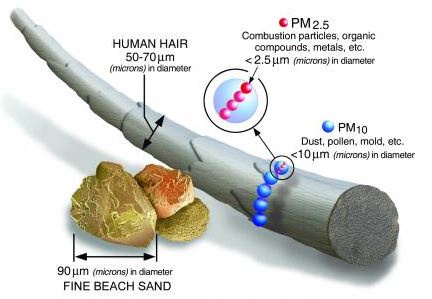
    • PM is the term for a mixture of solid particles and liquid droplets found in the air. Some particles, such as dust, dirt, soot, or smoke, are large or dark enough to be seen with the naked eye.
    • Others are so small they can only be detected using an electron microscope.
    • Particle pollution includes:
    1. PM10 : inhalable particles, with diameters that are generally 10 micrometres and smaller; and
    2. PM2.5: fine inhalable particles, with diameters that are generally 2.5 micrometres and smaller.

    Sources of PM

    • These particles come in many sizes and shapes and can be made up of hundreds of different chemicals.
    • Some are emitted directly from a source, such as construction sites, unpaved roads, fields, smokestacks or fires.
    • Most particles form in the atmosphere as a result of complex reactions of chemicals such as sulfur dioxide and nitrogen oxides, which are pollutants emitted from power plants, industries and automobiles.

    Harmful effects of PM

    • Particulate matter contains microscopic solids or liquid droplets that are so small that they can be inhaled and cause serious health problems.
    • Some particles less than 10 micrometres in diameter can get deep into your lungs and some may even get into your bloodstream.
    • Of these, particles less than 2.5 micrometres in diameter, also known as fine particles or PM2.5, pose the greatest risk to health.

  • Water Management – Institutional Reforms, Conservation Efforts, etc.

    Kaleshwaram Lift Irrigation System (KLIS)

    The National Green Tribunal (NGT) wants a relook at Kaleshwaram Project since the Telangana government subsequently changed the design of the project.

    Try this question from our AWE initiative:

    The Kaleshwaram Project

    • The Kaleshwaram Lift Irrigation System is considered to be one of the world’s largest multi-purpose projects.
    • It is designed to provide water for irrigation and drinking purposes to about 45 lakh acres in 20 of the 31 districts in Telangana, apart from Hyderabad and Secunderabad.
    • This project is unique because Telangana will harness water at the confluence of two rivers with the Godavari by constructing a barrage at Medigadda in Jayashankar Bhupalpally district.
    • It would reverse pump the water into the main Godavari River and divert it through lifts and pumps into a huge and complex system of reservoirs, water tunnels, pipelines and canals.

    Records to its glory

    • The project has set many records with the world’s longest water tunnels, aqueducts, underground surge pools, and biggest pumps.
    • By the time the water reaches Kondapochamma Sagar, the last reservoir in the system, the water would have been lifted to a height of 618 metres from its source at Medigadda.
    • The total length of the entire Kaleshwaram project is approximately 1,832 km of which 1,531 km is gravity canals and 203 km comprises water tunnels.

    How important is KLIS to Telangana?

    • The project will enable farmers in Telangana to reap multiple crops with a year-round supply of water wherein earlier they were dependent on rains resulting in frequent crop failures.
    • This year, Telangana farmers have already delivered bumper rabi crops of paddy and maize due to better irrigation facilities and an extended monsoon.
    • KLIS covers several districts which used to face rainfall deficit and the groundwater is fluoride-contaminated.
    • Apart from irrigation, a main component of the project is the supply of drinking water to several towns and villages and also to twin cities of Hyderabad and Secunderabad.
    • Mission Bhagiratha, the Rs 43,000-crore project to supply drinking water to every household in villages, draws a large quantity of water from the KLIS and some quantity from projects on River Krishna.
    • There is a burgeoning freshwater fishing industry in the state.

    Issues raised by NGT

    • The NGT has observed that the Telangana government subsequently changed the design of the project to increase its capacity.
    • By increasing its capacity to pump 3 TMC water from 2 TMC, large tracts of forest land and other land was taken over and massive infrastructure was built causing adverse impact on the environment.
    • Extraction of more water certainly requires more storage capacity and also affects hydrology and riverine ecology of Godavari River.
    • Such issues have to be examined by the statutory authorities concerned.

    B2Basics

    National Green tribunal

    • It is a specialised body set up under the National Green Tribunal Act (2010) for effective and expeditious disposal of cases relating to environmental protection and conservation of forests and other natural resources.
    • With the establishment of the NGT, India became the third country in the world to set up a specialised environmental tribunal, only after Australia and New Zealand, and the first developing country to do so.
    • NGT is mandated to make disposal of applications or appeals finally within 6 months of filing of the same.
    • The NGT has five places of sittings, New Delhi is the Principal place of sitting and Bhopal, Pune, Kolkata and Chennai are the other four.

    Structure of NGT

    • The Tribunal comprises of the Chairperson, the Judicial Members and Expert Members. They shall hold office for term of five years and are not eligible for reappointment.
    • The Chairperson is appointed by the Central Government in consultation with Chief Justice of India (CJI).
    • A Selection Committee shall be formed by central government to appoint the Judicial Members and Expert Members.
    • There are to be least 10 and maximum 20 full time Judicial members and Expert Members in the tribunal.
  • New Species of Plants and Animals Discovered

    Medicinal plants in news

    This newscard is an excerpt from the original article published in DownToEarth.

    Explained below are the medicinal properties of 10 valuable plants known to boost natural immunity:

    (1) Abrusprecatorius (Indian liquorice, Ratti)

    • The bright red ovoid seeds with a black spot weigh 1/10th of a gram, and were hence used as weighing unit called ‘Ratti’ in ancient India by goldsmiths.
    • Its seeds are said to have immune-modulating properties.

    (2) Artemisia scoparia (Redstem Wormwood)

    • These plants have excellent clinical anti-malarial properties due to the presence of artemisinin.
    • They possess potent anti-inflammatory properties and help regulate both innate and adaptive immunity.

    (3) Azadirachtaindica (Neem)

    • It is a well-known tree used in various systems of traditional medicine since time immemorial. In Sanskrit, it is known as Arishtha, which means ‘reliever of sicknesses’.
    • Neem bark is known to have strong immunostimulant Neem oil has been shown to possess activity by selectively activating cell-mediated immune mechanisms.

    (4) Boerhaviadiffusa (Punarnava)

    • In Ayurveda, Punarnava is included in the category of rasayana herbs that possess anti-ageing properties. It helps prevent diseases.
    • This means they increase resistance by providing hepatoprotection (the ability of a substance to prevent damage to the liver) and immune-modulation.

    (5) Cardaminehirsuta (Hairy Bitter Cress)

    • The plants contain vitamin C, calcium, magnesium, beta carotene, antioxidants and sulfur-containing compounds that boost immunity.

    (6) Clerodendrumphlomidis (Sage Glory Bower, Arni, Agnimantha)

    • It is an essential medicinal plant that is also mentioned in texts since the Vedic period. It is known to boost the immune system, purify the blood and cure urinary tract infection.
    • The decoction made from the whole plant is useful in improving strength and immunity following a bout of fever or other ailments.

    (7) Phyllanthus tenellus (Mascarene Island leaf-flower)

    • It is an annual herb commonly found near wetlands, ditches, wet places, edges of drains and disturbed places. It is known for immune-modulatory properties.
    • Physalis peruviana (Cape Gooseberry, Rasbhari) (Family: Solanaceae): It is used in traditional folk medicines as an immunomodulatory drug. It is rich in vitamin C and helps enhance body immunity.

    (8) Portulaca oleracea (Purslane)

    • Purslane has been used in folk medicine since ancient times and is included in the World Health Organization’s list of most widely used medicinal plants.
    • The leaves of the plant are a rich source of omega-3 fatty acids, which is important in preventing heart attacks and strengthening the immune system.

    (9) Withaniasomnifera (Indian Winter Cherry, Indian Ginseng, Aswagandha)

    • Ashwagandha is an important ancient herb and has been used in the indigenous medical system for over 3,000 years.
    • It is considered to be one of the best rejuvenating agents in Ayurveda that helps to maintain proper nourishment of the tissues. It possesses antioxidant, mind-boosting and immune-enhancing properties.

    Now try this PYQ:

    Q.Consider the following statements:

    1. The Taxus tree is naturally found in the Himalayas
    2. The Taxus tree is listed in the Red Data Book.
    3. A drug called “taxol” is obtained from Taxus tree is effective against Parkinson’s disease

    Which of the above statements is/are correct?

    (a) 1 only

    (b) 1 and 2 only

    (c) 2 and 3 only

    (d) 3 only

  • Minimum Support Prices for Agricultural Produce

    [pib] Market Intervention Scheme

    The Union Cabinet has approved the extension of Market Intervention Scheme (MIS) for apple procurement in Jammu and Kashmir (J&K) for the current season.

    UPSC can ask a question on the difference between MSP and MIP. All the agricultural and horticultural commodities for which Minimum Support Price (MSP) are not fixed and are generally perishable in nature are covered under Market Intervention Scheme (MIS).

    Market Intervention Scheme

    • MIS is a price support mechanism implemented on the request of State Governments for the procurement of perishable and horticultural commodities in the event of a fall in market prices.
    • It is implemented when there is at least a 10% increase in production or a 10% decrease in the ruling rates over the previous normal year.
    • MIS works in a similar fashion to Minimum Support Price based procurement mechanism for food grains but is an ad-hoc mechanism.
    • Its objective is to protect the growers of these horticultural/agricultural commodities from making distress sale in the event of the bumper crop.
    • Under MIS, support can be provided in some years, for a limited but defined period, in specified critical markets and by purchasing specified quantities. The initiative has to emerge from the concerned state.

    Commodities covered

    • The MIS has been implemented in case of commodities like apples, garlic, oranges, grapes, mushrooms, clove, black pepper, pineapple, ginger, red chillies, coriander seed, chicory, onions, potatoes, cabbage, mustard seed, castor seed, copra, palm oil etc.

    Remuneration under MIS

    • MIS provides remunerative prices to the farmers in case of the glut in production and fall in prices.
    • Proposal of MIS is approved on the specific request of State/UT Government, if they are ready to bear 50% loss (25% in case of North-Eastern States), if any, incurred on its implementation.
    • Further, the extent of total amount of loss shared is restricted to 25% of the total procurement value which includes the cost of the commodity procured plus permitted overhead expenses.

    Implementation of MIS

    1) Market Intervention Price (MIP)

    • The Department of Agriculture & Cooperation is implementing the scheme.
    • Under the MIS, a pre-determined quantity at a fixed MIP is procured by NAFED as the Central agency.
    • There are other agencies designated by the state government for a fixed period or till the prices are stabilized above the MIP whichever is earlier.
    • The area of operation is restricted to the concerned state only.

    2) Funds transfer

    • Under MIS, funds are not allocated to the States.
    • Instead, central share of losses as per the guidelines of MIS is released to the State Governments/UTs, for which MIS has been approved, based on specific proposals received from them.

  • Banking Sector Reforms

    SC asks govt to implement ‘interest waiver’ scheme at the earliest

    The article examines the implications of the Supreme Court order dealing with the loan waiver and ban on the recognition of the bad loan.

    Significance of common man as a depositor

    • India’s Rs 144 lakh crore in bank deposits make our Rs 110 lakh crore in bank loans possible.
    • The “common man” is more likely a depositor than a borrower; banks have 21 crore deposit accounts but only 2.7 crore loan accounts.

    Issues with the court order

    • The Supreme Court has weighed in on the waiver scheme and recognition of the bad loan.
    • Waiving interest dues or banning bad loan recognition is economically ignorant because more than 20 per cent of Indians are depositors while less than 2 per cent are borrowers.
    • It has nothing to with economic justice defined as the greatest good for the greatest number.
    • It sabotages economic justice because fiscally funding banking diverts money from education, health and skilling expenditure.
    •  It’s commercially ignorant because any “annualised effective rate” is adjusted for interest payment frequency.
    • Resources are finite with total central government expenditure at Rs 29 lakh crore, scarce as COVID creates a Rs 3 lakh crore GST shortfall and fragile our fiscal deficit may exceed 12 per cent.
    • Also, it is hardly what our Constitution imagined as the role of courts.
    • Our Constitution writers made a distinction between fundamental rights and directive principles was not a lack of ambition but a measured assessment of state capacity, resources and sequencing.
    • The Constitution also envisaged distinct roles for the judiciary, executive and legislature to balance samaj (society), bazaar (markets) and sarkar (government).
    • Courts have become less mindful of these two distinctions.

    Cost of credit and availability issue in India

    • One of the reasons for small size of Indian enterprises in the availability and cost of credit in India.
    • India’s credit-to-GDP ratio stands at dismal  50 per cent  — Bihar is 12 per cent and Arunachal is 1 per cent.
    • The MSME lending is stuck at Rs 20 lakh crore — needs to rise to 100 per cent.
    • Despite lower inflation and fiscal discipline, most borrowers don’t get globally competitive interest rates due to high bad loans and financial statement uncertainty.
    • The availability of credit will not rise and cost will not fall till our banking system has strong competition, consistent regulation, effective supervision and non-fiscal sustainability.

    Consider the question “How the crisis in the banking sector is different from the crisis in other sectors? Also, examine the issues with the Supreme Court order on the loan waiver and recongnition of bad loan ban?” 

    Conclusion

    Institutional immunity needs balancing of independence and accountability; rising citizen concern about mandates and appointments should trigger court introspection.

  • Defence Sector – DPP, Missions, Schemes, Security Forces, etc.

    Issues with dilution of offset condition for defence procurement

    The ‘offset clause’ could help the country achieve the technological expertise and consequently self-reliance. However, India recently relaxed some norms in the policy. The article discusses the stated reasons for tweaking and its implications for the defence manufacturing industry in India.

    Context

    • Recently, the government diluted the “offset” policy in defence procurement, reportedly in response to a Comptroller and Auditor General (CAG) of India’s report tabled in Parliament last month.

    Let’s understand ‘offset’ policy

    •  In order to safeguard national interest, most countries restrict trade in defence equipment and advanced technologies.
    • Yet, for commercial gains and for global technological recognition, governments and firms do like to expand the trade through negotiated bilateral sales.
    • Restrictions are often imposed on the buyer country on use, modification and resale of such equipment and technologies.
    • The product and technology compel buyers to stick to them for: the advantages of bulk purchase, and dependence on the supplier for spares and upgrades.
    • The price and the terms of the contract often reflect the government’s relative bargaining strength and also domestic political and economic considerations.
    • Large buyers such as India seek to exercise their “buying power” to secure not just the lowest price but also try to acquire the technology to upgrade domestic production and build R&D capabilities.
    • The offset clause — used globally — is the instrument for securing these goals.

    Changes in the offset policy

    • Initiated in 2005, the offset clause has following requirements:
    • 1) Sourcing 30% of the value of the contract domestically.
    • 2) Indigenisation of production in a strict time frame.
    • 3) Training Indian professionals in high-tech skills, for promoting domestic R&D.
    • However, the policy has been tweaked many times since.
    • According to the recent CAG report,  between 2007 and 2018, the government reportedly signed 46 offset contracts worth ₹66,427 crore of investments.
    • However, the realised investments were merely 8%, or worth ₹5,457 crore.
    • Reportedly, technology transfer agreements in the offsets were not implemented, failing to accomplish the stated policy objective.
    • Recently, the government has changed this policy further so that the offset clause will not be applicable to bilateral deals and deals with a single (monopoly) seller, to begin with.

    Implications of the changes in offset policy

    • The dilution means practically giving up the offset clause, and a setback to India’s prospects for boosting defence production and technological self-reliance.
    • The government, however, has defended the decision by claiming a cost advantage.
    • Howver, price is but one of many factors in such deals, as explained above.
    • The higher (upfront) cost of the agreement due to the offset clause would pay for itself by: reducing costs in the long term by indigenisation of production and the potential technology spill-overs for domestic industry.
    • Hence, giving up the offset clause is undoubtedly a severe setback.

    How did offset policy work for aerospace industry?

    • Despite the heft of Hindustan Aeronautics Limited, India is a lightweight in global civilian aircraft manufacturing, as the public sector giant mostly devotes itself to defence production.
    • The National Civil Aircraft Development (NCAD) project — to come up with an indigenously designed Regional Transport Aircraft (RTA) — has remained a non-starter from day one.
    • However, with the introduction of the offset policy in 2005, things changed dramatically.
    • For contracts valued at ₹300 crore or more, 30% of it will result in offsets, implemented through Indian offset partners.
    • As aerospace imports rose rapidly, so did the exports via the offsets, by a whopping 544% in 2007, compared to the previous year.
    • By 2014, exports increased to $6.7 billion from a paltry $62.5 million in 2005, according to the United Nations Comtrade Database.
    • The offset clause enabled India to join the league of the world’s top 10 aerospace exporters; the only country without a major domestic aerospace firm.
    • However, exports reduced after the offset clause was relaxed, primarily when the threshold for the policy was raised from the hitherto ₹300 crore to ₹2000 crore, in 2016.
    • The offset exports fell to $1.5 billion by 2019.
    • The 2005 policy helped promote a vibrant aerospace cluster, mostly micro, small and medium enterprises (MSMEs) around Bengaluru.

    Consider the question “How far has the offset clause been successful in enhancing the domestic capabilities of India in defence manufacturing? What are the challenges in achieving the objectives of the policy?”

    Conclusion

    There are successful examples to draw lessons from, as the aerospace industry episode demonstrates. India needs to re-conceive or re-imagine the offset clause in defence contracts with stricter enforcement of the deals, in national interest, and in order to aim for ‘Atma Nirbhar Bharat Abhiyaan’, or a self-reliant India.

  • Police Reforms – SC directives, NPC, other committees reports

    Reforms police in India need

    The article highlights the challenges facing the police force in India and suggests the measures to deal with them.

    Urgency of the police reforms

    • In a well-ordered democracy, the police are supposed to be a disciplined force trained to uphold the law and enforce the functioning of democracy on constitutional lines.
    • However, police in India suffers from a triad of malaises:
    • 1) The lack of sensitisation of police personnel.
    • 2) Absence of accountability.
    • 3) Politicisation of the police.

    Objectives of the reforms:

    1) Police sensitisation about their role in society

    • The sensitisation module should aim at bringing about attitudinal change in police — especially pertaining to gender and power relations and police behaviour.
    • There has to be promptness of action and decency of behaviour.
    • They need to be trained in body language and strictly advised to refrain from abusive behaviour.
    • It is necessary to increase public confidence in the police by upgrading levels of police service delivery as well as by investigating and acting in cases of police misconduct.

    2) Increasing accountability

    • Public confidence in police decreases when the public perceives that police abuses are not investigated effectively.
    • Enhancing accountability will improve police legitimacy and increase public confidence, which, in turn, will reinforce the integrity of the system.
    • The Police Ombudsman of Northern Ireland, the Danish Independent Police Complaints Authority are some examples of mechanisms for accountability of the police for acts of abuse of power.

    3) De-politicisation of the police

    • Linked to accountability is de-politicisation of the police force.
    • This is a must for the effective functioning of the country’s criminal justice system.
    • The police, as the custodian of maintenance of law and order, must stay away from agenda-driven politics.

    Need to resolve the structural issues

    In order to achieve the above-stated objectives, structural issues within the force must be given priority.

    1) Vacancies and fair representation to women

    • According to a report by Common Cause in 2019, the Indian police force is at only 77 per cent of its sanctioned strength.
    • India has 144 police personnel for one lakh population and, in some states, the figure is less than 100.
    • One in every five posts sanctioned in the Indian Police Service remains vacant.
    • In low and middle-rank posts, the vacancies of 5.28 lakh personnel account for nearly one-fourth of the total sanctioned strength of over 22 lakh.
    • A fully-staffed police force would only increase India’s police-to-population ratio to 185 against the UN recommended ratio of 222.
    • The police-to-people ratio should be improved by at least 50 per cent to meet the challenges faced by the force.
    • Women are grossly underrepresented in our police force at less than 7 per cent of our total police strength.
    • With the increase in the number of gender crimes, it has become a necessity to augment the strength of police by recruiting more and more women police personnel.
    • The situation in Uttar Pradesh is the worst where police are at roughly 50 per cent of sanctioned strength.
    • When the numbers are inadequate, police personnel are stretched, leading to shoddy policing.

    2) Lack of in-service training

    • The existing police personnel are also not adequately trained. Less than 7 per cent police get in-service training.
    • Gujarat scores the lowest, with less than one per cent having received any in-service training.

    3) Implementation of guidelines and recommendations

    • After the National Police Commission in 1977, several committees were set up, including the Gore Committee, Padmanabhaiah Committee and Malimath Committee.
    • These commissions and committees have made far-reaching recommendations.
    • The top police leadership should be selected by apolitical representatives and an impartial body as suggested by Dharma Vira Commission have farsighted implications.
    • It was a strong antidote to opportunistic appointments and transfers.
    • Recommendations of the commission, if implemented, along with the Supreme Court directives of 2006 by Justice Sabharwal, in true letter and spirit, will go a long way in police reform.

    4) Reforms in criminal justice system

    • Reforms in the criminal justice system and separation of law and order from investigation and prosecution are the other areas that need the attention of the authorities.
    • These aspects have been highlighted by many commissions and committees constituted by the Centre.

    Consider the question “What are the challenges facing the police force in the country? Suggest the measures to deal with these challenges.”

    Conclusion

    A new role and new philosophy have to be defined for the police to not only make it a capable and effective body but also one accountable to the law of the land and to the people whom they serve.

  • Electoral Reforms In India

    Govt. hikes poll expenditure ceiling by 10%

    The Law Ministry has increased the ceiling on poll expenditure for Assembly and Lok Sabha elections by 10% following a recommendation by the Election Commission in view of curbs imposed during the coronavirus pandemic.

    Try answering this question:

    Q.Ceiling on election expenses ends up being counterproductive and encourages candidates to under-report their expenditure. Critically analyse.

    New ceiling on poll expenditure

    • The ceiling on poll expenditure varies across States, with candidates in Assembly elections in bigger States like Bihar, Uttar Pradesh, and Tamil Nadu now allowed to spend up to ₹30.8 lakhs as against ₹28 lakhs earlier.
    • For a candidate contesting a Lok Sabha poll in these States, the revised ceiling on poll expenditure is now ₹77 lakhs instead of the earlier amount of ₹70 lakhs.
    • Goa, Arunachal Pradesh, Sikkim and a few Union Territories, based on the size of their constituencies and population, have a lower ceiling on poll expenditure.
    • Here while the enhanced ceiling for a Lok Sabha candidate is now ₹59.4 lakhs those contesting an Assembly can spend up to ₹22 lakhs.

    How are such ceilings made?

    • Such changes are made by amending the Conduct of Elections Rules.
    • The last time the expenditure ceiling was enhanced was in 2014 just ahead of the Lok Sabha polls.

    What doesn’t account to Election expenditure?

    • The expenditure incurred by leaders of a political party on account of travel by air or by any other means of transport for propagating programme of the political party is not considered to be the election expenditure.
    • Any expenditure which is done for service of the Government and discharge of official duty is also not considered to be election expenditure.

    Role of Election Commission

    • The EC imposes limits on campaign expenditure incurred by a candidate and not political parties.
    • However, it does not cover expenses incurred either by a party or the leader of a party for propagating the party’s programme.
    • Also, candidates must mandatorily file a true account of election expenses with the EC.
    • An incorrect account or expenditure beyond the ceiling can attract disqualification for up to three years as per Section 10A of The Representation of the People Act, 1951.
  • North-East India – Security and Developmental Issues

    Assam-Mizoram Boundary Dispute

    The Ministry of Home Affairs (MHA) has asked Assam and Mizoram to maintain peace and display “no aggressive posturing” after violent clashes took place at the border between the two States on Saturday night.

    Can you recall the chronology of reorganization of the entire North-East region?

    What is the issue?

    • Assam has had a boundary dispute with Mizoram for decades and several rounds of talks have been held since 1994-95 to solve the issue.
    • Till 1972, Mizoram was a part of Assam and acquired full statehood in 1987.
    • The 164.6 km-long border between the States runs along with Cachar, Hailakandi and Karimganj districts in Assam and Kolasib, Mamit and Aizawl districts in Mizoram.
    • There are several border areas where violence have been reported.

    How complex is this dispute?

    • In the Northeast’s complex boundary equations, showdowns between Assam and Mizoram residents are less frequent than they are.
    • The boundary between present-day Assam and Mizoram, 165 km long today, dates back to the colonial era when Mizoram was known as Lushai Hills, a district of Assam.
    • The dispute stems from a notification of 1875 that differentiated Lushai Hills from the plains of Cachar, and another of 1933 that demarcates a boundary between Lushai Hills and Manipur.
    • Mizoram believes the boundary should be demarcated on the basis of the 1875 notification, which is derived from the Bengal Eastern Frontier Regulation (BEFR) Act, 1873.
    • Mizo leaders have argued in the past argued against the demarcation notified in 1933 because Mizo society was not consulted.

    Other boundary disputes in North-East

    During British rule, Assam included present-day Nagaland, Arunachal Pradesh and Meghalaya besides Mizoram, which became separate state one by one. Today, Assam has boundary problems with each of them.

    • Nagaland shares a 500-km boundary with Assam.
    • In two major incidents of violence in 1979 and 1985, at least 100 persons were killed. The boundary dispute is now in the Supreme Court
    • On the Assam-Arunachal Pradesh boundary (over 800 km), clashes were first reported in 1992, according to the same research paper.
    • Since then, there have been several accusations of illegal encroachment from both sides, and intermittent clashes. This boundary issue is being heard by the Supreme Court.
    • The 884-km Assam-Meghalaya boundary, too, witnesses flare-ups frequently. As per Meghalaya government statements, today there are 12 areas of dispute between the two states.
  • Digital India Initiatives

    Ghar Tak Fibre Scheme

    The government’s ambitious ‘Ghar Tak Fibre’ scheme — which aims to connect all the villages with high-speed internet — is off to a slow start in poll-bound Bihar.

    Note the features of FTTH connections. They make a perfect case for a statement based prelims question. Also, try this PYQ:

    Q.Consider the following statements regarding optical fibres:

    1. A layer called the cladding, which has a refractive index more than that of the core, surrounds the core of the optical fibre.
    2. Light is propagated in an optical fibre by refraction and internal reflection.

    Which of the above statements is/are correct?

    (a) 1 only

    (b) 2 only

    (c) Both 1 and 2

    (d) Neither 1 nor 2

    Ghar Tak Fibre scheme

    • The Scheme will be implemented by the Ministry of Electronics and Information Technology.
    • It aims to connect all 45,945 villages of Bihar with high-speed optical fibre internet by 31st March 2021.
    • Under the scheme, Bihar has to provide at least five fibre-to-the-home (FTTH) connections per village and at least one WiFi hotspot per village.

    What is FTTH?

    • Fiber to the home (FTTH), also called fibre to the premises (FTTP), is the installation and use of optical fibre from a central point directly to individual buildings such as residences, apartment buildings and businesses to provide high-speed internet access.
    • FTTH dramatically increases connection speeds available to computer users compared with technologies now used in most places.
    • FTTH promises connection speeds of up to 100 megabits per second (Mbps).

Join the Community

Join us across Social Media platforms.
