💥UPSC 2027,2028 Mentorship (April Batch) + Access XFactor Notes & Microthemes PDF

Archives: News

  • Citizenship and Related Issues

    Citizens, domicile, migrants: Why should we worry about Provincial Citizenship?

    Introduction

    Indian citizenship was envisioned as singular and uniform, rising above provincial or ethnic divides. Yet, as Ranjan’s recent research (2025) and Sarkar’s reflections suggest, the rise of provincial citizenship has complicated this narrative. Rooted in nativist politics and tied to emotional belonging to one’s State, this phenomenon is altering the politics of domicile, migration, and rights. While the COVID-19 migrant crisis exposed vulnerabilities of inter-state labour, subsequent domicile policies and debates around NRC, SIR, and regional protectionism have re-opened constitutional fault lines. The issue compels us to revisit constitutional provisions, historical warnings, and contemporary challenges to Indian federalism.

    Why in the News

    The discussion on provincial citizenship has gained traction because it reflects a sharp break from the constitutional promise of uniform Indian citizenship. Jharkhand’s domicile politics, post-2000, demonstrates how regional grievances can weaponize ‘sons of the soil’ sentiment. J&K’s domicile rules post-2019 abrogation illustrate how domicile is used as a tool of inclusion and protection. Assam’s migration-linked exclusions add another layer of contestation. For the first time, an “unofficial citizenship” has become powerful enough to rival the official national framework, forcing judicial interventions and challenging the foundational principle of equality under Article 16(2). This is no longer a marginal issue but a structural problem, shaping electoral politics and democratic legitimacy.

    What is meant by Provincial Citizenship?

    1. Concept: Rooted in nativist politics, it emphasizes belonging to a State rather than to India as a whole.
    2. Political use: Gains leverage in regional elections by mobilising ‘locals’ against ‘outsiders’.
    3. Entanglement: Blurs lines between spatial identity, freedom of movement, and constitutional citizenship.

    Issues with Provincial Citizenship

    1. Exclusion & Discrimination: Creates second-class citizens among internal migrants, violating the spirit of Articles 15, 16(2), 19.
    2. Fragmentation of National Unity: Undermines the principle of one nation, one citizenship, fostering parochialism and regionalism.
    3. Economic Inefficiency: Restricts labour mobility, hurting industries and services in cities dependent on migrant workers.
    4. Judicial Burden: Conflicts between migrants’ rights and domicile rules often end up in Supreme Court adjudication, showing gaps in political resolution.

    Benefits of Provincial Citizenship

    1. Local Identity & Belonging: Strengthens emotional connection of “sons of the soil” to their State.
    2. Protection of Vulnerable Groups: In J&K, domicile rules safeguarded historically excluded groups like Valmikis, Gorkhas, and West Pakistan refugees.
    3. Equitable Resource Allocation: Ensures locals are not overshadowed by migrants in jobs, education, and land rights.
    4. Democratic Mobilisation: Acts as a rallying point in regional politics, giving voice to sub-national concerns.

    How has Jharkhand become a case study?

    1. Statehood in 2000: Did not end sub-nationalist demands but transformed them into domicile-based politics.
    2. Domicile politics: Used to articulate majoritarian grievances against minority elites.
    3. Departure: Unlike Sixth Schedule areas, it encompassed the entire State, challenging federal norms and Article 16(2).

    What role does Jammu & Kashmir and Assam play?

    1. J&K (Post-2019): Domicile introduced to safeguard minorities like Valmikis, Gorkhas, West Pakistan refugees after abrogation of Article 370.
    2. Assam: NRC and SIR processes highlight anxieties around migration and exclusion.

    How does this challenge the idea of One Citizenship?

    1. Undermines Article 15, 16, 19: Domicile restrictions contradict equality and mobility rights.
    2. Supreme Court interventions: Conflicts between migrants and provincial citizenship often need judicial resolution.
    3. Multiple vocabularies: Terms like citizen-outsiders (Roy), differentiated citizenship (Jayal), paused citizens (Sharma), hyphenated nationality (Sarkar) capture fragmented realities.

    Is this a new phenomenon or an old concern?

    1. Historical context: Myron Weiner’s Sons of the Soil (1978) already flagged migration-linked conflicts.
    2. SRC Report 1955: Explicitly warned that domicile rules undermine the concept of common Indian citizenship.
    3. Newness: The idea has now moved from reports and theory to an active political reality.

    Way Forward

    1. Constitutional Balance: Uphold national citizenship guarantees while allowing limited affirmative safeguards for locals.
    2. Labour Protections: Create a national migrant workers framework to ensure portability of rights and benefits.
    3. Dialogue & Federal Coordination: Encourage Centre–State mechanisms to harmonise domicile policies with constitutional provisions.
    4. Judicial & Policy Oversight: Courts to curb excesses, and Parliament may revisit domicile laws as warned by the States Reorganisation Commission (1955).
    5. Promote Inclusion: Foster constitutional morality and fraternity so regional protections don’t become exclusionary.

    Conclusion

    The rise of provincial citizenship shows that the unity of Indian citizenship is being tested not by foreign threats but by internal contestations of belonging. Jharkhand’s domicile struggles, Assam’s NRC anxieties, and J&K’s experiments demonstrate that citizenship is increasingly layered, contested, and politicised. Unless reconciled, such provincial claims may fracture the inclusive national vision of Akhanda Bharat and weaken democratic federalism.

    PYQ Relevance

    [UPSC 2024] Why do large cities tend to attract more migrants than smaller towns? Discuss in the light of conditions in developing countries.

    Linkage: This article is best linked with the GS1 PYQ “Why do large cities tend to attract more migrants than smaller towns?” as it directly discusses internal migration, mobility vs sedentarism, and the allure of metropolises for rural workers despite precarity, highlighted starkly during COVID-19. It also adds depth by showing how migrants face exclusion through provincial citizenship and domicile politics, raising constitutional questions under Articles 15, 16(2), and 19 and reflecting federal tensions. For UPSC, it is relevant across GS1 (urbanisation, migration, regionalism), GS2 (citizenship, federalism, rights), GS3 (labour and economic vulnerabilities), and GS4 (constitutional morality vs exclusion), making it a rich theme that connects social realities with polity and governance debates.

  • Indian Missile Program Updates

    Intermediate Range Agni-Prime Missile

    Why in the News?

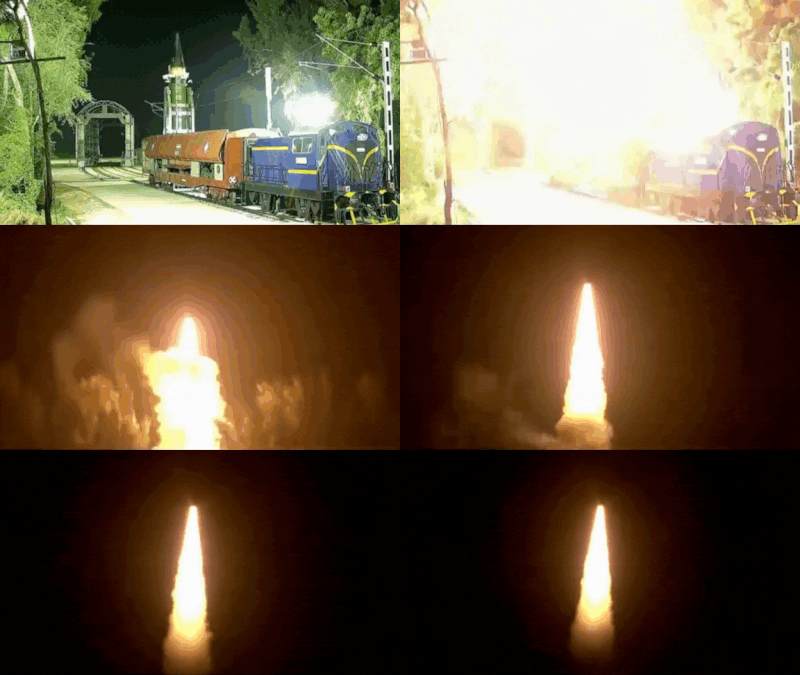
    The Defence Research and Development Organisation (DRDO) and the Strategic Forces Command (SFC) successfully test-fired the Agni-Prime missile from a rail-based mobile launcher, marking India’s first such operational test.

    About Agni-Prime Missile:

    • About: 6th missile in the Agni family, developed under the Integrated Guided Missile Development Programme (IGMDP).
    • Design: Two-stage, solid-propellant, canisterised surface-to-surface ballistic missile.
    • Range and Payload: 1,000–2,000 km; covering both China and Pakistan; Payload: Up to 1.5 tonnes (1,500–3,000 kg).
    • Navigation: Dual redundant guidance system; Maneuverable Re-entry Vehicle (MaRV) with delta fins to evade missile defence systems.
    • Deployment: Already inducted in road-mobile canisterised version; now tested with rail-based mobile launcher.

    Global Context: Rail-Based Missile Technology:

    With Agni-P rail launch, joins this select strategic group.

    • Soviet Union: Operated RT-23 Molodets Intercontinental Ballistic Missile (ICBM) on rail; dismantled after START Treaty.
    • Russia: Planned Barguzin rail-mobile ICBM system, shelved to focus on hypersonics.
    • United States: Explored rail-mobile Minuteman and Peacekeeper ICBMs, cancelled post-Cold War.
    • China: Tested rail-mobile DF-41 ICBM in 2016.
    • North Korea: Tested rail-based Short-Range Ballistic Missile system in 2021.

    Significance of Rail-Based Launch:

    • Mobility & Concealment: Railcars move across the network, hide in tunnels, evade satellite detection.
    • Survivability: Unlike silos, less vulnerable to pre-emptive strikes.
    • Rapid Response: Enables quick deployment and shorter reaction time.
    • Strategic Deterrence: Boosts credible second-strike nuclear capability.
    • Technological Showcase: Demonstrates India’s maturity in missile systems.

    Back2Basics: Integrated Guided Missile Development Programme (IGMDP)

    • Launch: Conceived in 1983 by Dr. A.P.J. Abdul Kalam to achieve self-reliance in missile technology.
    • Completion: 2012.
    • Missile Family (P-A-T-N-A):
      • Prithvi – Short-range ballistic missile.
      • Agni – Ballistic missiles of multiple ranges (Agni I–V, Agni-P).
      • Trishul – Short-range surface-to-air missile.
      • Nag – 3rd generation anti-tank guided missile.
      • Akash – Medium-range surface-to-air missile.

    Agni Series and its Development:

    • Origins: Began in 1983 under the IGMDP led by Dr. Kalam.
    • Evolution: Started as technology demonstrators for re-entry vehicles; later developed into full-fledged strategic missiles.
    • Variants:
      • Agni-I: 700–1,200 km range, inducted 2007.
      • Agni-II: 2,000–3,000 km range, inducted 2010.
      • Agni-III: 3,500 km range, highly accurate, tested 2007.
      • Agni-IV: 4,000 km range, advanced avionics, tested 2011.
      • Agni-V: 5,000+ km range, ICBM, MIRV capable.
      • Agni Prime (Agni-P): 1,000–2,000 km, lighter, tested 2021.
      • Agni-VI: Under development, 6,000–10,000 km, MIRV + submarine launch capable.
    • Significance: Backbone of India’s nuclear triad, enhancing deterrence against regional and global adversaries.


    [UPSC 2023] Consider the following statements:

    1. Ballistic missiles are jet-propelled at subsonic speeds throughout their fights, while cruise missiles are rocket-powered only in the initial phase of flight.

    2. Agni-V is a medium-range supersonic cruise missile, while BrahMos is a solid-fuelled intercontinental ballistic missile.

    Which of the statements given above is/are correct?

    (a) 1 only (b) 2 only (c) Both 1 and 2 (d) Neither 1 nor 2*


  • MGNREGA Scheme

    Centre amends MGNREGA for Water Conservation in Scarcity Zones

    Why in the News?

    The Central Government has amended the Mahatma Gandhi National Rural Employment Guarantee Act (2005) to mandate a minimum share of funds for water conservation and harvesting works. Earlier this month, MGNREGA completed 20 years of its implementation.

    What is entailed in this MGNREGA (2005) Amendment?

    • Objective: Prioritise long-term water management, shift focus from reactive drought relief to preventive groundwater conservation.
    • Provision Amended: Paragraph 4(2), Schedule I of MGNREGA (2005).
    • Mandate: Minimum share of MGNREGA funds earmarked for water conservation & harvesting works.
    • Allocation Criteria: Based on groundwater stress classification (Central Ground Water Board (CGWB) assessment):
      • 65% in over-exploited / critical (dark zones).
      • 40% in semi-critical blocks.
      • 30% in safe/non-critical blocks.
    • Responsibility: District Programme Coordinator / Programme Officer must ensure compliance.
    • Earlier Provision: Gram Panchayats could prioritise works; at least 60% of funds had to go to agriculture & allied works, including water.

    About MGNREGA:

    • Overview: MGNREGS is a rights-based Centrally Sponsored Scheme launched under the MGNREGA Act of 2005 to ensure the Right to Work for rural households.
    • Origins:
      • The idea of employment guarantee in India began with Maharashtra’s pilot, Employment Guarantee Scheme (MEGS), in 1965 under the Vasantrao Naik government.
      • At the national level, the idea was first proposed in 1991 by then PM P. V. Narasimha Rao and later enacted in 2005.
    • Employment Guarantee: It provides 100 days of wage employment per year to any adult willing to do unskilled manual labour in rural India.
    • Legal Obligation: It is the first law in India that imposes a legal duty on the government to provide employment and compensate for non-compliance.
    • Development Goal: The scheme aims to promote livelihood security, inclusive growth, and rural development.

    Key Features:

    • Statutory Right: Employment under MGNREGS is a legal entitlement, not just a welfare scheme.
    • Eligibility: Any rural adult aged 18 or above can apply and must be offered work within 15 days.
    • Proximity and Wages: Work must be provided within 5 km of the applicant’s residence with minimum wage, and delays attract compensation.
    • Unemployment Allowance: If work is not provided on time, the state must pay an allowance.
    • Demand-Driven Model: The scheme is worker-initiated, requiring the government to respond to demand.
    • Transparency and Audits: Regular social audits and online updates ensure accountability in job cards, muster rolls, and fund use.
    • Local Implementation: It is decentralised, led by Gram Panchayats, with support from block and state officials, and centrally funded.
    • Women’s Inclusion: At least one-third of beneficiaries must be women, enhancing gender equity.
    • Sustainable Assets: Projects focus on durable rural infrastructure like ponds, roads, canals, and plantations.
    [UPSC 2011] Among the following who are eligible to benefit from the “Mahatma Gandhi National Rural Employment Guarantee Act”?

    (a) Adult members of only the scheduled caste and scheduled tribe households

    (b) Adult members of below poverty line (BPL) households

    (c) Adult members of households of all backward communities

    (d) Adult members of any household *


  • Iran’s Nuclear Program & Western Sanctions

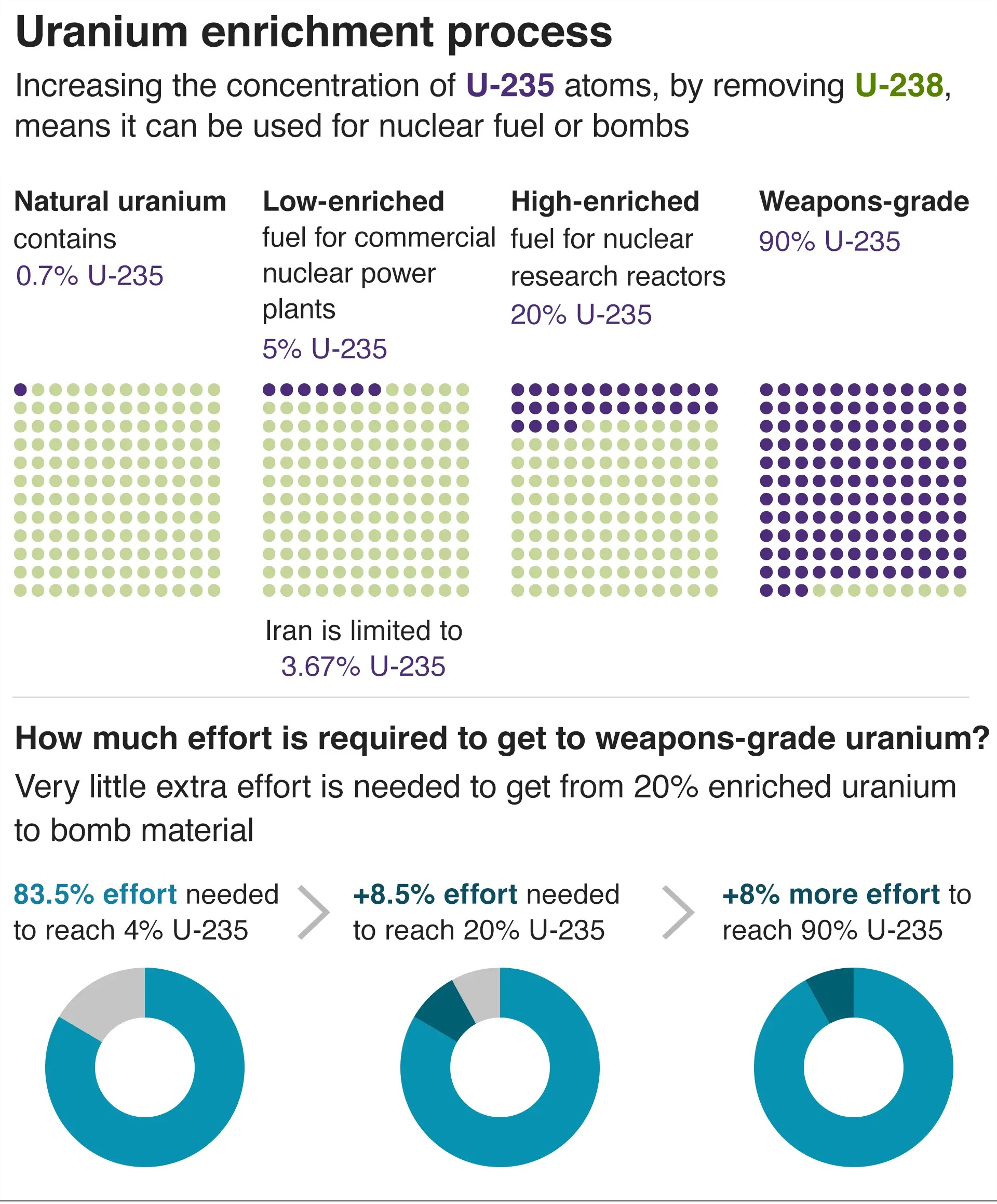
    What is Uranium Enrichment?

    Why in the News?

    Iran’s supreme leader recently said Tehran has limited uranium enrichment to 60% U-235 and will not pursue further enrichment to ~90% (weapons grade).

    About Uranium Enrichment:

    • What is it: The process of increasing the proportion of U-235 isotope in uranium samples. Natural uranium has only 0.7% U-235, while the rest is mostly U-238.
    • Types of Enrichment:
      • Low-Enriched Uranium (3–5%): Used in civilian nuclear power reactors.
      • Highly Enriched Uranium (HEU, >20%): At 90%+ enrichment, uranium becomes weapons-grade, usable for efficient nuclear weapons.
    • Methods: Physical separation methods such as gas centrifuges, requiring advanced infrastructure and technology.
    • Implications:
      • Low enrichment: Controlled power generation.
      • High enrichment: Proliferation risks, shorter path to nuclear weapons capability.

    What is Uranium Enrichment?

    Controversy about Iran’s Pursuit:

    • Declared Program: Iran enriches uranium to 60% U-235, claiming peaceful purposes, but insists it will not pursue 90%+ enrichment.
    • Global Concerns:
      • Civilian irrelevance: 60% has no reactor use, only shortens the “breakout time” to weapons-grade.
      • IAEA Monitoring: International Atomic Energy Agency reports show significant 60% stockpiles, heightening suspicion.
    • Geopolitical Context:
      • Joint Comprehensive Plan of Action (2015) capped enrichment at 3.67% but collapsed after U.S. withdrawal in 2018.
      • Western governments see 60% enrichment as undermining trust, while Iran argues it is a deterrence and bargaining tool.
    • Strategic Dimension: Keeps Iran on the nuclear threshold, enabling leverage in negotiations and projecting deterrence without overt weaponisation.
    [UPSC 2023] Consider the following statements:

    Statement-I: India, despite having uranium deposits, depends on coal for most of its electricity production.

    Statement-II: Uranium, enriched to the extent of at least 60%, is required for the production of electricity.

    Which one of the following is correct in respect of the above statements?

    (a) Both Statement-I and Statement-II are correct and Statement-II is the correct explanation for Statement-I

    (b) Both Statement-I and Statement-II are correct and Statement-II is not the correct explanation for Statement-1

    (c) Statement-I is correct but Statement-II is incorrect *

    (d) Statement-I is incorrect but Statement-II is correct


  • Horticulture, Floriculture, Commercial crops, Bamboo Production – MIDH, NFSM-CC, etc.

    Coffee Board to hold awareness program on EUDR compliance

    Why in the News?

    The Coffee Board of India has launched extensive awareness and capacity-building programmes to help coffee growers register on its mobile application for EU Deforestation Regulation (EUDR) compliance.

    What are EU Deforestation Regulation (EUDR)?

    • About: Effective from June 2023; Prevent imported products like coffee, cocoa, palm oil, soy, rubber, cattle, wood (and derivatives) from being linked to deforestation.
    • Requirements:

      • Proof of production on non-deforested land (post-2020).
      • Mandatory due diligence statement with geo-coordinates.
    • Penalties: Non-compliance may attract fines up to 4% of EU turnover, seizure of products, and temporary bans.

    About Coffee Board of India:

    • Establishment: In 1942 under the Coffee Act, Section 4; Functions under the Ministry of Commerce & Industry; Headquartered at Bengaluru, Karnataka.
    • Structure: A statutory organisation comprising 33 members, with the Chairperson/CEO appointed by the Government of India.
    • Focus areas: Research, Extension, Development, Market Intelligence, Export Promotion, Domestic Promotion.
    • Early years: Coffee marketing was under the pooling system until 1995, after which liberalisation shifted marketing to the private sector.
    • Initiatives: Runs promotional campaigns like India Coffee, Walk With Coffee, and awareness on EUDR compliance for exports.

    Back2Basics: Coffee Cultivation in India:

    • Overview: Coffee introduced in 1600 AD by Baba Budan in Chikmagalur, Karnataka.
    • Geographical Spread: Grown in the Western Ghats (Karnataka, Kerala, Tamil Nadu) and in smaller areas of Andhra Pradesh, Odisha, and Northeast India.
    • Production Share: Karnataka ~ 70%, Kerala ~ 20%, Tamil Nadu ~ 7%.
    • Agro-climatic Conditions: Requires 16°–28°C temperature, 150–250 cm rainfall, and well-drained slopes; sensitive to frost, dry spells, and harsh sunlight.
    • Soil: Grows best in laterite soils of Karnataka and rich, well-drained loams.
    • Varieties:

      • Arabica: Mild aromatic flavour, high export value, but more susceptible to pests/diseases.
      • Robusta: Hardy, disease-resistant, stronger taste, higher yields.
      • Liberica:  Rare, niche cultivation.
    • Seasonality: Coffee exports peak during March–June.
    • Domestic Consumption: Rising gradually; Coffee Board promoting events like International Coffee Day (October 1) to increase per capita intake.

    Production Statistics (2025-26):

    • India’s coffee production:  It is projected at a record 4.03 lakh tonnes in 2025 up 11% from last year’s 363,000 tonnes.
      • Arabica output forecast: 118,000 tonnes, up 12% year-on-year.
      • Robusta output forecast: 285,000 tonnes, up 9.5%.
    • Karnataka contributes ~70% of output, followed by Kerala and Tamil Nadu.
    • India is the world’s 7th largest producer and 5th largest exporter, contributing 3.5% of global production and 5% of global exports.
    • Exports: Reached $1.8 billion in 2024-25, a 125% growth over 11 years (from $800 million in 2014-15).
      • Around 70% of Indian coffee is exported, mainly to Europe (Italy, Germany, Belgium), the Middle East, Japan, and Korea.


    [UPSC 2022] With reference to the “Tea Board” in India, consider the following statements :

    1. The Tea Board is a statutory body.

    2. It is a regulatory body attached to the Ministry of Agriculture and Farmers Welfare.

    3. The Tea Board’s Head Office is situated in Bengaluru.

    4. The Board has overseas offices at Dubai and Moscow.

    Which of the statements given above are correct ?

    Options: (a) 1 and 3 (b) 2 and 4 (c) 3 and 4 (d) 1 and 4 *


  • New Species of Plants and Animals Discovered

    New species of finless Snake Eel named after Kanniyakumari

    Why in the News?

    ICAR- National Bureau of Fish Genetic Resources (NBFGR) researchers in Kochi have discovered a new finless snake eel species, Apterichtus kanniyakumari, named after Kanniyakumari district.

    New species of finless Snake Eel named after Kanniyakumari

    About Finless Snake Eel (Apterichtus kanniyakumari):

    • Location: Discovered off the Colachel coast, Kanniyakumari (Tamil Nadu), at ~100 m depth during deep-sea trawling.
    • Etymology: Named kanniyakumari in honour of the district’s cultural, linguistic, historical, and geographical heritage.
    • Taxonomy: Belongs to the genus Apterichtus, family Ophichthidae, commonly known as finless snake eels.
    • Morphological traits: Golden-yellow body, pale white ventral head with yellow jaw lines, three black blotches (behind eyes, at rictus, behind rictus origin), conical uniserial teeth, 3 preopercular & 9 supratemporal pores.
    • Molecular confirmation: Mitochondrial CO1 gene analysis shows it as a distinct clade, closely related to Apterichtus nanjilnaduensis.
    • Significance: Marks the 16th new species described from the Indian coast by NBFGR; adds to India’s marine biodiversity records.
    [UPSC 2016] Recently, our scientists have discovered a new and distinct species of banana plant which attains a height of about 11 meters and has orange coloured fruit pulp. In which part of India has it been discovered?

    (a) Andaman Islands *

    (b) Anaimalai Forests

    (c) Maikala Hills

    (d) Tropical rain forests of northeast


  • Urban Floods

    [25th September 2025] The Hindu Op-ed: Follow the rains, not the calendar to fight floods

    PYQ Relevance

    [UPSC 2016] The frequency of urban floods due to high-intensity rainfall is increasing over the years. Discussing the reasons for urban floods, highlight the mechanisms for preparedness to reduce the risk during such events.

    Linkage: This PYQ is directly linked to the article as both focus on increasing urban floods due to high-intensity, untimely rainfall and the need for better preparedness. It is important for UPSC as it tests understanding of climate change impacts, urban governance, and disaster management, all of which the article highlights through outdated drainage design, rainfall compression, and the need to “follow the rains, not the calendar.

    Mentor’s Comment

    Urban floods are no longer seasonal accidents; they are recurring crises that expose the mismatch between traditional planning calendars and the realities of a changing climate. This article unpacks the failures of outdated urban flood management and suggests a roadmap for building resilient cities. Aspirants must note its direct relevance to GS 1 (urbanisation), GS 2 (governance), GS 3 (disaster management, environment), and GS 4 (ethics in governance).

    Introduction

    Every monsoon, India’s cities brace for floods with desilting of drains, deploying contractors, and activating emergency protocols. Yet, reality unfolds differently, roads submerge, homes flood, and transport grinds to a halt. The core problem lies not only in the intensity and unpredictability of rainfall but also in city systems designed for a climate that no longer exists. Urban resilience now demands shifting from “seasonal schedules” to real-time rainfall preparedness.

    Why in the News?

    This year, northern states like Punjab (all 23 districts), Delhi, and Gurugram witnessed severe floods in September, well beyond the traditional monsoon period. Uttarakhand and Himachal Pradesh saw frequent cloudbursts, while Kolkata faced torrential rains. Such untimely, intense, and regionally widespread flooding marks a sharp departure from past rainfall behaviour. With single floods now causing damages worth ₹8,700 crore, the urgency to rethink urban flood management cannot be overstated.

    Understanding Changing Rainfall Patterns

    1. Shift in Timing: Mumbai recorded 135.4 mm rainfall in May (normally a pre-monsoon month), followed by 161.9 mm the next day. Delhi saw 81 mm fall in a few hours, overwhelming drains.
    2. Rise in Frequency: CEEW analysis shows 64% of tehsils across states like Maharashtra, Tamil Nadu, Gujarat, and Karnataka have seen heavy rainfall days increase by 1–15 days.
    3. Compression of Rainfall: Rainfall that earlier spanned a day is now compressed into hours, intensifying floods.

    Why are Indian Cities Flooding so Frequently?

    1. Outdated Drainage Design: Systems still rely on seasonal averages rather than short-duration, high-intensity rain data.
    2. Unmanaged Waste: Plastic and debris block drains; even after desilting, poor waste collection leads to quick clogging.
    3. Poor Coordination: Storm water, sanitation, and municipal waste departments work in silos, creating gaps in preparedness.
    4. Static Planning: Drainage infrastructure often relies on rainfall data decades old, ignoring evolving IDF (Intensity-Duration-Frequency) curves.

    What Solutions are Proposed?

    1. Sub-daily Rainfall Analysis: Municipalities must adopt rainfall data in smaller time frames (1–3 hours) to plan drainage.
    2. Drainage-Waste Synchronisation: Waste collection and drain cleaning must be coordinated; rainfall alerts should trigger joint drives.
    3. Updating IDF Curves: Curves must be revised every 5–10 years; new drainage should factor in topography and micro-catchments.
    4. Infrastructure Upgradation: Example – BMC’s plan to widen drains to handle 120 mm/hour rainfall and prepare a new drainage master plan.
    5. Separate Sewerage and Stormwater Networks: To prevent overload and improve efficiency.

    Broader Implications for Urban Planning

    1. Disaster Management: Floods are now the leading cause of life and property loss among natural disasters in India.
    2. Economic Impact: Each major flood inflicts damages of nearly ₹8,700 crore.
    3. Climate Resilience: Cities must adapt to “rain already falling” instead of waiting for calendar-based monsoon onset.

    Conclusion

    India is not losing to rain, but to outdated assumptions about rain. The fight against urban floods requires breaking the illusion of a uniform monsoon season. By following the rain, not the calendar, cities can design adaptive infrastructure, improve inter-departmental coordination, and protect citizens’ lives and livelihoods.

    Value Addition

    Case Study: Vijayawada’s Monsoon Response Teams

    • Integrated approach: The city administration created special monsoon response teams that brought together officials from the sanitation, engineering, and planning departments to work in coordination during high-risk rainy periods.
    • Real-time action: Instead of relying on rigid seasonal schedules, these teams responded dynamically to rainfall alerts and forecasts, immediately conducting joint sanitation drives and drain inspections.
    • Drainage & waste sync: Garbage clearance and storm water drain cleaning were aligned, preventing freshly desilted drains from being blocked again by unmanaged waste.
    • Impact: This reduced waterlogging and urban flooding, improved road accessibility, and lessened health risks for residents during monsoons.
    • Learning: Vijayawada shows how inter-departmental coordination, proactive planning, and rainfall-triggered response systems can make cities more resilient to changing monsoon patterns.

    Global Context in Urban Flood Management

    Rotterdam, Netherlands – “Room for the River” approach

    • Idea: Instead of resisting water, the city creates water plazas that double as playgrounds during dry weather and hold excess rainwater during storms.
    • Infrastructure: Underground reservoirs, widened canals, and lowered floodplains to absorb water.
    • Learning: Shows the importance of adaptive urban design that accommodates rainfall variability.

    Copenhagen, Denmark – Cloudburst Management Plan

    • Trigger: After a massive cloudburst in 2011 caused $1 billion in damages.
    • Action: Developed over 300 projects including green roofs, permeable pavements, detention basins, and blue-green corridors that store and channel stormwater.
    • Learning: Proactive planning with a mix of nature-based and engineered solutions.

    New York City, USA – Green Infrastructure Plan

    • Focus: Reduce stormwater runoff that overwhelms combined sewer systems.
    • Measures: Rain gardens, bioswales, green roofs, permeable streets to capture rainfall locally.
    • Learning: Urban flooding is not just a drainage issue but requires land-use and design-based solutions.

    Singapore – ABC Waters Programme (Active, Beautiful, Clean)

    • Approach: Transforms canals, rivers, and drains into multifunctional spaces.
    • Measures: Retention ponds, vegetated swales, rain gardens integrated with urban landscapes.
    • Learning: Integrates aesthetics, ecology, and flood management, showing flood resilience can coexist with urban beauty.

    Tokyo, Japan – Underground Flood Tunnels (G-Cans Project)

    • Infrastructure: World’s largest underground floodwater diversion facility with 6.5 km tunnels and giant silos to store stormwater.
    • Impact: Protects Tokyo’s dense urban areas from typhoon rains and river overflow.
    • Learning: Mega-engineering projects can be effective in high-density megacities with extreme rainfall.


  • Differentiated Banks – Payment Banks, Small Finance Banks, etc.

    Swipe, Tap, Spend: How UPI is a decisive step towards formalization of Indian Economy

    Introduction

    India’s journey towards a cash-lite economy has been marked by a staggering rise in UPI transactions, reflecting a decisive shift in household and business payment patterns. From groceries to loans, from investments to utility bills, UPI has emerged as the backbone of everyday economic life. This transformation is not merely technological but a structural change towards the formalisation of the economy, reducing cash-dependency while boosting transparency and traceability in transactions.

    Why is UPI making news now?

    1. Staggering growth: In April–June 2025, 34.9 billion person-to-merchant transactions occurred through UPI, worth ₹20.4 lakh crore, equal to 40% of private final consumption expenditure, up from 24% two years ago.
    2. Shift from ATMs: Cash withdrawals, once dominant, have halved despite the economy doubling in size—falling from ₹2.6 lakh crore (2018) to ₹2.3 lakh crore (2025).
    3. Wider impact: UPI is now used not only for routine consumption but also for debt repayments, investments, and financial services, signalling a major step in economic formalisation.

    How has household spending been transformed?

    1. Digital dominance: Household payments, earlier cash-heavy, are increasingly routed through UPI across income classes.
    2. Food & beverages: In April–June 2025, households spent ₹3.4 lakh crore on food and beverages via UPI—17% of all UPI transactions and 21% of household expenditure.
    3. Non-food items: Payments include utilities, medicines, petrol, taxi rides, and electronics, accounting for two-thirds of person-to-merchant transfers.

    What about precautionary savings and cash usage?

    1. Decline in cash holdings: Household currency holdings fell from 12.5% of gross savings (2020–21) to just 3.4% in 2023–24.
    2. Changing behaviour: While cash remains important for land, gold, and election financing, its share in household savings has been on a consistent decline.

    How is UPI impacting financial formalisation?

    1. Formalisation of firms and workers: Increased traceable transactions complement reforms like GST registrations and EPFO contributions, enhancing formalisation.
    2. Beyond consumption: UPI in July 2025 facilitated ₹93,857 crore debt repayments and ₹61,080 crore investments into securities—indicating a structural integration of households into formal financial markets.

    What are the larger implications for the economy?

    1. Scaling up formal economy: Digital payments extend across small, medium, and big-ticket transactions, shrinking the space for the informal sector.
    2. Global context: Countries like Germany also have high cash usage despite digitisation—India’s transformation is striking in scale.
    3. Policy question: With the public currency-to-GDP ratio falling from 12.9% (2022) to 10.9% (2025), the debate is whether India has reached an inflection point towards becoming a sustained cash-lite economy.

    Conclusion

    UPI’s ascendancy reflects not just a technological success but a social and economic restructuring of India. By shifting transactions from cash to traceable platforms, it has enhanced formalisation, reduced leakages, and encouraged financial inclusion. The challenge ahead lies in ensuring this transformation is sustainable while safeguarding against risks like digital divides, cybersecurity threats, and over-dependence on electronic infrastructure.

    PYQ Relevance:

    [UPSC 2023] What is the status of digitalization in the Indian economy? Examine the problems faced in this regard and suggest improvements.

    Linkage: This PYQ is important as UPSC often tests themes of digitalisation, financial inclusion, and formalisation of the economy under GS3. The article helps answer it by showing UPI’s role in reducing cash reliance and formalising payments, while also pointing to persisting challenges like cash use in land, gold, and elections.

    Value Addition

    Benefits of UPI

    • Digitalisation of the Economy: 
      1. UPI has made India the world’s largest real-time digital payments ecosystem (over 50% of global real-time transactions, as per the ACI Worldwide 2023 report).
      2. Strengthens transparency, traceability, and reduces black money circulation.
    • Financial Inclusion:
      1. UPI transactions span urban malls to rural kirana stores, enabling low-cost access for the unbanked.
      2. Integration with Aadhaar, Jan Dhan, and mobile numbers creates a seamless financial ecosystem.
    • Globalisation × Formal & Informal Economy:
      1. Shifts large segments from cash-heavy informal sector to traceable, formal payments.
      2. Helps MSMEs and street vendors gain access to credit as digital history substitutes collateral.
    • Economic Growth and Development:
      1. Boosts consumption visibility, enabling better policy targeting.
      2. Encourages formal lending and investments—e.g., ₹93,857 crore in debt repayments via UPI (article data).
  • Right To Privacy

    How are courts protecting personality rights?

    Introduction

    Personality rights, the right to control one’s name, image, likeness, and voice, have become a critical issue in India’s courts. With AI enabling deepfakes, voice cloning, and digital impersonation, Bollywood celebrities like Aishwarya Rai Bachchan, Abhishek Bachchan, Anil Kapoor, and Jackie Shroff have approached courts to restrain unauthorised commercial exploitation of their persona. While these judicial interventions protect individual dignity and brand equity, they also raise complex questions about the balance between Article 21 (privacy and autonomy) and Article 19(1)(a) (freedom of speech and expression).

    Why is this in the news?

    The Delhi High Court recently issued orders protecting Aishwarya Rai Bachchan and Abhishek Bachchan from AI-generated misuse of their images and voices. This is significant because:

    1. Novel threat: It highlights how AI deepfakes and voice cloning are creating unprecedented risks for identity and privacy.
    2. Judicial trend: Courts are extending personality rights protections to celebrities such as Karan Johar, Amitabh Bachchan, Anil Kapoor, Jackie Shroff, and Arijit Singh.
    3. Big problem: Without regulation, AI-driven impersonation undermines trust, dilutes brand equity, and strips individuals of control over their identity.
    4. Turning point: Courts are now explicitly linking personality rights to Article 21 of the Constitution, signalling a constitutional recognition of digital dignity.

    How are personality rights defined in India?

    1. Safeguards: Personality rights protect name, likeness, image, voice, signature, and other unique traits.
    2. Legal foundation: Rooted in common law doctrines of privacy, publicity, and defamation, supported by judicial precedents.

    Statutory framework:

    1. Copyright Act, 1957: Sections 38A & 38B grant performers exclusive and moral rights over their performances.
    2. Trade Marks Act, 1999: Allows registration of names/signatures as trademarks (e.g., Shah Rukh Khan, Priyanka Chopra).
    3. Tort of Passing Off: Prevents misrepresentation of a celebrity’s persona as endorsement.

    How have courts shaped personality rights?

    1. R. Rajagopal v. State of Tamil Nadu (1994): Supreme Court recognised the right to control one’s identity, grounding it in privacy under Article 21.
    2. Rajinikanth case (2015): Madras HC restrained unauthorised use of the actor’s persona in a film.
    3. Anil Kapoor case (2023): Delhi HC granted wide-ranging protection, clarifying that free speech covers parody/satire but not commercial misuse.
    4. Jackie Shroff case (2024): Court restrained misuse of his persona on e-commerce and AI platforms.
    5. Arijit Singh case (2024): Bombay HC recognised risks of voice cloning through AI.

    Do personality rights restrict free expression?

    Free speech scope: Article 19(1)(a) allows criticism, parody, satire, and lampooning of public figures.

    Judicial caution:

    1. DM Entertainment v. Baby Gift House (2010): Caricatures and parodies do not usually infringe publicity rights.
    2. Digital Collectibles v. Galactus Funware (2023): Material already in the public domain may be used without implying endorsement.
    3. Balancing test: Courts strike a balance between creative freedom and protection of dignity/brand equity.

    Why is regulation urgently needed?

    1. Fragmented protections: Enforcement is currently piecemeal, relying on case law.
    2. Digital threats: Generative AI expands risks of impersonation and deepfakes.
    3. Disproportionate impact: Ordinary citizens, especially women targeted through revenge porn, face greater harm.
    4. Policy need: Experts call for a comprehensive legislative framework to clearly define exceptions and ensure free speech is not chilled.

    Conclusion

    The judiciary is laying down crucial guardrails for personality rights in the digital age, particularly against AI-driven impersonation. However, without a clear legislative framework, judicial interventions remain reactive. The challenge lies in balancing dignity and privacy with freedom of speech, ensuring that protections do not turn into censorship while still safeguarding individuals, from Bollywood celebrities to ordinary citizens, against misuse of their identity.

    [UPSC 2024] Right to privacy is intrinsic to life and personal liberty and is inherently protected under Article 21 of the constitution. Explain. In this reference discuss the law relating to D.N.A. testing of child in the womb to establish its paternity.

    Linkage: The PYQ on Right to Privacy under Article 21 examines autonomy over personal identity, like in DNA testing. This article is relevant as it shows courts extending privacy into personality rights against AI misuse, with case laws and statutes providing examples to balance privacy and free speech in UPSC answers.

    Value Addition

    Global Context & Reports

    1. WIPO Intellectual Property Report (2022): Notes rapid rise of personality/IP litigation due to digital commerce.
    2. UNESCO Report on AI & Ethics (2021): Warns against deepfakes undermining democratic discourse and human dignity.
    3. US “Right of Publicity” Laws: Celebrities can sue for unauthorised commercial use of their persona, providing comparative perspective.
    4. EU GDPR (2018): Protects personal data, extending indirectly to digital identity misuse.


  • Monsoon Updates

    South-west Monsoon: Its Onset and Retreat

    Why in the News?

    According to the India Meteorological Department (IMD), the southwest monsoon began its earliest withdrawal in a decade on September 14 from western Rajasthan, three days before the usual date of September 17.

    What is Monsoon? 

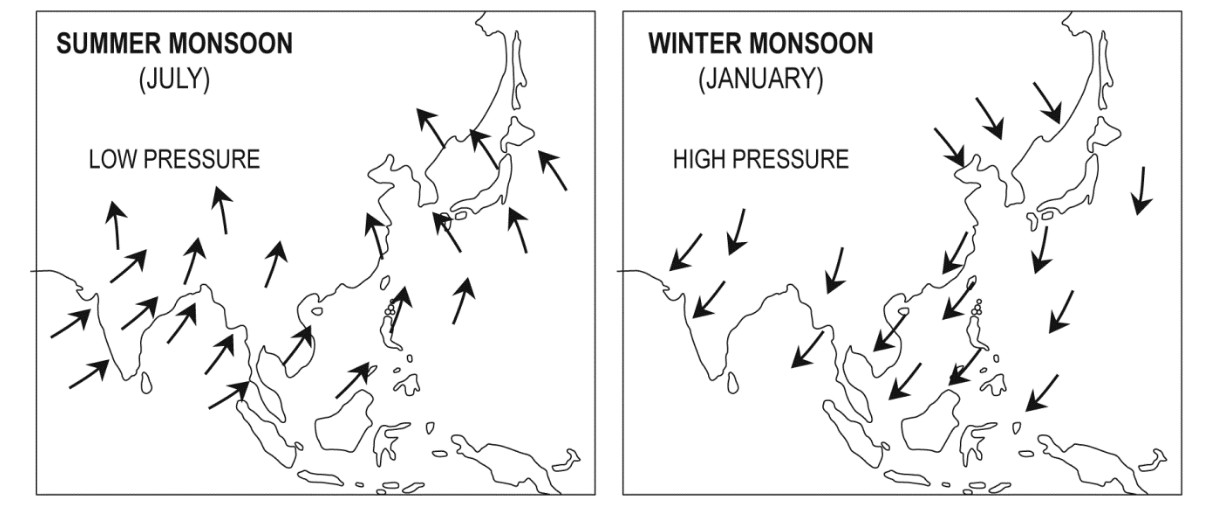
    • Overview: A seasonal reversal of winds, southwest winds (wet) in summer and northeast winds (dry) in winter.
    • Onset Date: Officially begins June 1 over Kerala, advances northwards, covering entire India by mid-July.
    • Importance: Accounts for ~75% of India’s annual rainfall, critical for Kharif crops, water storage, and ecosystems.

    Mechanism of Monsoon Onset:

    • Differential Heating: Indian landmass heats faster than the Indian Ocean, creating low pressure over NW India that pulls in moist winds.
    • Mascarene Highs:
      • Located near Mascarene Islands (east of Madagascar).
      • Strengthen during May–June winter in Southern Hemisphere.
      • Push strong cross-equatorial winds from the SE Indian Ocean towards India.
    • Cross-Equatorial Flow:
      • Southeast trades from Mascarene High cross the equator.
      • Deflected by Coriolis, they become southwest monsoon winds, feeding both Arabian Sea branch and Bay of Bengal branch.
    • ITCZ (Intertropical Convergence Zone) Shift: Moves northwards over Ganga plains, anchoring the monsoon trough.
    • Tibetan Plateau Heating: Acts as an elevated heat source, deepening low pressure.
    • Jet Stream Influence:
      • Subtropical Westerly Jet (STWJ) shifts north of Himalayas, allowing the monsoon trough.
      • Tropical Easterly Jet (TEJ) develops, enhancing moisture flow.
    • Local Triggers: Orographic uplift along Western Ghats, NE Hills, and Indo-Gangetic plains causes heavy rains.

    What is Retreat/Withdrawal of Monsoon?

    • Earliest Withdrawal (2025): Began Sept 14 from western Rajasthan — earliest in a decade (normal = Sept 17).
    • Withdrawal Process: Gradual, completes by mid-October.
    • IMD Withdrawal Criteria:
      1. Development of anti-cyclonic circulation at lower troposphere.
      2. No rainfall for 5 consecutive days over the region.
      3. Prevalence of dry weather conditions.
    • Seasonal Marker: IMD fixes Sept 30 as the official end of SW monsoon.
    • Agricultural Role: Retreat moisture crucial for Rabi crop sowing.

    Influencing Factors for Monsoon Retreat:

    • Seasonal Cooling: Reduced solar heating over land in September weakens low pressure.
    • Pressure Gradient Reversal: High pressure redevelops over NW India, collapsing SW winds.
    • ITCZ Shift: Moves back southwards towards the equator, reversing wind patterns.
    • Jet Stream Role: TEJ weakens, westerlies return, pushing out moist winds.
    • Topography & Seas: Coastal and mountainous regions (e.g., SE peninsula, Bay of Bengal) may still receive residual/post-monsoon showers.
    • Mascarene Highs: As SH winter ends, Mascarene highs weaken, cross-equatorial inflow diminishes, aiding withdrawal.

    Climatic Phenomena affecting the Indian Monsoon:

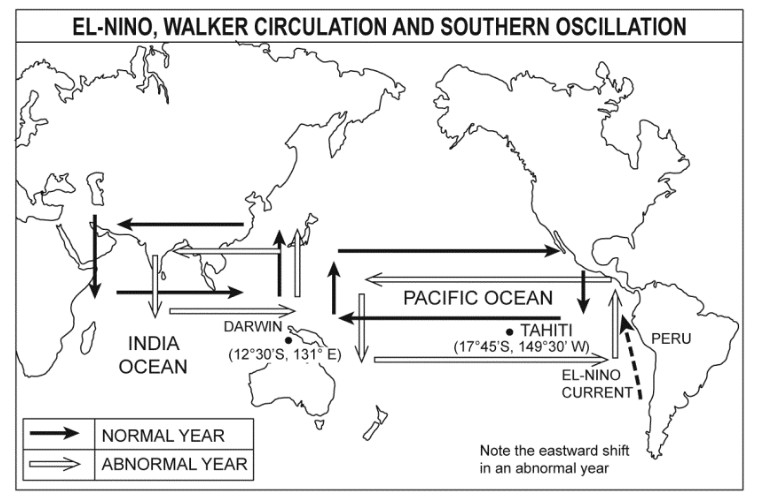
    1. ENSO (El Niño–Southern Oscillation):

    • ENSO originates in the equatorial Pacific Ocean and strongly influences the Pacific Walker Circulation (PWC).
      1. El Niño years: The eastern and central Pacific waters warm up. This weakens the Walker circulation and reduces the flow of moisture-laden winds from the Mascarene Highs towards India. As a result, the monsoon becomes weak or deficient, often leading to droughts.
      2. La Niña years: The opposite happens; Pacific waters cool, the Walker circulation strengthens, and strong cross-equatorial winds from the Mascarene Highs bring more moisture into India. Monsoon rainfall is usually above normal, sometimes leading to floods.
    • Key point: ENSO acts like a “remote controller” sitting in the Pacific but directly influencing the strength of the Indian monsoon winds.

    2. Indian Ocean Dipole (IOD):

    • The Indian Ocean itself has its own seesaw pattern of sea surface temperatures.
      • Positive IOD: Western Indian Ocean (near Africa) is warmer, and eastern Indian Ocean (near Indonesia) is cooler. This strengthens cross-equatorial winds from the Mascarene Highs, feeding more moisture into India. Result: Good rainfall, strong monsoon, even if El Niño is present.
      • Negative IOD: Western Indian Ocean is cooler, eastern side is warmer. This pulls away monsoon winds from India and weakens the rainfall.
    • Key point: IOD is a “local driver” sitting in the Indian Ocean, which can either amplify or cancel out ENSO’s effect.

    3. ENSO–IOD Interaction:

    • Monsoon outcome is not decided by ENSO or IOD alone, but by how they combine:
      • El Niño + Positive IOD: IOD can cancel El Niño’s bad effect (1997 monsoon was near normal).
      • El Niño + Negative IOD: Worst-case combo, often brings severe droughts.
      • La Niña + Positive IOD: Both reinforce each other, leading to very heavy rainfall and flood risk.
      • ENSO Neutral + Positive/Negative IOD: IOD becomes the deciding factor.

    The Big Picture:

    • Pacific Walker Circulation is the “conveyor belt” moving rising and sinking air across the Pacific and Indian Oceans.
      • When it shifts east (El Niño): India gets less rain.
      • When it strengthens west (La Niña): India gets more rain.
    • IOD modifies this system locally in the Indian Ocean-  it can either buffer or worsen ENSO’s impact.
    • The Mascarene Highs act as the main “engine room” for cross-equatorial winds, but the Walker circulation and IOD decide how strong that engine runs.
    • Madden–Julian Oscillation (MJO): An eastward-moving pulse of cloud and rainfall that travels around the equator every 30–60 days.
      • MJO decides the intra-seasonal variability: when it rains heavily (active phase) and when dry breaks occur.


    [UPSC 2012] Consider the following statements:

    1. The duration of the monsoon decreases from southern India to northern India.

    2. The amount of annual rainfall in the northern plains of India decreases from east to west.

    Which of the statements given above is/are correct?

    Options: (a) 1 Only (b) 2 Only (c) Both 1 and 2* (d) Neither 1 nor 2


    [UPSC 2017] With reference to ‘Indian Ocean Dipole (IOD)’ sometimes mentioned in the news while forecasting Indian monsoon, which of the following statements is/are correct?

    1. The IOD phenomenon is characterized by a difference in sea surface temperature between tropical Western Indian Ocean and tropical Eastern Pacific Ocean.

    2. An IOD phenomenon can influence an El Nino’s impact on the monsoon.

    Select the correct answer using the code given below:

    (a) 1 only  (b) 2 only * (c) Both 1 and 2  (d) Neither 1 nor 2


Join the Community

Join us across Social Media platforms.