💥UPSC 2026, 2027, 2028 UAP Mentorship (March Batch) + Access XFactor Notes & Microthemes PDF

Archives: News

  • Higher Education – RUSA, NIRF, HEFA, etc.

    Issues with the graded autonomy

    The article analyses the issues the graded with the graded autonomy to the Higher Education Institutes.

    Background

    • NEP 2020 provided for phasing out of the system of affiliated colleges and the grant of greater autonomy in academic, administrative and financial matters to premium colleges.

    Concerns with the autonomy

    • The move has raised concerns about the politico-bureaucratic interference in the internal functioning of universities.
    • It has also raised concerns about the substantial burden on universities which have to regulate admissions, set curricula and conduct examinations for a large number of undergraduate colleges.
    • Concerns have long existed about over-centralisation, due to constraints imposed on the potential for premium affiliated colleges to innovate and evolve.
    • These apprehensions about the autonomy came to be used by successive governments to build a case for the model of graded autonomy.

    The push towards graded autonomy

    • Successive governments have pushed through measures that have largely allowed for greater penetration of private capital in higher education.
    • Recommendations of recent education commissions have promoted the unequal structure of funding for higher education.
    • Under this, hierarchy in higher education was created: Central government-funded universities, provincial Central government-funded universities, regional universities and colleges funded by State governments, etc.
    • The National Knowledge Commission (2005) stated that good undergraduate colleges are constrained by their affiliated status… the problem is particularly acute for undergraduate colleges which are subjected to the ‘convoy problem’ as they are forced to move at the speed of the slowest.
    • In turn, the dominant policy discourse vocally propagates “graded autonomy” for better performing Higher Educational Institutions.
    • Under which academic excellence can be supported through a grant of special funds and allowing greater power to such institutions.
    • This basis has been gradually enforced with the UGC in 2018 granting public-funded universities the right to apply for autonomy based on whether they are ranked among top 500 of reputed world rankings or have National Assessment and Accreditation (NAAC) scores above 3.26.

    NEP 2020: Centralisation and autonomy

    • NEP 2020  is a combination of enhanced centralising features and specific features of autonomy.
    • Deeper centralisation is indicative in the constitution of the government nominated umbrella institution, Higher Education Council of India (HECI); Board of Governors, the National Education Commission etc.

    Concerns

    • The model of graded autonomy will encourage hierarchy that exists between different colleges within a public-funded university, and between different universities across the country.
    • While the best colleges gain the autonomy to bring in their own rules and regulations, affiliated colleges with lower rankings and less than 3,000 students face the threat of mergers and even closure.
    • A shrinking of the number of public-funded colleges will only further push out marginalised sections.
    • Autonomy could lead to more inaccessibility as the independent rules and regulations of autonomous colleges and universities shall curtail transparent admission procedures.
    • Graded autonomy can be expected to trigger a massive spurt in expensive self-financed courses as premium colleges, which will lead to exclusion.

    Conclusion “Examine the issues with the autonomy of Higher Education Institutes in the NEP 2020.”

    Conclusion

    More than deliverance, autonomy represents the via media for greater privatisation and enhanced hierarchization in higher education.

    Sources: https://www.thehindu.com/opinion/op-ed/privatisation-via-graded-autonomy/article32396753.ece

  • Minority Issues – SC, ST, Dalits, OBC, Reservations, etc.

    Domicile-based job quota in MP

    The Madhya Pradesh government’s recent decision to reserve all government jobs for “children of the state” raises constitutional questions relating to the fundamental right to equality.

    Try this PYQ:

    One of the implications of equality in society is the absence of- (CSP 2018)

    (a) Privileges

    (b) Restraints

    (c) Competition

    (d) Ideology

    Constitutional provision for Equal Treatment

    • Article 16 of the Constitution guarantees equal treatment under the law in matters of public employment. It prohibits the state from discriminating on grounds of place of birth or residence.
    • Article 16(2) states that “no citizen shall, on grounds only of religion, race, caste, sex, descent, place of birth, residence or any of them, be ineligible for, or discriminated against in respect of, any employment or office under the State”.
    • The provision is supplemented by the other clauses in the Constitution that guarantee equality.
    • However, Article 16(3) of the Constitution provides an exception by saying that Parliament may make a law “prescribing” a requirement of residence for jobs in a particular state.
    • This power vests solely in the Parliament, not state legislatures.

    Why does the Constitution prohibit reservation based on domicile?

    • When the Constitution came into force, India turned itself into one nation from a geographical unit of individual principalities and the idea of the universality of Indian citizenship took root.
    • India has single citizenship, and it gives citizens the liberty to move around freely in any part of the country.
    • Hence the requirement of a place of birth or residence cannot be qualifications for granting public employment in any state.

    But are reservations not granted on other grounds such as caste?

    • Equality enshrined in the Constitution is not mathematical equality and does not mean all citizens will be treated alike without any distinction.
    • To this effect, the Constitution underlines two distinct aspects which together form the essence of equality law:
    1. Non-discrimination among equals, and
    2. Affirmative action to equalize the unequal

    Supreme Court rulings on quota for locals

    • The Supreme Court has ruled against reservation based on place of birth or residence.
    • In 1984, ruling in Dr Pradeep Jain v Union of India, the issue of legislation for “sons of the soil” was discussed.
    • The court expressed an opinion that such policies would be unconstitutional but did not expressly rule on it as the case was on different aspects of the right to equality.
    • In a subsequent ruling in Sunanda Reddy v State of Andhra Pradesh (1995), the Supreme Court affirmed the observation in 1984 ruling to strike down a state government policy that gave 5% extra weightage to candidates.
    • In 2002, the Supreme Court invalidated appointment of government teachers in Rajasthan in which the state selection board gave preference to “applicants belonging to the district or the rural areas of the district concerned”.
    • In 2019, the Allahabad HC struck down a recruitment notification by the UP PSC which prescribed preference for women who are “original residents” of the UP alone.

    What about securing jobs for locals in the private sector?

    • Such a law will be difficult to implement even if allowed.
    • Private employers do not go on an annual recruitment drive to fill vacancies identified in advance but hire as and when required.
    • The state can recommend a preference to locals but ensuring that it is followed would be difficult.
    • In 2017, Karnataka mulled similar legislation but it was dropped after the state’s Advocate General raised questions on its legality.
    • In 2019, the state government once again issued a notification asking private employers to “prefer” Kannadigas for blue-collar jobs.

    How do some states then have laws that reserve jobs for locals?

    • Exercising the powers it has under Article 16(3), Parliament enacted the Public Employment (Requirement as to Residence) Act.
    • The act aimed at abolishing all existing residence requirements in the states and enacting exceptions only in the case of the special instances of Andhra Pradesh, Manipur, Tripura and Himachal Pradesh.
    • Constitutionally, some states also have special protections under Article 371. AP under Section 371(d) has powers to have “direct recruitment of local cadre” in specified areas.
    • Some states have gone around the mandate of Article 16(2) by using language. States that conduct official business in their regional languages prescribe knowledge of the language as a criterion.
    • This ensures that local citizens are preferred for jobs. For example, states including Maharashtra, West Bengal and Tamil Nadu require a language test.
  • Civil Services Reforms

    Setting up of National Recruitment Agency

    The Union Cabinet has approved the creation of a National Recruitment Agency (NRA) for conducting a Common Eligibility Test (CET) for various government jobs.

    Try this question:

    Q.Discuss the role and function of the newly setup National Recruitment Agency.

    National Recruitment Agency

    • NRA will be a Society registered under the Societies Registration Act, headed by a Chairman of the rank of the Secretary to the Government of India.
    • It will have representatives of the Ministry of Railways, Ministry of Finance/Department of Financial Services, the SSC, RRB and IBPS.
    • It is envisioned that the NRA would be a specialist body bringing the state-of-the-art technology and best practices to the field of Central Government recruitment.
    • The NRA will conduct the Common Eligibility Test (CET) for recruitment to non-gazetted posts in government and public sector banks.
    • This test aims to replace multiple examinations conducted by different recruiting agencies for selection to government jobs advertised each year, with a single online test.

    Salient features of NRA

    • The Common Eligibility Test will be held twice a year.
    • There will be different CETs for graduate level, 12th Pass level and 10th pass level to facilitate recruitment to vacancies at various levels.
    • The CET will be conducted in 12 major Indian languages. This is a major change, as hitherto examinations for recruitment to Central Government jobs were held only in English and Hindi.
    • To begin with, CET will cover recruitments made by three agencies: viz. Staff Selection Commission, Railway Recruitment Board and the Institute of Banking Personnel Selection.  This will be expanded in a phased manner.
    • CET will be held in 1,000 centres across India to bid remove the currently prevalent urban bias. There will be an examination centre in every district of the country.  There will be a special thrust on creating examination infrastructure in the 117 aspirational districts.
    • CET will be a first level test to shortlist candidates and the score will be valid for three years.
    • There shall be no restriction on the number of attempts to be taken by a candidate to appear in the CET subject to the upper age limit.
    • Age relaxation for SC/ST and OBC candidates as per existing rules will apply.

    Advantages for students

    • Removes the hassle of appearing in multiple examinations.
    • Single examination fee would reduce the financial burden that multiple exams imposed.
    • Since exams will be held in every district, it would substantially save travel and lodging cost for the candidates. Examination in their own district would encourage more and more women candidates also to apply for government jobs.
    • Applicants are required to register on a single Registration portal.
    • No need to worry about clashing of examination dates.

    Advantages for Institutions

    • Removes the hassle of conducting preliminary / screening test of candidates.
    • Drastically reduces the recruitment cycle.
    • Brings standardization in the examination pattern.
    • Reduces costs for different recruiting agencies. Rs 600 crore savings expected.
  • Micro-plastic Pollution in Atlantic Ocean

    The Atlantic Ocean contains 12-21 million tonnes of microplastics — about 10 times higher than previously determined — according to new research published in Nature Communications.

    Highlights of the report

    • In the study, scientists studied pollution of the Atlantic Ocean caused by three types of plastics: polyethylene, polypropylene, and polystyrene, which were suspended in the top 200 metres of the ocean.
    • These three types of plastic are most commonly used for packaging.
    • Scientists say that pollution caused by microplastics has been “severely” underestimated in previous assessments.
    • They also estimate that based on plastic waste generation trends from 1950-2015 and considering that the Atlantic Ocean has received 0.3-0.8 per cent of the global plastic waste for 65 years.
    • To date, a key uncertainty has been the magnitude of contamination of the ocean and our findings demonstrate that this is much higher in terms of mass than has been estimated previously.

    Try this PYQ:

    Q. Why is there a great concern about the ‘microbeads’ that are released into the environment? (CSP 2019)

    (a) They are considered harmful to marine ecosystems.

    (b) They are considered to cause skin cancer in children.

    (c) They are small enough to be absorbed by crop plants in irrigated fields.

    (d) They are often found to be used as food adulterants.

    What are Microplastics?

    • Microplastics are plastic debris smaller than 5mm in length, or about the size of a sesame seed.
    • While they come from a variety of sources, one of them is when larger pieces of plastic degrade into smaller pieces, which are difficult to detect.

    How does plastic reach the oceans?

    • There are multiple pathways for them to reach the oceans.
    • For instance, riverine and atmospheric transport from coastal and inland areas, illegal dumping activities and direct-at-sea littering from shipping, fishing and aquaculture activities, scientists have said.
    • According to the IUCN, at least 8 million tonnes of plastic end up in the oceans every year and makes up about 80 per cent of all marine debris from surface waters to deep-sea sediments.

    Why is plastic pollution especially harmful?

    • Plastic can take hundreds to thousands of years to decompose depending on the type of plastic and where it has been dumped.
    • Some marine species such as zooplanktons show preferential ingestion of smaller particles, making them easier to enter the food chain and their conversion to fast-sinking faecal pellets.
    • Over the past few years, various news reports have shown that marine animals such as whales, seabirds and turtles unknowingly ingest plastic and often suffocate to death.
    • While all sorts of marine species are prone to get impacted by plastic pollution, typically, bigger marine species tend to get more attention because of the amounts of debris they can hold up.

    Impact on humans

    • For humans, too, marine plastic pollution is harmful if it reaches the food chain. For instance, microplastics have been found in tap water, beer and even salt.
    • One of the first studies to estimate plastic pollution in human ingestion that was published in June 2019 said that an average person eats at least 50,000 particles of microplastic each year.
    • Consumption of plastic by humans is harmful since several chemicals that are used to produce plastics can be carcinogenic.
    • Even so, since microplastics are an emerging field of study, its exact risks on the environment and human health are not clearly known.
  • Labour, Jobs and Employment – Harmonization of labour laws, gender gap, unemployment, etc.

    Job Losses during Lockdown

    The data by the Centre for Monitoring Indian Economy (CMIE) briefs us about the job losses due to lockdown restrictions imposed because of the COVID pandemic.

    We can utilize this data as examples for answer writing.

    CMIE data on job losses

    • Salaried jobs: They suffered the biggest hit during the lockdown, with a total loss estimated to be at 18.9 million during April-July.
    • Informal and non-salaried jobs: They have shown improvement during the same period increasing to 325.6 million in July from 317.6 million last year, an increase of 2.5 per cent.
    • Small traders, hawkers and daily wage labourers: They were the worst hit by the lockdown in April, comprising 91.2 million of the jobs lost from the total loss of 121.5 million in that month.
    • Farm employment: A sharp rise was seen in June to 130 million, with good rains and the consequent sowing absorbing a lot of the labour that was lost in non-farm sectors.

    About CMIE

    • CMIE, or Centre for Monitoring Indian Economy, is a leading business information company.
    • It was established in 1976, primarily as an independent think tank.
    • CMIE produces economic and business databases and develops specialised analytical tools to deliver these to its customers for decision making and for research.
    • It analyses the data to decipher trends in the economy.
  • Digital India Initiatives

    Digital Quality of Life Index, 2020

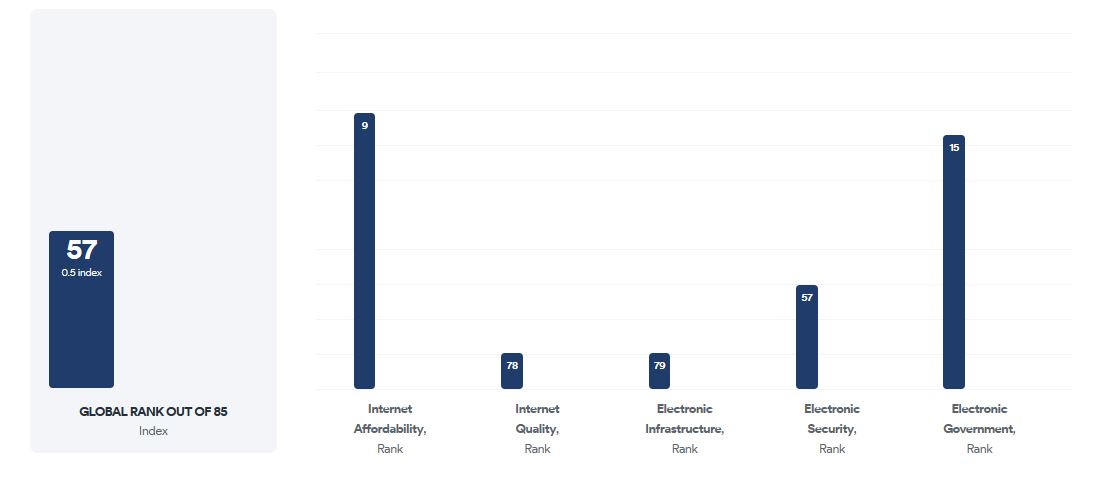
    India ranks among the lowest in the world in terms of Internet quality, according to the Digital Quality of Life Report.

    Note the following aspects:

    1)Organisation publishing the report

    2)India’s rank and its comparison with neighbors

    3)Rankers at the top

    Digital Quality of Life Index

    • It is global research released by online privacy solutions provider SurfShark.
    • It releases a report on the quality of digital wellbeing in 85 countries (81% of the global population), in terms of e-infrastructure.

    India’s ranking: Hits and Misses

    • India occupies 79th place, ranking below countries including Guatemala and Sri Lanka.
    • India makes it into the top 10 in terms of Internet affordability. With a ranking of nine, it outperforms countries such as the U.K., the U.S. and China.
    • Additionally, when it comes to e-government, India occupies the 15th place globally, just below countries like New Zealand and Italy.
    • However, at position 78, India’s Internet quality is one of the lowest across 85 countries analysed in the research.

    Global rankings

    • The report found that seven of the 10 countries with the highest digital quality of life are in Europe, with Denmark leading among 85 countries.
    • Canada stands out as a country with the highest digital quality of life in the Americas, while Japan takes the leading position in Asia.
    • Among the countries in Africa, people in South Africa enjoy the highest quality of digital lives whereas New Zealand leads in Oceania, outperforming Australia in various digital areas.
  • Higher Education – RUSA, NIRF, HEFA, etc.

    [pib] Atal Ranking of Institutions on Innovation Achievements (ARIIA) 2020

    The Vice-President has released the Atal ranking ‘ARIIA 2020’.

    Note the indicators on which the ARIIA ranking is based.  Also try this PYQ:

    Q. Which one of the following is not a sub-index of the World Bank’s ‘Ease of Doing Business Index’? (CSP 2019)

    (a) Maintenance of law and order

    (b) Paying taxes

    (c) Registering property

    (d) Dealing with construction permits

    Highlights of the ARIIA 2020

    • The Indian Institute of Technology (IIT) Madras has topped the ARIIA 2020 under the ‘Best Centrally Funded Institution’ category.
    • Last year too, the institute emerged as the top innovative institution in the country.
    • IIT Bombay and Delhi have secured the second and third spots, respectively.

    About ARIIA

    • ARIIA is an initiative of erstwhile Ministry of HRD, implemented by AICTE and Ministry’s Innovation Cell.
    • It systematically ranks all major higher educational institutions and universities in India on indicators related to “Innovation and Entrepreneurship Development” amongst students and faculties.
    • ARIIA 2020 will have six categories which also includes special category for women only higher educational institutions to encourage women and bringing gender parity in the areas of innovation and entrepreneurship.
    • The other five categories are 1) Centrally Funded Institutions 2) State-funded universities 3) State-funded autonomous institutions 4) Private/Deemed Universities and 5) Private Institutions.

    Major Indicators for consideration

    • Budget & Funding Support.
    • Infrastructure & Facilities.
    • Awareness, Promotions & support for Idea Generation & Innovation.
    • Promotion & Support for Entrepreneurship Development.
    • Innovative Learning Methods & Courses.
    • Intellectual Property Generation, Technology Transfer & Commercialization.
    • Innovation in Governance of the Institution.
  • Mother and Child Health – Immunization Program, BPBB, PMJSY, PMMSY, etc.

    PCPNDT Act and rule changes during pandemic

    The article deals with the issues of suspension of some requirements under PCPNDT Act. It also discusses the role judiciary played in 25-years jurisprudence around the Act.

    Context

    • Last week, the Supreme Court deferred a pronouncement on the legality of the Centre’s now-lapsed controversial notification relating to the rules of the law banning sex-selective abortions.
    • The apex court similarly erred on the side of caution in June, choosing not to stay the Ministry of Health and Family Welfare’s gazette notification.

    What were the changes

    • One of the rules requires a five-yearly renewal of registration of genetic laboratories, ultrasound clinics and imaging centres, subject to the fulfilment of eligibility criteria.
    • Another mandate to submit monthly records on the conduct of pregnancy-related procedures to the designated authority.
    • State governments and Union Territories are required to furnish quarterly reports to the Centre on the implementation of the law.
    • The Union Health Ministry had maintained that various procedural deadlines were relaxed in the wake of the public health crisis and that such flexibility would in no way jeopardise the larger objectives of the law.

    Issues with the suspension

    • Activists saw no rationale behind the suspension of rules, since the operation of diagnostic laboratories had been declared essential services.
    • They were understandably apprehensive that the freeze would result in large-scale violations.
    • It is one thing to offer relaxation for delays in the completion of formalities via an administrative order, but altogether another to declare a freeze via a gazette notification, they argued.

    Court judgements on PCPNDT Act

    • The 25-year jurisprudence around the PCPNDT legislation does not justify a casual approach on the enforcement of its various provisions.
    • The Court last year ruled that the non-maintenance of medical records as per Section 23 of the PCPNDT Act could serve as a conduit in the grave offence of foeticide.
    • In its 2016 judgment, the Supreme Court authorised the seizure of illegal equipment from clinics and the suspension of their registration as well as speedy disposal of relevant cases by the States.

    Consider the question “How far has the PCPNDT Act been successful in dealing with the menace of sex-selective abortion? What are the shortcomings in the Act?”

    Conclusion

    Crucially, the alarming decline witnessed in recent decades in India’s sex ratio at birth calls for uncompromising adherence to public policy, more than is evident from evolving case law.

  • Monetary Policy Committee Notifications

    Dilemma the RBI faces

    Limitations and contradictions in the functioning of RBI

    • The Reserve Bank of India, along with the monetary policy committee, has undertaken measures to address the fallout of the COVID-19 pandemic.
    • Their actions are guided by multiple considerations — inflation and growth management, debt management and currency management.
    • These multiple considerations have inadvertently exposed the limitations of and the inherent contradictions in the central banking framework in India.

    Monetary policy functions

    • The MPC is guided by the goal of maintaining inflation at 4 plus/minus 2 per cent.
    • In its August policy, despite dire growth prospects, MPC chose to maintain the status quo.
    • This decision was driven by elevated inflation i.e. above 4 plus/minus 2 per cent. 
    • This raises the question: At the current juncture, should the MPC be driven by growth considerations or should short-term inflation concerns dominate?

    Understanding the nature of current inflation

    • The current rise in inflation is driven by supply-chain dislocations owing to the lockdowns.
    • This is evident from the growing disconnect between the wholesale and consumer price index.
    • Since April, while WPI has been in negative territory, CPI has been elevated.
    • The MPC’s mandate is to deliver stable inflation over long periods of time, not just a few months.
    • Yet, it would appear as if it is more concerned about elevated inflation in the short run.
    • Equally puzzling is the refusal of MPC to provide any firm projection of future inflation.

    Manager of government debt

    •  As manager of the government debt, the RBI is tasked with ensuring that the government’s borrowing programme sails through smoothly.
    • To this end, it has carried out several rounds of interventions popularly known as operation twist.
    • in operation twist government RBI intended pushing down long-term Gsec yields, and exerting upward pressure on short-term yields as a consequence.
    • In doing so, the RBI ended up doing exactly the opposite of what the MPC was trying to achieve by cutting short term rates, well before it reached the lower limit of its conventional policy response.

    3) RBI’s intervention in currency markets

    • The RBI’s interventions in the currency market have constrained its ability to carry out open market operations as these would have led to further liquidity injections into the system.
    • Put differently, its debt management functions have run up against its currency management functions.
    • Underlining the complexity of all this is the talk of sterilisation — the opposite of injecting liquidity in the system.

    Consider the question “RBI’s functions at the current juncture suffers from contradicting functions. Examine such contradictions in its role and suggest the ways to avoid such contradictions.”

    Conclusion

    The central bank must develop a clear strategy on what to do. At this juncture, there is a strong argument to look past the current spurt in inflation, and test the limits of both conventional and unconventional monetary policy. At the other end, while it may want to intervene to prevent the rupee’s appreciation, in doing so, it is constricting its debt management functions which will have its own set of consequences. There are no easy answers.

  • RTI – CIC, RTI Backlog, etc.

    Resurrecting the right to know

    This article analyses the importance of peoples’ right to know and instrumental role judiciary played in harmonising it with the Official Secrets Act 1923.

    Context

    • A High Level Committee (HLC) chaired by a retired judge of the Gauhati High Court was constituted by the Home Ministry through a gazette notification.
    • Its mandate was, among others, to recommend measures to implement Clause 6 of the Assam Accord and define “Assamese People”.
    • The HLC finalised its report by mid-February 2020 and submitted it to the Assam Chief Minister and through him to the Central government.
    • With the Central government apparently “sitting idle” over the report, the All Assam Students’ Union (AASU), which was represented in the HLC, released the report.

    The right to know

    • The right to know was recognised nearly 50 years ago and is the foundational basis or the direct emanation for the right to information.
    • In State of U.P. v. Raj Narain (1975), the Supreme Court carved out a class of documents that demand protection even though their contents may not be damaging to the national interest.
    • Court held that “the people of this country are entitled to know the particulars of every public transaction in all its bearing”.
    • This view was endorsed in S.P. Gupta v. President of India (1981) and a few other decisions.
    • In Yashwant Sinha v. Central Bureau of Investigation (2019), the Supreme Court referred to the decision of the U.S. Supreme Court in New York Times v. United States (1971) wherein court declined to recognise the right of the government to restrain publication of the Pentagon Papers.
    • Our Supreme Court held that a review petition based on three documents published by The Hindu was maintainable since the provisions of the Official Secrets Act, 1923 had not been violated.
    • The SC held that there is no provision by which Parliament had vested power in the government either to restrain the publication of documents marked as secret or from placing such documents before a court.
    • Section 8(2) of the Right to Information Act, 2005 provides that a citizen can get a certified copy of a document even if the matter pertains to security or relationship with a foreign nation if a case is made out.
    • Therefore, it is clear that the right to know can be curtailed only in limited circumstances and if there is an overriding public interest.

    Consider the question “Analyse the importance of citizens’ right to know and how the judiciary harmonised the peoples right to know with the Official Secrets Act 1923? “

    Conclusion

    We must keep in mind observation made by the Supreme Court in S.P. Gupta: “If secrecy were to be observed in the functioning of government and the processes of government were to be kept hidden from public scrutiny, it would tend to promote and encourage oppression, corruption and misuse or abuse of authority, for it would all be shrouded in the veil of secrecy without any public accountability.”

    B2BASICS

    Official secrets act

    • OSA has its roots in the British colonial era and was originally known as The Indian Official Secrets Act (Act XIV), 1889.
    • The act was primarily mandated to gag the voice of a large number of newspapers that came up in several languages, and were opposing the Raj’s policies, building political consciousness and facing police crackdowns and prison terms.
    • The act was amended and made more stringent in the form of The Indian Official Secrets Act, 1904, during Lord Curzon’s tenure as Viceroy of India.
    • In 1923, a newer version was notified. The Indian Official Secrets Act (Act No XIX of 1923) was extended to all matters of secrecy and confidentiality in governance in the country.
    • It was further amended after India got independence in 1951 and 1967. The act in its present form deals with two aspects — spying or espionage and disclosure of other secret information of the government.
    • Secret information can be any official code, password, sketch, plan, model, article, note, document or information. Under the act both the person communicating the information, and the person receiving the information, can be punished.

Join the Community

Join us across Social Media platforms.