💥UPSC 2026, 2027, 2028 UAP Mentorship (March Batch) + Access XFactor Notes & Microthemes PDF

Archives: News

  • Important Judgements In News

    The issue of powers of Speaker and Court

    The article examines the larger issue of powers of the Speaker under 10th Schedule and the current interim order of the Rajasthan High Court.

    Context

    • The Rajasthan High Court had admitted the petition by the Congress faction group challenging the notice of the Speaker.
    • In the interim order, the High Court had ordered to maintain the status quo.

    Why Kihoto Hollohan Case matters

    • The Kihoto Hollohan decision of the Supreme Court delivered in 1992 forms the basis in such decisions.
    • The Constitution Bench which heard it was split 3:2.
    • The majority on the bench upheld the constitutionality of the Tenth Schedule of the Constitution.
    • The High Court is not empowered to unsettle Kihota Hollohan and must apply its ratio that the Chairman/Speaker is the final arbiter on the disqualification of a member.
    • Rajasthan High Court has raised the issue about whether disqualification under Tenth Schedule is applicable in the case of “intra-party dissent”.
    • Para 2(1) a of 10th Schedule deals with disqualification of a member of a House belonging to any party “if he has voluntarily given up his membership of such political party”.

    Let’s look at what the Supreme Court said  in Kihoto Hollohan case:

    “paragraph 2 of the Tenth Schedule of the Constitution is valid. Its provisions do not suffer from the vice of subverting democratic rights of elected members of Parliament and the legislatures of the States. It does not violate their freedom of speech, freedom of vote and conscience as contended”.

    Consider the question “Examine the issue of powers of Speaker/Chairman in the matters of disqualification of the member against the powers of the Courts in such matters. What are the reasons for frequent frictions between the two authorities on this matter?”

    Conclusion

    The high courts and the Supreme Court routinely refuse to interfere in matters where the concerned authority has merely issued a show-cause notice or granted an opportunity of being heard. So, it must fix the issue raised by the Rajasthan High Court interim order.

  • Insolvency and Bankruptcy Code

    What are Pre-packs under the present insolvency regime?

    The Ministry of Corporate Affairs (MCA) has set up a committee to look into the possibility of including what is called “pre-packs” under the current insolvency regime to offer faster insolvency resolution.

    Practice question for mains:

    Q.What are the key features of the Insolvency and Bankruptcy Code? Discuss how operationalization of IBC is hindered by the slower resolutions of insolvency cases. Suggest measures for faster resolution.

    What is Pre-pack?

    • A pre-pack is an agreement for the resolution of the debt of a distressed company through an agreement between secured creditors and investors instead of a public bidding process.
    • This system of insolvency proceedings has become an increasingly popular mechanism for insolvency resolution in the UK and Europe over the past decade.

    Why need Pre-packs?

    • Slow progress in the resolution of distressed companies has been one of the key issues raised by creditors regarding the Corporate Insolvency Resolution Process (CIRP) under the IBC.
    • Under the IBC, stakeholders are required to complete the CIRP within 330 days of the initiation of insolvency proceedings.

    A case for India

    • In India’s case, such a system would likely require that financial creditors agree on terms with potential investors and seek approval of the resolution plan from the National Company Law Tribunal (NCLT).
    • This process would likely be completed much faster than the traditional CIRP which requires that the creditors of the distressed company allow for an open auction for qualified investors to bid for the distressed company.
    • The process needs to be completed within 90 days so that all stakeholders retain faith in the system and cases that take more than this time should be taken through the normal CIRP.

    What are the other key benefits of a pre-pack?

    • Pre-packs would mostly be used for businesses that are running; the investors would likely need to maintain good relations with operational creditors.
    • In the case of pre-packs, the incumbent management retains control of the company until a final agreement is reached.
    • The transfer of control from the incumbent management to an insolvency professional as is the case in the CIRP leads to disruptions in the business and loss of some high-quality human resources and asset value.

    Some limitations

    • The key drawback of a pre-packaged insolvency resolution is the reduced transparency compared to the CIRP.
    • Financial creditors would reach an agreement with a potential investor privately and not through an open bidding process.
    • This could lead to stakeholders such as operational creditors raising issues of fair treatment when financial creditors reach agreements to reduce the liabilities of the distressed company.
  • Agricultural Sector and Marketing Reforms – eNAM, Model APMC Act, Eco Survey Reco, etc.

    What is Green-Ag Project?

    The Union government has launched the Green-Ag Project in Mizoram, to reduce emissions from agriculture and ensure sustainable agricultural practices.

    Note the following things about Green-Ag Project:

    1)Core objective

    2)Implementing agencies

    3)Regions of Implementation

    Green-Ag Project

    • The Green-Ag project is designed to achieve multiple global environmental benefits in at least 1.8 million hectares (ha) of land in five landscapes, with mixed land-use systems.
    • It aims to bring at least 104,070 ha of farms under sustainable land and water management.
    • The project will also ensure 49 million Carbon dioxide equivalent (CO2eq) sequestered or reduced through sustainable land use and agricultural practices.

    Implementing agencies

    • The project is funded by the Global Environment Facility, while the Department of Agriculture, Cooperation, and Farmers’ Welfare (DAC&FW) is the national executing agency.
    • Other key players involved in its implementation are the Food and Agriculture Organization (FAO) and the Environment Ministry (MoEF&CC).

    Regions of implementation

    The project has been launched in high-conservation-value landscapes of five States namely

    • Madhya Pradesh: Chambal Landscape
    • Mizoram: Dampa Landscape
    • Odisha: Similipal Landscape
    • Rajasthan: Desert National Park Landscape
    • Uttarakhand: Corbett-Rajaji Landscape
  • Water Management – Institutional Reforms, Conservation Efforts, etc.

    Ammonia Pollution in Yamuna River

    For the second time in a week, the Delhi Jal Board (DJB) had to reduce water production capacity by 25 per cent after high levels of ammonia were detected in the Yamuna River.

    Try this PYQ from CSP 2019:

    Q. Consider the following statements:

    1. Agricultural soils release nitrogen oxides into the environment.
    2. Cattle release ammonia into the environment.
    3. Poultry industry releases reactive nitrogen compounds into the environment.

    Which of the statements given above is/are correct?

    (a) 1 and 3 only

    (b) 2 and 3 only

    (c) 2 only

    (d) 1, 2 and 3

    What is Ammonia and what are its effects?

    • Ammonia is a colourless gas and is used as an industrial chemical in the production of fertilizers, plastics, synthetic fibres, dyes and other products.
    • Ammonia occurs naturally in the environment from the breakdown of organic waste matter, and may also find its way to ground and surface water sources through industrial effluents or through contamination by sewage.
    • If the concentration of ammonia in water is above 1 ppm it is toxic to fishes.
    • In humans, long term ingestion of water having ammonia levels of 1 ppm or above may cause damage to internal organs.

    A cause of concern

    • The level of ammonia in raw Yamuna water was 1.8 parts per million (ppm).
    • The acceptable maximum limit of ammonia in drinking water, as per the Bureau of Indian Standards, is 0.5 ppm.

    Where does Ammonia come from?

    • Ammonia is produced for commercial fertilizers and other industrial applications.
    • Natural sources of ammonia include the decomposition or breakdown of organic waste matter, gas exchange with the atmosphere, forest fires, animal and human waste, and nitrogen fixation processes.

    How is it treated?

    • The DJB at present does not have any specific technology to treat ammonia.
    • The only solution it adapts is to reduce production at its water treatment plants.
    • In addition to this, the board mixes raw water that carries a high concentration of ammonia with a fresh supply.
    • The amount of chlorine added to disinfect raw water is also increased when high levels of ammonia are detected.

    What is the long-term solution to the problem?

    • Stringent implementation of guidelines against dumping harmful waste into the river, and making sure untreated sewage does not enter the water are two things pollution control bodies are expected to do.
    • But, a more organic method agreed upon by environmentalists and experts is to maintain a sustainable minimum flow, called the ecological flow.
    • This is the minimum amount of water that should flow throughout the river at all times to sustain underwater and estuarine ecosystems and human livelihoods, and for self-regulation.
    • The lack of a minimum ecological flow also means an accumulation of other pollutants.
  • Tiger Conservation Efforts – Project Tiger, etc.

    Report of the All India Tiger Estimation 2020

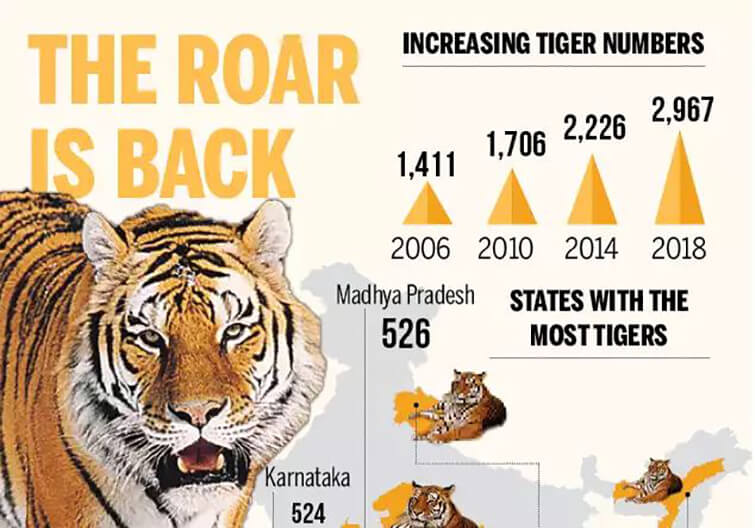
    India’s tiger population has reached a new high at 2,367.

    Before reading this newscard, try these PYQs:

    1. The term ‘M-STrIPES’ is sometimes seen in the news in the context of: (CSP 2017)

    (a) Captive breeding of Wild Fauna

    (b) Maintenance of Tiger Reserves

    (c) Indigenous Satellite Navigation System

    (d) Security of National Highways

    Q.Consider the following protected areas: (CSP 2012)

    1. Bandipur
    2. Bhitarkanika
    3. Manas
    4. Sunderbans

    Which of the above are declared Tiger Reserves?

    (a) 1 and 2 only

    (b) 1, 3 and 4 only

    (c) 2, 3 and 4 only

    (d) 1, 2, 3 and 4

    All India Tiger Estimation

    MP-tops-country-with-526-tigers-as-per-All-India-Tiger-Estimation-2018
    • The tiger count is prepared after every four years by the National Tiger Conservation Authority (NTCA) provides details on the number of tigers in the 18 tiger reign states with 50 tiger reserves.
    • However, this time, the census also included data collected from the rough terrains of north-eastern states which were not possible due to logistic constraints before.
    • The entire exercise spanned over four years is considered to be the world’s largest wildlife survey effort in terms of coverage and intensity of sampling.
    • Over 15, 000 cameras were installed at various strategic points to capture the movement of tigers. This was supported by extensive data collected by field personnel and satellite mapping.

    Details of the report

    • India has 70% of the world’s tigers, says the report.
    • Madhya Pradesh has the highest number of tigers at 526, closely followed by Karnataka (524) and Uttarakhand (442).
    • Chhattisgarh and Mizoram saw a decline in tiger population and all other States saw a “positive” increase, according to a press statement.

    Implementing CATS frameworks

    • India had embarked upon assessing management interventions through the globally developed Conservation Assured | Tiger Standards (CA|TS) framework.
    • This framework will now be extended to all fifty tiger reserves across the country.

    Back2Basics: Project Tiger

    • Project Tiger is a tiger conservation programme launched in April 1973 during PM Indira Gandhi’s tenure.
    • In 1970 India had only 1800 tigers and Project Tiger was launched in Jim Corbett National Park.
    • The project is administrated by the National Tiger Conservation Authority (NTCA).
    • It aims at ensuring a viable population of Bengal tigers in their natural habitats, protecting them from extinction etc.
    • Under this project the govt. has set up a Tiger Protection Force to combat poachers and funded relocation of villagers to minimize human-tiger conflicts.
  • Foreign Policy Watch: India-United States

    Global coalition of democracies amid Chinese assertion

    In the recent speed Mike Pompeo, the US Secretary of State, floated the idea of an ‘alliance of democracies’. This article discusses its implications for India.

    Two propositions on China

    • The US Secretary of State laid out two propositions.
    • One is that nearly five decades of US engagement with China have arrived at a dead-end.
    • Second is that the US can’t address the China challenge alone and called for collective action.
    • He mused on whether “it’s time for a new grouping of like-minded nations, a new alliance of democracies.”

    How it matters for India?

    • Both the propositions signal the breakdown of the relationship between the world’s two most important powers.
    • They also reflect on the need to create new frameworks to cope with emerging global challenges.
    • China, is a large neighbour of India and America, is India’s most important partner makes the new context rather different from the Cold War.

    Concerns for India in the propositions

    •  Many in Delhi would like to know if the current direction of China policy will endure if Joe Biden wins the presidential election in November.
    • India must pay close attention to the unfolding China debate in the US.
    • India also note the structural changes in American engagement with China over the last two decades.
    •  Delhi will certainly avoid calling the group proposed by US Secretary of State an “alliance”.
    • India would rather have it described as a “coalition of democracies”.

    Idea of ‘Coalition of democracies’

    • Over the last many years, India has become comfortable with the idea of a political partnership with the world’s leading democracies.
    • India also supported past US initiatives like-Clinton Administrations “Community of Democracies”, Bush Administrations democracy promotion fund at the UN.
    • Delhi has also welcomed President Trump’s initiative to convene an expanded gathering of the G-7 leaders.
    • The idea of democracies working together has an enduring appeal for the US.
    • India figures in this American vision is relatively new. So is Delhi’s readiness to reciprocate.

    Consider the question “In the ongoing geopolitical situation the U.S. has proposed the idea of ‘alliance of democracies’. Where does India feature in this vision and what are the implications of it for India.”

    Conclusion

    Constructing a global coalition of democracies will take much work and quite some time. But engaging with that initiative, amidst the rise and assertion of China, should open a whole range of new possibilities for Indian foreign and security policies.


    Original article:

    https://indianexpress.com/article/opinion/columns/us-india-democracy-china-cold-war-global-economy-6526409/

  • Food Procurement and Distribution – PDS & NFSA, Shanta Kumar Committee, FCI restructuring, Buffer stock, etc.

    Nutrition security along with food security


    • The “State of Food Security and Nutrition in the World” was recently released.

    About the report

    • It is published by the UN Food and Agriculture Organization (FAO) and other UN agencies including the WHO.
    • The report estimated that 820 million people worldwide did not have enough to eat in 2018, up from 811 million in the previous year.
    • At the same time, the number of overweight individuals and obesity continue to increase in all regions.

    Highlights of the report

    • The number of people going hungry has risen for the third year running to more than 820 million. After decades of decline, food insecurity began to increase in 2015.
    • Africa and Asia account for more than nine out of ten of the world’s stunted children, at 39.5% and 54.9% respectively.
    • However at the same time, obesity and excess weight are both on the rise in all regions, with school-age children and adults affected particularly.

    India scenario

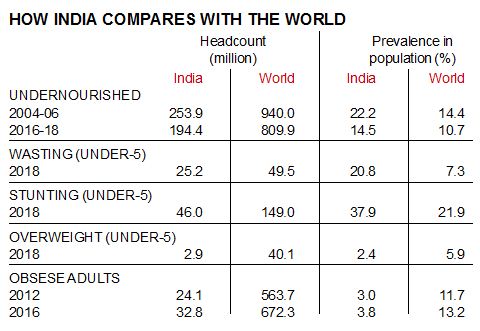
    • The number of obese adults in India has risen by a fourth in four years, from 24.1 million in 2012 to 32.8 million in 2016.
    • While India’s undernourished population has dropped by roughly the same fraction in 12 years, from 253.9 million in 2004-06 to 194.4 million in 2016-18.

    Compared with China

    • The report has a section on economic growth in China and India, and its effect on poverty.
    • Between 1990 and 2017, the two countries had an average GDP per capita growth rate of 8.6 per cent and 4.5 per cent respectively, the report said, citing World Bank.
    • In both countries, the increase in GDP per capita has been accompanied by poverty reduction.
  • Indian foreign policy and decline in soft power in neighbourhood

    The article examines the issue of declining political capital in India’s neighbourhood and the factors responsible for this. 

    India’s standing in neighbourhood: Past

    • Not long ago, India was seen as a natural rising power in South Asia and the Indian Ocean Region.
    • It was the de facto leader of the South Asian Association for Regional Cooperation (SAARC).
    • It has historical and cultural ties with Nepal.
    • It enjoyed traditional goodwill and influence in Sri Lanka and Bangladesh.
    • It had made investments worth billions of dollars in Afghanistan and cultivated vibrant ties with the post-Taliban stakeholders in Kabul.
    • It had committed itself to multilateralism and the Central Asian connectivity project, with Iran being its gateway.
    • It was competing and cooperating with China at the same time.

    India’s relations in with the neighbourhood: Present

    • India is perhaps facing its gravest national security crisis in 20 years, with China along the Line of Actual Control (LAC).
    • SAARC is defunct.
    • Nepal has turned hostile having adopted a new map and revived border disputes with India.
    • Sri Lanka has tilted towards China.
    • Bangladesh is clearly miffed at the Citizenship (Amendment) Act, 2019.
    • When Afghanistan is undergoing a major transition, India is out of the multi-party talks.
    • Iran has inaugurated a railway link project connecting the Chabahar port, on the Gulf of Oman, to Zahedan.

    What are the factors responsible for this?

    When we dig deep, three problems can be found which are more or less linked to this decline.

    1) Alignment with US

    • As India started moving away from non-alignment, there has been a steady erosion in India’s strategic autonomy.
    • India’s official policy is that it is committed to multilateralism.
    •  When India started deepening its partnership with the United States, New Delhi began steadily aligning its policies with U.S. interests.
    • The case of Iran is the best example.
    • India’s deepening defence and military ties with the U.S.  probably altered Beijing’s assessment of India.
    • One of the reasons for the shift could be Beijing’s assessment that India has already become a de facto ally of the U.S.
    • The forceful altering of the status quo on the border is a risky message as much to New Delhi as it is to Washington.

    2) Domestic politics

    • The passing of the CAA is regionalisation of the domestic problems of the countries in India’s neighbourhood.
    • Bangladesh took offence at the CAA and the National Register of Citizens, there were anti-India protests even in Afghanistan.
    • CAA also drove new wedges between India and the countries that had a Muslim majority and were friendly to India in the neighbourhood.
    • The abrogation of the special status of Jammu and Kashmir was another such move.
    • But it damaged India’s reputation as a responsible democratic power and gave propaganda weapons to Pakistan.
    • The change of status quo in Jammu and Kashmir, could be another factor that prompted the Chinese to move aggressively towards the border in Ladakh.

    3) Misplaced confidence

    • Great powers wait to establish their standing before declaring that they have arrived.
    • China bided its time for four decades before it started taking on the mighty U.S.
    • India should learn from at least these modern examples.
    • If it did, it would not have used high-handedness in Nepal during the country’s constitutional crisis and caused a traditional and civilisational ally to turn hostile.
    • The updated political map which India released in November rubbed salt into the wound on the Nepal border.

    Consider the question “India’s standing in its neighbourhood has been on the decline for some time now. Examine the factors responsible for this.”

    Conclusion

    To address the current crises, India has to reconsider its foreign policy trajectory. It does not lack resources to claim what is its due in global politics. What it lacks is strategic depth.

    Original article:

    https://www.thehindu.com/opinion/lead/needed-a-map-for-indias-foreign-policy/article32206877.ece

  • Anti Defection Law

    When can a Governor use his discretion, how has the SC ruled?

    Rajasthan Governor returning the fresh proposal by the state Cabinet – seeking to convene a session of the Assembly has raised fresh legal questions on the powers of the Governor.

    Try this question for mains:

    Q. “Time and again, the courts have spoken out against the Governor acting in the capacity of an all-pervading super-constitutional authority.” Analyse.

    Who has the powers to summon the House?

    • It is the Governor acting on the aid and advice of the cabinet.
    • Article 174 of the Constitution gives the Governor the power to summon from time to time “the House or each House of the Legislature of the State to meet at such time and place as he thinks fit…”
    • However, the phrase “as he thinks fit” is read as per Article 163 of the Constitution which says that the Governor acts on the aid and advice of the cabinet.
    • Article 163(1) essentially limits any discretionary power of the Governor only to cases where the Constitution expressly specifies that the Governor must act on his own and apply an independent mind.

    What has the Supreme Court said in the past about the Governor’s power to summon the House?

    • It is settled law that the Governor cannot refuse the request of the Cabinet to call for a sitting of the House for legislative purposes or for the chief minister to prove his majority.
    • In fact, on numerous occasions, including in the 2016 Uttarakhand case, the court has clarified that when the majority of the ruling party is in question, a floor test must be conducted at the earliest available opportunity.
    • In 2016, the Supreme Court in Nabam Rebia and Bamang Felix vs Deputy Speaker expressly said that the power to summon the House is not solely vested in the Governor.

    What did the SC say in the Arunachal case?

    • Referring to discussions in the Constituent Assembly, the court noted that the framers of the Constitution expressly and consciously left out vesting powers to summon or dissolve the House solely with the Governor.
    • It said that the powers of the Governor were substantially altered to indicate that the framers did not want to give Governors the discretion.
    • The Governor can summon, prorogue and dissolve the House, only on the aid and advice of the Council of Ministers (CoM) with the Chief Minister as the head and not at his own, said the Court.

    When can a Governor use his discretion?

    • Article 163(1) of the Constitution says that “there shall be a CoM with the CM at the head to aid and advice the Governor in the exercise of his functions, except some conditions for discretion.
    • However, in the 2016 case, the apex court has defined the circumstances if the aid and advice of CoM are binding on the Governor.
    • When the chief minister has lost the support of the House and his strength is debatable, then the Governor need not wait for the advice of the CoM to hold a floor test.

    Novel situations are created these days

    • Generally, when doubts are cast on the chief minister that he has lost the majority, the opposition and the Governor would rally for a floor test.
    • The ruling party may attempt to stall the process to buy time and keep its flock together.
    • In a puzzling situation, in Rajasthan’s case, despite requests from CM, the Governor has returned requests to call for a session.
    • However, in the current case, the rebel MLAs have not defected from their party but have repeatedly stated before the Rajasthan HC that they are merely expressing their dissent within the party.

    Back2Basics: Governor’s Discretionary Powers

    The governor can use his/her discretionary powers:

    • When no party gets a clear majority, the governor has the discretion to choose a candidate for the chief minister who will put together a majority coalition as soon as possible.
    • He can impose president’s rule.
    • He submits reports on his own to the president or on the direction of the president regarding the affairs of the state.
    • He can withhold his assent to a bill and send it to the president for his approval.
    • During emergency rule per Article 353, he can override the advice of the council of ministers if specifically permitted by the president.

Join the Community

Join us across Social Media platforms.