💥UPSC 2027,2028 Mentorship (April Batch) + Access XFactor Notes & Microthemes PDF

Archives: News

  • Cutting off online gaming with scissors of prohibition

    Introduction

    In a surprising move at the end of the Monsoon Session 2025, the Parliament passed the Promotion and Regulation of Online Gaming Act, 2025. The Act outlaws online real money games, citing societal harms such as addiction and financial ruin, while aiming to encourage e-sports. What makes this development significant is the abruptness of the ban, absence of stakeholder consultation, and the wiping out of a sunrise sector that had attracted heavy foreign investment and promised thousands of quality tech jobs.

    The Fallout of the Ban

    1. Job Losses: The industry was projected to employ 1.5 lakh people by 2025 in programming, design, analytics, and customer support. The ban curtails these opportunities in a job-scarce economy.
    2. Revenue Sacrifice: Online real money games were expected to generate ₹17,000 crore in GST revenues, benefiting both Centre and States. The ban erases this fiscal opportunity.
    3. Investor Confidence: Sudden policy reversals discourage foreign direct investment (FDI), raising doubts about India’s policy stability.
    4. Innovation Slowdown: Online gaming sits at the intersection of technology, payments, and digital content, key drivers of Digital India. The ban risks stifling entrepreneurship and innovation.

    Why Did the Government Ban Real Money Gaming?

    1. Societal Harm: The government argues online gaming has led to addiction, financial ruin, and behavioral issues comparable to drug dependence.
    2. Public Pressure: State-level cases of suicides and debt traps pushed policymakers to respond.
    3. Moral Positioning: The Centre framed the issue as a public health crisis requiring urgent intervention.

    Could Regulation Have Been a Better Alternative?

    1. Responsible Gaming Tools: Platforms had developed age-gating, self-exclusion, deposit/time limits, KYC/AML checks, and bot-detection to promote safer gaming.
    2. International Practices: Globally, ethical advertising and technological safeguards regulate the sector rather than outright bans.
    3. State Frameworks: States like Tamil Nadu were experimenting with balanced regulatory frameworks, creating scope for a middle path.

    Risks of the Ban

    1. Illegal Networks: Players may migrate to offshore and underground apps, which pay no taxes and are beyond Indian jurisdiction.
    2. Loss of Accountability: With regulated firms shut down, compulsive gamers are left vulnerable to fraud and unsafe practices.
    3. Federal Overreach: Betting and gambling fall under the State List; the Centre’s unilateral move undermines federalism.
    4. Constitutional Challenge: Article 19(1)(g) guarantees the Fundamental Right to practice any trade or business. The ban raises issues of proportionality and constitutional validity.

    The Middle Ground

    1. Licensing System: Grant licenses to vetted firms with strict compliance norms.
    2. Clear Distinction: Differentiate between games of skill (legitimate) and games of chance (gambling).
    3. Taxation Regime: Ensure predictable and fair taxation, boosting both revenue and compliance.
    4. Capacity Building: Strengthen regulatory institutions instead of relying on prohibition.

    Conclusion

    The Promotion and Regulation of Online Gaming Act, 2025, highlights the clash between state paternalism and economic freedom. While societal concerns around addiction are real, prohibition is a blunt instrument that risks pushing activity underground, sacrificing jobs, revenues, and investor trust. A regulatory middle path could have safeguarded both citizens and India’s economic interests.

    Value Addition

    Understanding the Online Gaming Sector

    1. E-sports: Organised competitive digital sports requiring strategy, coordination, decision-making; emerging as a legitimate sport.
    2. Online Social Games: Casual, skill-based games for recreation, learning, or social interaction; considered safe with minimal social risks.
    3. Online Money Games: Involve financial stakes (chance/skill/mixed); linked to addiction, financial losses, money laundering, and suicides.

    Game of Skill vs Game of Chance in India

    Game of Skill

    1. Outcome depends predominantly on knowledge, training, strategy, or judgment.
    2. Examples: Chess, Rummy, Fantasy sports (judicially recognised in some cases).
    3. Legal Status: Judicially upheld as legitimate business activity, not gambling. Protected under Article 19(1)(g) (right to trade/profession).

    Game of Chance

    1. Outcome depends mainly on luck or randomness, not player skill.
    2. Examples: Lotteries, Roulette, Dice-based betting.
    3. Legal Status: Considered gambling; regulated/prohibited by States (as per State List, Entry 34 of 7th Schedule).

    Regulation in India

    Judicial Precedents:

    1. R.M.D. Chamarbaugwala v. Union of India (1957) – distinguished games of skill from gambling.
    2. K.R. Lakshmanan v. State of Tamil Nadu (1996) – horse racing recognised as a game of skill.

    Federal Context: Betting & gambling are State subjects; hence regulation differs across states.

    Digital Loophole: Many online games operate in a grey zone → recent legislation like the Promotion and Regulation of Online Gaming Act, 2025 seeks to ban money games irrespective of skill/chance classification.

    Promotion and Regulation of Online Gaming Acy, 2025

    Why the Bill was Brought

    1. Addiction & Financial Ruin: 45 crore people affected; losses of over ₹20,000 crores due to online money games.
    2. Mental Health & Suicides: Financial distress linked to addiction resulted in suicides.
    3. Fraud & Money Laundering: Offshore platforms used for illegal financial flows.
    4. National Security Risks: Evidence of terror financing and illegal messaging.
    5. Closing Legal Loopholes: Existing gambling laws did not cover the digital domain.
    6. Balanced Approach: Distinguishes between exploitative money games and constructive e-sports/educational games.

    Key Provisions of the Bill

    1. Applicability: Applies to all of India, including offshore platforms targeting Indian users.
    2. Promotion of E-Sports: Recognised as legitimate sport; guidelines by Ministry of Youth Affairs & Sports; incentives, training, research centres.
    3. Promotion of Social & Educational Games: Registration of safe, age-appropriate games; focus on skill-building, culture, education.
    4. Ban on Online Money Games: Complete prohibition on games involving stakes (chance/skill/mixed); advertising and transactions banned.
    5. Online Gaming Authority: National regulator to register/categorise games, issue guidelines, handle grievances.
    6. Strict Penalties:
      1. Offering money games → up to 3 years jail + ₹1 crore fine.
      2. Advertising → up to 2 years jail + ₹50 lakh fine.
      3. Repeat offences → up to 5 years jail + ₹2 crore fine.
    7. Corporate Liability: Company officers accountable; independent directors exempt if due diligence is shown.
    8. Powers of Enforcement: Search, seizure, and arrests without warrant under BNSS, 2023.

    Complementary Measures Already in Place

    1. IT Act & Rules: Intermediaries must register; illegal platforms blocked (1,524 blocked between 2022–2025).
    2. Bharatiya Nyaya Sanhita, 2023: Sections 111 & 112 criminalise unlawful betting/cyber fraud.
    3. IGST Act, 2017: Offshore suppliers must register; GST Intelligence empowered to block non-compliant platforms.
    4. Consumer Protection Act, 2019: CCPA cracks down on misleading ads and celebrity endorsements.
    5. Advisories: MoIB & Education Ministry issued guidelines on safe gaming practices.
    6. Cybercrime Portal & Helpline (1930): Citizens enabled to report fraud and financial scams.
    7. International Reference: WHO: Recognises gaming disorder in ICD classification – loss of control, neglect of daily activities, continuation despite harm.

    PYQ Relevance:

    [UPSC 2020] Recent amendments to the Right to Information Act will have profound impact on the autonomy and independence of the Information Commission. Discuss.

    Linkage: Both the RTI Amendments (2020) and the Online Gaming Bill (2025) highlight rising executive control at the cost of autonomy and federal balance. In RTI, the independence of Information Commissions was weakened; in Gaming, sweeping central powers risk arbitrariness and undermine states’ jurisdiction. Both raise questions of transparency, proportionality, and constitutional freedoms, showing a trend of centralisation in governance.

  • Waste Management – SWM Rules, EWM Rules, etc

    How serious is the global plastic pollution crisis?

    Introduction

    Plastic—once hailed as a symbol of modern convenience—has now become a global menace. Its non-biodegradable nature, rising consumption, and weak waste management systems have led to an unprecedented ecological and socio-economic challenge. This year’s World Environment Day theme, Ending Plastic Pollution, reflects the international recognition of the crisis. The issue cuts across dimensions of environment, economy, health, governance, and ethics, making it a critical topic for civil services preparation.

    Why is Plastic Pollution Making Headlines?

    Plastic consumption and waste generation are reaching historic highs. In 2024 alone, 500 million tonnes of plastic were produced, generating 400 million tonnes of waste. The OECD projects that if current trends persist, plastic waste could almost triple to 1.2 billion tonnes by 2060. Such data marks a tipping point in human-environment relations. For the first time, experts warn that by mid-century there may be more plastic in the ocean than fish, a striking reversal of natural balance.

    How Severe is the Plastic Pollution Crisis?

    1. Rising consumption: Plastics production doubled between 2000 and 2019, reaching 460 million tonnes.
    2. Waste surge: Global plastic waste touched 353 million tonnes in 2019, with packaging alone contributing 40%.
    3. Recycling failure: Only 9% of waste is recycled; 50% ends up in landfills, and 22% escapes into open environments.
    4. Oceanic threat: About 11 million tonnes enter oceans annually, adding to the estimated 200 million tonnes already present.
    5. Climate connection: Plastics contribute 3.4% of global GHG emissions and could consume 19% of the global carbon budget by 2040.

    Why is Plastic Pollution So Difficult to Manage?

    1. Non-biodegradability: Plastics fragment into micro- and nano-particles, contaminating soil, water, and even human bloodstreams.
    2. Global spread: From Mount Everest to ocean trenches, no ecosystem is spared.
    3. Health risks: Microplastics pose risks to food chains, water safety, and respiratory and cardiovascular health.
    4. Economic burden: Poorer nations, with weak waste management, face disproportionate costs of uncontrolled plastic dumping.

    What Global Remedies Are Being Proposed?

    1. Legally binding agreement: In 2022, all 193 UN member states pledged at UNEA-5 to negotiate an international treaty to end plastic pollution.
    2. UNEP target: Ambition to cut plastic waste by 80% in two decades through innovation, design, and recycling.
    3. Reduce single-use plastics: Phasing out unnecessary items made from petrochemical feedstock is urgent.
    4. Extended Producer Responsibility (EPR): Holding manufacturers accountable through deposit refunds, landfill taxes, and pay-as-you-throw systems.
    5. Recycling revolution: Currently, only 6% of plastics come from recycled sources. Scaling this up requires technology and market incentives.

    What Role Do Individuals and Media Play?

    1. Greener alternatives: Shifting to traditional, reusable products and eco-friendly materials.
    2. Awareness campaigns: Media’s power in shaping consumer habits and pressuring governments is significant.
    3. Behavioural change: Collective reduction in consumption is as important as systemic reform.

    Conclusion

    Plastic pollution exemplifies the contradictions of modern development—where convenience has bred crisis. The data suggests humanity stands at a civilisational crossroads: either continue unsustainable consumption or pivot towards circular, sustainable economies. For India, with its population, coastline, and developmental challenges, the issue is not peripheral but central to environmental governance, climate action, and public health.

    UPSC Relevance

    [UPSC 2023] What is oil pollution? What are its impacts on the marine ecosystem? In what way is oil pollution particularly harmful for a country like India?

    Linkage: Plastic and oil pollution are both marine pollutants of petrochemical origin, threatening biodiversity, fisheries, and coastal livelihoods. Like oil, plastics enter oceans in massive quantities (11 MT annually), fragmenting into microplastics that disrupt ecosystems. For India, with a long coastline and dependence on marine resources, the risks of livelihood loss, food insecurity, and ecological imbalance are particularly acute.

  • Electronic System Design and Manufacturing Sector – M-SIPS, National Policy on Electronics, etc.

    PLI Scheme for White Goods

    Why in the News?

    The Centre has announced reopening of the application window for the Production-Linked Incentive (PLI) Scheme for White Goods, following the strong response and success of earlier rounds.

    Note: White goods refer to large household appliances like refrigerators, washing machines, and air conditioners, so named because they were traditionally white.

    About the PLI Scheme for White Goods:

    • Objective: To create a complete component ecosystem for ACs and LED lights, integrating India into global supply chains and boosting domestic manufacturing.
    • Approval: Cleared by the Union Cabinet in April 2021; implemented by the Department for Promotion of Industry and Internal Trade (DPIIT).
    • Duration: Implemented over seven years (FY 2021–22 to FY 2028–29) with a total outlay of ₹6,238 crore.
    • Incentives: Provides 4–6% incentive on incremental turnover (over base year 2019–20) for both domestic sales and exports, applicable for five years to eligible companies.
    • Eligibility:
      • Applicant must be a company incorporated under the Companies Act, 2013.
      • Eligibility depends on achieving threshold levels of incremental sales and investments.
      • Entities availing benefits under any other PLI scheme for the same products are not eligible.
    • Beneficiaries So Far: 83 companies with committed investment of ₹10,406 crore have been approved under the scheme, covering AC and LED components across the entire value chain.
    • Employment and Exports: Expected to create jobs, expand exports, and enhance self-reliance in components that were earlier imported.
    [UPSC 2023] Consider the following statements:

    Statement I: India accounts for 3.2% of global exports of goods.
    Statement II: Many local companies and some foreign companies operating in India have taken advantage of India’s ‘Production-linked Incentive’ scheme.
    Which one of the following is correct in respect of the above statements?
    (a) Both Statement-I and Statement-II are correct and Statement-II is the correct explanation for Statement-I
    (b) Both Statement-I and Statement-II are correct and Statement-II is not the correct explanation for Statement-I
    (c) Statement-I is correct but Statement-II is incorrect
    (d) Statement-I is incorrect but Statement-II is correct *


  • Interstate River Water Dispute

    In news: Cauvery River Dispute

    Why in the News?

    On the Cauvery dispute, Karnataka CM has said that water will be released to Tamil Nadu since the rainfall is adequate, while stressing the Mekedatu Dam’s role in water balance and clean energy.


    Back2Basics: Cauvery River

    • Origin & Course: Rises at Talakaveri, Brahmagiri range (Kodagu, Karnataka); flows ~800 km through Karnataka & Tamil Nadu into the Bay of Bengal.
    • Catchment: Spreads across Karnataka, Tamil Nadu, Kerala, Puducherry.
    • Tributaries: Harangi, Hemavati, Kabini, Suvarnavathi, Bhavani.
    • Nature: Perennial river, sustained by both advancing & retreating monsoons.
    • Protected Areas: Cauvery WLS, Biligirirangan Hills, Pushpagiri, Muthathi, Ranganathittu, Bhimeshwari, Nagarhole, Bandipur.

    About Cauvery Water Sharing Dispute:

    • Colonial Origins: Began in 1892 (Madras Presidency vs Mysore); 1924 Agreement (50 years, expired 1974).
    • Post-Independence: Disputes arose with dam projects by Karnataka (1960s–80s); Supreme Court referred to Cauvery Water Disputes Tribunal (CWDT).
    • Interim Phase: Cauvery River Authority (CRA, 1998) issued temporary orders.
    • CWDT Final Award (2013): Tamil Nadu 419 TMC, Karnataka 270, Kerala 30, Puducherry 7.
    • Karnataka’s Obligation: In normal years, release 177.25 TMC to TN, including 123.14 TMC in SW monsoon.
    • Challenges: Disputes sharpen in weak monsoons, triggering use of a “distress formula”.
    • Legal Basis: Governed by Article 262, Inter-State River Water Disputes Act, 1956; Seventh Schedule entries 17 (State List) & 56 (Union List).

    cauvery

    About Mekedatu Dam Project:

    • Location: Deep gorge at Cauvery–Arkavathi confluence near Kanakapura, Karnataka.
    • Design: Balancing reservoir of ~66 TMC capacity.
    • Objectives: Provide Bengaluru drinking water, generate 400 MW hydropower, regulate flows to TN in drought years.
    • Importance: Karnataka argues it benefits both states by ensuring regulated water release.
    • Opposition: Tamil Nadu objects, fearing reduced downstream availability.
    • Current Status: Karnataka insists on moving ahead, requiring Centre & TN’s clearance.
    [UPSC 2022] Gandikota canyon of South India was created by which one of the following rivers?

    Options: (a) Cauvery (b) Manjira (c) Pennar* (d) Tungabhadra


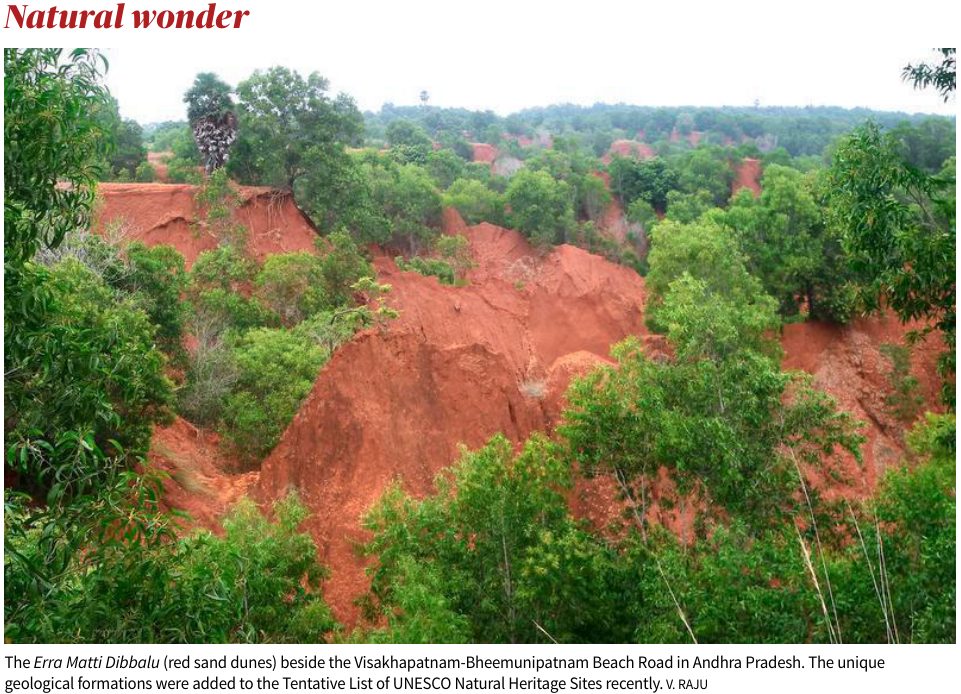
  • Places in news: Erra Matti Dibbalu

    Why in the News?

    This newscard is an excerpt from a photo published in ‘The Hindu’.

    About Erra Matti Dibbalu:

    • Location: Found between Visakhapatnam and Bheemunipatnam in Andhra Pradesh, stretching 5 km along the coast, with widths ranging from 200 m to 2 km.
    • Meaning: In Telugu, “Erra Matti” means red soil and “Dibbalu” means mounds, describing the reddish sand dunes.
    • Geological Heritage: Listed among the 34 National Geological Heritage Monument Sites of India by the Geological Survey of India (GSI).
    • Formation: Created around 12,000–18,500 years ago through the combined effect of tectonic activity (2.5 million–11,000 years ago), sea-level changes, monsoonal variability, and global climatic shifts.
    • Composition: Derived mainly from Khondalite rocks of the Eastern Ghats hinterland, with the red colour due to oxidation of iron-rich sediments.

    Significance:

    • Geological Value: Acts as a paleo-environment indicator, providing evidence of climate change, sea-level fluctuations, and coastal evolution during the late Quaternary period.
    • Archaeological Importance: Artefacts from Mesolithic and Neolithic periods and sediment layers dating back to the Late Pleistocene epoch have been found here.
    • Conservation Status: Declared a National Geo-heritage Monument (2016) and included in UNESCO’s Tentative List of World Heritage Sites (2025) for global recognition and protection.
    • Unique Landscape: Features badland topography with sand dunes, buried channels, gullies, and dendritic drainage patterns.
    • Rare Formation: Only two other similar red sand dune systems exist globally—the Teri dunes in Tamil Nadu and one site in Sri Lanka.
    [UPSC 2014] When you travel in Himalayas, you will see the following:

    1. Deep gorges 2. U-turn river courses 3. Parallel mountain ranges 4. Steep gradients causing land sliding

    Which of the above can be said to be the evidence for Himalayas being young fold mountains?

    Options: (a) 1 and 2 only (b) 1, 2 and 4 only (c) 3 and 4 only (d) 1, 2, 3 and 4*


  • Contention over South China Sea

    Scarborough Shoal in South China Sea

    Why in the News?

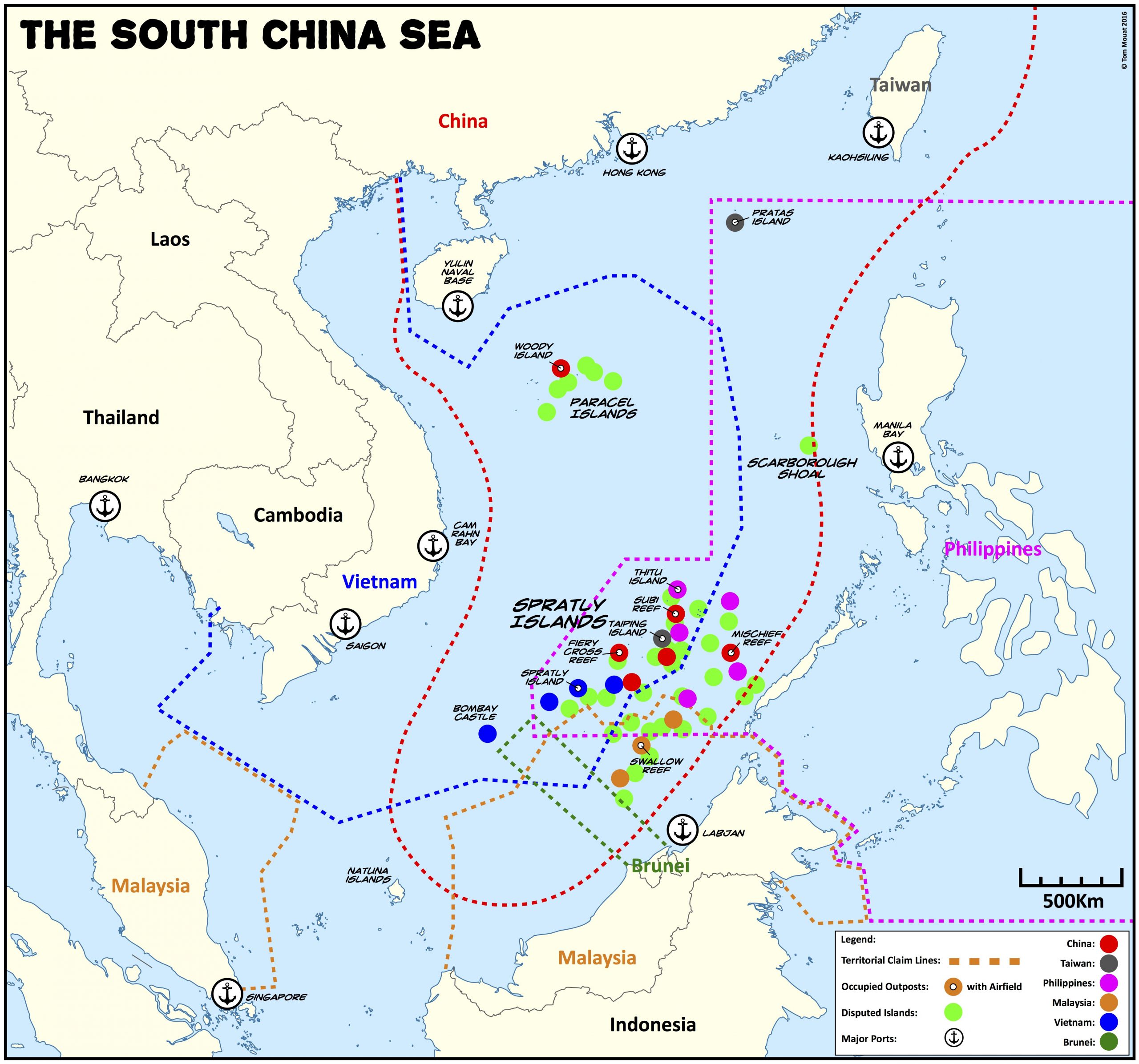
    China’s State Council has approved the creation of a national nature reserve at Scarborough Shoal (Huangyan Dao in Chinese, Bajo de Masinloc/Panatag Shoal in the Philippines).

    About Scarborough Shoal:

    • Geography: A triangle-shaped chain of reefs and rocks in the South China Sea, about 200 km from Luzon (Philippines) and 800+ km from Hainan (China).
    • Status: Uninhabited but strategic, located near shipping lanes carrying $3 trillion in trade annually.
    • Significance: The lagoon shelters boats, and surrounding waters hold rich fish stocks vital for Zambales and Pangasinan communities.

    Disputes about it:

    • Sovereignty Claims: Both China and the Philippines claim ownership.
    • 2016 Arbitration Ruling: Permanent Court of Arbitration (The Hague) held China’s nine-dash line claim invalid, declaring Scarborough a traditional fishing ground under UNCLOS; China rejected the verdict.
    • Philippines’ Grounds: Lies within Manila’s Exclusive Economic Zone (EEZ), making China’s reserve “illegitimate and unlawful.”
    • International Response: The US, Japan, Australia, and Canada conduct naval patrols/drills supporting the Philippines and freedom of navigation.
    [UPSC 2022] Which one of the following statements best reflects the issue with Senkaku Islands, sometimes mentioned in the news ?

    Options: (a) It is generally believed that they are artificial islands made by a country around South China Sea.

    (b) China and Japan engage in maritime disputes over these islands in East China Sea.*

    (c) A permanent American military base has been set up there to help Taiwan to increase its defence capabilities.

    (d) Though International Court of Justice declared them as no man’s land, some South-East Asian countries claim them.


  • Biofuel Policy

    PM inaugurated India’s first Bamboo-based Ethanol Plant

    Why in the News?

    PM has inaugurated the world’s first bamboo-based ethanol plant in Golaghat district, Assam, marking a significant step in India’s green energy journey.

    Note: Ethanol is prepared from bamboo using a multi-step biochemical conversion process that transforms its rich cellulose content into fermentable sugars, which are then fermented and distilled into ethanol.

    About Assam Bioethanol Plant:

    • Overview: World’s first 2G bamboo-based bioethanol facility, developed jointly by Numaligarh Refinery Limited (NRL), Fortum (Finland), and Chempolis OY.
    • Feedstock: Uses 5 lakh tonnes of green bamboo annually, sourced from Assam, Arunachal Pradesh, and other NE states.
    • Production Capacity: Generates 48,900 MT ethanol, 11,000 MT acetic acid, 19,000 MT furfural, and 31,000 MT food-grade CO₂ per year.
    • Benefits: Adds ~₹200 crore annually to Assam’s rural economy; supports farmers and tribal communities with assured markets.
    • Policy Enabler: Reclassification of bamboo (no longer a tree) allowed free cultivation and harvesting, unlocking industrial potential.

    Back2Basics: Regulation of Bamboo in India

    • Earlier Status: The Indian Forest Act, 1927 classified bamboo as a “tree”, though botanically it is a grass.
    • Regulatory Impact: Even in non-forest areas, felling, cutting, and transport of bamboo required permits like timber, discouraging farmers and traders.
    • 2017 Amendment: The Act was amended to remove “bamboos” from the definition of “tree” under Section 2(7), but only for non-forest areas.
    • Policy Goal: Intended to ease regulatory burdens, promote bamboo cultivation and trade, and strengthen agroforestry.
    • Current Rule: Bamboo on private/agricultural land can now be freely grown, cut, and transported without permits; bamboo in forest areas remains regulated.
    • Scientific Alignment: Recognises bamboo correctly as a grass (Poaceae family).
    • Significance: Supports rural farmers, artisans, and tribal communities by making bamboo a viable cash crop.


    [UPSC 2023] According to India’s National Policy on Biofuels, which of the following can be used as raw materials for the production of biofuels?

    1. Cassava 2. Damaged wheat grains 3. Groundnut seeds 4. Horse gram 5. Rotten potatoes 6. Sugar beet

    Select the correct answer using the code given below:

    Options: (a) 1, 2, 5 and 6 only * (b) 1, 3, 4 and 6 only (c) 2, 3, 4 and 5 only (d) 1, 2, 3, 4, 5 and 6


  • Tribes in News

    Ho Tribes’ Manki-Munda System

    Why in the News?

    Members of the Ho tribe in Jharkhand’s West Singhbhum district staged a protest for alleged interference in their traditional Manki-Munda governance system by removing village heads (Mundas).

    About Ho Tribes:

    • Location: Major community of Jharkhand (Kolhan, West Singhbhum), with presence in Odisha and Chhattisgarh.
    • Language: Speak Ho language (Munda branch, Austroasiatic family), traditionally written in Warang Citi script.
    • Livelihoods: Primarily agriculturalists, with farming, hunting, and forest produce as traditional occupations.
    • Festivals: Mage Parab, Ba Parab, Sohrai, tied to agriculture, celebrated with dance, music, rituals.
    • Resistance: Historically fought outsiders; staged Ho Revolt (1821–22) and Kol Revolt (1831) against British.
    • Social Fabric: Clan-based, community-oriented, guided by customary law and collective decision-making.

    What is the Manki-Munda System?

    • Structure:
      • Munda: Village head (hereditary), resolves disputes, represents village.
      • Manki: Head of pidh (cluster of 8–15 villages), adjudicates inter-village disputes.
    • Pre-British: Purely internal self-rule, no taxation or external sovereign authority.
    • British Codification:
      • Wilkinson’s Rules (1833–37) codified system into 31 rules, formally recognising Mankis/Mundas as British agents.
      • Introduced private property; Ho became raiyats (tenants) instead of communal landholders.
      • Led to demographic influx of dikkus (outsiders), rising from ~1,500 (1867) to ~15,700 (1897).
    • Post-Independence: Kolhan Government Estate dissolved (1947) but Wilkinson’s Rules still operative; Kolhan largely exempt from civil laws.
    • Judicial View: In Mora Ho vs State of Bihar (2000), Patna HC treated Wilkinson’s Rules as customs, not law, but upheld their continuance.
    • Current Practice: System governs village disputes; ~200 vacant posts filled by Gram Sabhas.
    • Criticism: Hereditary leadership limits efficiency; many leaders lack education for modern administration.
    • Reform Debate: Youth demand limiting hereditary succession and inclusion of non-tribal raiyats.
    • Contemporary Role: Remains a symbol of tribal autonomy yet requires modernisation for democratic governance.
    [UPSC 2010] Which one of the following pairs of primitive tribes and places of their inhabitation is not correctly matched?

    (a) Buksa : Pauri-Garhwal

    (b) Kol : Jabalpur

    (c) Munda : Chhotanagpur

    (d) Korba : Kodagu*


  • RTI – CIC, RTI Backlog, etc.

    [13th September 2025] The Hindu Op-ed: RTI’s shift to a ‘right to deny information’

    PYQ Relevance

    [UPSC 2020] Recent amendments to the Right to Information Act will have profound impact on the autonomy and independence of the Information Commission. Discuss.

    Linkage: The RTI’s strength lay in ensuring both citizens’ access to information and the independence of Information Commissions as watchdogs of transparency. Amendments such as those under the Digital Personal Data Protection Act, 2023–25, which expand the scope of “personal information” and override disclosure norms, severely limit this autonomy. This erosion risks converting RTI into a “Right to Deny Information,” thereby weakening institutional independence and citizen empowerment.

    Mentor’s Comment

    The Right to Information (RTI) Act, 2005 was once celebrated as a revolutionary step in India’s democratic journey, giving citizens a direct tool to hold the State accountable. But recent amendments through the Digital Personal Data Protection (DPDP) Act, 2023 have been termed a “fundamental regression of democracy.” By transforming RTI into a potential “Right to Deny Information (RDI),” the amendments threaten transparency, accountability, and the fight against corruption. This article unpacks the gravity of these changes, their implications for governance, and why the muted public response is a cause for deep concern.

    Introduction

    The RTI Act (2005) rests on the principle that in a democracy, government-held information belongs to the people. It has empowered ordinary citizens to expose corruption, inefficiency, and arbitrariness in governance. Section 8(1)(j) of the RTI Act, originally a balanced safeguard to protect personal privacy, has now been drastically curtailed by the DPDP Act, reducing it to six words. This shift fundamentally alters the spirit of transparency, tilting the Act from being a “Right to Know” towards a “Right to Deny.”

    Why is this in the news?

    For the first time since its enactment, the RTI Act faces a drastic truncation of one of its most crucial provisions. Section 8(1)(j), which earlier struck a delicate balance between privacy and transparency, has now been reduced in length and scope, effectively allowing authorities to deny a vast range of information. The problem is massive, nearly 90% of RTI requests could now be rejected as “personal information.” Yet, unlike earlier RTI amendments that triggered massive public protests, the current change has seen notable public and media apathy, making this a silent but severe assault on India’s democratic ethos.

    How has the original Section 8(1)(j) changed?

    1. Balanced safeguard: Earlier, information could be denied only if it had no connection to public activity or was an unwarranted invasion of privacy, unless larger public interest was served.
    2. Acid test provision: Any information that could not be denied to Parliament or State legislatures could not be denied to citizens.
    3. Case-by-case privacy: Privacy, as acknowledged in Justice K.S. Puttaswamy vs Union of India, was contextual and evolving, requiring nuanced interpretation.
    4. New truncated version: Reduced to just six words, making it vague and easier for Public Information Officers (PIOs) to deny information.

    What is the ambiguity around ‘personal information’?

    1. Natural person view: “Person” means a normal human being.
    2. DPDP definition: Expansive—includes companies, firms, associations, Hindu undivided families, and even the State.
    3. Result: Almost all government-held information can be linked to some “person,” enabling blanket denials.
    4. Overriding clause: DPDP Act overrides all other laws, with penalties up to ₹250 crore for violations, making PIOs fearful and risk-averse.

    How does this impact transparency and anti-corruption efforts?

    1. Loss of citizen monitoring: Citizens as watchdogs against corruption lose power. Other mechanisms like vigilance bodies or Lokpal have been ineffective.
    2. Denial of essential documents: Even mundane details, like corrected marksheets or pension beneficiary lists, can be refused. Rajasthan’s earlier use of such data to weed out “ghost employees” will now be impossible.
    3. Scope for corruption: By labeling corruption-related details as “personal information,” the law makes it easier to hide wrongdoing.
    4. Larger public interest clause weakens: Though Section 8(2) allows disclosure in larger public interest, it is rarely applied (<1% of cases).

    Why is there limited public outrage?

    1. Guise of data protection: Amendments are packaged under “privacy,” which appears benign or even desirable.
    2. Ego-driven perception: People instinctively think their information should remain private, ignoring how transparency aids collective accountability.
    3. Muted media response: Compared to earlier protests (e.g., changes to Information Commissioner tenure and salaries), public discussion is minimal.

    What needs to be done?

    1. Media engagement: Widespread discussion in print, digital, and regional media.
    2. Political accountability: Citizens must push parties to commit reversal of amendments in manifestos.
    3. Public opinion building: Civil society must highlight the democratic regression caused.
    4. Recognising gravity: The assault on RTI must be treated as seriously as threats to any other fundamental right.

    Conclusion

    The RTI Act, 2005  is not just a legal framework but a democratic ethos, where citizens are owners, not petitioners, of government-held information. The DPDP Act’s amendment transforms this ethos into an ethos of denial, threatening both transparency and accountability. Unless citizens, media, and political actors mobilise to resist, India risks losing one of its most powerful democratic tools.

  • Tribes in News

    Property rights, tribals, and the gender parity gap

    Introduction

    Property ownership is not merely an economic question; it is fundamentally about power, dignity, and equality. For tribal women in India, exclusion from statutory inheritance rights has been one of the deepest forms of gender injustice. The Supreme Court’s July 2025 judgment striking down customary exclusions in tribal property rights represents both a historic corrective and a challenge: how to reconcile tribal customs with constitutional equality. The debate is timely, following International Day of the World’s Indigenous Peoples (August 9) and growing recognition of indigenous rights worldwide.

    Why in the News

    In Ram Charan and Ors. vs Sukhram and Ors. (July 17, 2025), the Supreme Court equated the exclusion of daughters from ancestral property in tribal communities with a violation of their fundamental right to equality. This is a landmark first, since earlier judgments such as Madhu Kishwar vs State of Bihar (1996) had refrained from striking down such customs. The judgment underscores the scale of injustice: as per the Agriculture Census 2015–16, only 16.7% of ST women own land compared to 83.3% of men. This ruling, therefore, marks a dramatic departure from precedent and could fundamentally reshape tribal women’s access to property, inheritance, and dignity.

    Why are tribal women excluded from property rights?

    1. Customary laws: Tribals in Scheduled Areas follow customary laws on marriage, succession, and adoption, which largely exclude women from land inheritance.
    2. Economic contributions ignored: Despite tribal women contributing more to farms than men, they are legally excluded.
    3. Fear of land alienation: Communities argue that women marrying outside the tribe may lead to loss of tribal land to outsiders.
    4. Communitarian land ownership myth: Though land is termed “communitarian,” in practice, compensation from land sales rarely goes to gram sabhas; male members retain control.

    How did the courts address this case?

    1. Trial and appellate courts: Initially dismissed the claim, holding that no Gond custom granted daughters property rights.
    2. High Court intervention: Rejected Hindu Succession Act application but granted equality, noting that denying women rights under “custom” entrenched discrimination.
    3. Supreme Court ruling: Declared exclusion of daughters unconstitutional, setting a precedent for gender justice in tribal inheritance.

    What does the historical judicial background reveal?

    1. Madhu Kishwar (1996): SC upheld customary exclusions, citing possible chaos in existing law.
    2. Prabha Minz vs Martha Ekka (2022, Jharkhand HC): Recognized Oraon women’s inheritance rights, since defendants could not prove a valid exclusionary custom.
    3. Kamala Neti (2022, SC): Affirmed tribal women’s property rights in land acquisition compensation.

    Why is codification or a new law necessary?

    1. Exclusion from Hindu Succession Act: Section 2(2) leaves tribal women outside its ambit.
    2. Proposal for Tribal Succession Act: A separate codified framework could balance equality with respect for indigenous identity.
    3. Precedent in Hindu & Christian laws: Their codification addressed similar issues of gender parity and succession, showing a workable model.

    What makes this issue urgent and significant?

    1. Data on landholding: Only 16.7% ST women own land, highlighting systemic exclusion.
    2. Link to empowerment: Property rights directly determine women’s bargaining power, social security, and protection against violence.
    3. Constitutional mandate: Article 14 (equality), Article 15 (non-discrimination), and Article 21 (dignity) demand urgent correction.
    4. Global context: International Day of Indigenous Peoples (August 9) reaffirms focus on indigenous rights.

    Conclusion

    The Supreme Court’s July 2025 judgment marks a historic turning point in advancing gender justice for tribal women. Yet, lasting reform requires more than judicial intervention, it needs legislative codification, social sensitization, and integration of constitutional values into tribal governance frameworks. Recognizing tribal women as equal stakeholders in ancestral property is not just a matter of law, but of justice, dignity, and true nation-building.

    Value Addition

    Important Data & Reports

    1. Agriculture Census 2015–16: Only 16.7% of ST women own land vs. 83.3% of ST men.
    2. NITI Aayog Report on Women and Land (2020): Land ownership is key to reducing vulnerability and increasing empowerment.
    3. UNDP Gender Inequality Index (2023): India ranked 108/191, reflecting persistent gaps.
    4. FAO Report: Women with secure land rights invest more in family nutrition and education.

    Judicial Landmarks on Tribal Women’s Property Rights

    1. Madhu Kishwar vs State of Bihar (1996):
      1. Petition challenged customary laws that excluded tribal women from inheritance.
      2. SC majority upheld exclusion, fearing “chaos” if customs were struck down.
      3. Significance: Reflected judicial conservatism, prioritizing customary law over equality.
    2. Prabha Minz vs Martha Ekka (2022, Jharkhand HC):
      1. Inheritance rights of Oraon tribal women upheld.
      2. Court said no proven custom showed continuous exclusion.
      3. Significance: Shift towards demanding evidentiary proof of discriminatory customs.
    3. Kamala Neti vs Special Land Acquisition Officer (2022, SC)
      1. Affirmed tribal women’s rights to compensation in land acquisition.
      2. Significance: Opened the door to gender equality in compensation and land rights.
    4. Ram Charan vs Sukhram (2025, SC):
      1. Landmark ruling equating exclusion of daughters in ancestral property to violation of fundamental right to equality.
      2. First time SC directly struck down discriminatory tribal custom.
      3. Significance: A watershed in gender-justice jurisprudence, aligning tribal customs with constitutional morality.

    Committees & Commissions

    1. Xaxa Committee (2014): Noted that customary laws often disadvantage tribal women; recommended reforms.
    2. Law Commission of India (2008, 205th Report): Stressed codification of tribal customary laws to ensure women’s rights.

    Schemes & Policies

    1. Forest Rights Act, 2006: Joint titles in land given to both spouses, but implementation remains skewed towards men.
    2. National Tribal Policy (Draft, 2006): Proposed codification of tribal laws and ensuring gender parity, but never fully adopted.
    3. Beti Bachao, Beti Padhao: Though focused on education, land inheritance could complement its goals.

    International Conventions

    1. CEDAW (Convention on the Elimination of All Forms of Discrimination Against Women, 1979): India is a signatory, obligating reforms against gender-based discrimination.
    2. UNDRIP (United Nations Declaration on the Rights of Indigenous Peoples, 2007): Recognizes indigenous women’s equal rights in land and property.

    Analytical Enrichment

    1. Custom vs Constitutional Morality: As per Justice Chandrachud (Navtej Johar, 2018), customs must yield to constitutional morality when in conflict.
    2. Intersectionality: Tribal women face a double disadvantage: gender + tribal identity.
    3. Nation-building dimension: Empowering tribal women in land rights ensures inclusive growth, reduces poverty, and strengthens democratic justice.

    PYQ Relevance

    [UPSC 2024] Despite comprehensive policies for equity and social justice, underprivileged sections are not yet getting the full benefits of affirmative action envisaged by the Constitution. Comment.

    Linkage: This 2025 Supreme Court judgment on tribal women’s property rights directly illustrates the gap between constitutional promises of equality (Articles 14 & 15) and the reality of customary exclusions. Despite decades of affirmative action, only 16.7% of ST women own land, showing underutilization of protective policies. The case highlights how judicial intervention is now bridging the gap left by incomplete legislative and policy measures

Join the Community

Join us across Social Media platforms.