💥UPSC 2027,2028 Mentorship (April Batch) + Access XFactor Notes & Microthemes PDF

Archives: News

  • Pension Reforms

    Unified Pension Scheme (UPS)

    Why in the News?

    The Centre has approved the Unified Pension Scheme, starting Apr 2025, with NPS employees allowed to switch till Sept 30, 2025.

    About Unified Pension Scheme (UPS):

    • Launch & Applicability: Announced in August 2024; implemented from 1 April 2025. Applicable to central govt employees who joined service after 1 January 2004 (those under NPS).
    • Nature: Hybrid pension system combining features of the assured benefit of OPS and the contributory model of NPS.
    • Assured Pension: 50% of the average basic pay drawn in the last 12 months before retirement, with minimum 25 years of service.
    • Minimum Pension: ₹10,000/month assured after 10 years of service.
    • Family Pension: 60% of pension last drawn, payable to spouse on retiree’s death.
    • Contributions: Employee contributes 10% of basic pay + Dearness Allowances (DA); govt contributes 10% + an additional 8.5% towards a pooled corpus.
    • Lump Sum at Retirement: 1/10th of last pay + DA for every completed six months of service, in addition to gratuity.
    • Inflation Indexation: DA-linked relief on pensions, tied to CPI-IW.
    • Flexibility: Employees may choose between NPS and UPS, but once shifted, re-entry into UPS is not allowed.

    Difference between OPS, NPS and UPS:

    Old Pension Scheme (OPS) National Pension System (NPS) Unified Pension Scheme (UPS)
    Type Defined Benefit Defined Contribution (market-linked) Hybrid (Defined + Contribution)
    Employee Contribution None 10% of Basic + DA 10% of Basic + DA
    Govt Contribution Entire burden on govt 14% of Basic + DA 10% + 8.5% pooled corpus
    Assured Pension 50% of last drawn pay + DA None; depends on market returns 50% of avg. basic pay (last 12 months)
    Minimum Pension Not fixed, but effectively higher None ₹10,000 after 10 years’ service
    Family Pension 50% of pension last drawn Depends on accumulated corpus 60% of pension last drawn
    Lump Sum Commutation of up to 40% pension (reduces monthly pension) 60% withdrawal of accumulated corpus at retirement Lump sum = 1/10th of last pay + DA for every 6 months of service; pension unaffected
    Indexation (DA link) Full DA linked Market-driven returns; no DA link DA-linked inflation relief
    Fiscal Burden High, unfunded Lower, market-based Moderate (partially funded + assured)


    [UPSC 2021] With reference to casual workers employed in India, consider the following statements:

    1. All casual workers are entitled to Employees Provident Fund coverage.

    2. All casual workers are entitled to regular working hours and overtime payment.

    3. The government can, by notification, specify that an establishment or industry shall pay wages only through its bank account.

    Which of the above statements are correct?

    Options: (a) 1 and 2 only (b) 2 and 3 only* (c) 1 and 3 only (d) 1, 2, and 3


  • Health Sector – UHC, National Health Policy, Family Planning, Health Insurance, etc.

    [16th September 2025] The Hindu Op-ed: Court’s nod to Mental Health as Right

    PYQ Relevance

    [UPSC 2020] In order to enhance the prospects of social development, sound and adequate health care policies are needed in the fields of geriatric and maternal health care. Discuss.

    Linkage: The 2025 Sukdeb Saha judgment extends the scope of Article 21 by making mental health a constitutional right, just as geriatric and maternal health are essential to social development. Both contexts highlight the need for sound, inclusive health policies that address neglected yet critical areas. The ruling reinforces the argument that without adequate mental healthcare, broader social development goals remain incomplete.

    Mentor’s Comment

    The recent Supreme Court judgment in Sukdeb Saha vs State of Andhra Pradesh (2025) has elevated mental health to the level of a constitutional right under Article 21. More than a verdict on an individual tragedy, it has emerged as a landmark with systemic implications, redefining how student suicides, institutional neglect, and structural victimisation are understood in India. This article dissects the judgment, its social, legal, and criminological dimensions, and its significance for UPSC aspirants.

    Introduction

    In July 2025, the Supreme Court of India declared mental health to be an integral part of the right to life under Article 21. Triggered by the tragic suicide of a 17-year-old NEET aspirant in Visakhapatnam, the case (Sukdeb Saha vs State of Andhra Pradesh) transcended individual loss to expose the systemic failures of India’s education ecosystem. For the first time, the Court explicitly linked student suicides with institutional neglect and structural violence, framing mental health as a public injustice rather than a private bereavement. This landmark ruling has far-reaching implications for governance, education, victimology, and social justice.

    Why is the Judgment in the News?

    The verdict is a constitutional milestone because it:

    1. Recognises mental health as a fundamental right under Article 21, not just a statutory right under the Mental Healthcare Act 2017.
    2. Issues binding Saha Guidelines mandating schools, colleges, hostels, and coaching institutes to proactively create mental health support systems.
    3. Shifts accountability from individual students to institutions, framing neglect as a form of structural violence.
    4. Addresses India’s alarming student suicide epidemic, exposing deep systemic and cultural failures.
    5. This is the first time the Court has extended the doctrine of state responsibility to mental well-being, making it a case of historic significance.

    How does the case highlight structural victimisation?

    1. Structural neglect: Education systems, coaching centres, and hostels create conditions of high pressure with little support, making students vulnerable.
    2. State complicity: By failing to provide safeguards, institutions and the state become indirect perpetrators of harm.
    3. Victimology lens: Students are not merely individuals battling internal struggles; they are victims of systemic injustice and exploitative cultures.

    Why does the verdict matter legally?

    1. Constitutional elevation: Mental health is no longer a mere statutory right but a fundamental right under Article 21.
    2. Gap filling: The Mental Healthcare Act 2017 remains poorly enforced; the judgment provides a stronger normative benchmark.
    3. Legislative force: The Saha Guidelines have the same weight as law until Parliament enacts a mental health code.

    What are the “Saha Guidelines”?

    1. Institutional responsibility: Schools, colleges, hostels, and coaching institutes must establish mental health support systems.
    2. Time-bound compliance: States and UTs must frame rules within two months.
    3. Monitoring mechanisms: Creation of district-level monitoring committees for accountability.
    4. Binding nature: These interim orders have legislative effect until codified.

    Can student suicides be seen as structural violence?

    1. Galtung’s theory: Structural violence occurs when societal structures systematically deprive individuals of basic needs.
    2. Application: Educational institutions that ignore psychological well-being indirectly inflict harm.
    3. Reframing suicides: Shifts the discourse from “personal failures” to systemic injustice requiring state intervention.

    What are the challenges in implementation?

    1. Institutional inertia: Schools and coaching centres often resist reform.
    2. Resource constraints: Lack of trained mental health professionals in India.
    3. Cultural barriers: Persistent stigma around psychological counselling.
    4. State responsibility: The verdict’s success depends on political will, monitoring, and investment in mental health infrastructure.

    Conclusion

    The Sukdeb Saha judgment is a watershed moment in constitutional jurisprudence. By recognising mental health as a core aspect of the right to life, it challenges society to confront uncomfortable truths about neglect, exploitation, and indifference in the education system. Yet, the ruling’s legacy will depend on whether the Saha Guidelines are translated into action or remain judicial rhetoric. For students, too often silenced by despair, this judgment is a promise of dignity, recognition, and justice.

  • Minority Issues – SC, ST, Dalits, OBC, Reservations, etc.

    SC on amended Waqf Act: What has been stayed, what remains

    Introduction

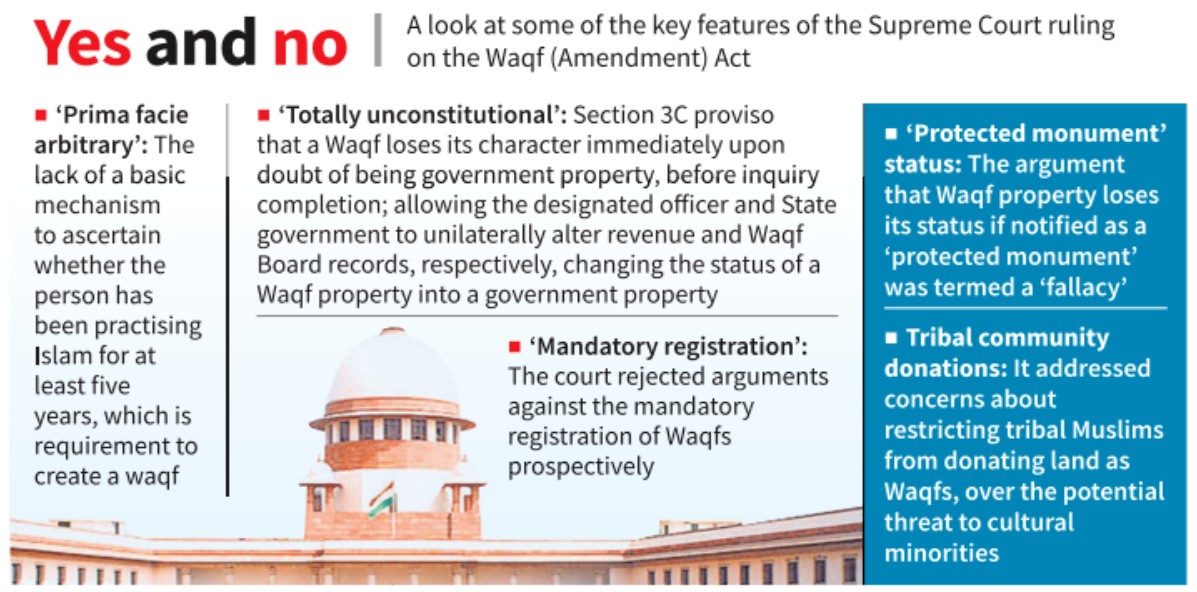
    The Waqf (Amendment) Act, 2025, passed by Parliament earlier this year, faced widespread opposition from political leaders, religious organisations, and civil society. Over 65 petitions were filed, challenging its constitutional validity. On September 15, the Supreme Court issued an interim order staying several key provisions, particularly those expanding the powers of district collectors, imposing a five-year Islam practice condition for creating a waqf, and capping non-Muslim representation in Waqf boards. At the same time, the Court upheld other significant changes such as the removal of “waqf-by-user” and the applicability of the Limitation Act. This selective intervention reflects the judiciary’s cautious approach in balancing equity, religious freedom, and governance.

    Waqf

    Why is the Supreme Court’s interim stay significant?

    1. First major judicial intervention: The SC’s order is the first substantive check on the Waqf (Amendment) Act, 2025 since its passage.
    2. Large-scale impact: With nearly 65 petitions filed, the matter affects thousands of properties and the rights of the Muslim community across India.
    3. Balance of powers: The Court flagged violation of the separation of powers doctrine by preventing revenue officers from adjudicating property titles.
    4. Guardrails against misuse: While not striking down the Act, the Court has added interim safeguards to prevent dispossession and misuse of powers.

    What powers of District Collectors were stayed?

    1. Section 3C inquiry power: District Collectors could declare that land claimed as waqf is government property. The SC stayed the clause that made waqf status cease immediately upon inquiry.
    2. Arbitrariness highlighted: Entrusting title determination to a revenue officer was held to be prima facie arbitrary.
    3. Safeguard applied: Waqf properties will retain their status until adjudicated by a Waqf Tribunal. However, no third-party rights can be created until final resolution.

    How did the Court deal with non-Muslim representation in Waqf Boards?

    1. Capping membership: Central Waqf Council (22 members) shall not have more than 4 non-Muslims; State Waqf Boards (11 members) shall not have more than 3 non-Muslims.
    2. Community rights upheld: This ensures that the Muslim community’s right under Article 26 to manage religious affairs is not diluted.
    3. Avoiding ambiguity: The SC clarified numbers to prevent misinterpretation of the law.

    What about the ‘five years of practising Islam’ rule?

    1. New definition of waqf: The 2025 Act required proof of practising Islam for five years to create a waqf.
    2. Provision stayed: SC stayed this rule until the government frames rules and mechanisms for proof.
    3. Judicial caution: The Court noted concerns of arbitrariness and discrimination, but also recognised historical misuse of waqf as a tool to evade creditors.

    Which provisions were not stayed?

    1. Abolition of ‘waqf by user’: The Court upheld its removal, citing misuse to encroach upon government lands.
    2. Applicability of the Limitation Act: Waqfs must now act within statutory limitation periods. This was upheld as removing previous discrimination.
    3. Registration compliance: SC emphasised that waqfs had 102 years (since 1923) to register, hence claims of arbitrariness were weak.

    What is the larger constitutional and governance context?

    1. Presumption of constitutionality: Laws passed by Parliament carry weight until struck down.
    2. Balancing equities: The SC avoided blanket suspension, staying only contentious clauses.
    3. Protection of minority rights: Ensures Article 26 freedoms are not eroded.
    4. Preventing property misuse: Legislative intent to protect government property and curb misuse was acknowledged.

    Conclusion

    The Supreme Court’s interim order on the Waqf (Amendment) Act, 2025 reflects a nuanced judicial approachprotecting religious freedoms while respecting legislative authority. By drawing constitutional boundaries for state power and emphasising procedural fairness, the Court has reinforced its role as a guardian of equity and minority rights. The final verdict will have long-lasting implications for governance of religious endowments and minority trust in legal institutions.

    PYQ Relevance:

    [UPSC 2019] What are the challenges to our cultural practices in the name of secularism.

    Linkage: The Waqf (Amendment) Act, 2025 has been challenged for allegedly curbing the Muslim community’s right under Article 26 to manage its religious endowments, showing how state intervention can threaten cultural practices. The Supreme Court’s interim stay on provisions like non-Muslim majority in Waqf Boards and “five years of practising Islam” directly reflects the tension between secular governance and religious autonomy. Thus, the case exemplifies the broader challenge of balancing secularism with protection of cultural practices, as asked in the 2019 question.

  • Social Media: Prospect and Challenges

    The conduct of social media companies amid political unrest

    Introduction

    The insurrection in Nepal, which led to the fall of the K.P. Sharma Oli government after just two days, brought with it an immediate digital clampdown: a ban on 26 social media platforms. While such state actions are not unprecedented, what deserves scrutiny is the consistent passivity of social media companies in moments of political crisis. Despite marketing themselves as champions of free expression, Big Social firms often prioritise profit motives and regulatory compliance over defending user rights. The Nepal episode is not an isolated case but part of a global pattern spanning Russia, Myanmar, Nigeria, and Iran.

    Why is this issue in the news?

    The Nepal unrest marks the latest instance of governments weaponising internet shutdowns, but the bigger story is the role of social media platforms. Instead of resisting, they largely issued boilerplate statements, leaving millions of users disconnected. This sharp contrast between their claims of empowering citizens and their reluctance to act exposes the gap between rhetoric and responsibility. The scale of the problem is massive, bans disrupt civic life, cost economies billions, and exacerbate inequality in times of crisis.

    The Conduct of Social Media Companies Amid Political Unrest

    Why do social media companies stay passive?

    1. Profit Motives: Companies fear losing access to lucrative markets more than reputational harm.
    2. Government Pressure: Host states can fine, jail, or exclude companies, discouraging open resistance.
    3. Commercial Interests vs. Civic Responsibility: Platforms project neutrality but continue profiting while users bear risks.

    How has this pattern unfolded globally?

    1. Russia (2018): Telegram fought bans technically but gave little political solidarity to users facing arrests.
    2. Myanmar (2021): Facebook ban cut off protestors from news and organising tools.
    3. Nigeria (2021): Twitter suspension cost the economy $26 million/day while the company stayed largely silent.
    4. Iran (2022): Instagram and WhatsApp issued generic appeals while small businesses collapsed.

    What technological solutions exist but remain unused?

    1. Decentralised Networks: Tor, I2P, Mastodon, and Signal proxies allow traffic rerouting.
    2. Corporate Tools: Google’s Outline VPN, YouTube’s delivery networks, and WhatsApp piggybacking on HTTPS could bypass bans.
    3. Underdeployment: Companies avoid such measures due to fears of retaliation and loss of ad-driven surveillance models.

    How does Big Social compare with other industries?

    1. Financial Sector: PayPal and Visa cut services in Russia citing ethics.
    2. Wikipedia: Won a legal battle against Turkey’s ban.
    3. Telecom Firms: Unlike them, SM companies market themselves as defenders of expression, making passivity starker.

    What are the wider consequences of passivity?

    1. Digital Divide: Richer users bypass bans with VPNs, poorer citizens are excluded.
    2. Insecurity: Users shift to unsafe alternatives, scams rise, and access to trusted news collapses.
    3. Corporate Power Paradox: Meta’s revenue ($134 bn) and Alphabet’s ($300 bn) exceed GDPs of Nepal and Nigeria, yet they plead helplessness.

    What could be the way forward?

    1. Transparency Mandates: Publish shutdown orders, legal justifications, and company responses.
    2. Technical Contingencies: Industry-wide standards for proxy modes, redundancy, and fallback networks.
    3. Regional Cooperation: Blocs like AU and SAARC can negotiate common demands.
    4. Moral Responsibility: Companies must balance profit motives with defending civic infrastructure.

    Conclusion

    The Nepal episode illustrates a broader global pattern where social media companies retreat into silence during political unrest. While they claim neutrality, their choices are deeply political, amplifying inequalities and weakening democratic resilience. Given their vast resources and influence, neutrality is no longer an option. Transparency, decentralisation, and moral responsibility must become cornerstones of their global operations, especially in the Global South where civic stakes are highest.

    Value Addition

    • Santa Clara Principles (2018): 
      • Framework urging tech companies to publish government takedown requests, explain moderation decisions, and ensure due process in digital rights protection.
      • Highlights the need for transparency and accountability in content moderation.
    • UNHRC Resolution (2016):
      • Declared internet shutdowns as a violation of international law and an infringement on freedom of expression.
      • Recognises access to the internet as a fundamental enabler of human rights.
    • Economic Impact of Shutdowns:
      • Nigeria’s Twitter ban (2021) cost the economy nearly $26 million/day, showing how bans hurt not just civic spaces but also small businesses and livelihoods.
      • Similarly, India has often topped the list of internet shutdowns globally, costing billions annually.
    • Concept of Digital Authoritarianism:
      • Use of internet control, shutdowns, and surveillance by states to curb dissent. Seen in Myanmar (2021 coup), Iran (2022 protests), and Nepal (2025 unrest).
    • Surveillance Capitalism (Shoshana Zuboff):
      • Business model of Big Tech that monetises user data through targeted ads. Centralised control discourages adoption of decentralised, privacy-respecting technologies.
    • Civic Infrastructure at Risk:
      • Platforms are not neutral spaces but essential public utilities during crises. Their passivity undermines democratic resilience and widens the digital divide.
    • Technological Solutions & Precedents:
      • Signal Proxies (Iran, 2022) – volunteers hosted relays to bypass censorship.
      • Wikipedia vs. Turkey – fought a multi-year legal battle and restored access, unlike Big Social’s passivity.
      • Google’s Outline VPN – toolkit for journalists and activists, an example of proactive circumvention tools.
    • International Comparisons:
      • Financial Sector – PayPal & Visa cut ties with Russia citing ethics after Ukraine invasion.
      • Telecoms – forced into compliance immediately with shutdown orders, unlike Big Social which claims neutrality yet markets itself as pro-free expression.

    PYQ Relevance:

    [UPSC 2016] Use of internet and social media by non-state actors for subversive activities is a major security concern. How have these been misused in the recent past? Suggest Effective guidelines to curb the above threat.

    Linkage: The Nepal case and similar crises show how governments misuse shutdowns while non-state actors exploit social media for mobilisation, misinformation, and violence. The passivity of Big Social aggravates risks by denying safe, transparent channels, widening the digital divide. Thus, effective guidelines must balance security imperatives with digital rights, corporate accountability, and technological safeguards.

  • Climate Change Negotiations – UNFCCC, COP, Other Conventions and Protocols

    Tropical Forest Forever Facility (TFFF)

    Why in the News?

    Brazil, the host of COP30, has proposed the Tropical Forest Forever Facility (TFFF) to finance the conservation of standing forests.

    What is Tropical Forest Forever Facility (TFFF)?

    • Nature: A global blended finance fund that pays Tropical Forest Countries (TFCs) per hectare of forest conserved.
    • Adjustments: Deductions made for deforestation or degradation.
    • Equity Provision: At least 20% of payments reserved for Indigenous Peoples & Local Communities (IPLCs).
    • Monitoring: Payments tracked via satellite systems and managed by a TFFF Secretariat.
    • Relation to REDD+: Complements but does not replace REDD+; no carbon credits or project-based offsets.

    Financial Mechanism:

    • Core Instrument: Tropical Forest Investment Fund (TFIF) under a Multilateral Development Bank (likely World Bank).
    • Funding Sources:
      • Sponsors (20%): High-income countries and philanthropies, via concessional loans/grants.
      • Market Investors (80%): Institutional investors, sovereign wealth funds, university endowments.
    • Investment Strategy: Invests in liquid public bonds (US Treasuries), corporate bonds (Apple), green/blue bonds; excludes fossil fuels.
    • Returns & Payments: Earnings from investment funds result-based payments to TFCs, with 2% annual increase for inflation.

    Key Hurdles:

    • Financing Burden: Global South may indirectly finance its own conservation as TFIF invests in their markets with higher borrowing costs.
    • Credit Rating Dependence: Returns hinge on ratings by Fitch, S&P, Moody’s.
    • Geopolitical Risk: Reliance on World Bank (US dominance) may skew control.
    • IPLC Gap: Despite pledges, historically Indigenous Peoples & Local Communities (IPLCs) receive <1% of climate aid.
    • Forest Definitions: Disputes over canopy thresholds (20–30%) may disadvantage sparser forest nations.

    Back2Basics: REDD+ (Reducing Emissions from Deforestation and Forest Degradation plus)

    • Launch: 2008 as a UN collaborative initiative (FAO, UNDP, UNEP); now >65 partner countries.
    • Framework: Under UNFCCC; incentivizes developing nations to cut emissions and improve forest carbon stocks.
    • ‘+’ Component: Adds conservation, sustainable management, and carbon stock enhancement.
    • Objectives: Financial incentives for verified actions in (1) reducing deforestation, (2) reducing degradation, (3) conservation, (4) sustainable management, (5) carbon enhancement.
    • Mechanism: Countries prepare national strategies, monitor/report, and get results-based payments for verified emission reductions.


    [UPSC 2025] Which one of the following launched the ‘Nature Solutions Finance Hub for Asia and the Pacific’?

    (a) The Asian Development Bank (ADB)*

    (b) The Asian Infrastructure Investment Bank (AIIB)

    (c) The New Development Bank (NDB)

    (d) The International Bank for Reconstruction and Development (IBRD)


  • Foreign Policy Watch: United Nations

    India secures International Seabed Authority (ISA) exploration contract

    Why in the News?

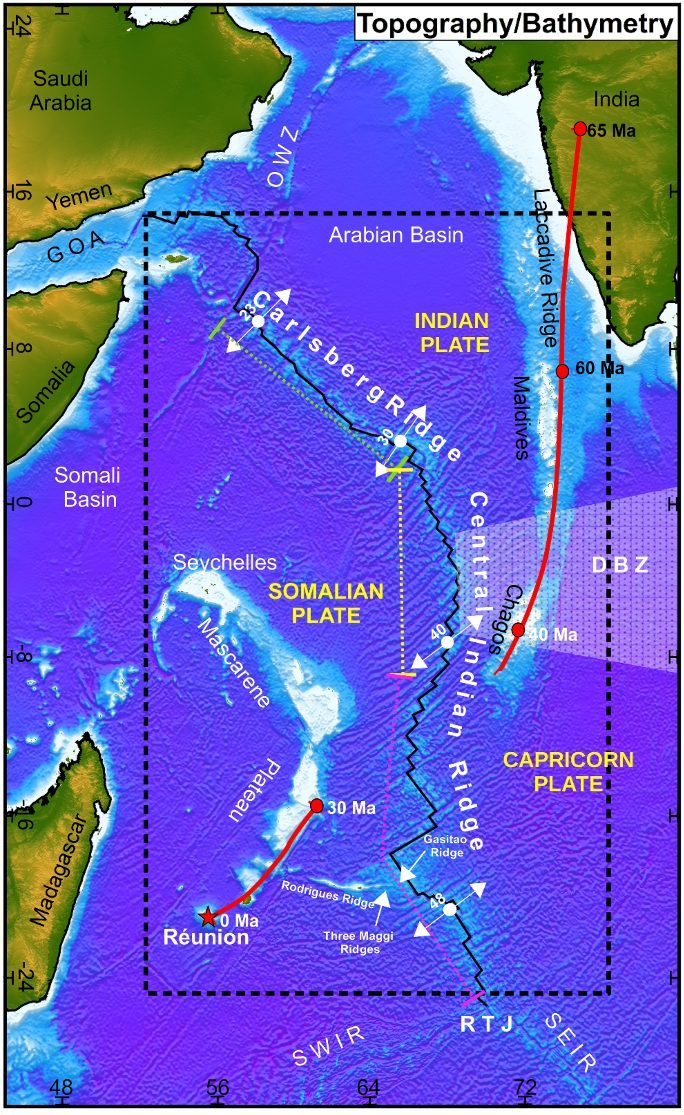
    India has secured the world’s first International Seabed Authority (ISA) licence to explore polymetallic sulphur nodules in the Carlsberg Ridge, northwest Indian Ocean.

    India’s Engagement with ISA:

    • Exploration Contracts:
      1. 2002 – Polymetallic nodules, Central Indian Ocean Basin (valid till 2027).
      2. 2016 – Polymetallic sulphides, Indian Ocean Ridge (valid till 2031).
      3. 2025 – First global licence for polymetallic sulphides in Carlsberg Ridge.
    • Pending Application: Afanasy-Nikitin Seamount (ANS), Central Indian Ocean.
    • Strategic Goals:
      • Secure access to critical minerals (nickel, cobalt, manganese, copper).
      • Balance energy transition needs with environmental safeguards.
      • Counter competing claims (e.g., China in the Indian Ocean).
    • Role in ISA: Active participant in Mining Code negotiations; pushes for sustainable, equitable exploration.

    About International Seabed Authority (ISA):

    • Establishment: Created under UNCLOS (1982) and the 1994 Agreement on Part XI; Based in Kingston, Jamaica.
    • Membership: 168 States (including India) + EU; the US is NOT a member or party to UNCLOS.
    • Mandate:
      • Regulate exploration/exploitation of minerals in the Area (beyond national jurisdictions, ~54% of oceans).
      • Ensure benefits for all humankind.
      • Protect marine environment from mining impacts.
      • Promote marine scientific research.
    • Regulatory Framework: Guided by the Mining Code (licensing, EIA, sustainability standards).
    • Functions:
      • Grants 15-year exploration contracts (extendable).
      • Monitors compliance of contractors.
      • Balances resource use with environmental safeguards.

    About Carlsberg Ridge:

    • Location: A mid-ocean ridge in the northwest Indian Ocean (Arabian Sea region).
    • Extent: Covers ~3,00,000 sq. km, stretching from Rodrigues Island (SW Indian Ocean) to the Owen fracture zone.
    • Tectonic Setting: Boundary between the Indian Plate and the Arabian Plate.
    • Critical Minerals: Deposits contain manganese, cobalt, nickel, copper, vital for clean energy, electronics, and defence.


    [UPSC 2021] Consider the following statements:

    1. The Global Ocean Commission grants licenses for seabed exploration and mining in international waters.

    2. India has received licenses for seabed mineral exploration in international waters.

    3. ‘Rare earth minerals’ are present on the seafloor in international waters.

    Which of the statements given above are correct?

    Options: (a) 1 and 2 only (b) 2 and 3 only* (c) 1 and 3 only (d) 1, 2, and 3


  • Insolvency and Bankruptcy Code

    In news: Bank for International Settlements (BIS)

    Why in the News?

    The Bank for International Settlements (BIS) has cautioned that record-high global share prices appear detached from concerns over rising government debt.

    About the Bank for International Settlements (BIS):

    • Establishment: Formed in 1930, making it the world’s oldest international financial institution.
    • Role: Known as the “central bank for central banks”, serving only central banks & international organisations, not private entities or governments.
    • Headquarters: Basel, Switzerland; offices in Hong Kong & Mexico City.
    • Membership: Owned by 63 central banks, covering ~95% of global GDP.
    • Purpose: Promotes international monetary and financial cooperation and ensures global monetary stability.
    • Functions:
      • Platform for policy coordination & information sharing among central banks.
      • Provides banking services: reserve management, gold/forex transactions, liquidity support.
      • Acts as trustee/agent in global financial operations.
      • Conducts research, training, and seminars on financial stability.
      • Hosts Basel Committee on Banking Supervision (BCBS), which frames Basel norms.

    India and the BIS:

    • Membership: Represented by the Reserve Bank of India (RBI) as a full member.
    • Representation: RBI Governor participates in BIS Board of Governors meetings.
    • Participation:
      • Engages in BIS research & policy discussions.
      • RBI officials join working groups on supervision, stability, and fintech.
    • Basel Norms: India, via RBI, has adopted Basel standards on capital adequacy, liquidity & risk management.
    • Innovation Hub: Collaborates with BIS on digital payments, central bank digital currencies (CBDCs), and cross-border fintech solutions.
    [UPSC 2015] ‘Basel III Accord’ or simply ‘Basel III’ often seen in the news, seeks to

    Options: (a) develop national strategies for the conservation and sustainable use of biological diversity

    (b) improve banking sector’s ability to deal with financial and economic stress and improve risk management*

    (c) reduce the greenhouse gas emissions but places a heavier burden on developed countries

    (d) transfer technology from developed countries to poor countries to enable them to replace the use of chlorofluorocarbons in refrigeration with harmless chemicals


  • Police Reforms – SC directives, NPC, other committees reports

    Supreme Court Guidelines on DNA Evidence in Criminal Cases

    Why in the News?

    The Supreme Court has issued guidelines in the Kattavellai @ Devakar v. State of Tamil Nadu Judgement to standardise DNA handling in criminal cases to prevent contamination and delays after evidence lapses in a major case.

    Key Highlights of the Supreme Court Guidelines:

    • Case Context: It involved rape, murder, and robbery. Court flagged delays in Forensic Science Laboratory (FSL) submission, lack of chain of custody, and risk of contamination.
    • Need: Lack of uniform procedures across states despite scattered rules. Since Police and Public Order are in the State List, Supreme Court intervened for national uniformity.
    • Guidelines Issued:
      • Collection and Documentation: Samples must be packaged properly, labelled with FIR details, and signed by medical officer, Investigating Officer, and witnesses.
      • Transportation: Investigating Officer (IO) must deliver samples to FSL within 48 hours. Reasons for any delay must be recorded.
      • Storage Pending Trial: Packages cannot be opened or resealed without trial court approval.
      • Chain of Custody Register: Maintained until conviction or acquittal. IO responsible for explaining lapses.

    Previous SC Observations on DNA Evidence:

    • Anil v. Maharashtra (2014): DNA reliable only if laboratory procedures are maintained.
    • Manoj v. Madhya Pradesh (2022): DNA rejected as recovery was from open area with contamination risk.
    • Rahul v. Delhi (2022): DNA held inadmissible after being kept in police custody for two months.
    • Pattu Rajan v. Tamil Nadu (2019): DNA value depends on corroborating evidence; absence not fatal.
    • Sharda v. Dharmpal (2003): DNA test orders valid; no violation of Article 21.
    • Das @ Anu v. Kerala (2022): DNA not self-incrimination under Article 20(3). Section 53A CrPC permits collection in rape cases.

    Back2Basics: DNA Profiling

    • Overview: DNA profiling, also called DNA fingerprinting, is a forensic technique to identify individuals by analysing unique DNA regions, mainly Short Tandem Repeats (STRs).
    • How it works: Human DNA is 99.9% identical; the 0.1% variability forms the basis of personal identification.
    • Sources: DNA can be extracted from blood, semen, saliva, hair, bone, skin, or even “touch DNA.”
    • Processes: The process includes isolation, purification, amplification, visualization, and statistical comparison of DNA markers.
    • Methods:  miniSTRs and mitochondrial DNA (mtDNA) help in degraded or limited samples.
    • Legal Status: Treated as expert opinion under Indian Evidence Act Section 45 (now BSA 2023 Section 39). DNA is corroborative, not substantive evidence.
  • Indian Navy Updates

    [pib] Exercise Pacific Reach, 2025

    Why in the News?

    INS Nistar, the Navy’s new indigenous Diving Support Vessel, made its maiden port call at Singapore to join the multinational Exercise Pacific Reach 2025.

    About Exercise Pacific Reach:

    • Overview: A biennial, multinational submarine rescue exercise initiated in 1996 (Asia-Pacific).
    • Objective: Enhances cooperation, interoperability, and readiness in submarine rescue.
    • Pacific Reach 2025 (XPR-25): 9th edition, hosted by Singapore.
    • Phases:
      • Harbour Phase: Seminars, Subject Matter Expert Exchanges (SMEE), medical symposium, cross-deck visits.
      • Sea Phase: Live submarine rescue drills, intervention ops, deep-water simulated emergencies, and Mass Evacuation Exercises (MASSEVEX).
    • Participation: 40+ countries (participants + observers).

    India’s Participation:

    • INS Nistar: India’s indigenous Diving Support Vessel (DSV), mothership for Deep Submergence Rescue Vehicle (DSRV).
    • Submarine Rescue Unit (East): Taking part in live rescue drills.
    • Significance: Showcases 80% indigenous capability (built by Hindustan Shipyard Ltd), and positions India as a regional leader in humanitarian submarine rescue.

    Back2Basics: INS Nistar

    • Commissioning: First indigenous DSV, commissioned July 2025 at Visakhapatnam.
    • Design: Built with 80% indigenous content, in line with Aatmanirbhar Bharat.
    • Capability: Supports DSRV rescue ops up to 300 m; equipped with ROVs, hyperbaric lifeboats, subsea cranes, helipad, and medical facilities.
    • Role: Provides endurance for long missions, reinforcing India’s deep-sea rescue & maritime safety architecture.
  • Economic Indicators and Various Reports On It- GDP, FD, EODB, WIR etc

    [15th September 2025] The Hindu Op-ed: Improving Macros: Period of low inflation and relatively high growth

    PYQ Relevance

    [UPSC 2019] Do you agree with the view that steady GDP growth and low inflation have left the Indian economy in good shape? Give reasons in support of your arguments.

    Linkage: The present scenario of low inflation (2.1%) coupled with high growth directly resonates with the 2019 PYQ, as it exemplifies how such a macro mix strengthens household purchasing power and policy space. However, just as in 2019, questions about data reliability and sustainability remain valid. Thus, India’s current economic outlook offers both affirmation and nuance to the earlier debate.

    Mentor’s Comment

    India’s macroeconomic trajectory has taken a remarkable turn, shifting from the troubling “low growth, high inflation” trap of last year to a far more favorable “high growth, low inflation” outlook. With inflation dipping within RBI’s comfort band and food prices contracting sharply, the macro story is compelling and holds lessons for India’s policy and global positioning. This article unpacks the nuances of the recent data, explores what it means for the future, and situates it within the UPSC Mains framework with value addition, practice questions, and micro-themes.

    Introduction

    The August 2025 retail inflation numbers marked a critical juncture in India’s economic narrative. Retail inflation, though it rose slightly, stood at 2.1%, comfortably within the Reserve Bank of India’s (RBI) target range of 2%-6%. This snapped a nine-month declining streak but did not trigger alarm. Food inflation remained subdued, with striking contractions of 15.9% in vegetable prices and 14.5% in pulses. Combined with welfare provisions under the National Food Security Act, this ensured affordability of essential items. With low inflation across housing, fuel, and clothing, India’s macroeconomic picture looks vastly different from last year, when high inflation coupled with low growth defined the economic outlook. The gap between growth and inflation has widened from 2.1 percentage points last year to 5.5 percentage points now—an enviable reversal.

    Understanding the Current Inflation Trends

    1. Retail inflation at 2.1%: Marginally within RBI’s comfort zone of 2%-6%, reflecting stability despite global uncertainty.
    2. Food prices contracting sharply: Vegetables fell by 15.9% and pulses by 14.5%, easing household expenditure.
    3. Other necessities stable: Housing, clothing, footwear, and fuel inflation are all lower in August than in July.
    4. Welfare cushioning: Free foodgrains under the NFSA ensure food affordability despite global volatility.

    How Has the Macro Picture Changed Since Last Year?

    1. From high inflation to low inflation: Inflationary pressures last year eroded purchasing power, but now they remain subdued.
    2. From sluggish growth to robust growth: Growth has accelerated, giving policymakers breathing room.
    3. Growth–inflation differential widened: From 2.1 percentage points last year to 5.5 points this year, a striking macro improvement.
    4. Comparability holds: Concerns about data integrity existed last year too, hence the relative improvement is valid.

    What Role Do Global and Domestic Policies Play?

    1. Russian oil purchases: Even if India abandons Russian crude under U.S. pressure, the inflationary impact will be limited due to already-low global crude prices.
    2. GST rate cuts: Effective September 22, lower GST rates are expected to reduce consumer prices further.
    3. RBI’s cautious optimism: While Q1’s low inflation-high growth dynamic raises hopes of a rate cut, global uncertainties may push this decision to December instead of September.

    What Lies Ahead for India’s Economic Outlook?

    1. Benign inflation trajectory: Indicators point to sustained price stability.
    2. Limited global oil shock risk: Declining discounts from Russia and stable crude prices mean less volatility for India.
    3. Prospects for rate cuts: The Monetary Policy Committee may consider easing monetary policy in December, enhancing growth.
    4. Strengthened fiscal space: Low inflation allows government welfare and investment measures to operate without inflationary spirals.

    Conclusion

    India’s macroeconomic outlook in 2025 is a story of resilience and reversal. The sharp transition from a vulnerable high-inflation, low-growth setup to a robust high-growth, low-inflation phase underscores effective price stabilization and cushioning mechanisms like NFSA. While global uncertainties remain, the benign inflation trajectory coupled with strong growth provides a foundation for India’s economic policy to focus on sustainable and inclusive development.

Join the Community

Join us across Social Media platforms.