💥UPSC 2027,2028 Mentorship (April Batch) + Access XFactor Notes & Microthemes PDF

Archives: News

  • Coronavirus – Economic Issues

    What the RBI has done to provide relief for the ongoing Coronavirus outbreak in India

    Context

    The RBI’s Governor’s ‘bazooka’ announcement earlier today has seen the usually conservative institution and its head pull out the big guns in word and action.

    Four steps taken by the RBI

    • One, increase the liquidity in the system.
    • Two, make sure the lower policy rate is transmitted. Steps one and two are linked.
    • Three, give a three-month window for a payback on all term loans.
    • Four, take steps to reduce volatility and provide stability.
    • Big cut in repo rate: He announced a big cut in the repo rate by 75 basis points (100 basis points make a per cent, so three-quarters of a percentage point) to 4.4%.
    • What is the repo rate? Repo rate is the rate at which the banks borrow from the RBI. Banks give ‘eligible securities’ they hold for cash that RBI gives as an overnight loan.
    • Banks pay the repo rate as interest for this borrowing.

    First two steps of the RBI: Increasing liquidity and ensuring policy rate transmission

    • Why lower repo rate matters? When the repo rate is high, banks find it costly to borrow and in turn raise the price of loans to their borrowers.
    • Reducing interest for the system: A low repo rate has the overall effect of reducing interest rates for the system. Lower rates make it easier for entrepreneurs to take loans for working capital and for households for homes, vehicles and so on.
    • Issue of policy rate transmission: Previous rate cuts have not been ‘transmitted’ by the banks who have not reduced lending rates and have preferred to keep money with the RBI at the ‘reverse repo rate’.
    • What is reverse repo rate? This is the rate at which banks lend to the RBI.

    How RBI is ensuring transmission now?

    • The RBI has now reduced the reverse repo rate by 90 basis points to 4%.
    • This cut in reverse rape sharper than the one on the repo rate to encourage banks to borrow from the RBI rather than lend to it.
    • How reverse repo rate matters? Banks have preferred to deposit money with the RBI rather than lend it out with an average daily amount of ₹3 trillion being kept with the RBI.
    • A reduction of the reverse repo to 4% makes it unattractive to banks to park it with the RBI and banks will be nudged to lend.
    • Why bank lending matters for business? Bank lending provides the needed oxygen to businesses for their working capital and longer-term loans.
    • Read this as a measure to help banks take the decision to lend rather than play it safe by keeping money with the RBI.

    How lock-down slows down the economy?

    • Rush to safety for money: If people are in a lock-down, the wheels of the economy begin to grind down and there is a rush to safety for money in the system.
    • Freezing of the markets market: Investors begin to redeem their shares, bonds and mutual funds. These redemptions cause a fire sale of assets. Finally, when there are no buyers, markets begin to freeze.

    What are the measures taken by RBI to stabilise the market?

    • To keep the wheels of the markets well-oiled with cash, the RBI has made ₹3.74 trillion available. This it has done using four weapons.
    • The first measure: It has used targeted long-term repo operations.
    • RBI will lend money to banks (a total of ₹1 trillion) that can be invested in bonds and other forms of lending instruments.
    • What is a hold-to-maturity way? Under the hold-to-maturity way, the portfolio is valued not on the market price but on what the price should be given the rate of interest of the bond, the holding period and the rating of the bond.
    • Basically, it allows trades to happen at a price that is not confused with the current pandemic in the market.
    • The second measure: The RBI reduced the cash reserve ratio (CRR) by a full percentage point down to 3% for a year.
    • The CRR is the percentage of demand and time deposits banks have to keep with the RBI.
    • Why CRR and not SLR was reduced? There is another 18.25% of deposits that is also not used for lending under the Statutory Liquidity Ratio (SLR), further reducing the money banks have to lend.
    • RBI has reduced the CRR to 3%, freeing up ₹1.37 trillion for banks to lend. CRR has been chosen rather than SLR because this increases ‘primary liquidity’ with the banks a bit better.
    • Not only is there CRR rate down, banks now need to maintain 80% of the limit on a daily basis instead of 90% till June 26, 2020.
    • The third measure: ₹1.37 trillion will be made available under the emergency lending window called the marginal standing facility (MSF).
    • Banks will now be able to borrow 3% of their deposits under this window, up from the current 2%. Basically, RBI is willing to lend more than before.
    • How much more? ₹1.37 trillion under this window.

    The third step of the RBI: Regulatory forbearance

    • What is the regulatory forbearance?

      What this means is that as economic activity grinds to a slowdown, people will not be able to pay back the loans they have taken for no fault of theirs.

    • This could be businesses with loans, households with EMIs on home loans and others with what are called ‘term loans’.
    • RBI will allow a moratorium of three months for loan repayment.
    • This is a relief especially for small entrepreneurs who have been forced to shut shop and for employees whose incomes have stopped since their place of work is shut.
    • It is good that the RBI has looked at the retail part of the market along with the corporate sector for once.
    • Working capital loans don’t come under the ‘term loan’ category, and these borrowers can defer paying interest for three months till June 2020.

    The fourth step of the RBI: Measures to reduce volatility in the exchange rate

    • Fourth is a measure to reduce the volatility of the price of the rupee in international markets by allowing banks to deal in off-shore non-deliverable rupee derivative markets.
    • It looks like reform using the crisis to bring about this long-awaited change.

    Conclusion

    We don’t know if measures taken by the RBI and the government are enough. But what is comforting is that the government and the RBI are working in tandem to deal with this giant killer of a virus.

  • RBI Notifications

    Regulation of Payment Aggregators (PAs)

    The Reserve Bank of India released guidelines for regulating payment aggregators (PAs) and payment gateways (PGs), nearly six months after it first proposed regulating these entities in a discussion paper.

    Payment Aggregators (PAs)

    • PAs are entities that facilitate e-commerce sites and merchants to accept various payment instruments from the customers for the completion of their payment obligations.
    • PGs are entities that provide technology infrastructure to route and facilitate the processing of an online payment transaction without any involvement in the handling of funds.
    • With the new set of guidelines PAs and PGs such as Paytm, Pay Pal, Mobikwik, Razorpay, PayU, CCAvenue etc. will be regulated by RBI to ensure the safety of all our online transactions.

    What are the new guidelines?

    The new guidelines say that-

    • A payment aggregator (entities that facilitate e-commerce sites and merchants to accept various payment instruments) should be a company incorporated in India under the Companies Act, 1956 / 2013.
    • Non-bank entities offering payment aggregator services will have to apply for authorisation on or before June 30, 2021.
    • E-commerce marketplaces providing payment aggregator services will have to be separated from the marketplace business and they will have to apply for authorisation on or before June 30, 2021.
    • Pas existing today will have to achieve a net worth of ₹15 crore by March 31, 2021 and a net worth of ₹25 crore by the end of third financial year, which means or before March 31, 2023.
    • The net-worth of ₹25 crore shall be maintained at all times thereafter.
  • Zoonotic Diseases: Medical Sciences Involved & Preventive Measures

    Serological test for COVID-19

    The ICMR invited bids for an estimated 10 lakh antibody kits (for serological tests) for the diagnosis of COVID-19.

    What are serological tests?

    • Viral infections are mainly identified by two kinds of tests– genetic and serological.
    • Genetic tests can identify infections that are active but cannot be used to detect past infections.
    • To trace how infections like the novel coronavirus have spread so far, it is important to detect people who contracted the disease in the past and have recovered.
    • This is what serological tests seek to determine.

    How are the two different?

    • The genetic test is conducted on a swab collected from the back of the throat, a liquid sample from the lower respiratory tract, or a simple saliva sample.
    • For SARS-COV-2, the virus’s RNA is first converted into DNA.
    • By a process called polymerase chain reaction (PCR), DNA fragments in the sample are copied exponentially — one is copied into two, the two are copied into four, and so on.
    • Unlike genetic tests, which look for RNA in swab samples, serological tests work on antibodies in blood samples. Hence, they are also called ‘antibody tests’.

    How serological tests work?

    • Antibodies, or protective proteins produced by the immune system to neutralize pathogens such as bacteria and viruses, are present in one’s bloodstream for a considerable period of time after the infection has gone.
    • To disable a pathogen, the antibody latches to a unique protein molecule on pathogen’s surface, called an antigen.
    • Serological tests use antigen molecules to detect the presence of antibodies relevant to the infection.
    • Generally, a blood sample is placed in a test tube that is lined with antigens on the inside. If the relevant antibodies are present, they latch on to the antigens.
    • Such tests are relatively inexpensive, and can display results within a few minutes.
  • G20 : Economic Cooperation ahead

    [pib] Virtual Summit of G20 Leaders

    A Virtual G20 Leaders’ Summit was recently convened yesterday to discuss the challenges posed by the outbreak of the COVID-19 pandemic and to forge a globally coordinated response.

    About G20

    • Formed in 1999, the G20 is an international forum of the governments and central bank governors from 20 major economies.
    • Collectively, the G20 economies account for around 85 percent of the Gross World Product (GWP), 80 percent of world trade.
    • To tackle the problems or the address issues that plague the world, the heads of governments of the G20 nations periodically participate in summits.
    • In addition to it, the group also hosts separate meetings of the finance ministers and foreign ministers.
    • The G20 has no permanent staff of its own and its chairmanship rotates annually between nations divided into regional groupings. 

    Aims and objectives

    • The Group was formed with the aim of studying, reviewing, and promoting high-level discussion of policy issues pertaining to the promotion of international financial stability.
    • The forum aims to pre-empt the balance of payments problems and turmoil on financial markets by improved coordination of monetary, fiscal, and financial policies.
    • It seeks to address issues that go beyond the responsibilities of any one organisation.

    Member Countries

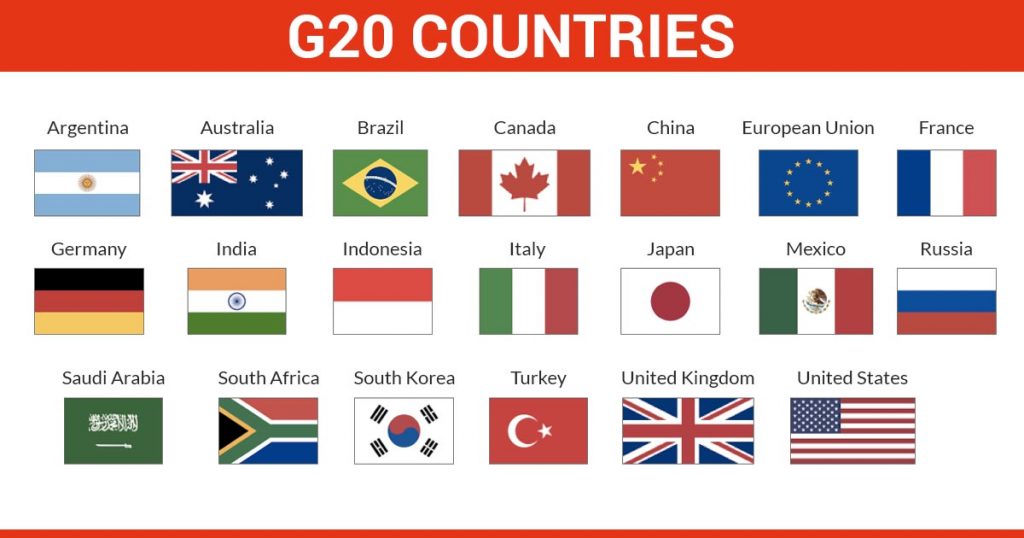
    The members of the G20 consist of 19 individual countries plus the European Union (EU).

    • The 19 member countries of the forum are Argentina, Australia, Brazil, Canada, China, France, Germany, India, Indonesia, Italy, Japan, Mexico, Russia, Saudi Arabia, South Africa, South Korea, Turkey, United Kingdom and the United States.
    • The European Union is represented by the European Commission and by the European Central Bank.

     Who are the G20 Sherpas?

    • A Sherpa is the personal representative of a head of state or government who prepares an international summit, particularly the annual G7 and G20 summits.
    • Between the summits, there are multiple Sherpa conferences where possible agreements are laid out.
    • This reduces the amount of time and resources required at the negotiations of the heads of state at the final summit.
    • The Sherpa is generally quite influential, although they do not have the authority to make a final decision about any given agreement.
    • The name is derived from the Sherpa people, a Nepalese ethnic group, who serve as guides and porters in the Himalayas, a reference to the fact that the Sherpa clears the way for a head of state at a major summit.
  • Zoonotic Diseases: Medical Sciences Involved & Preventive Measures

    [pib] Project ‘Isaac’

    IIT, Gandhinagar has launched Project Isaac to engage its students in creative projects to enhance their critical skills while they are confined to their homes because of Coronavirus.

    Project ‘Isaac’

    • The project is inspired by Sir Isaac Newton, who was similarly sent home by Trinity College, Cambridge, because of the Great Plague of London in 1665.
    • During this year, Newton, then a 22-year-old college student developed some of his most profound discoveries, including early calculus, as well as his theories of optics and gravity.
    • As part of the project, four different competitions are being organized by IIT, Gandhinagar to cultivate new skills among students regarding writing, painting, coding, music, creative expression, and so on.
    • Students can take part in competitions online.
  • Economic Indicators and Various Reports On It- GDP, FD, EODB, WIR etc

    What is Keqiang Index’?

    China’s GDP numbers which are preferably represented by Keqiang Index has been recently seen in news amid coronavirus outbreak.

    Keqiang Index

    • Li Keqiang index or Keqiang index is an economic measurement index created by The Economist to measure China’s economy using three indicators, as reportedly preferred by Li Keqiang.
    • It uses three other indicators:
    1. the railway cargo volume,
    2. electricity consumption and
    3. loans disbursed by banks
    • Li Keqiang currently the Premier of the People’s Republic of China, suggest the index as better economic indicator than official numbers of GDP.
  • Coronavirus – Economic Issues

    Let’s use follower’s advantage

    Context

    How this coronavirus pandemic threat will pan out no one knows but what we do know is that the intensity of the challenge and its impact on our well-being will depend greatly on how we reach out to ordinary people, and the policies we implement.

    Historical perspective and comparison

    • Compared to the fatality numbers of some earlier pandemics, such as the Asian flu, 1957-58 (1.1 million dead) and Hong Kong Flu, 1968 (2 million dead), the fatality numbers of the current coronavirus pandemic are, as yet, nowhere near.
    • One of the most comprehensive studies on the pandemic, by the Imperial College of London, shows that the “case fatality rate”, or fatality among those who get coronavirus is 0.9 per cent — this means a 99.1 per cent survival rate among the people who get it.
    • What makes this pandemic special is that it is happening in the age of digital connectivity and greater scientific knowledge than we have ever had.
    • We can inform people quickly and take big steps to contain it.
    • But this also has a danger we have never faced.
    • Policy actions can have a mega backlash on the economy.
    • We are in uncharted territory — never before have we taken the kind of collective action against a pandemic as we are doing now.

    Time to collectively confront our common humanitarian challenge

    • Using the experience of South Korea: There is some evidence from history, and from the country that has been the most successful in dealing with this pandemic —South Korea.
    • The country’s success has saved lives, protected the economy from undue damage, boosted the popularity of the Korean President Moon Jae-In across political divides and raised the global standing of South Korea.
    • France’s President Emmanuel Macron and Sweden’s Prime Minister Stefan Lofven have consulted Moon Jae-In for advice.
    • We have some evidence and estimates about the kind of damage this pandemic can do.
    • China’s industrial production in January-February 2020 declined by 5 per cent compared to a year ago.
    • Goldman Sachs has estimated that the US’s GDP growth could decline 24 per cent for the second quarter this year.
    • Data are coming in on recent US unemployment claims climbing by 30 per cent.
    • This is clearly time to put political differences aside, and collectively confront our common humanitarian challenge.

    Designing policy to deal with the pandemic

    • Economic implications: In designing policy, it is important to realise that all interventions to contain the pandemic have economic implications.
    • Some people react to this by saying that our first priority is to save lives, not the economy. This is a mistake. The two are not separate matters.
    • A poorly-executed policy can damage the economy and this can end up taking more lives than the original problem.
    • Examples of policy doing damage to lives: We have examples of the damage policies can do from history. In 1958, Mao Zedong initiated the Great Leap Forward to boost China’s production. This unleashed the biggest famine in modern times, which resulted in 20 to 40 million deaths.
    • The Bengal Famine of 1943 occurred with no decline in food production but there were disruptions in supply chains from the farms to those who needed food.
    • The death toll was two to three million. Such evidence from the past warns us that policies not designed well can cause more deaths than the pandemic itself.

    Three lessons from South Korea

    • We already have three lessons from Korea, which are being widely discussed in newspapers and the media around the world.
    • First, you need strong leadership.
    • Second, it is critically important to have trust between society and government. There is only that much you can do if people do not cooperate.
    • Third, the need is for nuanced policies, with the government having the courage to make course correction as it goes along.

    Way forward

    • First, trust can be a casualty with the lockdown. There are reports of the police wielding the baton too quickly on ordinary vendors, small grocers and sellers. They need to explain to people so that they begin to actually cooperate, instead of complying only when under observation. That is the key difference between a trusting society and a trustless one.
    • The government cannot be a substitute for the private firms: To believe that small traders and private firms can be substituted by the government is the mistake Communist China made in the 1960s and 1970s, before the arrival of Deng Xiaoping.
    • An example of the importance of specialised knowledge — this applies to the US as well — pertains to the role of cash grants to the poor. Such grants work well in normal times but may need to be supplemented with the direct support of food and medical services.

    Conclusion

    Some say that the Korea analogy is of no use to us because it is a relatively small country. It is true that everything will not apply here. But on the other hand, Korea and Hubei province of China are very comparable. Korea’s population is 52 million, Hubei’s is 58 million. The number of people who died of the virus in Korea is 126. The figure for Hubei is 3,160. Korea, of course, had the follower’s advantage since the virus struck there later. But we too have that advantage.

  • Oil and Gas Sector – HELP, Open Acreage Policy, etc.

    Impacts of the Oil Price War

    Context

    A “pass-through effect” of low crude prices is improbable given the constrained fiscal space.

    The backdrop to the oil price war

    • Against the backdrop of the covid-19 pandemic and the economic slowdown, Saudi Arabia-led oil cartel OPEC (Organization of the Petroleum Exporting Countries) wanted to curtail oil production by 1.5 million barrels per day.
    • However, as Russia has not agreed to this proposal, Saudi Arabia has declared a price war by reducing the Brent crude oil price from $65 per barrel in end-December 2019 to $33 now.
    • The race to the bottom to this extent by Brent is the first time ever since the 1991 Gulf crisis.

    Would it impact India by providing a fiscal dividend?

    • A $20 reduction in Brent oil prices can reduce India’s current account deficit.
    • However, the instability in oil prices is a short-run phenomenon, and India cannot anticipate a prolonged fiscal dividend.
    • Quite contrary to the expectations about a “pass-through effect” of low crude oil prices on consumers, the Government of India (GoI) raised the excise duty on petrol and diesel by `3 per litre.
    • The special excise duty on petrol was hiked by 2 to 8 per litre in the case of petrol and to 4 in the case of diesel.

    Fuel price determination in India

    • There has been no “pass-through effect” primarily because the price determination of petrol and diesel in India is not linked to crude oil prices in the international market.
    • Price determination is done through dynamic pricing, termed as “trade parity pricing,” based on the international prices of petrol and diesel (finished products) prevailing in the international markets, and not on crude oil per se.
    • An obvious question here is whether the crude oil prices and the petrol-diesel prices move in tandem in the international market. Not always.
    • Globally, the market mechanism of ad hoc configurations of demand and supply of crude oil is different from the demand-supply dynamics of petrol and diesel, and, in turn, their pricing behaviour will also be distinctly different.
    • The goi fixes the price of petrol and diesel based on dynamic pricing and trade parity pricing by converting the price from dollars to Indian rupees.

    Factors affecting fuel prices in India

    • The rupee-dollar exchange rate mechanism also affects the pricing of petrol and diesel.
    • This can offset the benefits India can reap from comparatively lower prices of crude oil in the international market, quoted in dollars.
    • The other components of this pricing formula are: 1.The cost of inland freight marketing costs. 2. Taxes levied by the centre and the state governments. 3. The margins (charged by the oil companies) and (the dealer) commissions.
    • It is, therefore, obvious that low international prices per se do not translate into lower prices for petrol and diesel in India as long as the centre and states levy exorbitant taxes on these products.
    • The interstate variation in the prices of petrol and diesel is also significantly explained by the differentials in taxes imposed.
    • Yet another factor to be borne in our minds is that the effect of international prices on the in-house pricing of petrol and diesel in India is not instantaneous or spontaneous.
    • There is a time lag involved in the pricing process.
    • Even though the goi uses the daily pricing mechanism in the dynamic pricing formula of petrol and diesel, the international prices component enters into the pricing equation as an international “benchmark price” of petrol and diesel.
    • Today’s price in India reflects the average international prices of petrol and diesel of the previous fortnight.
    • However, the fuel prices will not come down in a fortnight’s time.
    • This is because, in the price equation, the international price component is just one among many components, whereas the tax component constitutes a dominant part in the equation.

    The Covid-19 factor

    • The covid-19 outbreak has started striking the financial markets and the real sector, and especially investment in the energy sector.
    • So, the lowering of the oil price by Brent cannot help the global economy from recession.
    • Overall, the oil price war can negatively affect the investment decisions in the energy sector and can be a drag on global growth.
    • Due to the covid-19 outbreak, there could be reduced oil-drilling activities in the energy sector, and there will be some cutbacks in demand and, in turn, in the capex energy infrastructure.
    • Analysts have revealed that every $10 fall in oil prices transfers around 0.3% of the global gross domestic product from oil-producing nations to oil-consuming nations.
    • The interest rate strategists are also concerned as the Russian 10-year bond yields reached a record low of 2.56%, and Saudi Arabian government bonds maturing in April 2030 are currently at 2.38%.

    Microeconomic policy to tackle oil price war?

    • The US Federal Reserve has lowered the federal funds’ interest rate by 50 basis points (one-half of a percentage point) to 1.25%.
    • The Bank of Canada also reduced the bank rate by 50 basis points to the US level. The stock market indexes fell to the levels of  2008.
    • The 1.25% federal funds rate now is below the 2.5% US inflation rate. However, monetary policy has failed to trigger the economy.
    • As mentioned by the European Central Bank, “targeting” rather than generalised public policy needs to be done.

    Conclusion

    • The Reserve Bank of India policy tools may be ineffective now to tackle the slowdown, especially against the backdrop of the worsening of the economy from the effects of covid-19. The re-dominance of fiscal policy by the North Block is what is keenly awaited, for an economic turnaround.
  • Issues related to Economic growth

    Mind your own economic health

    Context

    The fragility of the global economy has been exposed twice within the last two decades. In 2008, the collapse of a financial services firm in the US triggered a global financial meltdown. In 2020, the emergence of a novel virus in a food market in Wuhan has done it again.

    The global economy and system theory

    • Systems theory: It that systems take various forms. Broadly speaking, there are three types of systems-1. Chaotic systems. 2. Engineered Systems, and 3. Complex self-adaptive systems.
    • As the weather in a storm, chaotic systems are unpredictable and uncontrollable.
    • The global economy is behaving like a chaotic system.
    • Engineered systems, on the other hand, can be controlled quite tightly, like machines.
    • However, they are dull. A nuclear power plant is a well-engineered system. We would want it to do just what it is supposed to and not produce any surprises.
    • In contrast to these systems is the design of nature. It is a complex self-adaptive system. It produces myriad innovations. It evolves. Yet, its fundamental stability is very reassuring.
    • The realisation that mankind’s technologies and engineering marvels are disrupting nature’s stability, has raised alarms about the architecture of global economic governance.
    • More about self-adaptive systems: The architecture of complex self-adaptive systems is formed by essential design principles. One is “permeable boundaries”.
    • The many parts of a complex self-adaptive system have permeable boundaries between themselves. Each part has its integrity. The parts exchange information and energy across their boundaries as required.
    • When there are no boundaries within, or they are too weak, an accident at one end will soon sink the whole ship.

    Consequences of boundarylessness within the global financial system

    • The drive for boundarylessness within the global financial system since the 1990s caused the sloshing around of contagion during the global financial crisis in 2008.
    • Whereas global economic growth has undoubtedly been enabled by global supply chains, the vulnerability of economies everywhere to their disruption has become painfully evident with the COVID-19 pandemic.
    • Complex adaptive systems exhibit “fractal-like” shapes. Their parts are complex, combining the same diverse energies that permeate across the whole.
    • Social forces, economic forces, and environmental forces combine within all countries, and in parts within countries too, albeit in different ways.
    • Though the parts are similar to each other, they are not the same. Therefore, the same solutions will not fit all.
    • An insight from systems theory is that global systemic problems such as climate change, persistent economic inequality, among others, will require local systems solutions.

    Six reforms for reshaping Indian economy

    • Stress test: Crises create stress tests for the health of systems. The financial crisis of 2008 exposed the fragility of an inter-connected and under-regulated financial system.
    • The COVID-19 pandemic has exposed the architectural weaknesses in the global economy.
    • Instead of worrying too much about the reversal of globalisation, national leaders should now focus on the well-being of their citizens and the health of their own economies.
    • Six reforms are essential for reshaping the Indian economy.
    • First, focus on the provision of universal social security, rather than on the misdirected demand for even more “flexibility” in labour laws
    • Second, respect the “informal” sector which provides the majority of Indians with opportunities to earn incomes, and give it more strength. It is also a great source for practical innovations and widespread entrepreneurship.
    • Third, change the economic paradigm from “trickle-down” to “build up”. Build the internal engine of growth of India’s economy by increasing incomes of India’s citizens.
    • Fourth, strengthen public health services. Medical tourism may put India’s private hospitals on the global map. However, they are not the solution to India’s huge health problems.
    • Fifth, reform and strengthen the public education system. It will contribute greatly to creating a level playing field for all children.
    • Sixth, strengthen local governance in India’s towns and districts to develop and implement local systems solutions. The well-being of Indian citizens will be improved, and India’s economy will be more resilient too.

    Conclusion

    • All governments are asking their citizens to increase “social distancing” between themselves to prevent the spread of a health contagion. It would be wise for countries to maintain sufficient “economic distancing” amongst themselves too. They should mind the health of their own economies. Thereby, they will improve the health of the global economy too.
  • Coronavirus – Economic Issues

    Dressing a wounded economy

    Context

    There are going to be the economic impact of the actions designed to combat the virus. The two major tools that the government has available before it are monetary policy and fiscal actions.

    Impact of virus and additional slowdown

    • The impact of the coronavirus pandemic is now felt by almost every country.
    • First, there are the health effects of the virus.
    • Second is the economic impact of the various actions that have to be taken to combat the virus.
    • The world is experiencing an additional slowdown on top of the contracting tendencies already present and India is no exception.
    • The economic impact on India can be traced through four channels: external demand; domestic demand; supply disruptions, and financial market disturbances.

    Impact on export

    • As the economies of the developed countries slow down (some people are even talking of recession), their demand for imports of goods will go down.
    • This lower demand will affect our exports which are even now not doing well.
    • In fact, after six months of negative growth, it was only in January that Indian exports showed positive growth.
    • The extent of decline will depend on how severely the other economies are affected. Not only merchandise exports but also service exports will suffer.
    • Besides these, the IT industry, travel, transport and hotel industries will be affected.

    Oil price factor

    • The only redeeming feature in the external sector is the fall in oil prices.
    • India’s oil import bill will come down substantially.
    • But this will affect adversely the oil-exporting countries which absorb Indian labour. Remittances may slow down.

    Supply disruption

    • To ward off the spread of the coronavirus, the government has declared a lockdown of the country.
    • As passengers travel less, the transportation industry, road, rail and air, is cutting down schedules, sometimes drastically.
    • This will affect in turn several other sectors closely related to them. The laying off of non-permanent employees has already started.
    • As people, in general, buy less, shops stock less, which in turn affects production.
    • Perhaps retail units will be first to be affected and they will, in turn, transmit this to the production units.
    • One is unable to make an estimate of the reduction in economic activity at this point.
    • If the situation is not reversed soon, there can be a serious decline in the growth rate during 2020-21.
    • Supply disruptions can occur because of the inability to import or procure inputs.
    • The break in supply chains can be severe. It is estimated that nearly 60% of our imports are in the category of ‘intermediate goods’.
    • Imports from countries which are affected by the virus can be a source of concern.
    • The domestic supply chain can also be affected as the inter-State movement of goods has also slowed down.

    Financial market issue

    • Financial markets are the ones which respond quickly and irrationally to a pandemic such as the coronavirus pandemic. The entire reaction is based on fear.
    • The stock market in India has collapsed. The indices are at a three-year low.
    • Foreign Portfolio Investors have shown great nervousness and the safe haven doctrine operates.
    • In this process, the value of the rupee in terms of the dollar has also fallen.
    • The stock market decline has a wealth effect and will have an impact on the behaviour of particularly high wealth holders.
    • How does the government deal with this sudden decline in economic activity which has come at a time when the economy is not doing well? The two major tools that are available are monetary policy and fiscal actions.

    Two major tools with government- Monetary Policy and Fiscal Action

    • Monetary policy: In a situation like this can only act to stimulate demand by a greater push of liquidity and credit.
    • The policy rate has already been brought down by 135 basis points over the last several months. There is obviously scope for further reduction.
    • But our own history, as well as the experience of other countries, clearly show that beyond a point, a reduction in interest rates does not work.
    • It is the environment of the overall economy that counts. Credit may be available. But there may not be takers.
    • Any substantial reduction of policy rate can also affect savers. Interest is a double-edged sword.
    • What the RBI needs to do? IT needs to go beyond cutting the policy rate.
    • A certain amount of regulatory forbearance is required to make the banks lend.
    • Even commercial banks on their own will have to think in terms of modifying norms they use for inventory holding by production units.
    • Repayments to banks can be delayed and the authorities must be willing to relax the rules.
    • Any relaxation of rules regarding the recognition of non-performing assets has to be across the entire business sector.
    • The authorities must be ready to tighten the rules as soon as the situation improves. This is a temporary relaxation and must be seen as such by banks and borrowers.
    • Fiscal Policy: Fiscal actions have a major role to play. Once again, the ability to play a big role is constrained by the fact that the fiscal position of the government of India is already difficult.
    • Even without the pandemic, the fiscal deficit of the Central government will turn out to be higher than that indicated in the budgets for 2019-20 and 2020-21.
    • Revenues are likely to go down further because of the virus-related slowdown in economic activity.
    • In this context, the ability to undertake big-ticket expenditures is
    • But there are some ‘musts’. The virus has to be fought and brought down. All expenditures to test and to take care of patients must be incurred.
    • Now that private hospitals are allowed to test, the cost of the people going to private hospitals must also be met by the government.
    • The involvement of private hospitals has become necessary. It is mentioned that a test costs ₹4,500. The total cost can be substantial if the numbers to be tested run in the thousands and more.
    • This may sound exaggerated. But we must be prepared so that we avoid the tragedy of Italy.
    • Therefore, the first priority is to mobilise adequate resources to meet all health-related expenditures which includes the supply of accessories such as masks, sanitisers and materials for tests.
    • The challenge is not only fiscal but also organisational.

    Mitigating the impact on the job sector

    • Serious concerns have been expressed about people who have been thrown out of employment. These are mostly daily-wage earners and non-permanent/temporary employees.
    • In fact, some of the migrant labour have gone back to home States. We must appeal to the business units to keep even non-permanent workers on their rolls and provide them with a minimal income.
    • Some relief can be thought of by the government for such business units even though this can be misused.
    • However, in general, in the case of sectors such as hospitality and travel, the government can extend relief through deferment of payments of dues to the government.
    • Issues in making cash transfer universal: There is talk of providing cash transfer to individuals. There is already a programme for rural farmers with all the limitations.
    • For a system of cash transfer to be workable, it has to be universal.
    • At this moment when all the energies of the government are required to combat the virus, to institute a system of universal cash transfer will be a diversion of efforts.
    • The burden on the government will depend upon the quantum of per capita cash transfer and the length of the period.
    • The government should advise all business units not to retrench workers and provide some relief to them to maintain the workers.
    • A supplemental income scheme for all the poor can be thought of once the immediate problem is resolved.
    • Provision of food and other essentials must be made available to the affected as is done at the time of floods or drought. States must take the initiative.

    Conclusion

    The fiscal deficit is bound to go up substantially. The higher borrowing programme will need the support of the RBI if the interest rate is to be kept low. The monetisation of the deficit is inevitable. The strong injection of liquidity will store up problems for the next year. Inflation can flare-up. The government needs to be mindful of this. All the same, the government must not stint and go out in a massive way to combat the virus. This is the government’s first priority.

Join the Community

Join us across Social Media platforms.