💥UPSC 2027,2028 Mentorship (April Batch) + Access XFactor Notes & Microthemes PDF

Archives: News

  • Poverty Eradication – Definition, Debates, etc.

    ‘Time to Care’ Report


    The report ‘Time to Care’  was recently released ahead of the 50th Annual Meeting of the World Economic Forum (WEF).

    ‘Time to Care’ Report

    • It is published by Oxfam International.
    • Its calculations are based on the latest data sources available, including from the Credit Suisse Research Institute’s Global Wealth Databook 2019 and Forbes’ 2019 Billionaires List.

    Findings of the report

    • Although global inequality has declined over the past three decades, domestic income inequality has risen in many countries, particularly in advanced economies and reached historic highs.
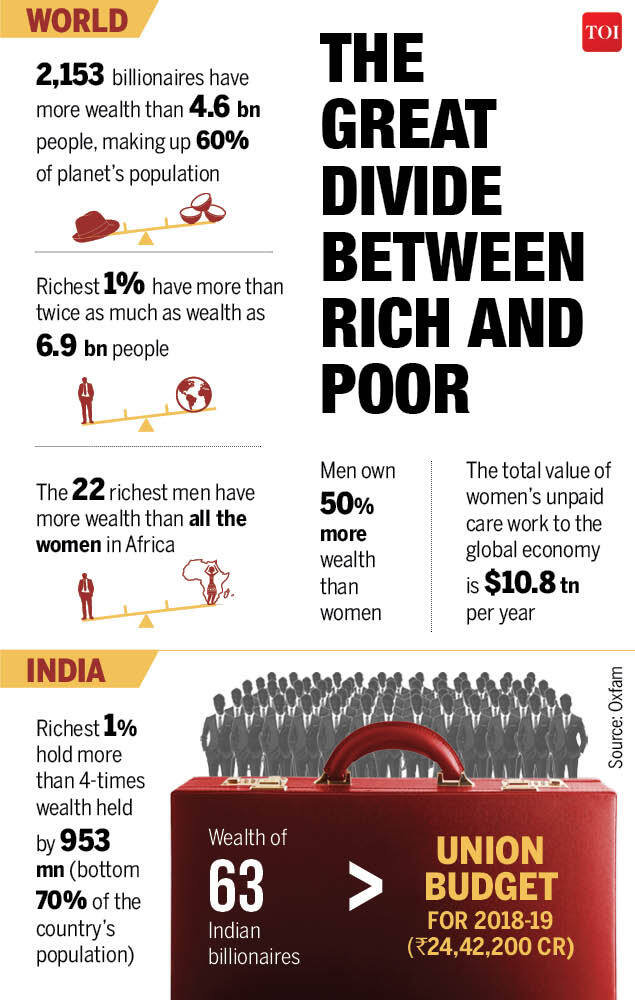
    • The report said that the world’s 2,153 billionaires have more wealth than the 4.6 billion people who make up 60 per cent of the planet’s population.
    • The report flagged that global inequality is shockingly entrenched and vast and the number of billionaires has doubled in the last decade, despite their combined wealth having declined in the last year.
    • The Oxfam report further said “sexist” economies are fuelling the inequality crisis by enabling a wealthy elite to accumulate vast fortunes at the expense of ordinary people and particularly poor women and girls.

    Income inequality in India

    • India’s richest 1 per cent hold more than four-times the wealth held by 953 million people who make up for the bottom 70 per cent of the country’s population.
    • The total wealth of all Indian billionaires is more than its full-year budget.
    • Regarding India, Oxfam said the combined total wealth of 63 Indian billionaires is higher than the total Union Budget of India for the fiscal year 2018-19 which was at Rs 24,42,200 crore.
    • It further said women and girls put in 3.26 billion hours of unpaid care work each and every day — a contribution to the Indian economy of at least Rs 19 lakh crore a year, which is 20 times the entire education budget of India in 2019 (Rs 93,000 crore).
    • He said women and girls are among those who benefit the least from today’s economic system.
    • They spend billions of hours cooking, cleaning and caring for children and the elderly. Unpaid care work is the ‘hidden engine’ that keeps the wheels of our economies, businesses and societies moving.

    Data on earnings

    • Oxfam said governments are massively under-taxing the wealthiest individuals and corporations and failing to collect revenues that could help lift the responsibility of care and tackle poverty and inequality.
    • As per the report, it would take a female domestic worker 22,277 years to earn what a top CEO of a technology company makes in one year.
    • With earnings pegged at Rs 106 per second, a tech CEO would make more in 10 minutes than what a domestic worker would make in one year.
    • Besides, direct public investments in the care economy of 2 per cent of GDP would potentially create 11 million new jobs and make up for the 11 million jobs lost in 2018, the report said.

  • Air Pollution

    Carbon Disclosure Project Report 2019

    The Carbon Disclosure Project (CDP) 2019 report was recently published.

    Carbon Disclosure Project

    • CDP is published by the Global Reporting Initiative.
    • It is aimed at measuring the carbon reduction activities undertaken by different companies and firms operating in various countries across the globe.
    • The report surveys corporate commitments to science-based targets (SBT) and evaluates the climate change risk that they are exposed to.

    India’s performance

    • India secured the 5th spot on the project report.
    • The CDP Report 2019 said that a total of 58 companies shared details about the environment-related activities undertaken by them in this year.
    • The report also claims that over 98 percent of top Indian companies have formed some type or committee or group within its organization to drive and address climate-related issues.
    • The report also showcased the changing mind-set of India Inc with nearly all major companies setting up some form of oversight to evaluate climate risk.

    Global scenario

    • The US topped the annual CDP report with 135 companies disclosing their climate-related activities, followed by Japan in the second position with 83 companies and the UK in the third position with 78 countries.
    • While France was placed fourth with 51 companies disclosing their details, India was placed fifth with 38 companies committing to the science-based targets.
    • In 2018, India had only 25 companies committing to the SBTs.
    • India is followed by Germany and Sweden with 30 and 27 companies respectively, while Switzerland and Spain had 23 and 22 companies respectively.
    • Netherlands was listed 10th on the list with 18 companies committing to SBT initiatives.

    Importance

    • India was ranked 5th, ahead of Germany and Sweden.
    • India is the first developing economy with a maximum number of companies committing to the science-based targets.
  • ISRO Missions and Discoveries

    Vyom Mitra: ISRO’s half-humanoid


    ISRO unveiled its first ‘woman’ astronaut during the event ‘Human Spaceflight and Exploration’.

    Vyom Mitra

    • The AI-based robotic system is being developed at a robotics lab at the VSSC in Thiruvananthapuram.
    • Vyom Mitra will be used for an unmanned flight of ISRO’s GSLV III rocket in December 2020, which, along with a second unmanned flight in July 2021.
    • This will serve as the test of ISRO’s preparedness for its maiden manned space mission, Gaganyaan, being targeted for 2022 to mark 75 years of India’s independence.

    Functions of the humanoid

    • Vyommitra, equipped with a head, two arms and a torso, is built to mimic crew activity inside the crew module of Gaganyaan.
    • Attaining launch and orbital postures, responding to the environment, generating warnings, replacing carbon dioxide canisters, operating switches, monitoring of the crew module, receiving voice commands, responding via speech (bilingual) are among its functions listed.
    • It will have a human-like face, with lips synchronised for movement to mimic speech.
    • Once it is fully developed, Vyommitra will be able to use equipment on board the spacecraft’s crew module, like safety mechanisms and switches, as well as receive and act on commands sent from ground stations.
  • Police Reforms – SC directives, NPC, other committees reports

    Blue Corner Notice

    Interpol has issued a Blue Corner notice to help locate an infamous fugitive self-styled godman weeks after the Gujarat Police sought the agency’s intervention for this.

     ‘Blue Corner’ notice

    • According to the Interpol website, “Notices are international requests for cooperation or alerts allowing police in member countries to share critical crime-related information.”
    • There are seven types of notices — Red Notice, Yellow Notice, Blue Notice, Black Notice, Green Notice, Orange Notice, and Purple Notice.
    • The Blue Notice is issued to “collect additional information about a person’s identity, location or activities in relation to a crime.”

    Blue notices a/c to CBI

    • The Central Bureau of Investigation (CBI) website refers to Blue Notices as ‘B Series (Blue) Notices’.
    • It says, “The ‘B’ series notices are also called ‘enquiry notices’ and may be issued in order to have someone’s identity verified; to obtain particulars of a person’s criminal record; to locate someone who is missing or is an identified or unidentified international criminal or is wanted for a violation of ordinary criminal law and whose extradition may be requested.”
  • Digital India Initiatives

    [pib] SERVICE Initiative

    The Steel Authority of India Ltd has launched an initiative called SERVICE to promote Voluntary Philanthropist Activities (VPA) by its employees.

    About SERVICE

    • SERVICE stands for “SAIL Employee Rendering Voluntarism and Initiatives for Community Engagement (SERVICE)”.
    • It aims to promote and facilitate philanthropist activities by the employees in a structured manner.
    • The Minister also launched a portal for the employees to register for the scheme.
    • This dedicated portal will act as a platform for enabling faster interaction and communication amongst the various stakeholders.
  • Climate Change Impact on India and World – International Reports, Key Observations, etc.

    [op-ed of the day] Electricity 4.0: The future of power in the age of climate change

    Context

    Significance of electricity in our life

    • Interconnecting economic prosperity: Electrical energy is a juncture that inter-connects economic prosperity.
      • Amplifies social equity.
      • Ushers in a liveable environment for us.
      • No development in its true sense is possible if we leave aside energy and specifically sustainable energy.
      • It is almost indispensable for holistic and sustainable progress of any kind.

    Burning of fossil fuel and climate change

    • Singular reliance on fossil fuel: Ever since the industrial revolution, development has almost singularly relied on the burning of fossil fuels, emitting huge volumes of carbon dioxide into the atmosphere.
      • 41% of electricity from coal: As per data by the World Coal Association, a little over 41% of all electricity generated is produced from coal.
      • Problems with coal: Burning coal for electricity production leads to-
      • High level of hazardous carbon emissions.
      • Rising levels of pollution: water and air pollution during mining and air pollution during burning.
      • Working condition of miners: Added to the disastrous working conditions of miners, coal cannot be regarded as a sustainable source of energy.
    • Global warming and climate change: Despite increasing awareness, not much is being done to mitigate climate change.
      • Rise over 1.5oC and Consequences: IPCC (Intergovernmental Panel on Climate Change) has reiterated that unless global temperature rise is not kept within 1.5 degrees Celsius, natural and human systems will be irreparably damaged.
      • Rise over  2o  C and Consequences: Even a slight increase in atmospheric temperature by 2 degrees Celsius will result in a substantial rise in sea levels.
      • Consequences for human life: The rise in sea level would, in turn, translate into a whopping 10 million more people going homeless and another 50% people facing severe water scarcity.
    • The aim of becoming carbon neutral: To join the efforts, many global public and private stakeholders have pledged their allegiance into becoming net-zero carbon emitters.
      • But we are still far from achieving our objectives, as the IEA (International Energy Agency) recently reported that the Earth’s temperature rise will range between 1.8 degrees Celsius and 2.7 degrees Celsius soon.

    Sustainable energy as a necessity

    • Energy efficiency and energy management: As the world is evolving into an interconnected form of world-of work, life and more-energy efficiency and energy management have slowly come to be a central driving force.
      • Sustainable energy a necessity: In order to power smart homes, industries, hospitals and other mission-critical operations, sustainable energy is no more a matter of choice, but of necessity.
      • IoT to help achieve energy efficiency: Technology adoptions like IoT and connected services can greatly enhance energy efficiencies and many global behemoths are coming to terms with this reality.
      • Demand for an alternative source of energy: Environmental factors, coupled with rising costs and stringent regulatory guidelines, are adding to the demand for alternative sources of energy.
      • Alternate as well as sustainable: The alternate sources are expected not only to satiate the growing consumption needs but are proven to be a sustainable option in the long run.

    Electricity 4.0

    • Electricity 4.0: That is, sustainable methods of energy generation and efficient and cost-effective usage of produced energy.
      • The sustainable energy need of the sustainable future: To lay the foundation stone for a sustainable future, there is a critical need to investigate how we create and consume energy.
      • The answer lies in renewables becoming the dominant source of power, globally.
    • A new form of energy mix: There is a growing need to build a new form of energy mix under Electricity 4.0, with renewable ways of electricity creation, at its very core. A new order where-
      • Electrical internet of things (EIOT).
      • Cloud computing.
      • Artificial intelligence.
      • And the tools of today’s digital era are fully leveraged to maximise energy efficiency.

    Way forward

    • Given that the major cause of global warming is Carbon Dioxide, so the first step to combat it would be-
    • Electrifying the planet: The augmented proliferation of energy-efficient, electricity-based equipments that are prevalent now, such as e-mobility, electrical heating, innovative applications such as electric aviation fleets can be one way to do that.
    • Scale up the production of renewable energy: The immediate need is to scale up the production of renewable electricity and build conducive public-policy frameworks to further this goal.
    • Adoption of digital technology: It is imperative to adopt digital technology in order to optimise the efficiency of our energy consumption and electrical networks. Digital connectivity, software and artificial intelligence can well be dubbed as the fulcrum that will support our transition toward Industry 4.0.
    • Concerted efforts from all stakeholders: To reduce carbon dioxide (CO2) emissions or to promote energy decarbonisation, concerted efforts are required from all stakeholders – the community, regions, government and the private sector.


  • Climate Change Impact on India and World – International Reports, Key Observations, etc.

     [op-ed snap] Global warming puts forests, plantations in the country at risk

    Context

    Global warming, drought and El Niño may lead to increased forest fires.

    The success story of India

    • Reduced deforestation: India has succeeded in reducing deforestation to some extent through an effective Forest Conservation Act and large-scale afforestation programme.
      • Comparison with other countries: India performed better when compared with other forest-rich tropical countries such as Brazil, Indonesia and the Democratic Republic of Congo.
      • Without the Forest Conservation Act and its reasonably effective implementation, India would have lost significant extent of forest area.
    • Increased afforestation: India has also been implementing significant scale afforestation, though the rates of afforestation have declined recently.
      • Agro-forestry, involving raising fruit tree plantations contribute to some extent.
      • Commercial plantations of eucalyptus, casuarina, teak, poplar, etc., have been raised by farmers for commercial purposes.
      • The above steps have resulted in potentially reducing the pressure on natural forests.

    Need to measure ‘natural forest’

    • Increase in an area under forest: According to the latest biennial State of Forest Report (SFR) of the Forest Survey of India (FSI), an area under forests has been increasing.
    • Natural forests not specifically measured: It is not clear what percentage of increase in forest area is due to changes in natural forests which are generally rich in biodiversity.
      • The report doesn’t specify what percentage of change in area is due to commercial plantation and what percentage is contributed by horticulture or urban parks.
    • Need to define ‘natural forest’: What will be of most concern to forest and biodiversity conservation is to understand the status of natural forest and biodiversity.
      • India can use the same definition of forests but must estimate and report the area under natural forests and other forest plantation categories.
      • India needs to define ‘natural forests’ first, further, this would involve additional staff time and resources.
    • The resilience of natural forests to forest fires: Tropical forests rich in biodiversity are likely to be more resilient than monoculture dominated plantations or exotics.
      • Vulnerability to forest fires varies from forests to forests: Studies by the Indian Institute of Science (IISc) have shown that degraded forests, fragmented forests and biodiversity-poor forests are more vulnerable to climate change.

    Climate change and its impacts

    • IPCC reports on large scale loss: The United Nations Intergovernmental Panel on Climate Change (IPCC) reports have repeatedly concluded that climate change will lead to large-scale loss of biodiversity, before the end of the current century or even earlier.
    • Modelling studies by IISc.: Preliminary modelling studies by Indian Institute of Science (IISc) have shown that about 20% of forests will be impacted by climate change.
      • No change to adapt: The modelling studies means that existing forest biodiversity and its structure and composition will not be able to adapt to the new climate and there could be mortality or forest dieback.
    • The threat of forest fires: Further, warming, drought and El Niño will lead to increased forest fires, and may even be favourable to forest pests.
      • Unfortunately, the models currently in use for assessing the impact of climate change are not suitable for the complex and highly diverse forest types that exist in India.

    Conclusions

    • Given that global warming will continue, India will have to brace itself to adapt to the impending impacts. In India, there is very limited research on climate change and its impacts on forests, putting our famed biodiversity-rich country status under threat.
    • India needs to realistically assess, monitor and model climate change and its impacts and be prepared to adapt to impending climate change.
  • Foreign Policy Watch: India-Pakistan

    [op-ed snap] Same country, different script

    Context

    Pakistan is changing significantly, which is good for itself and its neighbour as well.

    Changing Pakistan

    • Major stakeholders in favour of peace: The civil society, the political parties, and even the military establishment of Pakistan have come to favour peaceful and cooperative relations with India.
    • Both the power-centre on the same page: Both Islamabad and Rawalpindi, Pakistan’s two centres of power, are now on the same page in seeking “honourable peace” with New Delhi on the basis of “sovereign equality”.
      • Heavy price paid by Pakistan: There is a broad consensus in Pakistani society and polity that their country has paid a very heavy price by supporting the forces of Islamist extremism and terrorism.
      • The futility of using terrorism as foreign policy: There is also consensus that using terrorism for achieving mistaken foreign policy ends in Afghanistan and India.

    Conducive conditions for dialogues

    • Four factors have influenced the welcome winds of change in Pakistan.
    • First-Realisation that Pakistan has suffered a lot:
      • Harm at home and to the global image: There is the across-the-board realisation that Pakistan has suffered a lot, both domestically and in terms of damage to its global image, by supporting religious extremism and terrorism.
      • A large number of casualties: Terrorists have killed a shockingly large number of civilians -certainly far many more than in India. Several thousand soldiers have lost their lives in the army’s “war on terror”-more than the number of casualties in all the wars with India.
      • The threat of FATF blacklisting: Furthermore, Islamabad is under relentless pressure from the Financial Action Task Force (FATF) to act decisively and irreversibly against terrorist organisations.
    • Second-Decrease in religious radicalisation in Pakistan
      • The decrease in the financial support to radicalism: What has contributed to the diminished importance of religious radicalism is also the shrinking inflow of petrodollars from Saudi Arabia and Gulf countries that promoted this agenda.
      • The ideological influence of religious radicalisation on Pakistan’s civil society is clearly declining.
      • Change in Saudi Government Policy: Export of Wahhabism is no longer a foreign policy priority of the Saudi Arabian government.
      • Changing policies in UAE: The United Arab Emirates has gone a step further, under the leadership of Abu Dhabi’s Crown Prince Mohammed bin Zayed Al Nahyan, it is pursuing inter-religious tolerance with a zeal that has surprised Muslims and non-Muslims alike.
    • Third-Interest of China
      • Rise of China as an economic and security partner: The third factor is China, which has emerged as Pakistan’s most important economic and security partner.
      • The China-Pakistan Economic Corridor (CPEC) and BRI: The flagship projects under Beijing’s BRI has begun to modernise Pakistan’s infrastructure spectacularly, but its security is which could be threatened by terrorism is also the concern for China.
      • Connection with China’s Xinjiang Province: China has urged Pakistan’s ruling establishment to take firm steps to curb the activities of Islamist groups because they can easily foment trouble in China’s Muslim-majority Xinjiang province.
      • India-China relation factor: Beijing is also engaged in a steady effort to improve relations with New Delhi, in recognition of India’s rising economic and geopolitical stature in Asia and globally.
      • Possibility of India-China-Pakistan cooperation: China’s President Xi Jinping even mooted cooperation among China, India and Pakistan at Mamallapuram summit.
    • Fourth-Military establishment in favour of peace.
      • The military establishment seems to be fully convinced of the need for normalisation of India-Pakistan
      • Opening of Kartarpur Sahib Corridor: The opening of the Kartarpur Sahib Corridor, perhaps the greatest confidence-building measure between the two countries since 1947, is almost entirely due to Gen. Bajwa’s personal commitment to the project.
      • The economic crisis in Pakistan: Bajwa’s is also said to be convinced of the need to open the doors for economic and trade cooperation between the two countries given a serious economic crisis Pakistan is going through.
      • Discussion on the Kashmir issue: The Pakistan Army may also be ready to discuss a solution to the Kashmir issue on the basis of a formula Gen. Pervez Musharraf had discussed with PMs Atal Bihari Vajpayee and Dr Manmohan Singh.

    Conclusion

    India needs to seize the opportunity to resume the talks with Pakistan on all the contentious issues and try to resolve the disputes so that the improved relations could help both the countries and the neighbouring countries.

  • International Space Agencies – Missions and Discoveries

    Thirty Metre Telescope (TMT) in Hawaii


    India, a partner in the construction of one of the largest telescopes in the world, TMT, has said it wants the project to be moved out of the proposed site at Mauna Kea, a dormant volcano in Hawaii.

    Thirty Metre Telescope

    • The TMT is a proposed astronomical observatory with an extremely large telescope (ELT) that has become the source of controversy over its planned location on Mauna Kea on the island of Hawaii in the US state of Hawaii.
    • It is being built by an international collaboration of government organisations and educational institutions, at a cost of $1.4 billion.
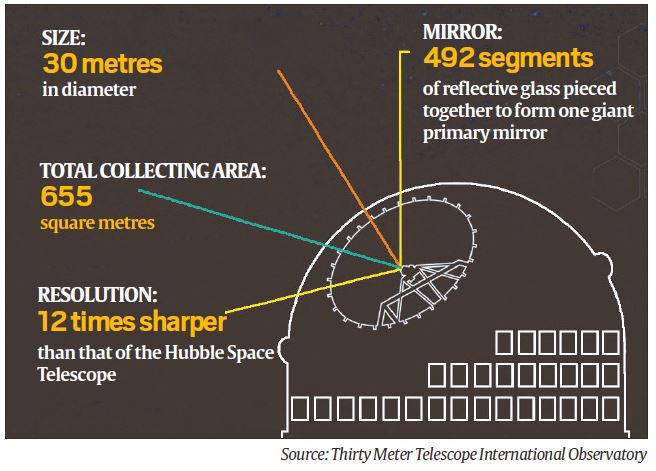
    • “Thirty Metre” refers to the 30-metre diameter of the mirror, with 492 segments of glass pieced together, which makes it three times as wide as the world’s largest existing visible-light telescope.
    • The larger the mirror, the more light a telescope can collect, which means, in turn, that it can “see” farther, fainter objects.
    • It would be more than 200 times more sensitive than current telescopes and would be able to resolve objects 12 times better than the Hubble Space Telescope.

    Utility of the telescope

    • One of its key uses will be the study of exoplanets, many of which have been detected in the last few years, and whether their atmospheres contain water vapour or methane — the signatures of possible life.
    • For the first time in history, this telescope will be capable of detecting extraterrestrial life.
    • The study of black holes is another objective.
    • While these have been observed in detail within the Milky Way, the next galaxy is 100 times farther away; the TMT will help bring them closer.
  • Capital Markets: Challenges and Developments

    InvITs and REITs


    Markets regulator SEBI has put in place a framework for the rights issue of units by listed REIT and InvITs.

    What are InvITs and REITs?

    Infrastructure Investment Trusts (InvIT)

    • An Infrastructure Investment Trust (InvITs) is like a mutual fund, which enables direct investment of small amounts of money from possible individual/institutional investors in infrastructure to earn a small portion of the income as return.
    • InvITs work like mutual funds or real estate investment trusts (REITs) in features.
    • InvITs can be treated as the modified version of REITs designed to suit the specific circumstances of the infrastructure sector.
    • They are similar to REIT but invest in infrastructure projects such as roads or highways which take some time to generate steady cash flows.

    Real Estate Investment Trusts (REIT)

    • A REIT is roughly like a mutual fund that invests in real estate although the similarity doesn’t go much further.
    • The basic deal on REITs is that you own a share of property, and so an appropriate share of the income from it will come to you, after deducting an appropriate share of expenses.
    • Essentially, it’s like a group of people pooling their money together and buying real estate except that it’s on a large scale and is regulated.
    • The obvious pitch for a REIT is that it enables individuals to generate income and capital appreciation with money that is a small fraction of what would be required to buy an entire property.
    • However, the resemblance to either mutual funds or to owning property ends there.
    • According to Indian regulation on REITs, these are meant to primarily own finished and rented out commercial properties –– 80 per cent of the investments must be in such assets. That excludes a real estate that is under development.

    Why need InvITs and REITs?

    • Infrastructure and real estate are the two most critical sectors in any developing economy.
    • A well-developed infrastructural set-up propels the overall development of a country.
    • It also facilitates a steady inflow of private and foreign investments, and thereby augments the capital base available for the growth of key sectors in an economy, as well as its own growth, in a sustained manner.
    • Given the importance of these two sectors in the country, and the paucity of public funds available to stimulate their growth, it is imperative that additional channels of financing are put in place.

    What did SEBI rule?

    • SEBI said the issuer will have to disclose objects of the issue, related-party transactions, valuation, financial details, review of credit rating and grievance redressal mechanism in the placement document.
    • The SEBI had first notified REITs and InvIT Regulations in 2014, allowing setting up and listing of such trusts which are popular in some advanced markets.

Join the Community

Join us across Social Media platforms.