💥UPSC 2027,2028 Mentorship (April Batch) + Access XFactor Notes & Microthemes PDF

Archives: News

  • Global Geological And Climatic Events

    Geography uncover why some rivers stay single while others split

    Introduction

    For decades, scientists wondered why some rivers flow as single channels while others split into braided systems. Researchers at the University of California, Santa Barbara (UCSB), after studying 84 rivers over 36 years using satellite data, have uncovered the mechanism. Their findings resolve a geomorphological puzzle and offer fresh insights for managing rivers amid climate change, rising floods, and human interventions.

    Why is this discovery significant?

    The UCSB study shows that erosion, not equilibrium, drives multi-threading. Single-thread rivers balance erosion and deposition, while braided rivers erode banks faster than they deposit, making them unstable. This overturns earlier models assuming fixed depth and width. In an era of extreme weather, such insights are vital for flood prediction, ecosystem restoration, and sustainable infrastructure.

    Understanding the dynamics of single-thread and multi-thread rivers

    1. Single-thread rivers: They maintain equilibrium between bank erosion and bar accretion, ensuring stable width.
    2. Multi-thread rivers: They are characterised by imbalance, where erosion exceeds deposition, causing channels to widen and split repeatedly.
    3. Example: Brahmaputra’s braided channels erode laterally at a rapid pace, making them inherently unstable.

    Scientific breakthrough in decoding river channel behavior

    1. Data analysed: 84 rivers across climates and terrains, spanning 36 years (1985–2021).
    2. Technology used: Particle Image Velocimetry (PIV) on satellite images, generating 4 lakh+ measurements of erosion and accretion.
    3. Outcome: Identification of patterns showing why some rivers remain stable and others split into multiple channels.

    The ecological role of vegetation in shaping river morphology

    1. Earlier belief: Vegetated banks were considered essential for meandering rivers.
    2. Stanford study finding: Vegetation alters river bend migration:
    3. Vegetated bends → Move outward, creating levees, limiting sinuosity.
    4. Unvegetated bends → Drift downstream, forming different sedimentary deposits.
    5. Implication: River evolution is not only hydrological but also ecological.

    Implications for India’s river systems: Ganga and Brahmaputra in focus

    • Case studies: Ganga near Patna, Farakka, Paksey; Brahmaputra near Pandu, Pasighat, Bahadurabad.
    • Findings: Multi-thread rivers like Brahmaputra are inherently unstable due to rapid lateral erosion.
    • Problem: Artificial confinement by embankments has worsened risks in India.
    • Implication: Flood forecasting models (rating curves) need frequent updates as channel shapes shift.

    Nature-based solutions and strategies for sustainable river management

    1. Remove artificial embankments
    2. Restore natural floodplains
    3. Create vegetated buffer zones along banks
    4. Reactivate abandoned channels
    5. Build wetlands in braided sections
    6. Advantages: Lower cost of restoration, better flood absorption, reduced disaster risk.

    Conclusion

    The new understanding of why rivers split reshapes our approach to flood management, river restoration, and ecological conservation. For India, where rivers like the Ganga and Brahmaputra are lifelines but also sources of recurrent floods, this research is a wake-up call. Emphasising natural solutions over artificial confinement could pave the way for sustainable water governance in the climate change era.

    PYQ Relevance

    [UPSC 2016] Major cities of India are becoming more vulnerable to flood conditions. Discuss.

    Linkage: The recent UCSB study highlights that multi-thread rivers like the Ganga and Brahmaputra are inherently unstable because erosion outpaces deposition, causing channels to split and shift rapidly. In India, this instability is often worsened by human interventions such as embankments, damming, and encroachment, which artificially confine rivers. As these channels change, urban centres located along floodplains (Patna, Guwahati, Kolkata, etc.) become highly flood-prone. The research also suggests that relying on outdated models assuming rivers are stable leads to poor flood prediction in cities. Thus, insights from this study strengthen the argument that urban flooding in India is not only due to unplanned urbanisation but also due to the geomorphological instability of river systems and flawed management practices.


  • Noise pollution is rising but policy is falling silent

    Introduction

    Noise pollution in India has emerged as a silent but significant public health crisis. With urban decibel levels routinely breaching permissible limits near schools, hospitals, and residential zones, the constitutional promise of dignity and peace is being eroded. Despite a robust legal framework in place since 2000, fragmented enforcement, civic fatigue, and policy inertia have left the issue largely unaddressed. Unlike Europe, where noise-induced illnesses shape policymaking, India remains institutionally and politically silent.

    Why is noise pollution in the news?

    Noise pollution has resurfaced as a pressing issue because of increasing violations in silence zones, lack of updated enforcement mechanisms, and alarming ecological findings. The Central Pollution Control Board’s National Ambient Noise Monitoring Network (NANMN), launched in 2011 as a flagship real-time monitoring system, has become a passive repository with little accountability. In 2024, the Supreme Court reaffirmed that excessive noise is a violation of Article 21. A 2025 ecological study added urgency, revealing that even one night of urban noise disrupts bird song and communication.

    Weaknesses in India’s noise monitoring system

    1. Flawed sensor placement: Many noise monitors are mounted 25–30 feet high, violating CPCB’s 2015 guidelines and recording misleading data.
    2. Data without enforcement: NANMN has been reduced to a dashboard of figures with no link to penalties or compliance.
    3. Fragmented institutions: State Pollution Control Boards, traffic police, and municipalities act in silos, preventing unified action.
    4. Opacity in data: RTI queries remain unanswered, and States like Uttar Pradesh have not released first-quarter 2025 data.

    Noise pollution as a constitutional and legal challenge

    1. Right to life with dignity (Article 21): Supreme Court reaffirmed in 2024 that unchecked urban noise directly undermines mental well-being.
    2. Directive Principle (Article 48A): The State has a duty to protect and improve the environment, but silence on noise policy reflects neglect.
    3. Failure of Silence Zones: Hospitals and schools often record 65–70 dB(A) against the permissible 50 dB(A) daytime and 40 dB(A) nighttime limits set by WHO.

    Human and ecological costs of unchecked urban noise

    1. Mental health erosion: Chronic noise exposure causes disturbed sleep cycles, hypertension, and reduced cognitive function.
    2. Children and elderly at risk: Sensitive groups face aggravated anxiety and cardiovascular problems.
    3. Biodiversity disruption: 2025 Auckland study shows even one night of noise alters bird song complexity, affecting species survival and ecological communication.
    4. Cultural normalisation: Honking, drilling, and loudspeakers have become ambient irritants, tolerated rather than resisted.

    Fragmented governance and symbolic compliance

    1. Weak legal update: Noise Pollution Rules, 2000 have not been revised to reflect rapid urbanisation and logistics-heavy economies.
    2. Institutional silos: No coordination between police, local bodies, and SPCBs, leaving sporadic enforcement drives without systemic change.
    3. Judicial reminders: Despite Noise Pollution (V), In Re (2005, reaffirmed in 2024), state capacity to enforce remains symbolic.

    Towards a national acoustic policy and cultural change

    1. Decentralise monitoring: Grant local governments access to real-time NANMN data.
    2. Link data with penalties: Without enforcement, monitoring becomes performative.
    3. National acoustic policy: Define permissible decibel limits across zones with periodic audits.
    4. Urban planning reforms: Embed acoustic resilience into city designs, zoning, and transport planning.
    5. Sonic empathy campaigns: Similar to seatbelt norms, honking reduction must be internalised through community education.

    Conclusion

    Noise pollution is not an invisible irritant, it is a public health emergency, an ecological disruptor, and a constitutional concern. Without a rights-based framework that treats silence as essential to dignity, India’s urban future risks becoming unliveable. The challenge is not only regulatory but also cultural: fostering a shared ethic of sonic empathy. Silence must not be imposed, but enabled through design, governance, and civic will.

    PYQ Relevance

    [UPSC 2023] What is oil pollution? What are its impacts on the marine ecosystem? In what way is oil pollution particularly harmful for a country like India?

    Linkage: Both oil and noise pollution are invisible pollutants with severe but often neglected impacts — oil disrupts marine ecosystems while noise erodes mental health and biodiversity.

    Like India’s vulnerability to oil spills due to its long coastline, rapid urbanisation makes it highly exposed to noise hazards. In both cases, regulatory frameworks exist but enforcement is fragmented, highlighting a gap between law and practice.

  • International Space Agencies – Missions and Discoveries

    NASA-ESA Solar Orbiter Mission

    Why in the News?

    The NASA-ESA Solar Orbiter Mission has recently traced the origin of Solar Energetic Electrons (SEE), advancing knowledge of solar activity and space weather.

    NASA-ESA Solar Orbiter Mission

    About NASA–ESA Solar Orbiter Mission:

    • Launch & Cost: Launched in Feb 2020 on an Atlas V from Cape Canaveral; joint ESA–NASA mission worth $1.5 billion.
    • Duration: Primary mission till 2026, extendable to 2030.
    • Orbit: Highly eccentric, approaching 0.28 AU (inside Mercury’s orbit); gradually tilts to image Sun’s poles.
    • Payload: 10 instruments — both in-situ (solar wind, magnetic fields, particles) and remote sensing (imaging, spectroscopy).
    • Firsts & Objectives: First to image solar poles; aims to study solar wind origin, solar cycle dynamics, causes of flares/CMEs, and their impact on heliosphere & space weather.

    What are Solar Energetic Electrons (SEE)?

    • What are they: Streams of high-energy electrons released into space, travelling across the heliosphere.
    • Sources: Emerge from solar flares (sudden surface bursts) and coronal mass ejections (CMEs) (plasma + magnetic eruptions).
    • Patterns: Release not always immediate; often delayed by hours due to turbulence/scattering in interplanetary medium.
    • Solar Orbiter Observations: Detected 300+ bursts (2020–22), clearly linking SEE to solar flares/CMEs for the first time.

    Significance of the recent findings:

    • Science: Clarifies Sun’s particle acceleration mechanisms.
    • Space Weather: CMEs are the main drivers of severe events — affecting satellites, GPS, communication, power grids, and astronaut safety.
    • Practical Utility: Improves solar storm forecasting and early-warning systems for infrastructure & human spaceflight.
    • Long Term Implications: Expected to revolutionise solar physics and our predictive capacity of Sun–Earth interactions.
    [UPSC 2022] If a major solar storm (solar flare) reaches the Earth, which of the following are the possible effects on the Earth?

    1. GPS and navigation systems could fail.

    2. Tsunamis could occur at equatorial regions.

    3. Power grids could be damaged.

    4. Intense auroras could occur over much of the Earth.

    5. Forest fires could take place over much of the planet.

    6. Orbits of the satellites could be disturbed.

    7. Shortwave radio communication of the aircraft flying over polar regions could be interrupted.

    Select the correct answer using the code given below:

    (a) 1, 2, 4 and 5 only (b) 2, 3, 5, 6 and 7 only (c) 1, 3, 4, 6 and 7* only (d) 1, 2, 3, 4, 5, 6 and 7


  • Agricultural Sector and Marketing Reforms – eNAM, Model APMC Act, Eco Survey Reco, etc.

    Dongar Cultivation of Odisha

    Why in the News?

    The Dongar cultivation, a hill-slope mixed cropping system of the Kondh tribals in Odisha’s Rayagada is now under decline due to eucalyptus monoculture.

    What is Dongar Cultivation?

    • Overview: A traditional shifting/mixed cropping system practised on hill slopes (uplands) by the Kondh tribal community in Odisha.
    • Crops grown: Millets (finger millet, foxtail millet), pulses, oilseeds, and even uncultivated foods like wild tubers.
    • Benefits offered: Provides nutritional diversity, supports birds and biodiversity, and maintains soil fertility without chemical inputs.
    • Cultural practice: Linked to seed conservation, labour exchange, and community-based farming traditions, reflecting a holistic tribal food system.
    • Significance: Its poly-cropping nature makes it more resilient to rainfall variability and climate shocks, unlike monocultures.

    Other Traditional Cultivation Practices in India:

    Type Key Features
    Bewar / Dahiya (Madhya Pradesh Baiga & Gond tribes, Dindori district) Shifting cultivation; mixed cropping of millets, pulses, oilseeds; similar to Dongar; sustainable tribal food system.
    Poonam Krishi (Western Ghats, Maharashtra & Karnataka) Traditional multi-cropping around rice fields; ensures year-round food and fodder security.
    Pamlou (Manipur) Form of jhum (slash-and-burn) cultivation; rotational clearing of forests; crops include cereals, pulses, vegetables; supports subsistence farming.
    Kuruma / Podu (Odisha, Andhra Pradesh, Telangana, Jharkhand, Chhattisgarh) Hill-slope shifting cultivation; millets and pulses dominant; threatened by monoculture plantations and forest restrictions.
    Apatanis’ Wet Rice Cultivation – Arunachal Pradesh Intensive valley wetland system; combines paddy farming with fish rearing; highly sustainable and productive.


    [UPSC 2018] With reference to the circumstances in Indian agriculture, the concept of “Conservation Agriculture” assumes significance.  Which of the following fall under the Conservation Agriculture?

    1. Avoiding the monoculture practices

    2. Adopting minimum tillage

    3. Avoiding the cultivation of plantation crops

    4. Using crop residues to cover soil surface

    5. Adopting spatial and temporal rop sequencing/crop rotations.

    Select the correct answer using the code given below:

    Options: (a) 1, 3 and 4 (b) 2, 3, 4 and 5 (c) 2, 4 and 5 (d) 1, 2, 3 and 5*


  • ISRO Missions and Discoveries

    Jarosite in Kutch: India’s Mars Analogue Site

    Why in the News?

    Matanomadh in Kutch, Gujarat, with jarosite deposits like those on Mars, is being considered by ISRO as a test site for future Mars missions.

    What is Jarosite?

    • Composition: A yellow, iron-rich sulphate mineral containing iron, sulphur, oxygen, and potassium.
    • Formation: Develops when volcanic ash or sulphur-bearing minerals chemically react with water, making it a marker of past water–rock interaction.
    • Discovery in India: Reported in 2016 at Matanomadh, Kutch (Gujarat) by ISRO’s Space Applications Centre; also found at Varkala cliffs, Kerala. Kutch is more suitable for planetary research.
    • Martian Link: Detected in 2004 by NASA’s Opportunity Rover. This referred as terrestrial clone of Martian surface.
    • Global Occurrence: Found in Mexico, Spain, Canada, Japan, and the USA (Utah, California), all serving as Mars analogue sites.

    Matanomadh’s Significance for Mars Study:

    • Mars Analogue Value: Geological dating shows deposits about 55 million years old (Paleocene period), resembling early Martian conditions.
    • Test Bed for ISRO: Provides ground for testing rover mobility, drilling systems, geochemical studies, and remote sensing for Mangalyaan-2 and future missions.
    • Astrobiology Potential: Since jarosite can trap organic molecules, it helps in shaping strategies to search for signs of past life on Mars.
    • Complement to Ladakh: While Ladakh sites simulate Martian climate, Matanomadh represents Martian geology and mineralogy, creating a comprehensive Mars-analogue ecosystem in India.
    • Conservation Importance: Facing threats from waterlogging and coal mining; scientists urge its declaration as a Planetary Geo-heritage Site.
    • Strategic Edge: Strengthens India’s role in planetary exploration, astrobiology research, and international collaborations.
    [UPSC 2016] Consider the following statements:

    1. The Mangalyaan launched by ISRO

    2. is also called the Mars Orbiter Mission

    3. made India the second country to have a spacecraft orbit the Mars after USA

    4. made India the only country to be successful in making its spacecraft orbit the Mars in its very first attempt

    Which of the statements given above is/are correct?

    (a) 1 only   (b) 2 and 3 only   (c) 1 and 3 only * (d) 1, 2 and 3


  • Global Geological And Climatic Events

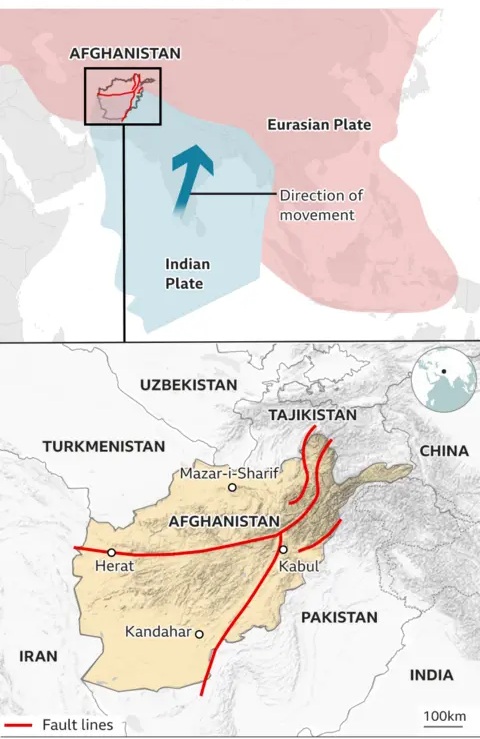
    Deadly Earthquake in Afghanistan

    Why in the News?

    A powerful earthquake in Afghanistan killed at least 800 people and injured thousands, highlighting the country’s extreme vulnerability to seismic hazards.

    Deadly Earthquake in Afghanistan

    Why is Afghanistan so prone to Earthquakes?

    • Geological Setting: Afghanistan lies in the Hindu Kush mountains, part of the Alpide Belt, the world’s second most seismically active belt after the Circum-Pacific.
    • Tectonic Origin: The Alpide Belt was formed by the closure of the Tethys Ocean, following the collision of the African, Arabian, and Indian Plates with the Eurasian Plate.
    • Ongoing Collision: The Indian Plate’s continued movement into the Eurasian Plate builds mountain ranges (Himalayas, Hindu Kush) and drives strong seismic activity.
    • Seismic Characteristics: Afghanistan experiences both shallow-focus earthquakes (0–70 km depth) causing major destruction and rare deep-focus quakes (up to 200 km) unique to the Hindu Kush.
    • Fault Structures: Major faults occur where the Indian and Eurasian Plates meet, making Afghanistan heavily fractured and highly vulnerable to tremors.

    Where do Afghanistan’s Earthquakes occur?

    • Hindu Kush Region (Northern Afghanistan): Produces both shallow and deep-focus quakes due to the Indian Plate’s lithosphere sinking into the mantle, making it one of the world’s most unique seismic zones.
    • Sulaiman Range (SE Afghanistan & Western Pakistan): Known for shallow, thrust fault quakes, often destructive at the surface.
    • Main Pamir Thrust Zone: Another hotspot for shallow, surface-level earthquakes that cause high damage.
    • Overall Vulnerability: These regions together make Afghanistan one of the most earthquake-prone countries, with repeated deadly events since the 1990s.
    [UPSC 2023] Consider the following statements:

    1. In a seismograph, P waves are recorded earlier than S waves.

    2. In P waves, the individual particles vibrate to and fro in the direction of waves propogation whereas in S waves, the particles vibrate up and down at right angles to the direction of wave propagation.

    Which of the statements given above is/are correct?

    Options: (a)  1 only (b) 2 only (c) Both 1 and 2 * (d) Neither 1 nor 2


  • Primary and Secondary Education – RTE, Education Policy, SEQI, RMSA, Committee Reports, etc.

    RTE Act and Minority Educational Institutions

    Why in the News?

    The Supreme Court has referred to a larger Bench the question of whether Minority Educational Institutions (MEIs) are completely exempt from the purview of the Right to Education (RTE) Act, 2009.

    About Minority Educational Institutions (MEIs):

    • Constitutional Basis:
      • Article 30(1) grants religious and linguistic minorities the right to establish and administer educational institutions of their choice.
      • Article 29 protects their cultural and educational rights.
    • Legal Framework:
      • Defined under the National Commission for Minority Educational Institutions (NCMEI) Act, 2004.
      • The NCMEI adjudicates disputes, grants recognition, and safeguards the autonomy of such institutions.
    • Recognized Minority Communities: Muslims, Christians, Sikhs, Buddhists, Jains, and Zoroastrians (Parsis) are notified as minorities by the Government of India.
    • Judicial Principles:
      • In T.M.A. Pai Foundation vs. State of Karnataka (2002), SC held that minority status is determined state-wise, not nationally.
      • Minority institutions can reserve seats for their community and enjoy greater control over administration and recruitment.
    • Purpose and Role:
      • Preserve the cultural, linguistic, and religious heritage of minority groups.
      • Provide quality education with constitutional protection from excessive state interference.

    What is the Right to Education (RTE) Act, 2009?

    • Genesis: Stemming from Unnikrishnan vs. State of Andhra Pradesh (1993), where SC declared education as a Fundamental Right under Article 21.
      • Later given constitutional backing through the 86th Amendment Act (2002), which inserted Article 21A – free and compulsory education for children aged 6–14 years.
    • Enactment: To operationalize Article 21A, Parliament passed the Right of Children to Free and Compulsory Education Act, 2009.
    • Key Provisions:
      • Free and compulsory education for all children aged 6–14 in a neighbourhood school.
      • 25% reservation in private schools for children from disadvantaged groups and weaker sections.
      • No detention, expulsion, or board exams up to Class VIII (amended in 2019 to allow states discretion).
      • Teacher norms: TET (Teachers Eligibility Test) qualification mandatory; ban on private tuitions by teachers.
      • School Management Committees (SMCs): Parents, local authority reps, and teachers oversee school functioning.
      • Curriculum & Standards: Developed by an academic authority (often NCERT/SCERT).
    • Amendments:
      • 2012: Included children with disabilities; exempted minority/religious institutions.
      • 2019: Abolished uniform “no-detention policy,” left to states’ choice.


    [UPSC 2018] Consider the following statements:

    1. As per the Right to Education (RTE) Act, to be eligible for appointment as a teacher in a State, a person would be required to possess the minimum qualification laid down by the concerned State Council of Teacher Education.

    2. As per the RTE Act, for teaching primary classes, a candidate is required to pass a Teacher Eligibility Test conducted in accordance with the National Council of Teacher Education guidelines.

    3. In India, more than 90% of teacher education institutions are directly under the State Governments

    Which of the statements given above is/are correct?

    Options: (a) 1 and 2 (b) 2 only* (c) 1 and 3 (d) 3 only


  • Primary and Secondary Education – RTE, Education Policy, SEQI, RMSA, Committee Reports, etc.

    In news: Samagra Shiksha Abhiyan

    Why in the News?

    The Supreme Court intervened after Tamil Nadu faced ₹3,000+ crore reimbursements to private schools for economically disadvantaged students’ admissions, as the Centre declined to share costs under Samagra Shiksha.

    About Samagra Shiksha Abhiyan:

    • Launch & Integration: Started in 2018 (by then Ministry of HRD), integrating Sarva Shiksha Abhiyan (SSA), Rashtriya Madhyamik Shiksha Abhiyan (RMSA), and Teacher Education (TE) into one holistic programme.
    • Benchmark Feature: Treats schooling as a continuous system from pre-primary to Class XII (ages 4–18), removing silos.
    • Funding Pattern: A Centrally Sponsored Scheme (CSS) with Centre–State sharing (60:40, 90:10 for NE/hilly states), implemented via a single State Implementation Society (SIS).
    • Policy Alignment: Aligned with NEP 2020 and UN SDG-4 (quality education).
    • Coverage: 1.16 million schools, 156+ million students, 5.7 million teachers across government & aided institutions.
    • Upgraded Phase: Samagra Shiksha 2.0 (2021–26) with focus on digital education, vocational training, FLN, and inclusion.

    Key Features of the Scheme:

    • Unified Structure: One umbrella for pre-primary to Class XII, ensuring coherent planning.
    • Teachers & Technology:
      • Continuous teacher training via SCERTs, DIETs, NISHTHA, SWAYAM.
      • Digital initiatives: DIKSHA, Operation Digital Board, ICT labs, smart classrooms, AI-based learning tools.
    • Foundational Literacy & Numeracy: NIPUN Bharat Mission (ages 3–9) for universal reading & numeracy.
    • Vocational & Skill Education: Subjects like coding, robotics, financial literacy, AI with 1000+ training centres (from Class VI).
    • Direct Benefit Transfers (DBT): Uniforms, textbooks, transport allowance directly credited via IT platforms.
    • Holistic Development: Integration of sports, physical education, self-defence, soft skills under Khelo India.
    • Funding Scale: Allocation crossed ₹41,000 crore (2025); nationwide coverage till March 2026 under Samagra Shiksha 2.0.
    [UPSC 2017] What is the aim of the programme ‘Unnat Bharat Abhiyan’?

    Options: (a) Achieving 100% literacy by promoting collaboration between voluntary organizations and government’s education system and local communities.

    (b) Connecting institutions of higher education with local communities to address development challenges through appropriate technologies. *

    (c) Strengthening India’s scientific research institutions in order to make India a scientific and technological Power.

    (d) Developing human capital by allocating special funds for health-care and education of rural and urban poor, and organizing skill development programmes and vocational training for them.


  • Economic Indicators and Various Reports On It- GDP, FD, EODB, WIR etc

    [1st September 2025] The Hindu Op-ed: India’s economic churn, the nectar of growth

    PYQ Relevance

    [UPSC 2019] Do you agree with the view that steady GDP growth and low inflation have left the Indian economy in good shape? Give reasons in support of your arguments.

    Linkage: India’s steady GDP growth of 7.8%, coupled with broad-based sectoral performance, reflects macroeconomic stability, while effective fiscal and monetary discipline underpins low inflation. The sovereign rating upgrade after 18 years validates external confidence in India’s fundamentals. These trends, along with inclusive poverty reduction, highlight that the economy is indeed in good shape.

    Mentor’s Comment

    India’s economy is once again at the centre of global attention. From being dismissed as a “dead economy” by sceptics, the latest economic data, sovereign rating upgrade, and energy security achievements have painted a powerful picture of resilience and renewal. This article unpacks the recent developments in India’s economic and energy story, their significance, and what they mean for aspirants of Viksit Bharat.

    Why is this issue in the news?

    India’s Q1 FY 2025-26 GDP figures revealed 7.8% real growth, the fastest among major economies, coupled with a historic sovereign rating upgrade by S&P Global after 18 years. Simultaneously, India has consolidated its position as the world’s third-largest energy consumer and is spearheading a green transition. These milestones are striking because they overturn the “dead economy” narrative, highlight India’s growing share in global growth, and showcase a balance between growth, reform, and welfare, all while maintaining democratic values in contrast to authoritarian models of fast-paced growth.

    Introduction

    Indian civilisation has always embraced the philosophy that turbulence precedes triumph, like the Samudra Manthan, where chaos yielded nectar. Similarly, India’s economic journey has turned crises into opportunities, from the liberalisation of 1991 to the digital surge during COVID-19. Today, India stands at another inflection point. Despite global headwinds and doubts, the country is demonstrating robust growth, deepening reforms, and a secure energy base, shaping the narrative of resilience and inclusive progress.

    Broad-based economic growth

    1. GDP expansion: Real GDP grew 7.8% in Q1 FY 2025-26, while GVA rose 7.6%, supported by manufacturing (7.7%), construction (7.6%), and services (9.3%).
    2. Global standing: India is the world’s fourth-largest economy and the fastest-growing major one, projected to overtake Germany by decade’s end.
    3. Global contribution: Independent estimates suggest India contributes 15% of incremental world growth, with ambitions to raise it to 20%.

    Why the sovereign rating upgrade matters

    1. S&P recognition: First upgrade in 18 years, citing robust growth, fiscal consolidation, and monetary credibility.
    2. Lower borrowing costs: Improves India’s access to cheaper capital and widens the investor base.
    3. Narrative shift: Counters the label of a “dead economy,” giving credibility to India’s reforms.

    Growth with inclusion

    1. Poverty reduction: 24.82 crore Indians moved out of multidimensional poverty between 2013-14 and 2022-23.
    2. Last-mile delivery: Success through bank accounts, clean cooking fuel, health cover, tap water, and direct benefit transfers (DBT).
    3. Democratic model: Built on consensus, competitive federalism, and digital rails, contrasting authoritarian growth models.

    Energy security as a growth driver

    1. Global role: India is the third-largest energy consumer, fourth-largest refiner, and fourth-largest LNG importer.
    2. Capacity expansion: Refining capacity of 5.2 mb/d with plans to cross 400 MTPA by 2030.
    3. Exploration reforms: Sedimentary basin coverage expanded to 16% in 2025 (from 8% in 2021), with 1 million sq km target by 2030.
    4. Gas reforms: New pricing linked to Indian crude basket; 20% premium for deepwater wells boosting investment.

    India’s energy transition

    1. Ethanol blending: Surged from 1.5% (2014) to 20% today, saving ₹1.25 lakh crore forex and paying ₹1 lakh crore to farmers.
    2. Green fuels: 300 compressed biogas plants under SATAT, targeting 5% blending by 2028.
    3. Hydrogen push: Oil PSUs driving the green hydrogen mission.

    Responding to global criticism on Russian oil

    1. Compliance: India operates fully within G-7/EU price cap systems; every transaction uses legal, audited channels.
    2. Global stabiliser: Purchases prevented oil shocks and stabilised prices, aligning with Vasudhaiva Kutumbakam.
    3. Export reality: India has been a top petroleum exporter for decades, not a “laundromat” for Russia.

    India’s digital-industrial revolution

    1. Semiconductors: Four new projects cleared under the India Semiconductor Mission; strengthened by Japan collaborations.
    2. Digital economy: India leads in real-time payments; UPI enhances small-business productivity and exports of solutions.
    3. Synergy: Gati Shakti logistics & digital rails reduce costs, formalise the economy, and spur consumption.

    Conclusion

    India’s recent performance is more than statistics, it is the reaffirmation of resilience, reform, and inclusion. The world’s doubters labelled it a “dead economy,” yet growth, energy security, digital leadership, and poverty reduction tell a different story. As reforms deepen, India is on track not just to become the world’s third-largest economy soon but also to build a model of democratic, inclusive, and sustainable growth. For India, Viksit Bharat is not aspiration, it is delivery in motion.

  • J&K – The issues around the state

    The importance of India’s federal design

    Introduction

    India’s federal design is unique, balancing a strong Union with an inclusive representation of States. The abrogation of Article 370 and the downgrading of Jammu and Kashmir into a Union Territory in 2019 raised critical constitutional and political debates. The Supreme Court’s December 2023 ruling upheld the abrogation but directed restoration of statehood. While elections were held in October 2024, the absence of progress on restoring statehood highlights a sharp tension between constitutional intent and political practice. The issue has become a litmus test of Indian federalism, bringing into focus the balance between unity, diversity, and democratic representation.

    The Demand for Restoration of Statehood to Jammu and Kashmir

    1. Supreme Court Intervention: Recently, the Court sought a detailed response from the Centre on the timeline for restoring statehood to J&K.
    2. Sharp Contrast: While elections were held in 2024, statehood has not been restored, despite the Court’s explicit direction.
    3. Federal Implications: Critics argue that prolonged delay undermines federalism, part of the Constitution’s basic structure, and weakens democratic rights of J&K’s citizens.
    4. Striking Point: For the first time, a full-fledged State was downgraded into a Union Territory, setting a precedent that challenges constitutional norms.

    Constitutional Processes for the Creation of States

    1. Admission: Admission of new States requires an organised political unit; e.g., J&K’s Instrument of Accession (1947).
    2. Establishment: Territory can be acquired under international law, as in the case of Goa and Sikkim.
    3. Formation: Article 3 empowers Parliament to reorganise existing States by altering boundaries, names, or creating new ones.

    India’s Federal Design and Its Unique Character

    1. Union of States: Article 1 describes India as a Union of States, signifying indivisibility while denying the right of secession.
    2. Composite Culture: The dual identity of India and Bharat reflects political unity and cultural plurality.
    3. Unitary Tilt: The word Union ensures a strong Centre, but representation of States through the Rajya Sabha balances federalism.
    4. Basic Structure Doctrine: Federalism is recognised as part of the Basic Structure, making it inviolable.

    Constitutional Imperatives for Restoring Statehood

    1. Violation of Federal Features: The Union can reorganise States but cannot permanently strip a State into a Union Territory.
    2. Supreme Court’s Directive: In December 2023, the Court mandated restoration of statehood along with Assembly elections.
    3. Representation at the Centre: Permanent representation of States in the Rajya Sabha is essential to sustain India’s federalism.
    4. Erosion of Trust: Prolonged delay risks alienating citizens and eroding India’s image as a welfare-oriented union.

    The Road Ahead for Jammu and Kashmir

    1. Elections Held: A 90-member Assembly election was conducted in October 2024.
    2. Centre’s Silence: No concrete roadmap has been shared for restoring statehood, despite judicial directions.
    3. Critics’ Argument: Restoring statehood would empower the elected government, reducing the powers of the Lieutenant Governor, which the Union may be reluctant to cede.
    4. Constitutional Morality: Failure to restore statehood risks weakening the principle of cooperative federalism.

    Conclusion

    The demand for restoration of J&K’s statehood is not a mere political debate but a constitutional necessity. India’s federal design hinges upon the delicate balance between a strong Union and empowered States. If the Union delays restoration indefinitely, it risks setting a precedent that erodes the sanctity of federalism and weakens democratic representation. Upholding statehood is thus not only about J&K but about preserving the essence of India’s constitutional federation.

    PYQ Relevance

    [UPSC 2014] Though the federal principle is dominant in our Constitution and that principle is one of its basic features, but it is equally true that federalism under the Indian Constitution leans in favour of a strong Centre, a feature that militates against the concept of strong federalism. Discuss.

    Linkage: The recent controversy over the restoration of statehood to Jammu & Kashmir directly exemplifies the asymmetry in India’s federal design. While federalism is a part of the Basic Structure, the downgrading of a full-fledged State into a Union Territory shows the unitary tilt of the Constitution. The Supreme Court’s directive to restore statehood reflects the tension between a strong Centre ensuring unity and the need to preserve the spirit of cooperative federalism, echoing the very debate raised in the 2014 question.

Join the Community

Join us across Social Media platforms.